The Slavery Adverts 250 Project chronicles the role of newspaper advertising in perpetuating slavery in the era of the American Revolution. The project seeks to reveal the ubiquity of slavery in eighteenth-century life from New England to Georgia by republishing advertisements about enslaved people – for sale as individuals or in groups, wanted to purchase or for hire for short periods, runaways who liberated themselves, and those who were subsequently captured and confined in jails and workhouses – in daily digests on this site as well as in real time via the @SlaveAdverts250 Twitter feed, utilizing twenty-first-century media to stand in for the print media of the eighteenth century.
The project aims to provide modern audiences with a sense of just how often colonizers encountered these advertisements in their daily lives. Enslaved men, women, and children appeared in print somewhere in the colonies almost every single day. Those advertisements served as a constant backdrop for social, cultural, economic, and political life in colonial and revolutionary America. Colonizers who did not purport to own enslaved people were still confronted with slavery as well as invited to maintain the system by purchasing enslaved men, women, and children or assisting in the capture of so-called “runaways” who sought to free themselves from bondage. The frequency of these newspaper advertisements suggests just how embedded slavery was in colonial and revolutionary American culture in everyday interactions beyond the printed page.
These advertisements also testify to the experiences of enslaved men, women, and children, though readers must consider that those experiences have been remediated through descriptions offered by enslavers rather than enslaved people themselves. Often unnamed in the advertisements, enslaved men, women, and children were not invisible or unimportant in early America.
These advertisements appeared in colonial American newspapers 250 years ago today.
South-Carolina Gazette and Country Journal (November 3, 1767).
**********
South-Carolina Gazette and Country Journal (November 3, 1767).
**********
South-Carolina Gazette and Country Journal (November 3, 1767).
**********
South-Carolina Gazette and Country Journal (November 3, 1767).
**********
South-Carolina Gazette and Country Journal (November 3, 1767).
**********
South-Carolina Gazette and Country Journal (November 3, 1767).
**********
South-Carolina Gazette and Country Journal (November 3, 1767).
**********
South-Carolina Gazette and Country Journal (November 3, 1767).
**********
South-Carolina Gazette and Country Journal (November 3, 1767).
**********
Supplement to the South-Carolina Gazette and Country Journal (November 3, 1767).
**********
Supplement to the South-Carolina Gazette and Country Journal (November 3, 1767).
**********
Supplement to the South-Carolina Gazette and Country Journal (November 3, 1767).
**********
Supplement to the South-Carolina Gazette and Country Journal (November 3, 1767).
**********
Supplement to the South-Carolina Gazette and Country Journal (November 3, 1767).
**********
Supplement to the South-Carolina Gazette and Country Journal (November 3, 1767).
**********
Supplement to the South-Carolina Gazette and Country Journal (November 3, 1767).
**********
Supplement to the South-Carolina Gazette and Country Journal (November 3, 1767).
**********
Supplement to the South-Carolina Gazette and Country Journal (November 3, 1767).
**********
Supplement to the South-Carolina Gazette and Country Journal (November 3, 1767).
**********
Supplement to the South-Carolina Gazette and Country Journal (November 3, 1767).
What was advertised in a colonial American newspaper 250 years ago today?
Boston Evening-Post (November 2, 1767).
“China Ware and Paper, much cheaper than they will come a little while hence.”
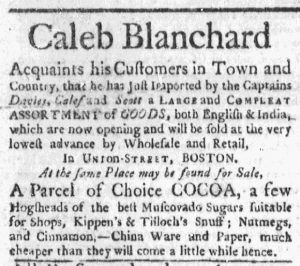
In the fall of 1767, Caleb Blanchard placed the same advertisement in multiple newspapers published in Boston, increasing the likelihood that potential customers would learn that he stocked an assortment of imported goods. In the course of a single week, his advertisement appeared in the Massachusetts Gazette on October 29 (examined yesterday) and the Boston Evening-Post and the Boston-Gazette on November 2. Blanchard certainly was not the only colonial merchant who attempted to broadcast his marketing efforts as widely as possible by advertising in several newspapers. By the late 1760s this was a fairly common strategy among advertisers in port cities with competing newspapers.
Yet Blanchard’s advertisement merits attention not only because it was the same advertisement, in terms of the content, in more than one newspaper. On closer examination it appears to have been the same advertisement set with the same type yet printed in two different newspapers.
Massachusetts Gazette (October 29, 1767).
At a glance, it is fairly easy to distinguish between the typography of Blanchard’s advertisement in the Massachusetts Gazette and its counterpart in the Boston-Gazette. The compositors make different decisions about capitalization, italics, and line breaks. In addition, the Massachusetts Gazette version lists three captains who imported Blanchard’s inventory but the version in the Boston-Gazette includes only two. While they had the same copy (with the exception of the third captain), these were two different advertisements.
Comparing the versions in the Massachusetts Gazette and the Boston Evening-Post, however, does not yield any readily apparent visual discrepancies. Even after examining the original issues in the collections of the American Antiquarian Society, the advertisements do not seem to be distinctive or unique to their respective publications. Instead, it appears that Richard Draper at Massachusetts Gazette and Thomas and John Fleet at the Boston Evening-Post shared an advertisement set in type at one printing office and transported to the other.
Boston Evening-Post (November 2, 1767).
This requires a lot more investigation, especially since this is not the first instance of this sort of cooperation and sharing of advertisements among Boston printers during the fall of 1767 that I have encountered. This example raises many questions about the printing trade and the business practices adopted in Boston that will require much more research. Yet I wanted to highlight these advertisements as a means of demonstrating how a much larger project can originate from discovering something unexpected. Blanchard’s advertisements are only a tiny part of an expansive print culture in eighteenth-century America, yet they suggest that big questions come from small pieces of evidence.
The Slavery Adverts 250 Project chronicles the role of newspaper advertising in perpetuating slavery in the era of the American Revolution. The project seeks to reveal the ubiquity of slavery in eighteenth-century life from New England to Georgia by republishing advertisements about enslaved people – for sale as individuals or in groups, wanted to purchase or for hire for short periods, runaways who liberated themselves, and those who were subsequently captured and confined in jails and workhouses – in daily digests on this site as well as in real time via the @SlaveAdverts250 Twitter feed, utilizing twenty-first-century media to stand in for the print media of the eighteenth century.
The project aims to provide modern audiences with a sense of just how often colonizers encountered these advertisements in their daily lives. Enslaved men, women, and children appeared in print somewhere in the colonies almost every single day. Those advertisements served as a constant backdrop for social, cultural, economic, and political life in colonial and revolutionary America. Colonizers who did not purport to own enslaved people were still confronted with slavery as well as invited to maintain the system by purchasing enslaved men, women, and children or assisting in the capture of so-called “runaways” who sought to free themselves from bondage. The frequency of these newspaper advertisements suggests just how embedded slavery was in colonial and revolutionary American culture in everyday interactions beyond the printed page.
These advertisements also testify to the experiences of enslaved men, women, and children, though readers must consider that those experiences have been remediated through descriptions offered by enslavers rather than enslaved people themselves. Often unnamed in the advertisements, enslaved men, women, and children were not invisible or unimportant in early America.
These advertisements appeared in colonial American newspapers 250 years ago today.
Boston-Gazette (November 2, 1767).
**********
Supplement to the Boston Gazette (November 2, 1767).
What was advertised in a colonial American newspaper 250 years ago this week?
Massachusetts Gazette (October 29, 1767).
“China Ware and Paper, much cheaper than they will come a little while hence.”
In an advertisement placed in the Massachusetts Gazette at the end of October 1767, Caleb Blanchard “Acquaints his Customers in Town and Country, that he has Just Imported … a LARGE and COMPLEAT ASSORTMENT of GOODS, both English & India” that he sold for low prices at his shop on Union Street in Boston. He also listed several other items that he stocked, including cocoa, sugar, tobacco, nutmegs, and cinnamon. Although he had already announced that he charged “the very lowest advance” for his wares, he concluded with another appeal to price. Blanchard proclaimed that he sold “China Ware and Paper, much cheaper than they will come a little while hence.”
Blanchard implied that the prices of china and paper would soon increase, but he did not explicitly state why he was so certain that customers would soon pay more for those particular items. He did not need to do so. Readers of the Massachusetts Gazette “in Town and Country” already knew that that the Townshend Act was set to go into effect in just three weeks on November 20, 1767. Indeed, residents throughout the colonies were aware of the provisions of the Townshend Act, in large part because newspaper printers from Massachusetts to Georgia had published excerpts of the legislation.
Article I of the Townshend Act assessed duties on dozens of different kinds of imported paper, from twelve shillings “For every ream of paper, usually called or known by the name Atlas Fine” to nine pence “For every ream of paper called Demy Second, made in Great Britain” to ten pence halfpenny “For every single ream of blue paper for sugar bakers.” Article II specified that duties on “all other paper” not specifically mentioned should be calculated on the nearest equivalent. Article III defined how many sheets of paper made a quire and how many quires made a ream.
Articles VII and VIII prohibited drawbacks on “china earthen ware.” In other words, merchants could not expect to receive a refund on any taxes they paid for re-exporting imported china. In the end, this would raise prices for consumers since merchants and shopkeepers would pass along the expense to their customers.
Caleb Blanchard did not name the Townshend Act in his advertisement, but that was not necessary to make his appeal to price resonate with consumers. Readers of the Massachusetts Gazette would have been well aware of the impending duties. They would have made the connection on their own. Blanchard depended on public awareness of politics and imperial economic policy in marketing his wares.
What was advertised in a colonial American newspaper 250 years ago today?
Providence Gazette (October 31, 1767).
“Have built and completed the best and largest Shop and Store in Providence.”
Benjamin Thurber and Daniel Cahoon placed an advertisement in the Providence Gazette to announce that “they have entered into Copartnership in all their mercantile Business.” The new partners operated a store that stocked “a very large and general Assortment of the very best of English and India Piece Goods, Hard Ware, all Sorts of West-India Goods, and Groceries of all Kinds.” They advanced some of the most common marketing strategies that appeared in eighteenth-century advertising – consumer choice, price, quality – but they also incorporated other appeals to distinguish their notice from others.
Merchants and shopkeepers rarely commented on their shops as retail spaces in newspaper advertisements, choosing instead to focus on their merchandise or personal attributes that qualified them to serve customers. Thurber and Cahoon, however, mentioned their location “at the Sign of the Bunch of Grapes” at the north end of Providence before launching any of the many other appeals in their advertisement. “[F]or the better accommodating their Customers,” they proclaimed, they “have built and completed the best and largest Shop and Store in Providence.” Considering the range of imported goods in their inventory, Thurber and Cahoon needed adequate space to store and display their stock. Yet operating the “largest Shop and Store” in town had other advantages. It presumably allowed customers sufficient room to examine the merchandise and to move throughout the establishment freely. By implication, their competitors occupied small and crowded spaces that detracted from the overall experience.
Thurber and Cahoon invited potential customers “to come and look for themselves” at their shop, promising the “greatest welcome.” Here customer service intersected with the amenities of the retail space to create an environment in which patrons would experience “Pleasure” even as they “lay out their Money.” The partners predicted that their customers would “chearfully” make purchases, in part because they so enjoyed shopping at the “best and largest Shop and Store” in Providence. In the nineteenth century department stores marketed themselves as palaces of consumption. Thurber and Cahoon’s advertisement anticipated that strategy approximately a century before it became a standard aspect of selling the shopping experience to customers.
The Slavery Adverts 250 Project chronicles the role of newspaper advertising in perpetuating slavery in the era of the American Revolution. The project seeks to reveal the ubiquity of slavery in eighteenth-century life from New England to Georgia by republishing advertisements about enslaved people – for sale as individuals or in groups, wanted to purchase or for hire for short periods, runaways who liberated themselves, and those who were subsequently captured and confined in jails and workhouses – in daily digests on this site as well as in real time via the @SlaveAdverts250 Twitter feed, utilizing twenty-first-century media to stand in for the print media of the eighteenth century.
The project aims to provide modern audiences with a sense of just how often colonizers encountered these advertisements in their daily lives. Enslaved men, women, and children appeared in print somewhere in the colonies almost every single day. Those advertisements served as a constant backdrop for social, cultural, economic, and political life in colonial and revolutionary America. Colonizers who did not purport to own enslaved people were still confronted with slavery as well as invited to maintain the system by purchasing enslaved men, women, and children or assisting in the capture of so-called “runaways” who sought to free themselves from bondage. The frequency of these newspaper advertisements suggests just how embedded slavery was in colonial and revolutionary American culture in everyday interactions beyond the printed page.
These advertisements also testify to the experiences of enslaved men, women, and children, though readers must consider that those experiences have been remediated through descriptions offered by enslavers rather than enslaved people themselves. Often unnamed in the advertisements, enslaved men, women, and children were not invisible or unimportant in early America.
These advertisements appeared in colonial American newspapers 250 years ago today.
What was advertised in a colonial American newspaper 250 years ago today?
South-Carolina and American General Gazette (October 30, 1767).
“Ravens Duck, German Stripes, Holland Shirting.”
It may appear that I have made an error in posting the image of today’s advertisement, but that is not the case. Rather than rotate it ninety degrees counterclockwise to make it easier to read, I have instead chosen to retain its original orientation from the October 30, 1767, edition of the South-Carolina and American General Gazette. A closer look at E. Pierce’s advertisement for “GERMAN Osnaburghs” and other textiles reveals important lessons about both eighteenth-century printing practices and modern remediation projects.
Pierce’s advertisement appeared on the fifth page of the October 30 issue. Although most issues of eighteenth-century newspapers consisted of only four pages (a single broadsheet printed on both sides and folded in half), sometimes printers issued a two-page supplement when they had sufficient news and advertising. Robert Wells took that approach with this issue, though he did not include a masthead that denoted a supplement. Instead, he continued the consecutive page numbering of the issue, indicating that he conceived of the contents of the extra sheet coming after the news and advertising from the standard issue. If the additional sheet had been tucked into the broadsheet to form the third and fourth pages of a six-page issue (which was quite likely, especially considering the lack of a masthead designating a supplemental issue), the page numbers did not match that format. The pages for the broadsheet ran from 213 to 216. The pages on the half sheet were 217 and 218, indicating Wells thought of them as coming after the other content. Otherwise, they would have been pages 215 and 216, the numbers associated with the third and fourth pages of the six-page issue. The numbering suggests that Wells may not have initially intended to issue a six-page issue but instead made that decision only after some of the sheets had been printed.
South-Carolina and American General Gazette (October 30, 1767).
Yet this does not explain the odd orientation of Pierce’s advertisement. In order to fit as much content as possible on the pages of the additional sheet, Wells rotated several advertisements to print in short columns that ran perpendicular to the three columns that ran from the top to bottom of the page. Given the scarcity of paper, this also resulted in maximum efficiency in using his resources.
That being the case, it would be helpful to know more about the dimensions of the extra sheet. From the digitized images of the newspaper, the extra sheet appears to be a different size than the standard issue. The broadsheet featured four columns of text, while the additional pages had only three and the narrow column of rotated advertisements. When printing the images on each page on office paper (once again remediating them to 8.5 x 11 inches), the type on the extra sheet appears much larger than the type from the broadsheet, though it all would have been the same type of a consistent size throughout the entire issue read by colonists in the eighteenth-century. Both the digitized images and hard copies of those images hide the original dimensions of the pages of the original newspaper. That aspect of the materiality of the text has been lost because the database that includes these images does not provide sufficient metadata about the size of each page. As an historian with significant experience investigating these sorts of discrepancies, I realize that if I want to learn more about the dimensions of the original broadsheet and additional sheet, which in turn will tell me more about newspaper production in colonial South Carolina, that I must consult an original copy of the newspaper.
Digitization of eighteenth-century newspapers is wonderful for delivering content. The process makes historical sources much more widely accessible to scholars and the general public. The Adverts 250 Project is possible because of digitization. Yet digitization, especially digitization without extensive metadata, only produces surrogates for the original sources, sometimes hiding certain aspects (such as the size of the page or type of paper) even while revealing others (the contents). Robert Wells found it necessary to print two extra pages to accompany the October 30, 1767, edition of the South-Carolina and American General Gazette. The digitized images, however, obscure elements of the printing process and the actual appearance of the newspapers that subscribers and other readers encountered in the eighteenth century.
The Slavery Adverts 250 Project chronicles the role of newspaper advertising in perpetuating slavery in the era of the American Revolution. The project seeks to reveal the ubiquity of slavery in eighteenth-century life from New England to Georgia by republishing advertisements about enslaved people – for sale as individuals or in groups, wanted to purchase or for hire for short periods, runaways who liberated themselves, and those who were subsequently captured and confined in jails and workhouses – in daily digests on this site as well as in real time via the @SlaveAdverts250 Twitter feed, utilizing twenty-first-century media to stand in for the print media of the eighteenth century.
The project aims to provide modern audiences with a sense of just how often colonizers encountered these advertisements in their daily lives. Enslaved men, women, and children appeared in print somewhere in the colonies almost every single day. Those advertisements served as a constant backdrop for social, cultural, economic, and political life in colonial and revolutionary America. Colonizers who did not purport to own enslaved people were still confronted with slavery as well as invited to maintain the system by purchasing enslaved men, women, and children or assisting in the capture of so-called “runaways” who sought to free themselves from bondage. The frequency of these newspaper advertisements suggests just how embedded slavery was in colonial and revolutionary American culture in everyday interactions beyond the printed page.
These advertisements also testify to the experiences of enslaved men, women, and children, though readers must consider that those experiences have been remediated through descriptions offered by enslavers rather than enslaved people themselves. Often unnamed in the advertisements, enslaved men, women, and children were not invisible or unimportant in early America.
These advertisements appeared in colonial American newspapers 250 years ago today.
New-Hampshire Gazette (October 30, 1767).
**********
South-Carolina and American General Gazette (October 30, 1767).
**********
South-Carolina and American General Gazette (October 30, 1767).
**********
South-Carolina and American General Gazette (October 30, 1767).
**********
South-Carolina and American General Gazette (October 30, 1767).
**********
South-Carolina and American General Gazette (October 30, 1767).
**********
South-Carolina and American General Gazette (October 30, 1767).
**********
South-Carolina and American General Gazette (October 30, 1767).
What was advertised in a colonial American newspaper 250 years ago today?
New-York Journal (October 29, 1767).
“The Medley of Goods.”
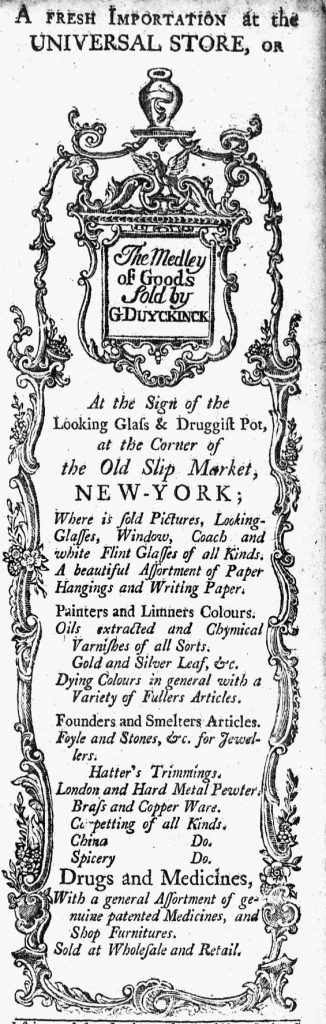
Gerardus Duyckinck, a prolific advertiser in New York’s newspapers in the 1760s, introduced consumers to an innovative advertisement for his “UNIVERSAL STORE” in the October 29, 1767, edition of the New-York Journal. His new advertisement enclosed most of the copy within an ornate rococo cartouche, a design suggestive of the frames for the “Pictures [and] Looking-Glasses” he sold. Visually, his advertisement was unique. Nothing else of the sort appeared in that issue of the New-York Journal, nor in any newspaper published in the colonies.
Several other advertisements included images, but all of them were comparatively crude woodcuts of ships, houses, slaves, and horses. These widely used yet generic images belonged to the printer, a standard part of the type acquired by anyone who printed a newspaper. They could be used to spruce up any relevant advertisement. Occasionally some merchants and shopkeepers commissioned woodcuts for their exclusive use, images often tied to the shop sign that marked their location. In such instances, the image appeared at the top of the advertisement before any copy, not enclosing the text, as was the case for Duyckinck’s notice.
That visual element also distinguished this advertisement from others. In general, eighteenth-century newspaper advertisements did not have borders that set them apart from other items on the same page. Printers usually inserted a line between advertisements to help readers identify where one ended and another began. Sometimes they used decorative ornaments to add some visual appeal, but borders surrounding entire advertisements were exceptionally rare. Jolley Allen experimented with rudimentary borders for his advertisements in Boston’s newspapers the previous year, but they looked primitive compared to the genteel frame that enclosed Duyckinck’s advertisement.
It would have been impossible for readers not to notice Duyckinck’s advertisement. Noticing likely led to reading and examining the advertisement in greater detail, taking in the novelty of a form both new and sophisticated. In addition, the use of an elaborate cartouche introduced a common feature of eighteenth-century trade cards, each printed on its own sheet, into colonial newspapers. The form of one influenced the other, perhaps to the delight of readers. Such an extraordinary advertisement might have also enflamed potential customers’ curiosity about the “Medley of Goods” that Duyckinck sold at his “UNIVERSAL STORE.”
The Slavery Adverts 250 Project chronicles the role of newspaper advertising in perpetuating slavery in the era of the American Revolution. The project seeks to reveal the ubiquity of slavery in eighteenth-century life from New England to Georgia by republishing advertisements about enslaved people – for sale as individuals or in groups, wanted to purchase or for hire for short periods, runaways who liberated themselves, and those who were subsequently captured and confined in jails and workhouses – in daily digests on this site as well as in real time via the @SlaveAdverts250 Twitter feed, utilizing twenty-first-century media to stand in for the print media of the eighteenth century.
The project aims to provide modern audiences with a sense of just how often colonizers encountered these advertisements in their daily lives. Enslaved men, women, and children appeared in print somewhere in the colonies almost every single day. Those advertisements served as a constant backdrop for social, cultural, economic, and political life in colonial and revolutionary America. Colonizers who did not purport to own enslaved people were still confronted with slavery as well as invited to maintain the system by purchasing enslaved men, women, and children or assisting in the capture of so-called “runaways” who sought to free themselves from bondage. The frequency of these newspaper advertisements suggests just how embedded slavery was in colonial and revolutionary American culture in everyday interactions beyond the printed page.
These advertisements also testify to the experiences of enslaved men, women, and children, though readers must consider that those experiences have been remediated through descriptions offered by enslavers rather than enslaved people themselves. Often unnamed in the advertisements, enslaved men, women, and children were not invisible or unimportant in early America.
These advertisements appeared in colonial American newspapers 250 years ago today.
Massachusetts Gazette (October 29, 1767).
**********
Massachusetts Gazette (October 29, 1767).
**********
New-York Gazette: Or, the Weekly Post-Boy (October 29, 1767).
**********
New-York Journal (October 29, 1767).
**********
New-York Journal (October 29, 1767).
**********
New-York Journal (October 29, 1767).
**********
New-York Journal (October 29, 1767).
**********
Pennsylvania Gazette (October 29, 1767).
**********
Pennsylvania Gazette (October 29, 1767).
**********
Supplement to the Pennsylvania Gazette (October 29, 1767).