June 3

What was advertised in a colonial American newspaper 250 years ago today?
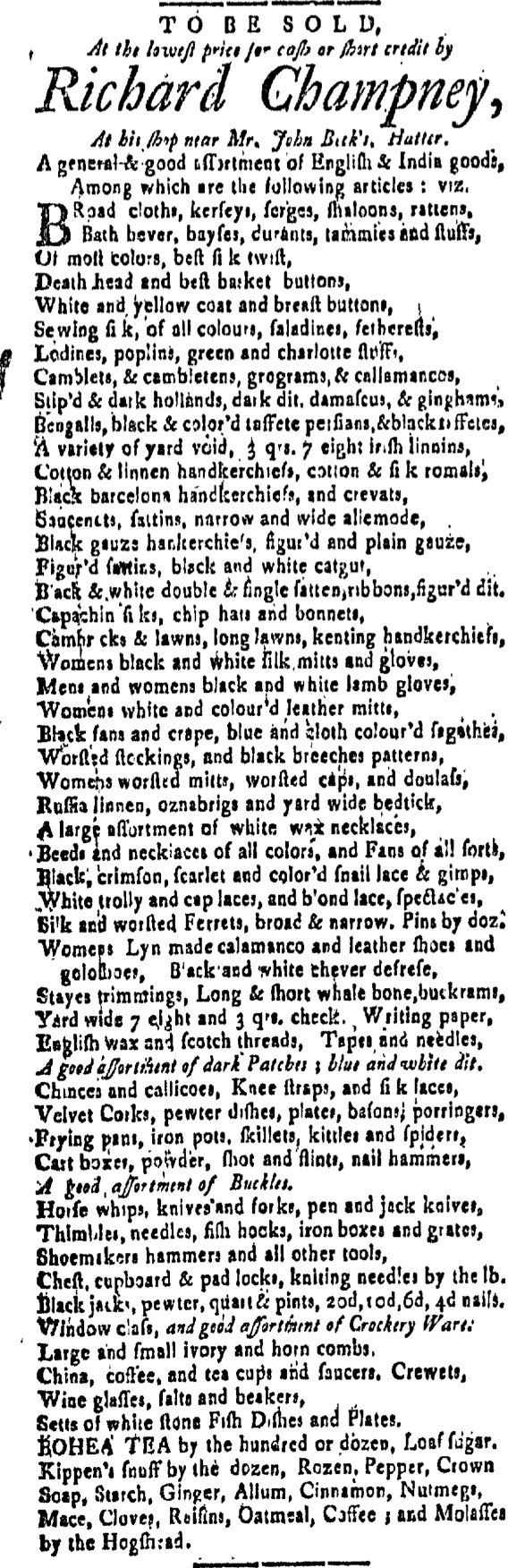
Jun 3 - 6:3:1768 New-Hampshire Gazette
New-Hampshire Gazette (June 3, 1768).

“Mens and womens black and white lamb gloves.”

Thanks to unique typographical features, Richard Champney’s advertisement for “A general & good assortment of English & India goods” stood out among those published in the June 3, 1768, edition of the New-Hampshire Gazette. Like several of his competitors, Champney promoted his merchandise by listing dozens of items, prompting prospective customers to imagine the extensive variety he offered them, everything from “White and yellow coat and breast buttons” to “A large assortment of white wax necklaces” to “China, coffee, and tea cups and saucers.” Rather than publish his list in the form of a dense paragraph justified on both the left and right, Champney opted instead to name a limited number of items on each line and justify only the left margin. Especially given the length of his advertisement – more than half a column and twice as long as any other advertisement for consumer goods and services in the same issue – this format aided readers in distinguishing among his sweeping inventory, whether reading or skimming.

This layout may very well have been the work of the compositor rather than the result of a request by the advertiser, but other graphic design elements suggest that Champney at least consulted with those who produced the newspaper. For instance, the sparing use of italics called attention to a few items, including “A good assortment of dark Patches; blue and white dit[to]” and “A good assortment of Buckles.” One line appeared only partially in italics: “Window glass, and good assortment of Crockery Ware.” The compositor would have had no reason to randomly alter the format for those items; it seems more likely that Champney instructed that they receive some sort of special attention, not unlike “BOHEA TEA,” the only item that appeared in capitals. The white space that resulted from grouping like items together and proceeding to the next line without justifying the right margin increased the readability of the advertisement, making it more likely that prospective customers would notice the items that merited particular attention.

At a glance, Champney’s advertisement looked quite different than the other contents of the New-Hampshire Gazette, whether advertisements or news items. The format most resembled poetry, sometimes inserted in colonial newspapers as a transition between news selected by the editors and paid notices submitted by advertisers. Experimenting with the format may have drawn more eyes to the advertisement, prompting readers to scan it closely enough to determine that it was something other than the ode they anticipated. By the time they figured out it was not a poem, Champney had introduced them to some of the merchandise available at his shop.

Slavery Advertisements Published June 3, 1768

The Slavery Adverts 250 Project chronicles the role of newspaper advertising in perpetuating slavery in the era of the American Revolution. The project seeks to reveal the ubiquity of slavery in eighteenth-century life from New England to Georgia by republishing advertisements for slaves – for sale, wanted to purchase, runaways, captured fugitives – in daily digests on this site as well as in real time via the @SlaveAdverts250 Twitter feed, utilizing twenty-first-century media to stand in for the print media of the eighteenth century.

The project aims to provide modern audiences with a sense of just how often colonists encountered these advertisements in their daily lives. Enslaved men, women, and children appeared in print somewhere in the colonies almost every single day. Those advertisements served as a constant backdrop for social, cultural, economic, and political life in colonial and revolutionary America. Colonists who did not own slaves were still confronted with slavery as well as invited to maintain the system by purchasing slaves or assisting in the capture of runaways. The frequency of these newspaper advertisements suggests just how embedded slavery was in colonial and revolutionary American culture in everyday interactions beyond the printed page.

These advertisements also testify to the experiences of enslaved men, women, and children, though readers must consider that those experiences have been remediated through descriptions offered by slaveholders rather than the slaves themselves. Often unnamed in the advertisements, enslaved men, women, and children were not invisible or unimportant in early America.

These advertisements appeared in colonial American newspapers 250 years ago today.

Jun 3 - New-Hampshire Gazette Slavery 1
New-Hampshire Gazette (June 3, 1768).

**********

Jun 3 - New-London Gazette Slavery 1
New-London Gazette (June 3, 1768).

**********

Jun 3 - New-London Gazette Slavery 2
New-London Gazette (June 3, 1768).

**********

Jun 3 - South-Carolina and American General Gazette Slavery 1
South-Carolina and American General Gazette (June 3, 1768).

**********

Jun 3 - South-Carolina and American General Gazette Slavery 2
South-Carolina and American General Gazette (June 3, 1768).

**********

Jun 3 - South-Carolina and American General Gazette Slavery 3
South-Carolina and American General Gazette (June 3, 1768).

**********

Jun 3 - South-Carolina and American General Gazette Slavery 4
South-Carolina and American General Gazette (June 3, 1768).

**********

Jun 3 - South-Carolina and American General Gazette Slavery 5
South-Carolina and American General Gazette (June 3, 1768).

**********

Jun 3 - South-Carolina and American General Gazette Slavery 6
South-Carolina and American General Gazette (June 3, 1768).

**********

Jun 3 - South-Carolina and American General Gazette Slavery 7
South-Carolina and American General Gazette (June 3, 1768).

**********

Jun 3 - South-Carolina and American General Gazette Slavery 8
South-Carolina and American General Gazette (June 3, 1768).

**********

Jun 3 - South-Carolina and American General Gazette Slavery 9
South-Carolina and American General Gazette (June 3, 1768).

**********

Jun 3 - South-Carolina and American General Gazette Slavery 10
South-Carolina and American General Gazette (June 3, 1768).

**********

Jun 3 - South-Carolina and American General Gazette Slavery 11
South-Carolina and American General Gazette (June 3, 1768).

**********

Jun 3 - South-Carolina and American General Gazette Slavery 12
South-Carolina and American General Gazette (June 3, 1768).

**********

Jun 3 - South-Carolina and American General Gazette Slavery 13
South-Carolina and American General Gazette (June 3, 1768).

**********

Jun 3 - South-Carolina and American General Gazette Slavery 14
South-Carolina and American General Gazette (June 3, 1768).

**********

Jun 3 - South-Carolina and American General Gazette Slavery 15
South-Carolina and American General Gazette (June 3, 1768).

June 2

What was advertised in a colonial American newspaper 250 years ago today?

Jun 2 - 6:2:1768 Pennsylvania Journal Supplement
Supplement to the Pennsylvania Journal (June 2, 1768).

“For a more particular description I refer to my printed catalogue.”

In the spring of 1768 William Semple advertised “A LARGE assortment of MERCHANDIZE” recently imported from Glasgow and Liverpool.  Although he enumerated a few of those items, such as “Silk gauzes of all kinds” and “Scotch threads,” he devoted most of the space in his advertisement to listing dozens of titles from among “a great collection of BOOKS.”  He concluded by inviting prospective customers to consult his “printed catalogue” for “a more particular description” of his inventory of books.

Semple did not rely on newspaper advertisements alone to promote the books he sold.  Like many other eighteenth-century printers and booksellers, he distributed a catalog intended to entice prospective customers by informing them of the various books, pamphlets, plays, and other printed items available.  A reading revolution took place in the eighteenth century:  habits shifted from intensive reading of the Bible and devotional materials to extensive reading from among many genres.  Book catalogs played a role in fueling that reading revolution by drawing attention to titles that consumers might not otherwise have considered purchasing.

In this case, Semple offered few details about his catalog other than noting that it was printed rather than a manuscript list.  Some booksellers advised that they sold their book catalogs for nominal fees, but Semple did not indicate that was the case.  He may have distributed his catalogs gratisin hopes that doing so would yield a higher return on his investment. His advertisement also does not reveal if his catalog was a broadside or a pamphlet.  He simply stated that a “printed catalogue” existed as a supplement to his newspaper advertisements.

In A Descriptive Checklist of Book Catalogues Separately Printed in America, 1693-1800, Robert B. Winans has compiled a list of 286 extant American book catalogs published before the nineteenth century. Booksellers’ catalogs and publishers’ catalogs accounted for just over half, with social library catalogs, auction catalogs, circulating library catalogs, and college library catalogs comprising the remainder.  In addition to the 286 book catalogs with at least one surviving copy, Winans includes entries for others identified from newspaper advertisements and other sources. He suspects, however, that “many if not most of them may be bibliographic ghosts.”  He also reports, “Many other newspaper advertisements could just as legitimately form the basis for additional entries.  But I have not included such entries since I have grave doubts about their validity.”[1]  He does not further explain his skepticism.

Winans includes an unnumbered entry for a “Catalogue of books in history, divinity, law, arts and sciences and the several parts of polite literature, to be sold by Garrat Noel, bookseller” advertised in the August 3, 1767, edition of the New-York Gazette, although no extant copy has been located.[2]  He does not include any entry for Semple’s catalog among those published the following year.  Winans’s annotated bibliography of extant book catalogs documents an impressive array of marketing materials distributed in eighteenth-century America.  Despite his skepticism about some that appeared in advertisements yet have not survived (which hardly comes as a surprise that such ephemeral items either no longer exist or have not yet been identified), these advertisements indicate that colonists had an expectation that booksellers and publishers did indeed print and distribute book catalogs as an alternate means of marketing their wares.

**********

[1]Robert B. Winans, A Descriptive Checklist of Book Catalogues Separately Printed in America, 1693-1800 (Worcester:  American Antiquarian Society, 1981), xvi.

[2]Winans, Descriptive Checklist, 43

Summary of Slavery Advertisements Published May 27 – June 2, 1768

These tables indicate how many advertisements for slaves appeared in colonial American newspapers during the week of May 27 – June 2, 1768.

Note:  These tables are as comprehensive as currently digitized sources permit, but they may not be an exhaustive account.  They includes all newspapers that have been digitized and made available via Accessible Archives, Colonial Williamsburg’s Digital Library, and Readex’s America’s Historical Newspapers.  There are several reasons some newspapers may not have been consulted:

  • Issues that are no longer extant;
  • Issues that are extant but have not yet been digitized (including the Pennsylvania Journal); and
  • Newspapers published in a language other than English (including the Wochentliche Philadelphische Staatsbote).

**********

Slavery Advertisements Published May 27 – June 2, 1768:  By Date

Slavery Adverts Tables 1768 By Date May 27

**********

Slavery Advertisements Published May 27 – June 2, 1768:  By Region

Slavery Adverts Tables 1768 By Region May 27

Slavery Advertisements Published June 2, 1768

The Slavery Adverts 250 Project chronicles the role of newspaper advertising in perpetuating slavery in the era of the American Revolution. The project seeks to reveal the ubiquity of slavery in eighteenth-century life from New England to Georgia by republishing advertisements for slaves – for sale, wanted to purchase, runaways, captured fugitives – in daily digests on this site as well as in real time via the @SlaveAdverts250 Twitter feed, utilizing twenty-first-century media to stand in for the print media of the eighteenth century.

The project aims to provide modern audiences with a sense of just how often colonists encountered these advertisements in their daily lives. Enslaved men, women, and children appeared in print somewhere in the colonies almost every single day. Those advertisements served as a constant backdrop for social, cultural, economic, and political life in colonial and revolutionary America. Colonists who did not own slaves were still confronted with slavery as well as invited to maintain the system by purchasing slaves or assisting in the capture of runaways. The frequency of these newspaper advertisements suggests just how embedded slavery was in colonial and revolutionary American culture in everyday interactions beyond the printed page.

These advertisements also testify to the experiences of enslaved men, women, and children, though readers must consider that those experiences have been remediated through descriptions offered by slaveholders rather than the slaves themselves. Often unnamed in the advertisements, enslaved men, women, and children were not invisible or unimportant in early America.

These advertisements appeared in colonial American newspapers 250 years ago today.

Jun 2 - New-York Journal Slavery 1
New-York Journal (June 2, 1768).

**********

Jun 2 - New-York Journal Slavery 2
New-York Journal (June 2, 1768).

**********

Jun 2 - New-York Journal Slavery 3
New-York Journal (June 2, 1768).

**********

Jun 2 - New-York Journal Supplement Slavery 1
New-York Journal (June 2, 1768).

**********

Jun 2 - Pennsylvania Gazette Slavery 1
Pennsylvania Gazette (June 2, 1768).

**********

Jun 2 - Pennsylvania Gazette Slavery 2
Pennsylvania Gazette (June 2, 1768).

**********

Jun 2 - Pennsylvania Gazette Supplement Slavery 1
Supplement to the Pennsylvania Gazette (June 2, 1768).

**********

Jun 2 - Pennsylvania Gazette Supplement Slavery 2
Supplement to the Pennsylvania Gazette (June 2, 1768).

**********

Jun 2 - Pennsylvania Gazette Supplement Slavery 3
Supplement to the Pennsylvania Gazette (June 2, 1768).

**********

Jun 2 - Pennsylvania Journal Supplement Slavery 1
Supplement to the Pennsylvania Journal (June 2, 1768).

**********

Jun 2 - Pennsylvania Journal Supplement Slavery 2
Supplement to the Pennsylvania Journal (June 2, 1768).

**********

Jun 2 - Pennsylvania Journal Supplement Slavery 3
Supplement to the Pennsylvania Journal (June 2, 1768).

**********

Jun 2 - Virginia Gazette Purdie and Dixon Slavery 1
Virginia Gazette [Purdie & Dixon] (June 2, 1768).

**********

Jun 2 - Virginia Gazette Purdie and Dixon Slavery 2
Virginia Gazette [Purdie & Dixon] (June 2, 1768).

**********

Jun 2 - Virginia Gazette Purdie and Dixon Slavery 3
Virginia Gazette [Purdie & Dixon] (June 2, 1768).

**********

Jun 2 - Virginia Gazette Purdie and Dixon Slavery 4
Virginia Gazette [Purdie & Dixon] (June 2, 1768).

**********

Jun 2 - Virginia Gazette Purdie and Dixon Slavery 5
Virginia Gazette [Purdie & Dixon] (June 2, 1768).

**********

Jun 2 - Virginia Gazette Purdie and Dixon Slavery 6
Virginia Gazette [Purdie & Dixon] (June 2, 1768).

**********

Jun 2 - Virginia Gazette Purdie and Dixon Slavery 7
Virginia Gazette [Purdie & Dixon] (June 2, 1768).

**********

Jun 2 - Virginia Gazette Purdie and Dixon Slavery 8
Virginia Gazette [Purdie & Dixon] (June 2, 1768).

June 1

What was advertised in a colonial American newspaper 250 years ago today?

Jun 1 - 6:1:1768 Georgia Gazette
Georgia Gazette (June 1, 1768).

“His method of teaching children being well known in the town of Savannah.”

In anticipation of opening a school on the following Monday, Peter Gandy inserted an advertisement in the Wednesday, June 1, 1768, edition of the Georgia Gazette. Compared to many other advertisements placed by schoolmasters and –mistresses in the 1760s, Gandy’s notice was fairly sparse. He provided little information about the subjects he intended to teach, his methods of instruction, or the accommodations for students. Instead, he invoked his prior experience and the reputation he had already established in the community. He called on “those gentlemen and ladies who formerly favoured him with the tuition of their children” to enroll them once again. Addressing all parents of prospective students, whether they previously attended his school or not, he confidently stated that because “his method of teaching children being well known in the town of Savannah” it “therefore needs no farther explanation.”

Gandy did not commence promoting his school in the public prints much in advance of the first day of classes. His advertisement first ran in the May 25 edition of the Georgia Gazette, less than two weeks before he planned to “OPEN SCHOOL.” It appeared again the following week in the June 1 edition, allowing Gandy only two opportunities to attract students via the only newspaper published in the colony. On June 8, Gandy published a slightly revised version of the advertisement, announcing that he had indeed “OPENED SCHOOL” earlier in the week. Beyond notices in the Georgia Gazette, he almost certainly relied on other means, including word of mouth and speaking directly to the parents of former pupils, to inform prospective students and their families that he offered lessons at “Mrs. Cuningham’s house.”

Though Gandy did not offer many particulars in his advertisement, expecting that readers were already aware of many of the details, he did extend some general promises to those who entrusted their children to his tutelage. He declared that parents could “depend upon sobriety, due care, diligence, and constant attendance” toward their children at his school. Parents who previously enrolled their children in Gandy’s school would have been aware of these aspects of his instruction, but the schoolmaster sought to reassure others who may not have been as familiar with his methods as he suggested earlier in his advertisement. He realized that he needed to do more than merely rely on his reputation to attract a sufficient number of students to “OPEN SCHOOL” in Savannah.

Slavery Advertisements Published June 1, 1768

The Slavery Adverts 250 Project chronicles the role of newspaper advertising in perpetuating slavery in the era of the American Revolution. The project seeks to reveal the ubiquity of slavery in eighteenth-century life from New England to Georgia by republishing advertisements for slaves – for sale, wanted to purchase, runaways, captured fugitives – in daily digests on this site as well as in real time via the @SlaveAdverts250 Twitter feed, utilizing twenty-first-century media to stand in for the print media of the eighteenth century.

The project aims to provide modern audiences with a sense of just how often colonists encountered these advertisements in their daily lives. Enslaved men, women, and children appeared in print somewhere in the colonies almost every single day. Those advertisements served as a constant backdrop for social, cultural, economic, and political life in colonial and revolutionary America. Colonists who did not own slaves were still confronted with slavery as well as invited to maintain the system by purchasing slaves or assisting in the capture of runaways. The frequency of these newspaper advertisements suggests just how embedded slavery was in colonial and revolutionary American culture in everyday interactions beyond the printed page.

These advertisements also testify to the experiences of enslaved men, women, and children, though readers must consider that those experiences have been remediated through descriptions offered by slaveholders rather than the slaves themselves. Often unnamed in the advertisements, enslaved men, women, and children were not invisible or unimportant in early America.

These advertisements appeared in colonial American newspapers 250 years ago today.

Jun 1 - Georgia Gazette Slavery 1
Georgia Gazette (June 1, 1768).

**********

Jun 1 - Georgia Gazette Slavery 2
Georgia Gazette (June 1, 1768).

**********

Jun 1 - Georgia Gazette Slavery 3
Georgia Gazette (June 1, 1768).

**********

Jun 1 - Georgia Gazette Slavery 4
Georgia Gazette (June 1, 1768).

**********

Jun 1 - Georgia Gazette Slavery 5
Georgia Gazette (June 1, 1768).

**********

Jun 1 - Georgia Gazette Slavery 6
Georgia Gazette (June 1, 1768).

**********

Jun 1 - Georgia Gazette Slavery 7
Georgia Gazette (June 1, 1768).

**********

Jun 1 - Georgia Gazette Slavery 8
Georgia Gazette (June 1, 1768).

**********

Jun 1 - Georgia Gazette Slavery 9
Georgia Gazette (June 1, 1768).