The Slavery Adverts 250 Project chronicles the role of newspaper advertising in perpetuating slavery in the era of the American Revolution. The project seeks to reveal the ubiquity of slavery in eighteenth-century life from New England to Georgia by republishing advertisements for slaves – for sale, wanted to purchase, runaways, captured fugitives – in daily digests on this site as well as in real time via the @SlaveAdverts250 Twitter feed, utilizing twenty-first-century media to stand in for the print media of the eighteenth century.
The project aims to provide modern audiences with a sense of just how often colonists encountered these advertisements in their daily lives. Enslaved men, women, and children appeared in print somewhere in the colonies almost every single day. Those advertisements served as a constant backdrop for social, cultural, economic, and political life in colonial and revolutionary America. Colonists who did not own slaves were still confronted with slavery as well as invited to maintain the system by purchasing slaves or assisting in the capture of runaways. The frequency of these newspaper advertisements suggests just how embedded slavery was in colonial and revolutionary American culture in everyday interactions beyond the printed page.
These advertisements also testify to the experiences of enslaved men, women, and children, though readers must consider that those experiences have been remediated through descriptions offered by slaveholders rather than the slaves themselves. Often unnamed in the advertisements, enslaved men, women, and children were not invisible or unimportant in early America.
From compiling an archive of digitized eighteenth-century newspapers to identifying advertisements about enslaved men, women, and children in those newspapers to preparing images of each advertisement to posting this daily digest, Parker Sears served as guest curator for this entry. Working on this project fulfilled his senior capstone requirement for completing the major in History at Assumption College in Worcester, Massachusetts.
These advertisements appeared in colonial American newspapers 250 years ago today.
What was advertised in a colonial American newspaper 250 years ago today?
Pennsylvania Journal (July 19, 1770).
“Ah—Liberty! …. An empty sound alone remains of thee.”
John Mason, an upholsterer, did not merely seek to sell paper hangings (or wallpaper) and bedding materials when he placed an advertisement in the Pennsylvania Journal in the summer of 1770. His entire advertisement was a short sermon about the current political crisis and the fate of the nonimportation agreement adopted by the merchants of Philadelphia in response to the duties imposed on certain imported goods by the Townshend Acts. All of those duties had been recently repealed, with the exception of the duty on tea, prompting merchants in New York to bring an end to their nonimportation agreement and begin trading with English merchants once again. Residents of other cities and towns debated whether they would continue their own boycotts. The nonimportation agreement in Philadelphia was on the verge of collapse. It came to an end on September 20.
Mason apparently did not agree with the direction he saw the merchants and traders in his city heading. He used his advertisement to encourage the continuation of the nonimportation agreement as well as condemn the merchants in New York for so hastily resuming trade as soon as they heard about the repeal of most of the duties. The nonimportation agreements were intended to stay in effect until Parliament repealed all the duties, yet the duties on tea remained.
Mason began his advertisement with a play on words, stating that he “STILL prays for liberty to inform the public, that he would be glad to dispose of his property.” He implied that all liberty was at stake, not just his ability to hawk goods in the marketplace. He deployed the same turn of phrase in another advertisement that doubled as a political lecture a year earlier. In his new epistle, he informed prospective customers that he sold papers hangings “not lately imported,” making clear that he continued to abide by the nonimportation agreement, as well as variety of bedding materials that he presumably made in his upholstery shop. “The utility of these beds,” he proclaimed, “is not duly attended to, as they say, by sleeping on them.” If the purpose of beds was not for sleeping then what was it? Mason believed his bedding materials served a more important purpose as symbols of American liberty. Consumers should purchase them to demonstrate their own commitment to the cause, especially during “this crisis, when our Liberty is tottering, like our Neighbour’s Resolutions*.” Just in case readers missed his meaning, an asterisk confirmed that he critiqued recent actions in “*NEW YORK.:”
To underscore his point, he inserted a short poem for the edification of both merchants and consumers in Philadelphia:
Ah—Liberty! How loved, how valued once, avail thee not
To whom retail’d, or by whom begot,
An empty sound alone remains of theee,
And its all thy one pretended Votaries‡ shall be—
Mason contended that liberty had been valued for a time, but all that remained of it was an “empty sound” because its “pretended Votaries,” the merchants in New York, prematurely abandoned the cause by withdrawing from the nonimportation agreement before all the duties had been repealed. He inserted two more lines of commentary about those “pretended Votaries‡.” Mason accused them of a “sad blunder, never to be mended” and accused them of causing the entire enterprise to fail. “This one bad step, the contest ended,” he lamented. Merchants in New York and other cities saw the repeal of most of the duties on imported goods as a victory. They believed their nonimportation agreement had served its purpose (or at least well enough to return to business and resume trading). Mason disagreed. Until Parliament repealed the duties on tea, bringing an end to the boycotts was nothing more than capitulation. Parliament had not met the terms that stated the nonimportation agreements would remain in effect until all the duties were repealed. Mason took a harder line than many other colonists, using a newspaper advertisement to express his views to the general public.
The Slavery Adverts 250 Project chronicles the role of newspaper advertising in perpetuating slavery in the era of the American Revolution. The project seeks to reveal the ubiquity of slavery in eighteenth-century life from New England to Georgia by republishing advertisements for slaves – for sale, wanted to purchase, runaways, captured fugitives – in daily digests on this site as well as in real time via the @SlaveAdverts250 Twitter feed, utilizing twenty-first-century media to stand in for the print media of the eighteenth century.
The project aims to provide modern audiences with a sense of just how often colonists encountered these advertisements in their daily lives. Enslaved men, women, and children appeared in print somewhere in the colonies almost every single day. Those advertisements served as a constant backdrop for social, cultural, economic, and political life in colonial and revolutionary America. Colonists who did not own slaves were still confronted with slavery as well as invited to maintain the system by purchasing slaves or assisting in the capture of runaways. The frequency of these newspaper advertisements suggests just how embedded slavery was in colonial and revolutionary American culture in everyday interactions beyond the printed page.
These advertisements also testify to the experiences of enslaved men, women, and children, though readers must consider that those experiences have been remediated through descriptions offered by slaveholders rather than the slaves themselves. Often unnamed in the advertisements, enslaved men, women, and children were not invisible or unimportant in early America.
From compiling an archive of digitized eighteenth-century newspapers to identifying advertisements about enslaved men, women, and children in those newspapers to preparing images of each advertisement to posting this daily digest, Parker Sears served as guest curator for this entry. Working on this project fulfilled his senior capstone requirement for completing the major in History at Assumption College in Worcester, Massachusetts.
These advertisements appeared in colonial American newspapers 250 years ago today.
What was advertised in a colonial American newspaper 250 years ago today?
South-Carolina and American General Gazette (July 18, 1770).
“Valuable pieces, professedly written in defence of the Liberties of Englishmen.”
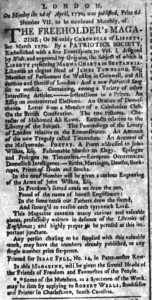
An advertisement for the March edition of “THE FREEHOLDER’s MAGAZINE; Or Monthly CHONRICLE of LIBERTY,” published in London, appeared in the July 18, 1770, edition of the South-Carolina and American General Gazette. Who placed the advertisement was not clear. The advertisement attributed the magazine to “a PATRIOTICK SOCIETY” and declared that it was “Printed for ISAAC FELL, No. 14, in Pater-noster Row.” Fell may have arranged with Robert Wells, the printer of the South-Carolina and American General Gazette, to insert the advertisement or Wells may have independently done so. The advertisement concluded with a note that “Some of the Numbers, as a Specimen of the Work, may be seen by applying to ROBERT WELLS, Bookseller and Printer in Charlestown, South-Carolina.” Wells may have acquired copies of the Freeholder’s Magazine and reprinted an advertisement from a London newspaper as part of his effort to make sales in his local market.
Either way, a publisher in London or a bookseller in Charleston believed that they could incite demand for the Freeholder’s Magazine in South Carolina given current events and public discourse. After all, the “Magazine contains many curious and valuable pieces, professedly written in defence of the Liberties of Englishmen; and highly proper to be perused at this important juncture.” The March issue included a frontispiece depicting “LIBERTY presenting MAGNA CHARTA to BRITANNIA.” The advertisement stated that the April edition would feature “a curious Engraving of the Arms of John Wilkes,” a noted defender of the liberties of Englishmen who resided on both sides of the Atlantic, continuing the theme of the publication via images as well as print. (The May edition included an engraving of “The Massacre perpetrated in King Street, Boston” pirated from Paul Revere’s print.) Fell or Wells or both likely believed that the tone of the magazine would resonate with readers in South Carolina. Most who lamented the abuses of Parliament and condemned the Boston Massacre had not settled on demanding independence. Instead, they valued being part of the British Empire and expected that they would enjoy “the Liberties of Englishmen” in the colonies. By selling the Freeholder’s Magazine, Wells contributed to the print and visual culture that shaped debates about the position of the colonies in the British Empire. In turn, consumers who read and viewed the contents of the Freeholder’s Magazinebecame better informed and better able to participate in the discourse of liberty as it evolved during the imperial crisis that led to the American Revolution.
The Slavery Adverts 250 Project chronicles the role of newspaper advertising in perpetuating slavery in the era of the American Revolution. The project seeks to reveal the ubiquity of slavery in eighteenth-century life from New England to Georgia by republishing advertisements for slaves – for sale, wanted to purchase, runaways, captured fugitives – in daily digests on this site as well as in real time via the @SlaveAdverts250 Twitter feed, utilizing twenty-first-century media to stand in for the print media of the eighteenth century.
The project aims to provide modern audiences with a sense of just how often colonists encountered these advertisements in their daily lives. Enslaved men, women, and children appeared in print somewhere in the colonies almost every single day. Those advertisements served as a constant backdrop for social, cultural, economic, and political life in colonial and revolutionary America. Colonists who did not own slaves were still confronted with slavery as well as invited to maintain the system by purchasing slaves or assisting in the capture of runaways. The frequency of these newspaper advertisements suggests just how embedded slavery was in colonial and revolutionary American culture in everyday interactions beyond the printed page.
These advertisements also testify to the experiences of enslaved men, women, and children, though readers must consider that those experiences have been remediated through descriptions offered by slaveholders rather than the slaves themselves. Often unnamed in the advertisements, enslaved men, women, and children were not invisible or unimportant in early America.
From compiling an archive of digitized eighteenth-century newspapers to identifying advertisements about enslaved men, women, and children in those newspapers to preparing images of each advertisement to posting this daily digest, Parker Sears served as guest curator for this entry. Working on this project fulfilled his senior capstone requirement for completing the major in History at Assumption College in Worcester, Massachusetts.
These advertisements appeared in colonial American newspapers 250 years ago today.
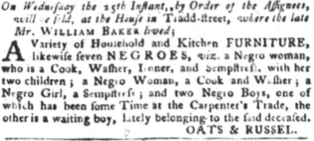
South-Carolina and American General Gazette (July 18, 1770)
**********
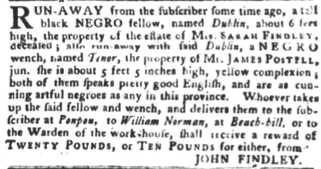
South-Carolina and American General Gazette (July 18, 1770)
*********
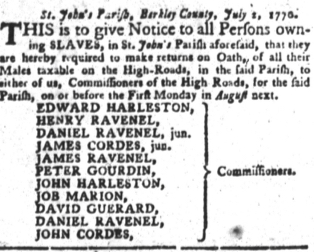
South-Carolina and American General Gazette (July 18, 1770)
*********
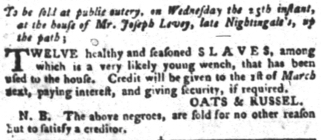
South-Carolina and American General Gazette (July 18, 1770)
What was advertised in a colonial American newspaper 250 years ago today?
Massachusetts Spy (July 17, 1770).
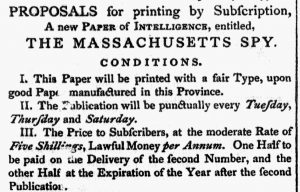
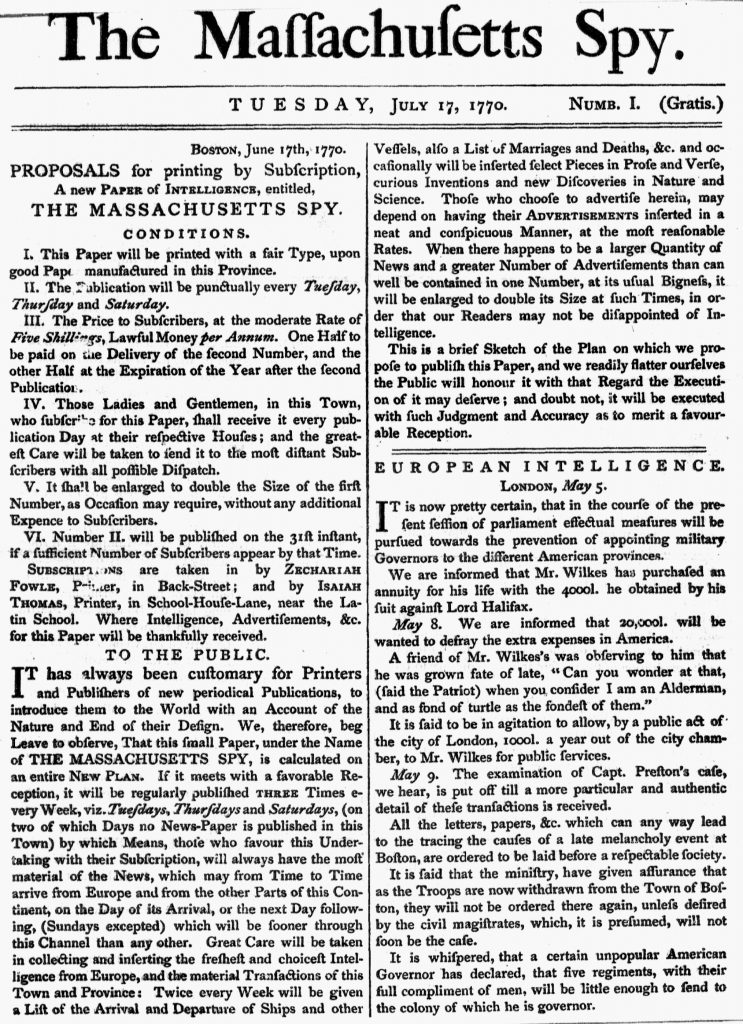
“PROPOSALS for printing by Subscription, A new PAPER of INTELLIGENCE, entitled, THE MASSACHUSETTS SPY.”
Isaiah Thomas, now remembered as the renowned patriot printer who published The History of Printing in America in 1810 and founded the American Antiquarian Society in 1812, launched his newspaper, the Massachusetts Spy, on July 17, 1770. The first issue, distributed free, began with an advertisement from the printer himself, the “PROPOSALS” that frequently inaugurated eighteenth-century newspapers. The proposal included two parts, the “CONDITIONS” of publication and an address “TO THE PUBLIC” in which the printer outlined the purpose of the newspaper.
The first condition stated that the Massachusetts Spy “will be printed with a fair Type, upon good Paper manufactured in this Province.” From the start Thomas took a political position. The Townshend Acts imposed duties on imported paper and other goods, prompting a boycott among colonial merchants. Although those duties, except for the one on tea, had been repealed recently, the nonimportation agreement still remained in effect in Boston. Thomas made clear that his newspaper would encourage domestic manufactures, specifically “good Paper manufactured in this Province,” as an alternative to imported goods.
Unlike most newspapers that consisted of four pages created by printed two pages on each side of a broadsheet and folding it in half, the Massachusetts Spy originally consisted of only two pages per issue. However, as Thomas explained in the second condition, the “Publication will be punctually every Tuesday, Thursday and Saturday.” The Boston Chronicle published two issues per week, on Mondays and Thursdays, but it folded in June 1770. No newspaper in Boston published more than one issue a week at the time Thomas founded the Massachusetts Spy. With three issues per week, Thomas provided six pages of news and advertising compared to only four pages for other newspapers. Furthermore, he explained in the address that on two of those days “no News-Paper is published in this Town.” As a result, his subscribers “will always have the most material of the News, which may from Time to Time arrive from Europe and from other Parts of this Continent, on the Day of its Arrival, or the next Day following, (Sundays excepted).” This was a particular advantage to subscribers. Thomas proclaimed that they would receive news “sooner through this Channel than any other.” The frequency of publication more than made up for the smaller size of the Massachusetts Spy.
Yet Thomas already envisioned expanding the newspaper when circumstances demanded. In the fifth condition he pledged that it “shall be enlarged to double the Size of the first Number,” the two-page issue in which the “PROPOSALS” appeared, “as Occasion may require, without any additional Expence to Subscribers.” In other word, Thomas would issue supplements when breaking news or an abundance of advertisements made doing so necessary, a common practice among eighteenth-century printers. Any additional pages were presented to subscribers free of charge. Thomas also made promises concerning the balance of news and advertising. In the address he stated, “When there happens to be a larger Quantity of News and a greater Number of Advertisements than can be contained in one Number, at its usual Bigness, it will be enlarged to double its Size at such Times, in order that our Readers may not be disappointed of Intelligence.” Thomas had no intention of allowing advertisements, often more lucrative for printers than subscriptions, crowd out the news, including “the freshest and choicest Intelligence from Europe, and the material Transactions of this Town and Province” as well as a “List of the Arrival and Departure of Ships and other Vessels” and a “List of Marriages and Deaths.” Thomas welcomed advertisements “at the most Reasonable Rates,” but had no plans for the Massachusetts Spy to fill its pages almost entirely with advertising.
Thomas anticipated publishing the second issue two weeks later on July 31 “if a sufficient Number of Subscribers appear by that Time.” It took an extra week for Thomas to issue “Number II” on August 7, but after that the Massachusetts Spy joined the ranks of the public prints in Boston. Thomas continued publication until April 1775. Shortly before the skirmishes at Lexington and Concord, he fled to Worcester and took his press with him. As an influential patriot printer, he feared British authorities and sought the safety of the smaller town in the countryside. He revived the Massachusetts Spy in Worcester in May 1775, but the newspaper had its origins on July 17, 1770, in Boston. The “PROPOSALS” for the newspaper, an extended advertisement, inaugurated the first issue.
The Slavery Adverts 250 Project chronicles the role of newspaper advertising in perpetuating slavery in the era of the American Revolution. The project seeks to reveal the ubiquity of slavery in eighteenth-century life from New England to Georgia by republishing advertisements for slaves – for sale, wanted to purchase, runaways, captured fugitives – in daily digests on this site as well as in real time via the @SlaveAdverts250 Twitter feed, utilizing twenty-first-century media to stand in for the print media of the eighteenth century.
The project aims to provide modern audiences with a sense of just how often colonists encountered these advertisements in their daily lives. Enslaved men, women, and children appeared in print somewhere in the colonies almost every single day. Those advertisements served as a constant backdrop for social, cultural, economic, and political life in colonial and revolutionary America. Colonists who did not own slaves were still confronted with slavery as well as invited to maintain the system by purchasing slaves or assisting in the capture of runaways. The frequency of these newspaper advertisements suggests just how embedded slavery was in colonial and revolutionary American culture in everyday interactions beyond the printed page.
These advertisements also testify to the experiences of enslaved men, women, and children, though readers must consider that those experiences have been remediated through descriptions offered by slaveholders rather than the slaves themselves. Often unnamed in the advertisements, enslaved men, women, and children were not invisible or unimportant in early America.
From compiling an archive of digitized eighteenth-century newspapers to identifying advertisements about enslaved men, women, and children in those newspapers to preparing images of each advertisement to posting this daily digest, Parker Sears served as guest curator for this entry. Working on this project fulfilled his senior capstone requirement for completing the major in History at Assumption College in Worcester, Massachusetts.
These advertisements appeared in colonial American newspapers 250 years ago today.
South-Carolina Gazette and Country Journal (July 17, 1770)
*********
South-Carolina Gazette and Country Journal (July 17, 1770)
*********
South-Carolina Gazette and Country Journal (July 17, 1770)
*********
South-Carolina Gazette and Country Journal (July 17, 1770)
*********
South-Carolina Gazette and Country Journal (July 17, 1770)
*********
South-Carolina Gazette and Country Journal (July 17, 1770)
*********
South-Carolina Gazette and Country Journal (July 17, 1770)
*********
South-Carolina Gazette and Country Journal (July 17, 1770)
*********
South-Carolina Gazette and Country Journal (July 17, 1770)
*********
South-Carolina Gazette and Country Journal (July 17, 1770)
*********
South-Carolina Gazette and Country Journal (July 17, 1770)
*********
South-Carolina Gazette and Country Journal (July 17, 1770)
What was advertised in a colonial American newspaper 250 years ago today?
Boston Evening-Post (July 16, 1770).
“A NARRATIVE of the late horrid MASSACRE in BOSTON.”
The commemoration and commodification of the events of the American Revolution began years before shots were fired at Concord and Lexington. Beginning in 1767, colonists marked the anniversary of the repeal of the Stamp Act with celebrations and toasts. Within weeks of the Boston Massacre in 1770, Paul Revere advertised and sold prints depicting the event, followed soon after by Henry Pelham. A few months later, John Kneeland and Seth Adams announced the imminent publication of “A NARRATIVE of the late horrid MASSACRE in BOSTON, perpetrated in the Evening of the 5th of March 1770, by Soldiers of the 29th Regiment; which with the 14th Regiment were then Quartered there.” The volume also included “some OBSERVATIONS on the STATE OF THINGS prior to that CATASTROPHE.”
This reprint “from the London Edition” was a departure for Kneeland and Adams. In his monumental History of Printing in America, Isaiah Thomas remarked that the “principal work of Kneeland & Adams was psalters, spelling books, and psalm books, for booksellers.”[1] What prompted Kneeland and Adams to reprint this particular book? Were their motivations primarily pecuniary or political or both? Thomas, often quick to comment of the politics of his fellow printers, did not note that either printer was known for promoting the patriot cause, but that did not necessarily mean that politics did not play a role in their decision to produce and market this “NARRATIVE of the late horrid MASSACRE.” Financial interests almost certainly influenced them as well. If Thomas did not recognize their press as one that advanced the patriot cause, then it seems unlikely that they would have printed the “NARRATIVE” solely as an act of commemoration and instruction for their fellow colonists. Kneeland and Adams spotted an opportunity to make money in the commercial marketplace. Regardless of their motivations, publishing this volume contributed to the discourse in the marketplace of ideas. As printers, they helped shape public sentiment.
Thomas Fleet, Jr., and John Fleet, the printers of the Boston Evening-Post, also played a role in making the “NARRATIVE” available to the public. Their newspaper not only carried Kneeland and Adams’s advertisement but also gave it a prominent place. The advertisements for the July 16 edition commenced with a notice calling on “All Persons indebted for this Paper” to settle accounts followed immediately by the advertisement for the “NARRATIVE.” Such placement increased the likelihood that readers would take note of the advertisement if they read through the news and then opted to skip the paid notices. A note that “Advertisements omitted shall be on our next” indicates that the Fleets made choices about which advertisements to include. Maybe they selected this advertisement because it was timely, with publication scheduled for “Next WEDNESDAY,” or as a courtesy to fellow printers, but their own feelings about the Boston Massacre may have part of their decision. Thomas described the Fleets as “good citizens” and lauded the “impartiality with which the paper was conducted, in those most critical times, the authenticity of its news, and the judicious selections of its publishers.”[2] Even if they were not explicitly promoting the patriot cause, the Fleets likely saw the dissemination of additional information about the Boston Massacre as an important service.
Historians debate whether eighteenth-century printers intentionally sought to shape public opinion in the era of the American Revolution or whether they aimed to earn their living by printing political tracts, prints, and other items. One does not necessarily exclude the other. Regardless of the motivations of the printers, the publication of these materials and the advertisements that promoted them contributed to the debates of the period.
**********
[1] Isaiah Thomas, The History of Printing in America: With a Biography of Printers and an Account of Newspapers (1810; New York: Weathervane Books, 1970), 148.
The Slavery Adverts 250 Project chronicles the role of newspaper advertising in perpetuating slavery in the era of the American Revolution. The project seeks to reveal the ubiquity of slavery in eighteenth-century life from New England to Georgia by republishing advertisements for slaves – for sale, wanted to purchase, runaways, captured fugitives – in daily digests on this site as well as in real time via the @SlaveAdverts250 Twitter feed, utilizing twenty-first-century media to stand in for the print media of the eighteenth century.
The project aims to provide modern audiences with a sense of just how often colonists encountered these advertisements in their daily lives. Enslaved men, women, and children appeared in print somewhere in the colonies almost every single day. Those advertisements served as a constant backdrop for social, cultural, economic, and political life in colonial and revolutionary America. Colonists who did not own slaves were still confronted with slavery as well as invited to maintain the system by purchasing slaves or assisting in the capture of runaways. The frequency of these newspaper advertisements suggests just how embedded slavery was in colonial and revolutionary American culture in everyday interactions beyond the printed page.
These advertisements also testify to the experiences of enslaved men, women, and children, though readers must consider that those experiences have been remediated through descriptions offered by slaveholders rather than the slaves themselves. Often unnamed in the advertisements, enslaved men, women, and children were not invisible or unimportant in early America.
From compiling an archive of digitized eighteenth-century newspapers to identifying advertisements about enslaved men, women, and children in those newspapers to preparing images of each advertisement to posting this daily digest, Parker Sears served as guest curator for this entry. Working on this project fulfilled his senior capstone requirement for completing the major in History at Assumption College in Worcester, Massachusetts.
These advertisements appeared in colonial American newspapers 250 years ago today.
Boston Evening-Post (July 16, 1770)
*********
Boston Gazette (July 16, 1770)
*********
New-York Gazette and Weekly Mercury (July 16, 1770)
*********
New-York Gazette and Weekly Mercury (July 16, 1770)
*********
New-York Gazette and Weekly Mercury (July 16, 1770)
*********
New-York Gazette and Weekly Mercury (July 16, 1770)
*********
New-York Gazette or Weekly Post-Boy (July 16, 1770)
*********
New-York Gazette or Weekly Post-Boy (July 16, 1770)
What was advertised in a colonial American newspaper 250 years ago today?
New-York Journal (July 12, 1770).
“Hear of good Encouragement, by applying to the Printer at the Exchange.”
By the late 1760s, entrepreneurial colonists established and advertised “intelligence offices” in Boston and New York. The brokers who operated those establishments provided a variety of services for their clients. They introduced merchants and traders seeking to buy and sell commodities. They conducted real estate transactions. They also facilitated sales of indentured servants and enslaved people in addition to aiding employers seeking workers. Brokers made matches in the marketplace.
Yet their occupation was not unique in that regard. Printing offices served as intelligence offices by another name. Throughout the eighteenth century, advertisements often concluded with instructions to “Enquire of the Printer” for more information. Consider some of the advertisements that appeared in the July 12, 1770, edition of the New-York Journal. One short notice offered a young enslaved woman for sale, but offered little detail beyond her age and a promise that she “can be well recommended.” The advertisement did not identify the enslaver; instead, it concluded with the familiar refrain, “Enquire of the Printer.” Another advertisement offered employment opportunities for men willing to migrate to Virginia. The anonymous advertiser sought a “Sober single Man, of a good Character, who understand the Smith’s Business” and “a single Man of like Character, who understands the tending and Management of a Merchant’s Mill.” Candidates could learn more “by applying to the Printer at the Exchange.” According to the colophon, John Holt, the printer of the New-York Journal, ran his office “near the Exchange, in Broad-Street.”
Printing offices were hubs for collecting and circulating information in eighteenth-century America. Printers disseminated some information via newspapers, but advertisements in those publications often hinted at far more information that did not appear in print. By visiting or sending notes to printers, readers could learn more about job opportunities and commodities, real estate, indentured servants, and enslaved people for sale. Newspaper advertisements reveal how frequently printers acted as brokers as one of the many facets of their occupation.