What was advertised in a colonial American newspaper 250 years ago today?
South-Carolina and American General Gazette (July 25, 1770).
“JOHN HATFIELD, TALLOW-CHANDLER and SOAP-BOILER … CARRIES on the said Business as usual.”
Among the three newspapers published in Charleston in 1770, readers encountered far more advertising than news in the final week of July. On Wednesday, July 25, Robert Wells distributed the South-Carolina and American General Gazette. Like most newspapers published in eighteenth-century America, it consisted of four pages created by printing two pages on each side of a broadsheet and then folding it in half. Wells divided each page of his newspaper into four columns, yielding sixteen columns of content for subscribers and other readers. Advertising comprised eleven of those sixteen columns, slightly more than two-thirds of the issue. Three of the four columns on the first page contained news.
Yet it was the South-Carolina and American General Gazette that delivered the most news that week. The following day, Peter Timothy published the weekly edition of the South-Carolina Gazette. It also consisted of four pages, but featured only three columns per page. Of the twelve columns in the July 26 issue, advertising comprised ten. Timothy devoted just two columns to news, including “Timothy’s Marine List,” the shipping news from the customs house. The first item on the first page was a proclamation from the acting governor calling the colonial assembly into session on August 14. Otherwise, news items appeared on pages two and three, though that was not an uncommon format for newspapers of the period.
Readers of the South-Carolina Gazette and Country Journal discovered the same proportion of advertising and news in the issue that circulated on Tuesday, July 31. Charles Crouch published two and half columns of news and editorials, confined entirely to the second page. Paid notices filled the first page. The contents of the newspapers published in South Carolina in the early 1770s were not always so lopsided in favor of advertising over news, but the issues from the final week of July 1770 underscore that newspapers were vehicles for disseminating advertising just as much as (and sometimes more than) delivering the news.
The Slavery Adverts 250 Project chronicles the role of newspaper advertising in perpetuating slavery in the era of the American Revolution. The project seeks to reveal the ubiquity of slavery in eighteenth-century life from New England to Georgia by republishing advertisements for slaves – for sale, wanted to purchase, runaways, captured fugitives – in daily digests on this site as well as in real time via the @SlaveAdverts250 Twitter feed, utilizing twenty-first-century media to stand in for the print media of the eighteenth century.
The project aims to provide modern audiences with a sense of just how often colonists encountered these advertisements in their daily lives. Enslaved men, women, and children appeared in print somewhere in the colonies almost every single day. Those advertisements served as a constant backdrop for social, cultural, economic, and political life in colonial and revolutionary America. Colonists who did not own slaves were still confronted with slavery as well as invited to maintain the system by purchasing slaves or assisting in the capture of runaways. The frequency of these newspaper advertisements suggests just how embedded slavery was in colonial and revolutionary American culture in everyday interactions beyond the printed page.
These advertisements also testify to the experiences of enslaved men, women, and children, though readers must consider that those experiences have been remediated through descriptions offered by slaveholders rather than the slaves themselves. Often unnamed in the advertisements, enslaved men, women, and children were not invisible or unimportant in early America.
From compiling an archive of digitized eighteenth-century newspapers to identifying advertisements about enslaved men, women, and children in those newspapers to preparing images of each advertisement to posting this daily digest, Parker Sears served as guest curator for this entry. Working on this project fulfilled his senior capstone requirement for completing the major in History at Assumption College in Worcester, Massachusetts.
These advertisements appeared in colonial American newspapers 250 years ago today.
What was advertised in a colonial American newspaper 250 years ago today?
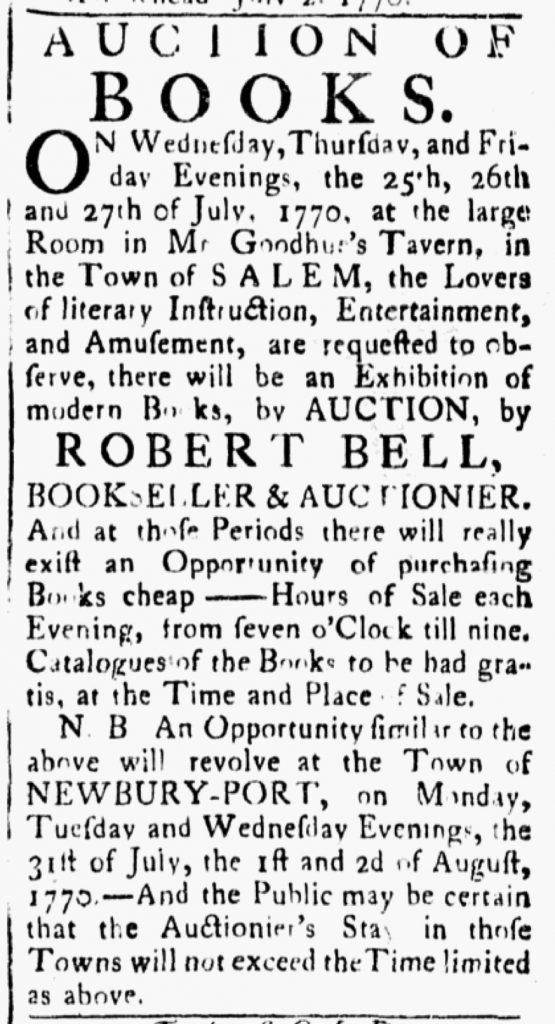
Essex Gazette (July 24, 1770).
“An Exhibition of modern Books, by AUCTION.”
Robert Bell, one of the most influential booksellers and auctioneers in eighteenth-century America, toured New England in the summer of 1770. Bell is widely recognized among historians of the book for his innovative marketing practices. The tone and language in his advertisement in the July 7, 1770, edition of the Providence Gazette, however, seems rather bland compared to the flashy approach that eventually became the hallmark of Bell’s efforts to promote his books and auctions. On the other hand, another advertisement in the Essex Gazette just a few weeks later hinted at the showmanship that Bell was in the process of developing and refining.
In announcing auctions that would take place at a tavern in Salem on three consecutive nights, Bell addressed prospective bidders as “the Lovers of literary Instruction, Entertainment, and Amusement.” Deploying such salutations eventually became a trademark of his newspaper advertisements, broadsides, and book catalogs. The advertisement in the Essex Gazette gave customers a glimpse of the personality they would encounter at the auction. Bell described each auction as “an Exhibition of modern Books” and proclaimed that one each evening “there will really exist an Opportunity of purchasing Books cheap.” He seemed to take readers into his confidence, offering assurances that the prospect of inexpensive books was more than just bluster to lure them to the auction.
In the same advertisement, Bell sought to incite interest in another trilogy of auctions. “An Opportunity similar to the above,” he declared, “will revolve at the Town of NEWBURY-PORT.” Readers of the Essex Gazette who could not attend any of the book auctions in Salem had another chance to get good bargains while mingling with other “Lovers of literary Instruction, Entertainment, and Amusement.” Like other itinerants who announced their visits in the public prints, whether peddlers or performers, Bell made clear that he would be in town for a limited time only. He advised that “the Public may be certain that the Auctionier’s Stay in those Towns will not exceed the Time limited as above.” Bell would be in Salem for just three nights and then in Newburyport for three more nights before moving along to his next destination.
Compared to his recent notice in the Providence Gazette, the advertisement Bell placed in the Essex Gazette much more resembled the style of promotion that made him famous in the eighteenth century and infamous in the history of the book. His lively language suggested that his auctions would be more than the usual sort of sale. They would be events that readers would not want to miss.
The Slavery Adverts 250 Project chronicles the role of newspaper advertising in perpetuating slavery in the era of the American Revolution. The project seeks to reveal the ubiquity of slavery in eighteenth-century life from New England to Georgia by republishing advertisements for slaves – for sale, wanted to purchase, runaways, captured fugitives – in daily digests on this site as well as in real time via the @SlaveAdverts250 Twitter feed, utilizing twenty-first-century media to stand in for the print media of the eighteenth century.
The project aims to provide modern audiences with a sense of just how often colonists encountered these advertisements in their daily lives. Enslaved men, women, and children appeared in print somewhere in the colonies almost every single day. Those advertisements served as a constant backdrop for social, cultural, economic, and political life in colonial and revolutionary America. Colonists who did not own slaves were still confronted with slavery as well as invited to maintain the system by purchasing slaves or assisting in the capture of runaways. The frequency of these newspaper advertisements suggests just how embedded slavery was in colonial and revolutionary American culture in everyday interactions beyond the printed page.
These advertisements also testify to the experiences of enslaved men, women, and children, though readers must consider that those experiences have been remediated through descriptions offered by slaveholders rather than the slaves themselves. Often unnamed in the advertisements, enslaved men, women, and children were not invisible or unimportant in early America.
From compiling an archive of digitized eighteenth-century newspapers to identifying advertisements about enslaved men, women, and children in those newspapers to preparing images of each advertisement to posting this daily digest, Parker Sears served as guest curator for this entry. Working on this project fulfilled his senior capstone requirement for completing the major in History at Assumption College in Worcester, Massachusetts.
These advertisements appeared in colonial American newspapers 250 years ago today.
Essex Gazette (July 24, 1770)
*********
South-Carolina Gazette and Country Journal (July 24, 1770)
*********
South-Carolina Gazette and Country Journal (July 24, 1770)
*********
South-Carolina Gazette and Country Journal (July 24, 1770)
*********
South-Carolina Gazette and Country Journal (July 24, 1770)
*********
South-Carolina Gazette and Country Journal (July 24, 1770)
*********
South-Carolina Gazette and Country Journal (July 24, 1770)
*********
South-Carolina Gazette and Country Journal (July 24, 1770)
*********
South-Carolina Gazette and Country Journal (July 24, 1770)
*********
South-Carolina Gazette and Country Journal (July 24, 1770)
*********
South-Carolina Gazette and Country Journal (July 24, 1770)
*********
South-Carolina Gazette and Country Journal (July 24, 1770)
********
South-Carolina Gazette and Country Journal (July 24, 1770)
**********
South-Carolina Gazette and Country Journal (July 24, 1770)
*********
South-Carolina Gazette and Country Journal (July 24, 1770)
What was advertised in a colonial American newspaper 250 years ago today?
Boston-Gazette (July 23, 1770).
“American Manufacture.”
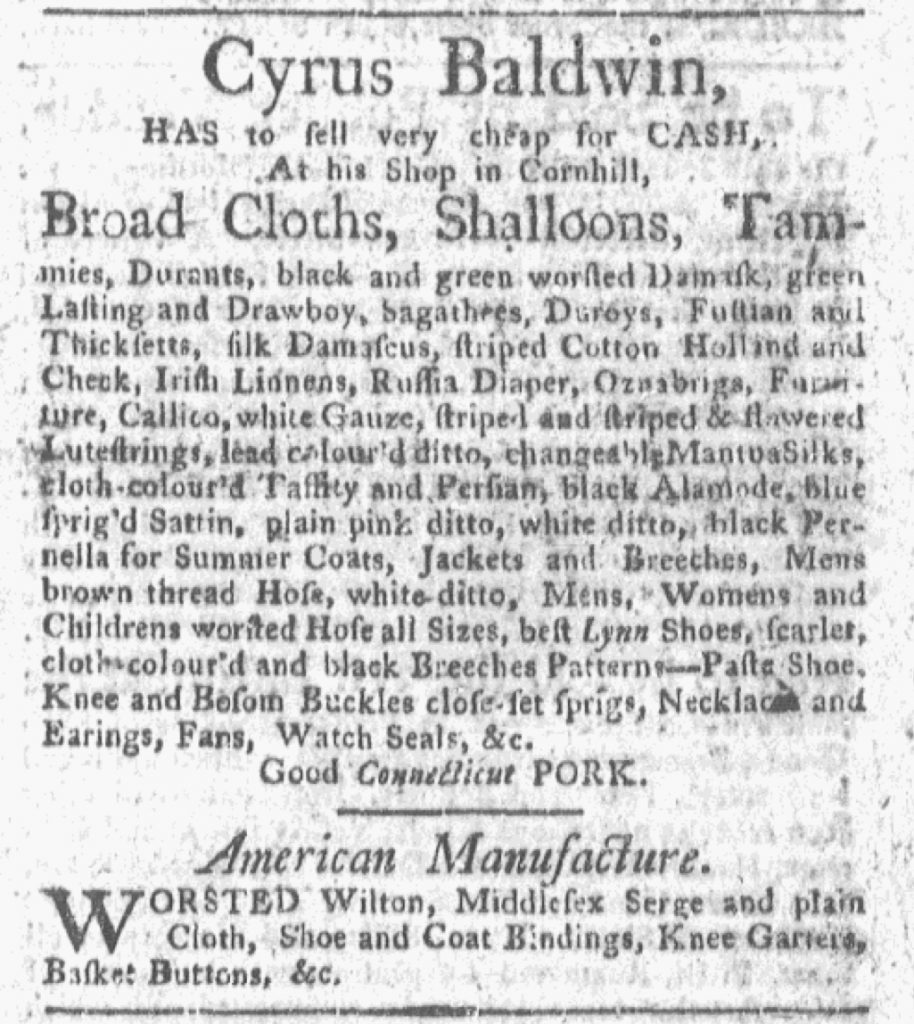
Cyrus Baldwin divided his advertisement in the July 23, 1770, edition of the Boston-Gazette into two parts. The first part, much longer than the second, looked much like other advertisements placed by shopkeepers during the period. It listed a variety of items for sale at Baldwin’s shop. The second part included a separate headline. That alone made the entire advertisement distinctive compared to others that ran in the Boston-Gazette and other newspapers.
The headline announced that the second part listed goods of “American Manufacture.” Baldwin carried “WORSTED Wilton, Middlesex Serge and plain Cloth, Shoe and Coat Bindings, Knee Garters, [and] Basket Buttons” made in the colonies. He concluded the list with “&c.” (the eighteenth-century abbreviation for et cetera) to suggest that he stocked even more items produced locally rather than imported. By inserting this headline and highlighting a second category of merchandise available at his shop, Baldwin both offered consumers an opportunity to practice politics when they shopped and encouraged them to do so.
The nonimportation agreement adopted to protest duties on certain imported goods imposed by the Townshend Acts was still in effect in Boston. At the time that merchants and traders adopted the measure, residents of the city also advocated that colonists encourage “domestic manufactures” through the production and consumption of goods in the colonies. Such goods provided an alternative to imported goods that became politically toxic, yet the repeal of the Townshend duties was not the only reason to buy American products. Colonists also worried about a trade imbalance with Britain. Encouraging domestic manufactures provided employment for colonists while reducing reliance on imported goods. Yet such encouragement could not be confined to production alone. Retailers and consumers had to play their parts as well. Baldwin did so by stocking goods produced in the colonies and calling particular attention to them in his advertisements. Consumers then had a duty to heed the call by choosing to purchase “American Manufacture[s].” Baldwin made it easy for them to identify goods that fit the bill.
The Slavery Adverts 250 Project chronicles the role of newspaper advertising in perpetuating slavery in the era of the American Revolution. The project seeks to reveal the ubiquity of slavery in eighteenth-century life from New England to Georgia by republishing advertisements for slaves – for sale, wanted to purchase, runaways, captured fugitives – in daily digests on this site as well as in real time via the @SlaveAdverts250 Twitter feed, utilizing twenty-first-century media to stand in for the print media of the eighteenth century.
The project aims to provide modern audiences with a sense of just how often colonists encountered these advertisements in their daily lives. Enslaved men, women, and children appeared in print somewhere in the colonies almost every single day. Those advertisements served as a constant backdrop for social, cultural, economic, and political life in colonial and revolutionary America. Colonists who did not own slaves were still confronted with slavery as well as invited to maintain the system by purchasing slaves or assisting in the capture of runaways. The frequency of these newspaper advertisements suggests just how embedded slavery was in colonial and revolutionary American culture in everyday interactions beyond the printed page.
These advertisements also testify to the experiences of enslaved men, women, and children, though readers must consider that those experiences have been remediated through descriptions offered by slaveholders rather than the slaves themselves. Often unnamed in the advertisements, enslaved men, women, and children were not invisible or unimportant in early America.
From compiling an archive of digitized eighteenth-century newspapers to identifying advertisements about enslaved men, women, and children in those newspapers to preparing images of each advertisement to posting this daily digest, Parker Sears served as guest curator for this entry. Working on this project fulfilled his senior capstone requirement for completing the major in History at Assumption College in Worcester, Massachusetts.
These advertisements appeared in colonial American newspapers 250 years ago today.
Boston-Evening Post (July 23, 1770)
*********
Boston Gazette (July 23, 1770)
*********
Boston Gazette (July 23, 1770)
*********
New-York Gazette and Weekly Mercury (July 23, 1770)
*********
New-York Gazette and Weekly Mercury (July 23, 1770)
*********
New-York Gazette and Weekly Mercury (July 23, 1770)
**********
New-York Gazette and Weekly Mercury (July 23, 1770)
*********
New-York Gazette and Weekly Mercury (July 23, 1770)
*********
New-York Gazette and Weekly Mercury (July 23, 1770)
*********
New-York Gazette or Weekly Post-Boy (July 23, 1770)
*********
New-York Gazette or Weekly Post-Boy (July 23, 1770)
*********
New-York Gazette or Weekly Post-Boy (July 23, 1770)
What was advertised in a colonial American newspaper 250 years ago this week?
Pennsylvania Journal (July 19, 1770).
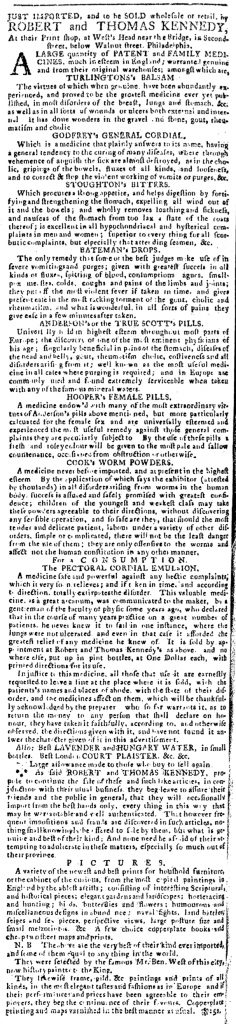
“A LARGE quantity of PATENT and FAMILY MEDICINES.”
Sometimes the advertisements in colonial American newspapers gave the impression that just about every purveyor of goods sold patent medicines. Apothecaries ran advertisements devoted almost exclusively to the drugs they stocked, including various patent medicines. Retailers listed patent medicines among the array of merchandise they sold. Even printers and booksellers advertised patent medicines in efforts to create additional revenue streams for their businesses. Most listed the names of the patent medicines they carried but did not elaborate on them. For instance, in the July 19, 1770, edition of the Pennsylvania Journal, Duffield and Delany, “Druggists; At Boerhaave’s Head,” stated that they sold “a variety of patent medicines, such as Godfrey’s cordial, Bateman’s drops, Anderson and Hooper’s pills.” William Richards peddled “Chemical and Galenical Medicines” wholesale and retail. In a short paragraph, he named fifteen familiar medicines, but did not describe the use of any except “Greenough’s tincture for preserving the teeth and gums.”
In contrast, Robert Kennedy and Thomas Kennedy ran an advertisement for “A LARGE quantity of PATENT and FAMILY MEDICINES” that almost filled an entire column. They listed eight patent medicines and provided short descriptions of the uses and effects of each. Most were so familiar that advertisers usually did not consider it necessary to offer so much detail. The Kennedys stocked all of the nostrums that Duffield and Delany named but did not describe; the “Druggists; At Boerhaave’s Head” expected that consumers already knew the purpose of each. For instance, Duffield and Delany merely listed “Bateman’s drops,” but the Kennedy’s created a headline for “BATEMAN’s DROPS” and followed it with this description: “The only remedy that some of the best judges make use of in severe vomitings and purges; given with greatest success in all kinds of fluxes, spitting of blood, consumptions, agues, smallpox, measles, colds, coughs and pains of the limbs and joints; they put off the most violent fever if taken in time, and gives present ease in the most racking torment of the gout, cholic and rheumatism, and what is wonderful, in all sorts of pains they give ease in a few minutes after taken.” The Kennedys devised an even longer description for Cook’s Worm Powders, introducing consumers to a “medicine never before imported” yet “at present in the highest esteem” in England.
Why did the Kennedys choose to publish such elaborate descriptions for such familiar patent medicines? With the exception of Cook’s Worm Powders, the general public already knew which patent medicines to take for various maladies. The length of the advertisement would have certainly attracted attention. It appeared on the same page as the notices placed by Duffield and Delany and William Richards, yet demanded more attention from readers. The Kennedys’ occupation may have also played a part in their decision to describe these patent medicines in so much detail. They sold them at “their Print Shop,” by which they meant a shop for purchasing prints to decorate homes rather than a printing office. They concluded their advertisement with a paragraph about “PICTURES” they also offered for sale. When it came to dispensing medicines, the Kennedys were not the same specialists as Duffield and Delany or William Richards. The descriptions may have been an attempt to justify their participation in that corner of the marketplace, a statement that they did not merely peddle patent medicines but also understood their uses and could aid customers in selecting the most appropriate remedies. They concluded the portion of the advertisement with a note that acknowledged they stocked patent medicines “in conjunction with their usual business” and pledged to sell “warrantable and well authenticated” items that they “import[ed] from the best hands only.” The Kennedys pledged to guard against frauds and counterfeits, selling only “what is genuine and the best of their kind.” They promised that “none need be afraid of their attempting to adulterate in these matters, especially so much out of their province.” The Kennedys acknowledged that selling patent medicines was different than selling prints, but consumers could trust them in those transactions. The offered the descriptions of the various patent medicines as a performance meant to demonstrate their knowledge about those products and their competence in offering the elixirs to customers.
What was advertised in a colonial American newspaper 250 years ago today?
Providence Gazette (July 21, 1770).
“Some Negroes likewise to be sold.”
For several weeks in the summer of 1770, Henry Paget took to the pagers of the Providence Gazette to advertise several properties for sale in Rhode Island, Massachusetts, and Connecticut. Those properties included a farm in Smithfield, Rhode Island, a “Lot of very good Land” near Ware, Massachusetts, and a house near Reading, Connecticut. He also offered for sale his “Dwelling-House” with “Shops and a good Store below” in Providence, promoting its prime location “near the Great Bridge, and handy to the College.” Yet Paget’s notice was not merely a real estate advertisement.
At the conclusion of the advertisement, Paget inserted two additional lines indicating that he also sought to sell enslaved people: “Some Negroes likewise to be sold. For further Particulars enquire of said Paget.” He did not provide further details. He did not state how many enslaved people he intended to sell. He did not say how many were men or women or children. He did not list any ages. He did not report on the skills any of them possessed. Other advertisements sometimes included those “Particulars,” but many did not.
Eighteenth-century newspapers, including those published in New England, frequently carried advertisements that casually mentioned enslaved people for sale. In many instances, such sales were not the primary purpose of the notices. Instead, such sales appeared as postscripts to advertisements placed for other reasons, such as Paget’s real estate notice, or enslaved people were included alongside various commodities, treating them as though they were nothing more than commodities themselves. Rather than focusing exclusively on enslaved people, many advertisements made casual reference to enslaved people, integrating the buying and selling of men, women, and children into other daily activities and commercial transactions.
At a glance, Paget’s advertisement does not appear to be an advertisement offering enslaved people for sale. The headline, “His FARM,” suggests that it was a real estate notice. That might make it easy for modern readers to overlook those final two lines unless they read carefully. For readers of the Providence Gazette in 1770, however, enslavement was part of the fabric of everyday life. Advertisements that hint at “Some Negroes likewise to be sold” only begin to tell much more extensive stories of enslavement in colonial and revolutionary New England.
The Slavery Adverts 250 Project chronicles the role of newspaper advertising in perpetuating slavery in the era of the American Revolution. The project seeks to reveal the ubiquity of slavery in eighteenth-century life from New England to Georgia by republishing advertisements for slaves – for sale, wanted to purchase, runaways, captured fugitives – in daily digests on this site as well as in real time via the @SlaveAdverts250 Twitter feed, utilizing twenty-first-century media to stand in for the print media of the eighteenth century.
The project aims to provide modern audiences with a sense of just how often colonists encountered these advertisements in their daily lives. Enslaved men, women, and children appeared in print somewhere in the colonies almost every single day. Those advertisements served as a constant backdrop for social, cultural, economic, and political life in colonial and revolutionary America. Colonists who did not own slaves were still confronted with slavery as well as invited to maintain the system by purchasing slaves or assisting in the capture of runaways. The frequency of these newspaper advertisements suggests just how embedded slavery was in colonial and revolutionary American culture in everyday interactions beyond the printed page.
These advertisements also testify to the experiences of enslaved men, women, and children, though readers must consider that those experiences have been remediated through descriptions offered by slaveholders rather than the slaves themselves. Often unnamed in the advertisements, enslaved men, women, and children were not invisible or unimportant in early America.
From compiling an archive of digitized eighteenth-century newspapers to identifying advertisements about enslaved men, women, and children in those newspapers to preparing images of each advertisement to posting this daily digest, Parker Sears served as guest curator for this entry. Working on this project fulfilled his senior capstone requirement for completing the major in History at Assumption College in Worcester, Massachusetts.
These advertisements appeared in colonial American newspapers 250 years ago today.
What was advertised in a colonial American newspaper 250 years ago today?
New-Hampshire Gazette (July 20, 1770).
“All Persons are hereby cautioned against buying any Shoes for his, that have not his Name therein.”
Samuel Foster advertised a “good and compleat Assortment of Womens Stuff-Shoes” in the July 20, 1770, edition of the New-Hampshire Gazette. He explained that he “manufactured” his wares “in the neatest and best Manner, at his Shop” in Portsmouth. Foster used “fresh and good” materials, “much better than is usually put to that Use in New England.” By 1770, Lynn, Massachusetts already achieved a reputation for producing shoes; Foster declared that his shoes were superior to those as well as “equal to any imported.”
Asserting the quality of “domestic manufactures,” goods made in the colonies, became a familiar element of advertisements when nonimportation agreements went into effect to protest the duties imposed on certain imported goods. American artisans reassured consumers that they did not have to sacrifice quality once trade with English merchants halted. With the repeal of all of the duties except for the one on tea, colonists debated whether to resume trading or hold out until Parliament repealed that last one. At the time Foster published his advertisements, New York already ended its nonimportation agreement. Philadelphia was on the verge of doing so and Boston would follow in the fall. This gave new urgency to pronouncements that domestic manufactures “will doubtless prove equal to any imported.” Foster sought to secure his position in the marketplace before facing greater competition from imported shoes.
Foster also devised another measure for securing his position in the marketplace. He concluded with a nota bene that included a warning: “All Persons are hereby cautioned against buying any Shoes for his, that have not his Name therein.” Foster insinuated that counterfeit shoes were in circulation … or could be in circulation. He did not explicitly state that unscrupulous retailers passed off other shoes as his, but he did suggest that it could happen. That warning buttressed his claims about the quality of his shoes. The materials and the craftsmanship were so good that it was not outside the realm of possibility that others would produce imitations and pretend Foster made them. He marked his wares with his name to avoid that from happening and encouraged buyers to examine shoes for signs of authenticity before making purchases.