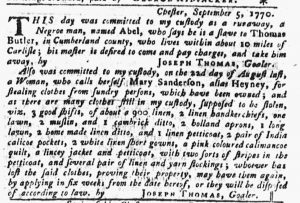
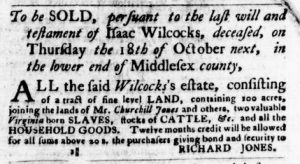
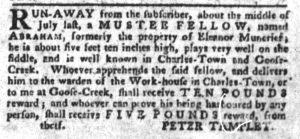
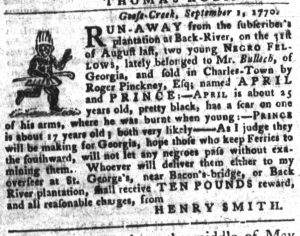
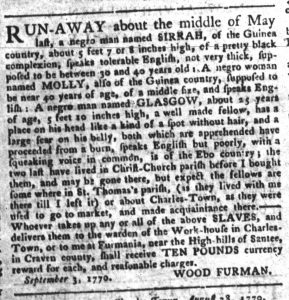
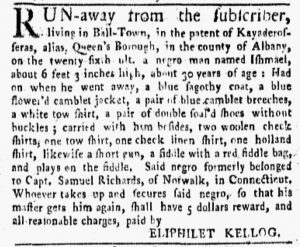
Slavery Advertisements Published September 13, 1770

GUEST CURATOR:  Garrett Cardoza

The Slavery Adverts 250 Project chronicles the role of newspaper advertising in perpetuating slavery in the era of the American Revolution. The project seeks to reveal the ubiquity of slavery in eighteenth-century life from New England to Georgia by republishing advertisements for slaves – for sale, wanted to purchase, runaways, captured fugitives – in daily digests on this site as well as in real time via the @SlaveAdverts250 Twitter feed, utilizing twenty-first-century media to stand in for the print media of the eighteenth century.

The project aims to provide modern audiences with a sense of just how often colonists encountered these advertisements in their daily lives. Enslaved men, women, and children appeared in print somewhere in the colonies almost every single day. Those advertisements served as a constant backdrop for social, cultural, economic, and political life in colonial and revolutionary America. Colonists who did not own slaves were still confronted with slavery as well as invited to maintain the system by purchasing slaves or assisting in the capture of runaways. The frequency of these newspaper advertisements suggests just how embedded slavery was in colonial and revolutionary American culture in everyday interactions beyond the printed page.

These advertisements also testify to the experiences of enslaved men, women, and children, though readers must consider that those experiences have been remediated through descriptions offered by slaveholders rather than the slaves themselves. Often unnamed in the advertisements, enslaved men, women, and children were not invisible or unimportant in early America.

These advertisements appeared in colonial American newspapers 250 years ago today.

Sep 13 1770 - Maryland Gazette Slavery 1
Maryland Gazette (September 13, 1770).

**********

Sep 13 1770 - Massachusets Gazette and Boston Weekly News-Letter Slavery 1
Massachusetts Gazette and Boston Weekly News-Letter (September 13, 1770).

**********
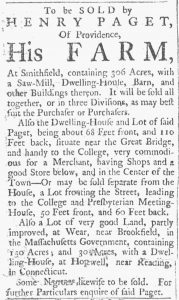
Sep 13 1770 - Massachusets Gazette and Boston Weekly News-Letter Slavery 2
Massachusetts Gazette and Boston Weekly News-Letter (September 13, 1770).

**********

Sep 13 1770 - Pennsylvania Gazette Slavery 1
Pennsylvania Gazette (September 13, 1770).

**********

Sep 13 1770 - Pennsylvania Gazette Slavery 2
Pennsylvania Gazette (September 13, 1770).

**********

Sep 13 1770 - Pennsylvania Journal Supplement Slavery 1
Supplement to the Pennsylvania Journal (September 13, 1770).

**********

Sep 13 1770 - Virginia Gazette Purdie & Dixon Slavery 1
Virginia Gazette [Purdie and Dixon] (September 13, 1770).

**********

Sep 13 1770 - Virginia Gazette Purdie & Dixon Slavery 2
Virginia Gazette [Purdie and Dixon] (September 13, 1770).

**********

Sep 13 1770 - Virginia Gazette Purdie & Dixon Slavery 3
Virginia Gazette [Purdie and Dixon] (September 13, 1770).

**********

Sep 13 1770 - Virginia Gazette Purdie & Dixon Slavery 4
Virginia Gazette [Purdie and Dixon] (September 13, 1770).

**********

Sep 13 1770 - Virginia Gazette Purdie & Dixon Slavery 5
Virginia Gazette [Purdie and Dixon] (September 13, 1770).

**********

Sep 13 1770 - Virginia Gazette Purdie & Dixon Slavery 6
Virginia Gazette [Purdie and Dixon] (September 13, 1770).

**********

Sep 13 1770 - Virginia Gazette Purdie & Dixon Slavery 7
Virginia Gazette [Purdie and Dixon] (September 13, 1770).

**********

Sep 13 1770 - Virginia Gazette Purdie & Dixon Slavery 8
Virginia Gazette [Purdie and Dixon] (September 13, 1770).

**********

Sep 13 1770 - Virginia Gazette Purdie & Dixon Slavery 9
Virginia Gazette [Purdie and Dixon] (September 13, 1770).

**********

Sep 13 1770 - Virginia Gazette Purdie & Dixon Slavery 10
Virginia Gazette [Purdie and Dixon] (September 13, 1770).

**********

Sep 13 1770 - Virginia Gazette Purdie & Dixon Slavery 11
Virginia Gazette [Purdie and Dixon] (September 13, 1770).

**********

Sep 13 1770 - Virginia Gazette Purdie & Dixon Slavery 12
Virginia Gazette [Purdie and Dixon] (September 13, 1770).

**********

Sep 13 1770 - Virginia Gazette Purdie & Dixon Slavery 13
Virginia Gazette [Purdie and Dixon] (September 13, 1770).

**********

Sep 13 1770 - Virginia Gazette Rind Slavery 1
Virginia Gazette [Rind] (September 13, 1770).

**********

Sep 13 1770 - Virginia Gazette Rind Slavery 2
Virginia Gazette [Rind] (September 13, 1770).

**********

Sep 13 1770 - Virginia Gazette Rind Slavery 3
Virginia Gazette [Rind] (September 13, 1770).

**********

Sep 13 1770 - Virginia Gazette Rind Slavery 4
Virginia Gazette [Rind] (September 13, 1770).

**********

Sep 13 1770 - Virginia Gazette Rind Slavery 5
Virginia Gazette [Rind] (September 13, 1770).

**********

Sep 13 1770 - Virginia Gazette Rind Slavery 6
Virginia Gazette [Rind] (September 13, 1770).

**********

Sep 13 1770 - Virginia Gazette Rind Slavery 7
Virginia Gazette [Rind] (September 13, 1770).

**********

Sep 13 1770 - Virginia Gazette Rind Slavery 8
Virginia Gazette [Rind] (September 13, 1770).

**********

Sep 13 1770 - Virginia Gazette Rind Slavery 9
Virginia Gazette [Rind] (September 13, 1770).

Welcome, Guest Curator Garrett Cardoza

Garrett Cardoza is a senior pursuing a double major in History and Political Science at Assumption University. Originally from Somerset, Massachusetts, he is interested in political philosophy and the development of political theory over time. On campus, Garrett has served as a Senator and Committee Chair for the Student Government Association, an Orientation Leader and Student Program Executive, a sub-chair for the Campus Activities Board, ambassador for the Students Involved in Better Success Program, and member of the Model Senate Project sponsored by the Daniel Patrick Moynihan Center for Scholarship and Statesmanship.  He is currently the president of the Student Government Association.  He conducted the research for his contributions as guest curator for the Slavery Adverts 250 Project when he was enrolled in HIS 400 – Research Methods: Vast Early America in Spring 2020.

Welcome, guest curator Garrett Cardoza!

September 12

What was advertised in a colonial American newspaper 250 years ago this week?

Pennsylvania Chronicle (September 10, 1770).

“Turtle, for large Companies, dressed to Perfection.”

When Edward Bardin opened the King’s Arms Tavern in New York in the summer of 1770, he did not confine his advertising to the newspapers published in that city.  Instead, he also placed a notice in the Pennsylvania Chronicle, advising “Gentlemen, Ladies and others” of the amenities available at his establishment.  He promised to entertain them “in the most complete and genteel Manner.”  To achieve that goal, he acquired “a good Stock of neat Wines and other Liquors, a professed Cook, and other proper Attendants.”  He also supplied “the public Papers” for his customers, likely including the New-York Journal, the New-York Gazette and Weekly Mercury, and the New-York Gazette or Weekly Post-Boy.  He may have also subscribed to newspapers printed in other cities and towns in the colonies and perhaps even London as well.  Bardin also offered “convenient Lodgings” for “Gentlemen who are Strangers,” including those who saw his advertisement in the Pennsylvania Chronicle and then traveled to New York.  The tavernkeeper aimed to impress, contending that he had everything “necessary to render” the King’s Arms “as complete a House of Business as any on the Continent in America.”

Bardin emphasized one additional amenity for prospective guests: “Turtle, for large Companies, dressed to perfection.”  Tavernkeepers occasionally mentioned that they provided turtle, shorthand for turtle feasts.  By the middle of the eighteenth century, turtle feasts became popular among the elite in London and the largest cities in the colonies.  In “An Historical and Zooarchaeological Approach to the Study of Turtle-based Foods in the City of Brotherly Love, ca. 1750-1850,” Teagan Schweitzer notes that the turtles for these feasts were often “large ocean-bound green sea turtles … in the range of 50 to 300 pounds” and “imported from the West Indies.”  Due to their size, they were served at banquets, just as Bardin suggested in his advertisement.  According to Schweitzer, “Hannah Glasse’s 1751 edition of The Art of Cookery, Made Plain and Easy, the earliest English cookbook to include a recipe for turtle, aside from the soup there was a dish highlighting the calipash (the back shell), one for the calipee (the belly), a dish made from the offal (entrails), and one from the fins.”  Recipes for turtle appeared in several eighteenth-century cookbooks.  In The Experienced English House-keeper (1769), Elizabeth Raffald “gave instructions for preparing seven dishes from a turtle weighing a hundred pounds.”  For one final example, Schweitzer highlights a recipe for turtle in Amelia Simmons’s American Cookery (1796), the first American cookbook.  Simmons included only thirty-nine recipes in that cookbook.

In the second half of the eighteenth-century, the turtle feast became a popular pastime for genteel diners who gathered for banquets at taverns like the King’s Arms in New York.  Bardin mentioned “Turtle, for large Companies, dressed to perfection” in his advertisement as an additional mark of distinction for his tavern, an amenity as important as the “neat Wines,” “public Papers,” and “proper Attendants” that made his establishment rival any other in the colonies.

September 11

What was advertised in a colonial American newspaper 250 years ago today?

South-Carolina Gazette and Country Journal (September 11, 1770).

“Merchants and Tradesmen may have their Books regulated by the Month.”

As summer turned to fall in 1770, Jacob Valk took to the pages of the South-Carolina Gazette and Country Journal to advertise his services as a bookkeeper.  He informed readers that he “keeps an Office where Merchants and Tradesmen may have their Books regulated by the Month.”  He assisted with balancing and closing accounts as well as opening accounts “properly for those commencing any Kind of Business.”  Valk oversaw books kept for various purposes: “Partnerships Accounts, and Accounts of Ships, Planters, or Executors.”  In each case, clients could depend on having their ledgers “properly scrutinized, and accurately adjusted.”  They could also expect confidentiality.  Valk promised “Secrecy and Dispatch.”

Valk made a special appeal to prospective clients “apprehensive of a Failure or Litigation at Law.”  By hiring his services, they could avoid Embarrassment in their Affairs.”  Although he did not offer any guarantees, he suggested that anyone anxious about their bookkeeping abilities could gain a sense of security by relying on his guidance and oversight.  It was “more than probable,” he asserted, that his clients would “meet with a happy Prevention” of undesirable outcomes, but only if they acted in a timely manner.  Valk encouraged prospective clients to consult with him early rather than wait until it was too late for him to help.

Valk presented a combination of invitation and warning in his advertisement.  By responding to his notice, “Merchants and Tradesmen” lessened the chances that they would find themselves in the position of having to respond to another sort of notice that frequently appeared in the South-Carolina Gazette and Country Journal and other newspapers, those that called on colonists to settle accounts or face legal action.  In the same issue that carried Valk’s advertisement, Andrew Taylor placed just such a notice directed at “all Persons indebted to me.”  Those who owed Taylor money were on the verge of experiencing “Embarrassment in their Affairs” if they did not settle accounts quickly.  Valk offered an alternative to clients who hired his bookkeeping services.

Slavery Advertisements Published September 11, 1770

GUEST CURATOR:  Benjamin Bartlett

The Slavery Adverts 250 Project chronicles the role of newspaper advertising in perpetuating slavery in the era of the American Revolution. The project seeks to reveal the ubiquity of slavery in eighteenth-century life from New England to Georgia by republishing advertisements for slaves – for sale, wanted to purchase, runaways, captured fugitives – in daily digests on this site as well as in real time via the @SlaveAdverts250 Twitter feed, utilizing twenty-first-century media to stand in for the print media of the eighteenth century.

The project aims to provide modern audiences with a sense of just how often colonists encountered these advertisements in their daily lives. Enslaved men, women, and children appeared in print somewhere in the colonies almost every single day. Those advertisements served as a constant backdrop for social, cultural, economic, and political life in colonial and revolutionary America. Colonists who did not own slaves were still confronted with slavery as well as invited to maintain the system by purchasing slaves or assisting in the capture of runaways. The frequency of these newspaper advertisements suggests just how embedded slavery was in colonial and revolutionary American culture in everyday interactions beyond the printed page.

These advertisements also testify to the experiences of enslaved men, women, and children, though readers must consider that those experiences have been remediated through descriptions offered by slaveholders rather than the slaves themselves. Often unnamed in the advertisements, enslaved men, women, and children were not invisible or unimportant in early America.

These advertisements appeared in colonial American newspapers 250 years ago today.

Sep 11 1770 - South-Carolina Gazette and Country Journal Slavery 1
South-Carolina Gazette and Country Journal (September 11, 1770).

**********

Sep 11 1770 - South-Carolina Gazette and Country Journal Slavery 2
South-Carolina Gazette and Country Journal (September 11, 1770).

**********

Sep 11 1770 - South-Carolina Gazette and Country Journal Slavery 3
South-Carolina Gazette and Country Journal (September 11, 1770).

**********

Sep 11 1770 - South-Carolina Gazette and Country Journal Slavery 4
South-Carolina Gazette and Country Journal (September 11, 1770).

**********

Sep 11 1770 - South-Carolina Gazette and Country Journal Slavery 5
South-Carolina Gazette and Country Journal (September 11, 1770).

**********

Sep 11 1770 - South-Carolina Gazette and Country Journal Slavery 6
South-Carolina Gazette and Country Journal (September 11, 1770).

**********

Sep 11 1770 - South-Carolina Gazette and Country Journal Slavery 7
South-Carolina Gazette and Country Journal (September 11, 1770).

**********

Sep 11 1770 - South-Carolina Gazette and Country Journal Slavery 8
South-Carolina Gazette and Country Journal (September 11, 1770).

**********

Sep 11 1770 - South-Carolina Gazette and Country Journal Slavery 9
South-Carolina Gazette and Country Journal (September 11, 1770).

**********

Sep 11 1770 - South-Carolina Gazette and Country Journal Slavery 10
South-Carolina Gazette and Country Journal (September 11, 1770).

September 10

What was advertised in a colonial American newspaper 250 years ago today?

Supplement to the New-York Gazette and Weekly Mercury (September 10, 1770).

“To be SOLD … Best PORTER.”

Colonial printers often devoted as much space to advertising as news, editorials, and other content in their newspapers.  Advertisements often overflowed from standard issues into supplements devoted entirely to paid notices.  Consider, for instance, Hugh Gaine’s New-York Gazette and Weekly Mercury.  Gaine published a standard issue once a week in 1770.  It consisted of four pages created by printing two on each side of a broadsheet and then folding it in half.  Those standard issues usually included a significant proportion of advertisements in relation to news.  In addition, a two-page supplement often accompanied the standard issue.  Such was the case on September 10.  This did not, however, increase the contents by half since Gaine used a smaller sheet for the supplement.  Still, the supplement accounted for a considerable amount of additional material disseminated to readers.

Notably, the supplement contained advertisements and nothing else, with the exception of the masthead.  Gaine inserted more than three dozen advertisements that did not fit in the standard issue.  This was not a case of separating news from advertising, saving the latter for the supplement.  Instead, paid notices appeared throughout the standard issue as well.  One advertisement ran at the bottom of the first page.  Every other page featured a greater number of advertisements:  nearly two of the four columns on the second page, a column and a half on the third page, and the entire fourth page.  Before turning to the supplement, advertising filled nearly half of the standard issue.

Advertising generated revenues for Gaine, making publishing the New-York Gazette and Weekly Mercury a viable enterprise.  Then, as now, advertising revenues contributed to the dissemination of the news, though sometimes their volume may have seemed to overwhelm the other content of the newspaper.  Joseph Lawrence’s advertisement for “Best PORTER” in the supplement, one example among many, helped to underwrite news from London and Constantinople on the first page and news from other colonies on the second and third pages.

Slavery Advertisements Published September 10, 1770

GUEST CURATOR:  Benjamin Bartlett

The Slavery Adverts 250 Project chronicles the role of newspaper advertising in perpetuating slavery in the era of the American Revolution. The project seeks to reveal the ubiquity of slavery in eighteenth-century life from New England to Georgia by republishing advertisements for slaves – for sale, wanted to purchase, runaways, captured fugitives – in daily digests on this site as well as in real time via the @SlaveAdverts250 Twitter feed, utilizing twenty-first-century media to stand in for the print media of the eighteenth century.

The project aims to provide modern audiences with a sense of just how often colonists encountered these advertisements in their daily lives. Enslaved men, women, and children appeared in print somewhere in the colonies almost every single day. Those advertisements served as a constant backdrop for social, cultural, economic, and political life in colonial and revolutionary America. Colonists who did not own slaves were still confronted with slavery as well as invited to maintain the system by purchasing slaves or assisting in the capture of runaways. The frequency of these newspaper advertisements suggests just how embedded slavery was in colonial and revolutionary American culture in everyday interactions beyond the printed page.

These advertisements also testify to the experiences of enslaved men, women, and children, though readers must consider that those experiences have been remediated through descriptions offered by slaveholders rather than the slaves themselves. Often unnamed in the advertisements, enslaved men, women, and children were not invisible or unimportant in early America.

These advertisements appeared in colonial American newspapers 250 years ago today.

Sep 10 1770 - Boston Evening-Post Slavery 1
Boston Evening-Post (September 10, 1770).

**********

Sep 10 1770 - New-York Gazette and Weekly Mercury Slavery 1
New-York Gazette and Weekly Mercury (September 10, 1770).

**********

Sep 10 1770 - New-York Gazette and Weekly Mercury Slavery 2
New-York Gazette and Weekly Mercury (September 10, 1770).

**********

Sep 10 1770 - New-York Gazette and Weekly Mercury Slavery 3
New-York Gazette and Weekly Mercury (September 10, 1770).

**********

Sep 10 1770 - New-York Gazette and Weekly Mercury Slavery 4
New-York Gazette and Weekly Mercury (September 10, 1770).

**********

Sep 10 1770 - New-York Gazette and Weekly Mercury Slavery 5
New-York Gazette and Weekly Mercury (September 10, 1770).

**********

Sep 10 1770 - New-York Gazette and Weekly Mercury Slavery 6
New-York Gazette and Weekly Mercury (September 10, 1770).

**********

Sep 10 1770 - New-York Gazette and Weekly Mercury Supplement Slavery 1
Supplement to the New-York Gazette and Weekly Mercury (September 10, 1770).

**********

Sep 10 1770 - New-York Gazette and Weekly Mercury Supplement Slavery 2
Supplement to the New-York Gazette and Weekly Mercury (September 10, 1770).

**********

Sep 10 1770 - South-Carolina and American General Gazette Slavery 1
South-Carolina and American General Gazette (September 10, 1770).

**********

Sep 10 1770 - South-Carolina and American General Gazette Slavery 2
South-Carolina and American General Gazette (September 10, 1770).

September 9

What was advertised in a colonial American newspaper 250 years ago this week?

New-York Journal (September 6, 1770).

“PETER VIANY.  CONTINUES to teach Fencing and Dancing.”

Peter Vianey taught dancing and fencing in New York in the late 1760s and early 1770s.  To attract students, he periodically placed newspaper advertisements in the New-York Journal.  His advertisements often appeared in September in advance of a new season of lessons to commence at his “public Dancing School” in October, though he placed notices on other occasions as well.  For prospective pupils who desired more personalized attention (or who were anxious about others potentially seeing them in awkward positions as they worked to master the steps), he also taught “Ladies and Gentleman in private either at his School or at their own Houses.”

Vianey inserted a relatively short advertisement into the September 6, 1770, edition of the New-York Journal.  His statement that he “CONTINUES to teach Fencing and Dancing” suggests that he expected that many residents of New York were already familiar with his services.  It was a very different tone than he took two years earlier when his advertisement included a short introduction and three additional paragraphs.  The first announced the opening of his school in October, described the dances he taught, listed his fees, and offered private lessons.  The second emphasized the quality of instruction.  Vianey proclaimed that he taught “in the Style of the best Masters in Europe.”  His methods were so effective that the results were already “discoverable in his Scholars” even though “none of them have yet had Time to be perfected in their Minuets.”  It was the final paragraph, however, that was the most important.  In it, Vianey addressed gossip and a case of mistaken identity.  “Having been informed,” he stated, “that he has been mistaken for a Dancing-Master, whose Behaviour to his Scholars gave just Offence in this City some Years ago, he takes Liberty to inform those who are acquainted with him, that he never was in this Country, till the Year 1764.”  He further asserted that “all who know him” could “testify that his Conduct has ever been regular and unexceptionable.”  Vianey sought to manage his reputation in the wake of reports that confused him with another dancing master.  Given that teaching dancing often required being in close physical proximity with his students, even touching them as they danced together and he demonstrated the steps, Vianey needed to establish that he was beyond reproach in order to protect his livelihood.

Apparently, Vianey successfully rehabilitated his reputation after placing his advertisement in 1768.  In subsequent advertisements, including the one placed in advance of a new season of lessons starting in October 1770, he did not mention further difficulties, nor was it in his interest to remind readers of gossip he wished to put behind him.  That he continued to reside in New York, offer lessons, and place advertisements testified to his success in overcoming the gossip and suspicions directed at him.

September 8

What was advertised in a colonial American newspaper 250 years ago today?

Providence Gazette (September 8, 1770).

“An Advertisement to be inserted three Weeks successively in the Providence Gazette, in the Newport Mercury, in one of the Boston, and in one of the New-York News-Papers.”

The misfortune of others generated advertising revenue for John Carter, printer of the Providence Gazette, and other newspaper printers in the 1770s.  Consider the September 8, 1770, edition of the Providence Gazette.  It featured six advertisements concerning insolvent debtors placed by Henry Ward, secretary of Rhode Island’s General Assembly.

Those notices reiterated formulaic language.  Each named a colonist and his place of residence, stating that he “preferred a Petition unto the General Assembly … representing that he is an insolvent Debtor, and praying that he may the receive the Benefit of an Act passed in June, 1756, intituled, ‘An Act for the Relief of insolvent Debtors.’”  According to the notice, the General Assembly deferred consideration of the petition until the next session, but also specified that “his creditors should be notified” via newspaper advertisements.  On behalf of the General Assembly, Ward invited those creditors to attend the next session and “there to shew Cause, if any they  have, why the said Petition should not be granted.”

Four of these notices called for such advertisements to appear in the Providence Gazette and the Newport Mercury, the two newspapers published in Rhode Island in 1770.  The two other notices each cast a wider net.  One added “one of the New-York News-Papers” and the other added “one of the Boston, and … one of the New-York News-Papers.”  All six called for the advertisements to run “three Weeks successively” in each newspaper.

Carter solicited advertisements for the Providence Gazette in the colophon at the bottom of the final page of every issue.  He may have been especially grateful for these notices in early September since he had few others to insert and he continued to run his own notice calling on “ALL Persons indebted to the Printer” to settle accounts or face legal action.  Assuming that he could depend on the General Assembly to pay for these advertisements in a timely manner, they might have been a windfall for Carter.

Slavery Advertisements Published September 8, 1770

GUEST CURATOR:  Benjamin Bartlett

The Slavery Adverts 250 Project chronicles the role of newspaper advertising in perpetuating slavery in the era of the American Revolution. The project seeks to reveal the ubiquity of slavery in eighteenth-century life from New England to Georgia by republishing advertisements for slaves – for sale, wanted to purchase, runaways, captured fugitives – in daily digests on this site as well as in real time via the @SlaveAdverts250 Twitter feed, utilizing twenty-first-century media to stand in for the print media of the eighteenth century.

The project aims to provide modern audiences with a sense of just how often colonists encountered these advertisements in their daily lives. Enslaved men, women, and children appeared in print somewhere in the colonies almost every single day. Those advertisements served as a constant backdrop for social, cultural, economic, and political life in colonial and revolutionary America. Colonists who did not own slaves were still confronted with slavery as well as invited to maintain the system by purchasing slaves or assisting in the capture of runaways. The frequency of these newspaper advertisements suggests just how embedded slavery was in colonial and revolutionary American culture in everyday interactions beyond the printed page.

These advertisements also testify to the experiences of enslaved men, women, and children, though readers must consider that those experiences have been remediated through descriptions offered by slaveholders rather than the slaves themselves. Often unnamed in the advertisements, enslaved men, women, and children were not invisible or unimportant in early America.

These advertisements appeared in colonial American newspapers 250 years ago today.

Sep 8 1770 - Providence Gazette Slavery 1
Providence Gazette (September 8, 1770).

**********

Sep 8 1770 - Providence Gazette Slavery 2
Providence Gazette (September 8, 1770).