Slavery Advertisements Published January 8, 1771

GUEST CURATOR:  Chloe Amour

The Slavery Adverts 250 Project chronicles the role of newspaper advertising in perpetuating slavery in the era of the American Revolution. The project seeks to reveal the ubiquity of slavery in eighteenth-century life from New England to Georgia by republishing advertisements for slaves – for sale, wanted to purchase, runaways, captured fugitives – in daily digests on this site as well as in real time via the @SlaveAdverts250 Twitter feed, utilizing twenty-first-century media to stand in for the print media of the eighteenth century.

The project aims to provide modern audiences with a sense of just how often colonists encountered these advertisements in their daily lives. Enslaved men, women, and children appeared in print somewhere in the colonies almost every single day. Those advertisements served as a constant backdrop for social, cultural, economic, and political life in colonial and revolutionary America. Colonists who did not own slaves were still confronted with slavery as well as invited to maintain the system by purchasing slaves or assisting in the capture of runaways. The frequency of these newspaper advertisements suggests just how embedded slavery was in colonial and revolutionary American culture in everyday interactions beyond the printed page.

These advertisements also testify to the experiences of enslaved men, women, and children, though readers must consider that those experiences have been remediated through descriptions offered by slaveholders rather than the slaves themselves. Often unnamed in the advertisements, enslaved men, women, and children were not invisible or unimportant in early America.

From compiling an archive of digitized eighteenth-century newspapers to identifying advertisements about enslaved men, women, and children in those newspapers to preparing images of each advertisement to posting this daily digest, Chloe Amour served as guest curator for this entry.  She completed this work while enrolled in an independent study for HIS 366 – Introduction to Public History at Assumption University in Worcester, Massachusetts, in Fall 2020.

These advertisements appeared in colonial American newspapers 250 years ago today.

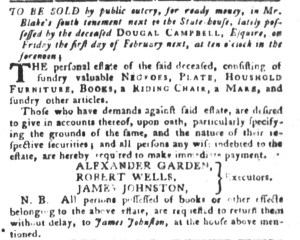
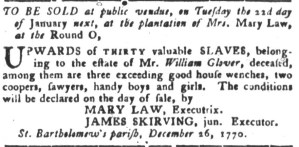
South-Carolina Gazette and Country Journal (January 8, 1771).

**********

South-Carolina Gazette and Country Journal (January 8, 1771).

**********

South-Carolina Gazette and Country Journal (January 8, 1771).

**********

South-Carolina Gazette and Country Journal (January 8, 1771).

January 7

What was advertised in a colonial American newspaper 250 years ago today?

Boston Evening-Post (January 7, 1771).

“Dr. Whitaker’s Sermon on the Death of Mr. WHITEFIELD.”

In addition to publishing the Boston Evening-Post, printers Thomas Fleet and John Fleet sold a variety of books at their shop at the Sign of the Heart and Crown.  Throughout the colonies, printers commonly augmented their incomes by selling books and pamphlets, mostly items that they either imported or acquired from associates in other towns alongside a few titles they produced on their own.

Such was the case in the advertisement the Fleets inserted in their own newspaper on January 7, 1771.  They concluded the notice with Jeremiah Dummer’s Defence of the New-England Charters, a pamphlet they reprinted in 1765, but they first listed titles published by others.  The Fleets devoted half of the notice to a pamphlet printed by William Goddard.  In The Partnership, Goddard detailed his disputes with “Joseph Galloway, Esq; Speaker of the Honorable House of Representatives of the Province of Pennsylvania, Mr. Thomas Wharton, sen.,” a prominent merchant, “and their Man Benjamin Towne,” a journeyman printer.  The four men had formerly been partners in the Pennsylvania Chronicle, but their disagreements led to a dissolution of the partnership in the summer of 1770 and a war of words in newspapers, handbills, and pamphlets.

The other titles available at the Heart and Crown included “Dr. Whitaker’s Sermon on the Death of Mr. WHITEFIELD.”  George Whitefield, one of the most prominent ministers associated with the eighteenth-century religious revivals now known as the Great Awakening, died in Newburyport, Massachusetts, on September 30, 1770.  In the wake of his death, printers and others produced, marketed, and sold a variety of commemorative items, including funeral sermons preached in memory of the minister.  For several months, advertisements for those items appeared alongside reports about reactions to the news in towns throughout the colonies and poetry composed for the occasion.  The Fleets’ advertisement, listing the funeral sermon third among four titles, marked a transition in the marketing of items commemorating Whitefield.  No longer was Whitefield the sole or even primary focus of the advertisement.  As time passed and the minister’s death became more distant in the memories of prospective buyers, the Fleets recognized that demand for such commemorative items waned.  Funeral sermons no longer had the same immediacy as when the news was fresh.  As a result, they became one item among several in booksellers’ inventories rather than items that merited advertisements of their own in the public prints.

After several months of Whitefield fervor, especially in newspapers published in New England, printers and booksellers like the Fleets recalibrated their advertising efforts.  In this case, a spirited account of a bitter feud among printers and politicians in Pennsylvania received top billing over a sermon in memory Whitefield.

Slavery Advertisements Published January 7, 1771

GUEST CURATOR:  Chloe Amour

The Slavery Adverts 250 Project chronicles the role of newspaper advertising in perpetuating slavery in the era of the American Revolution. The project seeks to reveal the ubiquity of slavery in eighteenth-century life from New England to Georgia by republishing advertisements for slaves – for sale, wanted to purchase, runaways, captured fugitives – in daily digests on this site as well as in real time via the @SlaveAdverts250 Twitter feed, utilizing twenty-first-century media to stand in for the print media of the eighteenth century.

The project aims to provide modern audiences with a sense of just how often colonists encountered these advertisements in their daily lives. Enslaved men, women, and children appeared in print somewhere in the colonies almost every single day. Those advertisements served as a constant backdrop for social, cultural, economic, and political life in colonial and revolutionary America. Colonists who did not own slaves were still confronted with slavery as well as invited to maintain the system by purchasing slaves or assisting in the capture of runaways. The frequency of these newspaper advertisements suggests just how embedded slavery was in colonial and revolutionary American culture in everyday interactions beyond the printed page.

These advertisements also testify to the experiences of enslaved men, women, and children, though readers must consider that those experiences have been remediated through descriptions offered by slaveholders rather than the slaves themselves. Often unnamed in the advertisements, enslaved men, women, and children were not invisible or unimportant in early America.

From compiling an archive of digitized eighteenth-century newspapers to identifying advertisements about enslaved men, women, and children in those newspapers to preparing images of each advertisement to posting this daily digest, Chloe Amour served as guest curator for this entry.  She completed this work while enrolled in an independent study for HIS 366 – Introduction to Public History at Assumption University in Worcester, Massachusetts, in Fall 2020.

These advertisements appeared in colonial American newspapers 250 years ago today.

Boston-Evening Post (January 7, 1771).

**********

Massachusetts Spy (January 7, 1771).

**********

Massachusetts Gazette and Boston-Post Boy (January 7, 1771).

**********

New-York Gazette and Weekly Mercury (January 7, 1771).

**********

New-York Gazette and Weekly Mercury (January 7, 1771).

**********

New-York Gazette and Weekly Mercury (January 7, 1771).

**********

New-York Gazette and Weekly Mercury (January 7, 1771).

**********

New-York Gazette and Weekly Mercury (January 7, 1771).

**********

New-York Gazette and Weekly Mercury (January 7, 1771).

**********

New-York Gazette and Weekly Mercury (January 7, 1771).

**********

Pennsylvania Chronicle (January 7, 1771).

**********

South-Carolina and American General Gazette (January 7, 1771).

**********

South-Carolina and American General Gazette (January 7, 1771).

**********

South-Carolina and American General Gazette (January 7, 1771).

**********

South-Carolina and American General Gazette (January 7, 1771).

**********

South-Carolina and American General Gazette (January 7, 1771).

**********

South-Carolina and American General Gazette (January 7, 1771).

**********

South-Carolina and American General Gazette (January 7, 1771).

**********

South-Carolina and American General Gazette (January 7, 1771).

**********

South-Carolina and American General Gazette (January 7, 1771).

**********

South-Carolina and American General Gazette (January 7, 1771).

**********

South-Carolina and American General Gazette (January 7, 1771).

**********

South-Carolina and American General Gazette (January 7, 1771).

**********

South-Carolina and American General Gazette (January 7, 1771).

**********

South-Carolina and American General Gazette (January 7, 1771).

**********

South-Carolina and American General Gazette (January 7, 1771).

January 6

What was advertised in a colonial American newspaper 250 years ago today?

Pennsylvania Gazette (January 3, 1771).

“Said EVITT prints advertisements, &c. at two hours notice.”

At first glance, many readers of the Pennsylvania Gazette may have thought that William Evitt’s notice in the January 3, 1771, edition was yet another advertisement for an almanac.  Such advertisements were common at the turn of the new year as printers attempted to sell surplus copies not purchased before the new year began.  David Hall and William Sellers, the printers of both the Pennsylvania Gazette and Poor Richard’s Almanack, inserted their own advertisement on the previous page.  The prologue to Evitt’s advertisement suggested that he would devote the entire notice to describing the contents of “THE UNIVERSAL and POOR ROBIN’S ALMANACKS, for the year 1771.”  Although he did promote those two publications, as well as “The GENTLEMAN and CITIZEN’S POCKET ALMANACK” with its “greater variety of useful lists, tables, &c. &c. &c. than any other almanack printed in America,” Evitt addressed a variety of other endeavors in the second half of his advertisement.  He informed customers that he sold books, stationery, and patent medicines, like many other printers, but he also carried other merchandise, including stockings, handkerchiefs, sieves, brushes, soap, and common grocery items.

Near the conclusion of his advertisement, Evitt returned to goods and services more closely associated with printers.  He advised prospective clients that he “prints advertisements, &c. at two hours notice.”  In other words, he did job printing.  Jobs included advertisements, broadsides (today known as posters), circular letters, and a vast array of printed blanks (or forms).  Clients submitted copy or, in the case of blanks, chose from among popular options, then Evitt set the type and produced the specified number of copies.  Evitt did not elaborate on the forms of advertising he printed, but they likely included handbills, catalogs, trade cards, bill heads, broadsides, and circular letters.  He produced them quickly, though the process of manually operating the press meant that he could produce only a limited quantity in that time.  Still, most orders were likely relatively small, in the range of a couple hundred copies.  Evitt considered job printing, especially advertisements, lucrative enough and potentially steady enough to merit mentioning alongside his other enterprises.  In emphasizing the speed of production, he suggested that he competed to provide a service already in demand.  It is quite likely that handbills, broadsides, and other advertisements that came off his press have been lost over time.  Evitt’s newspaper advertisement testifies to a more extensive circulation of other forms of advertising, each of them more ephemeral than newspapers systematically collected and preserved since the eighteenth century.  While newspaper advertising was by far the most common form of marketing in early America, colonists likely encountered other formats more regularly than the numbers of those that survive in research libraries, historical societies, and private collections suggest on their own.

January 5

What was advertised in a colonial American newspaper 250 years ago today?

Providence Gazette (January 5, 1771).

“A variety of other articles too tedious to mention.”

Shopkeepers Ebenezer Thompson and James Arnold placed a lengthy advertisement for a “GOOD assortment of English and India Goods” in the January 5, 1771, edition of the Providence Gazette.  The partners deployed a familiar format, a prologue that gave general information about their enterprise followed by an extensive inventory of their merchandise. The prologue listed their names and location, identified which ship had recently delivered their wares, and promised “the very lowest Rates” or prices for their customers.

Some advertisers, like Nicholas Brown and Company, Joseph and William Russell, and Thurber and Cahoon limited their advertisements to the information in the prologue, but Thompson and Arnold reasoned that if they demonstrated the range of choices available to consumers that they would attract more customers.  As a result, their advertisement filled half a column, enumerating dozens of textiles as well as everything from “womens black worsted gloves and mitts” to “horn and ivory combs” to “temple and common spectacles” to “leather bellows.”  Thompson and Arnold focused primarily on garments and trimmings, but also indicated that they stocked housewares and hardware.

After cataloging so many items, the shopkeepers concluded with a note that they carried “a variety of other articles too tedious to mention.”  Like the lengthy list, that was also a marketing strategy frequently employed by advertisers who wished to suggest that they provided such a vast array of choices that it was not possible to name all of them.  This enhanced the invitation for consumers to visit their shops by providing both certainty about some of the merchandise and opportunities for further discovery.  Thompson and Arnold demonstrated that they carried an assortment of goods to satisfy customers, but also allowed for some surprises that could make the experience of shopping even more pleasurable for prospective customers who took the time to examine their wares.

Thompson and Arnold certainly paid more for their advertisement than their competitors did for their notices.  Five that consisted solely of the material from the prologue filled the same amount of space as Thompson and Arnold’s advertisement on its own.  Yet the more extensive advertisement may very well have been worth the investment.  Not only did it give consumers a better sense of the goods that Thompson and Arnold carried, its length made it more visible on the page and suggested the prosperity and competence of the shopkeepers.

Slavery Advertisements Published January 5, 1771

GUEST CURATOR:  Chloe Amour

The Slavery Adverts 250 Project chronicles the role of newspaper advertising in perpetuating slavery in the era of the American Revolution. The project seeks to reveal the ubiquity of slavery in eighteenth-century life from New England to Georgia by republishing advertisements about enslaved people – for sale as individuals or in groups, wanted to purchase or for hire for short periods, runaways who liberated themselves, and those who were subsequently captured and confined in jails and workhouses – in daily digests on this site as well as in real time via the @SlaveAdverts250 Twitter feed, utilizing twenty-first-century media to stand in for the print media of the eighteenth century.

The project aims to provide modern audiences with a sense of just how often colonists encountered these advertisements in their daily lives. Enslaved men, women, and children appeared in print somewhere in the colonies almost every single day. Those advertisements served as a constant backdrop for social, cultural, economic, and political life in colonial and revolutionary America. Colonists who did not purport to own enslaved people were still confronted with slavery as well as invited to maintain the system by purchasing enslaved men, women, and children or assisting in the capture of so-called “runaways” who sought to free themselves from bondage. The frequency of these newspaper advertisements suggests just how embedded slavery was in colonial and revolutionary American culture in everyday interactions beyond the printed page.

These advertisements also testify to the experiences of enslaved men, women, and children, though readers must consider that those experiences have been remediated through descriptions offered by enslavers rather than enslaved people themselves. Often unnamed in the advertisements, enslaved men, women, and children were not invisible or unimportant in early America.

From compiling an archive of digitized eighteenth-century newspapers to identifying advertisements about enslaved men, women, and children in those newspapers to preparing images of each advertisement to posting this daily digest, Chloe Amour served as guest curator for this entry.  She completed this work while enrolled in an independent study for HIS 366 – Introduction to Public History at Assumption University in Worcester, Massachusetts, in Fall 2020.

These advertisements appeared in colonial American newspapers 250 years ago today.

Providence Gazette (January 5, 1771)

Welcome Back Again, Guest Curator Chloe Amour

Chloe Amour is a senior at Assumption University in Worcester, Massachusetts, where she is majoring in History with a minor in Education. She is from Holden, Massachusetts. Her interests in history include Colonial America, World War II, and the Vietnam War. Beyond history, Chloe is active on campus as a Resident Assistant, Campus Life Intern in the Office of Student Affairs, an Admissions Ambassador, and a Tutor in the Academic Support Center. Chloe is currently applying to graduate programs in higher education administration with a concentration in student affairs.

Chloe previously served as guest curator for the Slavery Adverts 250 Project when she enrolled in HIS 359 – Revolutionary America in Spring 2019 and, again, when she enrolled in HIS 400 – Research Methods: Vast Early America in Spring 2020. In Fall 2020, Chloe pursued an independent study for HIS 366 – Careers in Public History. Throughout that independent study, she developed additional skills in the production of digital projects to supplement the research skills that were the focus of her previous contributions.

Welcome back again, guest curator Chloe Amour.

January 4

What was advertised in a colonial American newspaper 250 years ago today?

Connecticut Journal (January 4, 1770).

“Stop the Felons!”

Although colonial newspapers carried stories about a variety of events, much of the crime reporting appeared among the advertisements.  Rather than printers, editors, and others affiliated with newspapers writing those accounts or selecting them to reprint from publication to another, the victims of crimes composed the narratives and paid to insert them in the public prints.  This was especially true in instances of theft.

Consider a burglary that took place in late December in 1770.  Joseph Hopkins, a goldsmith, placed an advertisement in the January 4, 1771, edition of the Connecticut Journal.  The dramatic headline proclaimed, “Stop the Felons!”  Hopkins explained that his shop “was broke up” sometime during the night of December 27.  The “Felons” stole “sundry Pair of Stone Ear Rings, one Pair Stone Buttons, one Pair Gold [Buttons], and one Gold Ring.”  The thieves also took some cash and “likely some other Articles of Goldsmith’s Ware.”  Hopkins identified a suspect, Richard Steele, though he did not venture a guess about Steele’s partner.  The goldsmith imagined that Steele was the culprit because he had been “lately punished for breaking open Mr. Marks’s House in Derby.”  According to Hopkins, Steele bore the marks of having been punished for that crime and possibly others.  He had “both Ears crop’d” in addition to being “branded twice in the Forehead.”  The goldsmith offered a reward for apprehending either Steele or his accomplice.

The same day that Hopkins advertisement first ran in the Connecticut Journal, another advertisement in the New-Hampshire Gazette also reported a crime.  “THIEVES,” the headline alerted readers, before listing a variety of items stolen from Isaac Hill’s shop in Dover on December 14.  Hill did not name any suspects, but he did offer a reward to “Whoever will discover” them “so that they may be brought to Justice.”  Not every issue of every colonial newspaper carried similar advertisements, but they were so common that they did not seem out of place when readers encountered them.  The victims of crimes, especially thefts, played an important role in producing newspaper coverage.  As a result, their advertisements often reported news, supplementing the articles and editorials that appeared elsewhere in newspapers.

January 3

What was advertised in a colonial American newspaper 250 years ago today?

New-York Journal (January 3, 1770).

“The promotion of which vivifieth individuals, and tendeth towards the elevation and enriching of THE LAND WE LIVE IN.”

Robert Bell was one of the most innovative, industrious, and influential booksellers in eighteenth-century America, known for the larger-than-life personality he cultivated and the entertainment he provided at auctions.  Bell’s auctions were events, public spectacles that amused those in attendance.  The bookseller was also known for his work in creating and promoting a distinctly American market for books, especially after the revolution.  He got started on that enterprise, however, several years before the colonies declared independence from Britain.

In the first issue of the New-York Journal published in 1771, Bell launched a new advertising campaign that announced book auctions on Friday and Saturday evenings.  In addition to giving information about the auctions, he devoted half of the advertisement to a nota bene about the “American Edition of Robertson’s Charles the Fifth.”  Rather than purchase imported alternatives, Bell asserted that the “real friends to the progress of Literary entertainment, and to the extension of useful Manufactures in a young country” would acquire the edition produced in the colonies.  Over the course of his career, Bell became known for the verbose and convoluted prose he deployed in his marketing materials.  He used labyrinthine language even by eighteenth-century standards, including in this advertisement for an American edition.  Consumers were already familiar with arguments in favor of domestic manufactures in the wake of boycotting imported goods, but Bell approached the endeavor with more verve than proponents when he trumped that “the promotion” of American products “vivifieth individuals, and tendeth towards the elevation and enriching of THE LAND WE LIVE IN.”  The bookseller advocated on behalf of American commerce and American culture simultaneously, arguing that consumers could enhance both through the decisions they made when buying books.

Bell did not merely present customers with options for reading “Divinity, History, Novels, and Entertainment.”  Instead, he challenged them to think about how their participation in the marketplace could aid the American cause and contribute to the formation of a distinctly American identity.  He intensified those arguments as his career continued, building on marketing strategies from the early 1770s.

Slavery Advertisements Published January 3, 1771

GUEST CURATOR:  Chloe Amour

The Slavery Adverts 250 Project chronicles the role of newspaper advertising in perpetuating slavery in the era of the American Revolution. The project seeks to reveal the ubiquity of slavery in eighteenth-century life from New England to Georgia by republishing advertisements about enslaved people – for sale as individuals or in groups, wanted to purchase or for hire for short periods, runaways who liberated themselves, and those who were subsequently captured and confined in jails and workhouses – in daily digests on this site as well as in real time via the @SlaveAdverts250 Twitter feed, utilizing twenty-first-century media to stand in for the print media of the eighteenth century.

The project aims to provide modern audiences with a sense of just how often colonists encountered these advertisements in their daily lives. Enslaved men, women, and children appeared in print somewhere in the colonies almost every single day. Those advertisements served as a constant backdrop for social, cultural, economic, and political life in colonial and revolutionary America. Colonists who did not purport to own enslaved people were still confronted with slavery as well as invited to maintain the system by purchasing enslaved men, women, and children or assisting in the capture of so-called “runaways” who sought to free themselves from bondage. The frequency of these newspaper advertisements suggests just how embedded slavery was in colonial and revolutionary American culture in everyday interactions beyond the printed page.

These advertisements also testify to the experiences of enslaved men, women, and children, though readers must consider that those experiences have been remediated through descriptions offered by enslavers rather than enslaved people themselves. Often unnamed in the advertisements, enslaved men, women, and children were not invisible or unimportant in early America.

From compiling an archive of digitized eighteenth-century newspapers to identifying advertisements about enslaved men, women, and children in those newspapers to preparing images of each advertisement to posting this daily digest, Chloe Amour served as guest curator for this entry.  She completed this work while enrolled in an independent study for HIS 366 – Introduction to Public History at Assumption University in Worcester, Massachusetts, in Fall 2020.

These advertisements appeared in colonial American newspapers 250 years ago today.

Maryland Gazette (January 3, 1771).

**********

Maryland Gazette (January 3, 1771).

**********

Maryland Gazette (January 3, 1771).

**********

Maryland Gazette (January 3, 1771).

**********

Maryland Gazette (January 3, 1771).

**********

Pennsylvania Gazette (January 3, 1771).

**********

Pennsylvania Gazette (January 3, 1771).

**********

Pennsylvania Journal (January 3, 1771).

**********

Pennsylvania Journal (January 3, 1771).

**********

South Carolina Gazette (January 3, 1771).

**********

South Carolina Gazette (January 3, 1771).

**********

South Carolina Gazette (January 3, 1771).

**********

South Carolina Gazette (January 3, 1771).

**********

South Carolina Gazette (January 3, 1771).

**********

South Carolina Gazette (January 3, 1771).

**********

South Carolina Gazette (January 3, 1771).

**********

South Carolina Gazette (January 3, 1771).

**********

South Carolina Gazette (January 3, 1771).

**********

South Carolina Gazette (January 3, 1771).

**********

South Carolina Gazette (January 3, 1771).

**********

South Carolina Gazette (January 3, 1771).

**********

South Carolina Gazette (January 3, 1771).

**********

South Carolina Gazette (January 3, 1771).

**********

South Carolina Gazette (January 3, 1771).

**********

South Carolina Gazette (January 3, 1771).

**********

South Carolina Gazette (January 3, 1771).

**********

South Carolina Gazette (January 3, 1771).

**********

Virginia Gazette [Purdie and Dixon] (January 3, 1771).

**********

Virginia Gazette [Purdie and Dixon] (January 3, 1771).

**********

Virginia Gazette [Purdie and Dixon] (January 3, 1771).

**********

Virginia Gazette [Purdie and Dixon] (January 3, 1771).

**********

Virginia Gazette [Purdie and Dixon] (January 3, 1771).

**********

Virginia Gazette [Purdie and Dixon] (January 3, 1771).

**********

Virginia Gazette [Purdie and Dixon] (January 3, 1771).

**********

Virginia Gazette [Purdie and Dixon] (January 3, 1771).

**********

Virginia Gazette [Purdie and Dixon] (January 3, 1771).

**********

Virginia Gazette [Purdie and Dixon] (January 3, 1771).

**********

Virginia Gazette [Purdie and Dixon] (January 3, 1771).