December 26

What was advertised in a colonial American newspaper 250 years ago this week?

Massachusetts Spy (December 23, 1773).

“The above teas were imported before the East India Company’s teas arrived, or it was known that they would send any here on their own account.”

A week after colonizers in Boston dumped tea into the harbor in an event now known as the Boston Tea Party, Cyrus Baldwin continued to advertise “CHOICE Bohea and Souchong Teas, best Hyson ditto.”  His advertisement on the December 23, 1773, edition of the Massachusetts Spy, like his advertisement that ran in the Boston Evening-Post three days earlier, concluded with a nota bene declaring that the “teas were imported before the East India Company’s teas arrived, or it was known that they would send any here on their own account.”  That previous advertisement ran below a “NOTIFICATION” that called on “all the Dealers in, and Venders of Teas” to attend a meeting on December 21 for the purpose of “determining on suitable Measures to be adopted, and to cooperate with a great number of respectable Inhabitants of this Province, express’d by a Vote of their late Assembly to suppress the Use of that detested Article.”  Those who attended did not reach any final decisions.  Instead, a notice dated December appeared in the Massachusetts Spy, advising the “Traders in TEA … that their meeting stands Adjourned to THIS Evening at 5 o’clock, at the Royal-Exchange Tavern.”

In addition to that brief notice, the December 23 edition of the Massachusetts Spy, the first published since the Boston Tea Party, included several articles and editorials about tea.  Among the local news in the first column on the first page, readers learned that East India Company’s tea commissioners remained at Castle William on an island in the harbor.  Mixing news and editorial, this update stated, “Their obstinacy has rendered them infinitely more obnoxious to their countrymen than even the Stamp-Masters were.”

Elsewhere on the first page, a letter to the printer, Isaiah Thomas, signed by “A WOMAN,” objected to the recitation “a great number of arguments used to persuade the ladies to leave off the use of [tea].”  The correspondent inquired, “If Tea has been really known to be a baneful weed, a poisonous draught, &c. why were not these arguments used against the use of it in former times, before it was thought a political evil?”  She also noted that “gentlemen as well as ladies” enjoyed drinking tea and derived benefits to their health from doing so.  However, she did not make these arguments to justify continuing to consume the beverage.  Instead, she wished to be presented with a rationale for boycotting tea “such as will convince persons who are capable of using their reason,” whether male or female.  To that end, she recommended that “the gentlemen who are fully acquainted with all the political reasons for discarding the use of Tea … to publish a full and plain narrative of fact, so that we might see how it comes to pass that the use of Tea is a political evil in this country.”  If men were to instruct women “in all they know” about the political implications of drinking tea “it would be a much more probable method to make us leave off the use of it than the calling it hard names, and telling us scare-crow stories about it.”  Women participated in politics through their decisions in the marketplace.  When treated as capable of understanding rational arguments, the correspondent suggested, women would join with men in more effective and powerful resistance to Parliament’s abuses.

Three other letters to the printer expressed outrage over tea, while a news article offered an overview of the town meetings that occurred in the days before colonizers disguised as Indians boarded three ships and destroyed the tea they carried.  Another article described that event: “A number of brave and resolute men, determined to do all in their power to save their country from the ruin which their enemies had plotted, emptied every chest of tea on board the three ships … without the least damage done to the ships or any other property.”  According to this article, “The masters and owners are well pleased that their ships are thus cleared; and the people are almost universally congratulating each other on this happy event.”

Among the advertisements, Baldwin was not the only shopkeeper who promoted tea in the December 23 edition of the Massachusetts Spy, though he alone inserted an explanation about when he acquired the tea in hopes of convincing the community that he could sell it in good conscious and prospective customers that they could purchase and drink it in good conscious.  Even as many colonizers in Boston and other towns called for a boycott of tea, many retailers and consumers did not immediately cease buying and selling the popular beverage.
December 25

What was advertised in a colonial American newspaper 250 years ago today?

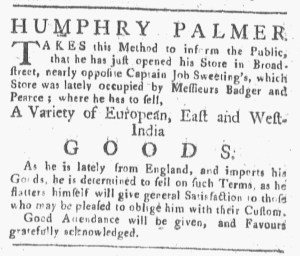
Providence Gazette (December 25, 1773).

“Good Attendance will be given, and Favours gratefully acknowledged.”

Unlike modern marketing, the advertisements disseminated during December in the eighteenth century did not take note of Christmas or associate consumerism with the holiday.  In the December 25, 1773, edition of the Providence Gazette, John Carter, the printer, did insert “A CHRISTMAS CAROL,” consisting of four stanzas, in the upper left corner of the final page of the newspaper.  In several other colonial newspapers, the “Poet’s Corner,” a weekly feature, occupied that space, a verse for that week’s issue appearing alongside the advertisements that filled the rest of the page.  Carter’s carol appeared in proximity to advertisements for consumer goods and services, but also apart.  Marketers did not yet widely depict Christmas as an occasion for making purchases.
That being the case, Humphry Palmer’s advertisement for a “Variety of European, East and West-India GOODS” did not make any special appeals that would not have appeared in the notice had he published it at some other time of the year.  Instead, he tended to some of the mechanics of shopping, describing the location of his store for prospective customers, and attempted to incite demand with promises of a broad selection and good prices.  He confided that he recently arrived in Providence, noting that worked to the advantage of his customers.  “As he is lately from England, and imports his goods,” Palmer declared, “he is determined to sell on such Terms, as he flatters himself will give general Satisfaction to those who may be pleased to oblige him with their Custom.”  His connections in England may have helped him acquire his inventory at low costs.  Perhaps more importantly, his status as a newcomer in town made him realize that the first impression that he made on consumers would become a lasting impression in the community.  He wanted the public to think of good bargains rather than unreasonably high prices when considered shopping at his store.  Palmer also noted that “Good Attendance will be given,” emphasizing customer service.  None of those appeals concerned Christmas or shopping and giving gifts as a holiday pastime.  None of the other advertisements published in the Providence Gazette on Christmas Day or the weeks leading up to it did so either.

December 24

What was advertised in a colonial American newspaper 250 years ago today?

New-Hampshire Gazette (December 24, 1773).

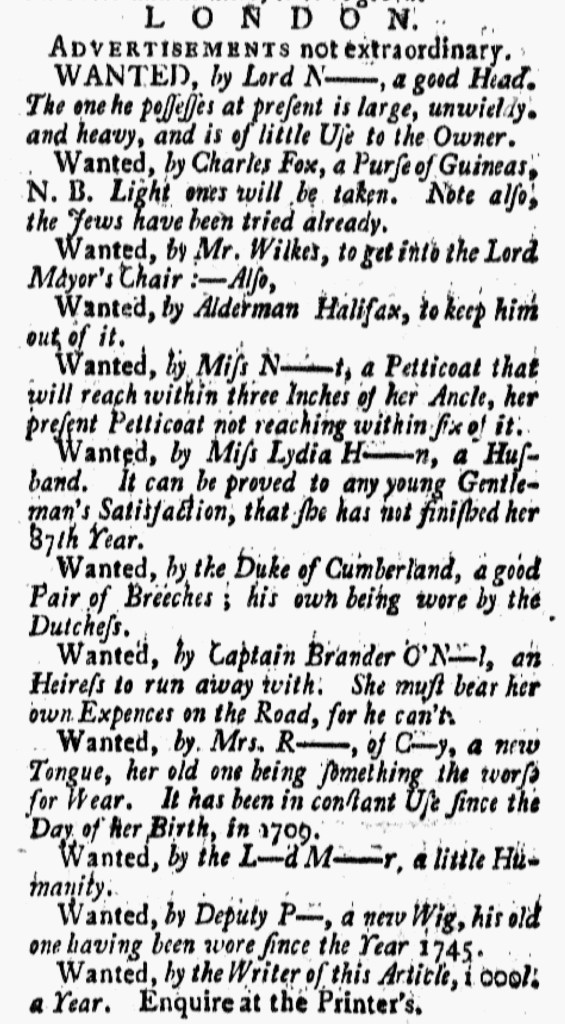
“WANTED, by Lord N—, a good Head.  The one he possesses at present, unwieldy, and heavy, and is of little Use to the Owner.”

Printers, authors, and others sometimes played with advertisements, adapting the format for unintended ends.  In recent weeks, the Adverts 250 Project has examined purported advertisements that delivered opinions about society and politics, made all the more powerful because they initially looked like they had been placed for one purpose but upon closer examination achieved another.  On November 22, 1773, for instance, the Pennsylvania Packet published more than a dozen advertisements submitted by an anonymous correspondent who believed that genre could be better perfected by extending them “to more of the different arts, professions, wants, losses, &c. of mankind.”  Several other newspapers subsequently reprinted the letter from the correspondent and the advertisements.  A few weeks later, the Connecticut Gazette carried a WANTED” advertisement that described an ideal husband.  While several of the advertisements in the piece in the Pennsylvania Packet critiqued women, this notice instead lectured men on how they should treat women.

As a transition between news, much of it about the crisis over tea, and advertising, the December 24, 1773, edition of the New-Hampshire Gazette published “ADVERTISEMENTS not extraordinary,” all of them “wanted” notices supposedly reprinted from newspapers in London.  Like the advertisements in the Pennsylvania Packet, this collection included some that expressed political views and others that provided social commentary.  In this instance, each of them invoked or alluded to the name of a real person, someone prominent enough that readers in England and the colonies would have recognized them.  The first advertisement proclaimed, “WANTED, by Lord N—, a good Head.  The one he possesses at present, unwieldy, and heavy, and is of little Use to the Owner.”  Readers did not need Lord North’s full name to recognize a jab at the prime minister.  Another advertisement stated, “Wanted, by the Duke of Cumberland, a good Pair of Breeches; his own being wore by the Dutchess.”  The writer apparently considered it well known that the duchess did not abide by her expected role but instead ruled her husband.  Yet another scolded a woman who did not demonstrate appropriate decorum in how she dressed.  “Wanted, by Miss N—t,” it declared, “a Petticoat that will reach within three Inches of her Ancle, her present Petticoat not reaching within six of it.”  The litany of advertisements concluded with one placed by the author: “Wanted, by the Writer of this Article, 1000l. a Year.  Enquire at the Printer’s.”  Those final instructions echoed the directions given in so many advertisements.  Printers often served as intermediaries who supplied additional information beyond what appeared in the advertisements published in their newspapers.  These “ADVERTISEMENTS not extraordinary” provided a platform for the anonymous author to become a pundit, each notice making a biting remark about contemporary politics and culture.

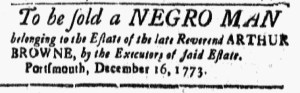
Slavery Advertisements Published December 24, 1773

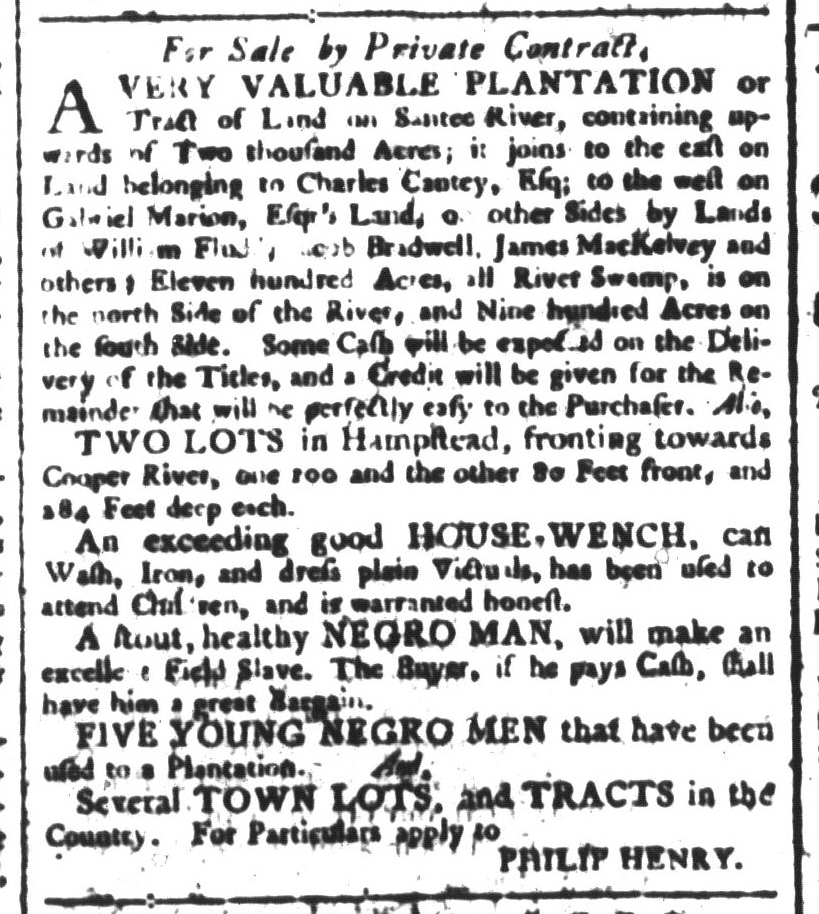
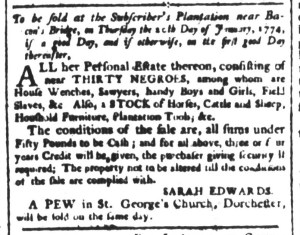
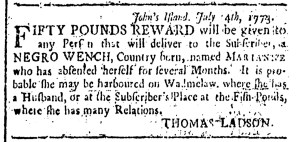
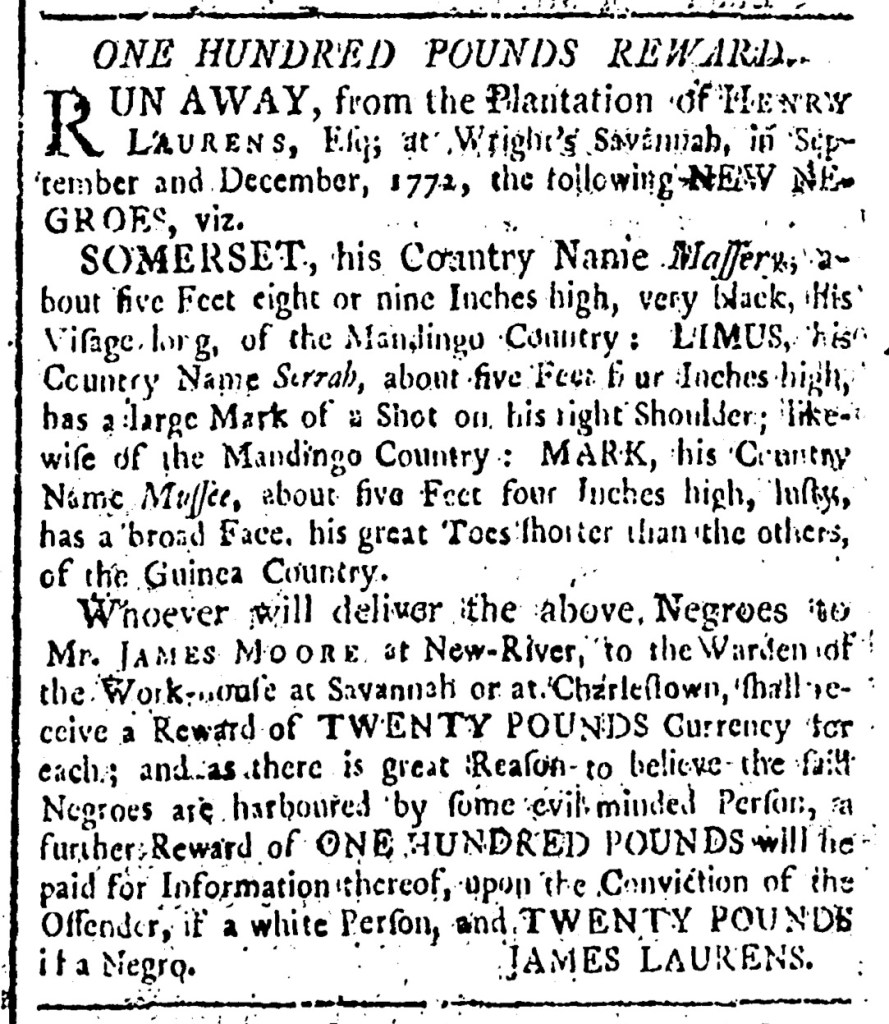
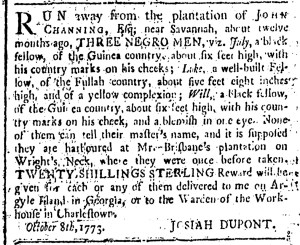
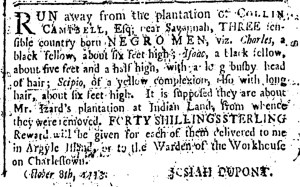
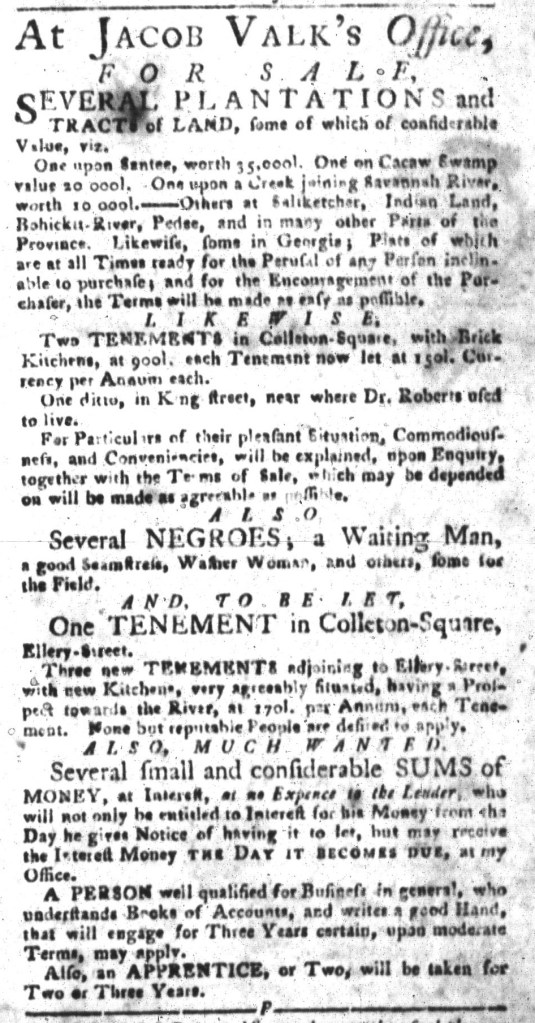
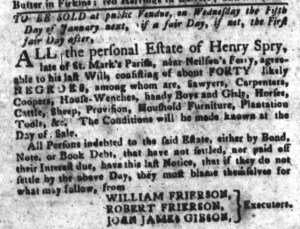
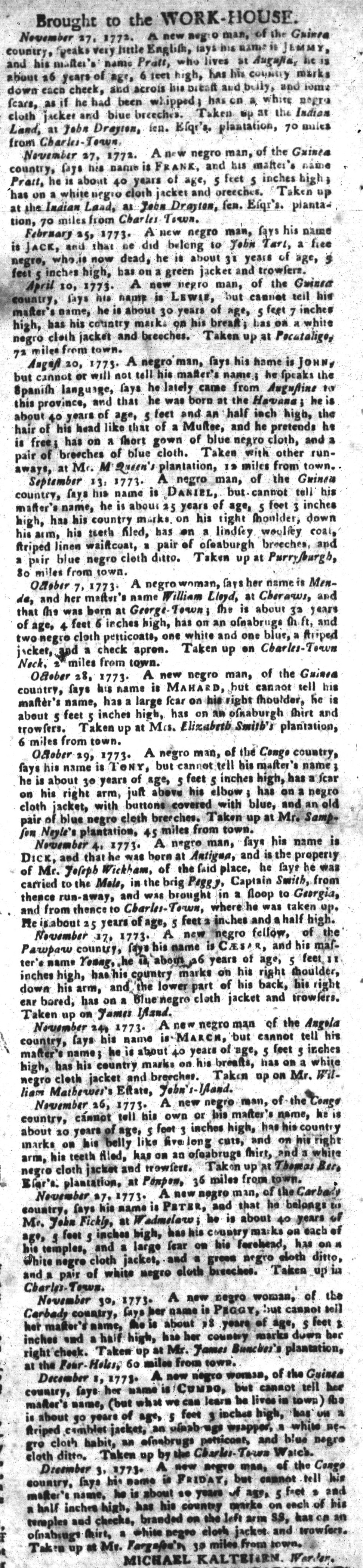
The Slavery Adverts 250 Project chronicles the role of newspaper advertising in perpetuating slavery in the era of the American Revolution. The project seeks to reveal the ubiquity of slavery in eighteenth-century life from New England to Georgia by republishing advertisements about enslaved people – for sale as individuals or in groups, wanted to purchase or for hire for short periods, runaways who liberated themselves, and those who were subsequently captured and confined in jails and workhouses – in daily digests on this site as well as in real time via the @SlaveAdverts250 Twitter feed, utilizing twenty-first-century media to stand in for the print media of the eighteenth century.

The project aims to provide modern audiences with a sense of just how often colonizers encountered these advertisements in their daily lives. Enslaved men, women, and children appeared in print somewhere in the colonies almost every single day. Those advertisements served as a constant backdrop for social, cultural, economic, and political life in colonial and revolutionary America. Colonizers who did not purport to own enslaved people were still confronted with slavery as well as invited to maintain the system by purchasing enslaved men, women, and children or assisting in the capture of so-called “runaways” who sought to free themselves from bondage. The frequency of these newspaper advertisements suggests just how embedded slavery was in colonial and revolutionary American culture in everyday interactions beyond the printed page.
These advertisements also testify to the experiences of enslaved men, women, and children, though readers must consider that those experiences have been remediated through descriptions offered by enslavers rather than enslaved people themselves. Often unnamed in the advertisements, enslaved men, women, and children were not invisible or unimportant in early America.
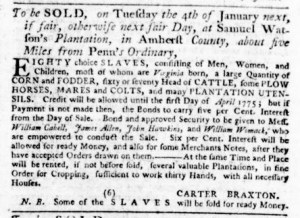
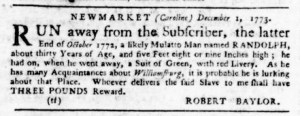
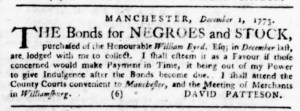
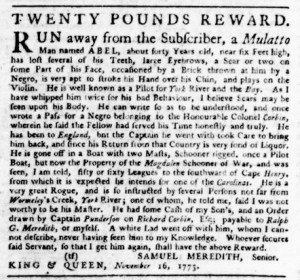
These advertisements appeared in colonial American newspapers 250 years ago today.

New-Hampshire Gazette (December 24, 1773).

**********

South-Carolina and American General Gazette (December 24, 1773).

**********

South-Carolina and American General Gazette (December 24, 1773).

**********

South-Carolina and American General Gazette (December 24, 1773).

**********

South-Carolina and American General Gazette (December 24, 1773).

**********

South-Carolina and American General Gazette (December 24, 1773).

**********

South-Carolina and American General Gazette (December 24, 1773).

**********

South-Carolina and American General Gazette (December 24, 1773).

**********

South-Carolina and American General Gazette (December 24, 1773).

**********

South-Carolina and American General Gazette (December 24, 1773).

**********

South-Carolina and American General Gazette (December 24, 1773).

**********

South-Carolina and American General Gazette (December 24, 1773).

**********

South-Carolina and American General Gazette (December 24, 1773).

**********

South-Carolina and American General Gazette (December 24, 1773).

**********

South-Carolina and American General Gazette (December 24, 1773).

**********

South-Carolina and American General Gazette (December 24, 1773).

**********

South-Carolina and American General Gazette (December 24, 1773).

**********

South-Carolina and American General Gazette (December 24, 1773).

**********

South-Carolina and American General Gazette (December 24, 1773).

**********

South-Carolina and American General Gazette (December 24, 1773).

**********

South-Carolina and American General Gazette (December 24, 1773).

December 23

What was advertised in a colonial American newspaper 250 years ago today?

New-York Journal (December 23, 1773).

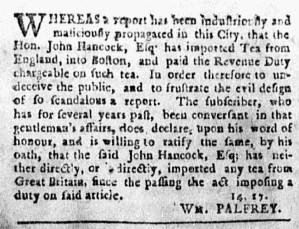
“John Hancock, Esq; has neither directly, or indirectly, imported any tea from Great Britain.”

As news of the Boston Tea Party reached New York and appeared in the December 23, 1773, edition of the New-York Journal, an advertisement in that newspaper took on new significance.  Starting on December 9 and continuing for four weeks, William Palfrey inserted an advertisement that addressed a “report [that] has been industriously and maliciously propagated in this City, that the Hon. John Hancock, Esq. has imported Tea from England, into Boston, and paid the Revenue Duty chargeable on such tea.”  Such rumors had the potential to tarnish the reputation of one of the merchants who had been most vocal in opposition to the provisions of the Tea Act, decrying Parliament’s attempts to meddle in affairs that he believed rightly belonged to colonial legislatures.

Palfrey, one Hancock’s clerks, took to the public prints to “undeceive the public, and to frustrate the evil design of so scandalous a report.”  He noted that he had “been conversant in that gentleman’s affairs” for “several years past” and, as a result, could vouch for Hancock.  In late 1773, many readers of the New-York Journal may not have been as familiar with the merchant as residents of Boston, though Hancock regularly appeared in articles reprinted from newspapers published in Massachusetts.  Five months before Palfrey’s advertisement appeared, the New-York Journal printed one of Governor Thomas Hutchinson’s letters from June 1768 that described the seizure of the Liberty, “a sloop belonging to Mr. Hancock, a wealthy merchant, of great influence over the populace,” for “a very notorious breach of the acts of trade.”  (The July 8, 1773, edition of the New-York Journal carried the entire letter and other private correspondence by the governor.)  Contrary to abiding by Parliament’s attempts to regulate colonial commerce and tax imported goods, Hancock had a history of smuggling tea and other items to avoid paying duties.  According to Palfrey, neither Hancock’s public position nor his private actions had changed.  The clerk declared “upon his word of honour” (and expressed his willingness to “ratify the dame, by his oath”) that Hancock had “neither directly, or indirectly, imported any tea from Great Britain, since the passing the act imposing a duty on said article” and most certainly had not paid import duties on tea.  As Jordan E. Taylor has recently demonstrated in Misinformation Nation: Foreign News and the Politics of Truth in Revolutionary America (2022), Patriots and Loyalists vied to establish narratives that fit their politics and their purposes, whether in newspapers, other printed materials, letters, or conversation.  That contest over the truth extended to advertisements, including Palfrey’s notice in the New-York Journal.

Slavery Advertisements Published December 23, 1773

The Slavery Adverts 250 Project chronicles the role of newspaper advertising in perpetuating slavery in the era of the American Revolution. The project seeks to reveal the ubiquity of slavery in eighteenth-century life from New England to Georgia by republishing advertisements about enslaved people – for sale as individuals or in groups, wanted to purchase or for hire for short periods, runaways who liberated themselves, and those who were subsequently captured and confined in jails and workhouses – in daily digests on this site as well as in real time via the @SlaveAdverts250 Twitter feed, utilizing twenty-first-century media to stand in for the print media of the eighteenth century.

The project aims to provide modern audiences with a sense of just how often colonizers encountered these advertisements in their daily lives. Enslaved men, women, and children appeared in print somewhere in the colonies almost every single day. Those advertisements served as a constant backdrop for social, cultural, economic, and political life in colonial and revolutionary America. Colonizers who did not purport to own enslaved people were still confronted with slavery as well as invited to maintain the system by purchasing enslaved men, women, and children or assisting in the capture of so-called “runaways” who sought to free themselves from bondage. The frequency of these newspaper advertisements suggests just how embedded slavery was in colonial and revolutionary American culture in everyday interactions beyond the printed page.

These advertisements also testify to the experiences of enslaved men, women, and children, though readers must consider that those experiences have been remediated through descriptions offered by enslavers rather than enslaved people themselves. Often unnamed in the advertisements, enslaved men, women, and children were not invisible or unimportant in early America.

These advertisements appeared in colonial American newspapers 250 years ago today.

Maryland Gazette (December 23, 1773).

**********

Maryland Gazette (December 23, 1773).

**********

Massachusetts Gazette and Boston Weekly News-Letter (December 23, 1773).

**********

Norwich Packet (December 23, 1773).

**********

Rivington’s New-York Gazetteer (December 23, 1773).

**********

Virginia Gazette [Purdie and Dixon] (December 23, 1773).

**********

Virginia Gazette [Purdie and Dixon] (December 23, 1773).

**********

Virginia Gazette [Purdie and Dixon] (December 23, 1773).

**********

Virginia Gazette [Purdie and Dixon] (December 23, 1773).

**********

Virginia Gazette [Purdie and Dixon] (December 23, 1773).

**********

Virginia Gazette [Purdie and Dixon] (December 23, 1773).

**********

Virginia Gazette [Purdie and Dixon] (December 23, 1773).

**********

Virginia Gazette [Purdie and Dixon] (December 23, 1773).

**********

Virginia Gazette [Purdie and Dixon] (December 23, 1773).

**********

Virginia Gazette [Purdie and Dixon] (December 23, 1773).

**********

Supplement to the Virginia Gazette [Purdie and Dixon] (December 23, 1773).

**********

Supplement to the Virginia Gazette [Purdie and Dixon] (December 23, 1773).

**********

Virginia Gazette [Rind] (December 23, 1773).

**********

Virginia Gazette [Rind] (December 23, 1773).

**********

Virginia Gazette [Rind] (December 23, 1773).

**********

Virginia Gazette [Rind] (December 23, 1773).

**********

Virginia Gazette [Rind] (December 23, 1773).

December 22

What was advertised in a colonial American newspaper 250 years ago today?

Pennsylvania Gazette (December 22, 1773).

“WAS committed … a man, by the name of John Smith, being described in the Gazette as a runaway servant.”

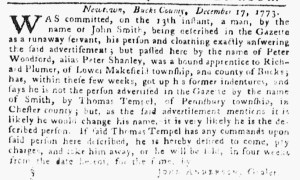
John Anderson, the jailer in Newtown in Bucks County, placed an advertisement in the December 22, 1773, edition of the Pennsylvania Gazette in hopes that it would come to the attention of Thomas Tempel of Pennsbury Township in Chester County, though he likely desired that other readers might supply additional information to help him sort out a situation at his jail.  Anderson reported that on December 13 he detained a man named John Smith,” being described in the Gazette as a runaway servant, his person and cloathing exactly answering the said advertisement.”  At least some colonizers closely read newspaper advertisements that described runaway indentured servants, convict servants, and apprentices or enslaved people who liberated themselves, making it worth the investment for masters and enslavers to place those notices.

Anderson stated that the man he believed was Smith “passed [in Newtown] by the name of Peter Woodford, alias Peter Shanley” and produced “former indentures” when he claimed he had been “a bound apprentice to Richard Plumer” in Lower Makefield Township in Bucks County.  The jailer doubted this story and even the documents that Smith presented because the advertisement that previously ran in the Pennsylvania Gazette “mentions it is likely he would change his name.”  Runaway servants and others often utilized that strategy to increase their chances of making good on their escapes.  Accordingly, Anderson considered it “very likely he is the described person.”  He did not mention any efforts to contact Plumer to determine whether the alleged Smith was actually his former apprentice.  Instead, he advised that if Temple “has any commands upon the said person here described” that he should “come, pay charges, and take him away.”  Otherwise, Anderson would sell Smith (or whoever he was) into a new indenture “in four weeks,” apparently unconvinced by his insistence that he was Peter Woodford or the documents he carried.  A man of low status, unknown to the jailer in Newtown, did not seem to have much recourse to avoid this fate, though perhaps someone that Anderson considered trustworthy would see the advertisement and intervene on the detained man’s behalf.  The prisoner also faced the possibility that Tempel would indeed go the Newtown and positively identify him.  The power of the press had the potential to negate or, perhaps more likely in this instance, to strengthen the authority exercised by the jailer.

December 21

What was advertised in a colonial American newspaper 250 years ago today?

Connecticut Courant (December 21, 1773).

“He has just received a fresh Assortment of BOOKS.”

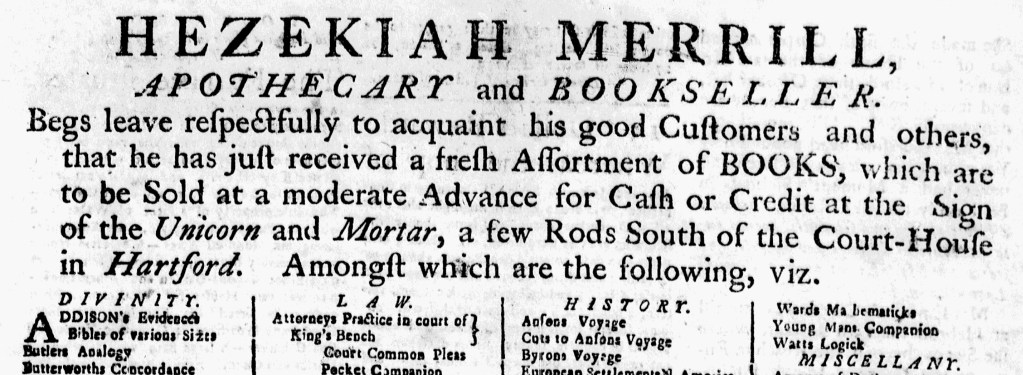
Hezekiah Merrill, “APOTHECARY and BOOKSELLER … at the Sign of the Unicorn and Mortar” in Hartford, ran a full-page advertisement in the December 21, 1773, edition of the Connecticut Courant.  His name and occupation served as headlines running across the top of the page, followed by an introduction that gave his location and announced that he “just received a fresh Assortment of BOOKS,” which also ran across the entire page.  To aid prospective customers in navigating the advertisement, Merrill divided the books by genre with headings that included “DIVINITY,” “LAW,” “PHYSIC & SURGERY,” “HISTORY,” “SCHOOL BOOKS,” and “MISCELLANY.”  In smaller type, four columns listed individual titles for sale, compared to three columns for news, editorials, advertising, and other contents on the other three pages of the newspaper.  A nota bene in the same size font as the list of titles, ran across the entire page at the bottom.  In it, Merrill promoted stationery, writing supplies, and a variety of items often sold by apothecaries.  In many ways, Merrill’s advertisement dominated that issue of the Connecticut Courant.  It accounted for one-quarter of the total space as well as more space than the other advertisements combined.  When readers perused the issue, Merrill’s advertisement became visible to others gathered nearby.

It was not the first time that the bookseller and apothecary published an oversized advertisement in his local newspaper.  On May 11, 1773, he ran an advertisement that filled two of the three columns on the second page.  He may have made arrangements with Ebenezer Watson, the printer, to produce the advertisement separately as handbills or broadside book catalogs, though no such items have been identified in research libraries, historical societies, or private collections.  Compared to newspapers, often preserved by printers or subscribers in complete or nearly complete runs, handbills and broadside book catalogs were much more ephemeral advertising media.  Still, in the case of Smith and Coit’s broadside book catalog that also ran as a full-page advertisement in the Connecticut Courant in July 1773, Watson had experience producing advertisements in more than one format for his clients.  For Smith and Coit, Watson reset the type, using five columns in the broadside but only four in the newspaper.  He could have done the same for Merrill or, even more easily, printed the newspaper advertisement as a separate handbill or broadside book catalog without making any adjustments to type already set.  Either way, Merrill, Smith and Coit, other booksellers, and other retailers likely distributed more advertisements in the eighteenth century than happen to survive today.

Connecticut Courant (December 21, 1773).

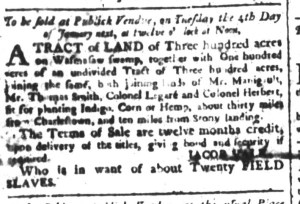
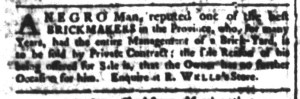
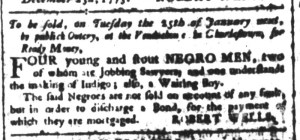
Slavery Advertisements Published December 21, 1773

The Slavery Adverts 250 Project chronicles the role of newspaper advertising in perpetuating slavery in the era of the American Revolution. The project seeks to reveal the ubiquity of slavery in eighteenth-century life from New England to Georgia by republishing advertisements about enslaved people – for sale as individuals or in groups, wanted to purchase or for hire for short periods, runaways who liberated themselves, and those who were subsequently captured and confined in jails and workhouses – in daily digests on this site as well as in real time via the @SlaveAdverts250 Twitter feed, utilizing twenty-first-century media to stand in for the print media of the eighteenth century.

The project aims to provide modern audiences with a sense of just how often colonizers encountered these advertisements in their daily lives. Enslaved men, women, and children appeared in print somewhere in the colonies almost every single day. Those advertisements served as a constant backdrop for social, cultural, economic, and political life in colonial and revolutionary America. Colonizers who did not purport to own enslaved people were still confronted with slavery as well as invited to maintain the system by purchasing enslaved men, women, and children or assisting in the capture of so-called “runaways” who sought to free themselves from bondage. The frequency of these newspaper advertisements suggests just how embedded slavery was in colonial and revolutionary American culture in everyday interactions beyond the printed page.

These advertisements also testify to the experiences of enslaved men, women, and children, though readers must consider that those experiences have been remediated through descriptions offered by enslavers rather than enslaved people themselves. Often unnamed in the advertisements, enslaved men, women, and children were not invisible or unimportant in early America.

These advertisements appeared in colonial American newspapers 250 years ago today.

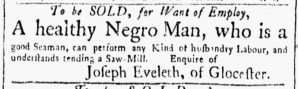
Connecticut Courant (December 21, 1773).

**********

Essex Gazette (December 21, 1773).

**********

South-Carolina Gazette and Country Journal (December 21, 1773).

**********

South-Carolina Gazette and Country Journal (December 21, 1773).

**********

South-Carolina Gazette and Country Journal (December 21, 1773).

**********

South-Carolina Gazette and Country Journal (December 21, 1773).

**********

South-Carolina Gazette and Country Journal (December 21, 1773).

**********

South-Carolina Gazette and Country Journal (December 21, 1773).

**********

South-Carolina Gazette and Country Journal (December 21, 1773).

**********

South-Carolina Gazette and Country Journal (December 21, 1773).

**********

South-Carolina Gazette and Country Journal (December 21, 1773).

**********

South-Carolina Gazette and Country Journal (December 21, 1773).

**********

South-Carolina Gazette and Country Journal (December 21, 1773).

December 20

What was advertised in a colonial American newspaper 250 years ago today?

Boston Evening-Post (December 20, 1773).

“The above Teas were imported before any of the East-India Company’s Tea arrived, or it was known they would send any on their own Account.”

Cyrus Baldwin hoped to sell the “Choice Bohea and Souchong Teas” that he stocked at his shop in Boston while he still had a chance.  Tea had become a lightning rod for political discourse throughout the fall of 1773, thanks to the Tea Act and the arrival of ships carrying tea on behalf of the East India Company.  That discourse erupted into a protest that involved the destruction of the tea on those ships when colonizers disguised as Indians tossed the tea into the harbor, an event now known as the Boston Tea Party.  That put Baldwin in a difficult position, especially as discussions about boycotting tea occurred at the town meeting.  When he advertised bohea, souchong, and hyson tea in the December 20 edition of the Boston Evening-Post, just four days after the East India Company’s tea went into the harbor, Baldwin appended a nota bene to inform prospective customers and the general public that “[t]he above Teas were imported before any of the East-India Company’s Tea arrived, or it was known they would send any on their own Account.”  Baldwin justified selling the tea he already stocked.  He also sought to give consumers a reasonable justification for purchasing his tea before the situation became any more volatile and they faced condemnation from the community.

Massachusetts Gazette and Boston Post-Boy (December 20, 1773).

Baldwin’s advertisement ran immediately below a “NOTIFICATION” that summarized a meeting “of some of the principal Venders of TEAS in Boston” that took place on Friday, December 17, the day after the protest on the docks.  The same notification ran in all three newspapers published in Boston on Mondays, the Boston Evening-Post, the Boston-Gazette, and the Massachusetts Gazette and Boston Post-Boy.  It reported that “Venders of TEAS” met for the purpose of “consulting and determining in suitable Measures to be adopted, and to cooperate with a great number of respectable Inhabitants of this Province, express’d by a Vote of their late Assembly to suppress the Use of that detested Article.”  They did not, however, reach any conclusions.  Instead, they “agreed that a general and full Meeting should be convened” on December 20 “where it is desired and expected that all the Dealers in, and Venders of Teas will punctually attend.”  That included Baldwin as well as Archibald Cunningham, William Jackson, Samuel Allyne Otis, and Elizabeth Perkins, all of whom advertised tea in the December 20 edition of the Boston Evening-Post, though none of the others included the same sort of disclaimer that Baldwin carefully inserted in his advertisement.  A nota bene warned, “It is earnestly desired, that those concerned would not fail of giving attendance at the Time fix’d.”

The notice in the Massachusetts Gazette and Boston Post-Boy included an additional note: “A common Cause is best supported by a common Association.—The Defence and Maintenance of our Rights and Liberties is the common Cause of every American; and therefore all should unite, Hand in Hand, in one common Association in order to support it.”  Answering the abuses perpetrated by Parliament, this note suggested, did not depend on a uniform response by “Venders of TEAS” alone but rather the support and concerted efforts of consumers to abide by whatever measures colonizers in Boston adopted when they voted at town meetings.  Everyone had a duty to defend American liberties via the choices they made about how they participated in the marketplace.  For the moment, however, Cyrus Baldwin just wanted to sell the tea that he claimed he imported before the crisis commenced.