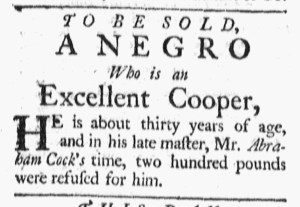
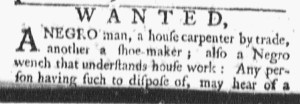
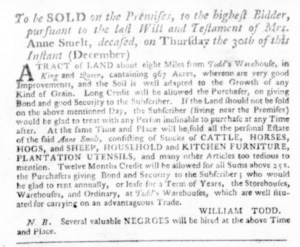
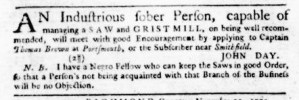
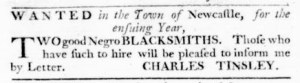
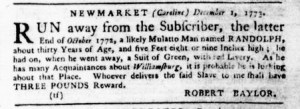
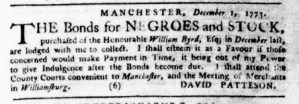
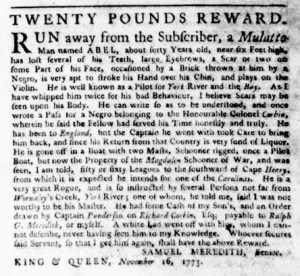
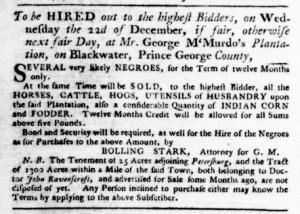
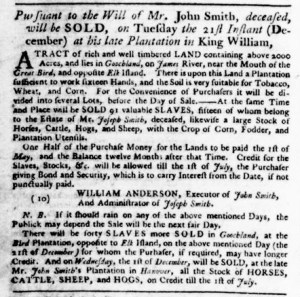
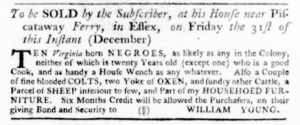
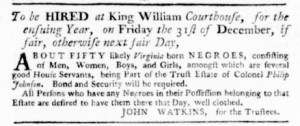
Slavery Advertisements Published December 20, 1773

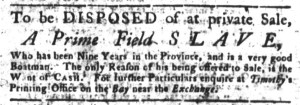
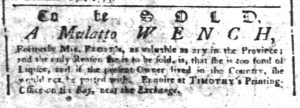
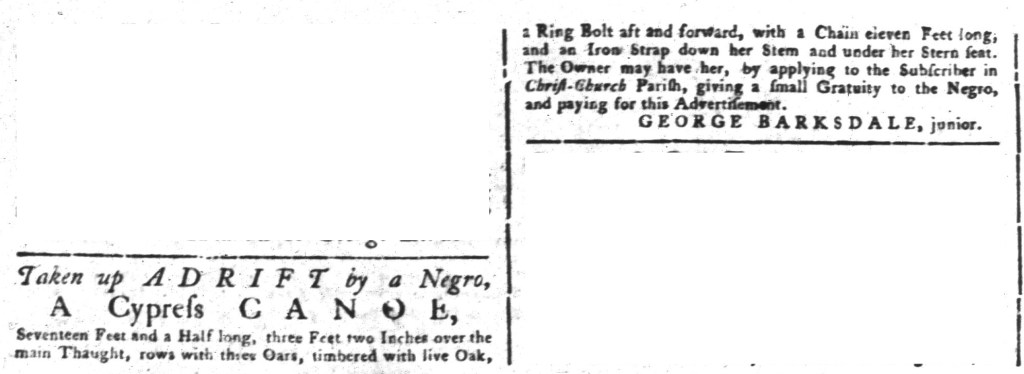
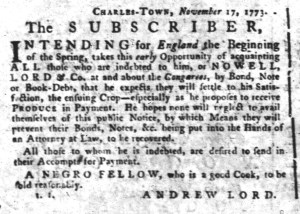
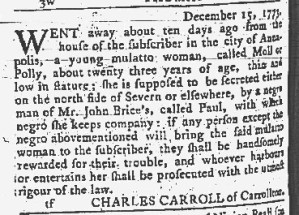
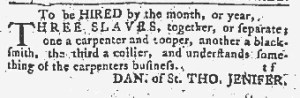
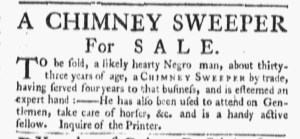
The Slavery Adverts 250 Project chronicles the role of newspaper advertising in perpetuating slavery in the era of the American Revolution. The project seeks to reveal the ubiquity of slavery in eighteenth-century life from New England to Georgia by republishing advertisements about enslaved people – for sale as individuals or in groups, wanted to purchase or for hire for short periods, runaways who liberated themselves, and those who were subsequently captured and confined in jails and workhouses – in daily digests on this site as well as in real time via the @SlaveAdverts250 Twitter feed, utilizing twenty-first-century media to stand in for the print media of the eighteenth century.

The project aims to provide modern audiences with a sense of just how often colonizers encountered these advertisements in their daily lives. Enslaved men, women, and children appeared in print somewhere in the colonies almost every single day. Those advertisements served as a constant backdrop for social, cultural, economic, and political life in colonial and revolutionary America. Colonizers who did not purport to own enslaved people were still confronted with slavery as well as invited to maintain the system by purchasing enslaved men, women, and children or assisting in the capture of so-called “runaways” who sought to free themselves from bondage. The frequency of these newspaper advertisements suggests just how embedded slavery was in colonial and revolutionary American culture in everyday interactions beyond the printed page.

These advertisements also testify to the experiences of enslaved men, women, and children, though readers must consider that those experiences have been remediated through descriptions offered by enslavers rather than enslaved people themselves. Often unnamed in the advertisements, enslaved men, women, and children were not invisible or unimportant in early America.

These advertisements appeared in colonial American newspapers 250 years ago today.

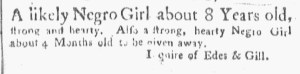
Boston-Gazette (December 20, 1773).

**********
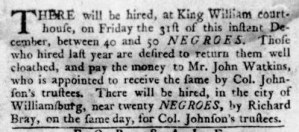
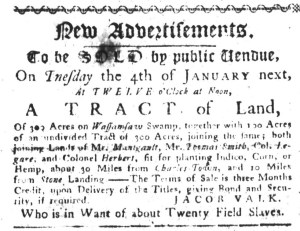
Boston-Gazette (December 20, 1773).

**********
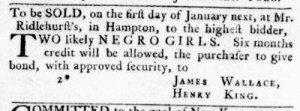
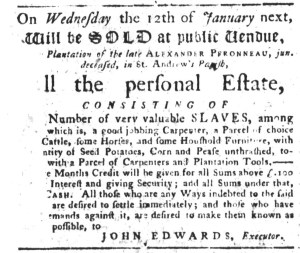
Supplement to the Boston-Gazette (December 20, 1773).

**********
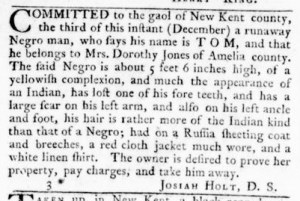
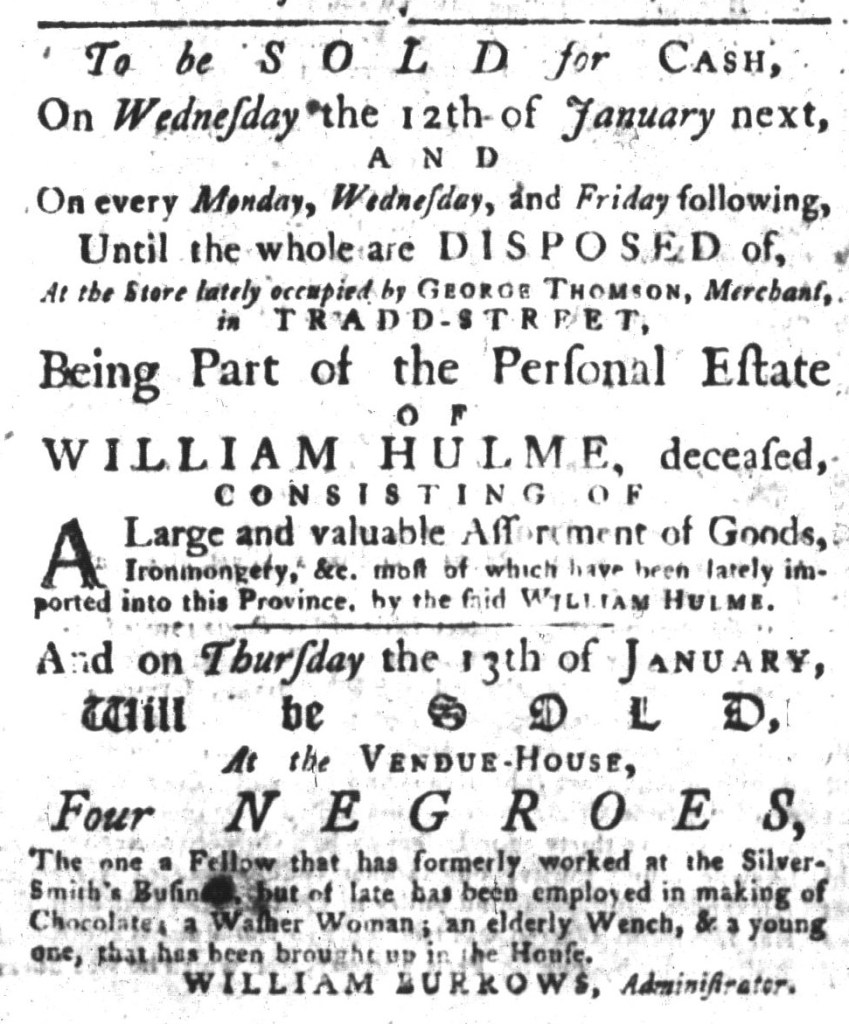
New-York Gazette and Weekly Mercury (December 20, 1773).

**********
New-York Gazette and Weekly Mercury (December 20, 1773).

**********

Pennsylvania Packet (December 20, 1773).

**********

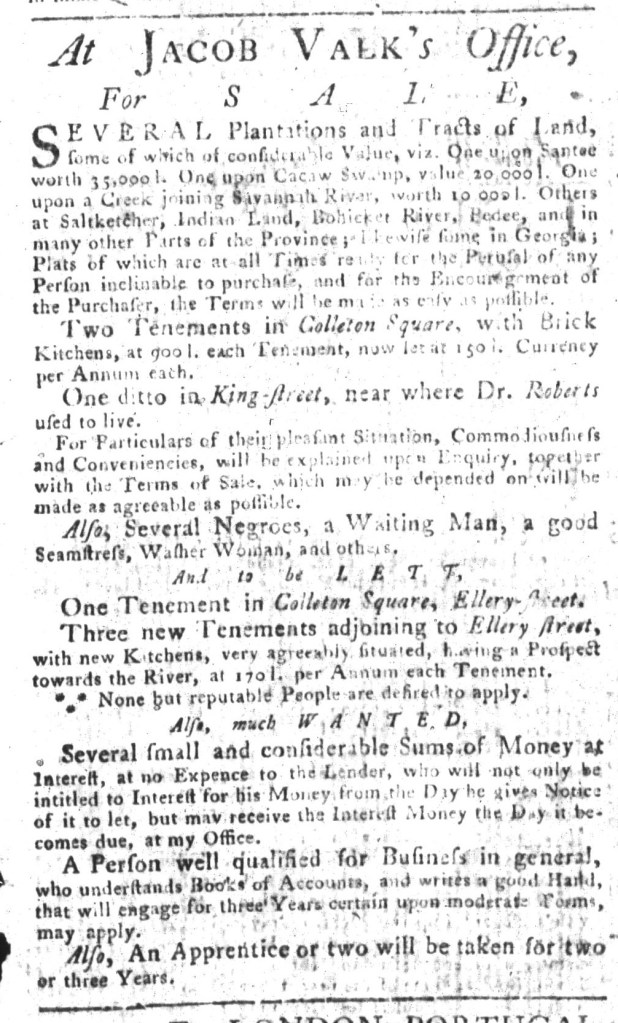
South-Carolina Gazette (December 20, 1773).

**********

South-Carolina Gazette (December 20, 1773).

**********

South-Carolina Gazette (December 20, 1773).

**********

South-Carolina Gazette (December 20, 1773).

**********

South-Carolina Gazette (December 20, 1773).

**********

South-Carolina Gazette (December 20, 1773).

**********

South-Carolina Gazette (December 20, 1773).

**********

South-Carolina Gazette (December 20, 1773).

**********

South-Carolina Gazette (December 20, 1773).

**********

South-Carolina Gazette (December 20, 1773).

**********

South-Carolina Gazette (December 20, 1773).

December 19

What was advertised in a colonial American newspaper 250 years ago this week?

Massachusetts Spy (December 16, 1773).

“SUBSCRIPTIONS for the SPY are also taken in by J. Larkin, Chairmaker, and Mr. W. Calder, Painter, in Charlestown.”

A colophon could include all sorts of information or little information at all.  Isaiah Thomas could have confined the colophon for the Massachusetts Spy to its first line: “BOSTON: Printed by ISAIAH THOMAS.”  However, he devised one of the most extensive colophons in colonial newspapers.  His colophon gave directions to his printing office, gave the price for annual subscriptions, and solicited advertisements and “Articles of Intelligence” to include among the contents of his weekly publication.  Thomas also announced, “PRINTING in its various Branches, performed in a neat Manner, with the greatest Care and Dispatch, on the most reasonable terms.”  Job printing orders included “Small HAND-BILLS” ready “at an Hour’s Notice.”  Other printers who used their colophons as perpetual advertisements at the bottom of the final page of each newspaper included some or all of these elements.

Thomas included a unique feature in the colophon for the Massachusetts Spy.  It was the only newspaper that listed a network of local agents in other towns who accepted subscriptions and forwarded them to the printing office.  “SUBSCRIPTIONS for the SPY,” the colophon advised, “are also taken in by J. Larkin, Chairmaker, and Mr. W. Calder, Painter, in Charlestown; Mr. J. Hillers, Watch-maker, in Salem; Mr. B. Emerson, Bookseller, in Newbury-Port; Mr. M. Belcher, in Bridgewater; and by Dr. Elijah Hewins, in Stoughtonham.”  Printers who published newspapers established networks for exchanging their newspapers with their counterparts in other towns, readily reprinting items from one publication to another to fill the pages.  They also forged relationships with printers and booksellers for the purposes of collecting subscriptions for proposed books, magazines, and pamphlets.  Throughout the second half of 1773, Thomas advertised his plans to publish the Royal American Magazine, enlisting printers and booksellers in towns in New England, New York, Pennsylvania, and Maryland to aid in the endeavor.  His colophon indicates that his efforts to promote his newspaper extended beyond fellow members of the printing and book trades to include associates from a variety of occupations.  At least in the case of the Massachusetts Spy, chairmakers, painters, watchmakers, and doctors all participated in creating an infrastructure for disseminating the news during the era of the American Revolution.

December 18

What was advertised in a colonial American newspaper 250 years ago today?

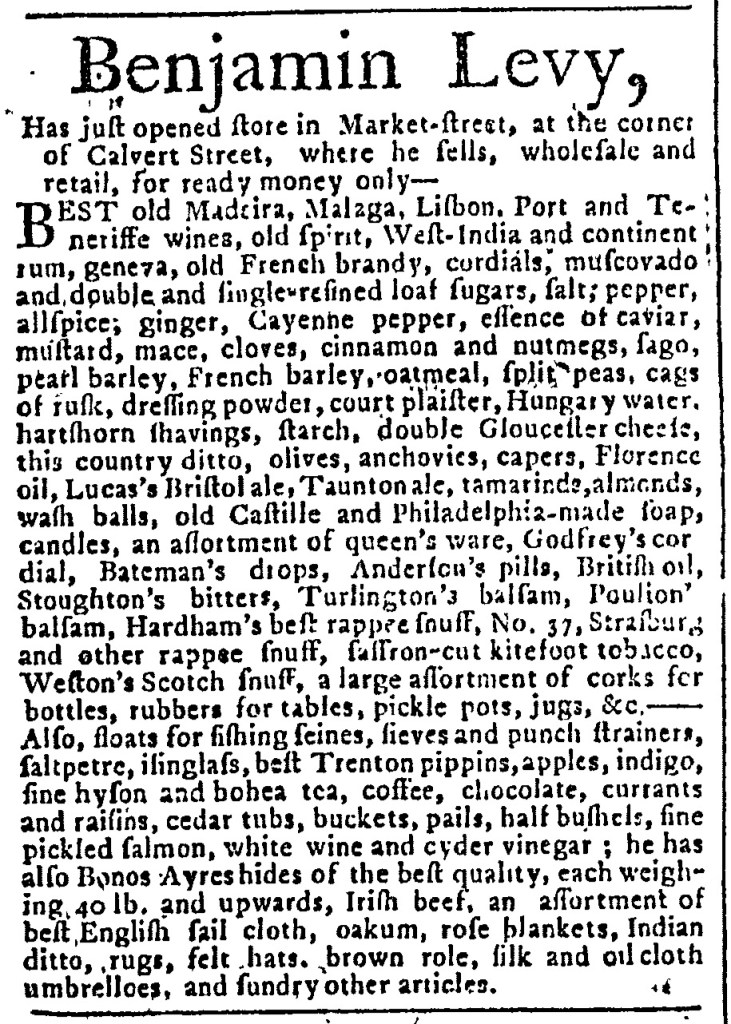
Maryland Journal (December 18, 1773).

“Fine hyson and bohea tea.”

Benjamin Levy advertised a variety of groceries, including “fine hyson and bohea tea,” available at his store on Market Street in Baltimore in the December 18, 1773, edition of the Maryland Journal.  Two nights earlier, colonizers disguised as Indians boarded ships in Boston and tossed tea shipped by the East India Company into the harbor to protest the Tea Act.  While it would take a little time for that news to reach Baltimore, the newspaper carried other news about the escalating crisis.

The first page featured news from Boston, dated November 29: “Yesterday morning arrived here the ship Dartmouth, Capt. Hall, in 8 weeks from London, with 114 chests of the long expected and much talked of TEA.”  The following morning, a handbill posted around town proclaimed, “FRIENDS!  BRETHREN!  COUNTRYMEN!  THAT worst of plagues, the detested TEA, shipped for this port by the East-India Company, is now arrived in this harbour; the hour of destruction or manly opposition to the machinations of tyranny stares you in the face.”  In the face of this threat, “every friend to his country, to himself and posterity, is now called upon to meet at Faneuil Hall … to make a united and successful resistance to this last, worst and most destructive measure of administration.”  The remainder of the page and two columns on the second page provided an overview of the meeting, a response from the governor and Loyalist merchants, and a resolution from the town meeting stating that “if any person or persons shall hereafter import Tea from Great-Britain … until the said unrighteous Act shall be repealed, he or they shall be deemed by this body, an enemy of his country.”  In addition, “we will prevent the landing and sale of the same, and the payment of any duty thereon.  And we will effect the return thereof to the place from whence it shall come.”  Another resolution called for “the foregoing vote to be printed and sent to England, and all the sea-ports in this province.”  That news made it far beyond other ports in Massachusetts.

A much shorter piece followed the accounts from Boston.  A condescending note to women suggested that their enjoyment of tea played a significant role in precipitating the crisis, ignoring the fact that both men and women, poor, middling, and wealthy, all consumed tea.  “LADIES,” it declared, “HOWEVER coolly some of you may now esteem your husband, it might be worth your while to consider, whether by abandoning the accursed TEA, you will preserve your country and posterity in peace and good order, or expose twenty-five thousand of them to spill their blood, in defence of their undoubted birth-right.”  The anonymous correspondent anticipated an armed conflict over the English liberties that colonizers were supposed to possess, arguing that if that did indeed come to pass then women would be at fault for not abstaining from tea.  This echoed a sentiment so often expressed among the editorials in newspapers during the imperial crisis:  women presented dangers both political and cultural through their consumption of tea and other goods.

The Maryland Journal even included an inaccurate account of what occurred in Massachusetts: “A Gentleman just come to Town from Boston assures us, That the East India Company’s TEA, lately arrived at that Place, in several Ships, from London, for the Purpose of enslaving and impoverishing, if not poisoning, the People, was all sent back to the Proprietors, conformable to the noble and Spirited Resolves of the brave Inhabitants of the Town of Boston.”  That was not what happened at all, as colonizers in Baltimore would soon learn.  Even as Benjamin Levy advertised “fine hyson and bohea tea” for sale at his store in Baltimore, tea shipped by the East India Company floated in Boston Harbor.  A new stage of the imperial crisis was brewing as colonizers faced repercussions from Parliament for that act of protest.

Slavery Advertisements Published December 18, 1773

The Slavery Adverts 250 Project chronicles the role of newspaper advertising in perpetuating slavery in the era of the American Revolution. The project seeks to reveal the ubiquity of slavery in eighteenth-century life from New England to Georgia by republishing advertisements about enslaved people – for sale as individuals or in groups, wanted to purchase or for hire for short periods, runaways who liberated themselves, and those who were subsequently captured and confined in jails and workhouses – in daily digests on this site as well as in real time via the @SlaveAdverts250 Twitter feed, utilizing twenty-first-century media to stand in for the print media of the eighteenth century.

The project aims to provide modern audiences with a sense of just how often colonizers encountered these advertisements in their daily lives. Enslaved men, women, and children appeared in print somewhere in the colonies almost every single day. Those advertisements served as a constant backdrop for social, cultural, economic, and political life in colonial and revolutionary America. Colonizers who did not purport to own enslaved people were still confronted with slavery as well as invited to maintain the system by purchasing enslaved men, women, and children or assisting in the capture of so-called “runaways” who sought to free themselves from bondage. The frequency of these newspaper advertisements suggests just how embedded slavery was in colonial and revolutionary American culture in everyday interactions beyond the printed page.

These advertisements also testify to the experiences of enslaved men, women, and children, though readers must consider that those experiences have been remediated through descriptions offered by enslavers rather than enslaved people themselves. Often unnamed in the advertisements, enslaved men, women, and children were not invisible or unimportant in early America.

These advertisements appeared in colonial American newspapers 250 years ago today.

Maryland Journal (December 18, 1773).

December 17

What was advertised in a colonial American newspaper 250 years ago today?

Connecticut Gazette (December 17, 1773).

WANTED, A HUSBAND.”

Was it an advertisement or an editorial?  The December 17, 1773, edition of the Connecticut Gazette included an item that purported to be a “WANTED” advertisement.  The anonymous woman who placed it sought a husband who “can be warranted to possess the following agreeable Qualifications” and listed a “good Education,” “good Morals,” a mind “richly furnish’d with all useful Knowledge,” and “genteel, easy, and graceful” behavior.  That husband should be “free from Pride and Arrogance.”  Overall, he needed to demonstrate “the most distinguish’d Character.”  A nota bene indicated the circumstances that likely prompted this particular “Advertisement.”  The anonymous advertiser insisted that her prospective husband “should treat the Ladies with the Respect that their Merits require, considering that their Sex alone intitles them to his Esteem.”  To behave otherwise would not be “consistent with the Character of a Gentleman.”  Patriarchal structures defined and confined women’s status in colonial America, but the system was also supposed to bestow certain privileges and protections upon them, especially middling and elite white women.

This item included a salutation, unlike most paid notices that appeared in the Connecticut Gazette and other colonial newspapers.  “Mr. GREEN,” it addressed the printer, “Please to give the following Advertisement a Place in your Paper, and oblige one of your constant Readers.”  The anonymous advertiser likely did not intend to pay for this “Advertisement,” but rather used the word according to another common meaning in both England and America in the eighteenth century.  The Oxford English Dictionary provides this “now chiefly historical” definition: “a (written) statement calling attention to anything; a notification; esp. a notice to readers in a book (typically, a preface).”  Printers and authors also used “advertisement” in that manner in newspapers.  In this instance, the “Advertisement” appeared in a curious place in the Connecticut Gazette, on the final page immediately below the “POET’S CORNER,” a weekly feature, and above advertisements that were indeed paid notices.  The printer chose to place the “Advertisement” with paid notices rather than among the news and editorials on other pages, perhaps suggesting that even though he did not collect payment he still considered the piece artful, like that week’s poem, rather than a serious editorial.  The anonymous advertiser could demand “the Respect that [Ladies’] Merits require,” but that did not mean that the printer was obliged to respond in that manner.  Just as John Adams would mock Abigail’s admonitions to “Remember the Ladies” in their correspondence in the spring of 1776, the printer of the Connecticut Gazette gave this “Advertisement” a place in his newspaper that suggested he did not take it as seriously as the anonymous advertiser intended.

Slavery Advertisements Published December 17, 1773

The Slavery Adverts 250 Project chronicles the role of newspaper advertising in perpetuating slavery in the era of the American Revolution. The project seeks to reveal the ubiquity of slavery in eighteenth-century life from New England to Georgia by republishing advertisements about enslaved people – for sale as individuals or in groups, wanted to purchase or for hire for short periods, runaways who liberated themselves, and those who were subsequently captured and confined in jails and workhouses – in daily digests on this site as well as in real time via the @SlaveAdverts250 Twitter feed, utilizing twenty-first-century media to stand in for the print media of the eighteenth century.

The project aims to provide modern audiences with a sense of just how often colonizers encountered these advertisements in their daily lives. Enslaved men, women, and children appeared in print somewhere in the colonies almost every single day. Those advertisements served as a constant backdrop for social, cultural, economic, and political life in colonial and revolutionary America. Colonizers who did not purport to own enslaved people were still confronted with slavery as well as invited to maintain the system by purchasing enslaved men, women, and children or assisting in the capture of so-called “runaways” who sought to free themselves from bondage. The frequency of these newspaper advertisements suggests just how embedded slavery was in colonial and revolutionary American culture in everyday interactions beyond the printed page.

These advertisements also testify to the experiences of enslaved men, women, and children, though readers must consider that those experiences have been remediated through descriptions offered by enslavers rather than enslaved people themselves. Often unnamed in the advertisements, enslaved men, women, and children were not invisible or unimportant in early America.

These advertisements appeared in colonial American newspapers 250 years ago today.

New-Hampshire Gazette (December 17, 1773).

December 16

What was advertised in a colonial American newspaper 250 years ago today?

Rivington’s New-York Gazetteer (December 16, 1773).

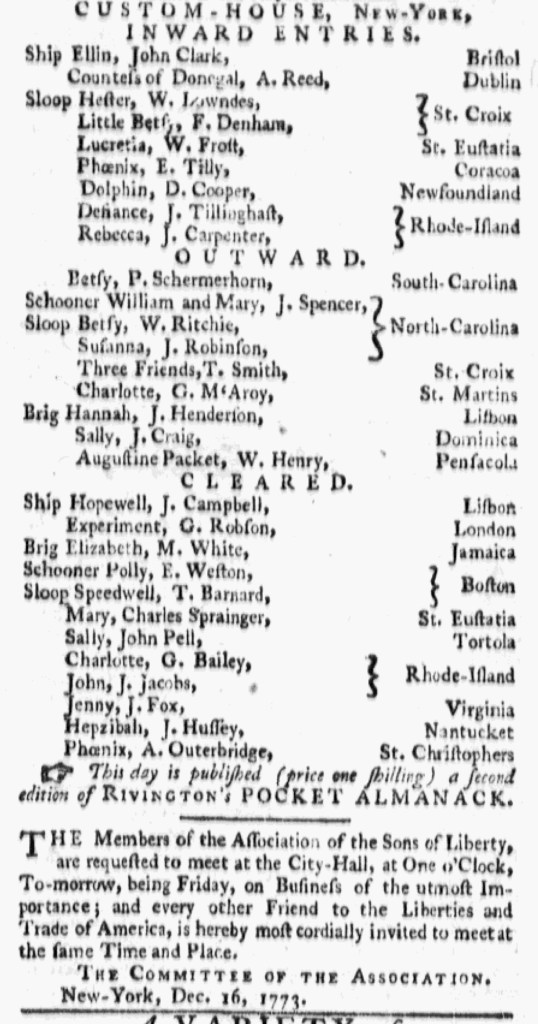
“The Sons of Liberty, are requested to meet at the City-Hall.”

James Rivington, bookseller and printer of Rivington’s New-York Gazetteer, is most often remembered as a Loyalist.  He began publishing his newspaper in April 1773.  According to Isaiah Thomas, a staunch Patriot printer and author of The History of Printing in America (1810), Rivington’s newspaper “was soon devoted to the royal cause,” yet he does not elaborate on what constituted “soon.”[1]  Rivington became so vociferous in expressing Tory sentiments in his newspaper that on November 27, 1775, the Sons of Liberty attacked his printing office and destroyed his press and type.  Rivington departed for England, but later returned to New York during the British occupation during the Revolutionary War.  He brought a new press and type with him, started publishing his newspaper again, and quickly changed the name to Rivington’s New York Loyal Gazette and then the Royal Gazette.  That newspaper continued publication under that title until the end of the war in 1783, then became Rivington’s New-York Gazette.  It ceased publication on the final day of that year.

Despite the positions that Rivington ultimately advocated in his newspapers, Thomas acknowledged in his biographical sketch of the printer that “[i]t is but justice to add, that Rivington, for some time, conducted his Gazette with such moderation and impartiality as did him honor.”[2]  Thomas reiterated that assessment in his overview of Rivington’s New-York Gazetteer, stating that “for some time Rivington conducted his paper with as much impartiality as most of the editors of that period.”[3]  That helps to explain the privileged place that an advertisement placed by the Sons of Liberty occupied in the December 16, 1773, edition of Rivington’s New-York Gazetteer.  That notice called on the “Members of the Association of the Sons of Liberty … to meet at the City-Hall” on the following day to discuss “Business of the utmost Importance.”  The “COMMITTEE OF THE ASSOCIATION” that placed the advertisement invited “every other Friend to the Liberties and Trade of America” to attend the meeting.  Rivington not only published the advertisement, he placed it immediately below the shipping news from the customs house.  Like many other colonial newspapers, Rivington’s New-York Gazetteer followed a particular format that placed news items and editorials first, then the shipping news, and finally advertisements.  The shipping news, a weekly feature, marked the end of news coverage and the beginning of advertisements.  Readers who were not especially interested in perusing the advertisements, many of which repeated from week to week, may have been more likely to take note of the first advertisement that followed the shipping news as they recognized the transition from one type of content to another. That gave the notice from the Sons of Liberty greater visibility than had it appeared embedded among the dozens of advertisements on the next two pages of the newspaper.  The savvy Rivington inserted a two-line notice about a pocket almanac he just published, not even separating it from the shipping news, before the announcement by the Sons of Liberty.  He certainly tended to his own interests, but he also provided impartial space in the public prints for a while after he commenced publishing Rivington’s New-York Gazetteer.

**********

[1] Isaiah Thomas, The History of Printing in America: With a Biography of Printers and an Account of Newspapers (1810; New York: Weathervane Books, 1970), 479.

[2] Thomas, History of Printing in America, 480.

[3] Thomas, History of Printing in America, 511.

Slavery Advertisements Published December 16, 1773

The Slavery Adverts 250 Project chronicles the role of newspaper advertising in perpetuating slavery in the era of the American Revolution. The project seeks to reveal the ubiquity of slavery in eighteenth-century life from New England to Georgia by republishing advertisements about enslaved people – for sale as individuals or in groups, wanted to purchase or for hire for short periods, runaways who liberated themselves, and those who were subsequently captured and confined in jails and workhouses – in daily digests on this site as well as in real time via the @SlaveAdverts250 Twitter feed, utilizing twenty-first-century media to stand in for the print media of the eighteenth century.

The project aims to provide modern audiences with a sense of just how often colonizers encountered these advertisements in their daily lives. Enslaved men, women, and children appeared in print somewhere in the colonies almost every single day. Those advertisements served as a constant backdrop for social, cultural, economic, and political life in colonial and revolutionary America. Colonizers who did not purport to own enslaved people were still confronted with slavery as well as invited to maintain the system by purchasing enslaved men, women, and children or assisting in the capture of so-called “runaways” who sought to free themselves from bondage. The frequency of these newspaper advertisements suggests just how embedded slavery was in colonial and revolutionary American culture in everyday interactions beyond the printed page.

These advertisements also testify to the experiences of enslaved men, women, and children, though readers must consider that those experiences have been remediated through descriptions offered by enslavers rather than enslaved people themselves. Often unnamed in the advertisements, enslaved men, women, and children were not invisible or unimportant in early America.

These advertisements appeared in colonial American newspapers 250 years ago today.

Maryland Gazette (December 16, 1773).

**********

Maryland Gazette (December 16, 1773).

**********

Massachusetts Gazette and Boston Weekly News-Letter (December 16, 1773).

**********

Norwich Packet (December 16, 1773).

**********

Rivington’s New-York Gazetteer (December 16, 1773).

**********

Rivington’s New-York Gazetteer (December 16, 1773).

**********

Rivington’s New-York Gazetteer (December 16, 1773).

**********

Virginia Gazette [Purdie and Dixon] (December 16, 1773).

**********

Virginia Gazette [Purdie and Dixon] (December 16, 1773).

**********

Virginia Gazette [Purdie and Dixon] (December 16, 1773).

**********

Virginia Gazette [Purdie and Dixon] (December 16, 1773).

**********

Virginia Gazette [Purdie and Dixon] (December 16, 1773).

**********

Virginia Gazette [Purdie and Dixon] (December 16, 1773).

**********

Virginia Gazette [Purdie and Dixon] (December 16, 1773).

**********

Virginia Gazette [Purdie and Dixon] (December 16, 1773).

**********

Virginia Gazette [Purdie and Dixon] (December 16, 1773).

**********

Virginia Gazette [Purdie and Dixon] (December 16, 1773).

**********

Virginia Gazette [Purdie and Dixon] (December 16, 1773).

**********

Virginia Gazette [Purdie and Dixon] (December 16, 1773).

**********

Virginia Gazette [Purdie and Dixon] (December 16, 1773).

**********

Virginia Gazette [Rind] (December 16, 1773).

**********

Virginia Gazette [Rind] (December 16, 1773).

**********

Virginia Gazette [Rind] (December 16, 1773).

December 15

What was advertised in a colonial American newspaper 250 years ago today?

Pennsylvania Journal (December 15, 1773).

“Gentlemen’s natural wigs … and all other fashioned wigs now worn in England.”

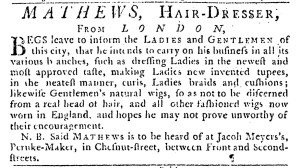
In December 1773, “MATHEWS, HAIR-DRESSER, FROM LONDON,” introduced himself to prospective clients in Philadelphia via advertisements in the Pennsylvania Gazette and the Pennsylvania Journal.  He informed “LADIES and GENTLEMEN of this city, that he intends to carry on his business in all its various branches.”  That included “dressing Ladies in the newest and most approved taste,” no doubt drawing on his connections to London to make sure they followed the latest trends, and “making Ladies new invented tupees, in the neatest manner.”  He also made “natural wigs” for gentlemen, “so as not to be discerned from a real head of hair,” as well as “other fashioned wigs now worn in England.”  His clients, Mathews suggested, could depend on looking as sophisticated as their cosmopolitan cousins in the capital of the empire.

Mathews had several choices for disseminating this message.  He opted for two newspapers, increasing the number of readers who would see his advertisement compared to publishing it in just one.  In addition to the Pennsylvania Gazetteand the Pennsylvania Journal, he could have placed it in the Pennsylvania Chronicle and the Pennsylvania Packet.  The cost of advertising may have prevented him from running notices in all four English-language newspapers published in Philadelphia at the time (and he likely considered advertising in the Wöchtenliche Pennsylvanische Staatsboteimpractical, even though the printer translated advertisements gratis).  Yet why did he choose the Pennsylvania Gazetteand the Pennsylvania Journal over the others?  The printers distributed those two newspapers on Wednesdays, while the printers of the Pennsylvania Chronicle and the Pennsylvania Packet distributed their publications on Mondays.  Mathews did not aim to have his advertisements spread out on different days, but that may not have mattered much in the context of weekly rather than daily publication.  Perhaps the cost of advertising influenced his decision, but that may not have been the case.  Although none of the printers included advertising fees in their colophons, they likely offered competitive rates.  All of them except for the Pennsylvania Gazette did include the annual subscription cost in their colophon.  The consistency, ten shilling for each of them, suggests that they set similar fees for advertising.  Perhaps Mathews selected the Pennsylvania Gazette and the Pennsylvania Journal because he believed they had a wider circulation or reached more of the local gentry that he hoped to cultivate as clients.  His example raises a larger question about why any advertiser in cities with multiple newspapers (including Boston, Charleston, New York, and Williamsburg) chose one over another or some over others to run their notices.

December 14

What was advertised in a colonial American newspaper 250 years ago today?

Essex Gazette (December 14, 1773).

“He is determined to sell so low as to give every Purchaser full Satisfaction.”

Nathaniel Sparhawk emphasized all the choices available to consumers when he advertised a “general Assortment of English and India GOODS” in the December 14, 1773, edition of the Essex Gazette.  To demonstrate some of those choices, he listed some of his merchandise.  His inventory included a “Beautiful assortment [of] superfine, middling and low priced Broad-Cloaths of the most fashionable colours,” “Ribbons of all sorts,” “MEN’s black & cloth colour’d worsted Hose,” “Women’s black, white and cloth-colour’d silk Gloves and Mitts,” “black and white gauze Handkerchiefs,” and “Silk & worsted Knee Garters.”  To further entice prospective customers, Sparhawk pledged to “sell so low as to give every reasonable Purchaser full Satisfaction.”  The shopkeeper intended for the combination of low prices and wide selection to draw customers to his shop in Salem.

In addition to those appeals, Sparhawk used graphic design to attract the attention of readers of the Essex Gazette.  His advertisement was the most visually striking of those that appeared in the December 14 edition.  A border composed of florettes enclosed the entire advertisement, setting it apart from news articles and other advertisements.  It was the only item that featured that sort of adornment on that page or anywhere in the issue.  George Deblois once again published his advertisement promoting a “fine Assortment of ENGLISH and HARD-WARE GOODS.”  It appeared in the column next to Sparhawk’s advertisement.  Both entrepreneurs enumerated many of their goods, but Deblois listed his wares in two dense paragraphs.  Sparhawk, in contrast, opted to divide his advertisement into two columns and list only one or two items on each line.  That likely made it easier for readers to peruse his notice.  In addition to the florettes that surrounded this advertisement, a line of other printing ornaments ran between the two columns, further enhancing its visual appeal.  Sparhawk stocked much of the same merchandise as Deblois and other competitors, but he leveraged graphic design in his advertisement to distinguish his business from the others.