The Slavery Adverts 250 Project chronicles the role of newspaper advertising in perpetuating slavery in the era of the American Revolution. The project seeks to reveal the ubiquity of slavery in eighteenth-century life from New England to Georgia by republishing advertisements about enslaved people – for sale as individuals or in groups, wanted to purchase or for hire for short periods, runaways who liberated themselves, and those who were subsequently captured and confined in jails and workhouses – in daily digests on this site as well as in real time via the @SlaveAdverts250 Twitter feed, utilizing twenty-first-century media to stand in for the print media of the eighteenth century.
The project aims to provide modern audiences with a sense of just how often colonizers encountered these advertisements in their daily lives. Enslaved men, women, and children appeared in print somewhere in the colonies almost every single day. Those advertisements served as a constant backdrop for social, cultural, economic, and political life in colonial and revolutionary America. Colonizers who did not purport to own enslaved people were still confronted with slavery as well as invited to maintain the system by purchasing enslaved men, women, and children or assisting in the capture of so-called “runaways” who sought to free themselves from bondage. The frequency of these newspaper advertisements suggests just how embedded slavery was in colonial and revolutionary American culture in everyday interactions beyond the printed page.
These advertisements also testify to the experiences of enslaved men, women, and children, though readers must consider that those experiences have been remediated through descriptions offered by enslavers rather than enslaved people themselves. Often unnamed in the advertisements, enslaved men, women, and children were not invisible or unimportant in early America.
These advertisements appeared in colonial American newspapers 250 years ago today.
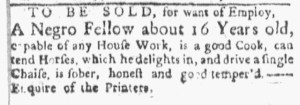
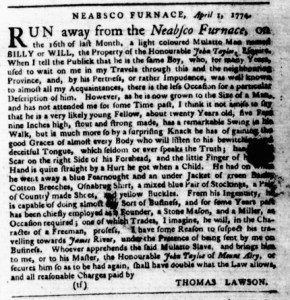
Boston Evening-Post (April 25, 1774).
**********
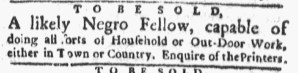
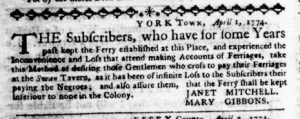
Boston Evening-Post (April 25, 1774).
**********
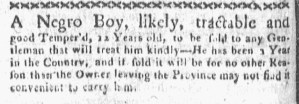
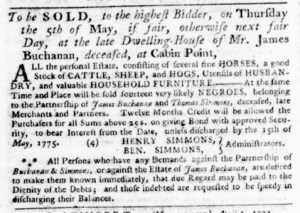
Boston Evening-Post (April 25, 1774).
**********
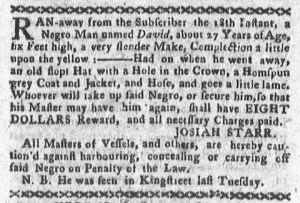
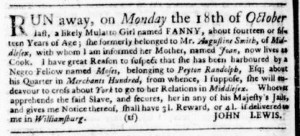
Boston-Gazette (April 25, 1774).
**********
Boston-Gazette (April 25, 1774).
**********
Boston-Gazette (April 25, 1774).
**********
Massachusetts Gazette and Boston Post-Boy (April 25, 1774).
**********
Newport Mercury (April 25, 1774).
**********
New-York Gazette and Weekly Mercury (April 25, 1774).
**********
Supplement to the New-York Gazette and Weekly Mercury (April 25, 1774).
**********
Supplement to the New-York Gazette and Weekly Mercury (April 25, 1774).
**********
Supplement to the New-York Gazette and Weekly Mercury (April 25, 1774).
What was advertised in a colonial American newspaper 250 years ago this week?
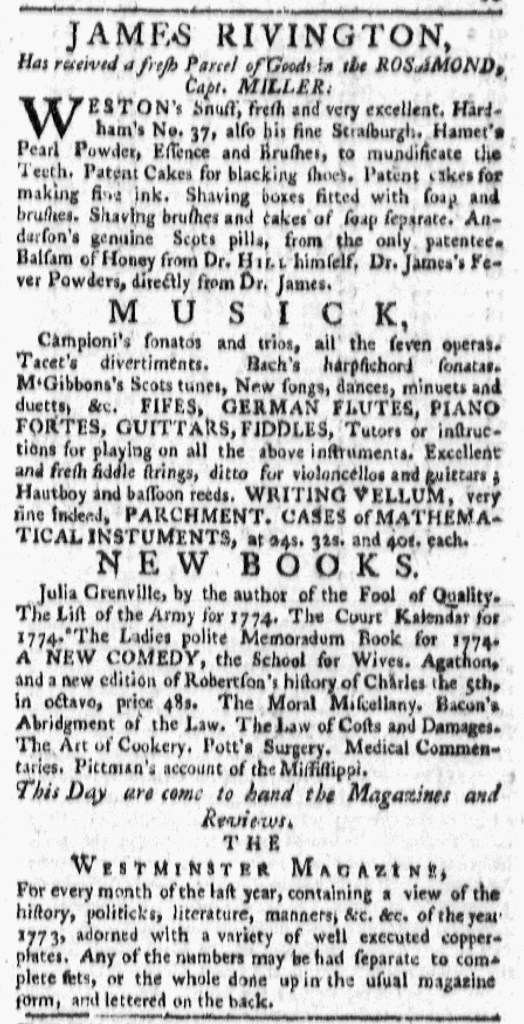
Rivington’s New-York Gazetteer (April 21, 1774).
“Any number may be had separate to complete sets, or the whole done up in the usual magazine form.”
James Rivington, the printer of Rivington’s New-York Gazetteer, cultivated alternate revenue streams at his printing office. Many printers were also booksellers, peddling books they imported from England. Such was the case with Rivington. He devoted a portion of his advertisement in the April 21, 1774, edition of his newspaper to “NEW BOOKS,” listing several that he had on hand. He also promoted other items from among the “fresh Parcel of Goods” he recently received. Like many other printers, he sold “cakes for making ink” and popular patent medicines, yet he also stocked a more elaborate inventory of other kinds of goods, including “Shaving boxes fitted with soap and brushes,” “CASES of METHEMATICAL INSTRUMENTS,” and “WESTON’s Snuff, fresh and very excellent.”
The printer and bookseller also advised prospective customers that “This Day are come to hand the Magazines and Reviews.” In particular, he hawked “THE WESTMINSTER MAGAZINE,” proclaiming that he had copies “For every month of the last year.” An associate on the other side of the Atlantic had assembled the annual run of the magazine and shipped it to Rivington to peddle to colonizers interested in a review of “the history, politicks, literature, manners,” and other cultural touchstones “of the year 1773.” To further entice readers, the magazine was “adorned with a variety of well executed copperplates” that buyers could leave intact or remove to frame and display in homes, shops, or offices. For those who had already purchased some editions but not others, Rivington allowed that “Amy of the numbers may be had separate to complete sets.” He also offered “the whole done up in the usual magazine form, and lettered on the back.” In other words, a bookbinder would compile all the issues of the Westminster Magazine from 1773 into a single bound volume and label the spine. That transformed the separate issues from ephemera into an attractive collection that would enhance any library.
Rivington advertised the Westminster Magazine at the same time that Isaiah Thomas continued marketing the Royal American Magazine, the publication that he launched earlier in the year. The Royal American Magazine was the only magazine published in the colonies at the time. Only about a dozen American magazines had been published before that, most of them folding in less than a year and none of them lasting longer than three years. Instead of American magazines, colonizers usually bought imported magazines from booksellers or received them from correspondents. Rivington’s method of importing, advertising, and disseminating the Westminster Magazine and other magazines was familiar and standard practice, making the Royal American Magazine the novelty in the American marketplace.
What was advertised in a colonial American newspaper 250 years ago today?
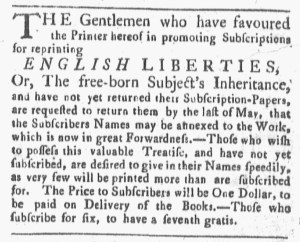
Providence Gazette (April 23, 1774).
“Subscribers Names may be annexed to the Work.”
When John Carter, the printer of the Providence Gazette, set about publishing a new edition of English Liberties, Or the Free-Born Subject’s Inheritance: Containing Magna Charta, Charta de Foresta, the Statute de Tallagio non Concedendo, the Habeas Corpus Act, and Several Other Statutes, with Comments on Each of Them, he started with subscription proposals. Early American printers often did not take books directly to press. Instead, they disseminated proposals that described their intended projects, simultaneously seeking to gauge the market and to incite demand. In requesting that subscribers reserve their copies in advance, sometimes asking them to pay a deposit, printers determined whether publishing proposed books would be viable ventures and, if so, how many copies to print to avoid producing surplus copies that cut into profits. Subscription proposals ran as advertisements in newspapers and, for some proposed works, “Subscription-Papers” circulated separately as handbills, broadsides, and pamphlets.
Many printers recruited local agents to assist them in collecting the names of subscribers and how many copies each wished to reserve. Carter did so with English Liberties. In an update in the April 23, 1774, edition of the Providence Gazette, he advised that the book “is now in great Forwardness.” Most likely much of the type had been set and supplies, such as paper, acquired by the printing office. Carter instructed the “Gentlemen who have favoured the Printer hereof in promoting Subscriptions … to return [their subscription papers] by the last of May.” He needed to receive them by that time so “the Subscribers Names may be annexed to the Work.” That was a popular strategy for inciting demand among prospective customers, promising that their names would appear along with others who also subscribed. They became part of a community of readers, even if they never met, and, in this instance, a community of citizens committed to those “ENGLISH LIBERTIES” that had been “The free-born Subject’s Inheritance” for generations. Printers suggested to those who had not yet subscribed that they needed to do so if they wished to be recognized alongside their friends and acquaintances and the most prominent members of their communities who already made a statement about the causes that they supported by subscribing for one or more copies.
Carter deployed other marketing strategies to encourage subscriptions for English Liberties. He warned that “very few will be printed more than are subscribed for,” so anyone who even had an inkling that they might want a copy should not depend on waiting to purchase the book after it went to press. In addition, Carter offered a premium: “Those who subscribe for six, to have a seventh gratis.” Subscribers who purchased multiple copies would receive a free one as a reward.
Carter did indeed insert a list of “SUBSCRIBERS NAMES” at the end of the book. They appeared in somewhat alphabetical order, with last names starting with “A” coming first, followed by “B,” and so on. Carter indicated the town for subscribers who did not reside in Providence and, within each letter, clustered subscribers from the same town together. That made it easier for subscribers to determine which of their neighbors had joined them in supporting the enterprise. Most were from towns in Rhode Island, Massachusetts, and Connecticut, but some subscribed from greater distances, including Robert Johnston of Chester County in Pennsylvania and Thomas Tillyer in Philadelphia. The roster of subscribers included nearly five hundred names, mostly men, but also Mrs. Elizabeth Belvher of Wrentham, Massachusetts, several lawyers and ministers, and even Darius Sessions, the deputy governor of Rhode Island. For those who subscribed for multiple copies, Carter listed how many. A few purchased two or three copies, but more commonly subscribers purchased six, a sign of the effectiveness of the printer’s marketing strategy.
Not all subscription proposals resulted in publishing books. Printers sometimes learned that they could not generate sufficient demand. In this case, however, the combination of the subject matter’s relationship to the political climate, widespread distribution of subscription papers to local agents, publishing the names of subscribers, and free copies for those who purchased at least six contributed to the success of the venture, though it had taken more than a year.
What was advertised in a colonial American newspaper 250 years ago today?
Massachusetts Spy (April 22, 1774).
“GARDEN SEEDS.”
“GARDEN SEEDS.”
“GARDEN SEEDS.”
“GARDEN SEEDS.”
“GARDEN SEEDS.”
Susanna Renken advertised “GARDEN SEEDS” in several newspapers published in Boston throughout the spring of 1774, just as she had been doing for many years. Many of her competitors, including Lydia Dyar, Elizabeth Greenleaf, and Anna Johnson, did the same. Each of them deployed the same headline, “GARDEN SEEDS,” and listed the many options they stocked in their shops. Dyar’s advertisement in the Massachusetts Spy included a final notation, “4 m,” intended for those who worked in the printing office, not for readers. It indicated that her advertisement should run for four months before the compositor removed it. All the advertisements placed by Boston’s female seed sellers became familiar sights in the public prints, an annual ritual that marked the changing of the seasons.
Their notices often appeared together. In the April 22 edition of the Massachusetts Spy, for instance, four of their advertisements filled most of a column, running one after another with Greenleaf’s first, followed by Dyar’s and Renken’s, and finally Johnson’s. That merits notice because printers did not tend to arrange advertisements by purpose or genre in eighteenth-century newspapers. Paid notices were not classified advertisements because they were not clustered together according to classification or category. Instead, they appeared in whatever order the compositor made them fit on the page. The eight advertisements immediately to the right of those placed by the female seed sellers included one for a pamphlet for sale, two for imported textiles and “all sorts of Groceries … except TEA,” one for imported silks and “Hard-Ware and Cutlery GOODS,” one for a lottery to benefit Harvard College, one for “CHOICE MADDER,” a plant used in dyeing, one for “ENGLISH, India, and Scotch Goods, suitable for the season, one for a school for girls, and one for millinery goods “of the newest fashion,” in that order. No guiding principle seemed to dictate which one followed which. Yet the compositor made a choice to place the advertisements for “GARDEN SEEDS” together, even opting to put Sarah Dawson’s notice first. The “Widow of the late Joseph Dawson, Gardner,” marketed a “collection of grafted and inoculated English FRUIT TREES,” but also happened to mention an “assortment of GARDEN SEEDS.” That apparently convinced the compositor to position her advertisement with those from Dyar, Greenleaf, Johnson, and Renken.
This practice made the notices placed by female seed sellers in Boston during the era of the American Revolution precursors to classified advertisements that would eventually run in American newspapers in later periods. For the most part, however, advertising in early American newspapers did not have that level of organization when it came to the order in which they appeared.
The Slavery Adverts 250 Project chronicles the role of newspaper advertising in perpetuating slavery in the era of the American Revolution. The project seeks to reveal the ubiquity of slavery in eighteenth-century life from New England to Georgia by republishing advertisements about enslaved people – for sale as individuals or in groups, wanted to purchase or for hire for short periods, runaways who liberated themselves, and those who were subsequently captured and confined in jails and workhouses – in daily digests on this site as well as in real time via the @SlaveAdverts250 Twitter feed, utilizing twenty-first-century media to stand in for the print media of the eighteenth century.
The project aims to provide modern audiences with a sense of just how often colonizers encountered these advertisements in their daily lives. Enslaved men, women, and children appeared in print somewhere in the colonies almost every single day. Those advertisements served as a constant backdrop for social, cultural, economic, and political life in colonial and revolutionary America. Colonizers who did not purport to own enslaved people were still confronted with slavery as well as invited to maintain the system by purchasing enslaved men, women, and children or assisting in the capture of so-called “runaways” who sought to free themselves from bondage. The frequency of these newspaper advertisements suggests just how embedded slavery was in colonial and revolutionary American culture in everyday interactions beyond the printed page.
These advertisements also testify to the experiences of enslaved men, women, and children, though readers must consider that those experiences have been remediated through descriptions offered by enslavers rather than enslaved people themselves. Often unnamed in the advertisements, enslaved men, women, and children were not invisible or unimportant in early America.
These advertisements appeared in colonial American newspapers 250 years ago today.
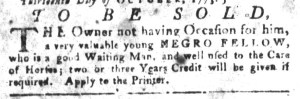
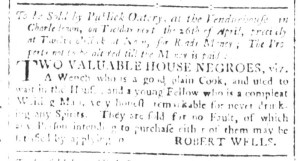
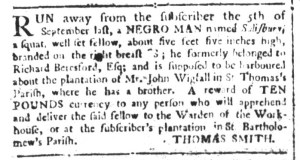
South-Carolina and American General Gazette (April 22, 1774).
**********
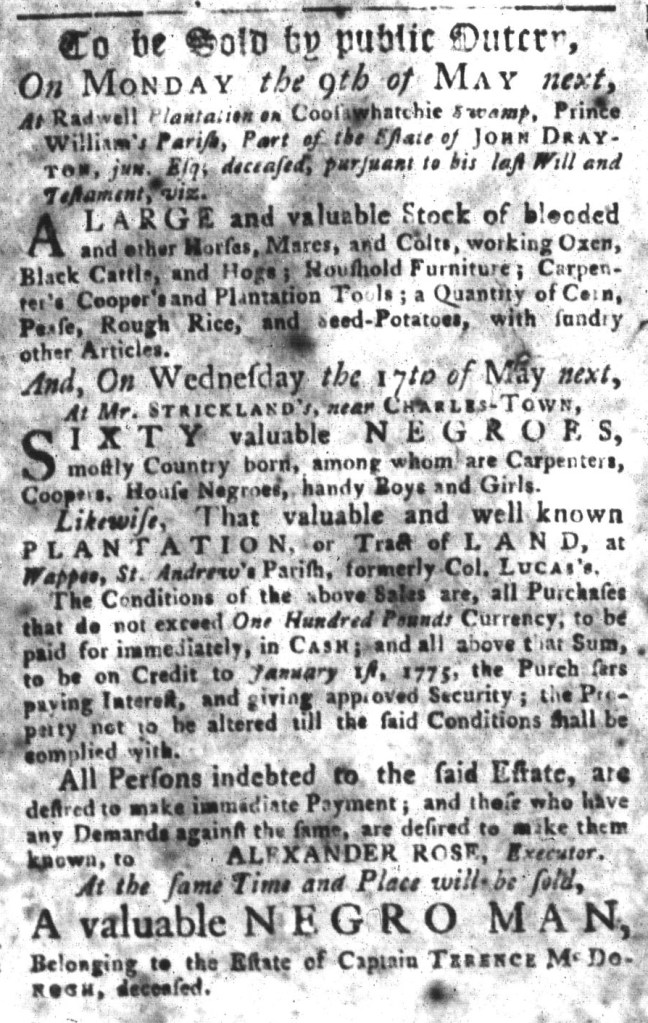
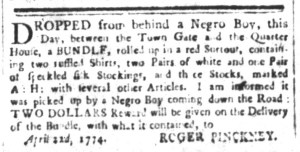
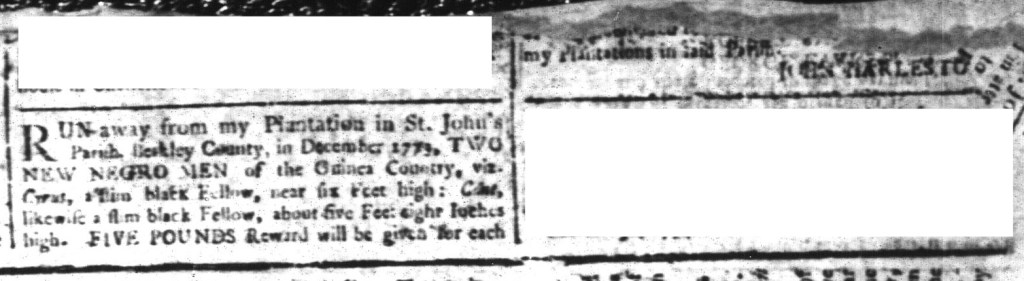
South-Carolina and American General Gazette (April 22, 1774).
**********
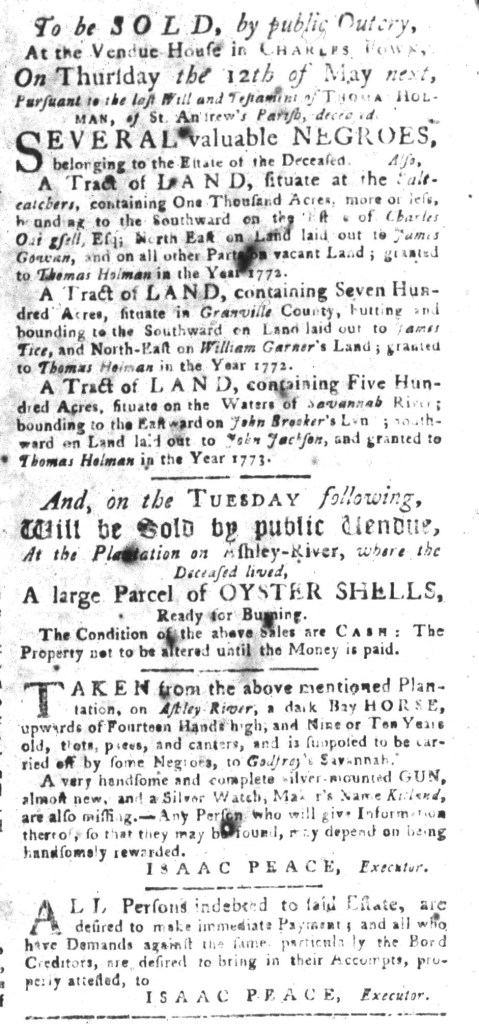
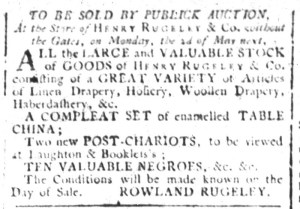
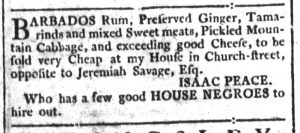
South-Carolina and American General Gazette (April 22, 1774).
**********
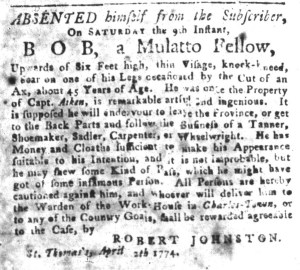
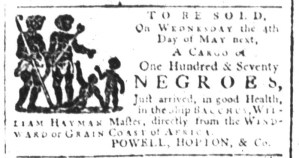
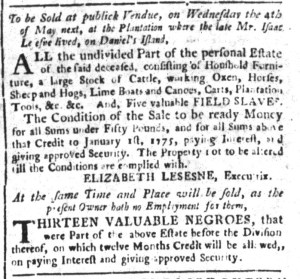
South-Carolina and American General Gazette (April 22, 1774).
**********
South-Carolina and American General Gazette (April 22, 1774).
**********
South-Carolina and American General Gazette (April 22, 1774).
**********
South-Carolina and American General Gazette (April 22, 1774).
**********
South-Carolina and American General Gazette (April 22, 1774).
**********
South-Carolina and American General Gazette (April 22, 1774).
**********
South-Carolina and American General Gazette (April 22, 1774).
**********
South-Carolina and American General Gazette (April 22, 1774).
**********
South-Carolina and American General Gazette (April 22, 1774).
**********
South-Carolina and American General Gazette (April 22, 1774).
**********
South-Carolina and American General Gazette (April 22, 1774).
**********
South-Carolina and American General Gazette (April 22, 1774).
**********
South-Carolina and American General Gazette (April 22, 1774).
**********
South-Carolina and American General Gazette (April 22, 1774).
**********
South-Carolina and American General Gazette (April 22, 1774).
**********
South-Carolina and American General Gazette (April 22, 1774).
**********
South-Carolina and American General Gazette (April 22, 1774).
**********
South-Carolina and American General Gazette (April 22, 1774).
**********
South-Carolina and American General Gazette (April 22, 1774).
**********
South-Carolina and American General Gazette (April 22, 1774).
**********
South-Carolina and American General Gazette (April 22, 1774).
**********
South-Carolina and American General Gazette (April 22, 1774).
**********
South-Carolina and American General Gazette (April 22, 1774).
**********
South-Carolina and American General Gazette (April 22, 1774).
**********
South-Carolina and American General Gazette (April 22, 1774).
What was advertised in a colonial American newspaper 250 years ago today?
Rivington’s New-York Gazetteer (April 21, 1774).
“I will requit their kindness by making a bonfire of [the tea].”
The Boston Tea Party serves as the most memorable destruction of tea during the imperial crisis that eventually resulted in thirteen colonies declaring independence from Great Britain, but greater numbers of colonizers participated in bonfires of tea. Benjamin Booth suggested that he would hold one of those bonfires if anyone in England had the audacity to designate him as the consignee of tea shipped to New York.
He made that bold declaration in an advertisement in the April 21, 1774, edition of the Rivington’s New-York Gazetteer, an advertisement that he felt compelled to place after becoming the subject of vicious rumors. “[S]ome evil minded persons, with a wicked design no doubt,” he declared, “have reported that I lately received TEA concealed in bales and other packages.” Booth considered such accusations “trouble enough already” before learning that he had been “appointed … consignee of the tea said to be daily expected, on board the ship London,” an appointment made without his knowledge or permission. Yet Booth wanted nothing to do with importing tea and all the trouble brewing with it. That prompted him to make a declaration “once for all” that he “never was, not ever will be knowingly concerned in any contraband goods.” Furthermore, if anyone had concerns about which commodities he imported and exported, he invited them to examine “the custom-house books, which are PUBLIC RECORDS” to confirm for themselves that Booth “religiously abid[ed] by this determination.” If that still was not enough to satisfy those who suspected him of operating against the public interest, he stated that “if any person England should treat me so ill, as to consign me any more tea, while the present obstacles remain,” referring to the duties that Parliament imposed, “I will requit their kindness by making a bonfire of it.” To emphasize the point, he proclaimed that he would do so “in the most public part of the city,” for all to witness, “and with my own hands set fire to the pile.”
Booth was not the first colonizer to resort to an advertisement to communicate his position on tea as the issue reached a boiling point. Jeremiah Cronin previously did so in the Massachusetts Spy, having a justice of the peace attest to the veracity of his assertions. Thomas Walley, Peter Boyer, and William Thompson did the same. Even an associate of John Hancock ran such an advertisement on behalf of the prominent merchant in the New-York Journal even before the Boston Tea Party. In each of these instances, advertisements provided updates and contributed to the discourse around tea. Those notices doubled as news items, helping to keep the public informed about developments that did not appear elsewhere in colonial newspapers.
The Slavery Adverts 250 Project chronicles the role of newspaper advertising in perpetuating slavery in the era of the American Revolution. The project seeks to reveal the ubiquity of slavery in eighteenth-century life from New England to Georgia by republishing advertisements about enslaved people – for sale as individuals or in groups, wanted to purchase or for hire for short periods, runaways who liberated themselves, and those who were subsequently captured and confined in jails and workhouses – in daily digests on this site as well as in real time via the @SlaveAdverts250 Twitter feed, utilizing twenty-first-century media to stand in for the print media of the eighteenth century.
The project aims to provide modern audiences with a sense of just how often colonizers encountered these advertisements in their daily lives. Enslaved men, women, and children appeared in print somewhere in the colonies almost every single day. Those advertisements served as a constant backdrop for social, cultural, economic, and political life in colonial and revolutionary America. Colonizers who did not purport to own enslaved people were still confronted with slavery as well as invited to maintain the system by purchasing enslaved men, women, and children or assisting in the capture of so-called “runaways” who sought to free themselves from bondage. The frequency of these newspaper advertisements suggests just how embedded slavery was in colonial and revolutionary American culture in everyday interactions beyond the printed page.
These advertisements also testify to the experiences of enslaved men, women, and children, though readers must consider that those experiences have been remediated through descriptions offered by enslavers rather than enslaved people themselves. Often unnamed in the advertisements, enslaved men, women, and children were not invisible or unimportant in early America.
These advertisements appeared in colonial American newspapers 250 years ago today.
What was advertised in a colonial American newspaper 250 years ago today?
Essex Journal (April 20, 1774).
“A large experience of 34 years at sea.”
Joseph Atkins took to the pages of the Essex Journal to inform the public that “he still continues to teach reading, writing, and arithmetic” in the spring of 1774. He apparently accepted both boys and girls, though he taught them separately. In a nota bene, he advised that he “intends to open a school for young ladies” at the end of April.
In addition to the basics of reading, writing, and arithmetic, Atkins also provide instruction in navigation “after the most approv[e]d methods. Experience mattered to the schoolmaster, not just experience in the classroom but also experience on ships. He asserted that his confidence in how he taught navigation to his pupils flowed from “a large experience of 34 years at sea.” Navigation was not merely academic to Atkins but instead a practical matter, an essential part of the occupation he previously pursued. Prospective students and their parents, he suggested, should feel similar confidence that his decades at sea prepared him to teach navigation to boys and young men who had prospects of working on vessels themselves. Newburyport was, after all, a maritime community.
The placement of Atkins’s advertisement on the third page of the April 20 edition of the Essex Journal underscored that was the case. It ran immediately below the “MARINE LIST,” a roster of ships that recently “ARRIVED” and “SAILED” from the “PORT of NEWBURY.” A day earlier, the town welcomed the Dove from Antigua and the Newhall from Guadeloupe. Most of the ships that departed in the past ten days made their way to the “West-Indies,” though the Larkventured to Newfoundland. Although Atkins’s time at sea was presumably behind him, he aimed to pass along a valuable skill to young men who might join the crew of any of the vessels that visited Newburyport. His “large experience of 34 years at sea” recommended him as a teacher as much as anything he could say about his methods of instruction.
The Slavery Adverts 250 Project chronicles the role of newspaper advertising in perpetuating slavery in the era of the American Revolution. The project seeks to reveal the ubiquity of slavery in eighteenth-century life from New England to Georgia by republishing advertisements about enslaved people – for sale as individuals or in groups, wanted to purchase or for hire for short periods, runaways who liberated themselves, and those who were subsequently captured and confined in jails and workhouses – in daily digests on this site as well as in real time via the @SlaveAdverts250 Twitter feed, utilizing twenty-first-century media to stand in for the print media of the eighteenth century.
The project aims to provide modern audiences with a sense of just how often colonizers encountered these advertisements in their daily lives. Enslaved men, women, and children appeared in print somewhere in the colonies almost every single day. Those advertisements served as a constant backdrop for social, cultural, economic, and political life in colonial and revolutionary America. Colonizers who did not purport to own enslaved people were still confronted with slavery as well as invited to maintain the system by purchasing enslaved men, women, and children or assisting in the capture of so-called “runaways” who sought to free themselves from bondage. The frequency of these newspaper advertisements suggests just how embedded slavery was in colonial and revolutionary American culture in everyday interactions beyond the printed page.
These advertisements also testify to the experiences of enslaved men, women, and children, though readers must consider that those experiences have been remediated through descriptions offered by enslavers rather than enslaved people themselves. Often unnamed in the advertisements, enslaved men, women, and children were not invisible or unimportant in early America.
These advertisements appeared in colonial American newspapers 250 years ago today.
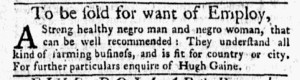
Pennsylvania Gazette (April 20, 1774).
**********
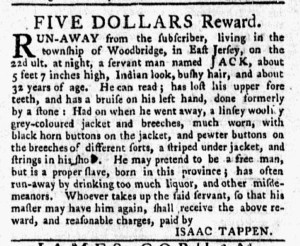
Pennsylvania Gazette (April 20, 1774).
**********
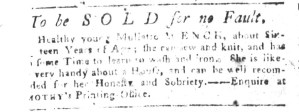
Pennsylvania Journal (April 20, 1774).
**********
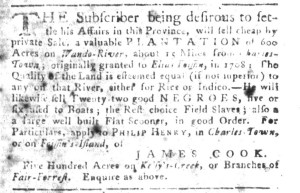
Postscript to the Pennsylvania Journal (April 20, 1774).
What was advertised in a colonial American newspaper 250 years ago today?
South-Carolina Gazette and Country Journal (April 19, 1774).
“BOHEA, GREEN, and HYSON TEA.”
Not all colonizers dispensed with advertising, selling, and drinking tea as an immediate response to the Boston Tea Party, especially if the tea in question had not been subject to import duties. In April 1774, Pott Shaw advertised “BOHEA, GREEN, and HYSON TEA, warranted of the finest Quality,” in the South-Carolina Gazette and Country Journal. Shaw did not reveal when the tea arrived in the colony, by what means, or its origins, leaving those details to prospective customers to ask about, if they chose to do so, when they made their purchases. Buying and selling this particular commodity occurred in the context of conversations about the politics of tea.
The April 19 edition of the South-Carolina Gazette and Country Journal carried some of the same updates about possible reactions to the Boston Tea Party that appeared in the Connecticut Courant a week earlier. Throughout the colonies, printers reprinted news from one newspaper to another. In this instance, both newspapers carried an “Extract of a letter from London, January 24,” that originally ran in newspapers in Philadelphia. It briefly stated, “Three men of war are ordered to be in readiness to sail for Boston, and exact payment for the TEA,” without providing additional information, including who had written the letter. Readers had to decide for themselves whether the report was accurate or merely rumor. Another news item, this one having arrived via New York, reported that the “intentions of the British administration, relative to the American duty on tea, are not yet fixed.” Readers in Charleston and Hartford read both these dispatches from London. They also encountered advertisements for tea in the same issues that carried that news.
Readers of the South-Carolina Gazette and Country Journal also read about commemorations of events that contributed to the imperial crisis. From Boston, they learned that “the horrid tragedy of the 5th of March,” the Boston Massacre, “was observed with the usual solemnity” on its fourth anniversary. That article described “a portrait of that inhuman and cruel massacre” put on display and the ringing of bells throughout the city for an entire hour. An update from New York followed, describing dinners that celebrated the “anniversary of the repeal of the STAMP-ACT.” Abuses perpetrated by both British soldiers and Parliament received attention alongside news about tea.
For the moment, however, that did not result in merchants, shopkeepers, and others refraining from advertising and selling tea in South Carolina or Connecticut or other colonies. The beverage was exceptionally popular, making it difficult to curtail consumption. Eventually, colonizers did enact boycotts, but some people still devised ways to evade them, at least according to Peter Oliver’s account. Although some entrepreneurs opted not to sell (or at least not to advertise) tea following the Boston Tea Party, it did not immediately disappear from shelves or newspaper advertisements.