April 13

What was advertised in a colonial American newspaper 250 years ago today?
Pennsylvania Gazette (April 13, 1774).

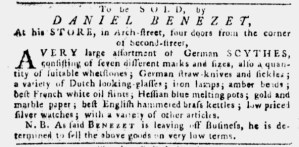
“Said BENEZET is leaving off Business.”

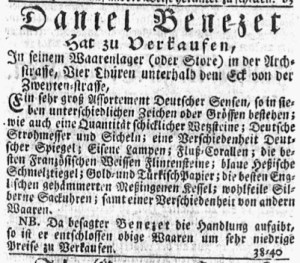
Daniel Benezet increased the likelihood that prospective customers would see his advertisements by placing them in every newspaper published in Philadelphia the spring of 1774.  Notices with identical copy appeared in Dunlap’s Pennsylvania Packet, the Pennsylvania Gazette, and the Pennsylvania Journal.  Benezet even took advantage of the offer that Henry Miller made in the masthead of each issue of the Wöchentliche Pennsylvanische Staatsbote: “All ADVERTISEMENTS to be inserted in this Paper, or printed single by HENRY MILLER, Publisher hereof, are by him translated gratis.”  That newspaper carried Benezet’s notice to German settlers.  No matter which newspaper colonizers in Pennsylvania read, they would encounter Benezet’s advertisement.
Wöchentliche Pennsylvanische Staatsbote (April 12, 1773).

Like many other entrepreneurs, Benezet listed some of his merchandise in hopes of enticing prospective customers.  He stocked “A VERY large assortment of German SCYTHES,” “a variety of Dutch looking-glasses,” “gold and marble paper,” “best English hammered brass kettles,” “low priced silver watches,” and “a variety of other articles” that consumers would discover when they visited “his STORE, in Arch-street, four doors from the corner of Second-street.”  Yet Benezet did not rely on appeals to choice alone to market his wares.  He also emphasized price and offered a reason for prospective customers to trust that he did indeed offer bargains.  In a nota bene, Benezet advised that since he “is leaving off Business, he is determined to sell the above goods on very low terms.”  In other words, he was holding an eighteenth-century version of a “going out of business” sale.  His desire to liquidate his merchandise justified not only low prices but also investing in advertising in four newspapers to make sure as many prospective customers as possible saw his notice.  Benezet saturated the local media market with his advertisements, signaling that he was serious about the deals at his store as he prepared for “leaving off Business.”

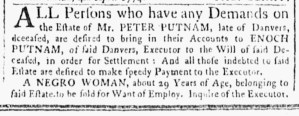
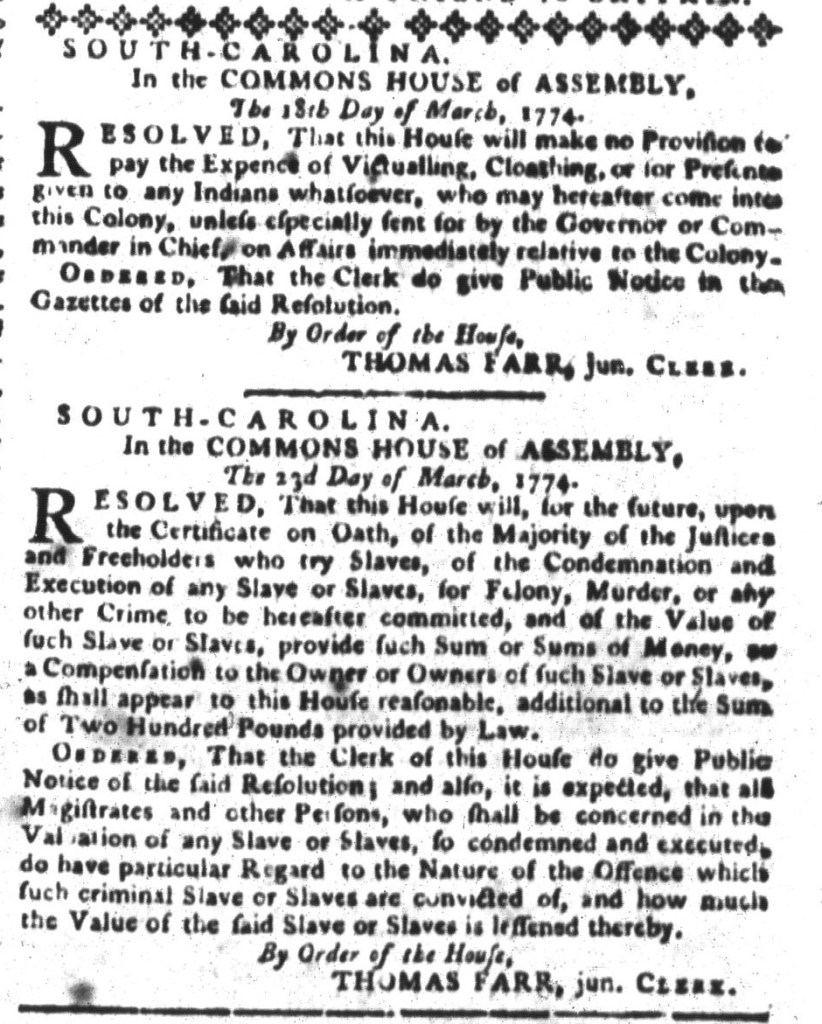
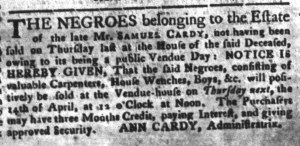
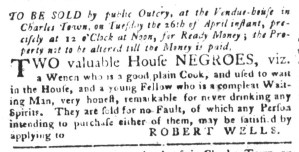
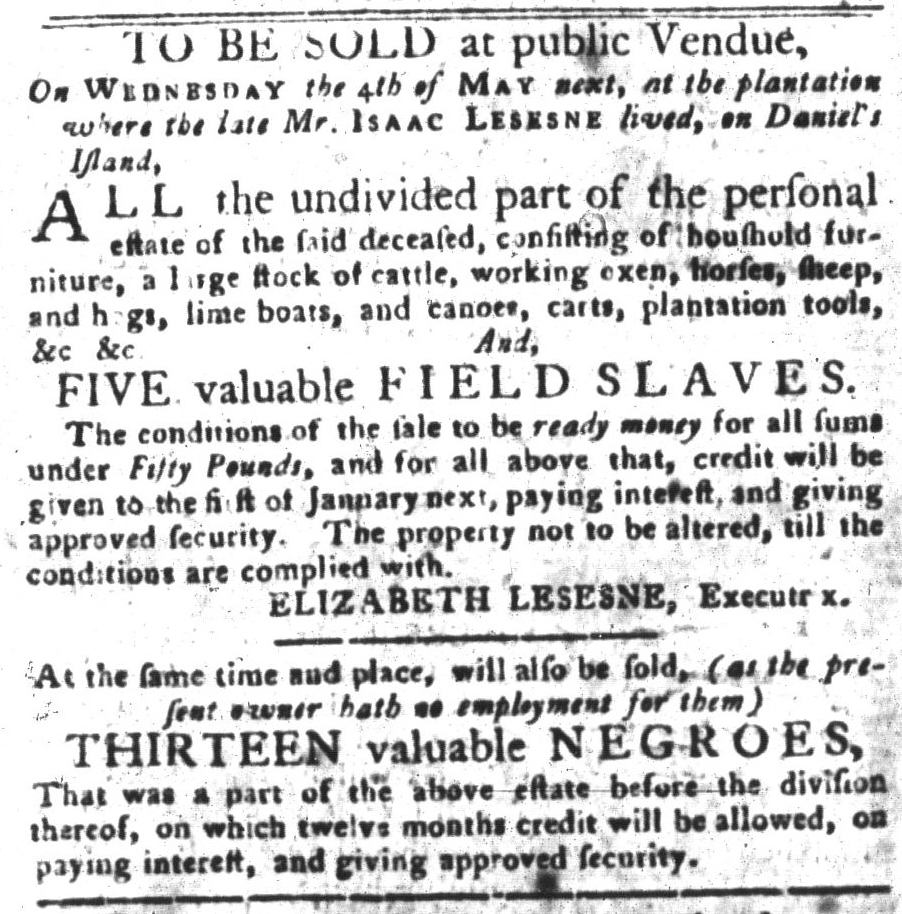
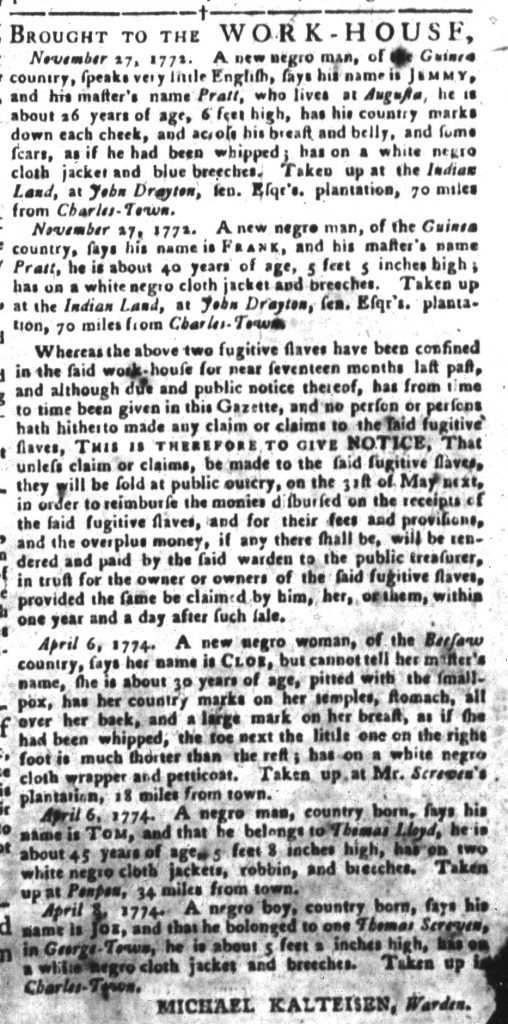
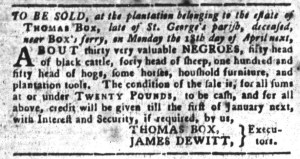
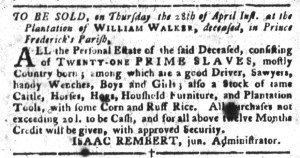
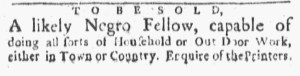
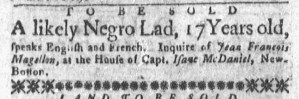
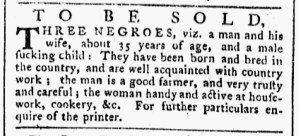
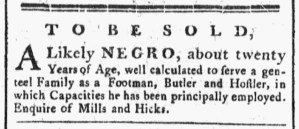
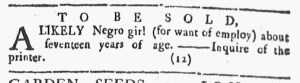
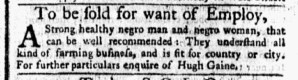
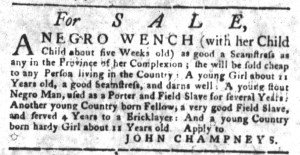
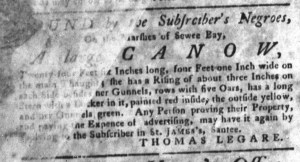
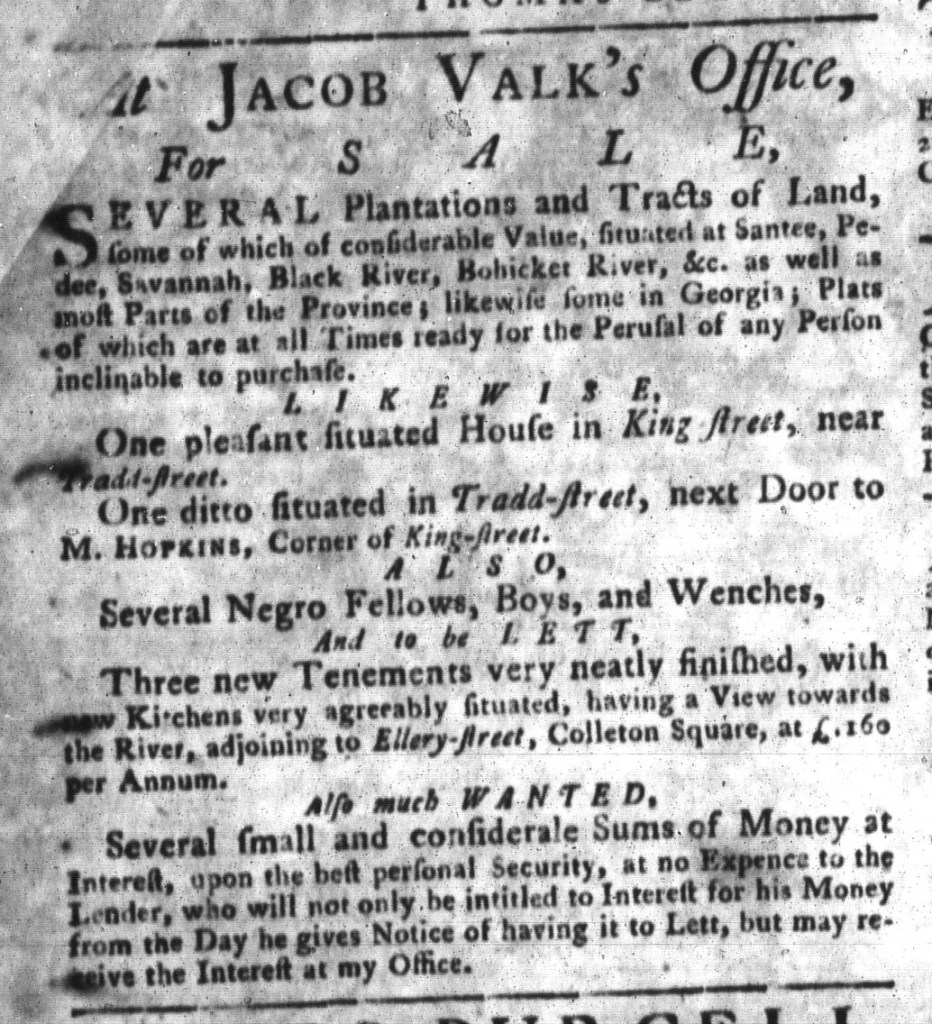
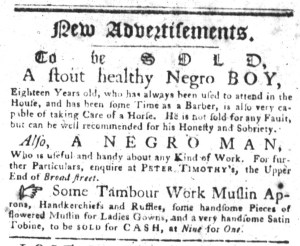
Slavery Advertisements Published April 13, 1774

GUEST CURATOR:  Maria Lepak

The Slavery Adverts 250 Project chronicles the role of newspaper advertising in perpetuating slavery in the era of the American Revolution. The project seeks to reveal the ubiquity of slavery in eighteenth-century life from New England to Georgia by republishing advertisements about enslaved people – for sale as individuals or in groups, wanted to purchase or for hire for short periods, runaways who liberated themselves, and those who were subsequently captured and confined in jails and workhouses – in daily digests on this site as well as in real time via the @SlaveAdverts250 Twitter feed, utilizing twenty-first-century media to stand in for the print media of the eighteenth century.

The project aims to provide modern audiences with a sense of just how often colonizers encountered these advertisements in their daily lives. Enslaved men, women, and children appeared in print somewhere in the colonies almost every single day. Those advertisements served as a constant backdrop for social, cultural, economic, and political life in colonial and revolutionary America. Colonizers who did not purport to own enslaved people were still confronted with slavery as well as invited to maintain the system by purchasing enslaved men, women, and children or assisting in the capture of so-called “runaways” who sought to free themselves from bondage. The frequency of these newspaper advertisements suggests just how embedded slavery was in colonial and revolutionary American culture in everyday interactions beyond the printed page.

These advertisements also testify to the experiences of enslaved men, women, and children, though readers must consider that those experiences have been remediated through descriptions offered by enslavers rather than enslaved people themselves. Often unnamed in the advertisements, enslaved men, women, and children were not invisible or unimportant in early America.

These advertisements appeared in colonial American newspapers 250 years ago today.

Pennsylvania Gazette (April 13, 1774).

April 12

What was advertised in a colonial American newspaper 250 years ago today?

Connecticut Courant (April 12, 1774).

“A New Supply of TEA, Extraordinary Good.”

William Beadle was at it again.  A few months after the Boston Tea Party, he once again took to the pages of the Connecticut Courant, published in Hartford, to inform readers that he stocked “A New Supply of TEA, Extraordinary Good” at his shop in Wethersfield.  That advertisement first ran on April 12, 1774, a month after the first time he promoted “Best Bohea TEA, Such as Fishes never drink!!”  Readers could not miss the reference to the destruction of the tea in Boston Harbor, though they could have read Beadle’s comment in different ways.  In Tea: Consumption, Politics, and Revolution, 1773-1776, James R. Fichter proposes that Beadle might have sold smuggled tea that had not been subject to import duties or he might have underscored that Connecticut did not have a tea boycott in place so consumers could make their own decisions about purchasing it.  He suggests that Beadle did not experience any backlash, at least not enough to make him reconsider his marketing efforts, because “he placed generic advertisements for tea,” such as today’s featured advertisement, “throughout the spring and summer of 1774 and early 1775.”[1]

Tea was certainly a topic of discussion in Wethersfield and other towns in Connecticut.  In the same issue that first carried Beadle’s “New Supply of TEA” advertisement, updates about tea appeared in several places among the “American Intelligence.”  One “Extract of a letter from Baltimore” stated, “The intentions of the British Administration relative to the American duty on tea, are not yet fixed; the Minister has many weighty subjects to lay before the lower house, before the article will be brought into debate, and the session will be far expended ere any alteration in the revenue laws will be attended to.”  An “Extract of a Letter from London” warned that “Three Men of War are ordered to be immediately in Readiness to sail to Boston, and exact Payment for the Tea.”  News from Newport, Rhode Island, focused on the “New-Yorkers [who] are determined in their resolutions of sending back the tea ship without suffering an ounce to be landed.” That report referred to the Nancy and the trouble that was brewing in New York as the Sons of Liberty there advertised that they would hold weekly meetings “till the Arrival and Departure of the TEA SHIP.”  Tea had become such a sensitive topic that many merchants and shopkeepers ceased listing it among their inventory in their advertisements, but, especially without a nonimportation pact in place, Beadle charted his own course in promoting the popular beverage to consumers in Connecticut.

**********

[1] James R. Fichter, Tea: Consumption, Politics, and Revolution, 1773-1776 (Cornell University Press, 2023), 147.

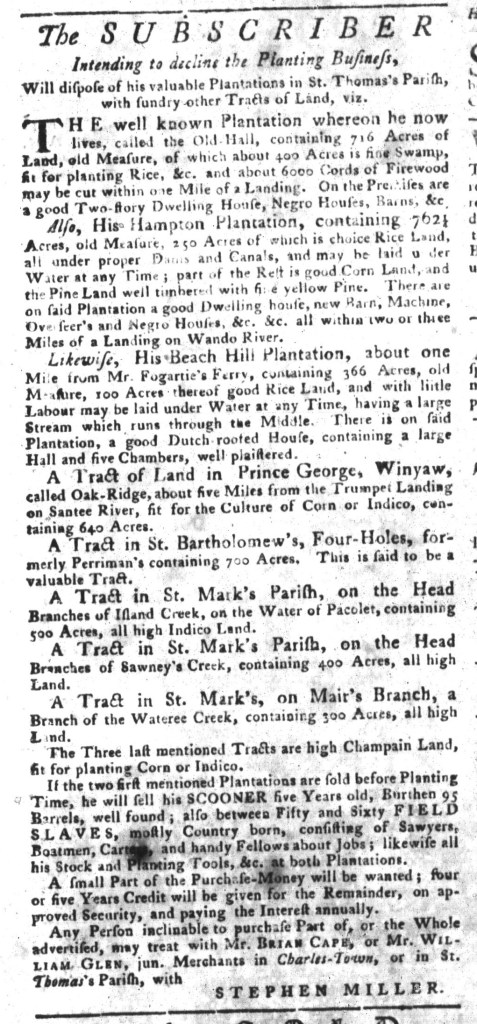
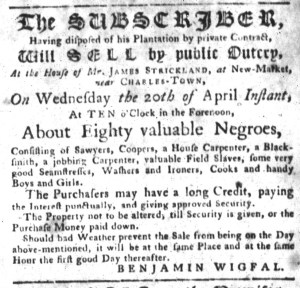
Slavery Advertisements Published April 12, 1774

GUEST CURATOR:  Maria Lepak

The Slavery Adverts 250 Project chronicles the role of newspaper advertising in perpetuating slavery in the era of the American Revolution. The project seeks to reveal the ubiquity of slavery in eighteenth-century life from New England to Georgia by republishing advertisements about enslaved people – for sale as individuals or in groups, wanted to purchase or for hire for short periods, runaways who liberated themselves, and those who were subsequently captured and confined in jails and workhouses – in daily digests on this site as well as in real time via the @SlaveAdverts250 Twitter feed, utilizing twenty-first-century media to stand in for the print media of the eighteenth century.

The project aims to provide modern audiences with a sense of just how often colonizers encountered these advertisements in their daily lives. Enslaved men, women, and children appeared in print somewhere in the colonies almost every single day. Those advertisements served as a constant backdrop for social, cultural, economic, and political life in colonial and revolutionary America. Colonizers who did not purport to own enslaved people were still confronted with slavery as well as invited to maintain the system by purchasing enslaved men, women, and children or assisting in the capture of so-called “runaways” who sought to free themselves from bondage. The frequency of these newspaper advertisements suggests just how embedded slavery was in colonial and revolutionary American culture in everyday interactions beyond the printed page.

These advertisements also testify to the experiences of enslaved men, women, and children, though readers must consider that those experiences have been remediated through descriptions offered by enslavers rather than enslaved people themselves. Often unnamed in the advertisements, enslaved men, women, and children were not invisible or unimportant in early America.

These advertisements appeared in colonial American newspapers 250 years ago today.

Essex Gazette (April 12, 1774).

**********

South-Carolina Gazette and Country Journal (April 12, 1774).

**********

South-Carolina Gazette and Country Journal (April 12, 1774).

**********

South-Carolina Gazette and Country Journal (April 12, 1774).

**********

South-Carolina Gazette and Country Journal (April 12, 1774).

**********

South-Carolina Gazette and Country Journal (April 12, 1774).

**********

South-Carolina Gazette and Country Journal (April 12, 1774).

**********

South-Carolina Gazette and Country Journal (April 12, 1774).

**********

South-Carolina Gazette and Country Journal (April 12, 1774).

**********

South-Carolina Gazette and Country Journal (April 12, 1774).

**********

South-Carolina Gazette and Country Journal (April 12, 1774).

April 11

What was advertised in a colonial American newspaper 250 years ago today?

Boston-Gazette (April 11, 1774).

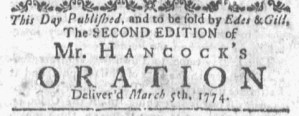
“The SECOND EDITION of Mr. HANCOCK’S ORATION.”

Benjamin Edes and John Gill, printers of the Boston-Gazette, gave their advertisement for the “SECOND EDITION of Mr. HANCOCK’S ORATION Deliver’d March 5th” a privileged place in their newspaper.  Readers did not need further explanation to understand that “March 5th” referred to the date of the Boston Massacre and that Hancock had been selected to give the annual address that memorialized the victims and raised an alarm about the danger of quartering an army in an urban center, like Boston, during times of peace.

Still, Edes and Gill, who printed the “ORATION” as well as the newspaper, did what they could to draw attention to the second edition.  The first time they announced it was “This Day Published,” in the April 4, 1774, edition of the Boston-Gazette, they ran the notice immediately below news and editorials.  Even if readers chose not to peruse other advertisements closely once they realized they had finished the news, they likely took note of the advertisement for the “ORATION” in its place of transition from one kind of content to another.  In the next issue of the weekly newspaper, the notice ran at the bottom of the last column on the first page, the only advertisement on that page.  Once again, the patriot printers increased the likelihood that readers would spot that advertisement and accept an invitation to demonstrate their own commitment to the patriot cause by purchasing copies for themselves.

That Edes and Gill published a “SECOND EDITION” testified to the demand for the first edition.  It sold well enough to justify another printing.  Edes and Gill took it to press just a few months after the Boston Tea Party and just a few weeks after another destruction of tea.  Although that second Boston Tea Party is not nearly as well known today, it was certainly among the current events that would have been on the minds of colonizers as they participated in commemorating the fourth anniversary of the Boston Massacre, discussed the politics of tea, and decried various abuses perpetrated by Parliament.  Purchasing and reading Hancock’s “ORATION” was part of the growing resistance to British rule in the colonies, a means for consumers to practice politics in the marketplace and imbibe the rhetoric of a noted patriot long after the Boston Massacre’s annual commemorative events concluded.

Slavery Advertisements Published April 11, 1774

GUEST CURATOR:  Maria Lepak

The Slavery Adverts 250 Project chronicles the role of newspaper advertising in perpetuating slavery in the era of the American Revolution. The project seeks to reveal the ubiquity of slavery in eighteenth-century life from New England to Georgia by republishing advertisements about enslaved people – for sale as individuals or in groups, wanted to purchase or for hire for short periods, runaways who liberated themselves, and those who were subsequently captured and confined in jails and workhouses – in daily digests on this site as well as in real time via the @SlaveAdverts250 Twitter feed, utilizing twenty-first-century media to stand in for the print media of the eighteenth century.

The project aims to provide modern audiences with a sense of just how often colonizers encountered these advertisements in their daily lives. Enslaved men, women, and children appeared in print somewhere in the colonies almost every single day. Those advertisements served as a constant backdrop for social, cultural, economic, and political life in colonial and revolutionary America. Colonizers who did not purport to own enslaved people were still confronted with slavery as well as invited to maintain the system by purchasing enslaved men, women, and children or assisting in the capture of so-called “runaways” who sought to free themselves from bondage. The frequency of these newspaper advertisements suggests just how embedded slavery was in colonial and revolutionary American culture in everyday interactions beyond the printed page.

These advertisements also testify to the experiences of enslaved men, women, and children, though readers must consider that those experiences have been remediated through descriptions offered by enslavers rather than enslaved people themselves. Often unnamed in the advertisements, enslaved men, women, and children were not invisible or unimportant in early America.

These advertisements appeared in colonial American newspapers 250 years ago today.

Boston Evening-Post (April 11, 1774).

**********

Boston Evening-Post (April 11, 1774).

**********

Boston Evening-Post (April 11, 1774).

**********

Boston-Gazette (April 11, 1774).

**********

Boston-Gazette (April 11, 1774).

**********

Boston-Gazette (April 11, 1774).

**********

Postscript to Dunlap’s Pennsylvania Packet (April 11, 1774).

**********

Massachusetts Gazette and Boston Post-Boy (April 11, 1774).

**********

Newport Mercury (April 11, 1774).

**********

New-York Gazette and Weekly Mercury (April 11, 1774).

**********

New-York Gazette and Weekly Mercury (April 11, 1774).

**********

Supplement to the New-York Gazette and Weekly Mercury (April 11, 1774).

**********

Supplement to the New-York Gazette and Weekly Mercury (April 11, 1774).

**********

Supplement to the New-York Gazette and Weekly Mercury (April 11, 1774).

**********

South-Carolina Gazette (April 11, 1774).

**********

South-Carolina Gazette (April 11, 1774).

**********

South-Carolina Gazette (April 11, 1774).

**********

South-Carolina Gazette (April 11, 1774).

**********

South-Carolina Gazette (April 11, 1774).

**********

South-Carolina Gazette (April 11, 1774).

**********

South-Carolina Gazette (April 11, 1774).

**********

South-Carolina Gazette (April 11, 1774).

**********

South-Carolina Gazette (April 11, 1774).

**********

South-Carolina Gazette (April 11, 1774).

**********

South-Carolina Gazette (April 11, 1774).

**********

South-Carolina Gazette (April 11, 1774).

**********

South-Carolina Gazette (April 11, 1774).

**********

South-Carolina Gazette (April 11, 1774).

April 10

What was advertised in a colonial American newspaper 250 years ago this week?

Rivington’s New-York Gazetteer (April 7, 1774).

“ETHAN SICKELS, Leather-Dresser and Breeches-Maker.”

Even if imitation is the sincerest form of flattery, Cornelius Ryan, “LEATHER DRESSER and BREECHES MAKER,” probably did not feel particularly flattered when Ethan Sickels, “Leather-Dresser and Breeches-Maker,” ran an advertisement that imitated Ryan’s advertisement a little too much.  Compare the copy from Ryan’s notice, which first appeared in the New-York Gazette and Weekly Mercury on March 21, 1774, and Sickels’s notice, which first appeared in Rivington’s New-York Gazetteer on March 31.

Ryan: “MAKES and sells best Buck and Doe Skin Breeches, find ground Lamb do, best Buck and Doe Skin Gloves, also the very best Kind of Caraboo Skin Breeches and Gloves.”

Sickels: “MAKES and sells the best buck and doe skin breeches, fine ground lamb best buck and doe skin gloves; Also the very best Caraboo skin breeches, and gloves.”

Ryan: “He likewise has a great Variety of Buck Skin Breeches for Traders or Country Stores … all which he will sell on as low Terms as they can be had from Philadelphia, or any Part of the Continent.”

Sickels: “he likewise has a great quantity of buckskin breeches for traders, or country stores … all which he will sell on as low terms as they can be had from Philadelphia, or any part of the continent.

This was not an instance of using standardized or formulaic language as was often the case in eighteenth-century advertisements for consumer goods and services.  Instead, Sickels quite clearly borrowed Ryan’s advertising copy … but that was not the only undeniable similarity between the two newspaper notices.  Each of them included a woodcut depicting a pair of breeches and the initials of the advertiser that accounted for approximately half of the space occupied by the advertisements.  Ryan’s image also included a sun, replicating his “Sign of the SUN and BREECHES,” while Sickels’s image had a border around it instead.

Sickels apparently admired Ryan’s advertisement or feared that it gave his competitor too much of an advantage or recognized a means of drawing more attention to his own business.  All those factors may have been at play when he saw Ryan’s notice in the New-York Gazette and Weekly Mercury and decided to cross the street from his workshop “Opposite Mr. RIVINGTON’S PRINTING-OFFICE” to arrange for such a similar advertisement to run in Rivington’s New-York Gazetteer.  This suggests that entrepreneurs did not place newspaper advertisements as mere announcements in the eighteenth century but instead some of them monitored the public prints to devise their own marketing efforts or at least keep up with their competitors.

April 9

What was advertised in a colonial American newspaper 250 years ago today?

Providence Gazette (April 9, 1774).

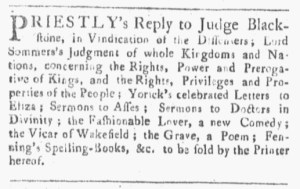
“… to be sold by the Printer hereof.”

Advertisements filled the final column on the third page and the entire last page of the April 9, 1774, edition of the Providence Gazette.  They generated significant revenue for John Carter, the printer, yet not all the advertisements were paid notices.  Like many other printers, Carter used his newspaper to disseminate his own advertisements.  He inserted five of the notices that appeared in that issue.

Those advertisements related to a variety of aspects of operating Carter’s printing office “at Shakespear’s Head, in Meeting-Street, near the Court-House.”  In one, he called on “ALL Persons indebted for this Gazette one Year, or more” and anyone else indebted to him for other services “to make immediate Payment.”  In another, Carter sought a “trusty and well-behaved Lad, about 13 or 14 Years of Age” as “an Apprentice to the Printing Business.”  Candidates needed to be able to “read well, and write tolerably.”  In yet another, a headline in a larger font than anything else in that issue, even the title of the newspaper in the masthead, proclaimed, “RAGS.”  Carter offered the “best Prices … for clean Linen Rags, of any Kind, and old Sail-Cloth, to supply the PAPER MANUFACTORY in Providence.”  The printer intended to recycle rags into paper that he would then use to publish subsequent editions of the Providence Gazette.
Providence Gazette (April 9, 1774).

Other advertisements promoted items for sale at the printing office.  Most printers also sold books.  A few came from their own presses or other colonial presses, but most were imported from England.  Carter listed several titles for readers with diverse interests, from “PRIESTLY’s Reply to Judge Blackstone, in Vindication of the Dissenters” to “the Fashionable Lover, a new Comedy” to “the Grave, a Poem” to “Fenning’s Spelling-Books.”  An “&c.” (an abbreviation for et cetera) indicated that he stocked many more books, pamphlets, and broadsides.  A shorter advertisement stated, “BLANKS of various Kinds to be sold by the Printer hereof.”  Carter printed and sold forms for common legal and commercial transactions.  Even the colophon doubled as an advertisement, informing readers that “all Manner of Printing-Work is performed with Care and Expedition.”
Carter took advantage of his access to the press to tend to the different parts of operating a busy printing office.  While his advertisements did not generate revenue in the same manner as the paid notices placed by merchants, shopkeepers, artisans, estate executors, lottery managers, and others, they supported his business in other ways and some likely resulted in revenue from the sale of books and blanks or the settling of accounts.  Collectively, they gave Carter a very visible presence in the pages of the Providence Gazette.

April 8

What was advertised in a colonial American newspaper 250 years ago today?

Connecticut Gazette (April 8, 1774).

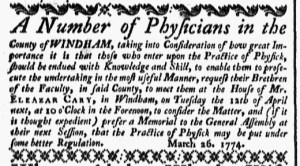
“… that the Practice of Physick may be put under some better Regulation.”

A “Number of Physicians in the County of WINDHAM” inserted an advertisement in the Connecticut Gazette in the spring of 1774.  In it, they professed that they had been contemplating “how great Importance it is that those who enter upon the Practice of Physick, should be endued with Knowledge and Skill.”  That was necessary, the physicians asserted, “to enable them to prosecute the undertaking in the most useful Manner,” achieving the best results for their patients.  That being the case, they called a meeting of “their Brethren of the Faculty” in Windham County to discuss “the Matter, and (if it thought expedient) prefer a Memorial” or petition “to the General Assembly … that the Practice of Physick may be put under some better Regulation.”  At a glance, their notice suggested that increased professionalization in their field would yield better care for patients.

The timing of their advertisement, however, suggests that this “Number of Physicians” may have had other motivations.  A call for “some better Regulation” may have been an attempt to reduce or eliminate competition from others who provided various forms of medical treatment.  Consider the testimonial about the hernia trusses “made and applied by Mr. STEPHEN JOHNSON, of Ashford, in Windham-County” that first ran in the March 25 edition of the Connecticut Gazette.  Then note the date, March 26, on the announcement from the “Number of Physicians.”  Did a “Number of Physicians” actually consult with each other before inserting that advertisement in the next issue of the Connecticut Gazette?  Or did one of them see the testimonial about the trusses that proclaimed Johnson “hath the greatest Skill in that Business of any Man we ever heard of” and determine that such competition threatened the livelihoods and, just as significantly, the status of physicians in the area?  Perhaps a single physician called the meeting, hoping to rally support among others.  The advertisement also served as a counterpoint to the testimonial about Johnson’s trusses, especially when both appeared in the Connecticut Gazette on April 1 and on the same page on April 8.

Professionalization of the medical field accelerated in the late eighteenth century.  Doctors displaced midwives, but women who provided care were not the only targets of physicians who received formal training.  These two advertisements seem to tell a story of a “Number of Physicians” (or perhaps just one with a lot of initiative) to limit the medical treatment delivered by other men who did meet the standards of the “better Regulation” they envisioned.

Slavery Advertisements Published April 8, 1774

GUEST CURATOR:  Maria Lepak

The Slavery Adverts 250 Project chronicles the role of newspaper advertising in perpetuating slavery in the era of the American Revolution. The project seeks to reveal the ubiquity of slavery in eighteenth-century life from New England to Georgia by republishing advertisements about enslaved people – for sale as individuals or in groups, wanted to purchase or for hire for short periods, runaways who liberated themselves, and those who were subsequently captured and confined in jails and workhouses – in daily digests on this site as well as in real time via the @SlaveAdverts250 Twitter feed, utilizing twenty-first-century media to stand in for the print media of the eighteenth century.

The project aims to provide modern audiences with a sense of just how often colonizers encountered these advertisements in their daily lives. Enslaved men, women, and children appeared in print somewhere in the colonies almost every single day. Those advertisements served as a constant backdrop for social, cultural, economic, and political life in colonial and revolutionary America. Colonizers who did not purport to own enslaved people were still confronted with slavery as well as invited to maintain the system by purchasing enslaved men, women, and children or assisting in the capture of so-called “runaways” who sought to free themselves from bondage. The frequency of these newspaper advertisements suggests just how embedded slavery was in colonial and revolutionary American culture in everyday interactions beyond the printed page.

These advertisements also testify to the experiences of enslaved men, women, and children, though readers must consider that those experiences have been remediated through descriptions offered by enslavers rather than enslaved people themselves. Often unnamed in the advertisements, enslaved men, women, and children were not invisible or unimportant in early America.

These advertisements appeared in colonial American newspapers 250 years ago today.

Connecticut Gazette (April 8, 1774).