September 13

What was advertised in a colonial American newspaper 250 years ago today?

Essex Gazette (September 13, 1774).

“This GAZETTE may be had for 6s. 8d. per Annum, exclusive of Postage.”

The printers of the Essex Gazette incorporated the colophon into the masthead of that newspaper.  Within that masthead, they declared that the publication “Contain[ed] the freshest Advices, both foreign and domestic” and gave the date and volume and issue numbers.  Next came the publication information that more often appeared at the bottom of the final page in other newspapers: “SALEM: Printed by Samuel and Ebenezer Hall, at their Printing-Office in King-Street.”  That made it easy for prospective subscriber and advertisers as well as others with business for the printers to contact or visit them.

Even with that choice about where to place the colophon, the Halls still recognized the bottom of the final page as valuable space for promoting their newspaper, publishing a perpetual advertisement that ran across all three columns in each issue.  A single line advised, “This GAZETTE may be had for 6s. 8d. per Annum, exclusive of Postage – 3s. 4d. (or 4s. 6d. if sent by the Eastern Post) to be paid at Entrance.”  Throughout the colonies, printers generously extended credit to subscribers, recognizing that if they increased their circulation then they could attract more advertisers.  In turn, printers often published notices calling on subscribers to pay for subscriptions going back months and even years.

For their part, the Halls refused to assume the risk of allowing readers to subscribe completely on credit.  They required payment of three shilling and four pence, half of the annual price of six shillings and eight pence, at the time that subscriptions commenced.  Even if they had difficulty collecting the balance from subscribers, those initial payments covered some of the expenses and limited their losses.  In addition, subscribers who ordered their newspapers delivered by a post rider were expected to pay an additional shilling at the start, though the notice did not indicate if that covered the entire year or, like the entrance fee, was only half of what subscribers were expected to pay.  Either way, the Halls intended that service would further expand their circulation.

No matter what kinds of news or paid notices the printers placed on the final page of the Essex Gazette from week to week, readers always encountered an advertisement for the newspaper as the final item.  Colonial newspapers often passed from hand to hand, reaching readers beyond the original subscribers.  This strategy encouraged those additional readers to consider purchasing their own subscriptions for consistent access to the news rather than rely on the possibility that others would share their newspapers.
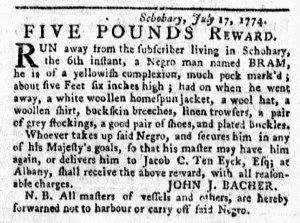
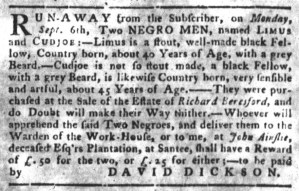
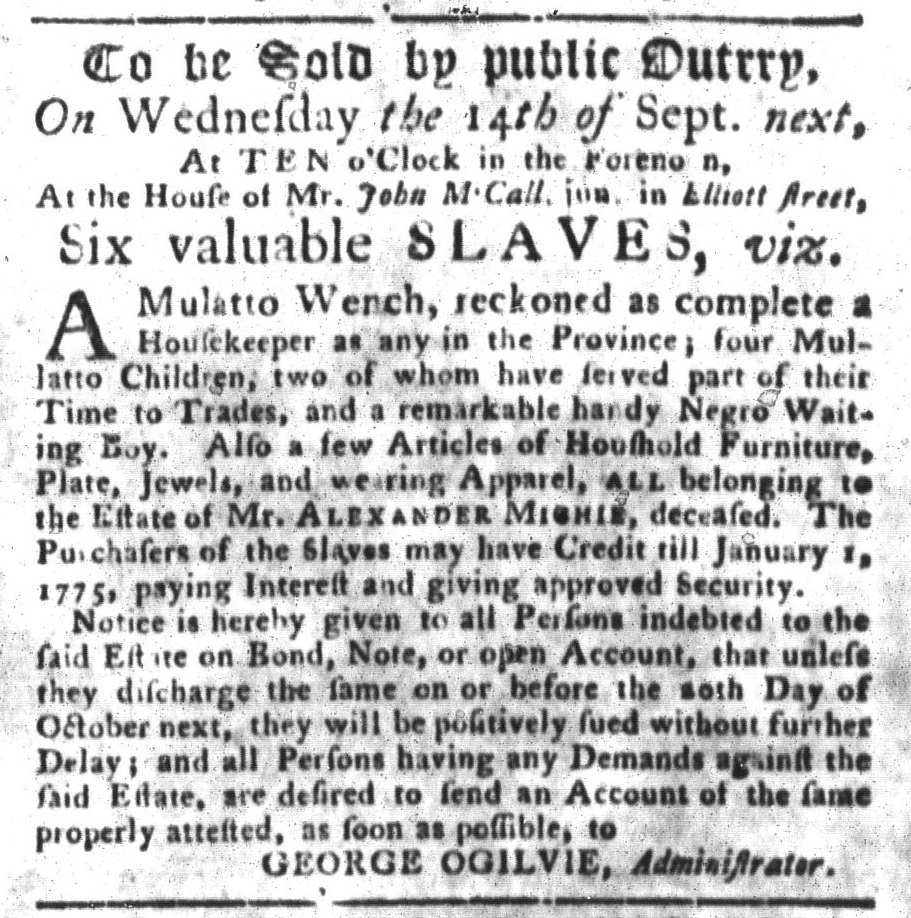
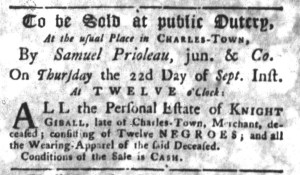
Slavery Advertisements Published September 13, 1774

The Slavery Adverts 250 Project chronicles the role of newspaper advertising in perpetuating slavery in the era of the American Revolution. The project seeks to reveal the ubiquity of slavery in eighteenth-century life from New England to Georgia by republishing advertisements about enslaved people – for sale as individuals or in groups, wanted to purchase or for hire for short periods, runaways who liberated themselves, and those who were subsequently captured and confined in jails and workhouses – in daily digests on this site as well as in real time via the @SlaveAdverts250 Twitter feed, utilizing twenty-first-century media to stand in for the print media of the eighteenth century.

The project aims to provide modern audiences with a sense of just how often colonizers encountered these advertisements in their daily lives. Enslaved men, women, and children appeared in print somewhere in the colonies almost every single day. Those advertisements served as a constant backdrop for social, cultural, economic, and political life in colonial and revolutionary America. Colonizers who did not purport to own enslaved people were still confronted with slavery as well as invited to maintain the system by purchasing enslaved men, women, and children or assisting in the capture of so-called “runaways” who sought to free themselves from bondage. The frequency of these newspaper advertisements suggests just how embedded slavery was in colonial and revolutionary American culture in everyday interactions beyond the printed page.

These advertisements also testify to the experiences of enslaved men, women, and children, though readers must consider that those experiences have been remediated through descriptions offered by enslavers rather than enslaved people themselves. Often unnamed in the advertisements, enslaved men, women, and children were not invisible or unimportant in early America.

These advertisements appeared in colonial American newspapers 250 years ago today.

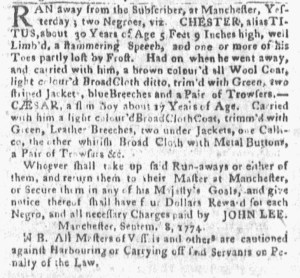
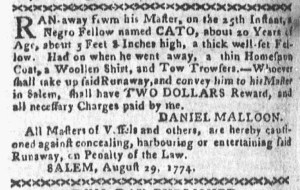
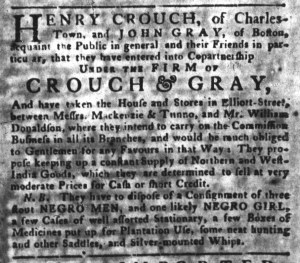
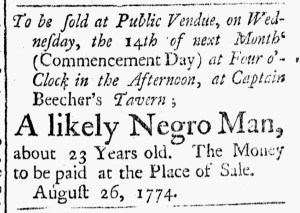
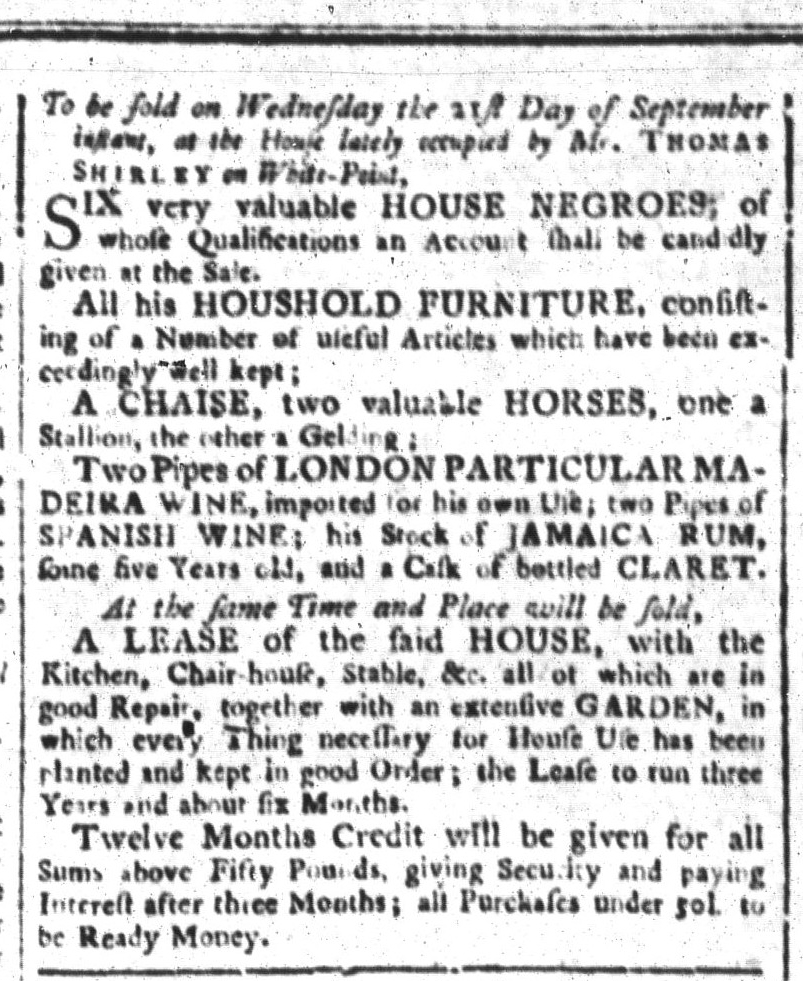
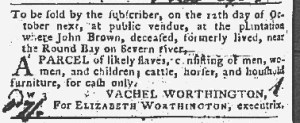
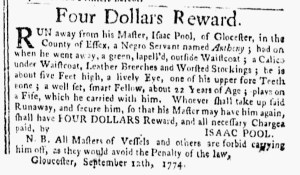
Essex Gazette (September 13, 1774).

**********

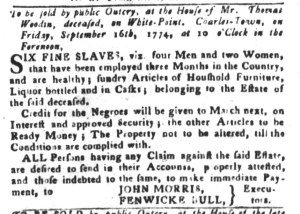
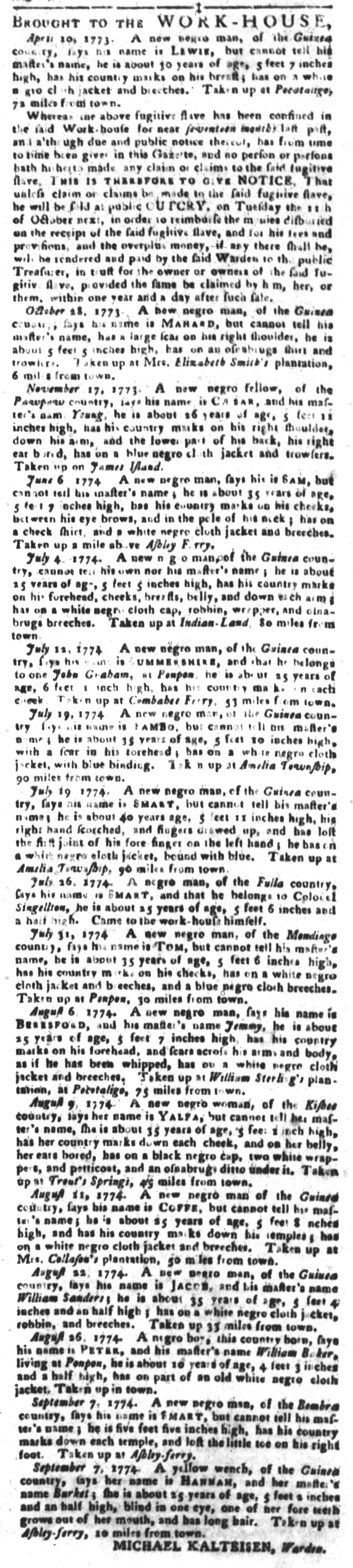
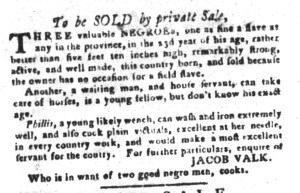
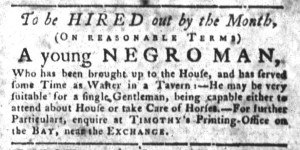
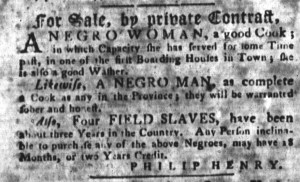
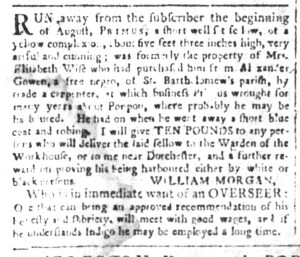
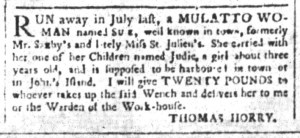
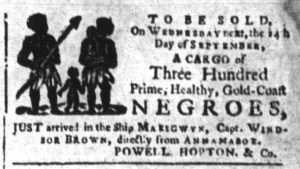
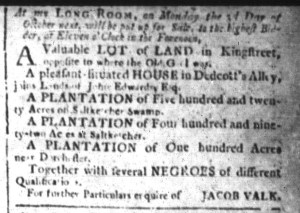
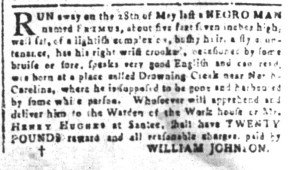
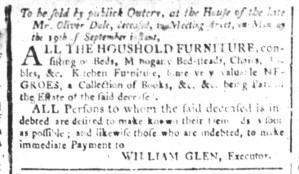
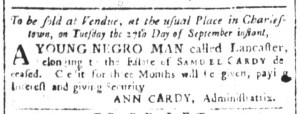
South-Carolina Gazette and Country Journal (September 13, 1774).

**********

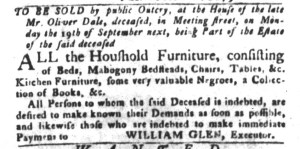
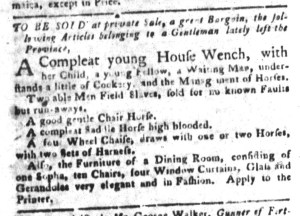
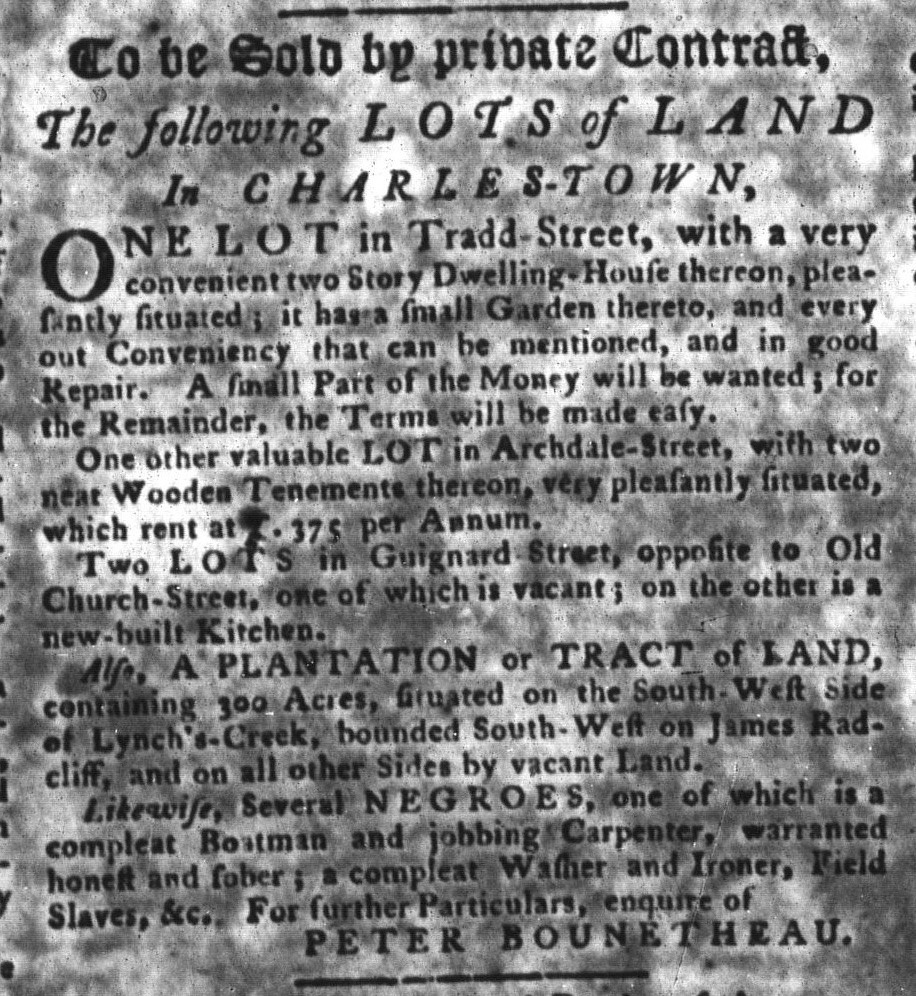
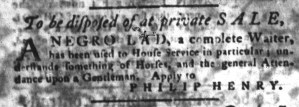
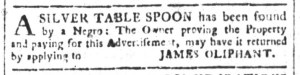
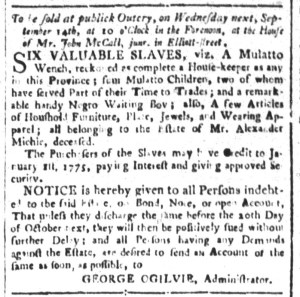
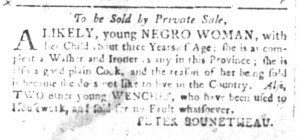
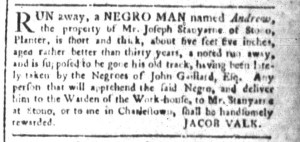
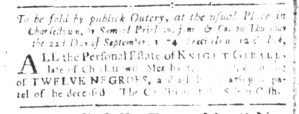
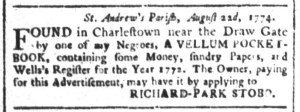
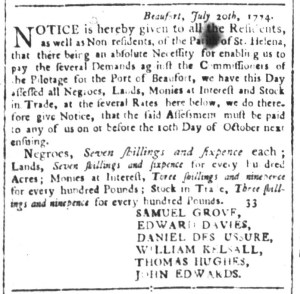
South-Carolina Gazette and Country Journal (September 13, 1774).

**********

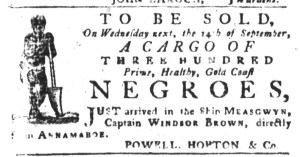
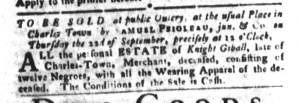
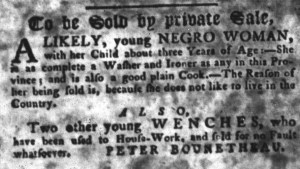
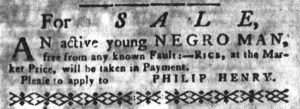
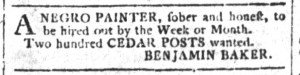
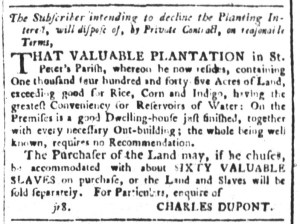
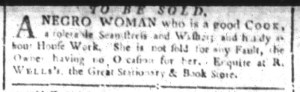
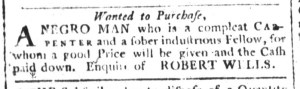
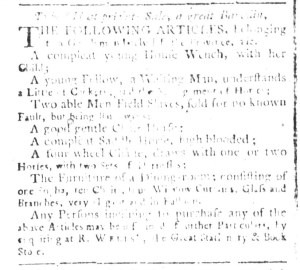
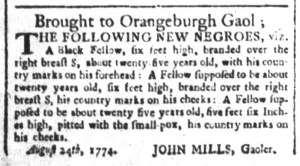
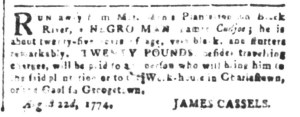
South-Carolina Gazette and Country Journal (September 13, 1774).

**********

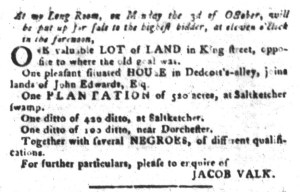
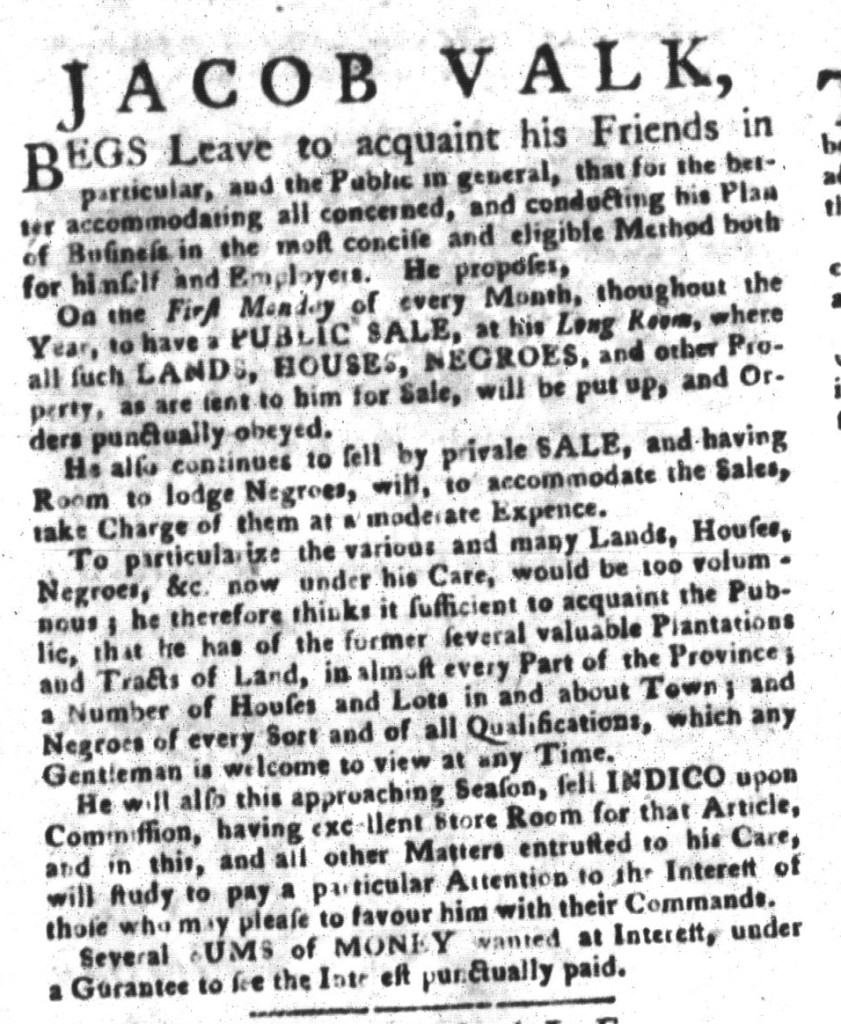
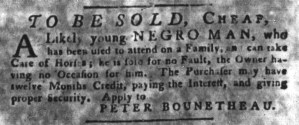
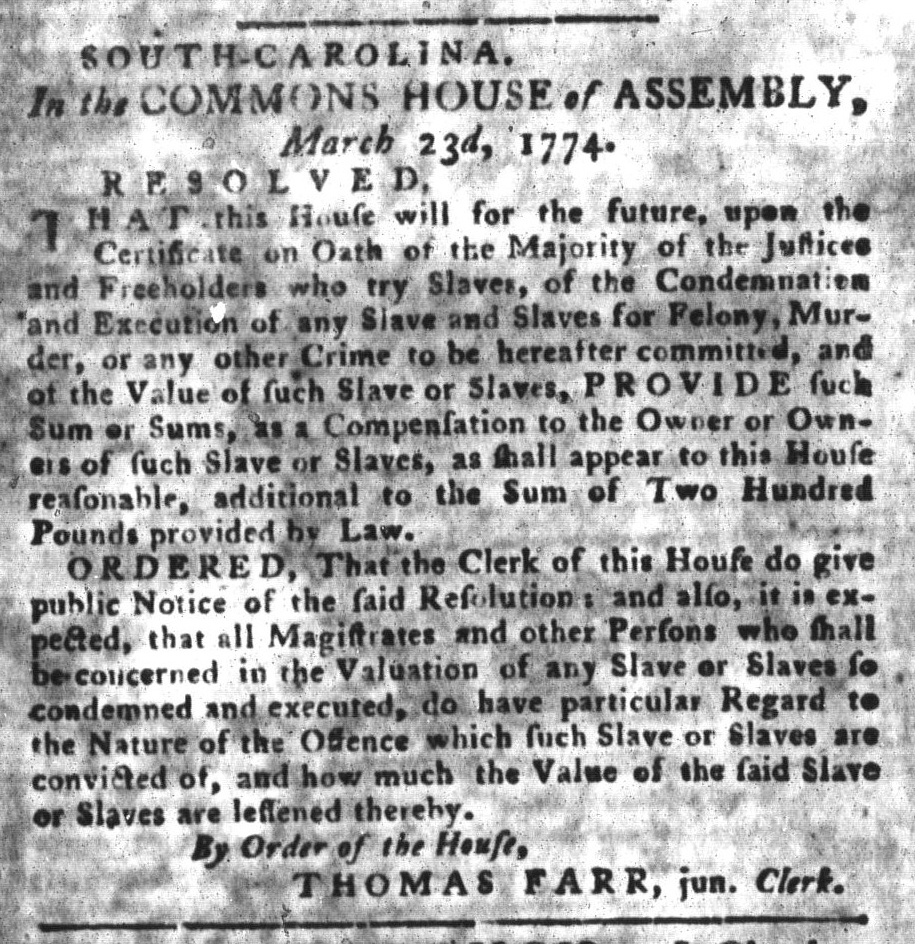
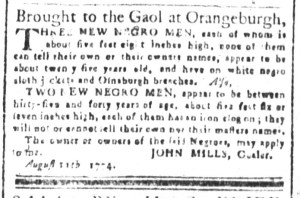
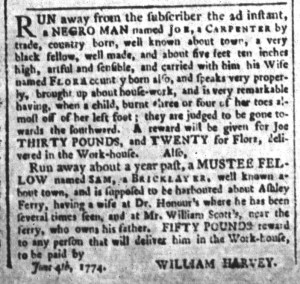
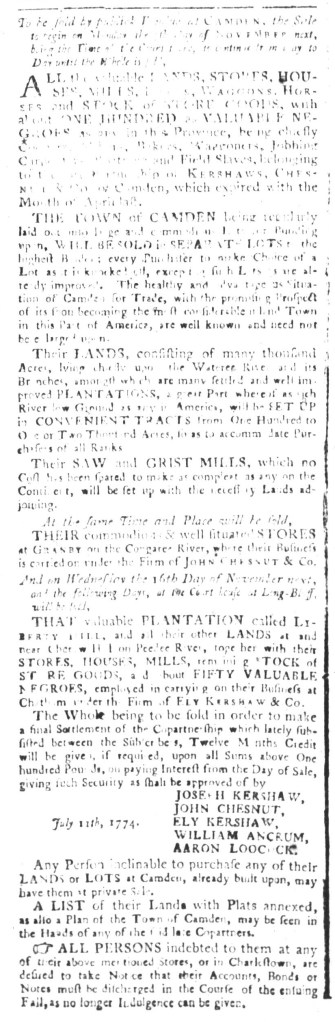
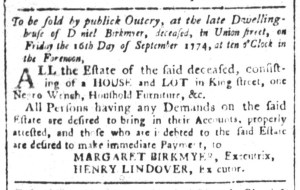
South-Carolina Gazette and Country Journal (September 13, 1774).

**********

South-Carolina Gazette and Country Journal (September 13, 1774).

**********

South-Carolina Gazette and Country Journal (September 13, 1774).

**********

South-Carolina Gazette and Country Journal (September 13, 1774).

**********

South-Carolina Gazette and Country Journal (September 13, 1774).

**********

South-Carolina Gazette and Country Journal (September 13, 1774).

**********

South-Carolina Gazette and Country Journal (September 13, 1774).

September 12

What was advertised in a colonial American newspaper 250 years ago today?

Connecticut Courant (September 12, 1774).

“A SERMON preached … after the Report arrived that People at Boston had destroyed a large Quantity of TEA.”

The September 12, 1774, edition of the Connecticut Courant carried relatively few advertisements.  News and editorials, especially concerning the imperial crisis that increasingly consumed public discourse, crowded out most of the notices that appeared the previous week.  Ebenezer Watson, the printer, however, did find space to include an advertisement for “A SERMON preached” by Israel Holly “at Suffield, Dec. 27, 1773, the next Sabbath after the Report arrived that the People at Boston had destroyed a large Quantity of TEA belonging to the East-India Company, rather than submit to Parliament Acts which they looked upon unconstitutional, tyrannical, and tending to enslave America.”  Watson proclaimed that he had “Just Published” the sermon and offered it for sale.

Even though Holly delivered the sermon eight months earlier, it was especially timely in September 1774 as colonizers received word of the Quebec Act.  Watson initially advertised the sermon in the September 6 edition, immediately below the notice for Considerations on the Measures Carrying On with Respect to the British Colonies in North-America.  He devoted most of the second and a portion of the third page to “an authentic Copy OF the ACT OF PARLIAMENT, For making more effectual Provision for the Government of the Province of QUEBEC, in NORTH-AMERICA.”  Colonizers found several aspects of that legislation troubling, including the free practice of Catholicism by the residents of the territory won from the French in the Seven Years War.  As relayed in the Connecticut Courant, the Quebec Act provided that “His Majesty’s Subject’s professing the Religion of the Church of Rome, of an in the said Province of Quebec, may have, hold and enjoy the free Exercise of the Religion of the Church of Rome … and that the Clergy of the said Church may hold, receive, and enjoy their accustomed Dues and Rights,” such as collecting tithes, “with respect to such Persons only as shall, profess the said Religion.”  Protestants in New England and elsewhere in the colonies did not appreciate those provisions.

How was the Quebec Act connected to a minister preaching in support of the Boston Tea Party?  In a review of James P. Byrd’s Sacred Scripture, Sacred War: The Bible and the American Revolution, Mark A. Noll explains that Holly’s “word of warning to New England reflected the deeply engrained anti-Catholic biblicism that had become standard in the British Empire over the course of previous decades.”  According to the minister’s line of reasoning, “[i]f New England did not repent of its own tyrannies … the expansion of British despotism could soon lead to more ‘arbitrary government’ and even ‘popery.’”[1]  The Quebec Act seemed to fulfill the prediction that Holly made in December 1773, helping to explain why the minister and the printer took the sermon to press when they did.

**********

[1] Mark A. Noll, “The Holy Book in a Holy War,” Reviews in American History 42, no. 2 (December 2014): 612.

Slavery Advertisements Published September 12, 1774

The Slavery Adverts 250 Project chronicles the role of newspaper advertising in perpetuating slavery in the era of the American Revolution. The project seeks to reveal the ubiquity of slavery in eighteenth-century life from New England to Georgia by republishing advertisements about enslaved people – for sale as individuals or in groups, wanted to purchase or for hire for short periods, runaways who liberated themselves, and those who were subsequently captured and confined in jails and workhouses – in daily digests on this site as well as in real time via the @SlaveAdverts250 Twitter feed, utilizing twenty-first-century media to stand in for the print media of the eighteenth century.

The project aims to provide modern audiences with a sense of just how often colonizers encountered these advertisements in their daily lives. Enslaved men, women, and children appeared in print somewhere in the colonies almost every single day. Those advertisements served as a constant backdrop for social, cultural, economic, and political life in colonial and revolutionary America. Colonizers who did not purport to own enslaved people were still confronted with slavery as well as invited to maintain the system by purchasing enslaved men, women, and children or assisting in the capture of so-called “runaways” who sought to free themselves from bondage. The frequency of these newspaper advertisements suggests just how embedded slavery was in colonial and revolutionary American culture in everyday interactions beyond the printed page.

These advertisements also testify to the experiences of enslaved men, women, and children, though readers must consider that those experiences have been remediated through descriptions offered by enslavers rather than enslaved people themselves. Often unnamed in the advertisements, enslaved men, women, and children were not invisible or unimportant in early America.

These advertisements appeared in colonial American newspapers 250 years ago today.

Boston Evening-Post (September 12, 1774).

**********

Boston-Gazette (September 12, 1774).

**********

Boston-Gazette (September 12, 1774).

**********

Boston-Gazette (September 12, 1774).

**********

Connecticut Courant (September 12, 1774).

**********

Dunlap’s Pennsylvania Packet (September 12, 1774).

**********

Dunlap’s Pennsylvania Packet (September 12, 1774).

**********

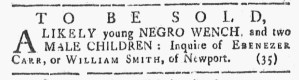
Newport Mercury (September 12, 1774).

**********

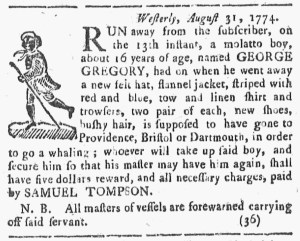
Newport Mercury (September 12, 1774).

**********

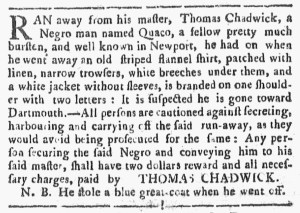
Newport Mercury (September 12, 1774).

**********

Newport Mercury (September 12, 1774).

**********

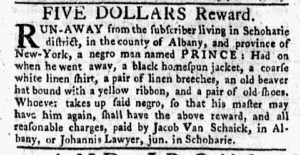
New-York Gazette and Weekly Mercury (September 12, 1774).

**********

Supplement to the New-York Gazette and Weekly Mercury (September 12, 1774).

**********

Supplement to the New-York Gazette and Weekly Mercury (September 12, 1774).

**********

South-Carolina Gazette (September 12, 1774).

**********

South-Carolina Gazette (September 12, 1774).

**********

South-Carolina Gazette (September 12, 1774).

**********

Supplement to the South-Carolina Gazette (September 12, 1774).

**********

Supplement to the South-Carolina Gazette (September 12, 1774).

**********

Supplement to the South-Carolina Gazette (September 12, 1774).

**********

Postscript to the South-Carolina Gazette (September 12, 1774).

**********

Postscript to the South-Carolina Gazette (September 12, 1774).

**********

Postscript to the South-Carolina Gazette (September 12, 1774).

**********

Postscript to the South-Carolina Gazette (September 12, 1774).

**********

Postscript to the South-Carolina Gazette (September 12, 1774).

**********

Postscript to the South-Carolina Gazette (September 12, 1774).

**********

Postscript to the South-Carolina Gazette (September 12, 1774).

**********

Postscript to the South-Carolina Gazette (September 12, 1774).

**********

Postscript to the South-Carolina Gazette (September 12, 1774).

**********

Postscript to the South-Carolina Gazette (September 12, 1774).

**********

Postscript to the South-Carolina Gazette (September 12, 1774).

**********

Postscript to the South-Carolina Gazette (September 12, 1774).

**********

Postscript to the South-Carolina Gazette (September 12, 1774).

September 11

What was advertised in a colonial American newspaper 250 years ago this week?

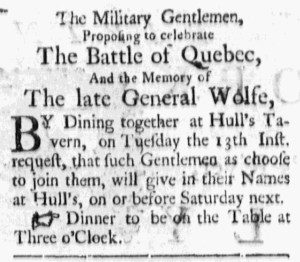
Rivington’s New-York Gazetteer (September 8, 1774).

“Celebrate The Battle of Quebec, And the Memory of The late General Wolfe.”

Even as turmoil brewed in the wake of colonizers learning of the Coercive Acts and the Quebec Act in the spring and summer of 1774, most continued to embrace their British identity while condemning Parliament for its treatment of the colonies.  As the First Continental Congress commenced its meetings in Philadelphia at the beginning of September, a notice in the September 8 edition of Rivington’s New-York Gazetteer advised “Military Gentlemen” of an upcoming dinner to celebrate “The Battle of Quebec, And the Memory of The late General Wolfe.”  The event would take place at Hull’s Tavern on September 13, marking the fifteenth anniversary of the death of General James Wolfe on the Plains of Abraham outside the walled city of Quebec during the Seven Years War.  Although Wolfe perished, the battle resulted in a British victory that ended the siege of Quebec, one of the most decisive moments of the war in North America.

At the end of the war, the French withdrew from the continent.  The British Empire gained the territory France had claimed in Canada.  English colonizers in America joined in memorializing Wolfe and celebrating such an important victory, emphasizing their own contributions throughout the war.  In 1770, Benjamin West, an influential American painter who had migrated to England and settled in London in the 1760s, memorialized the battle and celebrated the British Empire in The Death of General Wolfe.  It became his most famous history painting, frequently reproduced.  In the colonies, Americans honored Wolfe in other ways.  In Boston, for instance, William Murray marked the location of the shop where he sold an “Assortment of English Goods” with the “Sign of General WOLFE.”  In New York, veterans of the war and others participated in commemorative dinners, no doubt making toasts in memory of Wolfe and in honor of the British Empire.

On the fifteenth anniversary of Wolfe’s death, most colonizers had not yet determined to separate from the British Empire.  Instead, they sought a redress of their grievances against Parliament, many hoping that the king would intervene on their behalf.  The conversations and the toasts at the dinner celebrating the battle likely included references to English liberties that colonizers believed they were entitled to enjoy as members of the British Empire.  In remembering the Battle of Quebec and memorializing Wolfe, they demonstrated their continued attachment to the British Empire.  As the First Continental Congress began its deliberations in September 1774, the rupture was not yet so significant that declaring independence was inevitable.

September 10

What was advertised in a colonial American newspaper 250 years ago today?

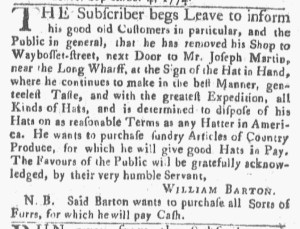
Providence Gazette (September 10, 1774).

“He has removed his Shop to … the Sign of the Hat in Hand.”

When William Barton moved to a new location as the summer came to a close in 1774, he placed an advertisement in the Providence Gazette to inform “his good old Customers in particular, and the Public in general” where to find him.  Having established a clientele, the hatter did not wish to miss out on subsequent business if customers went to his former shop and did not discover him there.  All prospective customers, whether or not they previously acquired hats from Barton, could recognize his new location by the “Sign of the Hat in Hand.”  The hatter did not indicate whether that marketing device had marked his previous location or if it was an innovation on the occasion of setting up shop on Weybosset Street.  Either way, it became part of the landscape of advertising that colonizers encountered as they traversed the streets “near the Long Wharff” in Providence.

To entice consumers to visit his shop, Barton made a variety of appeals.  He promised quality, stating that he made hats “in the best Manner.”  He emphasized fashion, declaring that his hats reflected “genteelest Taste.”  He touted his own skill and industriousness, asserting that “the greatest Expedition” went into producing his hats.  He offered choices to consumers, proclaiming that his inventory included “all Kinds of Hats.”  For his boldest appeal, he trumpeted that he was “determined to dispose of his Hats on as reasonable Terms as any Hatter in America.”  Barton did not merely compare his prices to his local competitors.  He confidently declared that consumers would not find any better deal anywhere, even if they sent away to Boston or New York or any other city or town in the colonies.  He challenged readers to visit his shop, learn his prices, and judge for themselves.  If his claim could get potential customers through the doors, that increased his chances of making sales.  Though his advertisement was not particularly lengthy, Barton incorporated many of the most common marketing appeals advanced by artisans in eighteenth-century America, anticipating that they collectively became more even more convincing.
September 9

What was advertised in a colonial American newspaper 250 years ago today?

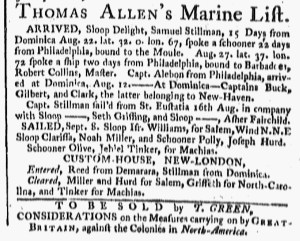
Connecticut Gazette (September 9, 1774).

“CONSIDERATIONS on the Measures carrying on by GREAT BRITAIN, against the Colonies in North-America.”

As the number of American editions of Considerations on the Measures Carrying On with Respect to the British Colonies in North-America increased in 1774, so did the number of newspapers that carried advertisements for the political tract.  John Holt, the printer of the New-York Journal, advertised his edition.  Benjamin Edes and John Gill, the printers of the Boston-Gazette, did so as well for their edition.  Ebenezer Watson, printer of the Connecticut Courant, ran his own advertisement when he published a Hartford edition.  Yet it was not solely the printers of the various American editions who advertised or sold the popular pamphlet.  Watson listed local agents in eight towns and two post riders who sold his edition.  David Atwater advertised the New York edition for sale in New Haven in the Connecticut Journal.

Timothy Green, printer of the Connecticut Gazette, joined their ranks with an advertisement in the September 9, 1774, edition of his newspaper.  That made the pamphlet available for purchase in New London in addition to other towns in New England and New York.  Compared to the other advertisements, however, Green’s notice was quite brief, just three lines that completed the column following “THOMAS ALLEN’S Marine List,” a regular feature, on the third page.  “TO BE SOLD by T. GREEN, CONSIDERATIONS on the Measures carrying on by GREAT BRITAIN, against the Colonies in North-America.”  Green did not provide any of the elaborate description about how well the pamphlet had been received in London and how it had influenced residents there to support the American colonies against the abuses perpetrated by Parliament, nor did he encourage readers to review it for themselves so they could be better informed.  Perhaps he expected that the news he printed throughout the rest of his newspaper and the conversations about current events taking place everywhere anyone went those days provided enough reason for colonizers to acquire the pamphlet.  He also did not state which edition he sold, though the variant title in his advertisement suggests that he carried Watson’s Hartford edition.  In stocking and promoting the pamphlet, Green joined printers, post riders, and others in disseminating a political tract intended to influence colonizers and help them in articulating their grievances against Parliament.

Slavery Advertisements Published September 9, 1774

The Slavery Adverts 250 Project chronicles the role of newspaper advertising in perpetuating slavery in the era of the American Revolution. The project seeks to reveal the ubiquity of slavery in eighteenth-century life from New England to Georgia by republishing advertisements about enslaved people – for sale as individuals or in groups, wanted to purchase or for hire for short periods, runaways who liberated themselves, and those who were subsequently captured and confined in jails and workhouses – in daily digests on this site as well as in real time via the @SlaveAdverts250 Twitter feed, utilizing twenty-first-century media to stand in for the print media of the eighteenth century.

The project aims to provide modern audiences with a sense of just how often colonizers encountered these advertisements in their daily lives. Enslaved men, women, and children appeared in print somewhere in the colonies almost every single day. Those advertisements served as a constant backdrop for social, cultural, economic, and political life in colonial and revolutionary America. Colonizers who did not purport to own enslaved people were still confronted with slavery as well as invited to maintain the system by purchasing enslaved men, women, and children or assisting in the capture of so-called “runaways” who sought to free themselves from bondage. The frequency of these newspaper advertisements suggests just how embedded slavery was in colonial and revolutionary American culture in everyday interactions beyond the printed page.

These advertisements also testify to the experiences of enslaved men, women, and children, though readers must consider that those experiences have been remediated through descriptions offered by enslavers rather than enslaved people themselves. Often unnamed in the advertisements, enslaved men, women, and children were not invisible or unimportant in early America.

These advertisements appeared in colonial American newspapers 250 years ago today.

Connecticut Gazette (September 9, 1774).

**********

Connecticut Gazette (September 9, 1774).

**********

Connecticut Journal (September 9, 1774).

**********

Connecticut Journal (September 9, 1774).

**********

Connecticut Journal (September 9, 1774).

**********

South-Carolina and American General Gazette (September 9, 1774).

**********

South-Carolina and American General Gazette (September 9, 1774).

**********

South-Carolina and American General Gazette (September 9, 1774).

**********

South-Carolina and American General Gazette (September 9, 1774).

**********

South-Carolina and American General Gazette (September 9, 1774).

**********

South-Carolina and American General Gazette (September 9, 1774).

**********

South-Carolina and American General Gazette (September 9, 1774).

**********

South-Carolina and American General Gazette (September 9, 1774).

**********

South-Carolina and American General Gazette (September 9, 1774).

**********

South-Carolina and American General Gazette (September 9, 1774).

**********

South-Carolina and American General Gazette (September 9, 1774).

**********

South-Carolina and American General Gazette (September 9, 1774).

**********

South-Carolina and American General Gazette (September 9, 1774).

**********

South-Carolina and American General Gazette (September 9, 1774).

**********

South-Carolina and American General Gazette (September 9, 1774).

**********

South-Carolina and American General Gazette (September 9, 1774).

**********

South-Carolina and American General Gazette (September 9, 1774).

**********

South-Carolina and American General Gazette (September 9, 1774).

**********

South-Carolina and American General Gazette (September 9, 1774).

**********

South-Carolina and American General Gazette (September 9, 1774).

**********

South-Carolina and American General Gazette (September 9, 1774).

**********

South-Carolina and American General Gazette (September 9, 1774).

**********

South-Carolina and American General Gazette (September 9, 1774).

**********

South-Carolina and American General Gazette (September 9, 1774).

**********

South-Carolina and American General Gazette (September 9, 1774).

**********

South-Carolina and American General Gazette (September 9, 1774).

**********

South-Carolina and American General Gazette (September 9, 1774).

**********

South-Carolina and American General Gazette (September 9, 1774).

September 8

What was advertised in a colonial American newspaper 250 years ago today?

Maryland Gazette (September 8, 1774).

“IF a certain E.V. does not immediately pay for his family picture, his name shall be published at full length in the next paper.”

A private scuffle over paying for a portrait became a public spectacle when Charles Willson Peale resorted to shaming Elie Vallette, author of the Deputy Commissary’s Guide, in a newspaper advertisement.  A notice in the September 8, 1774, edition of the Maryland Gazette advised that “IF a certain E.V. does not immediately pay for his family picture, his name shall be published at full length in the next paper.”  The painter, who signed his name as “CHARLES PEALE,” was near the beginning of his career, though he had already studied with Benjamin West in London for two years and then provided his services in Annapolis for a dozen more.  Still, at the time he sought the overdue payment, he was not yet the prominent figure, one of the most influential America painters and naturalists of his era, that he would become in the decades after the American Revolution.  He gained access to the power of celebrity later in his career, but at the moment he vied with Vallette he sought to leverage public shaming as the most effective tool available.

As Martha J. King notes, Peale “obtained a commission to paint a group portrait of the Vallette family and portrayed the author seated at a table with the engraved title page of the Deputy Commissary’s Guide clearly visible in the foreground.  [His] wife and two children clustered in the picture’s right.”[1]  Vallette had extensively advertised the Deputy Commissary’s Guide in the Maryland Gazette, gaining prominence for himself and his manual for settling estates and writing wills.  Commissioning a family portrait served to further enhance his status, yet the dispute that followed did not necessarily reflect well on Vallette.  On May 28, 1774, Peale sent a letter to Vallette to request payment, explaining that he needed to cover immediate expenses that included rent on the house where his family resided.[2]  The author did not heed that request.  Three months later, Peale decided to escalate his methods for collecting on the debt, placing the advertisement that gave Vallette’s initials and enough information that the author would recognize himself and perhaps enough that some readers could work out his identity, but not so much that readers in Annapolis and throughout the colony knew without a doubt that Peale addressed Vallette.  Was this strategy effective?  Next week the Adverts 250 Project will examine the subsequent issue of the Maryland Gazette to determine whether Peale had to further escalate his demand for payment.

**********

[1] Martha J. King, “The Printer and the Painter: Portraying Print Culture in an Age of Revolution,” Transactions of the American Philosophical Society 109, no. 5 (2021): 78.

[2] King, “Printer and the Painter,” 78.

Slavery Advertisements Published September 8, 1774

The Slavery Adverts 250 Project chronicles the role of newspaper advertising in perpetuating slavery in the era of the American Revolution. The project seeks to reveal the ubiquity of slavery in eighteenth-century life from New England to Georgia by republishing advertisements about enslaved people – for sale as individuals or in groups, wanted to purchase or for hire for short periods, runaways who liberated themselves, and those who were subsequently captured and confined in jails and workhouses – in daily digests on this site as well as in real time via the @SlaveAdverts250 Twitter feed, utilizing twenty-first-century media to stand in for the print media of the eighteenth century.

The project aims to provide modern audiences with a sense of just how often colonizers encountered these advertisements in their daily lives. Enslaved men, women, and children appeared in print somewhere in the colonies almost every single day. Those advertisements served as a constant backdrop for social, cultural, economic, and political life in colonial and revolutionary America. Colonizers who did not purport to own enslaved people were still confronted with slavery as well as invited to maintain the system by purchasing enslaved men, women, and children or assisting in the capture of so-called “runaways” who sought to free themselves from bondage. The frequency of these newspaper advertisements suggests just how embedded slavery was in colonial and revolutionary American culture in everyday interactions beyond the printed page.

These advertisements also testify to the experiences of enslaved men, women, and children, though readers must consider that those experiences have been remediated through descriptions offered by enslavers rather than enslaved people themselves. Often unnamed in the advertisements, enslaved men, women, and children were not invisible or unimportant in early America.

These advertisements appeared in colonial American newspapers 250 years ago today.

Maryland Gazette (September 8, 1774).

**********

Maryland Gazette (September 8, 1774).

**********

Maryland Gazette (September 8, 1774).

**********

Maryland Gazette (September 8, 1774).

**********

Maryland Gazette (September 8, 1774).

**********

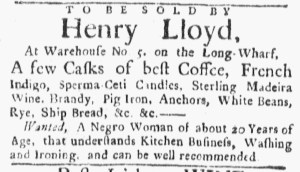
New-York Journal (September 8, 1774).

**********

Norwich Packet (September 8, 1774).

**********

Rivington’s New-York Gazetteer (September 8, 1774).

**********

Virginia Gazette [Purdie & Dixon] (September 8, 1774).

**********

Virginia Gazette [Purdie & Dixon] (September 8, 1774).

**********

Virginia Gazette [Purdie & Dixon] (September 8, 1774).

**********

Virginia Gazette [Purdie & Dixon] (September 8, 1774).

**********

Virginia Gazette [Purdie & Dixon] (September 8, 1774).

**********

Virginia Gazette [Purdie & Dixon] (September 8, 1774).

**********

Virginia Gazette [Purdie & Dixon] (September 8, 1774).

**********

Virginia Gazette [Purdie & Dixon] (September 8, 1774).

**********

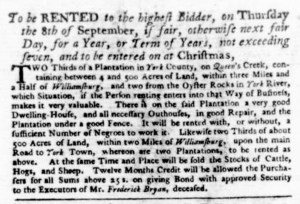
Virginia Gazette [Purdie & Dixon] (September 8, 1774).

**********

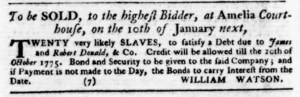
Virginia Gazette [Rind] (September 8, 1774).

**********

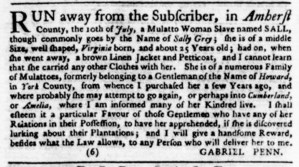
Virginia Gazette [Rind] (September 8, 1774).

**********

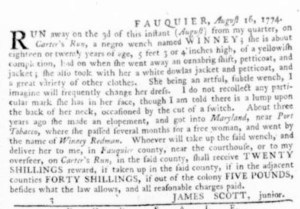
Virginia Gazette [Rind] (September 8, 1774).

**********

Virginia Gazette [Rind] (September 8, 1774).

**********

Virginia Gazette [Rind] (September 8, 1774).

**********

Virginia Gazette [Rind] (September 8, 1774).