September 7

What was advertised in a colonial American newspaper 250 years ago today?
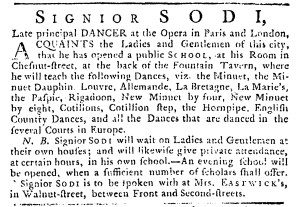
Pennsylvania Journal (September 7, 1774).

“He will teach … all the Dances that are danced in the several Courts in Europe.”

It could have been a coincidence that dancing masters Mr. Pike and Signior Sodi placed advertisements in Dunlap’s Pennsylvania Packet, the Pennsylvania Gazette, and the Pennsylvania Journal at the same time.  When Pike arrived in the Pennsylvania after teaching fencing and dancing in Charleston for a decade, he introduced himself to prospective pupils and the rest of the public with an advertisement in the September 5, 1775, edition of Dunlap’s Pennsylvania Packet.  He placed the same advertisement in the Pennsylvania Gazette two days later.

Sodi ran his own advertisement in the same issue of Dunlap’s Pennsylvania Packet.  The two notices appeared on the same page, Sodi’s at the bottom of one column and Pike’s at the top of the next one.  Two days later, Sodi inserted his advertisement in the Pennsylvania Journal.  Perhaps the “Late principal DANCER at the Opera in Paris and London” had previously intended to advertise in early September.  After all, he stated in his newspaper notice about a “GRAND CONCERT & BALL” in June that he “proposes to open a School publicly next September.”  He did not, however, commence advertising that school before Pike was on the scene.  Sodi may have heard that a new competitor would soon offer lessons to the local gentry, prompting him to advertise in the city’s newspaper published on Mondays and one of the two published on Wednesdays.

While Pike touted his experience as an instructor and a reputation that could be confirmed by “many respectable gentlemen” from South Carolina “present in this city,” likely including delegates to the First Continental Congress, Sodi emphasized his connections to some of the most cosmopolitan and refined places in Europe.  In addition to describing himself as the “Late Principal DANCER at the Opera in Paris and London,” he declared that he assisted students in learning “all the Dances that are dance in the several Courts in Europe.”  He also gave French names for several dances, suggesting the sophistication associated with the steps he taught at the Fountain Tavern and at private lessons in the homes of his pupils.

The advertisements that ran in Philadelphia’s newspapers outlined the choices available to prospective students and their families.  They could engage the services of a newcomer with endorsements from prominent men visiting the city or an Italian dancing master with experience in Paris, London, and European courts.  No matter which one they chose, the presence of these advertisements in the public prints reminded readers that dancing proficiently and gracefully was an important part of demonstrating gentility and status.
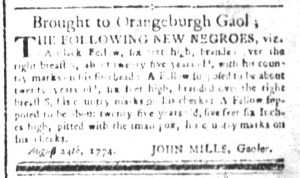
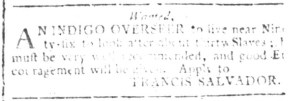
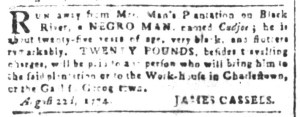
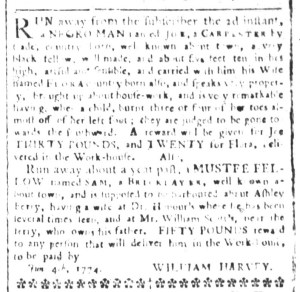
Slavery Advertisements Published September 7, 1774

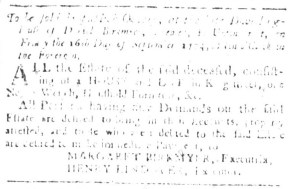
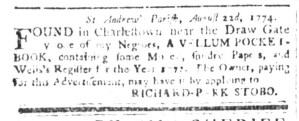
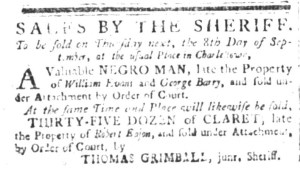
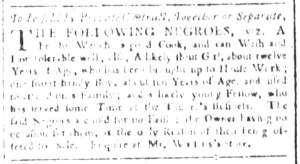
The Slavery Adverts 250 Project chronicles the role of newspaper advertising in perpetuating slavery in the era of the American Revolution. The project seeks to reveal the ubiquity of slavery in eighteenth-century life from New England to Georgia by republishing advertisements about enslaved people – for sale as individuals or in groups, wanted to purchase or for hire for short periods, runaways who liberated themselves, and those who were subsequently captured and confined in jails and workhouses – in daily digests on this site as well as in real time via the @SlaveAdverts250 Twitter feed, utilizing twenty-first-century media to stand in for the print media of the eighteenth century.

The project aims to provide modern audiences with a sense of just how often colonizers encountered these advertisements in their daily lives. Enslaved men, women, and children appeared in print somewhere in the colonies almost every single day. Those advertisements served as a constant backdrop for social, cultural, economic, and political life in colonial and revolutionary America. Colonizers who did not purport to own enslaved people were still confronted with slavery as well as invited to maintain the system by purchasing enslaved men, women, and children or assisting in the capture of so-called “runaways” who sought to free themselves from bondage. The frequency of these newspaper advertisements suggests just how embedded slavery was in colonial and revolutionary American culture in everyday interactions beyond the printed page.
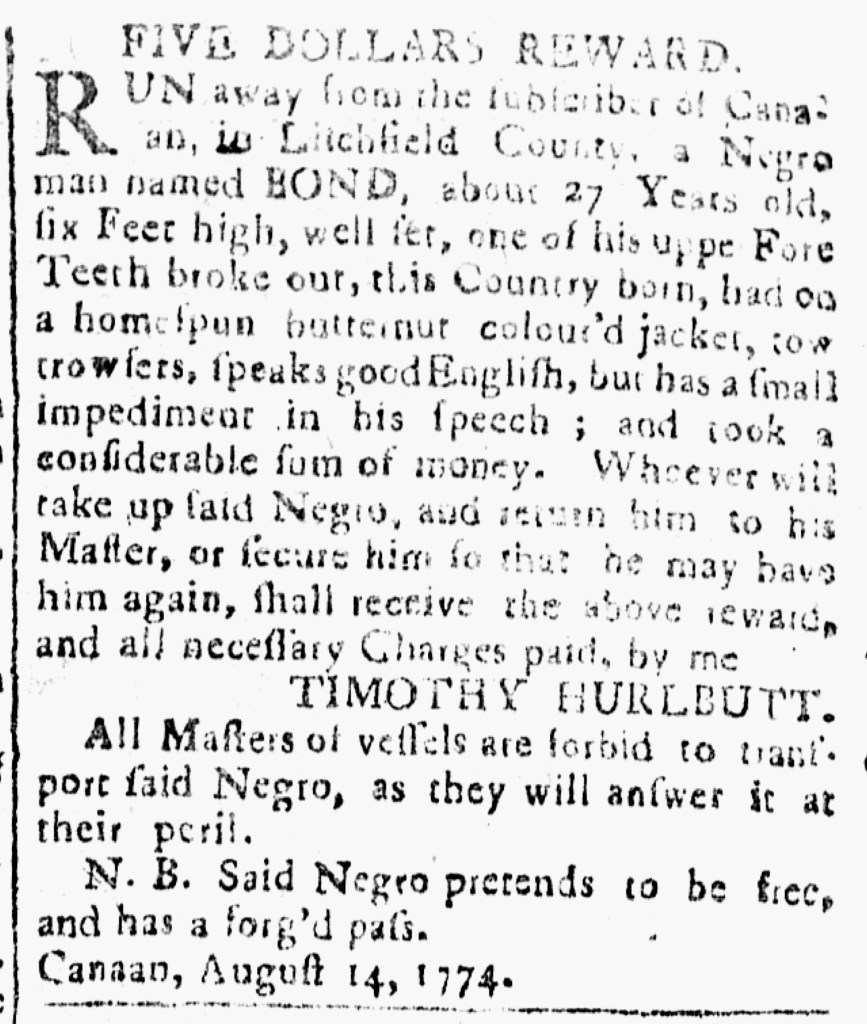
These advertisements also testify to the experiences of enslaved men, women, and children, though readers must consider that those experiences have been remediated through descriptions offered by enslavers rather than enslaved people themselves. Often unnamed in the advertisements, enslaved men, women, and children were not invisible or unimportant in early America.

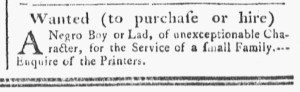
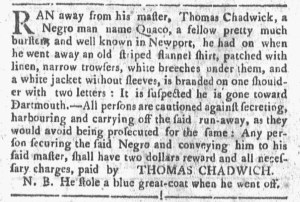
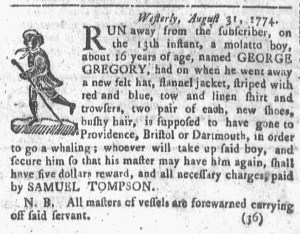
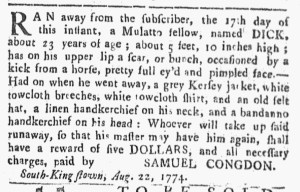
These advertisements appeared in colonial American newspapers 250 years ago today.

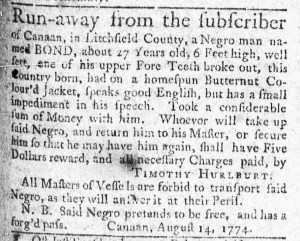
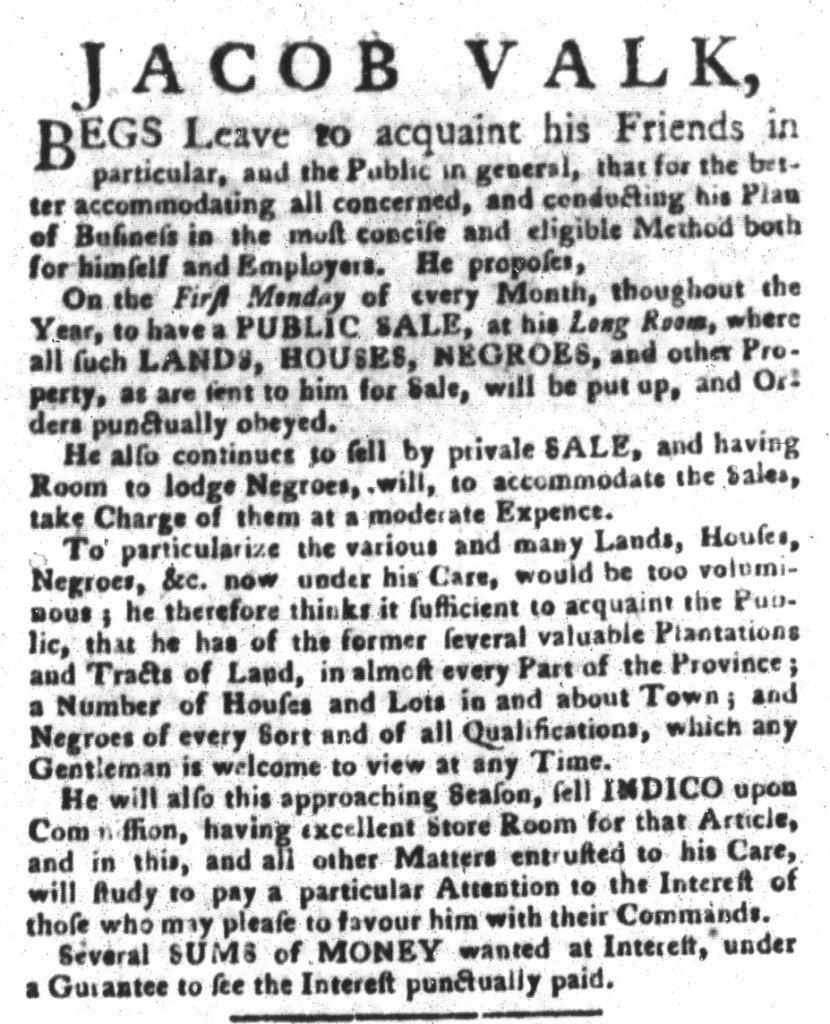
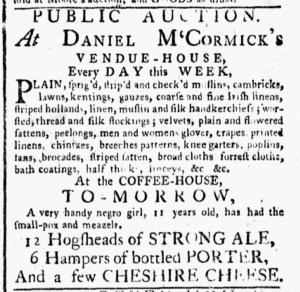
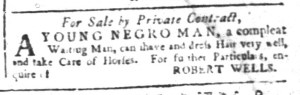
Maryland Journal (September 7, 1774).

**********

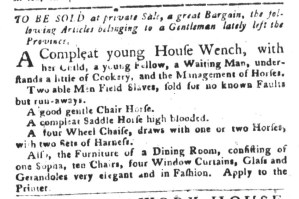
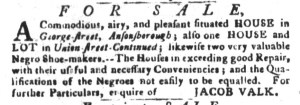
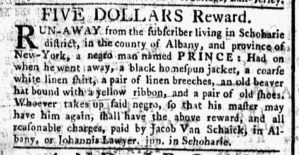
Maryland Journal (September 7, 1774).

**********

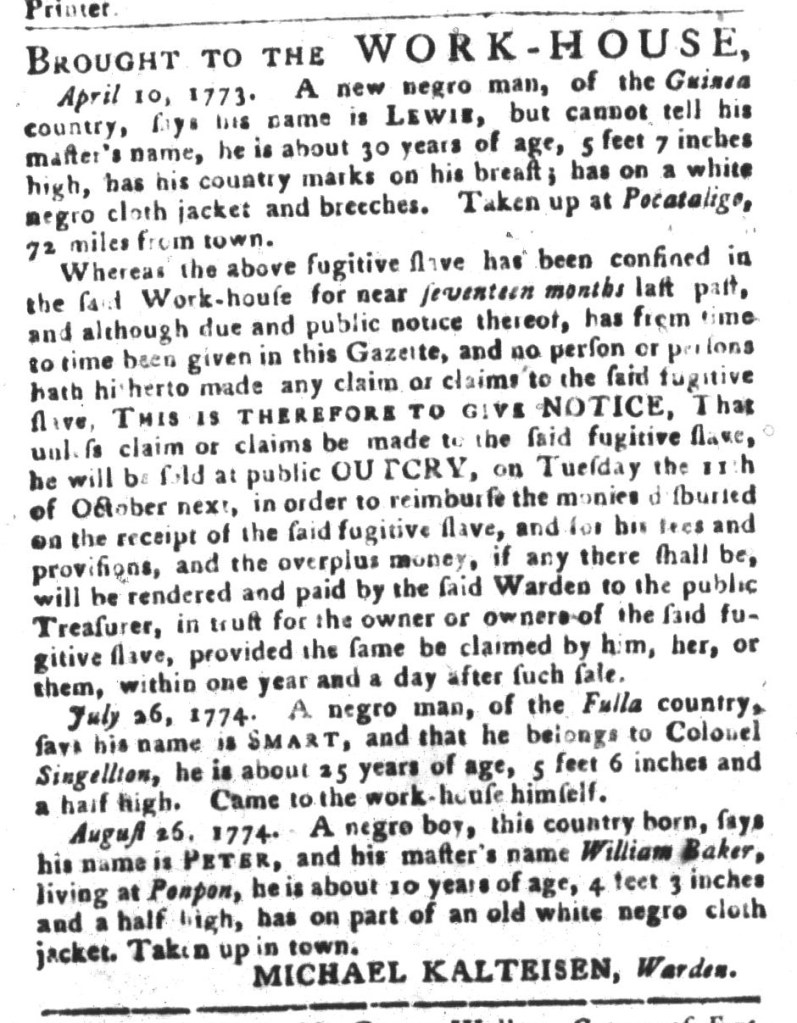
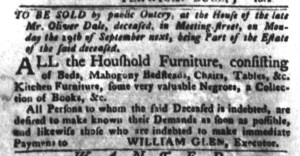
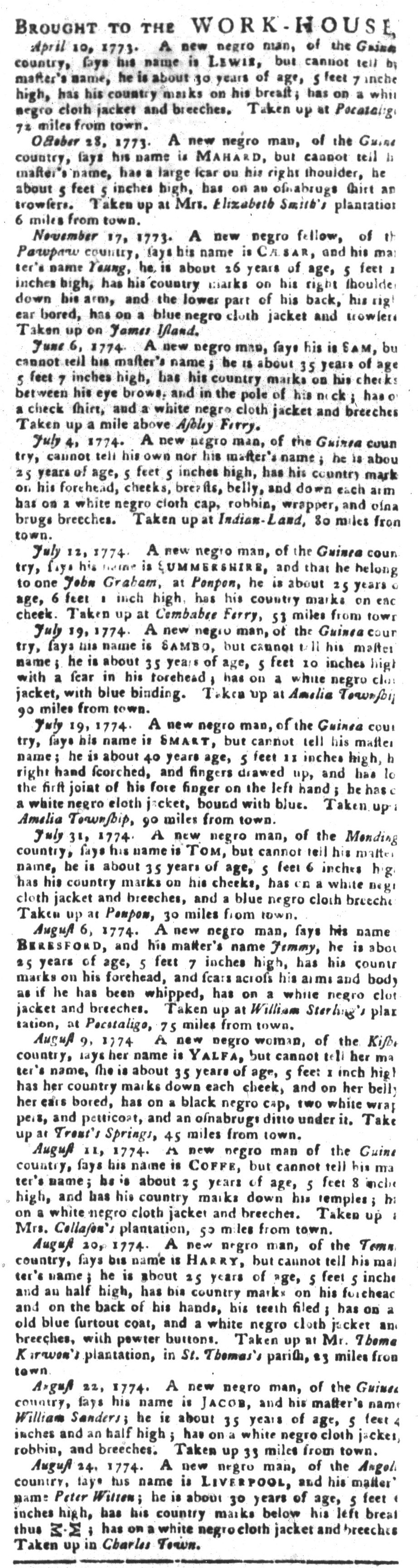
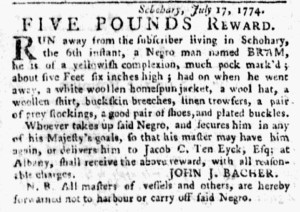
Pennsylvania Gazette (September 7, 1774).

September 6

What was advertised in a colonial American newspaper 250 years ago today?

Connecticut Courant (September 6, 1774).

This celebrated Performance … had a wonderful Operation on the Minds of that People.”

A popular political pamphlet originally printed in London and reprinted in four towns in the colonies made another appearance among the advertisements in the September 6, 1774, edition of the Connecticut Courant.  In this instance, Ebenezer Watson, the printer of that newspaper, promoted his own edition of Considerations on the Measures Carrying On with Respect to the British Colonies in North-America produced at his printing office in Hartford.  By that time, John Holt, printer of the New-York Journal, and Benjamin Edes and John Gill, printers of the Boston-Gazette, had already advertised their own editions of the tract.  In New Haven, David Atwater advertised and sold Holt’s New York edition.

Those advertisers replicated the copy from one notice to another.  For his part, however Watson devised his own copy, though he had likely seen at least some of the other advertisements as he scoured other newspapers for content to reprint in the Connecticut Courant.  Watson even offered a variant title in his advertisement, “CONSIDERATIONS On the Measures carrying on by GREAT-BRITAIN, Against the Colonies in NORTH-AMERICA,” though the title on the title page of the pamphlet itself was consistent with the original London edition and the others reprinted in the colonies.  Although Watson did not directly borrow copy from the other advertisements circulating at the time, he seems to have been inspired by them enough to paraphrase from them.  “This celebrated performance” (rather than a “most masterly performance”), he proclaimed, “was first published in England, and had a wonderful Operation on the Minds of that People, in eradicating their Prejudices against the Inhabitants of America.”  In comparison, the other advertisements declared that the tract “had a wonderful effect in removing the prejudices and convincing the people of England.”  Other advertisers commented on the price of American editions compared to the London edition.  Watson did so more elaborately, stating that a “Book so highly admired, and so wonderfully calculated to open blind Eyes, ought to be in the hands” of colonizers throughout America.  That convinced him “to sell it as cheap as he can possibly afford it” without losing money on it.

To disseminate the pamphlet widely, Watson enlisted the aid of local agents in several towns, including Canaan, Farmington, Great Barrington, Litchfield, Middletown, Norfolk, Sheffield, Simsbury, and Torringford.  In addition, readers could acquire copies from two post riders, Joseph Knight and Amos Alden.  As printers in New England marketed a variety of books and pamphlets related to the imperial crisis in the mid 1770s, some of them integrated post riders into their distribution networks in new ways.  They made a point of naming post riders as agents who sold these publications, entrusting them with responsibilities beyond delivering items that buyers ordered from a local dignitary or directly from the printer.  This made post riders’ role in keeping colonizers informed about arguments critiquing Parliament even more visible as they became active proponents rather than mere messengers.

Slavery Advertisements Published September 6, 1774

The Slavery Adverts 250 Project chronicles the role of newspaper advertising in perpetuating slavery in the era of the American Revolution. The project seeks to reveal the ubiquity of slavery in eighteenth-century life from New England to Georgia by republishing advertisements about enslaved people – for sale as individuals or in groups, wanted to purchase or for hire for short periods, runaways who liberated themselves, and those who were subsequently captured and confined in jails and workhouses – in daily digests on this site as well as in real time via the @SlaveAdverts250 Twitter feed, utilizing twenty-first-century media to stand in for the print media of the eighteenth century.

The project aims to provide modern audiences with a sense of just how often colonizers encountered these advertisements in their daily lives. Enslaved men, women, and children appeared in print somewhere in the colonies almost every single day. Those advertisements served as a constant backdrop for social, cultural, economic, and political life in colonial and revolutionary America. Colonizers who did not purport to own enslaved people were still confronted with slavery as well as invited to maintain the system by purchasing enslaved men, women, and children or assisting in the capture of so-called “runaways” who sought to free themselves from bondage. The frequency of these newspaper advertisements suggests just how embedded slavery was in colonial and revolutionary American culture in everyday interactions beyond the printed page.

These advertisements also testify to the experiences of enslaved men, women, and children, though readers must consider that those experiences have been remediated through descriptions offered by enslavers rather than enslaved people themselves. Often unnamed in the advertisements, enslaved men, women, and children were not invisible or unimportant in early America.

These advertisements appeared in colonial American newspapers 250 years ago today.

Connecticut Courant (September 6, 1774).

**********

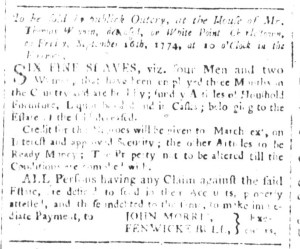
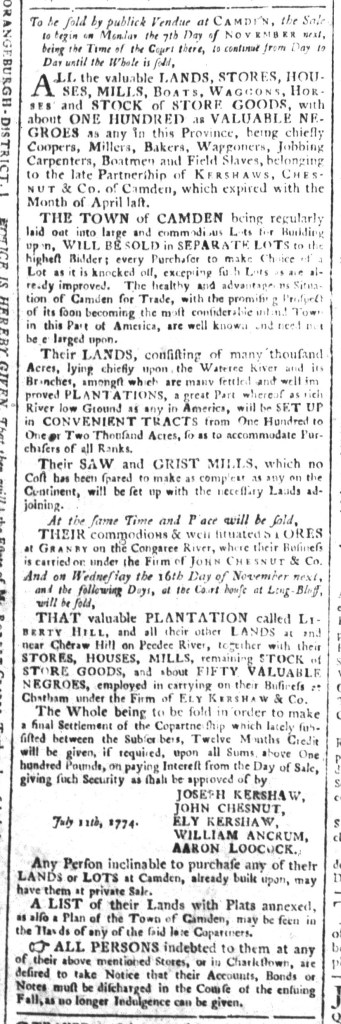
South-Carolina Gazette and Country Journal (September 6, 1774).

**********

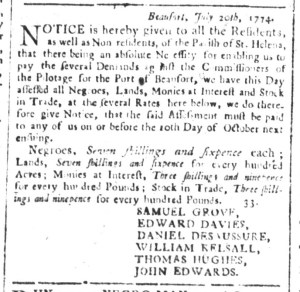
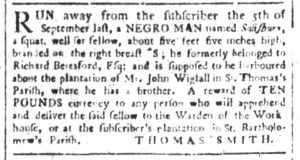
South-Carolina Gazette and Country Journal (September 6, 1774).

**********

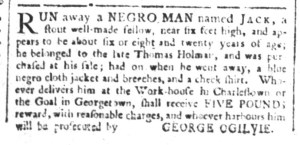
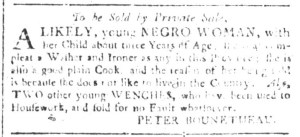
South-Carolina Gazette and Country Journal (September 6, 1774).

**********

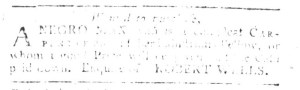
South-Carolina Gazette and Country Journal (September 6, 1774).

**********

South-Carolina Gazette and Country Journal (September 6, 1774).

**********

South-Carolina Gazette and Country Journal (September 6, 1774).

**********

South-Carolina Gazette and Country Journal (September 6, 1774).

**********

South-Carolina Gazette and Country Journal (September 6, 1774).

**********

South-Carolina Gazette and Country Journal (September 6, 1774).

**********

South-Carolina Gazette and Country Journal (September 6, 1774).

**********

South-Carolina Gazette and Country Journal (September 6, 1774).

**********

South-Carolina Gazette and Country Journal (September 6, 1774).

**********

South-Carolina Gazette and Country Journal (September 6, 1774).

**********

South-Carolina Gazette and Country Journal (September 6, 1774).

**********

South-Carolina Gazette and Country Journal (September 6, 1774).

**********

South-Carolina Gazette and Country Journal (September 6, 1774).

**********

South-Carolina Gazette and Country Journal (September 6, 1774).

September 5

What was advertised in a colonial American newspaper 250 years ago today?

Dunlap’s Pennsylvania Packet (September 5, 1774).

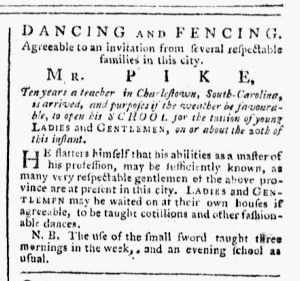
“MR. PIKE, Ten years a teacher in Charlestown, South-Carolina, is arrived.”

When Mr. Pike arrived in Philadelphia near the end of the summer of 1774, he introduced himself to his new neighbors and prospective students with an advertisement in Dunlap’s Pennsylvania Packet.  He devised a headline, “DANCING AND FENCING,” to attract attention and provide a general overview of the services he offered.  As a newcomer with a reputation largely unknown in the bustling urban port, he gave his résumé, declaring that he had been “Ten years a teacher in Charlestown, South-Carolina.”  (The Adverts 250 Project has traced his career there throughout most of his time in that city.)  For quite some time, Pike had been planning to leave Charleston, announcing his intentions in the newspapers there and publishing a farewell message in early May.

According to the dancing master, some of the gentry in Philadelphia already knew how well he had served his students and the community in Charleston.  He chose Philadelphia as his new home, he explained, “Agreeable to an invitation from several respectable families in this city.”  Furthermore, Pike feigned modesty, as many advertisers often did, in declaring that he “flatters himself that his abilities as a master of his profession, may be sufficiently known, as many very respectable gentlemen of the above province are at present in this city.”  He likely referred to Christopher Gadsden, Thomas Lynch, Jr., Henry Middleton, Edward Rutledge, and John Rutledge, South Carolina’s delegates to the First Continental Congress.  They had commenced their meetings in Carpenters’ Hall on the very day that Pike’s advertisement first ran in Dunlap’s Pennsylvania Packet.  Even if Pike had not instructed any of those gentlemen or members of their families, they almost certainly were familiar with his reputation and the balls he hosted so his pupils could demonstrate their grace and proficiency in “cotillions and other fashionable dances.”  The dancing master hoped that casual conversations would include inquiries about him directed to delegates and others from Charleston who happened to be in Philadelphia at the time, resulting in recommendations to supplement and support his advertisement in the public prints.

Slavery Advertisements Published September 5, 1774

The Slavery Adverts 250 Project chronicles the role of newspaper advertising in perpetuating slavery in the era of the American Revolution. The project seeks to reveal the ubiquity of slavery in eighteenth-century life from New England to Georgia by republishing advertisements about enslaved people – for sale as individuals or in groups, wanted to purchase or for hire for short periods, runaways who liberated themselves, and those who were subsequently captured and confined in jails and workhouses – in daily digests on this site as well as in real time via the @SlaveAdverts250 Twitter feed, utilizing twenty-first-century media to stand in for the print media of the eighteenth century.

The project aims to provide modern audiences with a sense of just how often colonizers encountered these advertisements in their daily lives. Enslaved men, women, and children appeared in print somewhere in the colonies almost every single day. Those advertisements served as a constant backdrop for social, cultural, economic, and political life in colonial and revolutionary America. Colonizers who did not purport to own enslaved people were still confronted with slavery as well as invited to maintain the system by purchasing enslaved men, women, and children or assisting in the capture of so-called “runaways” who sought to free themselves from bondage. The frequency of these newspaper advertisements suggests just how embedded slavery was in colonial and revolutionary American culture in everyday interactions beyond the printed page.

These advertisements also testify to the experiences of enslaved men, women, and children, though readers must consider that those experiences have been remediated through descriptions offered by enslavers rather than enslaved people themselves. Often unnamed in the advertisements, enslaved men, women, and children were not invisible or unimportant in early America.

These advertisements appeared in colonial American newspapers 250 years ago today.

Supplement to the Boston-Gazette (September 5, 1774).

**********

Dunlap’s Pennsylvania Packet (September 5, 1774).

**********

Dunlap’s Pennsylvania Packet (September 5, 1774).

**********

Massachusetts Gazette and Boston Post-Boy (September 5, 1774).

**********

Newport Mercury (September 5, 1774).

**********

Newport Mercury (September 5, 1774).

**********

Newport Mercury (September 5, 1774).

**********

Supplement to the Newport Mercury (September 5, 1774).

**********

New-York Gazette and Weekly Mercury (September 5, 1774).

**********

New-York Gazette and Weekly Mercury (September 5, 1774).

**********

New-York Gazette and Weekly Mercury (September 5, 1774).

**********

Supplement to the New-York Gazette and Weekly Mercury (September 5, 1774).

September 4

Who was the subject of an advertisement in a colonial American newspaper 250 years ago this week?

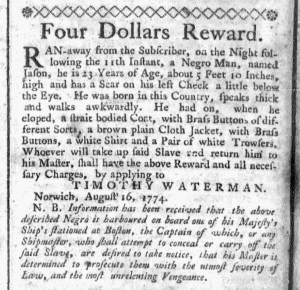
Norwich Packet (September 1, 1774).

“RAN-away … a Negro Man named Jason.”

Like every other newspaper published in the colonies, from New England to Georgia, during the era of the American Revolution, the Norwich Packet carried advertisements that described enslaved men and women who liberated themselves by running away from their enslavers.  Such advertisements encouraged all colonizers to engage in surveillance of Black bodies to determine whether the people they encountered matched descriptions in the newspapers, offering rewards to those who provided information or captured and returned fugitives seeking freedom.

One such advertisement appeared as summer turned to fall in 1774.  Jason, an enslaved man “born in this Country,” departed sometime during the night of August 11.  Timothy Waterman of Norwich spent a few days trying to find Jason on his before resorting to a newspaper advertisement dated August 16.  It first ran in the August 18 edition of the Norwich Packet and appeared again on August 25.  For its third iteration in the weekly newspaper, Waterman’s notice included a nota bene with an update: “Information has been received that the above described Negro is harboured on board one of his Majesty’s Ship’s stationed at Boston.”  Waterman did not reveal the source of this information.  Perhaps his advertisement and its dissemination far beyond Norwich yielded this lead.  Waterman warned the captain of that vessel “or any Shipmaster” that should they “attempt to conceal or carry off said slave … that his Master is determined to prosecute them with the utmost severity of Law, and the most unrelenting Vengeance.”  He sought to combine the power of the press and the power of the state in his effort to retrieve Jason and return him to enslavement.

Waterman also expected that the Norwich Packet and the Connecticut, Massachusetts, New-Hampshire, and Rhode-Island Weekly Advertiser circulated widely enough that ship captains in Boston would either see his advertisement or otherwise become aware of it.  The information infrastructure worked in favor of enslavers and against enslaved men and women who made their own declarations of independence during the era of the American Revolution.  That so many of these advertisements appeared in colonial newspapers, year after year, decade after decade, suggests that they must have been effective, at least to some degree, or else enslavers would not have continued investing in them.

September 3

What was advertised in a colonial American newspaper 250 years ago today?

Providence Gazette (September 3, 1774).

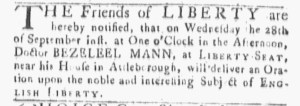
“An Oration upon the noble and interesting Subject of ENGLISH LIBERTY.”

An advertisement in the September 3, 1774, edition of the Providence Gazette advised the “Friends of LIBERTY” of an upcoming “Oration upon the noble and interesting Subject of ENGLISH LIBERTY” to be given by “Doctor BEZELEEL MANN, at LIBERTY SEAT, near his House in Attleborough,” Massachusetts, at the end of the month.  Just days before the delegates to the First Continental Congress commenced their meetings in Philadelphia, the doctor announced his intention to expound on some of the ideas that had inspired representatives from throughout the colonies to gather to discuss how to respond to the Coercive Acts.

John Carter, the printer of the Providence Gazette, did his part to promote the lecture.  He did not merely generate revenue from publishing the notice but instead gave it a privileged placed in his newspaper.  It appeared following local news from the Providence area, including coverage of recent town meetings, and immediately after the shipping news and death notices that regularly marked the end of the news and the beginning of advertising.  Carter could have chosen from among nearly twenty advertisements to place there, but he seems to have privileged one that reiterated the political sentiments and sense of alarm expressed in so much of the news he selected to print or reprint from other newspapers on the first several pages of that edition.  Even if readers did not closely examine all the advertisements, they were more likely to notice the first one that followed the news.  Throughout the colonies, newspaper printers frequently adopted this strategy of treating advertisements like news by placing them immediately after news coverage.

The advertisement for Mann’s lecture also resonated with Carter’s notice that he published an American edition of English Liberties, or the Free-born Subject’s Inheritance.  It made its second appearance on the final page of the September 3 edition of the Providence Gazette, having initially run as the first item on the front page a week earlier.  In both instances, advertisements as well as news and letters expressed an editorial position, both in terms of their content and their position on the page.  In addition, they directed readers to more ways to imbibe the rhetoric of resistance that ultimately became revolution.

September 2

What was advertised in a colonial American newspaper 250 years ago today?

South-Carolina and American General Gazette (September 2, 1774).

“A Non-importation Agreement will undoubtedly soon take Place here.”

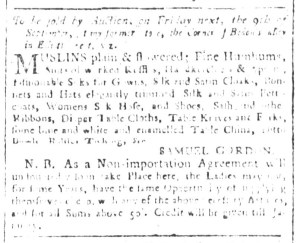
A week in advance of an auction to be held on September 9, 1774, Samuel Gordon took to the pages of the South-Carolina and American General Gazette to promote the various items up for bids.  The sale would include “MUSLINS plain & flowered; Fine Humhums, … fashionable Silks for Gowns, Silk and Satin Cloaks, Bonnets and Hats elegantly trimmed, Silk and Satin Petticoats, Womens Silk Hose, and Shoes, [and] Sash and other Ribbons.”  In addition, Gordon listed “Table Cloths, Table Knives and Fork, [and] some blue and white and enamelled Table China.”  He concluded with “&c.” (an abbreviation for et cetera) to indicate that consumers could acquire a variety of other wares at the auction.

Gordon appended a nota bene to his notice: “As a Non-importation Agreement will undoubtedly soon take Place here, the Ladies may not, for some Years, have the same Opportunity of supplying themselves cheap, with any of the above necessary Articles.”  The auctioneer referred to measures under consideration in response to the Boston Port Act, the Massachusetts Government Act, and the other Coercive Acts passed by Parliament in retaliation for the Boston Tea Party.  Throughout the colonies, patriots came to the defense of Massachusetts, rallying to determine common measures to address infringements on their liberty and rights as English subjects.  At the moment that Gordon published his advertisement, delegates were already arriving in Philadelphia for what would become known as the First Continental Congress.  Their deliberations would result indeed result in the Continental Association, a trade boycott intended as political leverage.  Colonizers had previously adopted similar nonimportation agreements in response to the Stamp Act and the duties on certain goods levied in the Townshend Acts.

Gordon encouraged readers to draw on their memories of the conditions during those boycotts or imagine what would likely happen when another nonimportation agreement went into effect.  He stoked fear and anxiety that goods would become scarce and, as a result, much more expensive.  Colonizers needed to acquire textiles and housewares while they were available and while they were affordable.  To facilitate that, he offered credit until January for purchases that exceeded fifty pounds.  That suggests that even though he addressed “Ladies,” the colonizers so often accused of the vice of luxuriating in consumption in newspaper editorials of the era, that he actually anticipated that it would be merchants and retailers, most of them men, who would make bids and purchase this merchandise with the intention of selling it once again.  Still, readers considered Gordon’s warning as they perused the many other advertisements for imported goods in the newspaper.  The auctioneer committed to print what many colonizers were likely thinking about their prospects for purchasing goods in the coming months and years.

Slavery Advertisements Published September 2, 1774

The Slavery Adverts 250 Project chronicles the role of newspaper advertising in perpetuating slavery in the era of the American Revolution. The project seeks to reveal the ubiquity of slavery in eighteenth-century life from New England to Georgia by republishing advertisements about enslaved people – for sale as individuals or in groups, wanted to purchase or for hire for short periods, runaways who liberated themselves, and those who were subsequently captured and confined in jails and workhouses – in daily digests on this site as well as in real time via the @SlaveAdverts250 Twitter feed, utilizing twenty-first-century media to stand in for the print media of the eighteenth century.

The project aims to provide modern audiences with a sense of just how often colonizers encountered these advertisements in their daily lives. Enslaved men, women, and children appeared in print somewhere in the colonies almost every single day. Those advertisements served as a constant backdrop for social, cultural, economic, and political life in colonial and revolutionary America. Colonizers who did not purport to own enslaved people were still confronted with slavery as well as invited to maintain the system by purchasing enslaved men, women, and children or assisting in the capture of so-called “runaways” who sought to free themselves from bondage. The frequency of these newspaper advertisements suggests just how embedded slavery was in colonial and revolutionary American culture in everyday interactions beyond the printed page.

These advertisements also testify to the experiences of enslaved men, women, and children, though readers must consider that those experiences have been remediated through descriptions offered by enslavers rather than enslaved people themselves. Often unnamed in the advertisements, enslaved men, women, and children were not invisible or unimportant in early America.

These advertisements appeared in colonial American newspapers 250 years ago today.

Connecticut Journal (September 2, 1774).

**********

Connecticut Journal (September 2, 1774).

**********

South-Carolina and American General Gazette (September 2, 1774).

**********

South-Carolina and American General Gazette (September 2, 1774).

**********

South-Carolina and American General Gazette (September 2, 1774).

**********

South-Carolina and American General Gazette (September 2, 1774).

**********

South-Carolina and American General Gazette (September 2, 1774).

**********

South-Carolina and American General Gazette (September 2, 1774).

**********

South-Carolina and American General Gazette (September 2, 1774).

**********

South-Carolina and American General Gazette (September 2, 1774).

**********

South-Carolina and American General Gazette (September 2, 1774).

**********

South-Carolina and American General Gazette (September 2, 1774).

**********

South-Carolina and American General Gazette (September 2, 1774).

**********

South-Carolina and American General Gazette (September 2, 1774).

**********

South-Carolina and American General Gazette (September 2, 1774).

**********

South-Carolina and American General Gazette (September 2, 1774).

**********

South-Carolina and American General Gazette (September 2, 1774).

**********

South-Carolina and American General Gazette (September 2, 1774).

**********

South-Carolina and American General Gazette (September 2, 1774).

**********

South-Carolina and American General Gazette (September 2, 1774).

**********

South-Carolina and American General Gazette (September 2, 1774).

**********

South-Carolina and American General Gazette (September 2, 1774).

**********

South-Carolina and American General Gazette (September 2, 1774).

**********

South-Carolina and American General Gazette (September 2, 1774).

**********

South-Carolina and American General Gazette (September 2, 1774).

**********

South-Carolina and American General Gazette (September 2, 1774).

**********

South-Carolina and American General Gazette (September 2, 1774).

**********

South-Carolina and American General Gazette (September 2, 1774).

**********

South-Carolina and American General Gazette (September 2, 1774).

**********

South-Carolina and American General Gazette (September 2, 1774).

**********

South-Carolina and American General Gazette (September 2, 1774).

**********

South-Carolina and American General Gazette (September 2, 1774).