Slavery Advertisements Published February 8, 1775

The Slavery Adverts 250 Project chronicles the role of newspaper advertising in perpetuating slavery in the era of the American Revolution. The project seeks to reveal the ubiquity of slavery in eighteenth-century life from New England to Georgia by republishing advertisements about enslaved people – for sale as individuals or in groups, wanted to purchase or for hire for short periods, runaways who liberated themselves, and those who were subsequently captured and confined in jails and workhouses – in daily digests on this site as well as in real time via the @SlaveAdverts250 Twitter feed, utilizing twenty-first-century media to stand in for the print media of the eighteenth century.

The project aims to provide modern audiences with a sense of just how often colonizers encountered these advertisements in their daily lives. Enslaved men, women, and children appeared in print somewhere in the colonies almost every single day. Those advertisements served as a constant backdrop for social, cultural, economic, and political life in colonial and revolutionary America. Colonizers who did not purport to own enslaved people were still confronted with slavery as well as invited to maintain the system by purchasing enslaved men, women, and children or assisting in the capture of so-called “runaways” who sought to free themselves from bondage. The frequency of these newspaper advertisements suggests just how embedded slavery was in colonial and revolutionary American culture in everyday interactions beyond the printed page.

These advertisements also testify to the experiences of enslaved men, women, and children, though readers must consider that those experiences have been remediated through descriptions offered by enslavers rather than enslaved people themselves. Often unnamed in the advertisements, enslaved men, women, and children were not invisible or unimportant in early America.

These advertisements appeared in colonial American newspapers 250 years ago today.
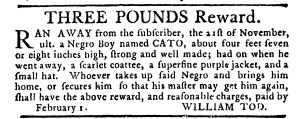
Pennsylvania Journal (February 8, 1775).

February 7

What was advertised in a colonial American newspaper 250 years ago today?

Essex Gazette (February 7, 1775).

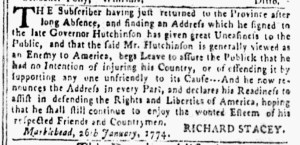
“He had no Intention of injuring his Country, or of defending any one unfriendly to its Cause.”

It was yet another public disavowal of an address honoring Thomas Hutchinson, the former governor of Massachusetts, that many colonizers signed when he returned to England.  This time, Richard Stacey inserted his recantation in the February 7, 1775, edition of the Essex Gazette.  Similar advertisements began appearing in that newspaper and sometimes newspapers printed in Boston as early as July 1774.  Stacey explained that he waited several months because he “just returned to the Province after long Absence” and only upon his arrival did he discover “an Address which he signed to the late Governor Hutchinson has given great Uneasiness to the Public.”  He further explained that the former governor “is generally viewed as an Enemy to America.”

That being the case, Stacey “begs Leave to assure the Publick that he had no Intention of injuring his Country, or of offending it by supporting any one unfriendly to its Cause.”  Accordingly, “he now renounces the Address in every Part, and declares his Readiness to assist in defending the Rights and Liberties of America.”  With such a proclamation, disseminated far and wide in the newspaper, Stacey desired “that he shall still continue to enjoy the wonted Esteem of his respected Friends and Countrymen.”  He considered the prospects of reconciling with friends, neighbors, and associates worth the expense of placing an advertisement in the Essex Gazette.

Was Stacey sincere?  Or did he merely seek to return to the good graces of his community and simply get along during difficult times?  That is impossible to determine from his advertisement.  It did differ from some that previously appeared in the public prints.  For instance, Stacey did not attempt to blame his error on having quickly read the address without considering its implications before signing it.  Instead, he did not comment on what had occurred at the time he signed the address but focused on the harm he had done by doing so.  Others offered lukewarm assurances that they did not truly support Hutchinson or the policies he had enforced, while Stacey proclaimed his “Readiness to assist in defending the Rights and Liberties of America.”  In addition, some signers published advertisements that clearly copied from the same script.  Stacey’s was entirely original.  That may have been the result of the time that had passed since others inserted their advertisement or the political situation deteriorating and thus requiring stronger assertions from signers of the address branded as Tories.  William Huntting Howell suggests that for some readers Stacey’s sincerity may have mattered much less than the fact that he felt compelled to express support for the “Cause” of “his Country” in print.[1]

**********

[1] William Huntting Howell, “Entering the Lists: The Politics of Ephemera in Eastern Massachusetts, 1774,” Early American Studies 9, no. 1 (Winter 2011): 191, 208-215.

Slavery Advertisements Published February 7, 1775

The Slavery Adverts 250 Project chronicles the role of newspaper advertising in perpetuating slavery in the era of the American Revolution. The project seeks to reveal the ubiquity of slavery in eighteenth-century life from New England to Georgia by republishing advertisements about enslaved people – for sale as individuals or in groups, wanted to purchase or for hire for short periods, runaways who liberated themselves, and those who were subsequently captured and confined in jails and workhouses – in daily digests on this site as well as in real time via the @SlaveAdverts250 Twitter feed, utilizing twenty-first-century media to stand in for the print media of the eighteenth century.

The project aims to provide modern audiences with a sense of just how often colonizers encountered these advertisements in their daily lives. Enslaved men, women, and children appeared in print somewhere in the colonies almost every single day. Those advertisements served as a constant backdrop for social, cultural, economic, and political life in colonial and revolutionary America. Colonizers who did not purport to own enslaved people were still confronted with slavery as well as invited to maintain the system by purchasing enslaved men, women, and children or assisting in the capture of so-called “runaways” who sought to free themselves from bondage. The frequency of these newspaper advertisements suggests just how embedded slavery was in colonial and revolutionary American culture in everyday interactions beyond the printed page.

These advertisements also testify to the experiences of enslaved men, women, and children, though readers must consider that those experiences have been remediated through descriptions offered by enslavers rather than enslaved people themselves. Often unnamed in the advertisements, enslaved men, women, and children were not invisible or unimportant in early America.

These advertisements appeared in colonial American newspapers 250 years ago today.
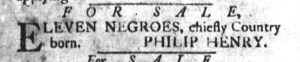
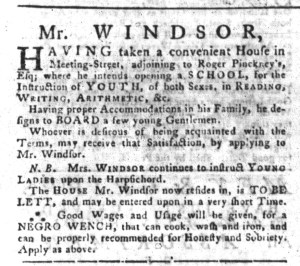
South-Carolina Gazette and Country Journal (February 7, 1775).

**********

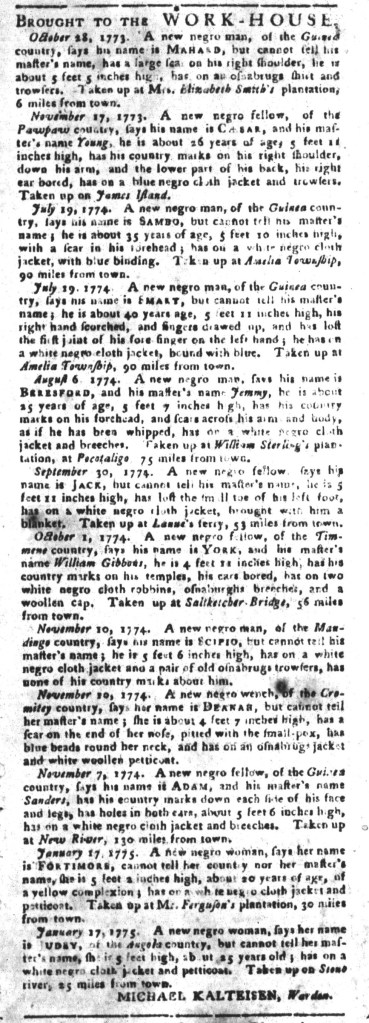
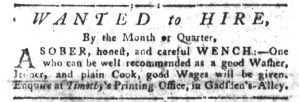
South-Carolina Gazette and Country Journal (February 7, 1775).

**********

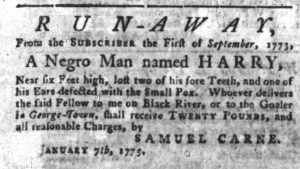
South-Carolina Gazette and Country Journal (February 7, 1775).

**********

South-Carolina Gazette and Country Journal (February 7, 1775).

**********

South-Carolina Gazette and Country Journal (February 7, 1775).

**********

South-Carolina Gazette and Country Journal (February 7, 1775).

**********

South-Carolina Gazette and Country Journal (February 7, 1775).

February 6

What was advertised in a colonial American newspaper 250 years ago today?

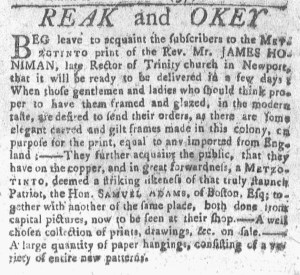
Newport Mercury (February 6, 1775).

“A METZOTINTO … of that truly staunch Patriot, the Hon. SAMUEL ADAMS.”

On February 6, 1775, Charles Reak and Samuel Okey took to the pages of the Newport Mercury to advise “subscribers to the METZOTINTO print of the Rev. JAMES HONIMAN … that it will be ready to be delivered in a few days.”  As printers often did for books, Okey, a British printmaker who migrated to Rhode Island, gauged the market by seeking subscribers to his print of James Honyman, the former rector of Trinity Church in Newport, before executing it.  That allowed him to determine whether the project would be viable and how many prints to produce to meet the demand of subscribers who reserved copies.

The print has been dated November 2, 1774, based on a line beneath the title that reads, “Printed by Reak & Okey, Newport Rhode Island, Novr. 2 1774,” yet the newspaper advertisement suggests that even though the engraving may have ready on that day that Reak and Okey printed the portrait in the following months before distributing it in February 1775.  The advertisement gives further evidence that was the case.  The partners informed readers of a forthcoming print depicting “that truly staunch Patriot, the Hon, SAMUEL ADAMS, of Boston.”  Reak and Okey explained that they “have on copper, and in great forwardness” that mezzotint.  The engraving was complete, but printing took time.

When they did deliver copies of the Honyman mezzotint to subscribers, Reak and Okey offered more than just the print to “those gentlemen and ladies who should think proper to have them framed and glazed in the modern taste.”  They promoted “some elegant carved and gilt frames, made in this colony, on purpose for the print, equal to any imported from England.”  With the Continental Association in effect, Reak and Okey gave their customers access to frames without departing from that nonimportation agreement.  The copy in the collections of the Preservation Society of Newport County is “housed in a black painted wood frame with an interior gilt gesso border,” though the description does not give the provenance of the frame.

In their choices about their latest subject, John Adams, and the frames for the James Honyman mezzotint, Reak and Okey courted customers who supported the American cause as the imperial crisis intensified.  They joined other artists and publishers who commemorated the American Revolution even before the war began at Lexington and Concord, doing so with both an image of a “staunch Patriot” and frames imbued with political as well as artistic significance.

Slavery Advertisements Published February 6, 1775

The Slavery Adverts 250 Project chronicles the role of newspaper advertising in perpetuating slavery in the era of the American Revolution. The project seeks to reveal the ubiquity of slavery in eighteenth-century life from New England to Georgia by republishing advertisements about enslaved people – for sale as individuals or in groups, wanted to purchase or for hire for short periods, runaways who liberated themselves, and those who were subsequently captured and confined in jails and workhouses – in daily digests on this site as well as in real time via the @SlaveAdverts250 Twitter feed, utilizing twenty-first-century media to stand in for the print media of the eighteenth century.

The project aims to provide modern audiences with a sense of just how often colonizers encountered these advertisements in their daily lives. Enslaved men, women, and children appeared in print somewhere in the colonies almost every single day. Those advertisements served as a constant backdrop for social, cultural, economic, and political life in colonial and revolutionary America. Colonizers who did not purport to own enslaved people were still confronted with slavery as well as invited to maintain the system by purchasing enslaved men, women, and children or assisting in the capture of so-called “runaways” who sought to free themselves from bondage. The frequency of these newspaper advertisements suggests just how embedded slavery was in colonial and revolutionary American culture in everyday interactions beyond the printed page.

These advertisements also testify to the experiences of enslaved men, women, and children, though readers must consider that those experiences have been remediated through descriptions offered by enslavers rather than enslaved people themselves. Often unnamed in the advertisements, enslaved men, women, and children were not invisible or unimportant in early America.

These advertisements appeared in colonial American newspapers 250 years ago today.
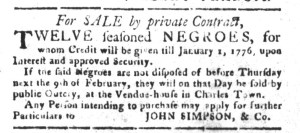
Supplement to the Boston-Gazette (February 6, 1775).

**********

Supplement to the Boston-Gazette (February 6, 1775).

**********

Connecticut Courant (February 6, 1775).

**********

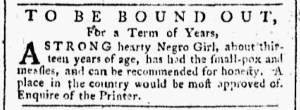
Dunlap’s Pennsylvania Packet (February 6, 1775).

**********

Dunlap’s Pennsylvania Packet (February 6, 1775).

**********

Dunlap’s Pennsylvania Packet (February 6, 1775).

**********

Newport Mercury (February 6, 1775).

**********

Newport Mercury (February 6, 1775).

**********

Newport Mercury (February 6, 1775).

**********

Newport Mercury (February 6, 1775).

**********

New-York Gazette and Weekly Mercury (February 6, 1775).

**********

South-Carolina Gazette (February 6, 1775).

**********

South-Carolina Gazette (February 6, 1775).

**********

South-Carolina Gazette (February 6, 1775).

**********

South-Carolina Gazette (February 6, 1775).

**********

South-Carolina Gazette (February 6, 1775).

**********

South-Carolina Gazette (February 6, 1775).

**********

Supplement to the South-Carolina Gazette (February 6, 1775).

**********

Supplement to the South-Carolina Gazette (February 6, 1775).

**********

Supplement to the South-Carolina Gazette (February 6, 1775).

**********

Supplement to the South-Carolina Gazette (February 6, 1775).

**********

Supplement to the South-Carolina Gazette (February 6, 1775).

**********

Supplement to the South-Carolina Gazette (February 6, 1775).

**********

Supplement to the South-Carolina Gazette (February 6, 1775).

**********

Supplement to the South-Carolina Gazette (February 6, 1775).

**********

Supplement to the South-Carolina Gazette (February 6, 1775).

February 5

What was advertised in a colonial American newspaper 250 years ago this week?

Massachusetts Spy (February 2, 1775).

“BUTTONS. MADE and sold … at the Manufactory-house, Boston.”

John Clarke’s advertisement for buttons that he “MADE and sold … at the Manufactory-house” in Boston was one of several in the February 2, 1775, edition of the Massachusetts Spy that hawked goods produced in the colonies.  He advertised at a time that the harbor had been closed and blockaded for more than eight months because of the Boston Port Act, one of several measures that Parliament enacted in response to the Boston Tea Party.  The other Coercive Acts included the Massachusetts Government Act, the Administration of Justice Act, and the Quartering Act.  In turn, the colonies refused to import British goods, having previously pursued that strategy in response to the Stamp Act in 1765 and the duties imposed on certain goods in the Townshend Acts in the late 1760s.  The Continental Association, devised by the First Continental Congress, went into effect on December 1, 1774.  In addition to prohibiting imports, it called on colonizers to encourage “domestic manufactures” or goods produced in the colonies.

Clarke not only made buttons in Boston, he made “two sorts of new fashioned buttons.”  One was a “plain flat Button, with a corded edge round it, either gilt or plated.  The other bore an inscription, “UNION AND LIBERTY IN ALL AMERICA,” that made a statement.  Consumers could express political sentiments and sartorial sensibilities simultaneously.  (Similarly, the Adverts 250 Project previously examined another newspaper notice that included “glass buttons having the word liberty printed in them.”)  Clarke’s “Liberty button,” well worth the investment, cost just a little more than the “plain flat Button,” at twenty shillings per dozen compared to eighteen shillings per dozen.  Clarke also gave “good allowance to shopkeepers to sell again.”  In other words, he offered discounts to retailers who purchased his buttons and presented them to their customers.  After all, shopkeepers had their own part to play in promoting American products to consumers and supplying them with alternatives to goods imported from Britain.  When it came to buttons, what better way to do that than with the inscribed “Liberty button” made in Boston?

February 4

What was advertised in a colonial American newspaper 250 years ago today?

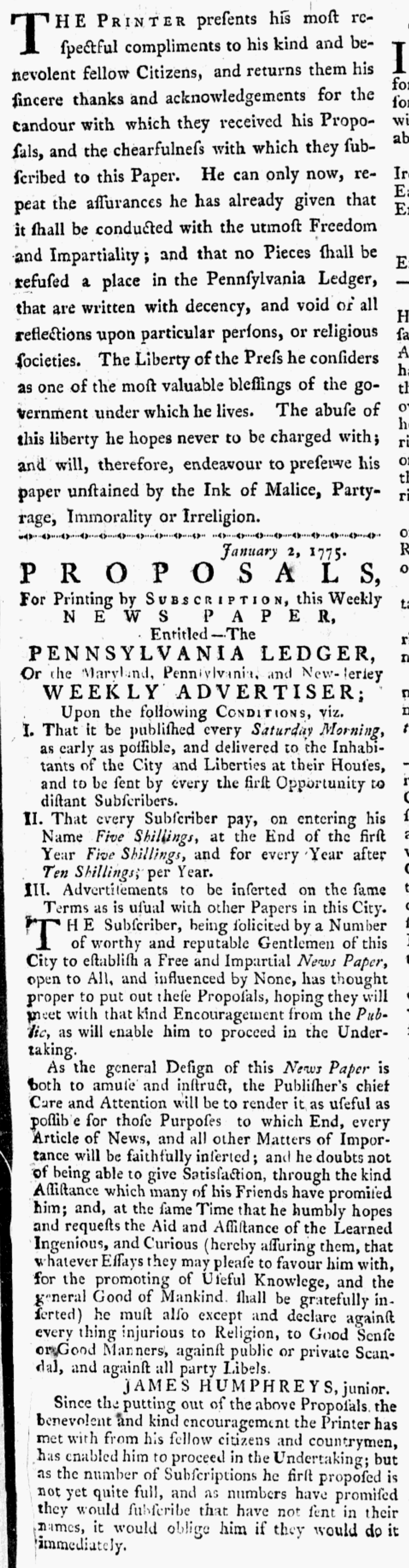
Pennsylvania Ledger (February 4, 1775).

“Numbers have promised they would subscribe that have not sent in their names.”

The second issue of the Pennsylvania Ledger began with the same notice from the printer, James Humphreys, Jr., that appeared as the first item in the first column on the first page of the inaugural issue a week earlier.  He apparently considered it worth running again, especially since the new publication had not yet achieved as wide a circulation as he hoped.  Humphreys’s message to “his kind and benevolent fellow Citizens” thus bore repeating to reach as many readers (and prospective subscribers) as possible as copies of Philadelphia’s newest newspaper found their way into coffeehouses and taverns or passed from hand to hand.

In that address, the printer “repeat[ed] the assurances he has already given” in proposals for the newspaper “that it shall be conducted with the utmost Freedom and Impartiality; and that no Pieces shall be refused a place in the Pennsylvania Ledger, that are written with decency, and void of all reflections upon particular persons, or religious societies.”  Printers often asserted that their publications would represent multiple perspectives when they addressed the public in the decade before the Revolutionary War, though many did not follow through on that promise.  Some privileged their own political views while others responded to what they perceived to be the overwhelming sense (or the most vocal voices) in the communities where they operated their printing presses.  In his subscription proposals, Humphreys promoted a “FREE and IMPARTIAL” newspaper.  In his monumental History of Printing in America (1810), Isaiah Thomas acknowledged that Humphreys purported to publish an impartial newspaper, yet “[i]t was supposed that Humphrey’s paper would be in the British interest” and the Pennsylvania Evening Post, founded by Benjamin Towne at the same time, “took the opposite ground.”[1]  In his address, Humphreys proclaimed that he considered “Liberty of the Press … one of the most valuable blessings of the government under which he lives,” though his ideas about what constituted “Liberty of the Press” may have differed from that of other colonizers.  As the imperial crisis intensified, more and more newspapers became associated with either Patriots or Loyalists.

Still, Humphreys wanted to make a go of it with the Pennsylvania Ledger.  In that second issue, he inserted the proposals immediately below his address to the public, filling the remainder of the column.  He explained in even more detail that “the general Design of this News Paper is both to amuse and instruct” so “every Article of News, and all other Matters of Importance will be faithfully inserted.”  In billing his newspaper as “Free and Impartial,” Humphreys may have intended to make a point that readers should expect to encounter pieces representing a variety of views, but, as Thomas suggested, many were suspicious of Humphreys’s intentions when it came to disseminating content from the Tory perspective.  That could have contributed to a note that the printer added to the proposals.  He claimed that he received enough “encouragement … to proceed in the Undertaking,” but “numbers have promised they would subscribe that have not sent in their names.”  As they learned more about the positions the Pennsylvania Ledger would likely take, some prospective subscribers apparently decided they did not wish to support the newspaper.

**********

[1] Isaiah Thomas, The History of Printing in America: With a Biography of Printers and an Account of Newspapers (1810; New York: Weathervane Books, 1970), 399.

Slavery Advertisements Published February 4, 1775

The Slavery Adverts 250 Project chronicles the role of newspaper advertising in perpetuating slavery in the era of the American Revolution. The project seeks to reveal the ubiquity of slavery in eighteenth-century life from New England to Georgia by republishing advertisements about enslaved people – for sale as individuals or in groups, wanted to purchase or for hire for short periods, runaways who liberated themselves, and those who were subsequently captured and confined in jails and workhouses – in daily digests on this site as well as in real time via the @SlaveAdverts250 Twitter feed, utilizing twenty-first-century media to stand in for the print media of the eighteenth century.

The project aims to provide modern audiences with a sense of just how often colonizers encountered these advertisements in their daily lives. Enslaved men, women, and children appeared in print somewhere in the colonies almost every single day. Those advertisements served as a constant backdrop for social, cultural, economic, and political life in colonial and revolutionary America. Colonizers who did not purport to own enslaved people were still confronted with slavery as well as invited to maintain the system by purchasing enslaved men, women, and children or assisting in the capture of so-called “runaways” who sought to free themselves from bondage. The frequency of these newspaper advertisements suggests just how embedded slavery was in colonial and revolutionary American culture in everyday interactions beyond the printed page.

These advertisements also testify to the experiences of enslaved men, women, and children, though readers must consider that those experiences have been remediated through descriptions offered by enslavers rather than enslaved people themselves. Often unnamed in the advertisements, enslaved men, women, and children were not invisible or unimportant in early America.

These advertisements appeared in colonial American newspapers 250 years ago today.
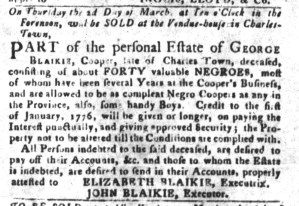
Providence Gazette (February 4, 1775).

**********

Virginia Gazette [Dixon and Hunter] (February 4, 1775).

**********

Virginia Gazette [Dixon and Hunter] (February 4, 1775).

**********

Virginia Gazette [Dixon and Hunter] (February 4, 1775).

**********

Virginia Gazette [Dixon and Hunter] (February 4, 1775).

**********

Virginia Gazette [Dixon and Hunter] (February 4, 1775).

**********

Virginia Gazette [Dixon and Hunter] (February 4, 1775).

**********

Virginia Gazette [Dixon and Hunter] (February 4, 1775).

**********

Virginia Gazette [Dixon and Hunter] (February 4, 1775).

**********

Virginia Gazette [Dixon and Hunter] (February 4, 1775).

**********

Virginia Gazette [Dixon and Hunter] (February 4, 1775).

**********

Virginia Gazette [Dixon and Hunter] (February 4, 1775).

February 3

What kinds of advertisements ran in the inaugural issue of Alexander Purdie’s Virginia Gazette 250 years ago today?

Virginia Gazette [Purdie] (February 3, 1775).

“BENJAMIN BUCKTROUT, Cabinet maker, … STILL carries on that business.”

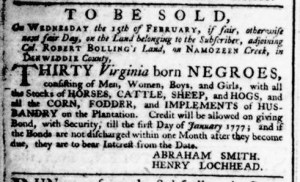
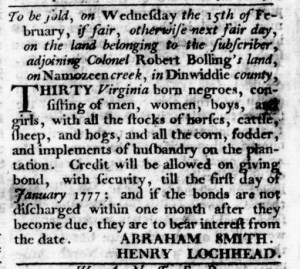
To be sold … THIRTY Virginia born negroes, consisting of men, women, boys, and girls.”

Alexander Purdie launched his Virginia Gazette on Friday, February 3, 1775.  It was the third newspaper bearing that name printed in Williamsburg at the time.  John Pinkney published his Virginia Gazette on Thursdays and John Dixon and William Hunter distributed their Virginia Gazette on Saturdays.  As the imperial crisis intensified, a third Virginia Gazetteincreased access and dissemination of news and editorials (and advertisements) in the colony.

In early December 1774, Purdie and Dixon announced the dissolution of their partnership, with Dixon indicating that he would continue to publish that iteration of the Virginia Gazette with Hunter as his new partner and Purdie asserting that he would commence publication of another newspaper as soon as he attracted a sufficient number of subscribers.  He also solicited advertisers, realizing that paid notices accounted for an important source of revenue for any newspaper.

When he published the inaugural issue of his Virginia Gazette, it included seven advertisements that filled most of the last column on the final page.  Those numbers did not rival the amount of advertising in either of the other newspapers printed in Williamsburg that week, both of which had enough notices to fill an entire page, but it was a start.  Those initial advertisers signaled to others that they might consider advertising in Purdie’s newspaper a good investment.

Benjamin Bucktrout, a cabinetmaker, did not entrust his marketing efforts solely to Purdie’s Virginia Gazette.   He placed an identical advertisement in Dixon and Hunter’s newspaper the next day.  It likely enjoyed greater circulation in the more established Virginia Gazette, yet may have garnered greater notice by readers of Purdie’s Virginia Gazette as the first of only a few advertisements in that publication.

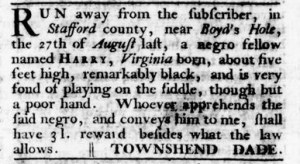
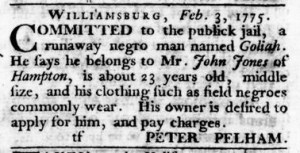
In addition to Bucktrout’s notice, one advertisement sought an apprentice to work in a store, two noted stray horses “TAKEN up” until their owners could be identified, and three concerned enslaved people.  Abraham Smith and Henry Lochhead presented “THIRTY Virginia born negroes, consisting of men, women, boys, and girls,” for sale.  Townshend Dade offered a reward for the capture and return of “a negro fellow named HARRY” who had liberated himself by running away from his enslaver the previous August.  Peter Pelham advised readers of “a runaway negro man named Goliah” who had been “COMMITTED to the publick jail” until his enslaver claimed him.  Advertisements about enslaved people represented a significant proportion of notices in each Virginia Gazette.  They amounted to nearly half of the advertisements in the first issue of Purdie’s Virginia Gazette.

Slavery Advertisements Published February 3, 1775

The Slavery Adverts 250 Project chronicles the role of newspaper advertising in perpetuating slavery in the era of the American Revolution. The project seeks to reveal the ubiquity of slavery in eighteenth-century life from New England to Georgia by republishing advertisements about enslaved people – for sale as individuals or in groups, wanted to purchase or for hire for short periods, runaways who liberated themselves, and those who were subsequently captured and confined in jails and workhouses – in daily digests on this site as well as in real time via the @SlaveAdverts250 Twitter feed, utilizing twenty-first-century media to stand in for the print media of the eighteenth century.

The project aims to provide modern audiences with a sense of just how often colonizers encountered these advertisements in their daily lives. Enslaved men, women, and children appeared in print somewhere in the colonies almost every single day. Those advertisements served as a constant backdrop for social, cultural, economic, and political life in colonial and revolutionary America. Colonizers who did not purport to own enslaved people were still confronted with slavery as well as invited to maintain the system by purchasing enslaved men, women, and children or assisting in the capture of so-called “runaways” who sought to free themselves from bondage. The frequency of these newspaper advertisements suggests just how embedded slavery was in colonial and revolutionary American culture in everyday interactions beyond the printed page.

These advertisements also testify to the experiences of enslaved men, women, and children, though readers must consider that those experiences have been remediated through descriptions offered by enslavers rather than enslaved people themselves. Often unnamed in the advertisements, enslaved men, women, and children were not invisible or unimportant in early America.

These advertisements appeared in colonial American newspapers 250 years ago today.
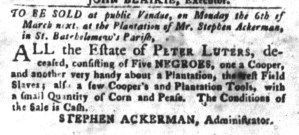
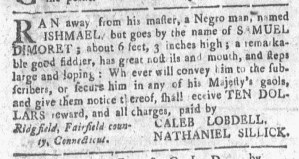
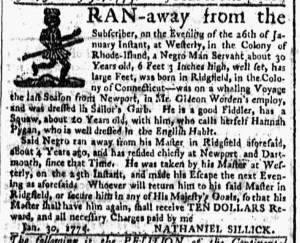
Connecticut Gazette (February 3, 1775).
**********

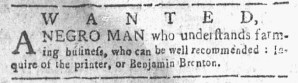
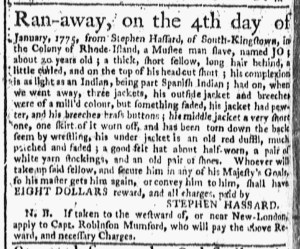
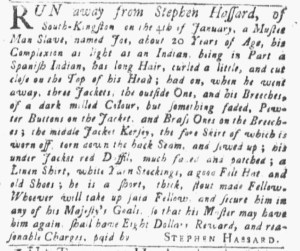
Connecticut Gazette (February 3, 1775).

**********

Virginia Gazette [Purdie] (February 3, 1775).

**********

Virginia Gazette [Purdie] (February 3, 1775).

**********

Virginia Gazette [Purdie] (February 3, 1775).