Slavery Advertisements Published March 10, 1775

The Slavery Adverts 250 Project chronicles the role of newspaper advertising in perpetuating slavery in the era of the American Revolution. The project seeks to reveal the ubiquity of slavery in eighteenth-century life from New England to Georgia by republishing advertisements about enslaved people – for sale as individuals or in groups, wanted to purchase or for hire for short periods, runaways who liberated themselves, and those who were subsequently captured and confined in jails and workhouses – in daily digests on this site as well as in real time via the @SlaveAdverts250 Twitter feed, utilizing twenty-first-century media to stand in for the print media of the eighteenth century.

The project aims to provide modern audiences with a sense of just how often colonizers encountered these advertisements in their daily lives. Enslaved men, women, and children appeared in print somewhere in the colonies almost every single day. Those advertisements served as a constant backdrop for social, cultural, economic, and political life in colonial and revolutionary America. Colonizers who did not purport to own enslaved people were still confronted with slavery as well as invited to maintain the system by purchasing enslaved men, women, and children or assisting in the capture of so-called “runaways” who sought to free themselves from bondage. The frequency of these newspaper advertisements suggests just how embedded slavery was in colonial and revolutionary American culture in everyday interactions beyond the printed page.

These advertisements also testify to the experiences of enslaved men, women, and children, though readers must consider that those experiences have been remediated through descriptions offered by enslavers rather than enslaved people themselves. Often unnamed in the advertisements, enslaved men, women, and children were not invisible or unimportant in early America.

These advertisements appeared in colonial American newspapers 250 years ago today.
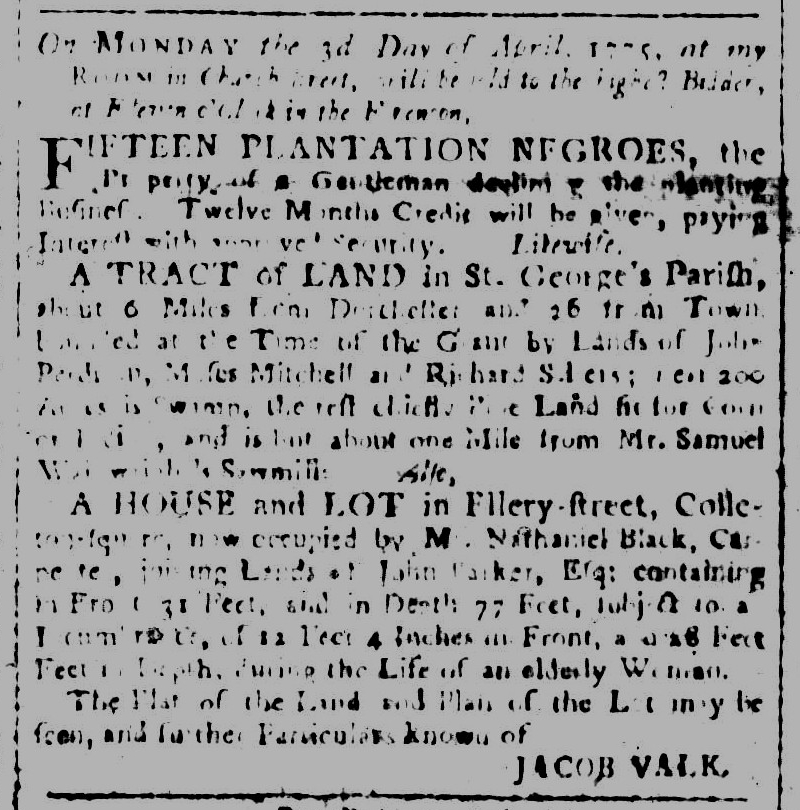
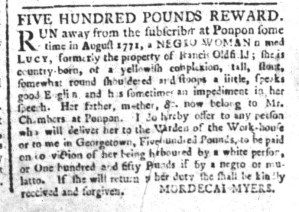
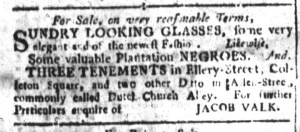
South-Carolina and American General Gazette (March 10, 1775).

**********

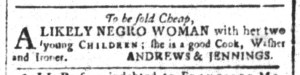
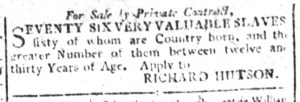
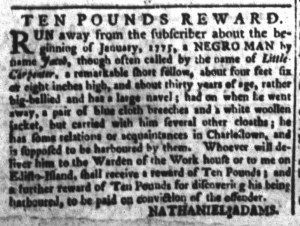
South-Carolina and American General Gazette (March 10, 1775).

**********

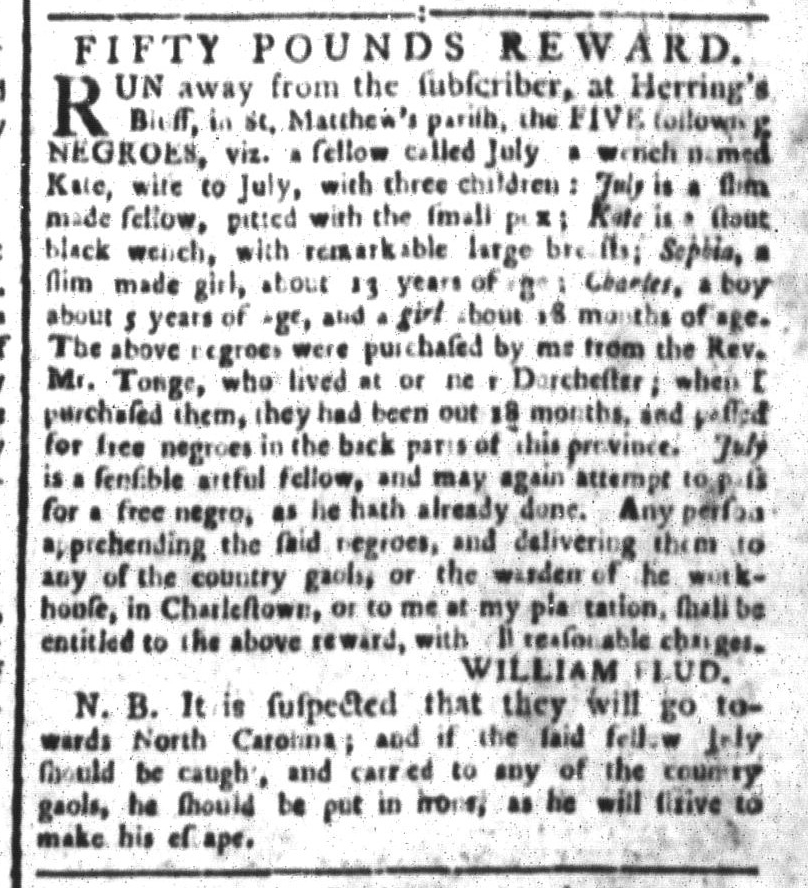
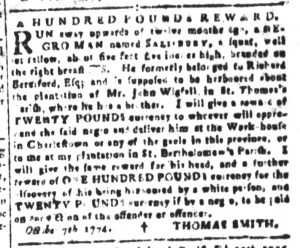
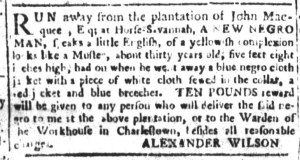
South-Carolina and American General Gazette (March 10, 1775).

**********

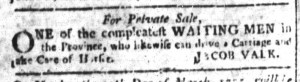
South-Carolina and American General Gazette (March 10, 1775).

**********

South-Carolina and American General Gazette (March 10, 1775).

**********

South-Carolina and American General Gazette (March 10, 1775).

**********

South-Carolina and American General Gazette (March 10, 1775).

**********

South-Carolina and American General Gazette (March 10, 1775).

**********

South-Carolina and American General Gazette (March 10, 1775).

**********

South-Carolina and American General Gazette (March 10, 1775).

**********

South-Carolina and American General Gazette (March 10, 1775).

**********

South-Carolina and American General Gazette (March 10, 1775).

**********

South-Carolina and American General Gazette (March 10, 1775).

**********

South-Carolina and American General Gazette (March 10, 1775).

**********

South-Carolina and American General Gazette (March 10, 1775).

**********

South-Carolina and American General Gazette (March 10, 1775).

**********

South-Carolina and American General Gazette (March 10, 1775).

**********

South-Carolina and American General Gazette (March 10, 1775).

**********

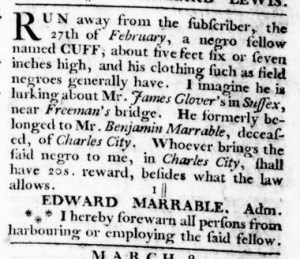
Virginia Gazette [Purdie] (March 10, 1775).

**********

Virginia Gazette [Purdie] (March 10, 1775).

March 9

What was advertised in a colonial American newspaper 250 years ago today?

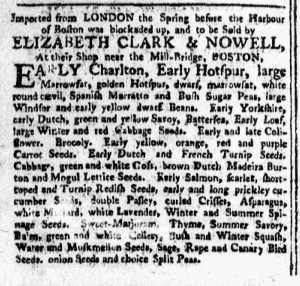
Massachusetts Spy (March 9, 1775).

“Imported from LONDON the Spring before the Harbour of Boston was blockade up.”

Although marketing began a little later in the season than in recent years, several retailers placed advertisements for garden seeds in Boston’s newspaper in early March 1775.  The March 9 edition of the Massachusetts Spy, for instance, once again carried Susannah Renken’s advertisement as well notices placed by John Adams, Elizabeth Clark and Elizabeth Nowell, and Ebenezer Oliver.  Each of these purveyors of seeds took to the public prints as spring approached each year, though many familiar names did not yet appear.  More than half a dozen women usually advertised garden seeds that they sold in Boston, but the imperial crisis, especially the closing of the harbor because of the Boston Port Act, disrupted that annual ritual.

Renken, one of the most enterprising of those female seed sellers, apparently acquired her inventory from a ship that landed at Salem.  She identified the captain of the vessel that had transported them across the Atlantic.  Adams and Oliver both declared that they sold seeds “Imported from London,” but did not provide additional details to allow prospective customers in the eighteenth century (or historians in the twenty-first century) to reach conclusions about when and how they came into possession of those seeds.  Clark and Nowell, on the other hand, made clear that their seeds had been “Imported from LONDON the Spring before the Harbour of Boston was blockade up.”  They received their seeds at least nine months earlier, a factor that may or may not have been an advantage.  Adams declared that he “warrants [his seeds] good, and of the last Year’s Growth.”  Similarly, Renken described her seeds as “New and warranted of the last Year’s Growth.”  Clark and Nowell could not make such claims.  Instead, they attempted to leverage the date of delivery as a point in their favor.  Although not “new,” their seeds also were not so old that they would not germinate, especially if Clark and Nowell had stored them carefully.  They asked prospective customers to take into account the challenges that they all faced due to the blockade, hoping that a sense of mutual support would convince consumers to select their seeds over the ones offered by their competitors.

March 8

What was advertised in a colonial American newspaper 250 years ago today?

Pennsylvania Gazette (March 8, 1775).

“The importation of Goods from Britain being stopped, obliges the said ACKEROYD to dispose of his stock on hand.”

With the Continental Association in effect throughout the colonies, John Ackeroyd decided that doing business in Philadelphia was no longer viable for him.  He concluded an advertisement in the March 8, 1775, edition of the Pennsylvania Gazette with a note that the “importation of Goods from Britain being stopped, obliges the said ACKEROYD to dispose of his stock on hand and return to England as soon as he can.”  To that end, he called on customers and associates to settle “all accounts past due to him.”  Ackeroyd did not reveal his own politics in his newspaper notice, but he made clear that he believed the Continental Association had a devastating effect on his business.  That he planned to return to England suggests that he may have favored the Tory perspective.

Whatever his views, Ackeroyd abided by the Continental Association, though he utilized a loophole to do so.  That nonimportation agreement went into effect on December 1.  Ackeroyd advertised that he sought to sell “the remainder of his GOODS, imported in the London Packet, Capt. Cook, from London.”  When the London Packet arrive in Philadelphia to deliver those goods?  The “INWARD ENTRIES” for the custom house in the December 12, 1774, edition of Dunlap’s Pennsylvania Packet included Cooke’s vessel.  That should have meant that importers had to refuse their shipments or surrender all goods aboard the London Packet to the local committee of inspection, according to the provisions of the tenth article of the Continental Association.  The entry, however, did not state that Cooke arrived from London.  Instead, it reported, “Ship London Packet, J. Cooke, Lewis on Del.”  The London Packet apparently landed the goods at Lewes, a town at the mouth of the Delaware Bay, before December 1 and then continued up the Delaware River to Philadelphia.  That technicality would have allowed Ackeroyd to accept and then sell “GOODS … from London” without involving the local committee of inspection.  Consumers may have embraced such cleverness … or found it violated the spirit of the Continental Association if not the letter of that pact.

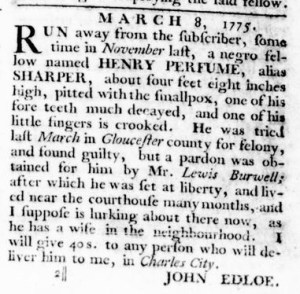
Slavery Advertisements Published March 8, 1775

The Slavery Adverts 250 Project chronicles the role of newspaper advertising in perpetuating slavery in the era of the American Revolution. The project seeks to reveal the ubiquity of slavery in eighteenth-century life from New England to Georgia by republishing advertisements about enslaved people – for sale as individuals or in groups, wanted to purchase or for hire for short periods, runaways who liberated themselves, and those who were subsequently captured and confined in jails and workhouses – in daily digests on this site as well as in real time via the @SlaveAdverts250 Twitter feed, utilizing twenty-first-century media to stand in for the print media of the eighteenth century.

The project aims to provide modern audiences with a sense of just how often colonizers encountered these advertisements in their daily lives. Enslaved men, women, and children appeared in print somewhere in the colonies almost every single day. Those advertisements served as a constant backdrop for social, cultural, economic, and political life in colonial and revolutionary America. Colonizers who did not purport to own enslaved people were still confronted with slavery as well as invited to maintain the system by purchasing enslaved men, women, and children or assisting in the capture of so-called “runaways” who sought to free themselves from bondage. The frequency of these newspaper advertisements suggests just how embedded slavery was in colonial and revolutionary American culture in everyday interactions beyond the printed page.

These advertisements also testify to the experiences of enslaved men, women, and children, though readers must consider that those experiences have been remediated through descriptions offered by enslavers rather than enslaved people themselves. Often unnamed in the advertisements, enslaved men, women, and children were not invisible or unimportant in early America.

These advertisements appeared in colonial American newspapers 250 years ago today.

Connecticut Journal (March 8, 1775).

**********

Connecticut Journal (March 8, 1775).

**********

Pennsylvania Journal (March 8, 1775).

Slavery Advertisements Published March 7, 1775

The Slavery Adverts 250 Project chronicles the role of newspaper advertising in perpetuating slavery in the era of the American Revolution. The project seeks to reveal the ubiquity of slavery in eighteenth-century life from New England to Georgia by republishing advertisements about enslaved people – for sale as individuals or in groups, wanted to purchase or for hire for short periods, runaways who liberated themselves, and those who were subsequently captured and confined in jails and workhouses – in daily digests on this site as well as in real time via the @SlaveAdverts250 Twitter feed, utilizing twenty-first-century media to stand in for the print media of the eighteenth century.

The project aims to provide modern audiences with a sense of just how often colonizers encountered these advertisements in their daily lives. Enslaved men, women, and children appeared in print somewhere in the colonies almost every single day. Those advertisements served as a constant backdrop for social, cultural, economic, and political life in colonial and revolutionary America. Colonizers who did not purport to own enslaved people were still confronted with slavery as well as invited to maintain the system by purchasing enslaved men, women, and children or assisting in the capture of so-called “runaways” who sought to free themselves from bondage. The frequency of these newspaper advertisements suggests just how embedded slavery was in colonial and revolutionary American culture in everyday interactions beyond the printed page.

These advertisements also testify to the experiences of enslaved men, women, and children, though readers must consider that those experiences have been remediated through descriptions offered by enslavers rather than enslaved people themselves. Often unnamed in the advertisements, enslaved men, women, and children were not invisible or unimportant in early America.

These advertisements appeared in colonial American newspapers 250 years ago today.

Essex Gazette (March 7, 1775).

**********

South-Carolina Gazette and Country Journal (March 7, 1775).

**********

South-Carolina Gazette and Country Journal (March 7, 1775).

**********

South-Carolina Gazette and Country Journal (March 7, 1775).

**********

South-Carolina Gazette and Country Journal (March 7, 1775).

**********

South-Carolina Gazette and Country Journal (March 7, 1775).

**********

South-Carolina Gazette and Country Journal (March 7, 1775).

**********

South-Carolina Gazette and Country Journal (March 7, 1775).

**********

South-Carolina Gazette and Country Journal (March 7, 1775).

**********

South-Carolina Gazette and Country Journal (March 7, 1775).

**********

South-Carolina Gazette and Country Journal (March 7, 1775).

**********

South-Carolina Gazette and Country Journal (March 7, 1775).

**********

South-Carolina Gazette and Country Journal (March 7, 1775).

**********

South-Carolina Gazette and Country Journal (March 7, 1775).

**********

South-Carolina Gazette and Country Journal (March 7, 1775).

**********

South-Carolina Gazette and Country Journal (March 7, 1775).

March 7

What was advertised in a colonial American newspaper 250 years ago today?

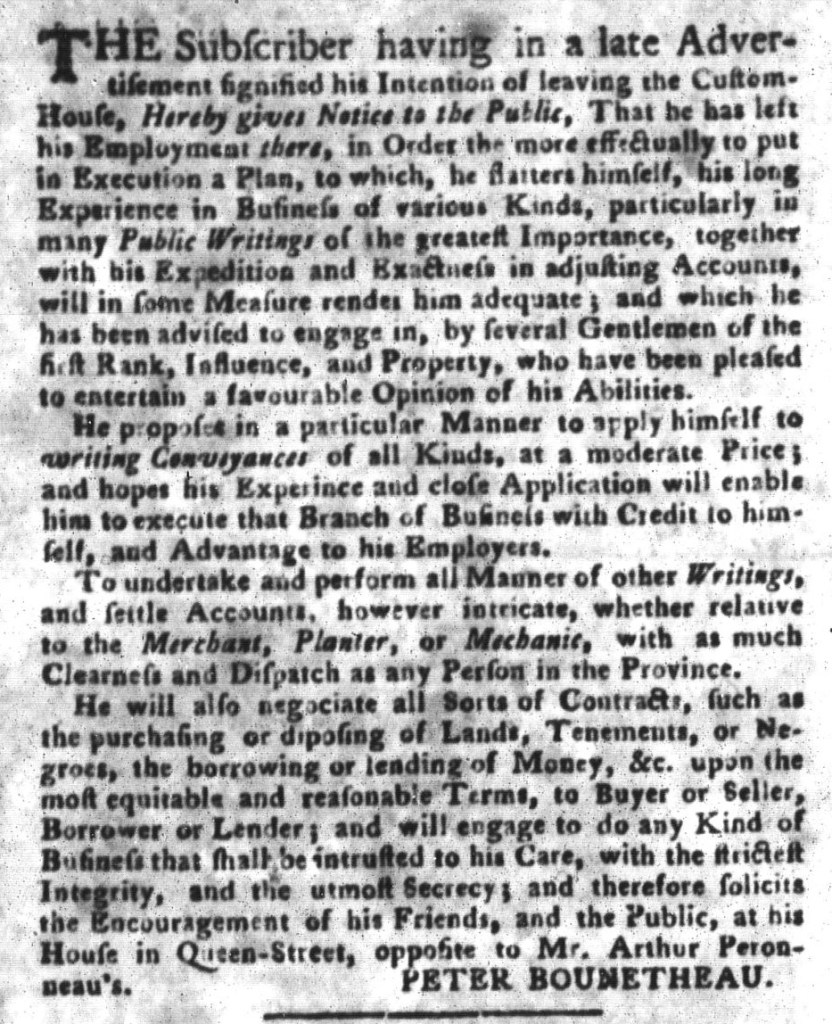
South-Carolina Gazette and Country Journal (March 7, 1775).

“He proposes … to apply himself to writing Conveyances of all Kinds.”

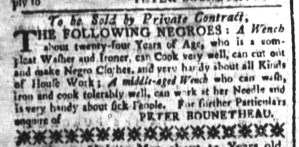
On the eve of the American Revolution, Peter Bounetheau left his job at the custom house in Charleston and established his own business for “writing Conveyances of all Kinds” and negotiating “all Sort of Contracts, such as the purchasing or disposing of Lands, Tenements, or Negroes [and] the borrowing or lending of Money.”  He claimed that he had done so on the advice of “several Gentlemen of the first Rank, Influence, and Property, who have been pleased to entertain a favourable Opinion of his Abilities.”  In addition to that endorsement, he emphasized “his long Experience in Business of various Kinds, particularly in many Public Writings of the greatest Importance, together with his Expedition and Exactness in adjusting Accounts.”

By the time his advertisement ran in the March 7, 1775, edition of the South-Carolina Gazette and Country Journal, Bounetheau had been in business for several months.  He had established himself well enough to attract clients that accounted for twelve other advertisements of various lengths on the same page.  A couple concerned real estate and a couple hawked commodities like mustard and olives, yet most of them offered enslaved people for sale.  Six of those advertisements enumerated three enslaved men, ten enslaved women, and six enslaved women that Bounetheau sought to sell on behalf of others.  A seventh advertisement listed “Several NEGROES,” but did not specify how many beyond “a complete boatman and jobbing carpenter” and “a complete washer and ironer.”  The others were “field slaves.”

Bounetheau’s enterprise meant good business for Charles Crouch, the printer of the South-Carolina Gazette and Country Journal.  Week after week, the broker placed multiple advertisements, representing significant revenues for the printing office.  In the March 7 edition, his notices filled an entire column and nearly half of another out of twelve total columns in a standard issue of four pages consisting of three columns each.  That meant that Bounetheau generating ten percent of the content.  Another broker, Philip Henry, inserted fifteen advertisements that occupied the same amount of space, though he focused more on real estate than enslaved people.  Still, he offered “TWENTY-TWO young and healthy NEGROES, that have been used to a Plantation” in one notice and “ELEVEN NEGROES, chiefly Country born” in another.  These brokerage firms likely increased the number of advertisements that ran in the South-Carolina Gazette and Country Journal and other newspapers published in Charleston in the 1770s.  Such endeavors included greater dissemination of advertisements that contributed to perpetuating the slave trade.

March 6

What was advertised in a colonial American newspaper 250 years ago today?

New-York Gazette and Weekly Mercury (March 6, 1775).

“Will be celebrated the Anniversary of the repeal of the STAMP-ACT.”

A manicule directed readers to take note of upcoming festivities to commemorate the “18th of MARCH” as they perused the advertisements in the March 6, 1775, edition of the New-York Gazette and Weekly Mercury.  Although that date is not familiar to most Americans in the twenty-first century, it certainly resonated with colonizers who associated it with the repeal of the Stamp Act on March 18, 1766.  Just as Americans today recognize the “4th of July” as Independence Day, “9/11” as the day terrorists hijacked four airplanes and used them as weapons to kill thousands of people, and “January 6” as the day insurrectionists attacked the United States Capitol at the bidding of a demagogue who refused to participate in a peaceful transfer of power after losing a free and fair election, colonizers knew the significance of the “18th of MARCH” without further explanation.

The Sons of Liberty and other supporters of the American cause had been gathering to celebrate “the Anniversary of the repeal of the STAMP-ACT” for many years, including in 1770, 1771, 1772, 1773, and 1774.  As the ninth anniversary approached, they prepared to dine “at the house of Mrs. De La Montagnie” with “those gentlemen and their friends, who associated there last year.”  The tavern operated by the De La Montagne family had often been the site of these commemorations.  “Mr. DE LA MONTAGNIE” served as host in 1774; following his death, his widow continued the tradition.  The celebrants did not know it at the time, but it would be the last time they commemorated the repeal of the Stamp Act before what would eventually become a war for independence began.  Just a month and a day later, the skirmishes at Lexington and Concord would occur.  While “those gentlemen and their friends” who marked the anniversary of the repeal of the Stamp Act did not yet know the significant of the “19th of April,” they did understand that the imperial crisis had intensified.  For many years they had already been commemorating the events that precipitated the American Revolution.  As John Adams suggested after the war, “The Revolution was in the Minds of the People … before a drop of blood was drawn at Lexington.”

Slavery Advertisements Published March 9, 1775

The Slavery Adverts 250 Project chronicles the role of newspaper advertising in perpetuating slavery in the era of the American Revolution. The project seeks to reveal the ubiquity of slavery in eighteenth-century life from New England to Georgia by republishing advertisements about enslaved people – for sale as individuals or in groups, wanted to purchase or for hire for short periods, runaways who liberated themselves, and those who were subsequently captured and confined in jails and workhouses – in daily digests on this site as well as in real time via the @SlaveAdverts250 Twitter feed, utilizing twenty-first-century media to stand in for the print media of the eighteenth century.

The project aims to provide modern audiences with a sense of just how often colonizers encountered these advertisements in their daily lives. Enslaved men, women, and children appeared in print somewhere in the colonies almost every single day. Those advertisements served as a constant backdrop for social, cultural, economic, and political life in colonial and revolutionary America. Colonizers who did not purport to own enslaved people were still confronted with slavery as well as invited to maintain the system by purchasing enslaved men, women, and children or assisting in the capture of so-called “runaways” who sought to free themselves from bondage. The frequency of these newspaper advertisements suggests just how embedded slavery was in colonial and revolutionary American culture in everyday interactions beyond the printed page.

These advertisements also testify to the experiences of enslaved men, women, and children, though readers must consider that those experiences have been remediated through descriptions offered by enslavers rather than enslaved people themselves. Often unnamed in the advertisements, enslaved men, women, and children were not invisible or unimportant in early America.

These advertisements appeared in colonial American newspapers 250 years ago today.

Maryland Gazette (March 9, 1775).

**********

Maryland Gazette (March 9, 1775).

**********

Maryland Gazette (March 9, 1775).

**********

Maryland Gazette (March 9, 1775).

**********

Maryland Gazette (March 9, 1775).

**********

Maryland Gazette (March 9, 1775).

**********

Maryland Gazette (March 9, 1775).

**********

Massachusetts Spy (March 9, 1775).

**********

New-York Journal (March 9, 1775).

**********

New-York Journal (March 9, 1775).

**********

Postscript to the Pennsylvania Journal (March 9, 1775).

**********

Rivington’s New-York Gazetteer (March 9, 1775).

**********

Virginia Gazette [Pinkney] (March 9, 1775).

**********

Virginia Gazette [Pinkney] (March 9, 1775).

**********

Virginia Gazette [Pinkney] (March 9, 1775).

Slavery Advertisements Published March 6, 1775

The Slavery Adverts 250 Project chronicles the role of newspaper advertising in perpetuating slavery in the era of the American Revolution. The project seeks to reveal the ubiquity of slavery in eighteenth-century life from New England to Georgia by republishing advertisements about enslaved people – for sale as individuals or in groups, wanted to purchase or for hire for short periods, runaways who liberated themselves, and those who were subsequently captured and confined in jails and workhouses – in daily digests on this site as well as in real time via the @SlaveAdverts250 Twitter feed, utilizing twenty-first-century media to stand in for the print media of the eighteenth century.

The project aims to provide modern audiences with a sense of just how often colonizers encountered these advertisements in their daily lives. Enslaved men, women, and children appeared in print somewhere in the colonies almost every single day. Those advertisements served as a constant backdrop for social, cultural, economic, and political life in colonial and revolutionary America. Colonizers who did not purport to own enslaved people were still confronted with slavery as well as invited to maintain the system by purchasing enslaved men, women, and children or assisting in the capture of so-called “runaways” who sought to free themselves from bondage. The frequency of these newspaper advertisements suggests just how embedded slavery was in colonial and revolutionary American culture in everyday interactions beyond the printed page.

These advertisements also testify to the experiences of enslaved men, women, and children, though readers must consider that those experiences have been remediated through descriptions offered by enslavers rather than enslaved people themselves. Often unnamed in the advertisements, enslaved men, women, and children were not invisible or unimportant in early America.

These advertisements appeared in colonial American newspapers 250 years ago today.

Boston Evening-Post (March 6, 1775).

**********

Boston Evening-Post (March 6, 1775).

**********

Boston Evening-Post (March 6, 1775).

**********

Boston-Gazette (March 6, 1775).

**********

Boston-Gazette (March 6, 1775).

**********

Boston-Gazette (March 6, 1775).

**********

Connecticut Courant (March 6, 1775).

**********

Dunlap’s Pennsylvania Packet (March 6, 1775).

**********

Dunlap’s Pennsylvania Packet (March 6, 1775).

**********

Dunlap’s Pennsylvania Packet (March 6, 1775).

**********

New-York Gazette and Weekly Mercury (March 6, 1775).

**********

New-York Gazette and Weekly Mercury (March 6, 1775).

**********

South-Carolina Gazette (March 6, 1775).

**********

South-Carolina Gazette (March 6, 1775).

March 5

What was advertised in a colonial American newspaper 250 years ago this week?

Supplement to the New-York Journal (March 2, 1775).

“PARCHMENT … Made and sold … [in] Philadelphia.”

In the early 1770s, Robert Wood made and sold parchment in Philadelphia, yet he did not confine his marketing or distribution of his product to that city and its hinterland.  As spring approached in 1775, he ran an advertisement in the supplement that accompanied the March 2 edition of the New-York Journal, advising prospective customers that they could acquire his parchment from local agents.  John Holt, the printer of the New-York Journal, and Hugh Gaine, the printer of the New-York Gazette and Weekly Mercury, each stocked Wood’s parchment along with books, stationery, and writing supplies at their printing offices.  In addition, Joseph Dunkley, a painter and glazier, also supplied Wood’s parchment at his workshop “opposite the Methodist Meeting House.”  The New-York Journal circulated beyond the city, so some prospective customers would have found it more convenient to acquire Wood’s parchment from Isaac Collins, a printer in Burlington, New Jersey.  According to previous advertisements, Collins had been peddling Wood’s parchment to “friends to American Manufactures” for several years.

Wood asserted that the “Demand for this Parchment [was] much increased of late,” though he left it to readers to imagine why that was the case.  Most would assume that the Continental Association, a nonimportation agreement that went into effect on December 1, 1774, played a role in increased demand for parchment produced in the colonies.  Wood likely intended for prospective customers to draw the conclusion that the quality of his product, not merely its availability, contributed to the demand.  He declared that “those who have tried it … esteemed [it] superior to most imported from England.”  He was bold enough to resort to superlatives, claiming that customers considered his parchment better than any imported to the colonies, yet he offered firm assurances about it quality.  Wood had recently met with so much demand for his parchment that he “extend[ed] his Works … to be able to supply his Customers in a manner more satisfactory than heretofore, without Fear of a Disappointment.”  In other words, he stepped up production to expand his inventory so every customer who wished to purchase his parchment could do so.  Wood answered the call of the eighth article of the Continental Association with his own “Industry” in producing “Manufactures of this Country” as alternatives to imported goods.