March 4

What was advertised in a colonial American newspaper 250 years ago today?

Pennsylvania Evening Post (March 4, 1775).

“WATCH MAIN SPRINGS MADE in Philadelphia.”

The headline proclaimed, “WATCH MAIN SPRINGS.”  Matthia Eyre, “SPRING MAKER from London,” hoped that would draw attention to his advertisement in the March 4, 1775, edition of the Pennsylvania Evening Post.  He informed readers, especially “Watchmakers in this and the neighbouring Provinces,” that he sold spring he produced in the colonies at the house on Third Street in Philadelphia.  In addition, watchmaker John Wood also stocked Eyre’s watch springs at his shop on Front Street.

Eyre asserted that “Watchmakers and others may be supplied with any Quantity of Springs much cheaper than can be afforded when imported from England.”  The price in combination with the “good Quality of the Springs” prompted the “Manufacturer” to suggest that he merited the “Encouragement” of watchmakers who needed parts.  Eyre likely composed his advertisement with confidence that both prospective customers and the public would consider his appeals in the context of current events, including the nonimportation agreement currently in place to protest the Coercive Acts.

The First Continental Congress devised the Continental Association in the fall of 1774.  The first article of that pact prohibited importing “any such Goods, Wares, or Merchandise, as shall have been exported from Great Britain.”  The eighth article, in turn, called for “encourag[ing] Frugality, Economy, and Industry; and promot[ing] Agriculture, Arts, and the Manufactures of this Country.”  Eyre offered an alternative to the watch springs that colonizers were no longer supposed to import, making it easier for them to abide by the Continental Association.  They could do so without sacrificing the quality of the parts they used in their work.  In addition, they had a duty to support a local “Manufacturer” in those troubling times.

Yet those “Watchmakers in this and the neighbouring Provinces” were not the only colonizers who read Eyre’s advertisement.  The spring maker enhanced his reputation in his community while simultaneously providing an example of American industriousness that answered the challenges of that tense political moment.  Readers could hardly peruse Eyre’s notice without having the Continental Association in mind.  He signaled to them that he answered the call, one of many artisans prepared to serve the American cause through his efforts in his workshop.

Slavery Advertisements Published March 4, 1775

The Slavery Adverts 250 Project chronicles the role of newspaper advertising in perpetuating slavery in the era of the American Revolution. The project seeks to reveal the ubiquity of slavery in eighteenth-century life from New England to Georgia by republishing advertisements about enslaved people – for sale as individuals or in groups, wanted to purchase or for hire for short periods, runaways who liberated themselves, and those who were subsequently captured and confined in jails and workhouses – in daily digests on this site as well as in real time via the @SlaveAdverts250 Twitter feed, utilizing twenty-first-century media to stand in for the print media of the eighteenth century.

The project aims to provide modern audiences with a sense of just how often colonizers encountered these advertisements in their daily lives. Enslaved men, women, and children appeared in print somewhere in the colonies almost every single day. Those advertisements served as a constant backdrop for social, cultural, economic, and political life in colonial and revolutionary America. Colonizers who did not purport to own enslaved people were still confronted with slavery as well as invited to maintain the system by purchasing enslaved men, women, and children or assisting in the capture of so-called “runaways” who sought to free themselves from bondage. The frequency of these newspaper advertisements suggests just how embedded slavery was in colonial and revolutionary American culture in everyday interactions beyond the printed page.

These advertisements also testify to the experiences of enslaved men, women, and children, though readers must consider that those experiences have been remediated through descriptions offered by enslavers rather than enslaved people themselves. Often unnamed in the advertisements, enslaved men, women, and children were not invisible or unimportant in early America.

These advertisements appeared in colonial American newspapers 250 years ago today.

Pennsylvania Ledger (March 4, 1775).

**********

Providence Gazette (March 4, 1775).

**********

Virginia Gazette [Dixon and Hunter] (March 4, 1775).

**********

Virginia Gazette [Dixon and Hunter] (March 4, 1775).

**********

Virginia Gazette [Dixon and Hunter] (March 4, 1775).

**********

Virginia Gazette [Dixon and Hunter] (March 4, 1775).

**********

Virginia Gazette [Dixon and Hunter] (March 4, 1775).

**********

Virginia Gazette [Dixon and Hunter] (March 4, 1775).

**********

Virginia Gazette [Dixon and Hunter] (March 4, 1775).

**********

Virginia Gazette [Dixon and Hunter] (March 4, 1775).

**********

Virginia Gazette [Dixon and Hunter] (March 4, 1775).

**********

Virginia Gazette [Dixon and Hunter] (March 4, 1775).

**********

Virginia Gazette [Dixon and Hunter] (March 4, 1775).

March 3

What was advertised in a colonial American newspaper 250 years ago today?

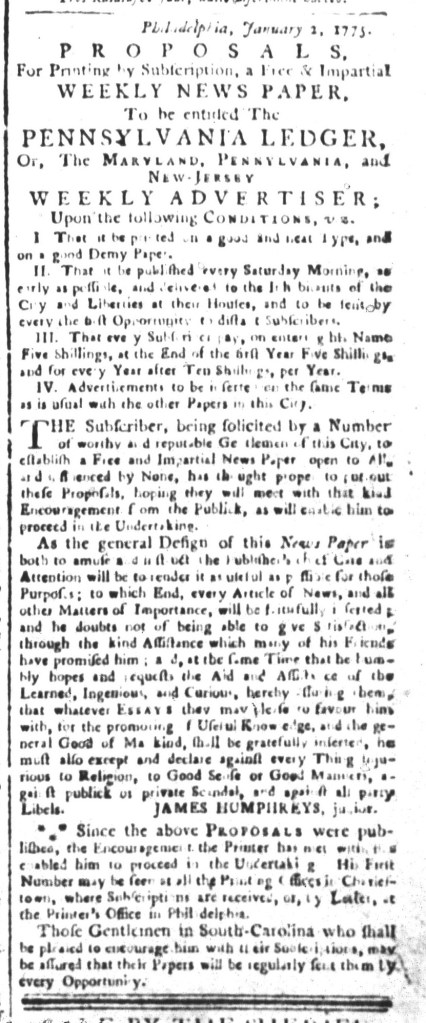
South-Carolina and American General Gazette (March 3, 1775).

“PENNSYLVANIA LEDGER … His First Number may be seen at all the Printing Offices in Charlestown.”

When James Humphreys, Jr., launched the Pennsylvania Ledger in 1775, he sought local subscribers by placing the proposals for his “Free & Impartial WEEKLY NEWSPAPER” in other newspapers published in Philadelphia.  Given the extended title – Pennsylvania Ledger, Or, the Maryland, Pennsylvania, and New-Jersey Weekly Advertiser (in the proposals) or Pennsylvania Ledger: Or the Virginia, Maryland, Pennsylvania, and New-Jersey Weekly Advertiser (on the masthead) – it made sense to promote the newspaper to prospective subscribers and advertisers in towns in Pennsylvania and neighboring colonies.  After all, colonial newspapers served vast regions.

Yet they circulated even more widely than the expansive title of the Pennsylvania Ledger suggested.  Realizing that was the case, Humphreys sent the proposals for the Pennsylvania Ledger to R. Wells and Son, the printers of the South-Carolina and American General Gazette, in Charleston.  Dated “Philadelphia, January 2, 1775,” the proposals ran in the February 24 and March 3 editions.  By that time, Humphreys had already commenced publication of his newspaper.  A note at the end of the advertisement acknowledged that was the case: “Since the above PROPOSALS were published, the Encouragement the Printer has met with has enabled him to proceed in the Undertaking.  His First Number,” published on January 28, “may be seen at all the Printing Offices in Charlestown, where Subscriptions are received.”  Wells and Son acted as local agents for Humphreys, a common practice among eighteenth-century printers who also participated in exchange networks for sharing newspapers and reprinting content.

Another note directed to readers of the South-Carolina and American General Gazette advised, “Those Gentlemen in South-Carolina who shall be pleased to encourage [Humphreys] with their Subscriptions, may be assured that their Papers will be regularly sent them by every Opportunity.”  That the January 28 edition was available for inspection at a local printing office by February 24 testified to Humphreys’s commitment to delivering newspapers to distant subscribers in a timely manner.  While he certainly welcomed individual subscribers, the printer likely hoped that his newspaper would attract the attention of the proprietors of establishments where merchants and others gathered to do business.  Coffeehouses, for instance, often supplied newspapers from near and far for patrons to peruse news about current events and consult the shipping news for updates about commerce in the British Atlantic world.  Humphreys had a reasonable expectation that publishing proposals for the Pennsylvania Ledger would yield subscribers in South Carolina.

Slavery Advertisements Published March 3, 1775

The Slavery Adverts 250 Project chronicles the role of newspaper advertising in perpetuating slavery in the era of the American Revolution. The project seeks to reveal the ubiquity of slavery in eighteenth-century life from New England to Georgia by republishing advertisements about enslaved people – for sale as individuals or in groups, wanted to purchase or for hire for short periods, runaways who liberated themselves, and those who were subsequently captured and confined in jails and workhouses – in daily digests on this site as well as in real time via the @SlaveAdverts250 Twitter feed, utilizing twenty-first-century media to stand in for the print media of the eighteenth century.

The project aims to provide modern audiences with a sense of just how often colonizers encountered these advertisements in their daily lives. Enslaved men, women, and children appeared in print somewhere in the colonies almost every single day. Those advertisements served as a constant backdrop for social, cultural, economic, and political life in colonial and revolutionary America. Colonizers who did not purport to own enslaved people were still confronted with slavery as well as invited to maintain the system by purchasing enslaved men, women, and children or assisting in the capture of so-called “runaways” who sought to free themselves from bondage. The frequency of these newspaper advertisements suggests just how embedded slavery was in colonial and revolutionary American culture in everyday interactions beyond the printed page.

These advertisements also testify to the experiences of enslaved men, women, and children, though readers must consider that those experiences have been remediated through descriptions offered by enslavers rather than enslaved people themselves. Often unnamed in the advertisements, enslaved men, women, and children were not invisible or unimportant in early America.

These advertisements appeared in colonial American newspapers 250 years ago today.

South-Carolina and American General Gazette (March 3, 1775).

**********

South-Carolina and American General Gazette (March 3, 1775).

**********

South-Carolina and American General Gazette (March 3, 1775).

**********

South-Carolina and American General Gazette (March 3, 1775).

**********

South-Carolina and American General Gazette (March 3, 1775).

**********

South-Carolina and American General Gazette (March 3, 1775).

**********

South-Carolina and American General Gazette (March 3, 1775).

**********

South-Carolina and American General Gazette (March 3, 1775).

**********

South-Carolina and American General Gazette (March 3, 1775).

**********

South-Carolina and American General Gazette (March 3, 1775).

**********

South-Carolina and American General Gazette (March 3, 1775).

**********

South-Carolina and American General Gazette (March 3, 1775).

**********

South-Carolina and American General Gazette (March 3, 1775).

**********

South-Carolina and American General Gazette (March 3, 1775).

**********

South-Carolina and American General Gazette (March 3, 1775).

**********

South-Carolina and American General Gazette (March 3, 1775).

**********

South-Carolina and American General Gazette (March 3, 1775).

**********

South-Carolina and American General Gazette (March 3, 1775).

**********

South-Carolina and American General Gazette (March 3, 1775).

**********

South-Carolina and American General Gazette (March 3, 1775).

**********

South-Carolina and American General Gazette (March 3, 1775).

**********

South-Carolina and American General Gazette (March 3, 1775).

**********

South-Carolina and American General Gazette (March 3, 1775).

**********

Virginia Gazette [Purdie] (March 3, 1775).

**********

Virginia Gazette [Purdie] (March 3, 1775).

March 2

What was advertised in a colonial American newspaper 250 years ago today?

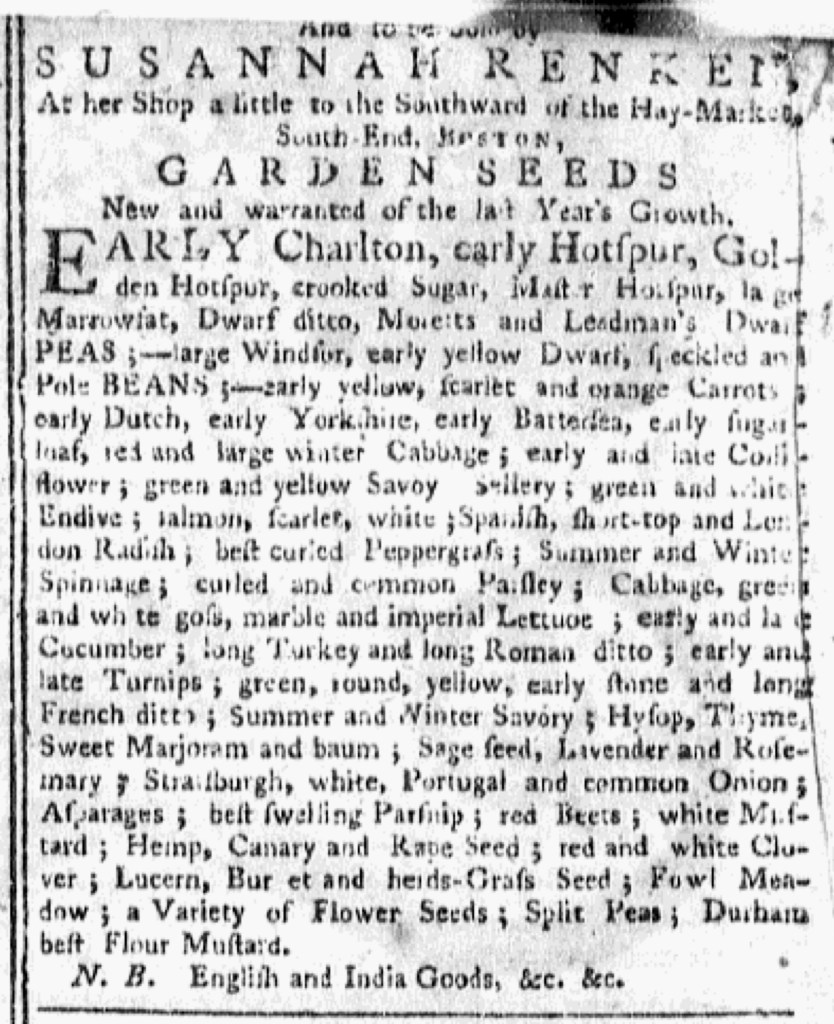
Massachusetts Spy (March 2, 1775).

“GARDEN SEEDS New and warranted of the last Year’s Growth.”

Although her advertisement appeared later than in some years, Susannah Renken was the first to advertise “GARDEN SEEDS” in Boston in 1775.  She had also been first in 1768, 1770, and 1773, commencing an annual ritual of seed sellers, most of them women, taking to the pages of Boston’s newspapers to hawk extensive selections of garden seeds.  In 1775, Renken’s first advertisements was brief, just two lines in the February 23 edition of the Massachusetts Spy: “SUSANNAH RENKEN, has received a fresh supply of Garden Seeds.  Particulars in our next.”  She may have been in such a rush to run any advertisement at all that she did not have time to prepare her usual list of seeds before Isaiah Thomas, the printer, took that issue to press, though Thomas may have opted to publish an abbreviated notice.  A note at the bottom of the column advised, “Advertisements omitted will be in our next.”  Renken may have been fortunate that even a short notice appeared.  The following week, her full advertisement, featuring dozens of varieties of seeds, ran in the Massachusetts Spy.

The copy of the March 2 edition digitized to grant greater access has been damaged, eliminating the first lines of Renken’s advertisement, but it ran again the following week.  That issue reveals that the notice began with a familiar introduction: “Imported in Capt, Shayler from LONDON, And to be Sold by SUSANNAH RENKEN.”  Merchants, shopkeepers, and other purveyors of goods often stated which vessels carried their merchandise, revealing to prospective customers when their wares had been shipped and delivered.  In this case, it meant that Renken’s seeds arrived in the colonies, but not in Boston, several months before she placed her advertisement; she may have acquired her seeds only recently.  With the city’s harbor closed to commerce because of the Boston Port Act, Shayler’s vessel arrived in Salem with “Fresh Advices from London” in late November 1774, according to the December 5 edition of the Boston-Gazette.  Shayler delivered goods as well as news, but Renken had to arrange to have her seeds transported from Salem to Boston.  Perhaps she had only just confirmed delivery when her brief notice appeared in the Massachusetts Spy.  When W.P. Bartlett advertised garden seeds in the February 21, 1775, edition of the Essex Gazette, published in Salem, he proclaimed that his wares were “JUST IMPORTED, in the Venus, from LONDON.”  In previous years, Renken and her sister seed sellers in Boston usually did not describe their seeds as “just imported.”  In 1775, the imperial crisis prevented them from even considering doing so.

Slavery Advertisements Published March 2, 1775

The Slavery Adverts 250 Project chronicles the role of newspaper advertising in perpetuating slavery in the era of the American Revolution. The project seeks to reveal the ubiquity of slavery in eighteenth-century life from New England to Georgia by republishing advertisements about enslaved people – for sale as individuals or in groups, wanted to purchase or for hire for short periods, runaways who liberated themselves, and those who were subsequently captured and confined in jails and workhouses – in daily digests on this site as well as in real time via the @SlaveAdverts250 Twitter feed, utilizing twenty-first-century media to stand in for the print media of the eighteenth century.

The project aims to provide modern audiences with a sense of just how often colonizers encountered these advertisements in their daily lives. Enslaved men, women, and children appeared in print somewhere in the colonies almost every single day. Those advertisements served as a constant backdrop for social, cultural, economic, and political life in colonial and revolutionary America. Colonizers who did not purport to own enslaved people were still confronted with slavery as well as invited to maintain the system by purchasing enslaved men, women, and children or assisting in the capture of so-called “runaways” who sought to free themselves from bondage. The frequency of these newspaper advertisements suggests just how embedded slavery was in colonial and revolutionary American culture in everyday interactions beyond the printed page.

These advertisements also testify to the experiences of enslaved men, women, and children, though readers must consider that those experiences have been remediated through descriptions offered by enslavers rather than enslaved people themselves. Often unnamed in the advertisements, enslaved men, women, and children were not invisible or unimportant in early America.

These advertisements appeared in colonial American newspapers 250 years ago today.

Maryland Gazette (March 2, 1775).

**********

Maryland Gazette (March 2, 1775).

**********

Maryland Gazette (March 2, 1775).

**********

Maryland Gazette (March 2, 1775).

**********

Maryland Gazette (March 2, 1775).

**********

Maryland Gazette (March 2, 1775).

**********

Maryland Gazette (March 2, 1775).

**********

Maryland Gazette (March 2, 1775).

**********

Massachusetts Spy (March 2, 1775).

**********

Supplement to the New-York Journal (March 2, 1775).

**********

Rivington’s New-York Gazetteer (March 2, 1775).

**********

Rivington’s New-York Gazetteer (March 2, 1775).

**********

Rivington’s New-York Gazetteer (March 2, 1775).

**********

Rivington’s New-York Gazetteer (March 2, 1775).

**********

Virginia Gazette [Pinkney] (March 2, 1775).

**********

Virginia Gazette [Pinkney] (March 2, 1775).

March 1

What was advertised in a colonial American newspaper 250 years ago today?

Pennsylvania Journal (March 1, 1775).

“THE American Edition of Swan’s British Architect.”

Less than a year after arriving in Philadelphia from London, John Norman, an engraver, embarked on producing an “American Edition of Swan’s British Architect” in the spring of 1775.  He unveiled the project with an advertisement in the March 1 edition of the Pennsylvania Journal, advising the public that he was “Now PUBLISHING” the volume “by SUBSCRIPTION” and seeking supporters to reserve their copies.  He asked those who did so to make a deposit and pay the remainder “at the delivery of the book,” noting that the total price “is Ten Shillings less than the London edition.”

The Continental Association, a nonimportation, nonconsumption, and nonexportation agreement devised by the First Continental Congress in response to the Coercive Acts, was in effect at the time that Norman advertised his American edition of Swan’s British Architect.  His project adhered to the eighth article, which called for “promot[ing] Agriculture, Arts, and the Manufacturers of this Country,” while the subject matter, all sorts of architectural elements in fashion in England, suggested that colonizers continued to value transatlantic cultural ties and their identity as members of the British empire.  The dispute with Parliament had intensified, but most still hoped for a redress of grievances and return to amiable relations.

In addition to the newspaper advertisement, Norman printed more extensive “proposals, with a specimen of the plates and letter press,” that interested parties could view at his house.  Prospective subscribers could learn more about the project and assess the quality of the engravings before placing their orders.  To further entice them, Norman declared that the “names of the subscribers to this useful and ornamental work will be published.”  Just as disseminating subscription proposals was a common marketing strategy in eighteenth-century America, so was publishing the list of subscribers.  In other circumstances, the “gentlemen” who subscribed wanted to see their names alongside those of other genteel members of their community.  That was still the case for this book, yet they likely also wished to see their names in print as they for supporting for an American edition.  Norman offered an opportunity to simultaneously demonstrate their commitment to both the arts and the Continental Association.

Slavery Advertisements Published March 1, 1775

The Slavery Adverts 250 Project chronicles the role of newspaper advertising in perpetuating slavery in the era of the American Revolution. The project seeks to reveal the ubiquity of slavery in eighteenth-century life from New England to Georgia by republishing advertisements about enslaved people – for sale as individuals or in groups, wanted to purchase or for hire for short periods, runaways who liberated themselves, and those who were subsequently captured and confined in jails and workhouses – in daily digests on this site as well as in real time via the @SlaveAdverts250 Twitter feed, utilizing twenty-first-century media to stand in for the print media of the eighteenth century.

The project aims to provide modern audiences with a sense of just how often colonizers encountered these advertisements in their daily lives. Enslaved men, women, and children appeared in print somewhere in the colonies almost every single day. Those advertisements served as a constant backdrop for social, cultural, economic, and political life in colonial and revolutionary America. Colonizers who did not purport to own enslaved people were still confronted with slavery as well as invited to maintain the system by purchasing enslaved men, women, and children or assisting in the capture of so-called “runaways” who sought to free themselves from bondage. The frequency of these newspaper advertisements suggests just how embedded slavery was in colonial and revolutionary American culture in everyday interactions beyond the printed page.

These advertisements also testify to the experiences of enslaved men, women, and children, though readers must consider that those experiences have been remediated through descriptions offered by enslavers rather than enslaved people themselves. Often unnamed in the advertisements, enslaved men, women, and children were not invisible or unimportant in early America.

These advertisements appeared in colonial American newspapers 250 years ago today.

Connecticut Journal (March 1, 1775).

**********

Supplement to the Pennsylvania Gazette (March 1, 1775).

**********

Pennsylvania Journal (March 1, 1775).

**********

Pennsylvania Journal (March 1, 1775).

**********

Supplement to the Pennsylvania Journal (March 1, 1775).