April 8

What was advertised in a colonial American newspaper 250 years ago today?
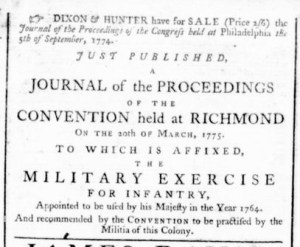
Virginia Gazette [Dixon and Hunter] (April 8, 1775).

“JOURNAL of the PROCEEDINGS OF THE CONVENTION held at RICHMOND.”

John Carter once again advertised that “A few Copies of The Proceedings of the late Continental CONGRESS May be had at the Printing-Office” in the April 8, 1775, edition of the Providence Gazette.  That same day, John Dixon and William Hunter advertised that they “have for SALE … the Journal of the Proceedings of the Congress held at Philadelphia” in the Virginia Gazette.  When the First Continental Congress concluded its meetings near the end of October 1774, printers in many towns rushed to publish local editions of the Extracts from the Votes and Proceedings of the American Continental Congress.  Dixon and his partner at the time, Alexander Purdie, printed the Extracts.  So did Carter.  Advertisements for the Extracts quickly appeared in newspapers.  Not nearly as many printers published the Journal.  William and Thomas Bradford produced a Philadelphia edition about a month after they published the Extracts.  In New York, Hugh Gaine published the only other edition.  In contrast to marketing for the Extracts, advertisements for the Journal did not immediately pepper newspapers throughout the colonies.

Yet over time printers and booksellers acquired copies of the Journal from the Bradfords or from Gaine and informed prospective customers that they stocked that volume.  Dixon and Hunter did so when they advertised a publication that came off their own press, “A JOURNAL of the PROCEEDINGS OF THE CONVENTION held at RICHMOND ON THE 20th OF MARCH, 1775.”  Although listed first in the advertisement, the Journal for the First Continental Congress received secondary attention.  Dixon and Hunter used larger type for the title of their new publication and created greater visual interest by breaking the title into several lines and centering each line.  Dixon and Hunter did not diminish the significance of the Journal for the First Continental Congress; instead, they treated the Journal for the convention at Richmond as breaking news, an important local update, and a continuation of coverage of proceedings that commenced with delegates in Philadelphia and then moved to meetings held throughout the colonies.  They also had an interest in selling the volume that they produced, yet they recognized an opportunity to package it with the Journal for the First Continental Congress and increase revenue.  Both publications kept the public informed while simultaneously commodifying American responses to the imperial crisis that ultimately became a revolution.

Slavery Advertisements Published April 8, 1775

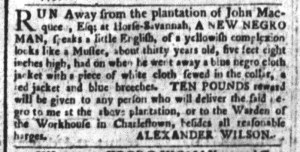
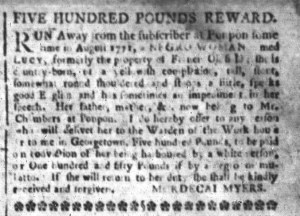
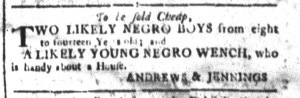
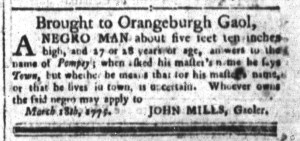
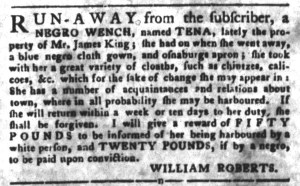
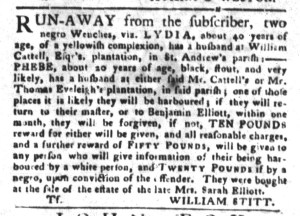
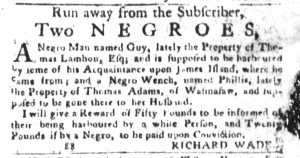
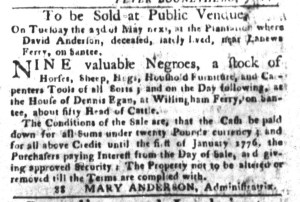
The Slavery Adverts 250 Project chronicles the role of newspaper advertising in perpetuating slavery in the era of the American Revolution. The project seeks to reveal the ubiquity of slavery in eighteenth-century life from New England to Georgia by republishing advertisements about enslaved people – for sale as individuals or in groups, wanted to purchase or for hire for short periods, runaways who liberated themselves, and those who were subsequently captured and confined in jails and workhouses – in daily digests on this site as well as in real time via the @SlaveAdverts250 Twitter feed, utilizing twenty-first-century media to stand in for the print media of the eighteenth century.
The project aims to provide modern audiences with a sense of just how often colonizers encountered these advertisements in their daily lives. Enslaved men, women, and children appeared in print somewhere in the colonies almost every single day. Those advertisements served as a constant backdrop for social, cultural, economic, and political life in colonial and revolutionary America. Colonizers who did not purport to own enslaved people were still confronted with slavery as well as invited to maintain the system by purchasing enslaved men, women, and children or assisting in the capture of so-called “runaways” who sought to free themselves from bondage. The frequency of these newspaper advertisements suggests just how embedded slavery was in colonial and revolutionary American culture in everyday interactions beyond the printed page.

These advertisements also testify to the experiences of enslaved men, women, and children, though readers must consider that those experiences have been remediated through descriptions offered by enslavers rather than enslaved people themselves. Often unnamed in the advertisements, enslaved men, women, and children were not invisible or unimportant in early America.

These advertisements appeared in colonial American newspapers 250 years ago today.

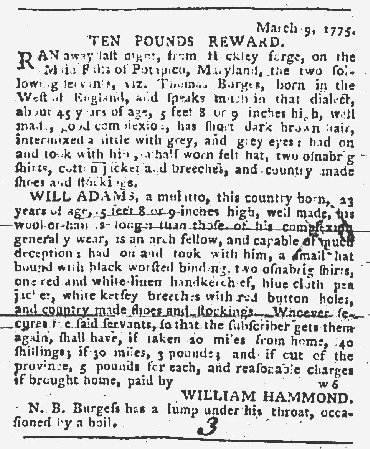
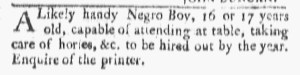
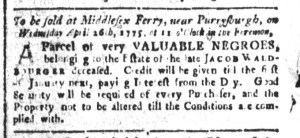
Pennsylvania Ledger (April 8, 1775).

**********

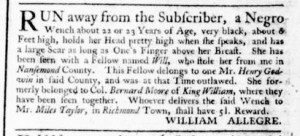
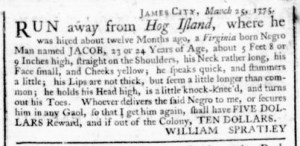
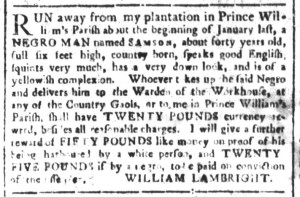
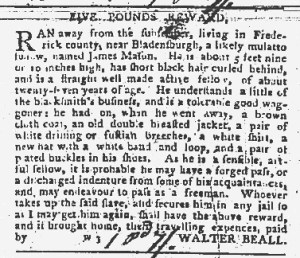
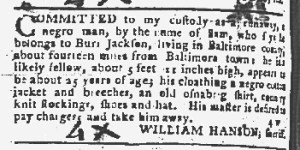
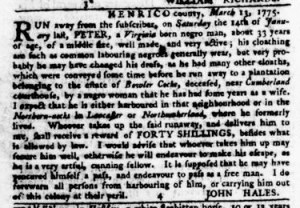
Virginia Gazette [Dixon and Hunter] (April 8, 1775).

**********

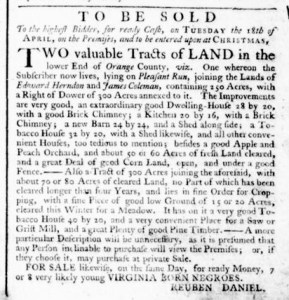
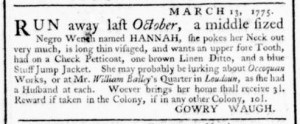
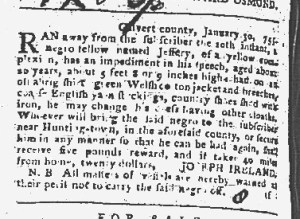
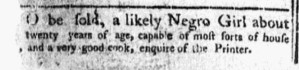
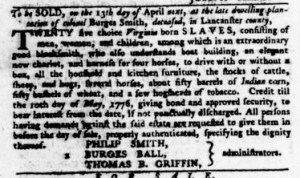
Virginia Gazette [Dixon and Hunter] (April 8, 1775).

**********

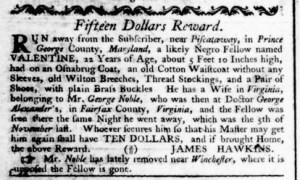
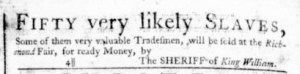
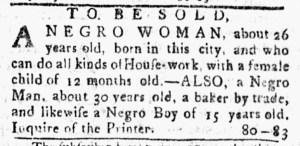
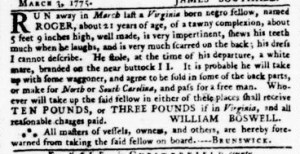
Virginia Gazette [Dixon and Hunter] (April 8, 1775).

**********

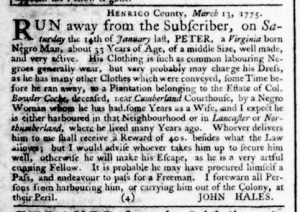
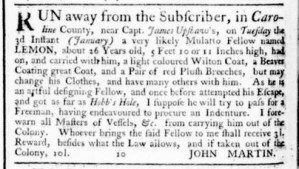
Virginia Gazette [Dixon and Hunter] (April 8, 1775).

**********

Virginia Gazette [Dixon and Hunter] (April 8, 1775).

**********

Virginia Gazette [Dixon and Hunter] (April 8, 1775).

**********

Virginia Gazette [Dixon and Hunter] (April 8, 1775).

**********

Virginia Gazette [Dixon and Hunter] (April 8, 1775).

**********

Virginia Gazette [Dixon and Hunter] (April 8, 1775).

**********

Virginia Gazette [Dixon and Hunter] (April 8, 1775).

**********

Virginia Gazette [Dixon and Hunter] (April 8, 1775).

**********

Virginia Gazette [Dixon and Hunter] (April 8, 1775).

**********

Virginia Gazette [Dixon and Hunter] (April 8, 1775).

April 7

What was advertised in a colonial American newspaper 250 years ago today?

Pennsylvania Mercury (April 7, 1775).

“DR. HILL’S AMERICAN BALSAM.”

Enoch Story and Daniel Humphreys began distributing subscription proposals for a new newspaper, the Pennsylvania Mercury and Universal Advertiser, in the middle of January 1775.  They began promoting their newspaper at the same time that James Humphreys, Jr., commenced publication of the Pennsylvania Ledger and Benjamin Towne established Philadelphia’s first tri-weekly newspaper, the Pennsylvania Evening Post.  Those two newspapers brought the total in the city to six, joining Dunlap’s Pennsylvania Packet, the Pennsylvania Gazette, the Pennsylvania Journal, and the Wöchentliche Pennsylvanische Staatsbote.  As the imperial crisis intensified, the number of newspapers published in the largest city in the colonies increased … but did a market exist for yet another?  Could Story and Humphreys attract enough subscribers and advertisers to make a go of the Pennsylvania Mercury?

They decided that they could.  On Friday, April 7, they published the first issue.  In a note to “Subscribers and the Public” on the first page, they explained that they deviated from the conditions in their proposals only slightly, distributing it on Fridays instead of Saturdays, because “one of the eastern mails is now dispatched from Boston, in such time as to arrive here on Thursday (instead of Saturday as formerly).”  That meant that Story and Humphreys could distribute “the most early intelligence from that interesting quarter.”  That meant that the Pennsylvania Mercury scooped the Pennsylvania Evening Post and the Pennsylvania Ledger, both published on Saturday.  The printers also proclaimed that “the TYPE with which THIS Paper is printed are of AMERICAN manufacture,” signaling their support for the article in the Continental Association that called for supporting domestic manufactures, and asked for “every patriotic allowance” if the quality did not give “entire satisfaction to the judicious and accurate eye.”  It was, after all, a small sacrifice.  “[W]e flatter ourselves,” the printers declared, “that the rustic manufactures of America will prove more graceful to the patriotic eye, than the more finished productions of Europe.”

Story and Humphreys also managed to line up advertisers for the first issue of the Pennsylvania Mercury, an importance source of revenue for any newspaper.  In addition to their notice, two advertisements appeared on the first page, including one for “DR. HILL’S AMERICAN BALSAM.”  Advertising filled more than a column on the third page and nearly twice as much on the last page.  In total, paid notices accounted for one-quarter of the content of the inaugural issue.  The colophon encouraged readers to submit advertisements to the printing office in Norris’s Alley near Front Street.  The success of Philadelphia’s newest newspaper would depend in part on advertisers choosing to insert their notices in it.

Slavery Advertisements Published April 7, 1775

The Slavery Adverts 250 Project chronicles the role of newspaper advertising in perpetuating slavery in the era of the American Revolution. The project seeks to reveal the ubiquity of slavery in eighteenth-century life from New England to Georgia by republishing advertisements about enslaved people – for sale as individuals or in groups, wanted to purchase or for hire for short periods, runaways who liberated themselves, and those who were subsequently captured and confined in jails and workhouses – in daily digests on this site as well as in real time via the @SlaveAdverts250 Twitter feed, utilizing twenty-first-century media to stand in for the print media of the eighteenth century.
The project aims to provide modern audiences with a sense of just how often colonizers encountered these advertisements in their daily lives. Enslaved men, women, and children appeared in print somewhere in the colonies almost every single day. Those advertisements served as a constant backdrop for social, cultural, economic, and political life in colonial and revolutionary America. Colonizers who did not purport to own enslaved people were still confronted with slavery as well as invited to maintain the system by purchasing enslaved men, women, and children or assisting in the capture of so-called “runaways” who sought to free themselves from bondage. The frequency of these newspaper advertisements suggests just how embedded slavery was in colonial and revolutionary American culture in everyday interactions beyond the printed page.

These advertisements also testify to the experiences of enslaved men, women, and children, though readers must consider that those experiences have been remediated through descriptions offered by enslavers rather than enslaved people themselves. Often unnamed in the advertisements, enslaved men, women, and children were not invisible or unimportant in early America.

These advertisements appeared in colonial American newspapers 250 years ago today.

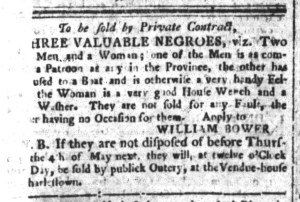
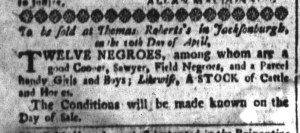
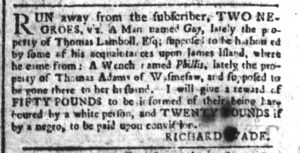
North-Carolina Gazette (April 7, 1775).

**********

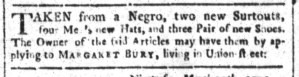
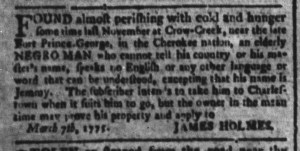
South-Carolina and American General Gazette (April 7, 1775).

**********

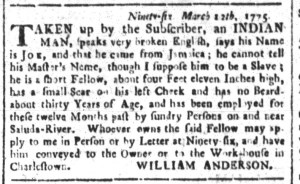
South-Carolina and American General Gazette (April 7, 1775).

**********

South-Carolina and American General Gazette (April 7, 1775).

**********

South-Carolina and American General Gazette (April 7, 1775).

**********

South-Carolina and American General Gazette (April 7, 1775).

**********

South-Carolina and American General Gazette (April 7, 1775).

**********

South-Carolina and American General Gazette (April 7, 1775).

**********

South-Carolina and American General Gazette (April 7, 1775).

**********

South-Carolina and American General Gazette (April 7, 1775).

**********

South-Carolina and American General Gazette (April 7, 1775).

**********

South-Carolina and American General Gazette (April 7, 1775).

**********

South-Carolina and American General Gazette (April 7, 1775).

**********

South-Carolina and American General Gazette (April 7, 1775).

**********

South-Carolina and American General Gazette (April 7, 1775).

**********

South-Carolina and American General Gazette (April 7, 1775).

**********

Virginia Gazette [Purdie] (April 7, 1775).

**********

Virginia Gazette [Purdie] (April 7, 1775).

April 6

What was advertised in a colonial American newspaper 250 years ago today?

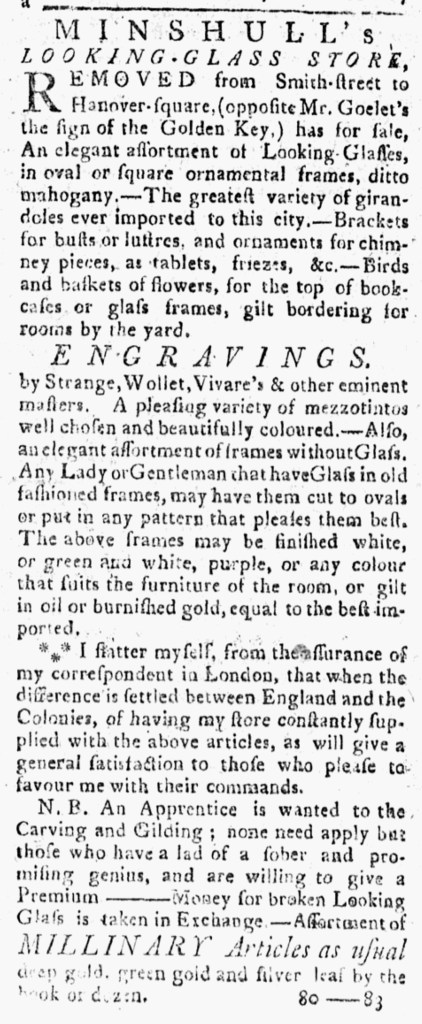
Supplement to the New-York Journal (April 6, 1775).

“Assurance … that when the difference is settled between England and the colonies, of having my store constantly supplied.”

In the spring of 1775, the proprietor of “MINSHULL’s LOOKING-GLASS STORE” ran a newspaper advertisement to announce that he had “REMOVED” from Smith Street to a new location “opposite Mr. Goelet’s [at] the sign of the Golden Key” on Hanover Square in New York.  In addition to an “elegant assortment” of looking glasses, he stocked other items for decorating homes and offices, including brackets for displaying busts, arrangements of flowers and birds “for the top of bookcases,” and the “greatest variety of girandoles” or candleholders “ever imported to the city.”  He also devoted a separate paragraph, with its own headline, to a “pleasing variety” of mezzotint “ENGRAVINGS” and the choices for frames.

John Minshull confided that he had “assurances of my correspondent in London, that when the difference is settled between England and the Colonies, of having my store constantly supplied with the above articles, as will give a general satisfaction” to his customers.  Readers realized that he referred to the imperial crisis and the effects of the Continental Association, the nonimportation agreement devised by the First Continental Congress in response to the Coercive Acts.  Minshull did not state that he imported his inventory before that pact went into effect on December 1, 1774.  Instead, he allowed readers to make that assumption, especially when he noted that he would not receive any new merchandise from England until the colonies and Parliament reached an accord.

That did not happen.  Within weeks of Minshull placing his advertisement, the Revolutionary War began with the Battles of Lexington and Concord in Massachusetts.  A little over a year later, the British occupied New York and remained in the city until 1783.  Yet Minshull persevered, continued operating his shop, and, according to an advertisement in the November 8, 1780, edition of the Royal Gazette, “imported in the Fleet from England, A large Assortment of LOOKING GLASSES, adapted to the present mode of Town and Country.”  He apparently managed to maintain his connections with his correspondents and suppliers in London.

Perhaps Minshull abided by the Continental Association in 1775 as a matter of political principle.  Perhaps he did so merely to stay in the good graces of his customers and the community.  The latter seems more likely since, according to Luke Beckerdite, “a ‘John Michalsal’ was included in a list of Loyalists” in 1775 and “a ‘John Minchull’ subsequently fled to Shelburne, Nova Scotia,” a haven for Loyalists during and immediately after the war.  From August 1782 through February 1783, ran an advertisement in the Royal Gazette for his “remaining Stock” that he sold “Cheap! Cheap! Cheap!”  It appears that Minshull had a going-out-of-business sale before evacuating from New York when the war ended.  Before that, he resumed business as usual when circumstances changed under the British occupation, weathering the storm and attempting to earn his livelihood during uncertain times.  When the “difference [was] settled between England and the Colonies,” he no longer sold looking glasses or anything else in New York.

Slavery Advertisements Published April 6, 1775

The Slavery Adverts 250 Project chronicles the role of newspaper advertising in perpetuating slavery in the era of the American Revolution. The project seeks to reveal the ubiquity of slavery in eighteenth-century life from New England to Georgia by republishing advertisements about enslaved people – for sale as individuals or in groups, wanted to purchase or for hire for short periods, runaways who liberated themselves, and those who were subsequently captured and confined in jails and workhouses – in daily digests on this site as well as in real time via the @SlaveAdverts250 Twitter feed, utilizing twenty-first-century media to stand in for the print media of the eighteenth century.
The project aims to provide modern audiences with a sense of just how often colonizers encountered these advertisements in their daily lives. Enslaved men, women, and children appeared in print somewhere in the colonies almost every single day. Those advertisements served as a constant backdrop for social, cultural, economic, and political life in colonial and revolutionary America. Colonizers who did not purport to own enslaved people were still confronted with slavery as well as invited to maintain the system by purchasing enslaved men, women, and children or assisting in the capture of so-called “runaways” who sought to free themselves from bondage. The frequency of these newspaper advertisements suggests just how embedded slavery was in colonial and revolutionary American culture in everyday interactions beyond the printed page.

These advertisements also testify to the experiences of enslaved men, women, and children, though readers must consider that those experiences have been remediated through descriptions offered by enslavers rather than enslaved people themselves. Often unnamed in the advertisements, enslaved men, women, and children were not invisible or unimportant in early America.

These advertisements appeared in colonial American newspapers 250 years ago today.

Maryland Gazette (April 6, 1775).

**********

Maryland Gazette (April 6, 1775).

**********

Maryland Gazette (April 6, 1775).

**********

Maryland Gazette (April 6, 1775).

**********

Maryland Gazette (April 6, 1775).

**********

Maryland Gazette (April 6, 1775).

**********

Massachusetts Spy (April 6, 1775).

**********

Supplement to the New-York Journal (April 6, 1775).

**********

Rivington’s New-York Gazetteer (April 6, 1775).

**********

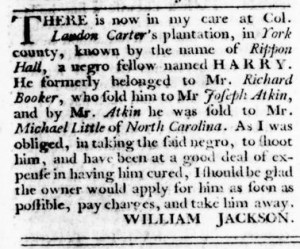
Virginia Gazette [Pinkney] (April 6, 1775).

**********

Supplement to the Virginia Gazette [Pinkney] (April 6, 1775).

**********

Supplement to the Virginia Gazette [Pinkney] (April 6, 1775).

**********

Supplement to the Virginia Gazette [Pinkney] (April 6, 1775).

**********

Supplement to the Virginia Gazette [Pinkney] (April 6, 1775).

April 5

What was advertised in a colonial American newspaper 250 years ago today?

Pennsylvania Journal (April 5, 1775).

“JOHN MITCHELL’s WINE, SPIRIT, RUM, and SUGAR STORES.”

John Mitchell operated an alcohol emporium in Philadelphia in the 1770s.  In April 1775, he advertised his “WINE SPIRIT, RUM, and SUGAR STORES” on Front Street, inviting customers in the city and its hinterland to purchase his wares and then retail them at their shops or taverns or enjoy imbibing them at home.  To entice prospective customers, he compiled a lengthy list of his current selection along with a pledge to “keep a constant supply of the above Articles” to avoid disappointments associated with selling out of any favorites.

His inventory included, for instance, “BEST Genuine Madeira Wines,” “Excellent bottled Claret,” “Genuine new and old Port Wine,” “Teneriffe and Fyal Wines,” “Red Lisbon Wine,” “Genuine old French Brandy,” “Shone’s, Ben. Kenton and Parker’s best London bottled Porter,” “Genuine Button and Taunton Ale,” and “West-India and New-England Rum,” along with many other choices.  For many items, Mitchell listed several sizes, indicating that customers could purchase the right amount for their home or business.  He sold Madeira by the gallon or in barrels of various sizes, including “by the pipe, hogshead, [and] quarter-cask.”  The bottled porters came “by the hogshead, hamper or dozen” to meet the budget and the convenience of his customers.

The format of Mitchell’s advertisement highlighted the choices.  Rather than list his wines and spirits in a dense paragraph, as many advertisers did when they sought to demonstrate the selection of goods they offered to consumers, Mitchell devoted one line to each item.  That made it easier for readers to peruse his catalog while also creating visual elements that differentiated his advertisement from news items and other notices that consisted of blocks of text justified on both the left and the right.  The variations in white space that resulted from centering each item on its own line made “Best Genuine Madeira Wines,” “Teneriffe and Fyal Wines,” “Genuine old French Brandy,” and “Spanish Brandy” even more visible within the advertisement.  Both the extensive accounting of wines and spirits and the design of Mitchell’s notice contributed to attracting the attention of prospective customers.

Slavery Advertisements Published April 5, 1775

The Slavery Adverts 250 Project chronicles the role of newspaper advertising in perpetuating slavery in the era of the American Revolution. The project seeks to reveal the ubiquity of slavery in eighteenth-century life from New England to Georgia by republishing advertisements about enslaved people – for sale as individuals or in groups, wanted to purchase or for hire for short periods, runaways who liberated themselves, and those who were subsequently captured and confined in jails and workhouses – in daily digests on this site as well as in real time via the @SlaveAdverts250 Twitter feed, utilizing twenty-first-century media to stand in for the print media of the eighteenth century.
The project aims to provide modern audiences with a sense of just how often colonizers encountered these advertisements in their daily lives. Enslaved men, women, and children appeared in print somewhere in the colonies almost every single day. Those advertisements served as a constant backdrop for social, cultural, economic, and political life in colonial and revolutionary America. Colonizers who did not purport to own enslaved people were still confronted with slavery as well as invited to maintain the system by purchasing enslaved men, women, and children or assisting in the capture of so-called “runaways” who sought to free themselves from bondage. The frequency of these newspaper advertisements suggests just how embedded slavery was in colonial and revolutionary American culture in everyday interactions beyond the printed page.

These advertisements also testify to the experiences of enslaved men, women, and children, though readers must consider that those experiences have been remediated through descriptions offered by enslavers rather than enslaved people themselves. Often unnamed in the advertisements, enslaved men, women, and children were not invisible or unimportant in early America.

These advertisements appeared in colonial American newspapers 250 years ago today.

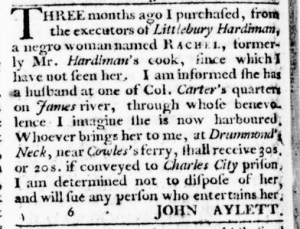
Maryland Journal (April 5, 1775).

**********

Maryland Journal (April 5, 1775).

April 4

What was advertised in a colonial American newspaper 250 years ago today?

Pennsylvania Evening Post (April 4, 1775).

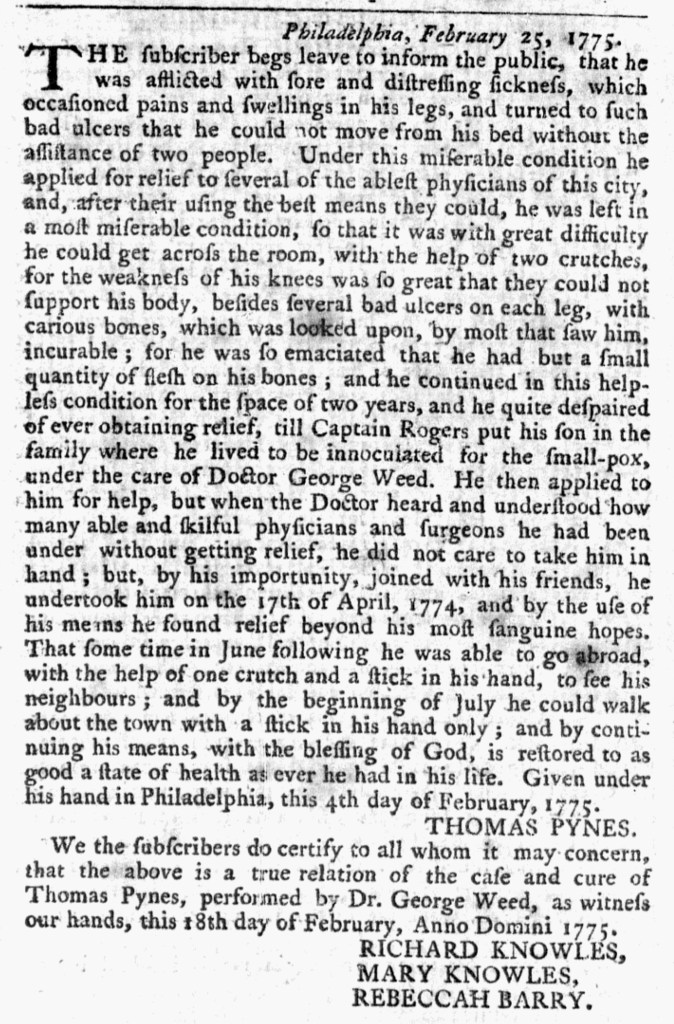
“Restored to as good a state of health as ever he had in his life.”

The final page of the April 4, 1775, edition of the Pennsylvania Evening Post consisted entirely of advertisements (and the colophon running across both columns at the bottom of the page).  The final notice filled about two-thirds of the column, making it longer than many of the news items that ran elsewhere in that issue.  It took the form of an open letter in which Thomas Pynes described how he was formerly “afflicted with sore and distressing sickness, which occasioned pains and swellings in his legs, and turned to such bad ulcers that he could not move from his bed without the assistance of two people.”  In that “miserable condition,” he “applied for relief” and consulted “several of the ablest physicians” in Philadelphia, but he did not experience any relief even after they provided “the best means they could.”  Most of those doctors considered him “incurable.”

Pynes endured that condition for two years, “despair[ing] of ever obtaining relief.”  He eventually learned of patients “under the care of Doctor George Weed” and felt renewed hope, yet when Weed “heard and understood how many able and skilful physicians and surgeons [Pynes] had been under without getting relief, he did not care to take him in hand.”  Weed overcame those misgivings when Pynes enlisted the aid of friends in petitioning the doctor.  Pynes entered his care on April 17, 1774, about a year before his letter appeared in the Pennsylvania Evening Post.  He reported that “found relief beyond his most sanguine hopes.”  Furthermore, that relief arrived very quickly, especially considering how long he had been ill.  In June, just two months after Weed commenced treatment, Pynes was able to leave his house and visit his neighbors “with the help of one crutch and a stick in his hand.”  By July, he “could walk about the town with a stick in his hand only.”  Under Weed’s care, “with the blessing of God,” Pynes was “restored to as good a state of health as ever he had in his life.”

A short confirmation of Pynes’s account appeared at the end of the advertisement.  Richard Knowles, Mary Knowles, and Rebeccah Barry “certif[ied] … that the above is a true relation of the case and cure of Thomas Pynes, performed by Dr. George Weed.”  Pynes and his friends likely did not insert this letter in the Pennsylvania Evening Post on their own, just as Joseph Wellahway and Samuel Hallo probably did not submit their testimonials to that newspaper about six weeks earlier without guidance from the doctor.  Weed adopted a clever strategy in not adding anything else to these testimonials, not even giving his location, hawking the patent medicines he produced, or making other sorts of appeals.  Instead, he depended on the story told by Pynes and its authenticity as affirmed by three witnesses as all the marketing necessary to draw the attention of prospective patients.  Rather than an advertisement devised by the doctor, Pynes’s story looked like a narrative written and published for the benefit of the public, especially those who despaired of finding relief for the maladies that incapacitated them.

Slavery Advertisements Published April 4, 1775

The Slavery Adverts 250 Project chronicles the role of newspaper advertising in perpetuating slavery in the era of the American Revolution. The project seeks to reveal the ubiquity of slavery in eighteenth-century life from New England to Georgia by republishing advertisements about enslaved people – for sale as individuals or in groups, wanted to purchase or for hire for short periods, runaways who liberated themselves, and those who were subsequently captured and confined in jails and workhouses – in daily digests on this site as well as in real time via the @SlaveAdverts250 Twitter feed, utilizing twenty-first-century media to stand in for the print media of the eighteenth century.
The project aims to provide modern audiences with a sense of just how often colonizers encountered these advertisements in their daily lives. Enslaved men, women, and children appeared in print somewhere in the colonies almost every single day. Those advertisements served as a constant backdrop for social, cultural, economic, and political life in colonial and revolutionary America. Colonizers who did not purport to own enslaved people were still confronted with slavery as well as invited to maintain the system by purchasing enslaved men, women, and children or assisting in the capture of so-called “runaways” who sought to free themselves from bondage. The frequency of these newspaper advertisements suggests just how embedded slavery was in colonial and revolutionary American culture in everyday interactions beyond the printed page.

These advertisements also testify to the experiences of enslaved men, women, and children, though readers must consider that those experiences have been remediated through descriptions offered by enslavers rather than enslaved people themselves. Often unnamed in the advertisements, enslaved men, women, and children were not invisible or unimportant in early America.

These advertisements appeared in colonial American newspapers 250 years ago today.

South-Carolina Gazette and Country Journal (April 4, 1775).

**********

South-Carolina Gazette and Country Journal (April 4, 1775).

**********

South-Carolina Gazette and Country Journal (April 4, 1775).

**********

South-Carolina Gazette and Country Journal (April 4, 1775).

**********

South-Carolina Gazette and Country Journal (April 4, 1775).

**********

South-Carolina Gazette and Country Journal (April 4, 1775).

**********

South-Carolina Gazette and Country Journal (April 4, 1775).

**********

South-Carolina Gazette and Country Journal (April 4, 1775).

**********

South-Carolina Gazette and Country Journal (April 4, 1775).

**********

South-Carolina Gazette and Country Journal (April 4, 1775).

**********

South-Carolina Gazette and Country Journal (April 4, 1775).

**********

South-Carolina Gazette and Country Journal (April 4, 1775).

**********

South-Carolina Gazette and Country Journal (April 4, 1775).

**********

South-Carolina Gazette and Country Journal (April 4, 1775).

**********

South-Carolina Gazette and Country Journal (April 4, 1775).