The Slavery Adverts 250 Project chronicles the role of newspaper advertising in perpetuating slavery in the era of the American Revolution. The project seeks to reveal the ubiquity of slavery in eighteenth-century life from New England to Georgia by republishing advertisements about enslaved people – for sale as individuals or in groups, wanted to purchase or for hire for short periods, runaways who liberated themselves, and those who were subsequently captured and confined in jails and workhouses – in daily digests on this site as well as in real time via the @SlaveAdverts250 Twitter feed, utilizing twenty-first-century media to stand in for the print media of the eighteenth century.
The project aims to provide modern audiences with a sense of just how often colonizers encountered these advertisements in their daily lives. Enslaved men, women, and children appeared in print somewhere in the colonies almost every single day. Those advertisements served as a constant backdrop for social, cultural, economic, and political life in colonial and revolutionary America. Colonizers who did not purport to own enslaved people were still confronted with slavery as well as invited to maintain the system by purchasing enslaved men, women, and children or assisting in the capture of so-called “runaways” who sought to free themselves from bondage. The frequency of these newspaper advertisements suggests just how embedded slavery was in colonial and revolutionary American culture in everyday interactions beyond the printed page.
These advertisements also testify to the experiences of enslaved men, women, and children, though readers must consider that those experiences have been remediated through descriptions offered by enslavers rather than enslaved people themselves. Often unnamed in the advertisements, enslaved men, women, and children were not invisible or unimportant in early America.
These advertisements appeared in colonial American newspapers 250 years ago today.
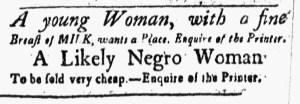
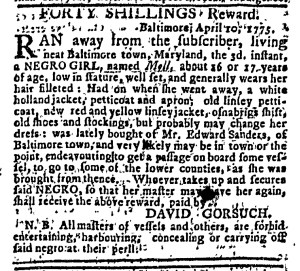
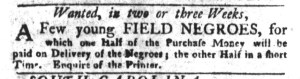
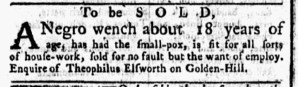
New-Hampshire Gazette (April 14, 1775).
**********
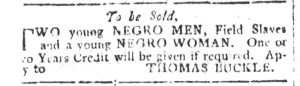
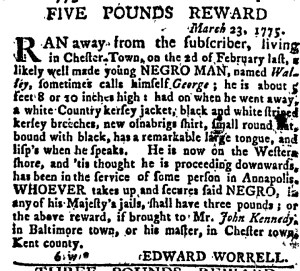
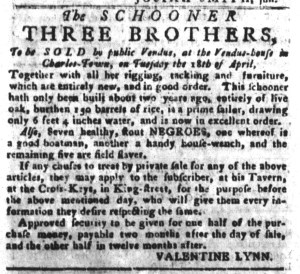
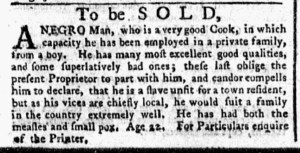
South-Carolina and American General Gazette (April 14, 1775).
**********
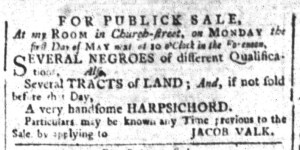
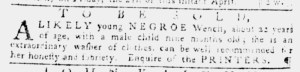
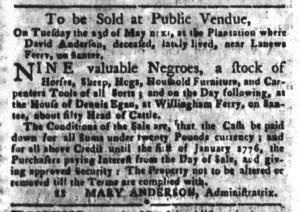
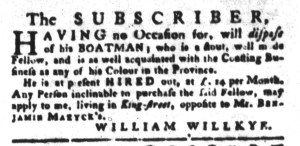
South-Carolina and American General Gazette (April 14, 1775).
**********
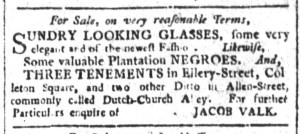
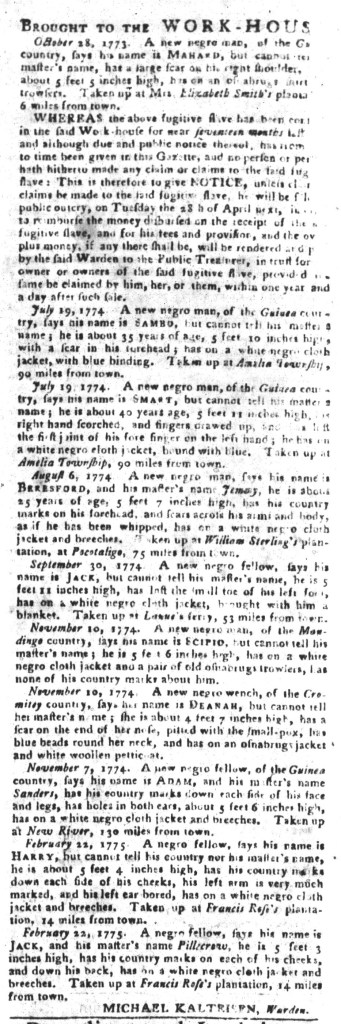
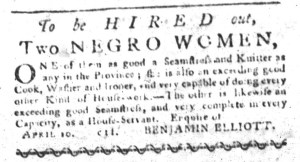
South-Carolina and American General Gazette (April 14, 1775).
**********
South-Carolina and American General Gazette (April 14, 1775).
**********
South-Carolina and American General Gazette (April 14, 1775).
**********
South-Carolina and American General Gazette (April 14, 1775).
**********
South-Carolina and American General Gazette (April 14, 1775).
**********
South-Carolina and American General Gazette (April 14, 1775).
**********
South-Carolina and American General Gazette (April 14, 1775).
**********
South-Carolina and American General Gazette (April 14, 1775).
**********
South-Carolina and American General Gazette (April 14, 1775).
**********
South-Carolina and American General Gazette (April 14, 1775).
**********
South-Carolina and American General Gazette (April 14, 1775).
**********
South-Carolina and American General Gazette (April 14, 1775).
**********
South-Carolina and American General Gazette (April 14, 1775).
**********
South-Carolina and American General Gazette (April 14, 1775).
**********
South-Carolina and American General Gazette (April 14, 1775).
**********
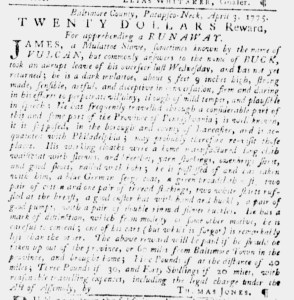
Story and Humphreys’s Pennsylvania Mercury (April 14, 1775).
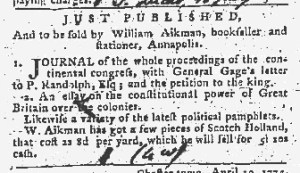
“JOURNAL of the whole proceedings of the continental congress.”
An advertisement by William Aikman, a bookseller and stationer in Annapolis, in the April 13, 1775, edition of the Maryland Gazette proclaimed, “JUST PUBLISHED, And to be sold … JOURNAL of the whole proceedings of the continental congress” and “An essay on the constitutional power of Great Britain over the colonies.” While Aikman no doubt sold those items, they had not been “JUST PUBLISHED,” nor had he published them.
Readers understood that “JUST PUBLISHED” did not always mean that an item was hot off the presses; sometimes that phrase was a vestige of an advertisement originally composed and disseminated weeks or months earlier and printed once again without revisions. Readers also understood that “JUST PUBLISHED, and to be sold by” did not necessarily mean that the retailer was also the publisher, merely that the retailer sold an item that had been published by someone, somewhere. Keeping that in mind yields a better understanding of the production and dissemination of the items that Aikman advertised.
Aikman’s advertisement also stated that he carried “a variety of the latest political pamphlets,” but he did not list additional titles. Perhaps he followed the lead of James Rivington in New York and tried to profit from selling pamphlets “on both sides, in the unhappy dispute with Great-Britain.” As the imperial crisis reached its boiling point in April 1775, Aikman took to the pages of the Maryland Gazette to hawk two items published by the Bradfords in 1774 that became more timely and relevant as well as the “latest political pamphlets” that provided even more for colonizers to consider as they learned about and participated in current events.
The Slavery Adverts 250 Project chronicles the role of newspaper advertising in perpetuating slavery in the era of the American Revolution. The project seeks to reveal the ubiquity of slavery in eighteenth-century life from New England to Georgia by republishing advertisements about enslaved people – for sale as individuals or in groups, wanted to purchase or for hire for short periods, runaways who liberated themselves, and those who were subsequently captured and confined in jails and workhouses – in daily digests on this site as well as in real time via the @SlaveAdverts250 Twitter feed, utilizing twenty-first-century media to stand in for the print media of the eighteenth century.
The project aims to provide modern audiences with a sense of just how often colonizers encountered these advertisements in their daily lives. Enslaved men, women, and children appeared in print somewhere in the colonies almost every single day. Those advertisements served as a constant backdrop for social, cultural, economic, and political life in colonial and revolutionary America. Colonizers who did not purport to own enslaved people were still confronted with slavery as well as invited to maintain the system by purchasing enslaved men, women, and children or assisting in the capture of so-called “runaways” who sought to free themselves from bondage. The frequency of these newspaper advertisements suggests just how embedded slavery was in colonial and revolutionary American culture in everyday interactions beyond the printed page.
These advertisements also testify to the experiences of enslaved men, women, and children, though readers must consider that those experiences have been remediated through descriptions offered by enslavers rather than enslaved people themselves. Often unnamed in the advertisements, enslaved men, women, and children were not invisible or unimportant in early America.
These advertisements appeared in colonial American newspapers 250 years ago today.
What was advertised in a colonial American newspaper 250 years ago today?
Maryland Journal (April 12, 1775).
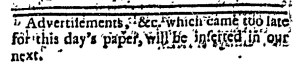
“Advertisements, &c. which came too late for this day’s paper, will be inserted in our next.”
Some advertisers and correspondents may have been frustrated when the content they submitted to the printing office did not appear in the April 12, 1775, edition of the Maryland Journal. To mollify them, the printer, William Goddard, inserted a brief note advising that “Advertisements, &c. which came too late for this day’s paper, will be inserted in our next.” No printer wished to disappoint advertisers who paid to run their notices nor correspondents who contributed the “FRESHEST ADVICES, both FOREIGN and DOMESTIC” that subscribers expected to find when they perused colonial newspapers. In this instance, some material just had not arrived in time to set the type and integrate it into the issue, but Goddard pledged that it would appear in print the following week.
The placement of the printer’s notice at the bottom of the final column on the third page suggests that he made the decision to include it shortly before taking the issue to press. Each edition of the Maryland Journal, like other colonial newspapers, consisted of four pages, two printed on each side of a broadsheet folded in half. Printers typically printed the side with the first and fourth pages and then the side with the second and third pages. As a result, the newest content, whether articles, letters, editorials, or advertisements, appeared “inside” the newspaper rather than on the front page. Goddard had just enough space for his notice to advertisers and correspondents when the compositor finished setting type and laying out the rest of the third page (the last page prepared for the press).
Many of the advertisements that did appear in that issue featured datelines, sometimes including both the town and date and other times just the date. Most on the fourth page (the first prepared for the press) were from March, along with a couple from February and the most recent from April 1, April 3 and April 4. All of them ran in the previous issue on April 5, so the compositor merely used type already set. The advertisements immediately above Goddard’s notice on the third page were dated April 6 and April 10, further demonstrating that where advertisements appeared in an issue depended in part on when they arrived in the printing office. Goddard did not play favorites or decide that some advertisements were more important than others. Instead, time constraints prevented him from immediately printing every advertisement submitted to him. Those advertisers could depend on their notices running in the next issue.
The Slavery Adverts 250 Project chronicles the role of newspaper advertising in perpetuating slavery in the era of the American Revolution. The project seeks to reveal the ubiquity of slavery in eighteenth-century life from New England to Georgia by republishing advertisements about enslaved people – for sale as individuals or in groups, wanted to purchase or for hire for short periods, runaways who liberated themselves, and those who were subsequently captured and confined in jails and workhouses – in daily digests on this site as well as in real time via the @SlaveAdverts250 Twitter feed, utilizing twenty-first-century media to stand in for the print media of the eighteenth century.
The project aims to provide modern audiences with a sense of just how often colonizers encountered these advertisements in their daily lives. Enslaved men, women, and children appeared in print somewhere in the colonies almost every single day. Those advertisements served as a constant backdrop for social, cultural, economic, and political life in colonial and revolutionary America. Colonizers who did not purport to own enslaved people were still confronted with slavery as well as invited to maintain the system by purchasing enslaved men, women, and children or assisting in the capture of so-called “runaways” who sought to free themselves from bondage. The frequency of these newspaper advertisements suggests just how embedded slavery was in colonial and revolutionary American culture in everyday interactions beyond the printed page.
These advertisements also testify to the experiences of enslaved men, women, and children, though readers must consider that those experiences have been remediated through descriptions offered by enslavers rather than enslaved people themselves. Often unnamed in the advertisements, enslaved men, women, and children were not invisible or unimportant in early America.
These advertisements appeared in colonial American newspapers 250 years ago today.
What was advertised in a colonial American newspaper 250 years ago today?
South-Carolina Gazette and Country Journal (April 11, 1775).
“The Sign of the NEGRO BOY.”
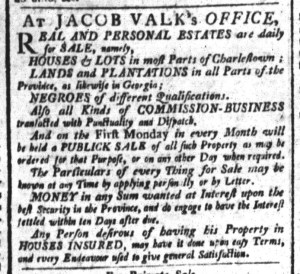
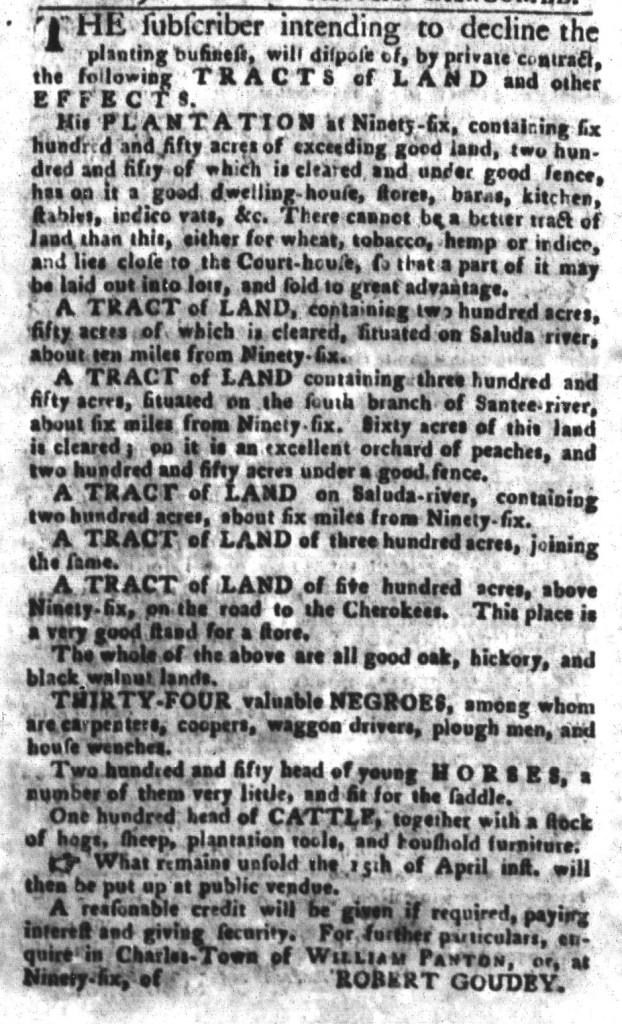
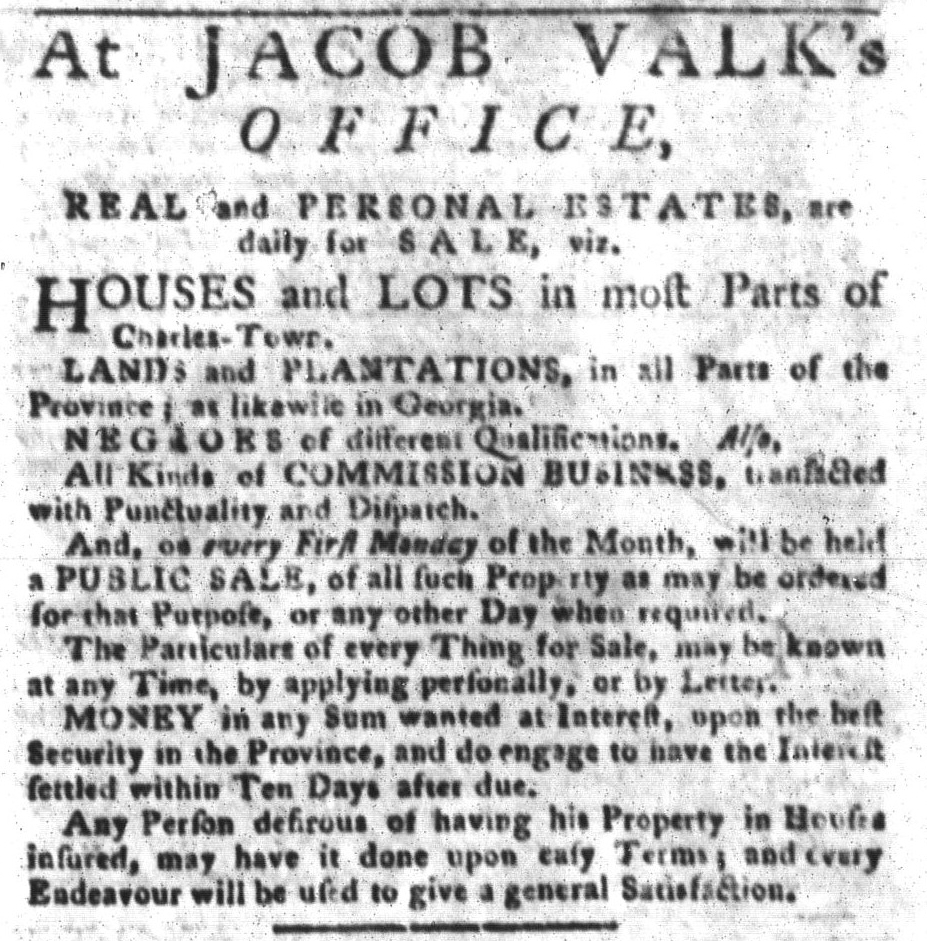
The April 11, 1775, edition of the South-Carolina Gazette and Country Journal carried seventeen advertisements about enslaved people. Several offered enslaved people for sale. Jacob Valk, a broker who regularly advertised, noted that “NEGROES of different Qualifications” were “daily for SALE” at his office. Valentine Lynn sought to sell “Seven healthy, stout NEGROES,” including “a good boatman,” a “handy” domestic servant, and five “field slaves.” Robert Goudey announced that he “will dispose of, by private contract,” nearly three dozen enslaved people, “among whom are carpenters, coopers, wagon drivers, plough men, and house” maids. Prospective purchasers could presumably examine those enslaved people, just as they could examine any of the eleven Black men and women “Brought to the Workhouse” and imprisoned there until their enslavers claimed them.
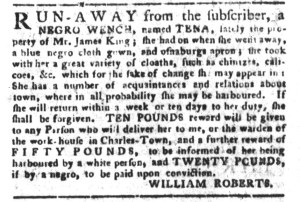
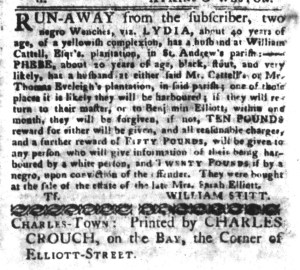
Other advertisements certainly enlisted readers in examining Black bodies closely to determine if they matched the descriptions of enslaved people who liberated themselves by running away from their enslavers. William Stitt, for instance, asked readers to take note of any Black women they encountered who might be Lydia, “about 40 years of age, of a yellowish complexion.” William Roberts described Tena, who “had on when she went away, a blue negro cloth gown, and osnaburgs apron.”
Yet these were not the only instances of Black bodies on display in Charleston. In a notice asking others to settle accounts before he left the city for a while, John Welch, a tobacconist, advised his “Friends and Customers” that associates would conduct business “as usual” at his “SHOP in Union-street, the Sign of the NEGRO BOY.” He may have chosen that emblem to represent the laborers who cultivated the tobacco he sold. By the time Welch ran his advertisement in the spring of 1775 the sign that marked his shop was a familiar sight to those who traversed the streets of Charleston. He referenced it in an advertisement the previous summer, so it had been in place for the better part of a year and probably longer, especially considering that he also referred to that location as his “old SHOP.” Welch’s commercial enterprise appropriated the labor the enslaved men and women who raised the tobacco he sold, but that was not the extent of his use of Black bodies in earning his livelihood. He also deployed an image of a Black boy as the emblem of his business and the device that confirmed customers arrived at the right location to purchase tobacco and snuff.
The Slavery Adverts 250 Project chronicles the role of newspaper advertising in perpetuating slavery in the era of the American Revolution. The project seeks to reveal the ubiquity of slavery in eighteenth-century life from New England to Georgia by republishing advertisements about enslaved people – for sale as individuals or in groups, wanted to purchase or for hire for short periods, runaways who liberated themselves, and those who were subsequently captured and confined in jails and workhouses – in daily digests on this site as well as in real time via the @SlaveAdverts250 Twitter feed, utilizing twenty-first-century media to stand in for the print media of the eighteenth century.
The project aims to provide modern audiences with a sense of just how often colonizers encountered these advertisements in their daily lives. Enslaved men, women, and children appeared in print somewhere in the colonies almost every single day. Those advertisements served as a constant backdrop for social, cultural, economic, and political life in colonial and revolutionary America. Colonizers who did not purport to own enslaved people were still confronted with slavery as well as invited to maintain the system by purchasing enslaved men, women, and children or assisting in the capture of so-called “runaways” who sought to free themselves from bondage. The frequency of these newspaper advertisements suggests just how embedded slavery was in colonial and revolutionary American culture in everyday interactions beyond the printed page.
These advertisements also testify to the experiences of enslaved men, women, and children, though readers must consider that those experiences have been remediated through descriptions offered by enslavers rather than enslaved people themselves. Often unnamed in the advertisements, enslaved men, women, and children were not invisible or unimportant in early America.
These advertisements appeared in colonial American newspapers 250 years ago today.
South-Carolina Gazette and Country Journal (April 11, 1775).
**********
South-Carolina Gazette and Country Journal (April 11, 1775).
**********
South-Carolina Gazette and Country Journal (April 11, 1775).
**********
South-Carolina Gazette and Country Journal (April 11, 1775).
**********
South-Carolina Gazette and Country Journal (April 11, 1775).
**********
South-Carolina Gazette and Country Journal (April 11, 1775).
**********
South-Carolina Gazette and Country Journal (April 11, 1775).
**********
South-Carolina Gazette and Country Journal (April 11, 1775).
**********
South-Carolina Gazette and Country Journal (April 11, 1775).
**********
South-Carolina Gazette and Country Journal (April 11, 1775).
**********
South-Carolina Gazette and Country Journal (April 11, 1775).
**********
South-Carolina Gazette and Country Journal (April 11, 1775).
**********
South-Carolina Gazette and Country Journal (April 11, 1775).
**********
South-Carolina Gazette and Country Journal (April 11, 1775).
**********
South-Carolina Gazette and Country Journal (April 11, 1775).
**********
South-Carolina Gazette and Country Journal (April 11, 1775).
**********
South-Carolina Gazette and Country Journal (April 11, 1775).
What was advertised in a colonial American newspaper 250 years ago today?
New-York Gazette and Weekly Mercury (April 10, 1775).
“Turn them speedily into cash, before the trade opens with Great-Britain.”
In the spring of 1775, Samuel Loudon, a bookseller and stationer, took to the pages of the New-York Gazette and Weekly Mercury to promote his current inventory. His advertisement included a catalog listing many of the titles currently in stock as well as “a Variety of Religious books too tedious to mention” and “a variety of History and Romance.” He also carried writing supplies, including “Quills, Writing Paper, Blank Books, Wafers and Sealing Wax.”
Loudon hoped to make a deal with customers “who take a quantity,” whether for themselves or to retail at their own shops, offering to sell the books “nearly at prime cost” or just a small markup. He stated that he wished to “turn them speedily into cash, before the trade opens with Great-Britain” because he wanted to be in a better position to “lay in a fresh assortment.” Despite the volume of newspaper advertisements and subscription proposals for books and pamphlets published by American printers, most books purchased and read by colonizers were printed in England and imported to the colonies. At that moment, however, Americans participated in a nonimportation agreement, the Continental Association, enacted in response to the Coercive Acts. Loudon acknowledged that he did not currently have access to new books, yet he looked to the future with optimism and planned to place orders as soon as Parliament repealed the offensive legislation and trade returned to normal.
In that regard, his advertisement echoed the one that John Minshull placed for looking glasses and engravings in the New-York Journal a few days earlier, though Minshull, likely a Loyalist, may have adhered to the nonimportation agreement out of necessity rather than enthusiasm. Loudon “was decidedly a whig,” according to Patriot printer Isaiah Thomas, so his support may the Continental Association could have been more genuine despite any frustration with the disruptions it caused for his business. Not long after he placed his advertisement in the New-York Gazette and Weekly Mercury, he purchased “printing materials, and opened a printing house.” He commenced publishing “a newspaper devoted to the cause of the country” in January 1776.[1] Neither Loudon nor Minshull saw trade resume with Britain in the way they imagined. They did not know when they submitted their advertisements to the printing offices that resistance would soon become revolution following the battles at Lexington and Concord in Massachusetts.
**********
[1] Isaiah Thomas, The History of Printing in America: With a Biography of Printers and an Account of Newspapers (1810; New York: Weathervane Books, 1970), 482.
The Slavery Adverts 250 Project chronicles the role of newspaper advertising in perpetuating slavery in the era of the American Revolution. The project seeks to reveal the ubiquity of slavery in eighteenth-century life from New England to Georgia by republishing advertisements about enslaved people – for sale as individuals or in groups, wanted to purchase or for hire for short periods, runaways who liberated themselves, and those who were subsequently captured and confined in jails and workhouses – in daily digests on this site as well as in real time via the @SlaveAdverts250 Twitter feed, utilizing twenty-first-century media to stand in for the print media of the eighteenth century.
The project aims to provide modern audiences with a sense of just how often colonizers encountered these advertisements in their daily lives. Enslaved men, women, and children appeared in print somewhere in the colonies almost every single day. Those advertisements served as a constant backdrop for social, cultural, economic, and political life in colonial and revolutionary America. Colonizers who did not purport to own enslaved people were still confronted with slavery as well as invited to maintain the system by purchasing enslaved men, women, and children or assisting in the capture of so-called “runaways” who sought to free themselves from bondage. The frequency of these newspaper advertisements suggests just how embedded slavery was in colonial and revolutionary American culture in everyday interactions beyond the printed page.
These advertisements also testify to the experiences of enslaved men, women, and children, though readers must consider that those experiences have been remediated through descriptions offered by enslavers rather than enslaved people themselves. Often unnamed in the advertisements, enslaved men, women, and children were not invisible or unimportant in early America.
These advertisements appeared in colonial American newspapers 250 years ago today.
Boston-Gazette (April 10, 1775).
**********
Newport Mercury (April 10, 1775).
**********
Newport Mercury (April 10, 1775).
**********
New-York Gazette and Weekly Mercury (April 10, 1775).
**********
New-York Gazette and Weekly Mercury (April 10, 1775).
What was advertised in a colonial American newspaper 250 years ago this week?
North Carolina Gazette (April 7, 1775).
“EXTRACTS from the Votes and Proceedings of the AMERICAN CONTINENTAL CONGRESS.”
The North-Carolina Gazette, published by James Davis in New Bern from May 1768 through November 1778, with some interruptions, only made its first appearance in the Adverts 250 Project a couple of weeks ago because extant copies are so rare that few have been digitized and made more broadly accessible to scholars. America’s Historical Newspapers, the most comprehensive database of digitized eighteenth-century newspapers, includes only seven issues of the North-Carolina Gazette, all of them from 1775. Other databases do not include any.
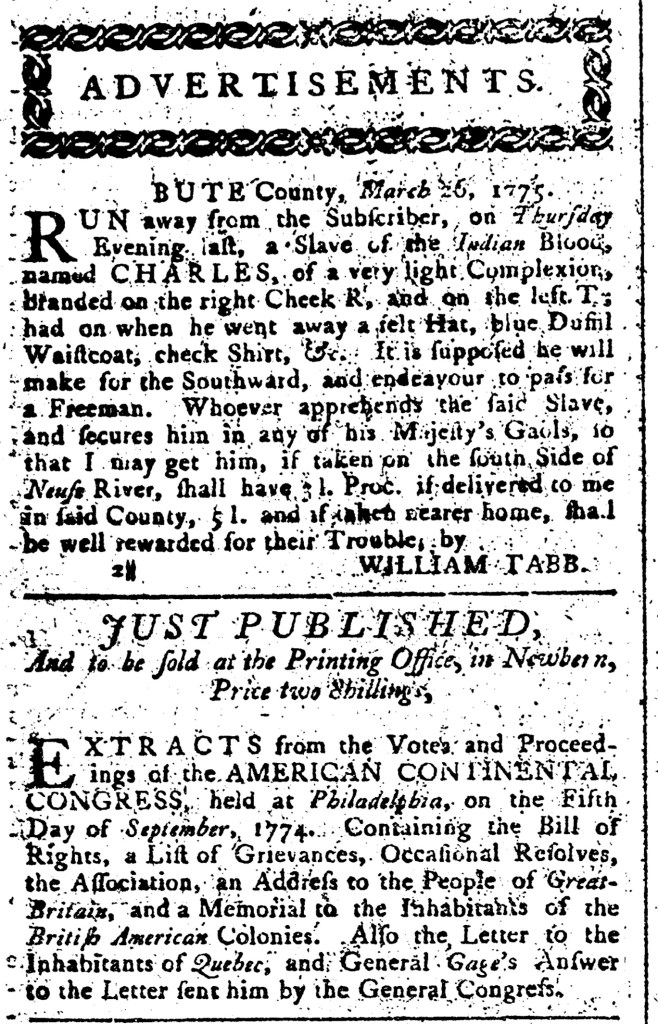
As a result, the April 7 edition is the second issue of the North-Carolina Gazette available for inclusion in the Adverts 250 Project and the Slavery Adverts 250 Project. The first two advertisements in that issue drew my attention. The first described and offered a reward for “a Slave of the Indian Blood, named CHARLES” who liberated himself by running away from his enslaver. Charles’s story of resistance has been compiled with other advertisements about enslaved men, women, and children published in American newspapers on April 7, 1775, as part of the Slavery Adverts 250 Project.
The second promoted “EXTRACTS from the Votes and Proceedings of the AMERICAN CONTINENTAL CONGRESS, held at Philadelphia” in September and October 1774. The Adverts 250 Project has traced the publication and marketing of the Extracts, starting with William Bradford and Thomas Bradford’s edition in Philadelphia and continuing with local editions published in many other towns. This advertisement confirms that Davis sold the Extracts.
Did he print a local edition? Or did he sell copies that he received from another printer? The formulaic language in the advertisement — “JUST PUBLISHED, And to be sold at the Printing Office, in Newbern” — does not definitively answer those questions. The phrase “JUST PUBLISHED,” for instance, merely meant that a book, pamphlet, or almanac was available. When an advertisement first ran, “JUST PUBLISHED” meant that it had been published recently, but printers and booksellers sometimes ran advertisements for weeks or months without updating them. They did not consider setting type once again worth investing their time or attention. Eighteenth-century readers understood that “JUST PUBLISHED” did not always mean that the item was hot off the presses. Similarly, they separated “JUST PUBLISHED” and “to be sold at the Printing Office,” realizing that printers often peddled books, pamphlets, and almanacs “JUST PUBLISHED” by other printers.
This language suggests that Davis may or may not have printed the edition of the Extracts that he advertised. Some bibliographers, however, have trusted advertisements in the North-Carolina Gazette as sufficient proof that he did publish a local edition. In “James Davis: North Carolina’s First Printer,” a thesis submitted to the School of Information and Library Science of the University of North Carolina at Chapel Hill, Scott Aaron Reavis includes the Extracts among works printed on Davis’s press. He notes, “No copies are known to exist, however, it was advertised for sale in the North Carolina Gazette, 24 February 1775.”[1] By the time the subsequent advertisement ran in the April 7 edition, the Extracts were “JUST PUBLISHED” indeed! Charles Evans did not list Davis’s New Bern edition in American Bibliography: A Chronological Dictionary of All Books, Pamphlets, and Periodical Publications Printed in the United States of America from the Genesis of Printing in 1639 Down to and Including the Year 1820, but, according to Reavis, Douglas C. McMurtie included the Extracts in his “Bibliography of North Carolina Imprints.”[2] Given how many printers published local editions of the Extracts, I am inclined to agree with McMurtie and Reavis that Davis did as well. I disagree, however, with the date assigned to the work. Davis’s edition has been dated to 1775 based on an advertisement in one of the few extant issues of the North-Carolina Gazette. More likely, if Davis published the Extracts then he did so in November or December 1774, the same time that printers in other towns produced local editions, and occasionally inserted his advertisement that he had “JUST PUBLISHED” and sold the volume at his printing office several times over the next several months.
**********
[1] Scott Aaron Reavis, “James Davis: North Carolina’s First Printer” (master’s thesis, University of North Carolina at Chapel Hill, 2000), 44.