July 31

What was advertised in a revolutionary American newspaper 250 years ago today?

Dunlap’s Pennsylvania Packet (July 31, 1775).

“… that we may not now, nor hereafter, have any occasion to import from our ministerial enemies in Great-Britain.”

Charles Maise, a “MUSTARD and CHOCOLATE MAKER” in Philadelphia, took to the pages of Dunlap’s Pennsylvania Packet to promote his business at the end of July 1775.  First, he needed supplies, offering “Forty shillings per bushel for any quantity of good clean Mustard-seed.”  Yet Maise wanted readers to think bigger about his business and their role as both suppliers and consumers given the imperial crisis experienced in the colonies over the last decade.  He expressed his hope that “farmers and others will use their best endeavours to encourage this valuable manufactory, by cultivating and improving the growth of so valuable an article, that we may not now, nor hereafter, have any occasion to import from our ministerial enemies in Great-Britain.”  Such sentiments certainly resonated with the Continental Association, a nonimportant agreement devised by the First Continental Congress in the fall of 1774 in response to the Coercive Acts. The eight article called on colonizers “in our several Stations,” including mustard and chocolate makers, to “encourage Frugality, Economy, and Industry; and promote Agriculture, Arts, and the Manufactures of this Country.”

Producers had a part to play in making available alternatives to imported goods, but the Continental Association did not depend on their efforts alone.  Consumers also had to make choices aligned with their political principles.  That meant purchasing “domestic manufactures,” goods produced in the colonies.  Maise stood ready to partner with consumers in pursuing their common cause.  In a nota bene, he announced that he “stands in the market on market days, opposite the London Coffee-house.”  Customers could find him there.  He extended “thanks to his former customers,” stating that he “hopes for a continuance of their favours, and doubts not but to merit their esteem.”  Of course, Maise also intended for his advertisement to reach new customers and wanted them to join existing customers in supporting both his business and the American cause by purchasing mustard produced locally from mustard seeds grown in the colonies.  Mustard gained political significance when taking into consideration “our ministerial enemies in Great-Britain,” especially in the wake of recent news of hostilities commencing at Lexington and Concord, the siege of Boston, and the Battle of Bunker Hill.

Slavery Advertisements Published July 31, 1775

GUEST CURATORS:  Katie Adams, Avi Miller, and Ava Wojnarowski

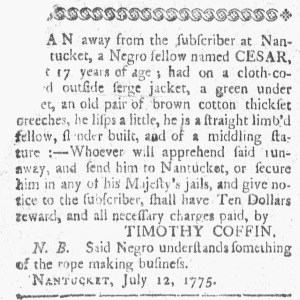
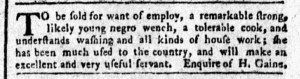
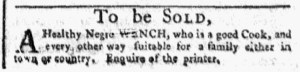
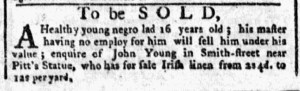
The Slavery Adverts 250 Project chronicles the role of newspaper advertising in perpetuating slavery in the era of the American Revolution. The project seeks to reveal the ubiquity of slavery in eighteenth-century life from New England to Georgia by republishing advertisements about enslaved people – for sale as individuals or in groups, wanted to purchase or for hire for short periods, runaways who liberated themselves, and those who were subsequently captured and confined in jails and workhouses – in daily digests on this site as well as in real time via the @SlaveAdverts250 Twitter feed, utilizing twenty-first-century media to stand in for the print media of the eighteenth century.

The project aims to provide modern audiences with a sense of just how often colonizers encountered these advertisements in their daily lives. Enslaved men, women, and children appeared in print somewhere in the colonies almost every single day. Those advertisements served as a constant backdrop for social, cultural, economic, and political life in colonial and revolutionary America. Colonizers who did not purport to own enslaved people were still confronted with slavery as well as invited to maintain the system by purchasing enslaved men, women, and children or assisting in the capture of so-called “runaways” who sought to free themselves from bondage. The frequency of these newspaper advertisements suggests just how embedded slavery was in colonial and revolutionary American culture in everyday interactions beyond the printed page.

These advertisements also testify to the experiences of enslaved men, women, and children, though readers must consider that those experiences have been remediated through descriptions offered by enslavers rather than enslaved people themselves. Often unnamed in the advertisements, enslaved men, women, and children were not invisible or unimportant in early America.

These advertisements appeared in colonial American newspapers 250 years ago today.

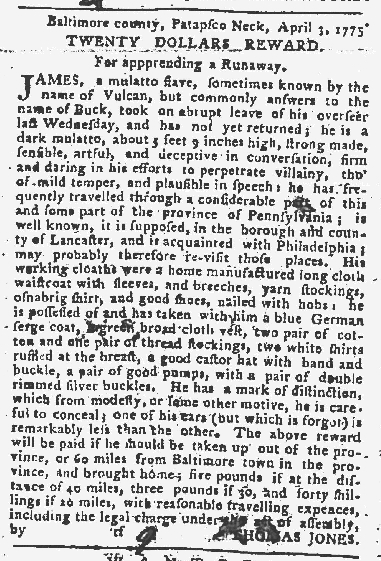
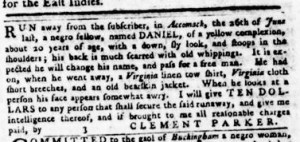
Boston-Gazette (July 31, 1775).

**********

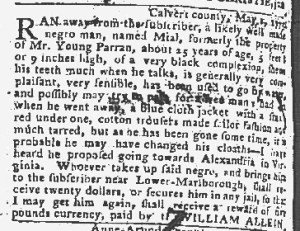
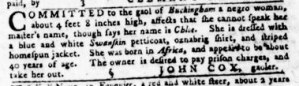
Connecticut Courant (July 31, 1775).

**********

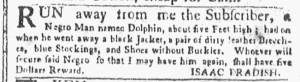
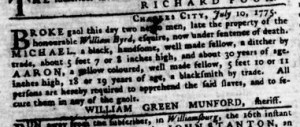
Newport Mercury (July 31, 1775).

**********

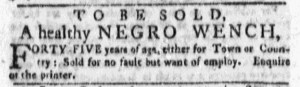
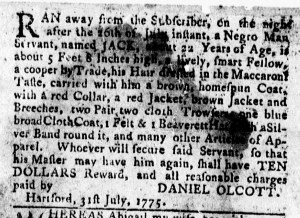
New-York Gazette and Weekly Mercury (July 31, 1775).

**********

New-York Gazette and Weekly Mercury (July 31, 1775).

**********

New-York Gazette and Weekly Mercury (July 31, 1775).

**********

New-York Gazette and Weekly Mercury (July 31, 1775).

**********

New-York Gazette and Weekly Mercury (July 31, 1775).

July 30

What was advertised in a revolutionary American newspaper 250 years ago this week?

Rivington’s New-York Gazetteer (July 27, 1775).

“Iron utensils, so much recommended by physicians for their safety.”

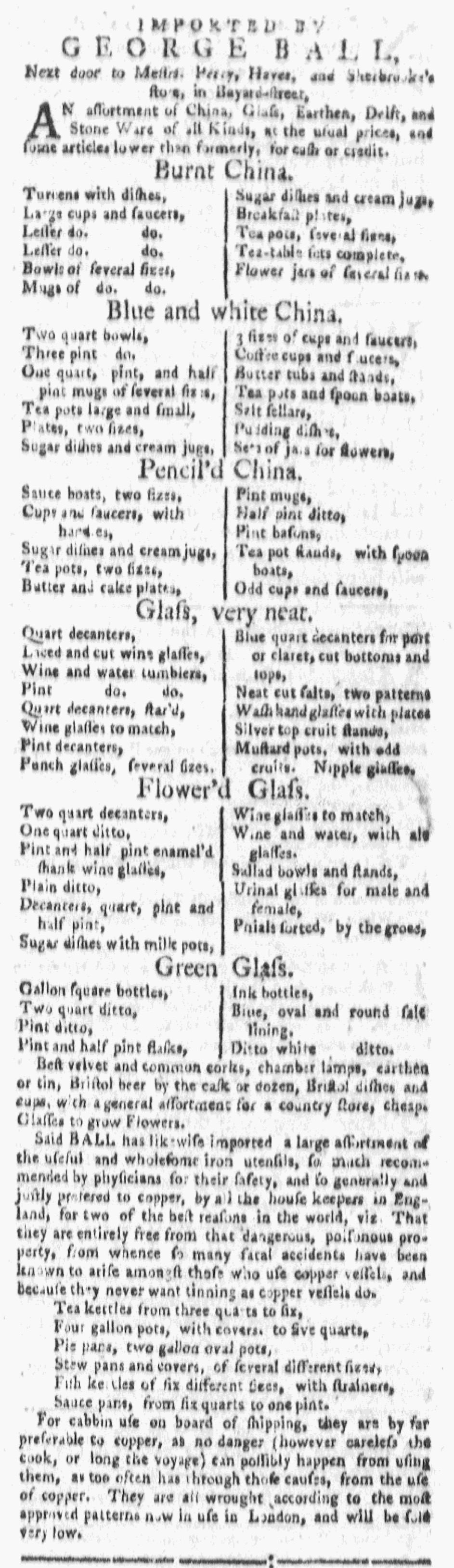
As July 1775 came to a close, George Ball advertised an “assortment of China, Glass, Earthen, Delft, and Stone Ware of all Kinds” in Rivington’s New-York Gazetteer.  He conveniently did not mention when he acquired his merchandise, whether it arrived in the colonies before the Continental Association went into effect, though the headline did proclaim “IMPORTED BY GEORGE BALL” rather than “JUST IMPORTED BY GEORGE BALL.”

Most of Ball’s advertisement consisted of a list of the various items he stocked, divided into categories that included “Burnt China,” “Blue and white China,” “Pencil’d China,” “Glass, very neat,” “Flower’d Glass,” and “Green Glass.”  In the final third of the advertisement, however, Ball highlighted “iron utensils” and made a pitch to convince consumers to demand iron tea kettles, iron pots, iron saucepans, iron pie pans, and iron stew pans with iron covers instead of copper ones.  Those “useful and wholesome iron utensils,” Ball asserted, were “so much recommended by physicians for their safety” and, accordingly, “so generally and justly prefered to copper, by all the house keepers in England.”  Ball made health and safety the centerpiece of his marketing, citing “the best reasons in the world.”  He emphasized that cookware made of iron was “entirely free from that dangerous, poisonous property, from whence so many fatal accidents have been known to arise amongst those who use copper vessels.”  As a bonus, consumers could save money over time since “iron utensils” did not need the same maintenance: “they never want tinning as copper vessels do.”  In addition to the “house keepers” of New York, Ball promoted his wares to readers responsible for outfitting ships.  “For cabbin use on board shipping,” he declared, iron items “are by far preferable to copper, as no danger (however careless the cook, or long the voyage) can possibly happen from using them, as too often has through those causes, from the use of copper.”  Ball concluded by noting that his “iron utensils” were “all wrought according to the most approved patterns now in use in London,” but that nod to fashion and taste merely supplemented his primary marketing strategy.  For consumers concerned about health and safety in the kitchen, he carried the cookware that they needed to use instead of taking chances with copper kettles, pots, and pans.

July 29

What was advertised in a revolutionary American newspaper 250 years ago today?

Pennsylvania Ledger (July 29, 1775).

“All Letters Post free, and small bundles not exceeding eight ounces, carried gratis for any Subscriber.”

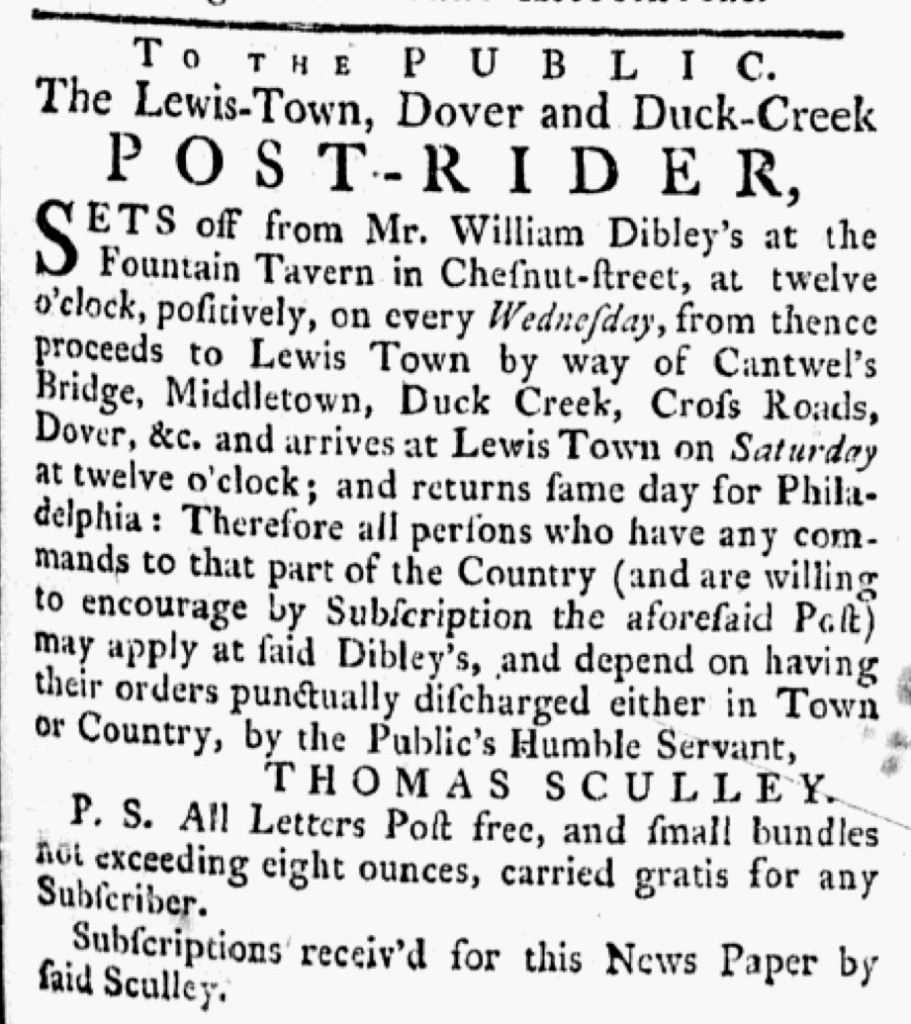
As the Revolutionary War commenced, Thomas Sculley, a post rider, followed a route that connected several towns in Delaware to Philadelphia.  At noon on every Wednesday, he departed from William Dibley’s Fountain Tavern on Chestnut Street and made for Lewis Town (now Lewes).  He stopped at Middletown, Dover, and other towns along the way, delivering letters, newspapers, and packages.  That took three days.  Sculley arrived at Lewis Town by noon on Saturday and started the return trip later the same day.  Presumably he made it to Philadelphia on Tuesday, giving customers an opportunity to consult with him at the Fountain Tavern.

Sculley placed an advertisement for his services in the July 29, 1775, edition of the Pennsylvania Ledger.  Like some other post riders, he did not charge solely by the letter, package, or newspaper subscription but instead marketed a subscription service.  Subscribers paid a set fee on a regular basis whether they made use of the service or not.  In return, they could post as many letters as they wished as well as send “small bundles not exceeding eight ounces.”  Anything else incurred additional charges.  Even if customers did not use Sculley’s service every time he rode between Philadelphia and Lewes, the subscription fee could have been a bargain compared to paying for each letter or package each time.  In addition, Sculley intended for subscriptions, if paid on time, to yield steady income that made serving his route possible. Prospective customers who wanted to make sure that a post rider was available when they desired needed to support the enterprise with their subscriptions, not just when they had letters and packages to send.

Sculley also accepted subscriptions for the Pennsylvania Ledger.  He may have also delivered other newspapers printed in Philadelphia at the time, including Dunlap’s Pennsylvania Packet, the Pennsylvania Evening Post, the Pennsylvania Gazette, and the Pennsylvania Journal.  Subscriptions to his service also supported dissemination of news about the imperial crisis, the hostilities that had recently commenced in Massachusetts, the meeting of the Second Continental Congress in Philadelphia, and reactions from throughout the colonies.  Post riders like Thomas Sculley played an important role in the communications infrastructure that disseminated news during the era of the American Revolution.
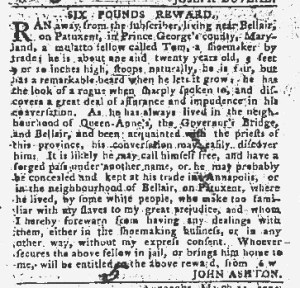
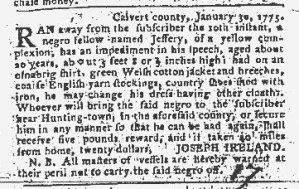
Slavery Advertisements Published July 29, 1775

GUEST CURATORS:  Katie Adams, Avi Miller, and Ava Wojnarowski

The Slavery Adverts 250 Project chronicles the role of newspaper advertising in perpetuating slavery in the era of the American Revolution. The project seeks to reveal the ubiquity of slavery in eighteenth-century life from New England to Georgia by republishing advertisements about enslaved people – for sale as individuals or in groups, wanted to purchase or for hire for short periods, runaways who liberated themselves, and those who were subsequently captured and confined in jails and workhouses – in daily digests on this site as well as in real time via the @SlaveAdverts250 Twitter feed, utilizing twenty-first-century media to stand in for the print media of the eighteenth century.

The project aims to provide modern audiences with a sense of just how often colonizers encountered these advertisements in their daily lives. Enslaved men, women, and children appeared in print somewhere in the colonies almost every single day. Those advertisements served as a constant backdrop for social, cultural, economic, and political life in colonial and revolutionary America. Colonizers who did not purport to own enslaved people were still confronted with slavery as well as invited to maintain the system by purchasing enslaved men, women, and children or assisting in the capture of so-called “runaways” who sought to free themselves from bondage. The frequency of these newspaper advertisements suggests just how embedded slavery was in colonial and revolutionary American culture in everyday interactions beyond the printed page.

These advertisements also testify to the experiences of enslaved men, women, and children, though readers must consider that those experiences have been remediated through descriptions offered by enslavers rather than enslaved people themselves. Often unnamed in the advertisements, enslaved men, women, and children were not invisible or unimportant in early America.

These advertisements appeared in colonial American newspapers 250 years ago today.

Virginia Gazette [Dixon and Hunter] (July 29, 1775).

**********

Virginia Gazette [Dixon and Hunter] (July 29, 1775).

**********

Virginia Gazette [Dixon and Hunter] (July 29, 1775).

**********

Virginia Gazette [Dixon and Hunter] (July 29, 1775).

**********

Virginia Gazette [Dixon and Hunter] (July 29, 1775).

July 28

What was advertised in a revolutionary American newspaper 250 years ago today?

Essex Journal (July 28, 1775).

“Encourage their children and servants to save the old Rags … and send them to the Printing-office.”

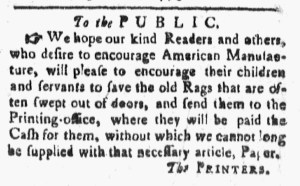
John Mycall and Henry-Walter Tinges, the printers of the Essex Journal in Newburyport, Massachusetts, concluded the July 28, 1775, edition of their newspaper with an advertisement that presented colonizers an opportunity to aid the American cause.  “We hope our kind Readers and others, who desire to encourage American Manufacture,” Mycall and Tinges declared, “will please to encourage their children and servants to save the old Rags that are often swept out of doors, and send them to the Printing-office.”  The printers offered cash for the rags, explaining that without them “we cannot long be supplied with that necessary article, Paper.”  Mycall and Tinges oversaw a recycling venture imperative in producing an essential article for continuing to publish their newspaper and anything else.  They were not the only printers in the region who experienced a disruption in acquiring paper in the months after the battles at Lexington and Concord.  Daniel Fowle, the printer of the New-Hampshire Gazette, had a similar experience.

Throughout the imperial crisis, collecting rags to recycle into paper had been imbued with political significance.  Producing paper in the colonies meant that printers did not need to import as much paper from England.  As nonimportation agreements went into effect in 1768, Christopher Leffingwell of Norwich, Connecticut, described collecting rags as “an entire Saving to the COUNTRY” and encouraged “every Friend and lover thereof [to] save every Scrap” of discarded linen.  For years, John Keating regularly promoted his “Paper Manufactory” in New York’s newspapers, arguing that economic resistance during the “present alarming situation of the colonies” was the “safest and most efficacious method of convincing the Ministry of Great-Britain of their error.”  He suggested that each household designate a “certain place” for collecting rags and cultivate a habit that would “establish this valuable manufactory upon a permanent foundation.”  Who undertook such work?  John Dunlap, the printer of the Pennsylvania Packet, hoped “to prevail upon our LADIES to grant us a little of their industry and assistance,” believing that “the welfare of their country will influence them” to do their part in collecting rags to recycle into paper.  Mycall and Tinges extended the call to include “children and servants.”  As men mustered to defend their liberties, women, children, and servants had their own role to play.  They could contribute to the American cause by supporting “American Manufacture,” including collecting rags to transform into the newspapers and pamphlets that disseminated the rhetoric of the Revolution.

Slavery Advertisements Published July 28, 1775

GUEST CURATORS:  Katie Adams, Avi Miller, and Ava Wojnarowski

The Slavery Adverts 250 Project chronicles the role of newspaper advertising in perpetuating slavery in the era of the American Revolution. The project seeks to reveal the ubiquity of slavery in eighteenth-century life from New England to Georgia by republishing advertisements about enslaved people – for sale as individuals or in groups, wanted to purchase or for hire for short periods, runaways who liberated themselves, and those who were subsequently captured and confined in jails and workhouses – in daily digests on this site as well as in real time via the @SlaveAdverts250 Twitter feed, utilizing twenty-first-century media to stand in for the print media of the eighteenth century.

The project aims to provide modern audiences with a sense of just how often colonizers encountered these advertisements in their daily lives. Enslaved men, women, and children appeared in print somewhere in the colonies almost every single day. Those advertisements served as a constant backdrop for social, cultural, economic, and political life in colonial and revolutionary America. Colonizers who did not purport to own enslaved people were still confronted with slavery as well as invited to maintain the system by purchasing enslaved men, women, and children or assisting in the capture of so-called “runaways” who sought to free themselves from bondage. The frequency of these newspaper advertisements suggests just how embedded slavery was in colonial and revolutionary American culture in everyday interactions beyond the printed page.

These advertisements also testify to the experiences of enslaved men, women, and children, though readers must consider that those experiences have been remediated through descriptions offered by enslavers rather than enslaved people themselves. Often unnamed in the advertisements, enslaved men, women, and children were not invisible or unimportant in early America.

These advertisements appeared in colonial American newspapers 250 years ago today.

South-Carolina and American General Gazette (July 28, 1775).

**********

South-Carolina and American General Gazette (July 28, 1775).

**********

South-Carolina and American General Gazette (July 28, 1775).

**********

South-Carolina and American General Gazette (July 28, 1775).

**********

South-Carolina and American General Gazette (July 28, 1775).

**********

South-Carolina and American General Gazette (July 28, 1775).

**********

South-Carolina and American General Gazette (July 28, 1775).

**********

South-Carolina and American General Gazette (July 28, 1775).

**********

South-Carolina and American General Gazette (July 28, 1775).

**********

South-Carolina and American General Gazette (July 28, 1775).

**********

Story and Humphrey’s Pennsylvania Mercury (July 28, 1775).

**********

Virginia Gazette [Purdie] (July 28, 1775).

**********

Virginia Gazette [Purdie] (July 28, 1775).

**********

Virginia Gazette [Purdie] (July 28, 1775).

**********

Virginia Gazette [Purdie] (July 28, 1775).

**********

Virginia Gazette [Purdie] (July 28, 1775).

**********

Virginia Gazette [Purdie] (July 28, 1775).

**********

Virginia Gazette [Purdie] (July 28, 1775).

**********

Virginia Gazette [Purdie] (July 28, 1775).

July 27

What was advertised in a revolutionary American newspaper 250 years ago today?

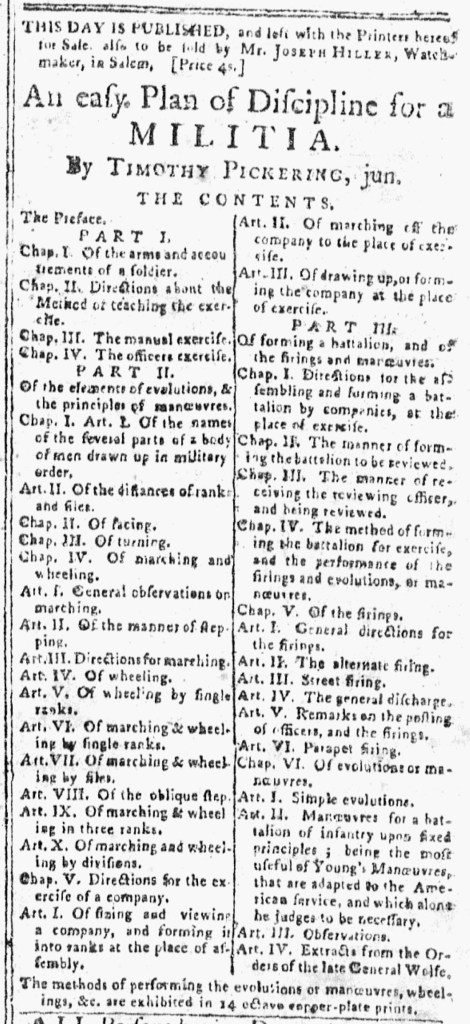
New-England Chronicle (July 27, 1775).

“An easy Plan of Discipline for a MILITIA. By TIMOTHY PICKERING.”

As the imperial crisis intensified when the Coercive Acts went into effect in 1774, the Massachusetts Provincial Congress recommended publication of a manual for training militia throughout the colony, The Manual Exercise as Ordered by His Majesty in 1764: Together with Plans and Explanations of the Method Generally Practis’d at Reviews and Field-Days.  Over the next several months, several printers in New England published their own editions.  Advertisements for The Manual Exercise appeared frequently in newspapers throughout the region.  Printers beyond New England followed their lead.  After the battles at Lexington and Concord, advertisements for other military manuals proliferated, including advertisements for Thomas Hanson’s Prussian Evolutions in Actual Engagements published by subscription in Philadelphia.

Samuel Hall and Ebenezer Hall, printers of the New-England Chronicle, published and advertised yet another military manual, An Easy Plan of Discipline for a Militia by Timothy Pickering, Jr.  An advertisement for the work appeared in the July 27, 1775, edition of their newspaper.  The Halls indicated that they had copies available at their printing office in Cambridge, where they had only recently moved from Salem and renamed and continued publishing the Essex Gazette. In addition, Joseph Hiller, a watchmaker in Salem, also sold the manual.  The advertisement consisted primarily of an extensive list of the contents, demonstrating to prospective customers what they could expect to find in the volume, followed by a short note that the “methods of performing the evolutions or manœuvres, wheelings, &c. are exhibited in 14 octavo copper-plate prints.”  The illustrations were an important addition that would aid readers in understanding the various maneuvers described in the book.

In addition to the advertisement the Halls inserted in the New-England Chronicle, Pickering pursued another means of marketing the book.  He sent a copy directly to George Washington with a request that he consider “recommending or permitting its use among the officers & soldiers under your command.”  Pickering flattered the commander of the Continental Army following his appointment to the post by the Second Continental Congress, declaring that the army had been “committed to your excellency’s care & direction” “to the joy of every American.”  Pickering asserted his own “duty & inclination” inspired him to compose the manual and present it to the general for his consideration.  He deemed it a “service [to] my country” that he hoped “may well prove advantageous in an army hastily assembled.”  Washington did indeed take note.  According to the American Revolution Institute, “Washington promoted the use of several published works, including Timothy Pickering’s An Easy Plan of Discipline for a Militia and Thomas Hanson’s The Prussian Evolutions” during the early years of the Revolutionary War.  In 1779, Baron von Steuben’s Regulations for the Order and Discipline of the Troops of the United States became the first official manual of the Continental Army.  Until then, Pickering’s manual was a popular choice for training American soldiers.

Slavery Advertisements Published July 27, 1775

GUEST CURATORS:  Katie Adams, Avi Miller, and Ava Wojnarowski

The Slavery Adverts 250 Project chronicles the role of newspaper advertising in perpetuating slavery in the era of the American Revolution. The project seeks to reveal the ubiquity of slavery in eighteenth-century life from New England to Georgia by republishing advertisements about enslaved people – for sale as individuals or in groups, wanted to purchase or for hire for short periods, runaways who liberated themselves, and those who were subsequently captured and confined in jails and workhouses – in daily digests on this site as well as in real time via the @SlaveAdverts250 Twitter feed, utilizing twenty-first-century media to stand in for the print media of the eighteenth century.

The project aims to provide modern audiences with a sense of just how often colonizers encountered these advertisements in their daily lives. Enslaved men, women, and children appeared in print somewhere in the colonies almost every single day. Those advertisements served as a constant backdrop for social, cultural, economic, and political life in colonial and revolutionary America. Colonizers who did not purport to own enslaved people were still confronted with slavery as well as invited to maintain the system by purchasing enslaved men, women, and children or assisting in the capture of so-called “runaways” who sought to free themselves from bondage. The frequency of these newspaper advertisements suggests just how embedded slavery was in colonial and revolutionary American culture in everyday interactions beyond the printed page.

These advertisements also testify to the experiences of enslaved men, women, and children, though readers must consider that those experiences have been remediated through descriptions offered by enslavers rather than enslaved people themselves. Often unnamed in the advertisements, enslaved men, women, and children were not invisible or unimportant in early America.

These advertisements appeared in colonial American newspapers 250 years ago today.

Maryland Gazette (July 27, 1775).

**********

Maryland Gazette (July 27, 1775).

**********

Maryland Gazette (July 27, 1775).

**********

Maryland Gazette (July 27, 1775).

**********

Maryland Gazette (July 27, 1775).

**********

Maryland Gazette (July 27, 1775).

**********

Maryland Gazette (July 27, 1775).

**********

Maryland Gazette (July 27, 1775).

**********

New-England Chronicle (July 27, 1775).

**********

New-England Chronicle (July 27, 1775).

**********

New-York Journal (July 27, 1775).

**********

Rivington’s New-York Gazetteer (July 27, 1775).

**********

Rivington’s New-York Gazetteer (July 27, 1775).

**********

Rivington’s New-York Gazetteer (July 27, 1775).

**********

Rivington’s New-York Gazetteer (July 27, 1775).

**********

Virginia Gazette [Pinkney] (July 27, 1775).

**********

Virginia Gazette [Pinkney] (July 27, 1775).

**********

Virginia Gazette [Pinkney] (July 27, 1775).

**********

Virginia Gazette [Pinkney] (July 27, 1775).

July 26

What was advertised in a revolutionary American newspaper 250 years ago today?

Pennsylvania Gazette (July 26, 1775).

“A SERMON, on the present Situation of American Affairs … to distribute … among the Military Associators.”

A few days ago, I examined an advertisement for “A sermon on the present Situation of American Affairs” by William Smith that ran in the July 21, 1775, edition of the South-Carolina and American General Gazette.  I concluded that Wells likely sold copies of the pamphlet printed by James Humphreys, Jr., in Philadelphia and shipped to his “GREAT STATIONARY & BOOK STORE” in Charleston.  An advertisement in the July 26, 1775, edition of the Pennsylvania Gazette suggests that was indeed the case.

That notice listed several printers who stocked the sermon.  It gave top billing to James Humphreys, Jr., and noted that “the other Printers in Philadelphia” also sold the sermon.  Radiating outward from the city, the list next named Matthias Slough and Francis Bailey in Lancaster and then Hugh Gaine, the printer of the New-York Gazette and Weekly Mercury, in New York.  The list concluded with “Mr. ROBERT WELLS, in Charlestown, South-Carolina.”  Humphreys apparently dispatched copies to associates both in his own city and in other towns and colonies.

Another aspect of that advertisement indicates that Wells most likely sold copies of the sermon printed by Humphreys in Philadelphia.  Wells did not mention the price in his advertisement, but Humphreys gave prices for a single copy and multiple copies: nine pence for one copy, six shillings for a dozen, and six dollars for one hundred copies.  That pricing structure concluded with a note that Humphreys intended the discount for purchasing in volume as a benefit “for such Persons as may desire to distribute them among the Military Associators.”  He encouraged officers and other Patriots to disseminate the sermon widely by making a gift of it to those who volunteered to defend American liberties.  Humphreys was not alone in envisioning that officers would give books and pamphlets about current affairs as gifts.  George Washington had recently ordered eight copies of Thomas Hanson’s Prussian Evolutions in Actual Engagements to distribute among his subordinates.

The details in Humphreys’s advertisement strengthen the case that Wells did not publish his own edition of Smith’s sermon but instead advertised and sold copies that Humphreys printed in Philadelphia and distributed to printers and booksellers in several cities and towns.  Doing so contributed to the creation of what Benedict Anderson terms an “imagined community” grounded in print.  Newspapers played an important role as printers reprinted news and editorials from one to another, yet colonizers also had access to pamphlets, tracts, and sermons that circulated widely.  They did not have to be present when Smith delivered his sermon to engage with the ideas and arguments that the minister offered for consideration.