What was advertised in a revolutionary American newspaper 250 years ago this week?
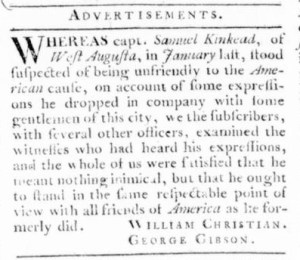
“He ought to stand in the same respectable point of view with all friends of America.”
As the imperial crisis intensified and became a war, some colonizers published newspaper advertisements intended to rehabilitate their reputations. Many of the signers of an address to Thomas Hutchinson took to the pages of the newspapers published in New England to apologize and to explain the circumstances that led to their error. In response to other incidents that called their support for American liberties into question, Asa Dunbar published “RECANTATIONS” in the New-England Chronicle, Lemuel Bower and Joseph Lyon both expressed regret for not showing support for nonimportation agreement in advertisements in the New-York Journal, and John Bergum promised to “conduct myself as a true friend to America” in the Pennsylvania Evening Post.
Samuel Kinkead got into similar trouble in Virginia in January 1776. An advertisement in the March 22 edition of Alexander Purdie’s Virginia Gazette reported that Kinkead “stood suspected of being unfriendly to the American cause, on account of some expressions he dropped in company with some gentlemen” in West Augusta. William Christian and George Gibson, and “several other officers, examined the witnesses who had heard his expressions.” At the conclusion of their interviews, “the whole of us were satisfied that [Kinkead] meant that he ought to stand in the same respectable point of view with all friends of America as he formerly did.” This advertisement delivered important news, at least from Kinkead’s perspective, so he may have been grateful that it ran first among the paid notices in that issue of the Virginia Gazette. It thus served as a transition between news and editorials that kept readers informed about politics and the war and the advertisements placed for a variety of purposes. This notice, like so many others, delivered local news to readers, bypassing the printer who made editorial decisions about what to include elsewhere in the newspaper. Kinkead did not address readers himself as others had done, but he may have considered it more effective for Christian and Gibson to vouch for him.