May 3

What was advertised in a revolutionary American newspaper 250 years ago today?
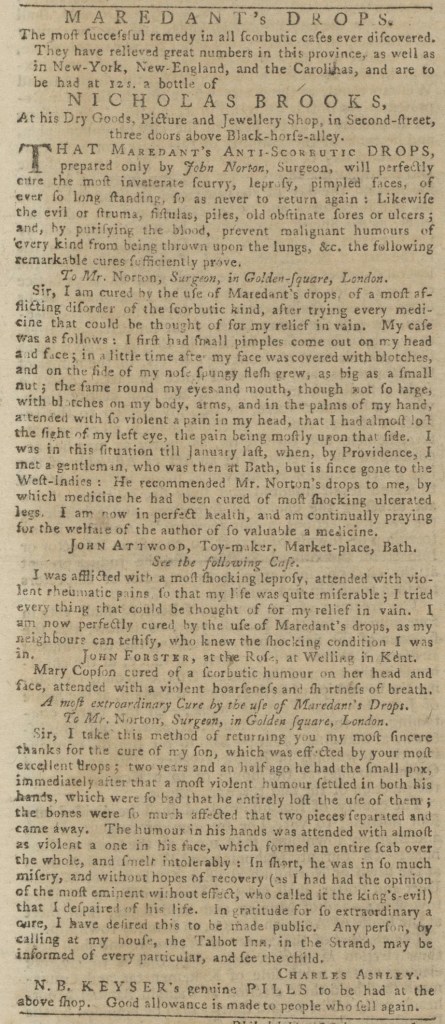
Virginia Gazette [Purdie] (May 3, 1776).

“Thirteen months Gazette due mrs. Rind’s estate, 13s. 6d.”

Most early American printers extended generous credit to newspaper subscribers, sometimes allowing them to fall years behind in making payment.  They frequently placed notices calling on subscribers to settle accounts in their own newspapers.  A notice in Alexander Purdie’s Virginia Gazette in the spring of 1776, however, requested that subscribers to a newspaper that ceased publication submit what they owed.

That newspaper had also been known as the Virginia Gazette.  William Rind commenced publishing Rind’s Virginia Gazette in Williamsburg on May 16, 1766.  He changed the name to Virginia Gazette in the fall of 1766.  Following his death in August 1773, his widow, Clementina Rind, published the newspaper for just over a year until her own death in September 1774.  John Pinkney then printed the newspaper, according to the colophon, “for the benefit of Clementina Rind’s estate” or, later, “for the benefit of Clementina Rind’s children.”  He became the sole publisher in April 1775.  Pinkney’s Virginia Gazette folded in the winter of 1776.  The issue for February 3, 1776, is the last known edition.  At the time, it was one of three newspapers named Virginia Gazette printed in Williamsburg.

The notice that ran in Purdie’s Virginia Gazette called on the “gentlemen who are still indebted to the estate of mrs. Clementina Rind, deceased, and mr. John Pinkney, for Gazettes … to send their respective balances” to “the administrator.”  For their convenience, they could dispatch them via “those gentlemen who are chosen delegates for their respective counties” who planned to travel to Williamsburg for meetings in May 1776.  A note at the end of the advertisements reminded subscribers that “Thirteen months Gazette due mrs. Rind’s estate” amounted to thirteen shillings and six pence and “Sixteen [months of the Virginia Gazette] due mr. John Pinkney” amounted to sixteen shillings and eight pence.  Those periods matched the amount of time that Clementina Rind printed the Virginia Gazette and then John Pinkney printed it, indicating that some subscribers had not paid for years, even when asked to settle with Rind’s estate.  Other newspaper printers experienced similar difficulties in collecting subscription fees, prompting some to threaten legal action in their notices.  In this instance, the administrator instead noted the “large debts still due from the said estate.”

May 2

What was advertised in a revolutionary American newspaper 250 years ago today?

New-England Chronicle (May 2, 1776).

American Coffee-House.”

Not long after British forces departed from Boston on March 17, 1776, and the siege of the city ended, Daniel Jones opened the “American Coffee-House.”  At about the same time, Samuel Hall, the printer of the New-England Chronicle, moved his printing office from “Stoughton-Hall, HARVARD-COLLEGE,” in Cambridge into Boston “next to the OLIVER CROMWELL TAVERN, in SCHOOL-STREET.”  He printed the first issue in the formerly occupied city on April 25.  A week later, Jones ran a notice in which he “respectfully acquaints the Gentlemen of the UNITED COLONIES, that the AMERICAN COFFEE HOUSE, at the sign of the Golden Eagle, King Street, BOSTON, is now opened for those Gentlemen who please to favour him with their commands.”

As much as Jones hoped to offer a place of respite for patrons who joined him for coffee and dining, that opening sentence testified to the uncertainty of the times.  The war had entered its second year.  When it began, most colonizers sought a redress of their grievances within the imperial system, but over time more and more of them advocated for declaring independence, especially following the publication of Thomas Paine’s Common Sense in Philadelphia in January 1776 and the widespread dissemination of local editions in the following months.  In the past, establishments like the one that Jones advertised were often known as the London Coffee House, a nod to the largest and most cosmopolitan city in the empire and, especially, to the transatlantic and even global networks of commerce that converged there.  Yet Jones named his establishment the “American Coffee-House” and addressed the “Gentlemen of the UNITED COLONIES,” privileging their American identity and acknowledging that the diverse colonies had banded together.  A Continental Congress organized resistance.  A Continental Army defended American liberties.  Even though Jones associated his new establishment with the American cause, it happened to be located on King Street (which would be renamed State Street shortly after the Treaty of Paris officially ended the Revolutionary War).  The “sign of the Golden Eagle,” a familiar device in several towns, one that did not have revolutionary significance, marked the coffeehouse’s location.  That the “Gentlemen of the UNITED COLONIES” gathered at the “AMERICAN COFFEE HOUSE” on King Street exemplified the transition taking place as colonizers moved from engaging in resistance to embracing revolution in 1776.

May 1

What was advertised in a revolutionary American newspaper 250 years ago today?

Maryland Journal (May 1, 1776).

“The Continental Spring Garden, nigh Baltimore town.”

Adam Lindsay, a fencing master in Baltimore, advertised lessons in the “Art of Defence (now so necessary for every Gentleman” in the May 1, 1776, edition of the Maryland Journal, yet that was not the primary purpose of his notice.  Instead, he informed readers that he “NOW lives at the Continental Spring Garden” near the town and “proposes to entertain LADIES and GENTLEMENT, who may think proper to view his Garden and refresh themselves, after a pleasing walk.”  That sort of activity was part of what Vaughn Scribner has described as “a news sort of commercial leisure sector” that developed in the colonies during the second half of the eighteenth century.[1]  Lindsay described his Continental Spring Garden as “large and genteelly laid out.”  Furthermore, he believed that “those who choose to recreate themselves with a view thereof, will not be displeased with their entertainment.”  An excursion to the Continental Spring Garden may have included light refreshments in a comfortable parlor since Lindsay invited guests to “his House and Garden.”

Scribner notes that the “fascination with commercial pleasure gardens coincided with Enlightenment notions of health, exercise, and natural romanticism,” some of the factors that contributed to the popularity of baths, spas, and mineral waters like the “COLD BATH” advertised in the Pennsylvania Evening Post the day before Lindsay’s notice ran in the Maryland Journal.[2]  He documents the founding and operation of pleasure gardens in or near the largest urban ports – Boston, Charleston, New York, and Philadelphia – as well as Baltimore and Providence.  The Adverts 250 Project has featured advertisements for some of those sites, including Ranelagh Garden and Vauxhall Garden (both named after famous attractions in London) in New York.  At the time that Lindsay established the Continental Spring Garden and advertised it, Baltimore was growing and becoming a more important port.  It was becoming a rival to Annapolis and would eventually overshadow the colonial capitol.  Just three years earlier, William Goddard commenced publication of the city’s first newspaper, the Maryland Journal.  The city quickly became a more significant center for commerce, prompting John Dunlap to introduce a second newspaper in 1775, which meant that Baltimore now had more newspapers than the sole Maryland Gazette published in Annapolis.  With such growth, Lindasy joined in an effort, as Scribner puts it, “to harness the verdant nature of their surroundings to make their cities more urbane, and healthy, spaces.”[3]  The Continental Spring Garden was part of a larger project undertaken in and near major ports along the Atlantic coast.

**********

[1] Vaughn Scribner, “The World of Nature,” in A Cultural History of Leisure in the Enlightenment, ed. Peter Borsay and Jan Hein Furnee (London: Bloomsbury Press, 2024), 183.

[2] Scribner, “World of Nature,” 184.

[3] Scribner, “World of Nature,” 183.

April 30

What was advertised in a revolutionary American newspaper 250 years ago today?

Pennsylvania Evening Post (April 30, 1776).

“Apply for tickets … at a Pistole each, or one Shilling each time bathing.”

With the arrival of spring in 1776, Joseph Jewell opened the “COLD BATH, AT Bathtown, in Second-street, about a quarter of a mile from the Barracks in the Northern liberties” on the outskirts of Philadelphia.  Readers sometimes encountered promotions for spas, baths, and mineral springs as they perused newspapers in the decade before the Revolutionary War, including the “Cold-Bath at Jackson’s Mineral Well” in Boston and a “NEW and CONVENIENT BATH” in Perth Amboy, New Jersey.  The New-York Chronicle carried an advertisement for the “Chalybeat Springs, in the Borough of Bristol, in Pennsylvania.”  The facility “answers the Description of the celebrated GERMAN SPAW.”  In addition to the bath and mineral spring at Perth Amboy, residents of Philadelphia who read local newspapers encountered invitations to partake of “ABINGTON MINERAL WATER” when they visited the “most healthy Part of the Province of Pennsylvania.”  The “COLD BATH, AT Bathtown,” however, was a more convenient location that offered greater access to those who wished to purchase admission.

In an advertisement in the April 30, 1776, edition of the Pennsylvania Evening Post, Jewell announced that the facility was “now in the possession of the subscriber,” indicating a transfer of ownership since the previous season.  William Drewet Smith, an apothecary, previously operated the bath.  Regardless of who ran it, the “COLD BATH” was “in complete order, and fit for immediate use.”  Jewell instructed “[l]adies and gentlemen who are inclined to make use of it for the season” to acquire tickets directly from him or “at the bar of the London Coffee-house,” a popular place for socializing and conducting business in the bustling urban port.  Just as advertisers frequently enlisted printers in supplying additional information to readers who followed directions to “enquire of the printer,” some also made arrangements for the proprietor of the coffeehouse to act as their agent.  Such convenience likely increased sales.  Jewell charged the same amount for a season pass, “a Pistole each,” as Smith had the previous year, but he also allowed for day passes at “one Shilling each time bathing.”  Smith may have done so as well, though he did not promote it as an option in his advertisement.  Jewell may have hoped that highlighting a less expensive option would stimulate greater demand and more visitors to the “COLD BATH.”

April 29

What was advertised in a revolutionary American newspaper 250 years ago today?

Connecticut Courant (April 29, 1776).

“His assortment would be too large for a news-paper.”

The April 29, 1776, edition of the Connecticut Courant featured a series of advertisements for imported “ENGLISH GOODS.”  George Merrill, for instance, advertised an “Assortment of English and India GOODS” available “At the Sign of the UNICORN and MORTAR” in Hartford.  An anonymous advertiser offered “ENGLISH GOODS, By WHOLESALE,” instructing interested parties to “Enquire of the Printer” for more information.  None of the advertisements indicated when the imported goods had arrived in the colonies, but they had presumably done so before the Continental Association went into effect.  In his advertisement for “English, India, and home goods,” Leonard Chester of Weathersfield declared, “Shops that mean to keep themselves alive, ‘till trade opens again, may be supplied with several articles in the wholesale way.”  That suggested that the advertisers sold goods that had been imported before the Revolutionary War began and perhaps some time before that.

Apart from James Lamb and Son, advertisers who hawked imported goods did not publish lengthy advertisements that listed their merchandise in an effort to entice prospective customers, yet that did not mean that they refrained from emphasizing the choices they made available to consumers.  Jacob Sebor claimed that he stocked the “largest and genteelest assortment of ENGLISH GOODS this day in the colony.”  Rather than naming any of them, he resorted to a nota bene to explain that he “would give a more particular advertisement, but his assortment would be too large for a news-paper.”  Merchants and shopkeepers sometimes made such claims, some even stating that it would be “too tedious” to enumerate their wares or impossible to do.  Instead, they invited, usually implicitly, readers to visit their shops and warehouses to discover what they had in stock.  Sebor extended that invitation explicitly, proclaiming that he “begs the ladies and gentlemen to call and see” his extensive inventory.  He sought to activate their curiosity about what they might find at his store and encouraged them to examine the merchandise themselves rather than rely on brief descriptions in newspaper advertisements.

April 28

What was advertised in a revolutionary American newspaper 250 years ago this week?

Thomas’s Massachusetts Spy (April 26, 1776).

“He … most earnestly requests that all who are indebted to him for News-Papers, Advertisements, &c. would pay him.”

The April 26, 1776, edition of Thomas’s Massachusetts Spy opened with a notice from the printer, Isaiah Thomas.  “THE Printer hereby gives notice,” he declared, “that, for the present he shall continue his business in Worcester.”  Thomas had arrived in town a year earlier.  In the spring of 1775, he advertised his intention to establish Worcester’s first printing office and newspaper and entrust both to a junior partner.  As the imperial crisis intensified, however, he departed Boston just before the battles at Lexington and Concord, relocated to Worcester beyond the reach of the British, and set himself up as the town’s new printer.  On May 3, 1775, he published the first issue of the Massachusetts Spy printed in Worcester.  A year later, he considered whether he wished to remain following the British evacuation of Boston.  Although he announced that “for the present he shall continue his business in Worcester,” a month later he leased the newspaper to William Stearns and Daniel Bigelow.  Thomas moved to Salem “with an intention to commence business in that place; but many obstructions to the plan arising in consequence of the war, he sold the printing materials which he carried to that town, and, in 1778, returned to Worcester, took into possession the press which he had left there, and resumed publication of the Spy.”[1]

In late April 1776, Thomas had not yet decided to leave Worcester.  In hopes of maintaining he business he pursued there, he issued a call for customers to pay their bills.  Throughout the colonies, printers (and other entrepreneurs) frequently ran similar notices.  Thomas did so occasionally and “once more, earnestly requests that all those who are indebted to him for News-Papers, Advertisements, &c. would pay him.”  Like other printers, he extended generous credit to subscribers and other customers.  Doing so put his business in a difficult position: “Although the sum due from each person is small, yet his accounts of this kind are so numerous, they were they paid, it would enable him to support his business with credit, and satisfaction to his readers and himself.”  Thomas emphasized the benefits to readers and the public – the quality of the newspaper – rather than taking a more common approach, threatening legal action against those who disregarded his notice.  In the era of the American revolution, printers often proclaimed that their communities should give them credit for publishing newspapers as a public service.

Thomas indicated that customers owed him for both newspapers and advertisements.  Historians of the early American press sometimes assert that printers allowed credit for subscriptions but insisted that advertisers pay for notice in advance.  Thomas’s notice may suggest that he took a different approach, but it depends on what he meant by “Advertisements.”  He could have referred to newspaper notices, though not necessarily.  He might have meant broadsides, handbills, and other advertising materials printed separately.  Thomas’s account books and correspondence may clarify which kinds of advertisements qualified for credit and which had to be paid before they went to press.

**********

[1] Isaiah Thomas, The History of Printing in America: With a Biography of Printers and an Account of Newspapers (1810; New York: Weathervane Books, 1970), 181.

April 27

What was advertised in a revolutionary American newspaper 250 years ago today?

Providence Gazette (April 27, 1776).

“He is persuaded that none of his Readers will think him unreasonable in adding a Shilling to the Price per Year.”

The first advertisement in the April 27, 1776, edition of the Providence Gazette featured news for subscribers.  John Carter, the printer, informed them of an imminent price increase.  His own expenses had gone up in the year since the war began at Lexington and Concord.  “THE increased Price of Paper (the chief Article of a Printer’s Stock) and of almost every Necessary of Life, has been so great,” he explained, “that it must have naturally fallen within the Notice of every Reader of this Gazette.”  Given the circumstances that Carter believed honest readers acknowledged, he was “thereforecompelled to acquaint his Customers, that the Price thereof in future will be Eight Shillings per Annum.”

He emphasized that the situation “compelled” him to take this action rather than doing so willingly or eagerly.  Carter also noted that other printers had recently done the same, so he was not alone in seeking such a remedy to his financial woes.  “He likewise begs leave to inform [subscribers],” the printer stated, “that for the same Reason the Price of the Cambridge Paper,” the New-England Chronicle, “has been raised to Eight Shillings” and “the Philadelphia Evening-Post to Two Dollars.”  (Carter meant the Pennsylvania Evening Post.)  In addition, John Dunlap had recently advertised a price increase from ten to fifteen shillings for Dunlap’s Maryland Gazette; or, the Baltimore General Advertiser.  In consideration of those recent precedents, Carter was “persuaded that none of his Readers will think him unreasonable in adding a Shilling to the Price per Year, which is not quite a Farthing on each Gazette” or each issue of the newspaper.[1]

The printer pledged to honor the previous price for current subscribers “till the Year, or other Time for which each Subscriber contracted, shall be expired.”  Once their current year (or other amount of time previously agreed between printer and subscriber) came to an end, the new price went into effect.  Those who did not wish to continue their subscriptions “at the Price above mentioned, … are requested to give Notice to the Printer.”  Carter understood that money was also tight for his subscribers, but he hoped that they would accept a small increase in the annual subscription fee in order to continue receiving the news (about the war, politics, and other matters), editorials, advertisements, and other content he published and disseminated each week.

**********

[1] A farthing was worth one-quarter of a penny.  Carter published the Providence Gazette weekly.  An additional farthing for fifty-two issues amounted to thirteen pence … or one shilling and one penny.  Carter raised the price by only one shilling, so indeed “not quite a Farthing” for each issue.

April 26

What was advertised in a revolutionary American newspaper 250 years ago today?

Essex Journal (April 26, 1776).

“A NEW WEEKLY PAPER ENTITLED The FREEMAN’s JOURNAL, OR New-Hampshire GAZETTE.”

A year after the battles at Lexington and Concord, Benjamin Dearborn issued “PROPOSALS, FOR PRINTING BY SUBSCRIPTION … A NEW WEEKLY PAPER ENTITLED The FREEMAN’s JOURNAL, OR New-Hampshire GAZETTE.”  Dated April 20, 1776, the subscription proposals appeared in the April 26 edition of the Essex Journal, printed in Newburyport, Massachusetts, though they may have circulated separately as well.  Dearborn intended to publish the Freeman’s Journal in Portsmouth, making it the only newspaper printed in the colony since Daniel Fowle suspended the New-Hampshire Gazette earlier in the year.  The printer asserted that “As soon as a sufficient number of Subscribers appear, the first number will be publish’d.”  A month later, he distributed the first issue on May 25.

The title of the Freeman’s Journal made the editorial stance clear.  So did the explanation that Dearborn gave for establishing the newspaper: “As the Publisher determines to use his utmost efforts to serve the PUBLIC, and the GLORIOUS CAUSE they are so ardently, so unitedly engaged in, he flatters himself he shall meet with their friendly encouragement.”  He took on this service despite the “extraordinary expences which necessarily attend the Printing Business at this time,” simultaneously asking prospective subscribers to “excuse the publication of half a sheet, sometimes,” when “accidents … prevent supplying our kind customers with a whole sheet.”  During the first year of the war, shortages of paper, fears of impending attacks by British forces, post riders arriving behind schedule, and other “accidents” disrupted publication of the newspapers in New England and beyond.

The “CONDITIONS” in Dearborn’s subscription proposals outlined the expectations for the printer and subscribers.  A subscription cost “Eight Shillings Lawful Money per year, (exclusive of postage),” with half due immediately and the other half due in six months.  Newspaper printers often extended generous credit to subscribers, but circumstances did not permit Dearborn to do so for the Freeman’s Journal.  He pledged, “Advertisements impartially inserted at the customary price,” though he did not specify what that was.  He apparently expected that prospective advertisers knew the going rate for running notices in newspapers in the region.  He did declare that advertisements had “to be paid on receiving them.”  The printer did not allow any credit for advertisements.

New issues would circulate “every Monday morning” for as long as “the post arrives on Fridays.”  That allowed time for Dearborn to peruse other newspapers to select items to reprint in the Freeman’s Journal, sift through his own correspondence, and collaborate with others who received letters containing news.  The printer would collate “all authentic domestic intelligence worth notice; together with the most material Extracts from the Southern and other papers.”  He also solicited “[i]nteresting, instructive, and entertaining Poetry Speculations,” presumably for “Poet’s Corner,” a standard feature in many colonial newspapers, that he would publish “gratis” with “grateful acknowledgments for the favour.”

Dearborn accepted subscriptions at his printing office in Portsmouth.  John Mycall, the printer of the Essex Journal, also gathered subscriptions at the printing office in Newburyport.  Dearborn also expected that “most of the Printers on the Continent” would forward any subscriptions they received, signaling to the public that he was part of an expansive network that exchanged news for the benefit of “the PUBLIC, and the GLORIOUS CAUSE.”  Despite the upheavals of the war (or perhaps because of them), Dearborn and other printers established new newspapers during the summer of 1776.

April 25

What was advertised in a revolutionary American newspaper 250 years ago today?

New-England Chronicle (April 25, 1776).

“An ORATION … on the re-interment of the remains of … JOSEPH WARREN.”

Samuel Hall, the printer of the New-England Chronicle, published the last issue of that newspaper “at his Printing-Office in Stoughton-Hall, HARVARD-COLLEGE,” in Cambridge on April 4, 1776.  Three weeks later, he resumed publication “at his Office next to the OLIVER CROMWELL Tavern, in SCHOOL-STREET,” in Boston.  The newspaper continued with the same volume and issue numbering.  The evacuation of the British and the end of the siege of Boston on March 17 presented an opportunity for Hall to enter the city, making the New-England Chronicle the only newspaper printed in Boston at the time.  Benjamin Edes continued publishing the Boston-Gazette in Watertown until late October and returned the newspaper to Boston in early November.

The end of the British occupation also allowed for events and rituals that could not be undertaken while they remained.  For example, the annual commemoration of the Boston Massacre occurred in Watertown rather than in Boston.  A month later, however, the British had departed and patriots gathered “at the King’s Chapel in Boston [for] the re-interment of the remains of the late Most Worshipful Grand Master, JOSEPH WARREN, Esq; President of the late Congress of this Colony, and Major-General of the Massachusetts forces; who was slain in the battle of Bunker’s-Hill, June 17, 1775.”  On that solemn occasion, Perez Morton delivered an oration, yet colonizers did not have to attend the reinterment on April 8 to learn about the minister’s message.  John Gill, Edes’s former partner in printing the Boston-Gazette, advertised that he published and sold Morton’s Oration in the April 25 edition of the New-England Chronicle, that first issue published in Boston.  It was simultaneously an act of commemoration and an act of commodification of the events of the revolutionary era, not unlike the publication and dissemination of the annual oration delivered on the anniversary of the Boston Massacre.  Putting copies of Morton’s Oration into circulation in Boston and beyond contributed to the veneration of Warren as a hero who made the ultimate sacrifice on behalf of his country.  The pamphlet met with such demand that Gill published a second edition.  In addition, John Holt published a local edition in New York and John Dunlap did the same in Philadelphia, disseminating Morton’s oration in memory of Warren beyond New England.

Hall, a savvy entrepreneur, piggybacked on Gill’s advertisement for Morton’s Oration.  Immediately below, he inserted his own advertisement for a “Mezzotinto Print of the late Gen. Warren.”  He apparently expected that demand for one would enhance demand for the other, providing consumers with another opportunity to demonstrate their patriotism through their decision to purchase commemorative items.

April 24

What was advertised in a revolutionary American newspaper 250 years ago today?

Pennsylvania Journal (April 24, 1776).

“A NEW AMERICAN MANUFACTORY.”

In the spring of 1776, Edward Ryves, a “PAPER STAINER, advertised that he “MANUFTURES and sells all kinds of paper hangings” or wallpaper “at his factory in Pine-street, Philadelphia.”  It was not the first time that Ryves placed such an advertisement.  The previous summer, the partnership of Ryves and Fletcher ran a similar advertisement, one that also proclaimed, “A NEW AMERICAN MANUFACTORY,” in its headline.  Ryves and Fletcher apparently parted ways, but the former retained their marketing strategy and updated it accordingly.  An advertisement that previously stated, “they are the first who have attempted that manufacture on this continent,” now asserted that “he is the first and only one who has attempted such manufacture on the Continent.”  Now that he was on his own, Ryves reserved that accolade exclusively for himself.

He also reiterated appeals intended to enlist consumers who supported the American cause: “he is induced to hope for the countenance and protection of all well wishers of the infant manufactures of America.”  Ryves then expanded on the appeal that he and Fletcher made, stating that “most especially at this time,” a year after a war began at Lexington and Concord, “that the assistance to, and promotion of every kinds of manufacture, must be the most essential service that the inhabitants of this place can render it.”  The paper stainer suggested that buying goods produced in the colonies gave every consumer an opportunity to support the American cause.  Military service was not an option for every colonizer, but every colonizer was a consumer who made decisions about which goods to purchase.  Throughout the imperial crisis, many colonizers advocated for encouraging “domestic manufactures” as an alternative to importing goods from Great Britain.  The Second Continental Congress codified such calls in the eighth article of the Continental Association: “we will, in our several Stations, encourage Frugality, Economy, and Industry; and promote Agriculture, Arts, and the Manufactures of this Country.”  Ryves banked on prospective customers acting on that provision.

As a bonus, Ryves promoted a new product.  In a nota bene, he announced that he “has manufactured a few playing cards, all of the produce of America, which he will sell reasonable, considering the great price of the materials they are made of.”  Readers not in the market for paper hangings could instead support his business (and, by extension, the “infant manufactures of America’) by purchasing a deck of cards for use in their leisure time.