What was advertised in a colonial American newspaper 250 years ago today?
Boston-Gazette (January 2, 1775).
“The GRAND AMERICAN CONTINENTAL ASSOCIATION … to be pasted up in every Family.”
In the first issue of the Boston-Gazette published in 1775, Benjamin Edes and John Gill, the printers, opened with a notice concerning the Continental Association as the first item in the first column on the first page. The First Continental Congress had devised that nonimportation, nonconsumption, and nonexportation pact when it met in Philadelphia in September and October 1774, intending for it to go into effect on December 1. The Continental Association answered the Boston Port Act, the Massachusetts Government Act, and the other Coercive Acts that Parliament had passed in retaliation for the Boston Tea Party, perhaps not expecting a unified response from the colonies. The First Continental Congress, however, devised a plan that allowed consumers from New England to Georgia to express their political principles through the decisions they made in the marketplace., drawing inspiration from the nonimportation agreements that went into effect to protest the Stamp Act and the duties on imported goods in the Townshend Acts.
Edes and Gill helped to raise awareness of the Continental Association not only through newspaper coverage but also by disseminating copies far and wide. “ANY Town or District within this Province,” their notice advised, “may be supplied by Edes and Gill, on the shortest Notice, with the GRAND AMERICAN CONTINENTAL ASSOCIATION, printed on one Side of a Sheet of Paper.” They offered the pact as a broadside “on purpose to be pasted up in every Family.” The printers wished for local governments to purchase their edition of the Continental Association and distribute them to households for constant reference. Putting the pact on display demonstrated support for the American cause against Parliament or at least signaled an intention to comply. Posting it in homes as well as public spaces made it easy to consult, reminding everyone that they had a part to play in the protest. The Continental Association made decisions about participating in the marketplace inherently political, making it impossible for any individual or household to take a neutral stance. Edes and Gill recognized that was the case. Although they stood to generate revenue from selling broadside copies of the Continental Association by the dozen or gross, the political stance they consistently advanced throughout the imperial crisis suggested that increasing awareness of the pact and encouraging compliance with it motivated them as much or even more.
In the final issue of Rivington’s New-York Gazetteer for 1774, James Rivington continued advertising pamphlets “written on the Whig and Tory Side of the Question.” He inserted an advertisement similar to the “POLITICAL PUBLICATIONS” catalog that he ran on December 15. Both listed nine tracts that Rivington sold to readers or to “Gentlemen living at a Distance … to distribute amongst their Friends.” Some of the titles appeared a second time. Rivington eliminated some, added others, and reorganized the order accordingly.
For instance, a pamphlet documenting the Continental Association, a nonimportation agreement adopted by the First Continental Congress had been first in the previous iteration, but Rivington listed it fourth in the new one. A new entry led the catalog: “The Congress Canvassed, OR, An Examination into the Conduct of the Delegates, At the Grand Continental Congress, Addressed to the Merchants of New-York, By the FARMER, A.W.” Rivington had previously advertised that he would soon publish that piece, having included “Free Thoughts on the Proceedings of the Continental Congress” among the “POLITICAL PUBLICATIONS” in his earlier catalog. That item appeared once again, paired this time with “A full Vindication of the Measures of the Continental Congress IN ANSWER TO Free Thoughts on the Proceedings of the said Congress.” Again, Rivington had previously advertised “A full Vindication” separately, but collated together “Free Thoughts” and the pamphlet that responded to it in the new catalog. The enterprising printer aimed to help prospective customers craft a narrative when selecting among his offerings.
Rivington gave this catalog a new headline. Instead of “POLITICAL PUBLICATIONS,” he called it “The American Contest.” That dramatic flourish did not exaggerate the tensions in New York and other colonies as the imperial crisis intensified. Within months, the Revolutionary War would commence with battles at Lexington and Concord in Massachusetts. As Rivington reported on current events and political debates, he often took a more balance approach than many of his fellow printers who made their support for the Patriot cause very plain. The masthead for his newspaper proclaimed that it was “PRINTED at his OPEN and UNINFLUENCED PRESS.” Rivington enacted the same policy for the pamphlets he printed, marketed, and sold. No other American printer so vigorously represented both perspectives in “The American Contest” in the advertisements in their newspapers.
**********
January 1, 1775, fell on a Sunday. Colonial printers distributed newspapers every day except Sunday. The Adverts 250 Project will commence examining advertisements from 1775 tomorrow.
What was advertised in a colonial American newspaper 250 years ago today?
Providence Gazette (December 31, 1774).
“For the Support … of the distressed Town of Boston … suffering in the common Cause of North-America.”
As 1774 ended, readers of the Providence Gazette contemplated how they could aid the town of Boston where the harbor had been closed to commerce for seven months. The Boston Port Act went into effect on June 1, retribution for the Boston Tea Party. In turn, that inspired a variety of responses, including the meetings of the First Continental Congress in Philadelphia in September and October and the formation of relief efforts for Boston. Local committees throughout the colonies started subscriptions for collecting food to send to the town, as Bob Ruppert documents in “The Winter of 1774-1775 in Boston.”
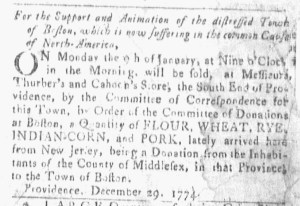
An advertisement in the December 31, 1774, edition of the Providence Gazette announced an upcoming sale of a “Quantity of FLOUR, WHEAT, RYE, INDIAN-CORN, and PORK” that would be held “For the Support and Animation of the distressed town of Boston, which is now suffering in the common Cause of North-America.” Although Parliament aimed the Boston Port Act, the Massachusetts Government Act, and the other Coercive Acts at agitators in Massachusetts, that legislation prompted a unified response, a sense of a “common Cause” as other colonies realized that Parliament could just as easily target them. The shipment of grains and pork that arrived in Providence came from New Jersey, “a Donation … to the Town of Boston.” According to the advertisement, the Committee of Correspondence in Boston instructed the Committee of Correspondence in Providence to sell the grains and pork to raise funds rather than attempt to transport them to Boston.
John Carter, the printer of the Providence Gazette, gave that advertisement a privileged place both times that it ran in his newspaper. The first time that it appeared, he inserted it immediately after local news and before other advertisements. Readers likely experienced it as a continuation of news related to the imperial crisis, including updates about other “Donations … to the Town of Boston.” When the advertisement ran a week later, two days before the sale, it was the first item in the first column on the first page, making it nearly impossible for readers to miss. Through the choices he made about the layout of his newspaper, the printer made his own contribution in support of the “common Cause of North-America.”
What was advertised in a colonial American newspaper 250 years ago today?
New-Hampshire Gazette (December 30, 1774).
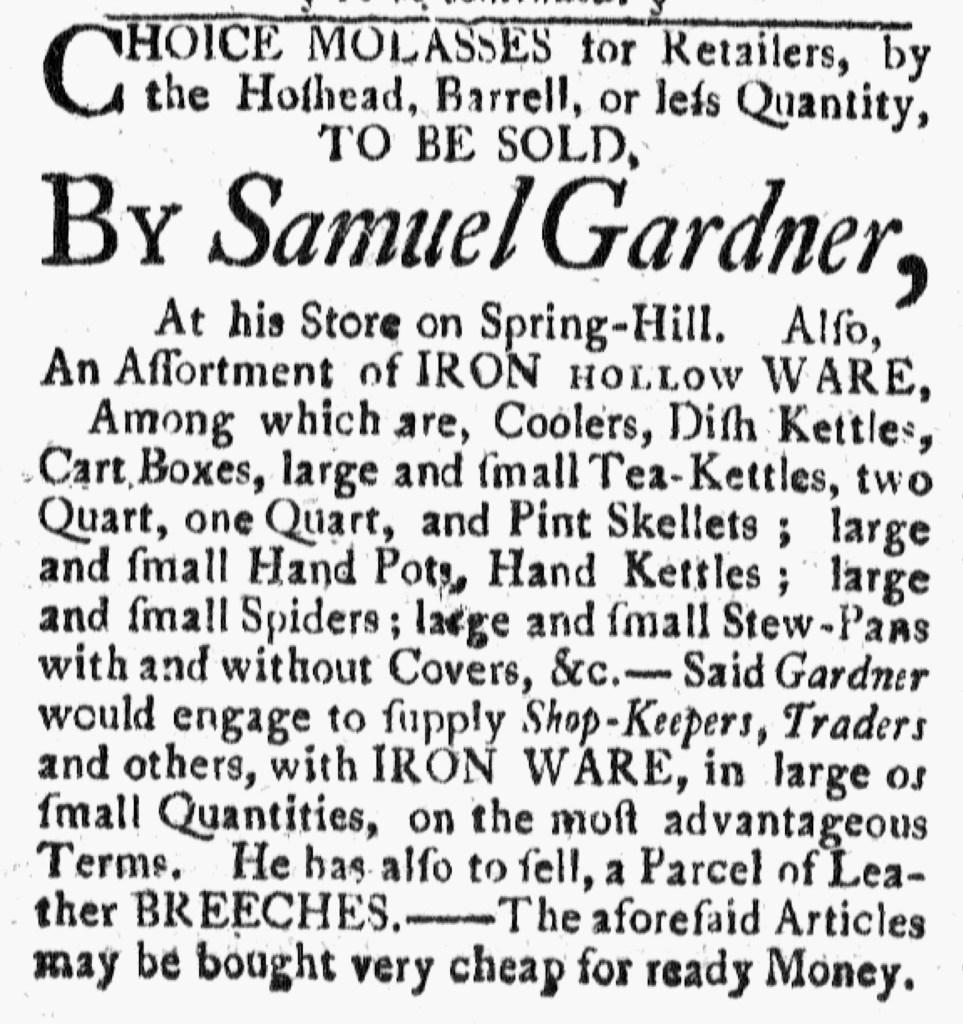
“TO BE SOLD, BY Samuel Gardner, At his Store on Spring-Hill.”
When it came to interspersing advertisements among news, editorials, and other content in colonial newspapers, the New-Hampshire Gazette was the exception to the rule. Not all newspapers took the same approach to where advertisements appeared, but they generally avoided mixing advertisements and other content. For instance, some newspapers reserved advertising for the final pages, printing all the news and editorials first, then the shipping news from the custom house to signal the transition to advertising, and finally the paid notices. Others ran advertising on the first and last pages, printed first on the same side of the broadsheet, and saved the second and third pages for the latest news that arrived. In some instances, news and advertising appeared on the same page. The front page, for example, could include a column of paid notices and two columns of news with the advertisements in either the left column or the right column. No matter the order, individual advertisements did not appear interspersed with news …
… except in the New-Hampshire Gazette. Daniel Fowle, the printer, took a novel approach that may have looked haphazard to contemporary readers, though later generations came to expect news and advertising alternating in newspapers. The layout of the New-Hampshire Gazette often required active reading to determine which portions featured advertising and which delivered news. Consider the December 30, 1774, edition. A short advertisement placed by George Whipple, “Attorney at LAW,” ran as the first item in the first column on the first page. News constituted the remainder of the content on that page. The second page began with news from the “Continental Congress continu’d” from the previous issue.” It spilled over into a second column, followed by an advertisement for goods available at Samuel Gardner’s store, and then a lengthy essay about conditions in Boston by “MASSACHUSETTENSIS.” That essay occupied most of the third page. Three advertisements completed the third column. More news and editorials appeared in the first column on the final page. In addition, news from New York and the shipping news from the custom house ran at the top of the third column. George Craigie’s lengthy advertisement for “A General Assortment of English Goods” interrupted the news and editorials. Half a dozen advertisements appeared below the shipping news in the final column. In other issues, Fowle interspersed short advertisements and short news items even more indiscriminately, giving readers of the New-Hampshire Gazette a different sort of visual experience in terms of organizing content compared to what they encountered in other colonial newspapers.
What was advertised in a colonial American newspaper 250 years ago today?
Massachusetts Spy (December 29, 1774).
“*** The last Chance.”
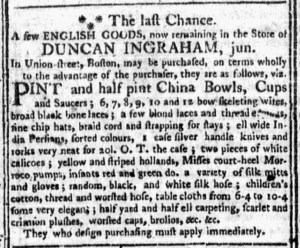
Prospective customers needed to act quickly or risk missing out on the opportunity entirely. That was the message that Duncan Ingraham, Jr., emphasized in his advertisement for “A few ENGLISH GOODS, now remaining” in his store in Boston at the end of 1774. His notice featured a headline that proclaimed “The last Chance” that he hoped would entice readers to look more closely at the list of merchandise in stock. Unlike the headlines for other advertisements, Ingraham’s headline included three asterisks to help draw attention to the offer he made available for a limited time. That offer included low prices that he described as “terms wholly to the advantage of the purchaser.” Ingraham was so eager to liquidate his inventory that he passed along significant savings to consumers, but only if they acted quickly. He concluded his advertisement with a warning that those “who design purchasing must apply immediately.”
Those “few ENGLISH GOODS, now remaining” had been on hand for six months or more. The Boston Port Act closed the harbor on June 1, 1774. Parliament asserted that the harbor would remain blockaded to commerce until the town made restitution for the property destroyed during the Boston Tea Party in December 1773. As a result, merchants and shopkeepers did not receive shipments from their suppliers in England. Ingraham peddled goods, including “China Bowls, Cups and Saucers,” “a variety of silk mitts and gloves,” and “children’s cotton, thread and worsted hose,” that had been on his shelves for some time. Under other circumstances, advertisers often emphasized that they received their merchandise via the ships most recently arrived in port, anticipating that consumers would associate the newest goods with the most fashionables ones. Such appeals, however, no longer held sway in Boston in the wake of the Boston Port Act. Elsewhere in the colonies, similar appeals lost their effectiveness once the Continental Association, a nonimportation agreement enacted in response to the Boston Port Act and the other Coercive Acts, went into effect on December 1, 1774.
What was advertised in a colonial American newspaper 250 years ago today?
Pennsylvania Journal (December 28, 1774).
“No advantage of the times taken.”
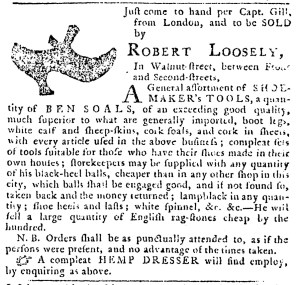
In the early 1770s, Robert Loosely sold “SHOEMAKER’s TOOLS” and materials at his shop on Walnut Street in Philadelphia. In an advertisement he ran in the Pennsylvania Chronicle in May 1772, he advised the public that he “served his apprenticeship in England, and for some years carried on a considerable trade there.” During that time, he “became acquainted with the most reputed manufacturers of tools and leather.” After migrating to Philadelphia, he put his knowledge and connections to good use in importing and selling only the highest quality items connected to that trade.
Loosely did not rehearse that history when he advertised in the Pennsylvania Journal in December 1774. Perhaps he believed that prospective customers were familiar enough with his reputation that he no longer needed to do so. He did, however, continue to make appeals to quality and even offered a money-back guarantee for some of his wares. He described his tools and soles as “exceeding good quality,” even “much superior to what are generally imported. When it came to “black-heel balls” used to blacken the edges of heels and soles, Loosely told shopkeepers that they “may be supplied with any quantity … cheaper than in any other shop in this city.” Furthermore, those items “shall be engaged good, and if not found so, taken back and the money returned.” He trusted that his confidence would entice prospective customers to purchase from him over his competitors.
In a nota bene, Loosely encouraged customers to send orders rather than visiting his shop, declaring that they “shall be as punctually attended to, as if the persons were present.” In addition, he assured readers, “no advantage of the times taken.” He referred to the Continental Association, a nonimportation agreement enacted by the First Continental Congress in response to the Coercive Acts. With imported goods curtailed after December 1, he could have raised prices, yet he abided by the ninth article that asserted, “Venders of Goods or Merchandise will not take Advantage of the Scarcity of Goods that may be occasioned by this Associacion, but will sell the same at the Rates we have been respectively accustomed to do for twelve Months last past.” Politics and commerce interested in Loosely’s marketing efforts in the final days of 1774.
What was advertised in a colonial American newspaper 250 years ago today?
Essex Gazette (December 27, 1774).
“THE Committee of Inspection for the Town of PLYMOUTH, hereby give Notice.”
Once the Continental Association went into effect on December 1, 1774, a new sort of advertisement began appearing in the Essex Gazette and other newspapers. Rather than advertising and selling their own merchandise, importers surrendered those roles to local Committees of Inspection, “agreeable to the Tenth Article of the Association of the American Continental Congress.” The First Continental Congress had devised the nonimportation agreement during its meetings in Philadelphia in September and October 1774 and then disseminated it throughout the colonies.
The tenth article of the Continental Association made provisions for goods imported between December 1, 1774, and February 1, 1775. The importers could choose to return the merchandise or turn it over to the local Committee of Inspection. If they chose the latter, they could opt for the committee to store the wares until the nonimportation agreement ended or sell them on behalf of the importer, in which case the importer recovered the cost of the items, but profits were designated for relief of Boston since it faced so much hardship once the Boston Port Bill closed and blockaded the harbor. The tenth article also specified that “a particular Account of all goods so returned, stored, or sold, [was] to be inserted in the publick Papers.”
Such was the case in two advertisements that John Torrey, chairman of the Committee of Inspection in Plymouth, first placed in the Essex Gazette on December 20, 1774, and again in subsequent issues. Those advertisements indicated which vessels transported the goods, but did not name the importers. They gave straightforward lists of the merchandise offered for sale without incorporating any of the common appeals to price, quality, fashion, or consumer choice. No marketing strategy nor turn of phrase (such as “very cheap” or “large Assortment”) sought to distinguish the merchandise in these advertisements from other goods available for sale. With political principles as the primary focus, John Torrey and the Committee of Inspection had little motivation to craft the sort of lively advertisements that the importers might have placed on their own behalf under other circumstances.
What was advertised in a colonial American newspaper 250 years ago today?
Massachusetts Gazette and Boston Post-Boy (December 26, 1774).
“Bride and Christening Cakes.”
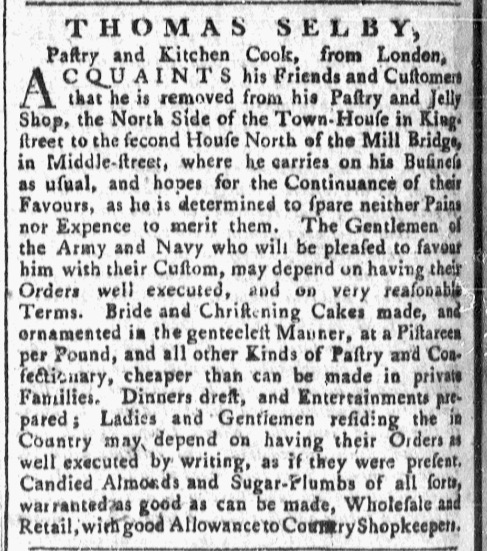
Despite the distresses that Boston experienced in the fall and winter of 1774 because of the Boston Port Act, the Massachusetts Government Act, and the Quartering Act, Thomas Selby, a “Pastry and Kitchen Cook, from London,” advertised that he “carries on his Business as usual” and declared to his “Friends and Customers” that he “hopes for the Continuance of their Favours, as he is determined to spare neither Pain nor Expence to merit them.” Apparently, he did not intend to discriminate when it came to prospective customers since he also confided that the “Gentlemen of the Army and Navy who will be pleased to favour him with their Custom, may depend on having their Orders well executed.” Selby chose to look beyond politics, figuring that a customer was a customer during hard times. Notably, he advertised in the Massachusetts Gazette and Boston Post-Boy, known for its more sympathetic stance toward the government than other newspapers published by Patriot printers. He also advised “Country Shopkeepers” that he would make a “good Allowance” for those who submitted orders for “Candied Almonds and Sugar-Plumbs of all sorts.” In other words, he gave discounts for purchasing in volume to retailers outside the city.
Selby filled many kinds of orders at his “Pastry and Jelly Shop.” He prepared and sold “Pastry and Confectionary, cheaper than can be made in private Families,” making it smart and economical to engage his services. He offered the eighteenth-century version of take-out food, advertising “Dinners drest” at his shop, and catered functions for his clients, highlighting “Entertainments prepared.” In addition, he baked and decorated cakes for special events: “Bride and Christening Cakes made, and ornamented in the genteelest Manner.” Bakers occasionally advertised such items. In November 1773, for instance, Frederick Kreitner marketed “Wedding-Cakes” among the many “Sorts of Confections” that he made in Charleston. The term “bride cake” was more widely used in England and America, including in Selby’s advertisement. Such cakes contained candied fruits, symbolizing fertility and prosperity. At about the time that Selby advertised his bride cake, icing became an essential element, as Carol Wilson explains in “Wedding Cake: A Slice of History.” Selby suggested that his “Bride and Christening Cakes” featured elaborate decorations to help commemorate the occasions. Even as the imperial crisis intensified, some colonizers paused to mark important milestones, including weddings and baptisms, and incorporated special foods into those observances.
What was advertised in a colonial American newspaper 250 years ago this month?
Boston Evening-Post (December 26, 1774).
“THIS DAY PUBLISHED … The Royal American Magazine … For NOVEMBER, 1774.”
Joseph Greenleaf published a new issue of the Royal American Magazine and advertised sporadically in December 1774. Perhaps the troubles that Boston experienced in the wake of the Boston Port Act, the Massachusetts Government Act, and the other Coercive Acts played a role in placing advertisements without the same attention to developing a marketing strategy that Isaiah Thomas had sometimes shown when he first launched the magazine, though the original publisher had also advertised somewhat haphazardly in his final months as proprietor before transferring the publication to Greenleaf. In general, Thomas had been much more intentional about advertising in the early stages when he sought subscribers than he had been once the magazine began circulating to readers.
As previously noted, Greenleaf advertised on November 17 that he would publish the October edition of the Royal American Magazine the following day, but no subsequent advertisements appeared in any of Boston’s newspapers until December 5. On that day, the Boston-Evening Post ran a notice that declared, “THIS DAY PUBLISHED … The Royal American Magazine … For OCTOBER, 1774.” To entice readers, Greenleaf noted that the issue was “Embellished with an elegant Engraving of the Dancing Bishops.” Eighteenth-century readers knew that “THIS DAY PUBLISHED” meant that a book, pamphlet, almanac, magazine, or other item was available for sale, not necessarily that it had been published on that day. As a result, Greenleaf could have published and circulated the October edition any time between November, if he had not met any delays after his previous advertisement, and December 5.
Three days later, Greenleaf placed advertisements in both the Massachusetts Gazette and Boston Weekly News-Letterand the Massachusetts Spy. In the former, he hawked the October edition of the magazine, “Embellished with an elegant Engraving.” That notice did not describe the engraving, but it did indicate that Greenleaf continued to take in subscribers. A much shorter advertisement in the Massachusetts Spy announced, “To-morrow will be published, by J. GREENLEAF, THE Royal American Magazine, No. XI. For NOVEMBER, 1774.” Subsequent advertisements suggest that Greenleaf did indeed publish the new edition in the next few days. That meant that whatever difficulties he experienced in the past month, he was nearly on time in delivering the November issue of the Royal American Magazine. In the eighteenth-century, magazines usually came out at the end of the month or the first week of the next month rather than in advance of the date on the cover.
During the following week, Greenleaf inserted advertisements for the November edition of the Royal American Magazine in four of the five newspapers published in Boston at the time. Rather than submit identical copy to the printing offices, he devised four variations, starting with one that ran in the Boston Evening-Post on December 12. In that one, he stated that the November issue was “THIS DAY PUBLISHED” and promoted two engravings, “the Gerubaor Russian Rabbit, and Mademoiselle Clarion, in the Habit of an Actress.” (Paul Revere produced all the engravings for the Royal American Magazine, though neither Thomas nor Greenleaf ever identified him in their advertisements.) On December 16, the Massachusetts Gazette and Boston Weekly News-Letter and the Massachusetts Spy, each published a day later than usual, both ran advertisements about the Royal American Magazine, though this time about the same edition. The advertisement in the Massachusetts Gazette and Boston Weekly News-Letter merely updated the month and issue number, presumably using type already set for the previous advertisement. The compositor for the Massachusetts Spy seemingly did something similar, updating the first line to read “This day was published, by J. GREENLEAF” instead of ““To-morrow will be published, by J. GREENLEAF.” The “T” in “THE Royal American Magazine,” slightly out of alignment in both advertisements suggests that was the case. Finally, the Boston-Gazettecarried a brief advertisement on December 19: “Just Published (No. XI) The Royal American Magazine, For November 1774, at Greenleaf’s Printing-Office, near the Market, Boston.”
Greenleaf inserted advertisements in the Boston Evening-Post and the Massachusetts Gazette and Boston Weekly News-Letter a second time, but not the Boston-Gazette and the Massachusetts Spy. For some reason, two weeks passed between the first and second appearance of those notices that did run twice. Still, Greenleaf pursued a more extensive advertising campaign for the Royal American Magazine in December than November, increasing to nine advertisements compared to only four. Although not as robust as some months, these marketing efforts gave the magazine’s November edition greater visibility in the public prints.
**********
“THIS DAY PUBLISHED … Royal American Magazine … For OCTOBER, 1774”
December 5 – Boston Evening-Post (first appearance)
“JUST PUBLISHED … Royal American Magazine … For OCTOBER, 1774”
December 8 – Massachusetts Gazette and Boston Weekly News-Letter (first appearance)
“To-Morrow will be published … Royal American Magazine … NOVEMBER, 1774”
December 8 – Massachusetts Spy (first appearance)
“THIS DAY PUBLISHED … Royal American Magazine … For NOVEMBER, 1774”
December 12 – Boston Evening-Post (first appearance)
December 26 – Boston Evening-Post (second appearance)
“JUST PUBLISHED … Royal American Magazine … For NOVEMBER, 1774”
December 16 – Massachusetts Gazette and Boston Weekly News-Letter (first appearance)
December 29 – Massachusetts Gazette and Boston Weekly News-Letter (second appearance)
“This day was published … Royal American Magazine … NOVEMBER, 1774”
December 16 – Massachusetts Spy (first appearance)
“Just Published (No. XI) The Royal American Magazine, For November 1774”
What was advertised in a colonial American newspaper 250 years ago today?
Providence Gazette (December 24, 1774).
“A History of New-England, With particular Reference to the People called BAPTISTS.”
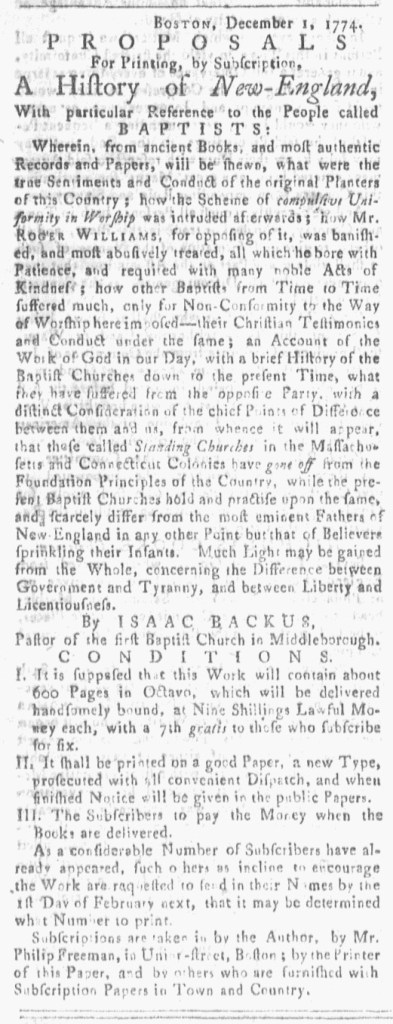
A subscription proposal for “A History of New-England, With particular Reference to the People called BAPTISTS” appeared among the various advertisements in the December 24, 1774, edition of the Providence Gazette. Dated “BOSTON, December 1,” it described a work in which Isaac Backus, “Pastor of the first Baptist Church in Middleborough,” consulted “ancient Books, and most authentic Records and Papers” to demonstrate the “true Sentiments and Conduct of the original Planters of this Country” and how the “Scheme of compulsive Uniformity in Worship was intruded afterwards.” The book included a “brief History of the Baptist Churches down to the present time” and “what they have suffered from the opposite Party, with a distinct Consideration of the chief Points of Difference between them and us, from whence it will appear, that those called Standing Churches in Massachusetts and Connecticut Colonies have gone off from the Foundation Principles of the Country.” As the imperial crisis intensified, Backus offered his own interpretation of the “Difference between Government and Tyranny, and between Liberty and Licentiousness” when it came to how Baptists had comported themselves and been treated in New England. Positioning Roger Williams as a protagonist in his narrative, the minister expected to attract subscribers in Rhode Island.
Beyond the contents of the volume, Backus promoted the “CONDITIONS” for publication that subscribers could expect. He anticipated that the book “will contain about 600 Pages in Octavo, which will be delivered handsomely bound.” Furthermore, they “shall be printed on good Paper” with a “new Type” to enhance legibility. Each copy cost nine shillings, though Backus offered a free seventh copy “to those who subscribe for six,” whether to gift to friends or retail in shops and bookstores. Subscribers did not need to make any payments in advance; sometimes subscription proposals called for deposits to help defray the initial costs of printing, but Backus stated that subscribers would “pay the Money when the Books are delivered.” Rather than raising funds, he intended for the proposals to gauge interest in the project and incite demand. To that end, he confided that a “considerable Number of Subscribers have already appeared.” Given the popularity of the book, Backus suggested, prospective subscribers did not want to miss an opportunity to reserve their own copies. They could submit their names to Backus or an associate in Boston or the printer of the Providence Gazette. In addition, the minister disseminated “Subscription Papers in Town and Country,” enlisting the aid of local agents in displaying his marketing materials.
Backus called for subscribers “to send in their Names by the 1st Day of February next, that it may be determined what Number to print.” Distributing subscription proposals did not always result in books going to press. In this case, Backus apparently found a sufficient number of subscribers to make the project viable, yet he did not publish the book as quickly as intended. Given the circumstances, an imperial crisis that became a war between the colonies and Britain in the spring of 1775, Backus published the first of three volumes in 1777 and the other two over the course of two decades. That first volume covered the period through 1690. The second, published in 1784, extended from 1690 to 1784, including “a concise view of the American war, and of the conduct of the Baptists therein, with the present state of their churches.” In 1796, Backus published the final volume, a church history that covered the period from 1783 through 1796 that featured a “particular history of the Baptist churches in the five states of New-England.” The project extended far beyond what he described in the subscription proposals the minister circulated in December 1774.