What was advertised in a colonial American newspaper 250 years ago today?
New-Hampshire Gazette (December 23, 1774).
“Fall GOODS, which were imported before the 1st of Dec.”
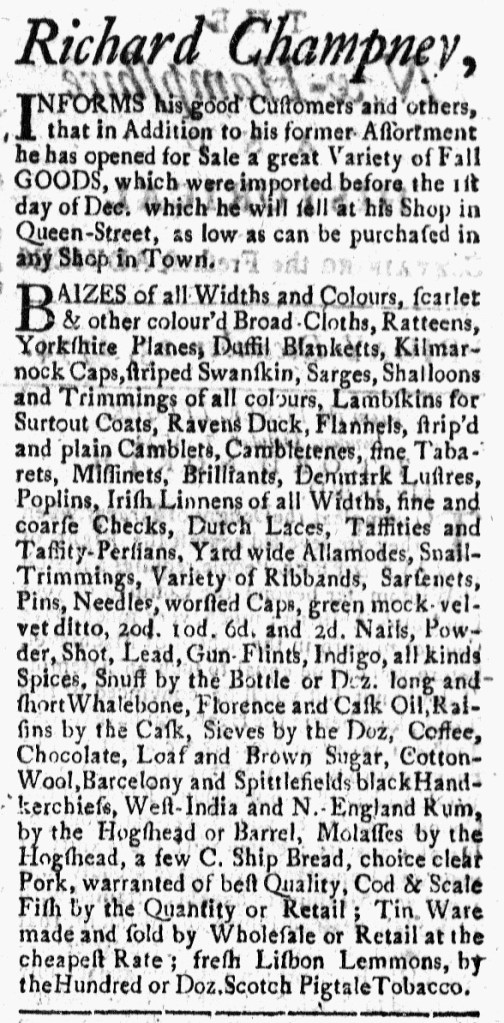
Richard Champney’s advertisement in the December 23, 1774, edition of the New-Hampshire Gazette looked like many others that had appeared in that newspaper and others throughout the colonies for about two decades. The shopkeeper emphasized that he stocked “a great Variety of Fall GOODS” and promised competitive prices, declaring that consumers could acquire his merchandise “as low as can be purchased in any Shop in Town.” To demonstrate the array of choices he offered, he devoted most of his advertisement to an extensive list that included “BAIZES of all Widths and Colours,” “Shalloons and Trimmings of all colours,” “strip’d and plain Camblets,” “fine and coarse Checks,” a “Variety of Ribbands,” “worsted Caps,” and “Barcelony and Spittlefields black Handkerchiefs.” Although many of those textiles and accessories may not be immediately familiar to modern readers, they resonated with readers immersed in the consumer revolution of the eighteenth century. They fluently spoke the language of consumption.
Despite the similarities with longstanding forms of advertising, Champney’s notice included one detail that distinguished it from what he would have published even a month earlier. Although he had “opened” a new stock to supplement his “former Assortment,” those new goods “were imported before the 1st day of Dec[ember].” That clarification was important for the shopkeeper to bring to the attention of prospective customers in Portsmouth and nearby towns and anyone who might read the New-Hampshire Gazette far and wide. Champney explicitly specified that he observed the Continental Association, a nonimportation agreement adopted by the First Continental Congress that went into effect on December 1. Since he had received this “great Variety of Fall GOODS” before that date, he could sell them with a clear conscience. Similarly, consumers could purchase them without worrying whether they aided the shopkeeper in breaking the agreement. For many years advertisers had noted when they imported their merchandise as a means of assuring prospective customers that they carried new items of the latest styles and taste. After December 1, 1774, however, when a shipment arrived had political significance and new sorts of ramifications for both advertisers and buyers.
What was advertised in a colonial American newspaper 250 years ago today?
New-York Journal (December 22, 1774).
“Willing to comply with the association entered into by the late Continental Congress.”
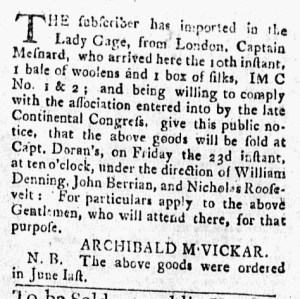
When a shipment of “1 bale of woolens and 1 box of silks” arrived in New York via the Lady Gage on December 10, 1774, Archibald McVickar surrendered the good to the local Committee of Inspection and placed an advertisement to that effect in the New-York Journal. He declared that he was “willing to comply with the association entered into by the late Continental Congress.” Accordingly, those goods “will be sold … under the direction of William Denning, John Berrian, and Nicholas Roosevelt.” Anyone wishing to learn more about the sale should “apply to the above Gentlemen” rather than to the McVickar.
McVickar abided by the Continental Association, a nonimportation agreement enacted by the First Continental Congress in response to the Coercive Acts. In particular, the tenth article stated, “In Case any Merchant, Trader, or other Persons, shall import any Goods or Merchandise after the first Day of December [1774], and before the first Day of February next, the same ought forthwith, at the Election of the Owner, to be either reshipped or delivered up to the Committee of the County or town wherein they shall be imported, to be stored at the Risk of the Importer, until the Non-importation Agreement shall cease, or be sold under the Direction of the Committee aforesaid.” In other words, McVickar had three options since his shipment arrived on December 10. He could return it, turn the goods over to the committee to store until the nonimportation agreement ended, or turn the goods over to the committee to sell.
McVickar chose the final option. The Continental Association made further provisions that he would be reimbursed for the cost of the goods yet could not earn any profit on them. Instead, any profit was to be applied to relief efforts for Boston where the harbor had been closed and blockaded since the Boston Port Act went into effect on June 1. McVickar added a nota bene to clarify that the “goods were ordered in June last.” At that time, colonizers suspected that a nonimportation agreement might go into effect in the future, but the First Continental Congress had not yet met or composed and disseminated the Continental Association. McVickar suggested that he had not deliberately attempted to get around that agreement, as he further demonstrated in asserting that he was “willing to comply with the association.” Whatever he lost in profit, he gained in staying in the good graces of members of the community who supported the Patriot cause.
What was advertised in a colonial American newspaper 250 years ago today?
Essex Journal (December 21, 1774).
“Intend to enlarge the paper equal to any in the province the year ensuing.”
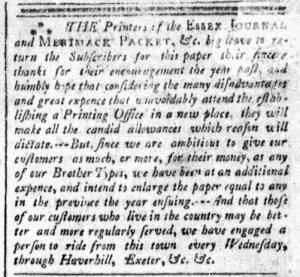
The Essex Journal and Merimack Packet: Or The Massachusetts and New-Hampshire General Advertiser completed its first year of publication with its December 21, 1774, edition. For the last time, the masthead stated, “VOL. I.” The compositor updated that to “VOL. II” the following week. Isaiah Thomas and Henry-Walter Tinges launched the newspaper, published in Newburyport, with a free preview issue on December 4, 1773, then commenced weekly publication on December 29. Thomas withdrew from the partnership in August 1774, about the same time that he transferred proprietorship of the Royal American Magazine to Joseph Greenleaf. Ezra Lunt joined Tinges in publishing the Essex Journal without a disruption in distributing the newspaper to subscribers. Despite those disruptions and the “many disadvantages and great expence that unavoidably attend the establishing a Printing Office in a new place,” the Essex Journal made it through its first year and continued into a second.
In a notice in the final issue of Volume I, Lunt and Tinges announced their plans to improve and expand the newspaper. They proclaimed that they “are ambitious to give our customers as much, or more, for their money, as any of our Brother Types” who published the Essex Gazette in Salem, the New-Hampshire Gazette in Portsmouth, or any of the five newspapers printed in Boston at the time. To that end, Lunt and Tinges confided, “we have been at an additional expence, and intend to enlarge the paper equal to any in the province the year ensuing.” Furthermore, they sought to improve the newspaper for subscribers in other ways. In order that “those of our customers who live in the country may be better and more regularly served, we have engaged a person to ride from this town every Wednesday, through Haverhill, Exeter,” and other towns. Lunt and Tinges published the Essex Journal on Wednesdays. As soon as the ink dried, they gave copies to a postrider to deliver to subscribers throughout the countryside, improving on the services provided throughout the previous year.
Printers often noted when their newspapers completed another year of publication, often marking the occasion with calls for subscribers and others to settle overdue accounts. Lunt and Tinges did not make any mention of subscribers who were delinquent in making payment. Instead, they expressed their appreciation and sketched their plans for the next year, hoping to increase support and enthusiasm for the newest newspaper published in Massachusetts.
What was advertised in a colonial American newspaper 250 years ago today?
Essex Gazette (December 20, 1774).
“I find the retaining said Commission is contrary to the Sentiments of the Publick in general.”
The December 20, 1774, edition of the Essex Gazette, published in Salem, carried three advertisements in which residents of Marblehead disavowed commissions granted to them by the former governor, Thomas Hutchinson. Nathaniel Lindsey, for instance, declared, “I find the retaining said Commissions is contrary to the Sentiments of the Publick in general, as well as inconsistent with my private Opinion.” He carefully asserted that his politics aligned with the principles espoused by Patriots, though such an assertion may have been performative rather than authentic. Either way, Lindsey distanced himself from his affiliation with the unpopular former governor, proclaiming, “I will not act any farther under said Commission, neither will I receive any Commission or act under any Authority whatsoever, that proceeds from any Creature which appears to have two Faces.” In other words, he did not find the current administration trustworthy to act in the interests of the colonies instead of Parliament. “I am a Well-Wisher to my Country and Town,” Lindsey concluded.
Ebenezer Graves and Samuel Trevett published the other two notices with similar messages. Indeed, their advertisements featured identical wording except for the first line. Graves stated that he “some Time since received a military Commission from the late infamous Governor Hutchinson,” while Trevett similarly declared, “I was so unhappy as to receive a military Commission from the late infamous Governor Hutchinson.” Each of them acknowledged that the “Commission has been continued by his successor,” General Thomas Gage. Graves and Trevett used identical language throughout the remainder of their notices: “I hereby publish a full Resignation of said Commission, as I conceive it inconsistent with the Laws of God and the Welfare of my Country, to hold it under the Command of such an enemy of my Country’s Liberties.” Hutchinson enforced the Coercive Acts, including the Boston Port Act, the Massachusetts Government Act, and the Quartering Act.
These advertisements resembled the apologies that many colonizers published to distance themselves from an address to Governor Hutchinson that they signed upon his departure for England. They claimed that they signed in haste, not having carefully read or fully comprehended the document. As William Huntting Howell has noted, many of the apologies featured identical language, leading him to argue that the signatories were not necessarily sincere but merely wanted to return to the good graces of their neighbors. Furthermore, Howell argues, what mattered most to Patriots was the public expression of allegiance to their cause, finding that more important for shaping public opinion than the true conversion of any individual. When Lindsay, Graves, and Trevett ran advertisements resigning their military commissions, they perhaps followed a similar path as their counterparts who apologized for signing the address to Hutchinson.
What was advertised in a colonial American newspaper 250 years ago today?
New-York Gazette and Weekly Mercury (December 19, 1774).
“He will undertake to make middle-siz’d men cloaths at the under-mentioned prices.”
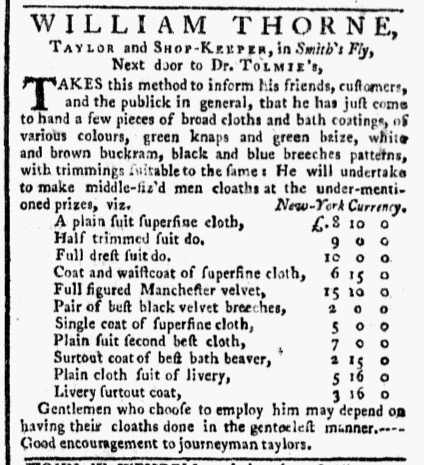
William Thorne, a tailor, took to the pages of the New-York Gazette and Weekly Mercury to advertise his services in late December 1774. He began his notice with an announcement that he had recently acquired various textiles, trimmings, and patterns, though he devoted half of the space to a list of prices that he charged for “middle-siz’d men cloaths.” Presumably he adjusted the prices accordingly depending on whether a client was tall or short or stout. The “middle-siz’d” prices at least gave prospective customers an estimate of what they could expect to pay for an array of garments.
For instance, a ”Full figured Manchester velvet,” the most genteel item on the list, cost fifteen pounds and ten shillings “New-York Currency.” For some items, the list revealed a progression of prices. A “plain suit [made of] superfine cloth” cost eight pounds and ten shillings, a “Half trimmed suit” of the same material cost nine pounds, and a “Full drest suit,” also of the same material, cost ten pounds. Clients interested in just a “Coat and waistcoat of superfine cloth” paid only six pounds and fifteen shillings, with a “Single coat of superfine cloth” costing five pounds. For those of more modest means, a “Plain suit [made of] second best cloth” cost seven pounds. The prices for the “Half trimmed” and “Full drest” suits made of superfine cloth suggested the likely increase in price for such items made of “second best cloth.” Thorne also made other garments. A “Surtout coat” or overcoat “of best bath beaver” cost two pounds and fifteen shillings and a “Pair of best black velvet breeches” went for two pounds.
Tailors only occasionally listed prices in their advertisements. The list that Thorne published allowed “his friends, customers, and the publick in general” to do some comparison shopping without needing to visit his shop of contact him directly. Readers could determine for themselves how Thorne’s prices compared to what they paid their own tailors for similar garments, perhaps prompting them to recognize bargains that made Thorne’s services attractive to them.
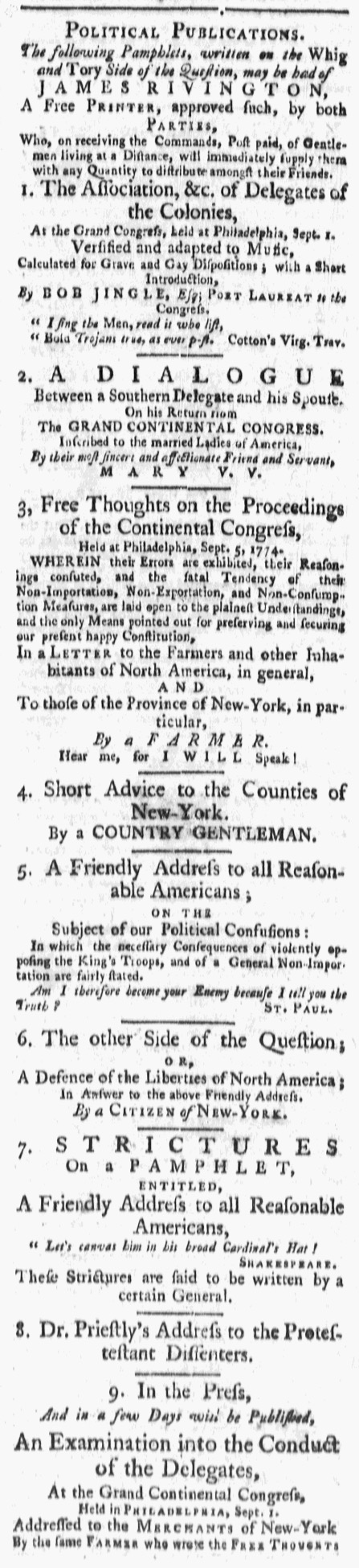
“POLITICAL PUBLICATIONS … written on the Whig and Tory Side of the Question.”
In chronicling the momentous events of 1774, the Adverts 250 Project has frequently featured advertisements for books, pamphlets, and other items related to the imperial crisis as it intensified following the Boston Tea Party and the Coercive Acts passed by Parliament in retaliation. Most printers increasingly privileged the Patriot’s perspective, both in terms of the news and editorials they selected for their newspapers and the works that they published, advertised, and sold. Yet they did not uniformly do so.
James Rivington, a Loyalist, proclaimed in the masthead of Rivington’s New-York Gazetteer that his newspaper was “PRINTED at his OPEN and UNINFLUENCED PRESS.” In Revolutionary Networks: The Business and Politics of Printing the News, 1763-1789, Joseph M. Adelman notes that “Rivington’s bookselling career was about making money rather than promoting a political ideology, so much so that he wanted to capitalize on relatively popular anti-imperial political tracts.”[1] One of his advertisements in the December 15, 1774, edition of his newspaper listed nine “POLITICAL PUBLICATIONS” that he sold. He explained that he stocked pamphlets “written on the Whig and Tory Side of the Question.” He demonstrated that was the case in the descriptions of some of those tracts. For instance, he carried “A Friendly Address to all Reasonable Americans; ON THE Subject of our Political Confusions: In which the necessary Consequences of violently opposing the King’s Troops, and of a General Non-Importation are fairly stated” and “The other Side of the Question; OR, A Defence of the Liberties of North America; In Answer to the above Friendly Address.” Debates over current events extended beyond the town common and newspaper editorials into pamphlet wars during the imperial crisis.
Those nine “POLITICAL PUBLICATIONS” included “Free Thoughts on the Proceedings of the Continental Congress,” in which “a FARMER” commented on the widely published and advertised account of the meetings held in Philadelphia in September and October. In that pamphlet, “their Errors are exhibited, their Reasonings confuted, and the fatal tendency of their Non-Importation, Non-Exportation, and Non-Consumption Measures, are laid open to the plainest Understandings, and the only Means pointed out for preserving and securing our present happy Constitution.” On the first page of the same issue, Rivington advertised “A full Vindication of the Measures of the Continental Congress, IN ANSWER TO Free Thoughts on the Proceedings of the said Congress.” The advertisement mocked “a FARMER” and his pamphlet, stating that in this response “his Sophistry is exposed, his Cavils confuted, his Artifices detected, and his Wit ridiculed.” Rivington added his own note: “The Printer, with humble Deference, presumes that this answer will meet with a gracious reception at the hands of every reader who has expressed disapprobation to the Freethoughts of Farmer.” For those who appreciated that pamphlet, however, Rivington announced that he would soon publish “THE CONGRESS CANVASSED; OR, An Examination into the Conduct of the Delegates … By the FARMER … Who wrote Free Thoughts on their Proceedings.” Rivington believed that political controversy meant business as he published, advertised, and sold works “on the Whig and Tory Side of the Question.” Seeking to maximize revenues, he suggested that “Gentlemen living at a Distance” submit orders for “any Quantity to distribute amongst their Friends.”
Rivington simultaneously asserted that he was “A Free PRINTER, approved such, by both PARTIES,” yet many observers did not care for his “OPEN and UNINFLUENCED” approach that undermined the Patriots’ perspective. Adelman explains that “Patriots eventually targeted Rivington and intended to destroy his business, by force if necessary.” In December 1774, as Rivington published these advertisements, an anonymous group of Patriots sent a letter to Stephen Ward and Stephen Hopkins in Newport. They “urged Ward and Hopkin to obtain a general agreement in Rhode Island not to purchase his New-York Gazetteer or deal with anyone advertising in it.”[2] Less than a year later, a contingent from the Sons of Liberty marched from New Haven to New York to capture Loyalist leaders and silence Rivington. They seized his types, reportedly melting them down for shot, and destroyed his press. Seeking to represent both sides (and generate revenues while doing so) came with consequences for the printer.
**********
[1] Joseph M. Adelman, Revolutionary Networks: The Business and Politics of Printing the News, 1763-1789 (Baltimore: Johns Hopkins University Press, 2019), 127.
What was advertised in a colonial American newspaper 250 years ago today?
Providence Gazette (December 17, 1774).
“The NEW-ENGLAND ALMANACK … By BENJAMIN WEST.”
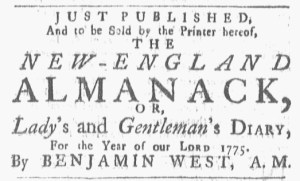
The December 17, 1774, edition of the Providence Gazette carried nearly two dozen advertisements, including one by the printer, John Carter, for “THE NEW-ENGLAND ALMANACK, OR, Lady’s and Gentleman’s DIARY, For the Year of our LORD 1775. By BENJAMIN WEST.” For a decade, West and the printers of the Providence Gazette had been collaborating on that annual publication, even as proprietorship of the newspaper and the printing office changed hands. The Adverts 250 Project has documented that partnership, covering West’s almanac perhaps more extensively than any other almanac advertised in early American newspapers.
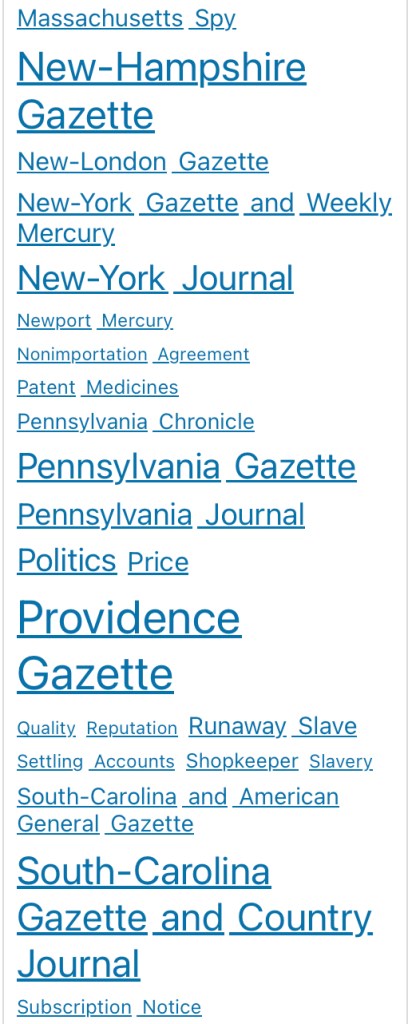
Some of the “most used” tags for the Adverts 250 Project.
That is a result, in part, of the project’s methodology that calls for examining an advertisement published 250 years ago that day. Accordingly, I select advertisements from approximately two dozen newspapers that have been digitized and made more widely accessible, yet publication of those newspapers did not occur evenly throughout the week. Throughout most of the nine years that I have produced the Adverts 250 Project, the Providence Gazette was the only newspaper published in Saturdays. As a result, that newspaper has been disproportionately featured in the project … and the methodology has encouraged me to have a closer look at the annual publication of West’s New-England Almanack than most other almanacs.
The word cloud generated for the “most used tags” by WordPress reflects this. “Providence Gazette” appears in a larger font and thicker bold than any other newspaper or other tag, even though it was not the most significant newspaper published in the colonies, neither for news coverage nor for advertising innovation. Similarly, advertisements from the New-Hampshire Gazette have also been featured regularly due to the methodology because for quite some time that was only newspaper published on Fridays that had been digitized. While the Providence Gazetteand the New-Hampshire Gazette might not be considered as significant as certain other newspapers published during the era of the American Revolution, this project’s methodology has caused me to approach the contents of those newspapers with greater attention and creativity.
These are the newspapers published 250 years ago this week that have been digitized for greater access:
Monday
Boston Evening-Post
Boston-Gazette
Connecticut Courant (Hartford)
Dunlap’s Pennsylvania Packet (Philadelphia)
Maryland Journal (Baltimore)
Massachusetts Gazette and Boston Post-Boy
Newport Mercury
New-York Gazette and Weekly Mercury
South-Carolina Gazette
Tuesday
Essex Gazette (Salem)
South-Carolina Gazette and Country Journal (Charleston)
Wednesday
Essex Journal (Newburyport)
Pennsylvania Gazette (Philadelphia)
Pennsylvania Journal (Philadelphia)
Thursday
Maryland Gazette (Annapolis)
Massachusetts Gazette and Boston Weekly News-Letter
Massachusetts Spy
New-York Journal
Norwich Packet
Rivington’s New-York Gazetteer
Virginia Gazette [Pinkney] (Williamsburg)
Virginia Gazette [Purdie and Dixon] (Williamsburg)
Friday
Connecticut Gazette (New London)
Connecticut Journal (New Haven)
New-Hampshire Gazette (Portsmouth)
South-Carolina and American General Gazette (Charleston)
What was advertised in a colonial American newspaper 250 years ago today?
Connecticut Gazette (December 16, 1774).
“Embellish’d with an Engraving of the patriotic Bishop of ST. ASAPH.”
With a new year only weeks away, advertisements for almanacs appeared in newspapers throughout the colonies in December 1774. Most printers who published newspapers also produced almanacs as an alternate revenue stream, joined by other printers who supported themselves by performing job printing. Consumers had an array of choices when they selected their almanacs for the coming year.
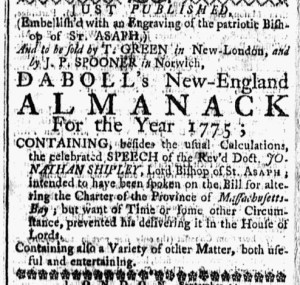
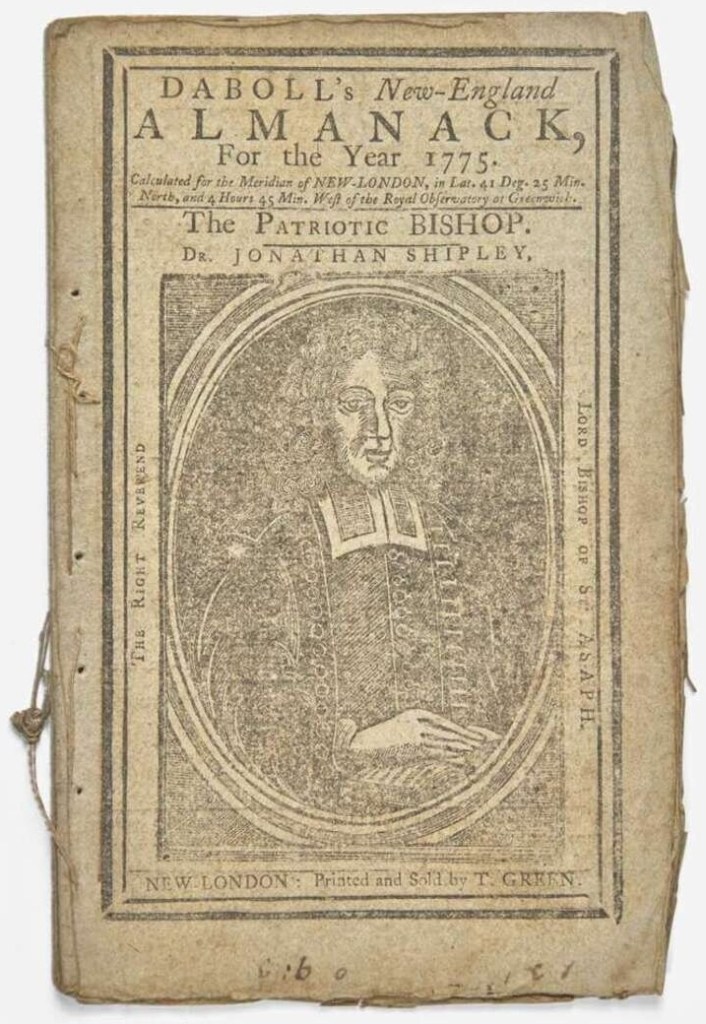
As a result, printers often marketed the contents of their almanacs, emphasizing anything that made them distinctive. When Timothy Green, the printer of the Connecticut Gazette, advertised “DABOLL’s New-England ALMANACK For the Year 1775,” he indicated that it included the “usual Calculations” as a well as a “Variety of other Matter, both useful and entertaining.” He emphasized a particular item: “the celebrated SPEECH of the Rev’d Doct. JONATHAN SHIPLEY, Lord Bishop of St. ASAPH; intended to have been spoken on the Bill for altering the Charter of the Province of Massachusetts-Bay; but want of Time or some other Circumstance, prevented his delivering it in the House of Lords.” Shipley had gained acclaim in the colonies because he had been the only bishop in the Church of England who expressed opposition to the Massachusetts Government Act when Parliament considered how to respond to the Boston Tea Party. When he did not have a chance to deliver the speech, he opted to publish it instead.
Though Shipley’s speech had little impact in England, the colonizers greeted it warmly. Several newspapers published the speech, printers advertised pamphlets containing the speech, and Green devoted twelve of the thirty-two pages of Daboll’s New-England Almanack to the speech, anticipating that doing so would entice customers. Furthermore, he “Embellished [the almanac] with an Engraving of the patriotic Bishop of ST. ASAPH” on the front cover. Each time readers consulted any of the contents, they glimpsed the bishop whether or not they also read any portion of his speech. Green advertised Daboll’s New-England Almanack at the same time he promoted his own edition of “The PROCEEDINGS and RESOLUTIONS of The Continental Congress,” joining other printers in producing and disseminating an array of items related to current events and, especially, making a case against the abuses perpetrated by Parliament.
Daboll’s New-England Almanack, For the Year 1775 (New London: Timothy Green, 1774). Courtesy Freeman’s | Hindman.
What was advertised in a colonial American newspaper 250 years ago today?
New-York Journal (December 15, 1774).
“JOURNAL OF THE PROCEEDINGS OF THE CONGRESS.”
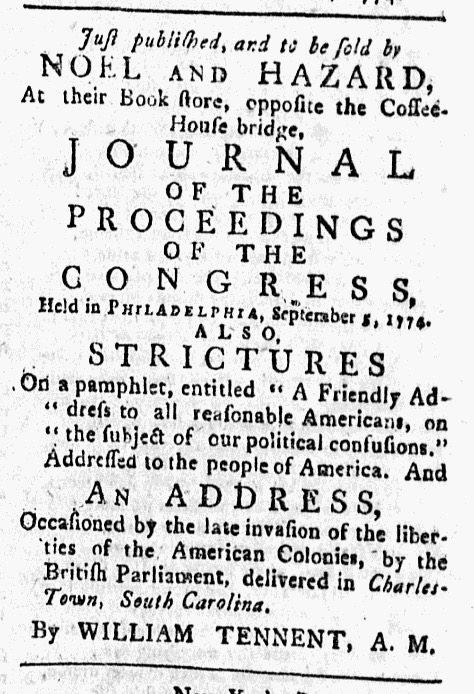
According to their advertisement in the December 15, 1775, edition of the New-York Journal, Garrat Noel and Ebenezer Hazard stocked the “JOURNAL OF THE PROCEEDINGS OF THE CONGRESS, Held in PHILADELPHIA” at their bookstore. They also marketed “STRICTURES On a pamphlet, entitled ‘A Friendly Address to all reasonable Americans, on the subject of our political confusions’” by Charles Lee and “AN ADDRESS, Occasioned by the late invasion of the liberties of the American Colonies, by the British Parliament, delivered in Charles-Town, South Carolina” by William Tennent. The booksellers provided the public access to news and commentary about current events beyond what appeared in the public prints, though they privileged perspectives expressed by Patriots rather than Loyalists.
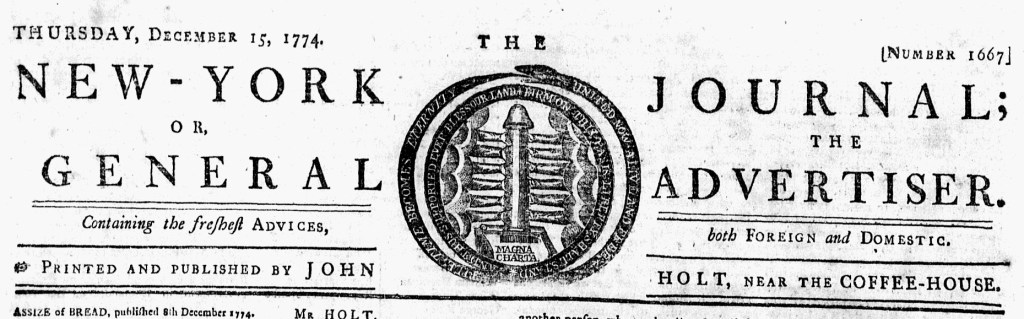
Noel and Hazard may have sold Hugh Gaine’s New York edition of the Proceedings of the First Continental Congress, though the other titles in their advertisement suggest that they could have sold the Philadelphia edition printed by William Bradford and Thomas Bradford. The Bradfords also published Lee’s Strictures and Tennent’s Address, possibly sending copies of all three titles to Noel and Hazard. Either way, the masthead of the newspaper that featured the booksellers’ advertisement suggested that the Bradfords’ edition of the Proceedings made their way to New York. Six months earlier, John Holt, the printer of the New-York Journal, incorporated a political cartoon depicting a severed snake, each segment representing one of the colonies, with the motto “UNITE OR DIE” into the masthead. On December 15, he replaced it with a woodcut depicting twelve hands, one for each colony represented at the First Continental Congress, grasping a liberty pole with a liberty cap perched atop it on a pedestal inscribed “MAGNA CHARTA.” A similar image appeared on the title page of the Bradfords’ edition of the Proceedings, described in Princeton University Library’s online catalog as “the first wood-cut device of the 12 colonies intended to symbolize the need for the true political unity of the colonies.” Holt enhanced that image, having an ouroboros twice encircle the hands and pillar. A message on the ouroboros proclaimed, “UNITED NOW – ALIVE AND FREE – AND THUS SUPPORTED EVER – BLESS OUR LAND – FIRM ON THIS BASIS LIBERTY SHALL STAND – TILL TIME BECOMES ETERNITY.” This addition to his newspaper set the tone for readers to peruse Noel and Hazard’s advertisement, other paid notices, and the news and editorials selected by Holt.
What was advertised in a colonial American newspaper 250 years ago today?
Pennsylvania Journal (December 14, 1774).
“GREEN and SOUCHONG TEAS.”
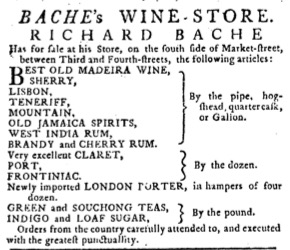
A year after the Boston Tea Party, advertisements for tea continued to appear in newspapers throughout the colonies. They even continued to run after the Continental Association, a nonimportation agreement adopted by the First Continental Congress, went into effect on December 1, 1774. The December 14, 1774, edition of the Pennsylvania Journal, for instance, carried two advertisements, side by side at the top of the final page, that included tea among the commodities offered for sale. “BACHE’s WINE-STORE” stocked more than just wine and spirits. Richard Bache also promoted “GREEN and SOUCHONG TEAS … By the pound.” Similarly, “JOHN MITCHELL’s Wine, Spirit, Rum and Sugar STORES” provided consumers with “Bohea Tea, warranted good, by the chest, half chest or dozen” and “Best Green and Hyson Tea, by the dozen or pound.” These advertisements apparently did not meet with the sort of ire that resulted in Bache or Mitchell quickly discontinuing them. Instead, James R. Fichter documents in Tea: Consumption, Politics, and Revolution, 1773-1776, that “between May 1774 and March 1775 their ads appeared most weeks.”[1]
That seems incongruous considering the editorial position of the Pennsylvania Journal and the actions of William Bradford, one of its printers. Fichter explains that Bradford “hosted in his home the meeting which decided how to oppose the East India Company’s shipment to Philadelphia in 1773. Furthermore, he published “John Dickinson’s denunciation of the 1773 tea scheme, the broadsides from ‘Committee on Tarring and Feathering,’ which threatened pilots” who brought ships carrying tea up the Delaware River, and the “JOURNAL OF THE PROCEEDINGS” of the First Continental Congress. On July 27, 1774, the Pennsylvania Journalaltered its masthead to include a woodcut depicting a severed snake, each segment labeled to represent one of the colonies, and the motto, “UNITE OR DIE.” How did advertisements that offered tea for sale find their way into such a newspaper so regularly? Fichter explains that Bradford “was also a business” as well as a Patriot. Like other newspaper printers who shared his political principles, he “did not censor tea ads” but instead “ran these ads as long as they were politically permissible.” Even so late in 1774, “discourse and consumption were only partially politicized,” Fichter asserts, “and advertisements remained separate from but parallel to political debate.”[2] While that was the case for advertisements about tea, other advertisements did take positions, either implicitly or explicitly, about the politics of consumption, yet Fichter demonstrates the complexity and nuance in how printers, advertisers, and the public approached such issues. Neither the Boston Tea Party nor the Continental Association resulted in colonizers immediately giving up tea or other imported goods.
**********
[1] James R. Fichter, Tea: Consumption Politics, and Revolution, 1773-1776 (Ithaca: Cornell University Press, 2023), 143.