March 7

GUEST CURATOR: Olivia Burke

What was advertised in a colonial American newspaper 250 years ago today?

Essex Gazette (March 7, 1769).

“The best New-England Flour of Mustard.”

In “A Taste for Mustard: An Archaeological Examination of a Condiment and Its Bottles from a Loyalist Homestead in Upper Canada,” Denise C. McGuire provides an overview of mustard production and consumption and examines an excavation of the Butler Homestead site in Niagara-on-the-Lake, Ontario. “Flour of Mustard” was very popular in Britain. It played an important role in eighteenth-century cooking, but was also considered to have medicinal value. It also reveals changes in transatlantic trade. Initially imported in the American colonies, it was subsequently grown there. As we can see in this advertisement, flour of mustard was sold in the colonies; it even specifically states that it was “New-England Flour of Mustard,” proudly showing that the mustard was grown and produced in the colonies.

That production continued after the American Revolution, intended for local consumption as well as export. When a cache of glass bottles was discovered, the square shape led McGuire to believe that they were mustard bottles. The discoveries at the Butler Homestead show that Loyalists got their flour of mustard from American producers after the Revolution. “[E]ven two generations after the first wave of Loyalist settlement, the ability to acquire simple commodities was not always easily accessible in more remote locations.”[1] Such evidence shows that the Butler family retained commercial ties to upstate New York even after the Revolutionary War.

**********

ADDITIONAL COMMENTARY: Carl Robert Keyes

When she consulted me about including this advertisement among those she would examine during her week as guest curator, Olivia expressed some concern about Chloe Amour previously examined flour of mustard in another advertisement recently featured on the Adverts 250 Project. She did not wish to duplicate the work of one of her peers. I encouraged her to continue with Thomas Walley’s advertisement, especially after she revealed that she had already consulted McGuire’s article. We certainly had more to learn about this particular commodity. As we move chronologically from the imperial crisis to the early republic, our Revolutionary America class has so far focused on the politics and economics of producing, trading, and consuming goods in the 1760s through the early 1780s. By incorporating mustard bottles uncovered during an archaeological excavation of a Loyalist site in Canada, Olivia has given our class a preview of the period we will be examining later in the semester.

For my part, I’m interested in the many similarities between Walley’s advertisement in the Essex Gazette and William Chace’s advertisement in the Providence Gazette. Both named their products “New-England Flour of Mustard,” emphasizing that it had been produced locally. Walley underscored that his mustard “has been greatly admired, both for its Strength and Flavor, by all that have used it.” Similarly, Chace proclaimed that his mustard “is allowed by the best Judges to be superior both for Strength and Flavour to any imported.” In this instance, Chace more explicitly attached a political meaning to acquiring his mustard, comparing it imports that many colonists had vowed to eschew as acts of economic resistance against the Townshend Acts. Walley made a nod toward such appeals when he offered to make “An Allowance … to those that buy to sell again, in order to encourage this Manufacture.” Such discounts may have helped to move his product out the door and, eventually, into the hands of greater numbers of consumers, but they also invoked images of “domestic manufacture” so often touted in news and editorials, especially in those moments that the imperial crisis intensified. Even Samuel Hall, the printer of the Essex Gazette, stocked a “small Parcel of the above Mustard” to make it available to residents of Salem who might not otherwise have an opportunity to acquire it from Walley at his store in Boston. In advancing similar appeals to prospective customers, Walley and Chace demonstrated that they participated in a larger conversation about the meaning of mustard. In the late 1760s, mustard did more than merely flavor food. It was enmeshed in the politics of the period.

**********

[1] Denise C. McGuire, “A Taste for Mustard: An Archaeological Examination of a Condiment and Its Bottles from a Loyalist Homestead in Upper Canada,” International Journal of Historical Archaeology 20, no. 4 (December 2016): 680.
March 6

GUEST CURATOR: Olivia Burke

What was advertised in a colonial American newspaper 250 years ago today?

Boston Evening-Post (March 6, 1769).

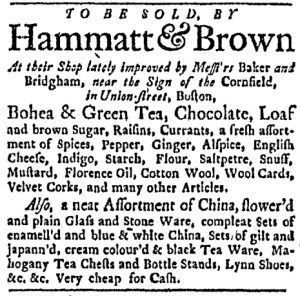
“A neat Assortment of China, flower’d and plain Glass and Stone Ware.”

Advertisements like this were very common in newspapers in the latter half of the eighteenth century. Hammatt and Brown had for sale an impressive list of goods, including tea, chocolate, cotton wool and a “neat Assortment” of china, glass, and stoneware. This advertisement displayed the expanding consumer culture in the colonies. No longer were people producing things for self-sufficiency. As T.H. Breen explains, “[A] pioneer world of homespun cloth and wooden dishes … was swept away by a flood of store-bought sundries.”[1] Colonists became interested in things and what those material goods did for their image. This change also led to an emergence of a commonalities and a community mindset among colonists of different areas. For example, in “Baubles of Britain”; The American and Consumer Revolutions of the Eighteenth Century,” Breen describes a “shared language of consumption.”[2] People in the colonies had this newfound connection with each other. A colonist from Massachusetts would see the type of fabric a visitor from a southern colony wore and immediately know the material and social class that went with it. This created a common connection among people and subsequently grew a feeling of nationalism through the colonies as the imperial crisis with Britain drew to its boiling point.

**********

ADDITIONAL COMMENTARY: Carl Robert Keyes

As Olivia indicates, advertisements of this sort were indeed commonly inserted in eighteenth-century newspapers, especially in those published in the largest port cities. Although they ran in every newspaper printed in the colonies, they appeared in greater numbers and with greater frequency in publications from Boston, Charleston, New York, and Philadelphia. In each of those cities, advertisers contended not only with competitors who placed advertisements in the same newspapers they did but also with rival merchants and shopkeepers who advertised in other newspapers as well as those who did not advertise at all. The advertisements in the Boston Evening-Post, for instance, reveal only a small portion of the commercial landscape that made consumer goods available in colonial Massachusetts.

When they decided to advertise the assortment of goods they sold at their shop in Union Street, Hammatt and Brown chose from among several newspapers published in Boston. The Boston Chronicle, the Boston Evening-Post, the Boston-Gazette, the Boston Post-Boy, and Green and Russell’s Massachusetts Gazette were all published on Mondays. A second issue of the Boston Chronicle came out on Thursdays, along with the Boston Weekly News-Letter and Draper’s Massachusetts Gazette. Each included an array of advertisements that hawked the same kinds of wares that Hammatt and Brown listed in their notice. Some merchants and shopkeepers opted to advertise in more than one publication, but others, like Hammatt and Brown, confined themselves to a single newspaper. Among them, advertisers created sufficient copy to barrage colonial readers and potential customers with lists of goods and encouragement to acquire them. Advertising often accounted for as much as half or more of each newspaper. Advertisers submitted so many notices to T. and J. Fleet’s printing office that the issue of the Boston Evening-Post that carried Hammatt and Brown’s advertisement was accompanied by a two-page supplement comprised entirely of advertisement, including Thomas Knight’s advertisement that listed almost all of the same merchandise. Elsewhere in the colonies, other newspapers carried advertisements that peddled similar inventory, contributing to a shared experience, as both readers and consumers, among colonists from New Hampshire to Georgia.

**********

[1] Breen, “‘Baubles of Britain’: The American and Consumer Revolutions of the Eighteenth Century,” Past and Present 119, (May 1988): 78

[2] Breen, 76.

March 5

GUEST CURATOR: Olivia Burke

What was advertised in a colonial American newspaper 250 years ago this week?

New-Hampshire Gazette (March 3, 1769).

“JUDITH, the Wife of me the Subscriber, hath Eloped from me”

In this advertisement in the New Hampshire Gazette, William Sampson said that his wife left him and would no longer live with him. He cautioned the public from trusting her or letting her charge things to his account; it was a typical warning in advertisements similar to this one. Sampson reported that his wife had “eloped” from him. Eloped in this sense meant she left suddenly. There is no information in the advertisement about what transpired between the couple to give readers an understanding of why she left.

At this time, divorces were nearly impossible to obtain, according to Dorothy Mays in Women in Early America: Struggle, Survival and Freedom in a New World. In a marital relationship, a wife’s duties centered around maintaining and running the household.[1] Marital relations were conservative partnerships in which the wife was understood to act faithfully to her husband at all times. Women were not able to act independently for themselves. Once they got married to a man, they had no legal options to leave. The only way to get out of a marriage was to leave on their own accord. In this advertisement it appears that Judith did just that. This is a daring move given the way colonists looked upon women who disrupted and acted outside of their place in society, a move met with public humiliation in the newspaper.

**********

ADDITIONAL COMMENTARY: Carl Robert Keyes

Olivia is correct that advertisements like the one William Sampson placed concerning his wife Judith departing from their home and refusing to live with him were intended to humiliate women when they engaged in such acts of resistance. Yet Judith would not have been the only partner in that relationship who experienced public scrutiny and disgrace for her actions. By placing a notice in the New-Hampshire Gazette, William made a public pronouncement that he was incapable of exercising the patriarchal authority that he was supposed to wield. He had been unable to keep Judith in her place as a dutiful helpmate and had to resort to cutting off her credit when she “Eloped” from him.

As Olivia indicates, this advertisement does not provide much detail about what transpired between Judith and William. It succinctly deployed formulaic language that appeared in such advertisements in newspapers throughout the colonies. Some readers, especially those who lived near the Sampsons in Arundel, may have been quite familiar with the causes of the domestic discord. Considering that the situation got to the point that Judith eloped, friends and neighbors had likely already witnessed some of the disagreements between the couple. They did not need William to rehearse them in a newspaper notice, nor did he necessarily wish to air all of his grievances with his wife in a public forum and, in the process, demonstrate his shortcomings as a husband to a much broader audience.

Other husbands who placed such advertisement, however, did provide much greater detail about the misbehavior of their wives. They accrued personal embarrassment when doing so, but may have calculated that the public would direct greater opprobrium at recalcitrant wives when presented with evidence of their impudence. In placing these advertisements, husbands exercised one more form of authority usually beyond the reach of wives: using the public prints to advance their version of events to the disadvantage of wives who had “eloped.” Very rarely did runaway wives publish notices in response. The printers who published advertisements on behalf of their husbands already knew not to extend them credit; they reserved whatever resources they had in their possession for necessities rather than newspaper notices.

Like advertisements for runaway indentured servants and enslaved men and women who escaped from those who held them in bondage, advertisements for runaway wives tell truncated stories from the perspectives of those who believed they had been aggrieved by the runaways. When considered from the perspective of the subjects of the advertisements, however, these notices tell stories of resistance that contribute to a more complete rendering of the past, one that incorporates the agency and experiences of colonists often marginalized in the historical record.

**********

[1] Dorothy A. Mays, Women on Early America: Struggle, Survival, and Freedom in a New World (Santa Barbara, CA: ABC-CLIO, 2004), 251

March 4

GUEST CURATOR: Olivia Burke

What was advertised in a colonial American newspaper 250 years ago this week?

Supplement to the New-York Journal (March 4, 1769).

“PAINT STORE … Yellow oaker … Prussian blue.”

This advertisement for a paint store can gives a look into status in colonial America by listing different color paints. In eighteenth-century America, some paint colors represented wealth and high social standing, but others did not. Some pigments were easier to produce so were therefore cheaper. For example, iron oxide pigment created a dark red color and was readily available and primarily used by people of a lower status. Other paint colors were hard to achieve, like “Prussian blue” and “Yellow oaker” (ochre), both in this advertisement.

When the Colonial Williamsburg Foundation was working on restoring their historic buildings, historians had to figure out what the original colors of some of the historic buildings were to return them to how they appeared in the eighteenth century. However, not all the buildings survived and some that did did not have paint residues left on them. Historians had to make educated guesses as to what the original colors were. To figure this out, they looked to the houses’ values in the eighteenth century. One house was valued at 1100 pounds in 1790, a very large amount. “This indicated a higher-status structure,” according to Paul Aron, causing the team to choose yellow ochre, an expensive and sought-after color of the gentry. Another house, only valued at 70 pounds, was painted brown, a cheaper pigment that was readily available for the lower sorts. The paint types being sold in the advertisement would be primarily only available to the middling and better sorts. Just by the color, a house and therefore a family could display their wealth and social standing. Paint colors help to tell the story about how colonists made distinctions between social classes.

**********

ADDITIONAL COMMENTARY: Carl Robert Keyes

March 4 fell on a Saturday in 1769. The New-York Journal was not usually published on Saturdays, but John Holt, the printer, made an exception when he distributed a two-page supplement just two days after the newspaper’s usual publication date. Supplements usually appeared on the same day as regular issues, especially when printers already had the news in hand. Breaking news that could not wait until the next issue sometimes merited speedy publication in a midweek supplement or extraordinary issue, such as news of the repeal of the Stamp Act in the spring of 1766.

Yet this supplement did not deliver breaking news, suggesting that Holt just did not have enough time to print the supplement for distribution on Thursday. He offered a brief description of its contents at the top of the first column on the first page: “[Further Advices by Capt. Berrian, left out, on Thursday last for want of Room.]” Those “Advices” from Berlin and London, a series of news items, filled the entire first page and most of the second. To complete the supplementary issue, Holt inserted brief updates from Charleston and Boston, a little bit of local news from New York, and four advertisements. L. Kilburn’s notice concerning his “PAINT STORE, at the White-Hall” was one of those advertisements.

That advertisement, or any other advertisement from the New-York Journal, usually would not have been an option for Olivia to analyze. As I explained in a recent entry about the Adverts 250 Project’s methodology and the distribution of newspaper publication throughout the week in 1769, the Providence Gazette was the only colonial newspaper published on Saturdays in 1769 (which correspond to dates that fall on Mondays in 1769). During most other weeks, the methodology would have prescribed that Olivia choose from among the advertisements in the Providence Gazette, a newspaper overrepresented in the project because it was the only one published on Saturdays.

In selecting an advertisement from the Supplement to the New-York Journal, Olivia continues a practice that I had previously instituted: choosing advertisements from midweek supplements whenever possible as a means of addressing the overrepresentation of the Essex Gazette (published on Tuesdays in 1769), the Georgia Gazette (Wednesdays) and the Providence Gazette (Saturdays).

March 3

GUEST CURATOR: Olivia Burke

What was advertised in a colonial American newspaper 250 years ago today?

Connecticut Journal (March 3, 1769).

“OAKUM by the Hundred, or lesser Quantity.”

Oakum is a product made from old rope. According to the Oxford English Dictionary, oakum consisted of “loosely twisted fibres obtained chiefly by untwisting and picking old hemp rope” Workers shredded and separated the fibers of “junk,” old unusable ropes, to create fine, thin fibers. This product, oakum, was a crucial commodity in the shipping industry. It was used as caulking to seal and pack the joints of wooden vessels. Later oakum was used for deck planking for iron and steel ships, in plumbing, and sealing joints in cast iron piping. Today, hemp or jute are used instead.

In this advertisement, Israel Bunnel claims that customers could get his oakum “as Cheap as may be bought in New-York, or Boston.” Oakum was a crucial element for shipbuilding and repairs, making it highly sought after in colonial ports. Bunnel reassured the consumer that his product was just as good and just as cheap as the oakum being sold in Boston and New York, which in 1769 were some of the most important ports in the colonies.

**********

ADDITIONAL COMMENTARY: Carl Robert Keyes

Israel Bunnel placed his advertisement for oakum in the Connecticut Journal and New-Haven Post-Boy. As Olivia notes, he favorably compared the price for his oakum to what customers could expect to pay in Boston and New York, thus placing himself in direct competition with suppliers in those much larger and busier ports located in the same region as New Haven. In so doing, he adopted a strategy sometimes deployed by shopkeepers in smaller towns: places like Boston and New York were bigger, but that did not necessarily mean that better deals could be found there.

Bunnel’s advertisement addressed more than one aspect of life in a colonial port. In addition to peddling oakum, he inserted a nota bene to announce that he “teaches in the easiest and familiar manner, NAVIGATION as Usual.” Although he did not describe his curriculum, it most likely incorporated celestial navigation aided by the use of various equipment, including sextants, quadrants, and charts. He provided an important service in a seafaring town, one that might produce opportunities for advancement for those who could afford to pay the fees for his instruction, but only if they mastered his lessons. That Bunnel stated that he taught navigation “as Usual” suggests that he had been doing so for some time, long enough that some readers would have been familiar with his reputation as an instructor.

The shipping news appeared on the same page as Bunnel’s advertisement. During the past week the “Sloop Cloe” and the “Sloop Polly” had both “ENTRED in” at the customs house. The “Sloop Charlotte,” the “Sloop Greyhound,” and the “Sloop Diamond” had all been “CLEARED” for departure to the Caribbean. Even if the captains and sailors did not trade with Bunnel while in New Haven, all of them depended on both the goods and services that he provided to the maritime community.

Reflections from Guest Curator Chloe Amour

During my time as guest curator for the Adverts 250 Project, I learned a great deal about what it means to dive into history. From retrieving dozens of colonial newspapers from 1769 to wisely selecting advertisements to dissect, I was able to jump into the daily life of colonists. Prior to working on this project, my knowledge of colonial America was solely based on high school textbooks, documentary clips, and some pre-selected additional readings. It was a change of pace to use more advanced historical skills to gain a deeper understanding of consumer culture and advertising in print culture. I was no longer just reading a summary of historical facts; I was “doing history” in a way that allowed myself to go beyond the text. By using primary sources, I was able to apply critical thinking skills to analyze various advertisements. It was fascinating to see which goods were sought after, such as chairs, sugar, flour of mustard, and textiles. Amongst the goods, there were also advertisements for slaves and other services which appealed to colonists. The most interesting I found was the advertisement for hair styling – self-image was valued back then too! Adding to that, it is even more interesting how prevalent and important the printed newspaper was. The newspapers contributed to the uproar of advertising, which I was able to see through this first-hand experience. Today, people rarely read a printed copy of the news – social media makes it way easier to keep up with the news via smartphones or tablets. Diving into the realm of historical research was an experience that enhanced my analytical skills. I gained a deeper appreciation for history, too.

Initially the biggest challenge I faced was how to find the meaning behind each advertisement. With varying lengths, it did not appear that some had too much to grapple with. At a glance, the brief words made me think I would struggle to make connections to Revolutionary America. However, during my time working on the project, I was able to gain the skills necessary to interpret advertisements. Now, I am able to look at a brief advertisement and go beyond the surface to learn about colonial society. It’s exciting to explore the symbolic meanings, which encapsulates the purpose of historical research. There are so many aspects to look at closely and make connections that highlight the advertisement. Having read through several newspapers, it was interesting to see the trends in consumer goods in advertisements all the way from Connecticut to Georgia. The complex demand for slaves as well as consumer goods varied yet shed light on the differences in the colonies. My main takeaway from the research was that the desire to hold a British identity was universal. Advertising “London goods” attracted colonists longing to uphold ties to the Crown. This speaks on the values, everyday life, and culture of colonial America, which had not yet pulled away from Britain in 1769.

One of my favorite aspects of the project was conducting research with scholarly articles to find additional information on colonial and revolutionary America. Using online databases to find journal articles was a bit of trial and error as I tired various keyword searches to find just the right supplementary source. I liked being able to connect the colonial advertisements to some other aspect of lifestyles and politics. I have furthered my knowledge in regard to using scholarly sources, which I look forward to applying in future historical research.

It was rewarding to carry out historical research to contribute to the Adverts 250 Project. I learned a great deal about the colonists’ desire to be identified as British, which influenced consumer culture. Through my work on the project, I have a greater sense of appreciation for advertisements, and the realm of marketing, as it has the ability to strongly influence society. I am still in a bit of awe that newspapers are recovered from 250 years ago. Having those readily available, with online databases, makes history that much more accessible and intriguing. As I continue my studies in the field of history, I strive to continue to find unique sources that give further insights on different periods of history. It was a pleasure to present my remarks on such interesting advertisements throughout the week, and I hope I am able to return as guest curator in the future.


March 2

GUEST CURATOR: Chloe Amour

What was advertised in a colonial American newspaper 250 years ago today?

New-York Journal (March 2, 1769).

“Windsor Chairs made in the best and neatest Manner.”

The most striking aspect of this advertisement is the use of an image to sell “A Large and neat Assortment of Windsor Chairs.” Often, illustrations were not included in eighteenth-century newspapers, neither with news nor with advertisements. It was most common to see small symbols for incoming ships or runaway slaves. Larger images for consumer goods were rare. The image of the chair in Jonathan Hampton’s advertisement catches viewers’ attention and makes them more susceptible to buying the piece of furniture.

In fact, there was a multi-step process for including an image in an advertisement. According to Colonial Williamsburg’s overview of the trade, being a printer was “among the most labor intensive” professions. In order to produce newspapers using the printing press, printers worked long days on hand-operated presses. Including an image tacked on more labor.  There were two important types of employees who worked for the printer, the compositor and the pressman, William Parks, a printer in Virginia in the eighteenth century, wrote, “The Compositor is he who arranges the Letters and makes up the Forms; the Pressman only works at the Press, takes off the Impression, and requires no other Qualification than Strength and a little Practice.” Publishing newspapers called for collaboration, cooperation, and time. It is quite impressive how printers, compositors, and pressmen repeated these processes each day, in order to publish newspapers and other printed materials.

**********

ADDITIONAL COMMENTARY: Carl Robert Keyes

Chloe is correct the woodcut depicting a Windsor chair distinguished Jonathan Hampton’s advertisement from others that appeared on the same page issue. Very few visual images appeared in eighteenth-century newspapers. Even fewer unique images directly correlated to the content of advertisements appeared, in part because of the time and, especially, expense required to incorporate them. Woodcuts were also fragile; they broke or wore down over time. The missing arm on Hampton’s Windsor chair was not a printing error. The arm was also missing when the same woodcut accompanied an advertisement placed four months earlier.

To demonstrate that images like Hampton’s Windsor chair were not a standard part of advertisements or other content in eighteenth-century newspapers, consider the newspapers published on March 2, 1769. The Boston Chronicle did not include any visual images, not even in the masthead.   The Boston Weekly New-Letter did not include any visual images, neither in the standard issue nor in the supplement that accompanied it. Richard Draper disseminated the Massachusetts Gazette with the Boston Weekly News-Letter, printing them on the same broadsheet. The Massachusetts Gazette did include a visual image in the masthead, the royal coat of arms of the United Kingdom, but no others elsewhere in the newspaper. The New-York Journal included six visual images spread over the six pages of the regular issue and the supplement. In addition to the royal arms in the masthead, five advertisements incorporated images: Hampston’s Windsor chair, two ships in advertisements for freight and passage, and two houses in advertisements for real estate. The Pennsylvania Gazette did not include any visual images among the news items and advertisements, but did feature the coat of arms of the Penn family in the masthead. The Pennsylvania Journal also had an image in its masthead, though it drew on different iconography than the other newspaper printers deployed. It showed a Native American and Britannia flanking a ship and the Journal itself. An advertisement for freight and passage also incorporated a woodcut of a ship.

South-Carolina Gazette (March 2, 1769).

The South-Carolina Gazette included by far the most visual images, fifteen in all. In addition to the royal arms in the masthead, an image of a ship and a man on horseback heading toward town, each representing the circulation of information, preceded the first news item. One advertisement passage and freight included an image of a ship. Three advertisements for real estate included images of houses. Three advertisements for stallions to “cover” mares included images of houses. Four advertisements describing escaped slaves included generic images of the runaways, woodcuts that could have been used interchangeably since they did not depict any particular person. In that issue of the South-Carolina Gazette, printer Peter Timothy displayed the four woodcuts that commonly supplemented type in colonial newspapers: horses, houses, ships, and runaways. The South-Carolina Gazette included one unique image that decorated an advertisement for consumer goods and services. Jonathan Sarrazin decorated his advertisement for “JEWELLERY & PLATE” with a woodcut of teapot. Sarrazin used that image so often that it became his brand. Readers of the South-Carolina Gazette likely recognized it on sight.

This census of visual images in newspapers published on March 2, 1769, further illustrates the argument that Chloe advanced in her analysis of Hampton’s advertisement. Woodcuts were indeed rare and usually limited to only a few standard symbols. Hampton’s image of a Windsor chair was certainly exceptional. He apparently considered it an important element of his marketing, continuing to use it even after it had been damaged.

March 1

GUEST CURATOR: Chloe Amour

Who was the subject of an advertisement in a colonial American newspaper 250 years ago today?

Georgia Gazette (March 1, 1769).

“He is branded on the breast IW in small letters.”

In this particular advertisement for a runaway slave, the vivid description suggests the desperation to find him. Including a reward made the search that much more enticing. A key detail in the advertisement states the slave, named Bristol, was “Angola born.” He was brought to the West Indies, then eventually to Georgia. This implies the slave has been sold multiple times. Coming from the West Indies with a brand also became a telltale sign he had previous masters. In addition, Bristol speaks “pretty good English,” which implies he had been enslaved long enough to learn the language. With the demand for slave labor and the revenue it produced, masters circulated their slaves for profit. The amount of information and detail provided in the advertisement allows for readers to reconstruct the story of Bristol.

The brand on Bristol’s breast, “IW in small letters,” helped to identify him. Betty Wood examines the practice of branding enslaved people: “If they had not been branded before leaving Africa, then there was a good chance that it would happen to them upon their arrival in America.”[1] Branding, using a “red-hot iron,” was a common technique to leave an imprint upon the bodies of slaves. Typically, the brand was stamped on the chest, shoulder, or cheek. The act of branding by slave owners made a bold statement; it displayed complete ownership and possession of the slave. The visual image of a brand made a statement, to deny the humanity of people of African origin. To put branding in perspective, this type of treatment was used on animals, such as cattle and horses, to keep track of them if they became lost. Similar to the runaway slave Bristol, the origins of other enslaved people could be traced through the symbol branded upon their body.

**********

ADDITIONAL COMMENTARY: Carl Robert Keyes

By the time George McIntosh’s advertisement concerning Bristol ran in the March 1, 1769, edition of the Georgia Gazette, the runaway had been absent for nearly seven weeks. McIntosh reported that Bristol “WENT AWAY” on January 13. Also by early March the advertisement would have been familiar to colonists who regularly read the Georgia Gazette. Dated “17th January, 1769,” it appeared in its sixth consecutive issue. McIntosh apparently submitted it to the printing office too late for inclusion in the January 18 edition, but starting on January 25 the advertisement appeared every week. By then, Bristol had been “AWAY” from McIntosh’s plantation for nearly two weeks. In the several weeks since, he continued to make good on his escape. Perhaps he had learned from a previous failed attempt and crafted a better plan. McIntosh stated that Bristol had been “taken up once before” in the area of Sunbury and Midway.

The longevity of McIntosh’s advertisement describing a man who had escaped from bondage was hardly unique, at least not compared to other advertisements that described runaways and offered rewards for their capture and return. Some ran for as long as six months before being discontinued. When such advertisements disappeared from the pages of the Georgia Gazette after so long, it most likely indicated that slaveholders decided not to make further investments in alerting the public about the runaways. After seeing the same advertisements for months, readers were probably well aware of the descriptions of the runaways and the circumstances of their escapes.

In contrast to the constant republishing of runaway advertisements, other sorts of paid notices usually ran for a much more limited time. Advertisements for consumer goods and services, for example, typically ran for three or four weeks. Merchants and shopkeepers did not make the same investment in notifying the public about their wares as slaveholders made in their attempts to reclaim their human property. Advertisements for runaway slaves were an important revenue stream for the Georgia Gazette not only because colonists placed so many of them but also because those advertisements ran for so much longer than any others.

**********

[1] Betty Wood, Slavery in Colonial America, 1619-1776 (New York: Rowman and Littlefield, 2005), 28.

February 28

GUEST CURATOR: Chloe Amour

What was advertised in a colonial American newspaper 250 years ago today?

Essex Gazette (February 28, 1769).

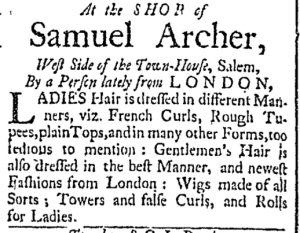
“LADIES Hair is dressed in different Manners.”

On February 28, 1769, Samuel Archer advertised his services as a hairdresser for both men and women in the Essex Gazette.

For the men, Archer offered wigs according to the “newest Fashions from London,” especially attractive for “Gentlemen” heavily influenced by their British counterparts. For the “Ladies,” he provided “French Curls,” “Towers and false Curls,” and “Rolls.” For both men and women, fashion played a role in helping to determine status and identity to distinguish among social groups. In “Fashion and the Culture Wars of Revolutionary Philadelphia,” Kate Haulman explains that fashion was “dictated for some colonists by Europe” and “indicated commercial and cultural inclusion in a far wide, cosmopolitan Atlantic world. It suggested connection and distinction, proving essential to expressions of rank and power dependent on performing one’s place in the British Empire.”[1] The British identity important to American colonists was reflected in the sorts of fashion, goods, and styles that were part of their lifestyles, including the hairstyles created at Samuel Archer’s shop.

**********

ADDITIONAL COMMENTARY: Carl Robert Keyes

Samuel Archer proclaimed that the ladies of Salem could visit his shop to have their hair “dressed in different Manners.” He listed a few of the most popular styles, but, like many shopkeepers who listed their wares in their advertisements, he insisted that he had not exhausted the possibilities. There were so many “other Forms” that it was “too tedious to mention” them all. Prospective clients could depend on Archer dressing their hair in practically any manner they desired.

Among the styles that he did include, the hairdresser decided to conclude with “Rolls for Ladies,” perhaps hoping to create a lasting impression by ending with one of the most popular styles adopted by women who wished to assert their status. Kate Haulman relates a description of a high roll taken from the diary of Anna Green Winslow of Boston: “red Cow Tail … horsehair … & a little human hair … all carded together and twisted up.” The roll was often decorated with pearls and flowers. A side curl brought down over one shoulder completed the look, which could take hours to create. As Haulman explains, “The amount of time involved in achieving the elaborate look meant that wearing a high roll signified high social status in two ways: by replicating a style worn at court and the beau monde in England and by requiring plenty of spare time to have it constructed.”[2]

The amount of time that hairdressers spent with their clients, particularly clients of the opposite sex, caused some concern, not unlike the uneasiness sometimes directed at dancing masters. “Anxieties over relationships between men and women of different ranks, the potentially illicit exchanges that were occurring, and the social dependency of women with means on men without informed attacks on hairdressers and their clients,” according to Haulman.[3] Although not genteel themselves, hairdressers assisted their clients in crafting appearances that testified to their gentility, thus inverting the usual positions of authority by conferring power on those who earned their livelihood by providing a service rather than those who purchased the service. As Chloe indicates in her analysis of Archer’s advertisement, hairdressers marketed status. Their efforts to do so, however, were fraught with other challenges.

**********

[1] Kate Haulman, “Fashion and the Culture Wars of Revolutionary Philadelphia,” William and Mary Quarterly, 3rd ser., 62, no. 4 (October 2005): 627.
[2] Haulman, 639.
[3] Haulman, 639.

February 27

GUEST CURATOR: Chloe Amour

What was advertised in a colonial American newspaper 250 years ago today?

Boston Chronicle (February 27, 1769).

“ABOUT TWENTY PIECES of fine IRISH LINEN, just imported in fine Order.”

This advertisement offers insight into sought-after items in colonial America, such as linens, sheeting, and other types of cloth. John Gerrish promoted textiles, many of which had symbolic importance associated with status. Networks of importing and selling textiles in colonial America added to the material culture that expanded as part of the consumer revolution. The rise of consumer society brought about universal participation by nearly all colonists, to one extent or another. Drawing on a “language of goods,” colonists could assess others based on their clothing and other possessions. Assessing social meaning focused on whether the apparel matched their character and status, especially as the importation and circulation of textiles increased and prices went down.

According to N.B. Harte in “The British Linen Trade with the United States in the Eighteenth and Nineteenth Centuries,” even though the “production of linen was the most widespread industrial activity in America during the colonial period … large amounts of linen were imported from across the Atlantic.” As Harte mentions, colonists produced their own linen yet at the same time remained dependent on imports from the British Isles. The linen industry suggested the potential for a break from Britain, as Americans made some their own consumer goods.

**********

ADDITIONAL COMMENTARY: Carl Robert Keyes

Chloe concludes with a tantalizing possibility. Drawing on discussions about economic resistance to the Stamp Act, the Townshend Acts, and other abuses by Parliament from our Revolutionary America class, she invokes plans envisioned by colonists who wanted to establish greater commercial independence from England even if they were not yet prepared to declare political independence. In addition to new taxes and new regulations imposed by Parliament, colonists lamented an imbalance of trade with England in the late 1760s, giving them another reason to promote both production and consumption of local goods.

Yet as the advertisement Chloe selected demonstrates, colonists imported large quantities of textiles. “IRISH LINEN” was one of several sorts of fabrics up for bids at John Gerrish’s “PUBLIC VENDUE-OFFICE” in Boston. The auctioneer also listed “Cotton Checks,” “Striped Holland,” “Kersies,” “Serges,” and other kinds of imported cloth readily recognized by colonial consumers. Those who advocated for production and consumption of “domestic manufactures” thus had to overcome at least two obstacles. On the production side, they needed to expand the capacity for producing textiles. After all, colonists imported so many linens and other fabrics because they did not produce sufficient quantities themselves. On the consumption side, they needed to shift tastes away from some of the finer fabrics that denoted wealth and status. Affixing a political meaning to homespun cloth was part of that process.

Even if colonists could accomplish the latter – and they had some success in doing so, at least for short periods during particularly tense relations with Parliament – the former remained idealistic rather than practical. Editorials promoting domestic manufactures ran in newspapers throughout the colonies. Many artisans, shopkeepers, and other advertisers responded by incorporating such messages into their notices aimed at prospective customers. Yet even when consumers were willing to consider local alternatives to imported textiles, the colonies did not have the capacity to produce sufficient quantities to meet their needs. Rhetoric and reality deviated, but that did not necessarily diminish the power of the rhetoric as colonists considered their own consumer choices and assessed other for they choices they made.