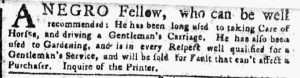
November 7

GUEST CURATOR:  Nicholas Macchione

What was advertised in a colonial American newspaper 250 years ago today?

Supplement to the Massachusetts Gazette and Boston Weekly News-Letter (November 7, 1771).

“A New MEDICINAL DISCOVERY, of the UTMOST CONSEQUENCE to MANKIND; known abroad by the Name of, VELNOS’ Vegetable SYRUP: An acknowledged Specific in all Venereal and Scorbutic Cases

This plant-based medication is proposed as a safer alternative to the conventional treatment of the day, which involved exposing patients to mercury in the hopes that it would induce them to expel the disease through bodily secretions. Despite the known dangers of mercury, and its unsavory side effects, it was still widely accepted in the medical community in the late eighteenth century. The advertisement claims that in addition to acting as a substitute for mercury, it also “repairs the havock it has made.” To emphasize the legitimacy of this alternative treatment to any skeptics, the advertisement describes the rigorous testing and clinical trials that the syrup underwent in Paris. Another selling point is the substance’s use in the relief of a number of ailments “arising from a foulness of the blood” not limited to venereal cases.

J. Burrows, the physician who claimed to be the “sole Proprietor of this remedy,” appears to have been one of several enterprising men who began selling their own version of vegetable syrup under the same name throughout the colonies. A certain Isaac Swainson took issue with this and denounced these imposters in his 1792 work, An Account of Cures by Velnos’ Vegetable Syrup, mentioning Burrows and others by name and assuring the public that “the Genuine Syrup of De Velnos can be prepared only by me.” This reveals that a certain level of competition between purveyors of this cure must have existed which prompted Swainson to put such a warning in writing, either out of concern for prospective patients or, more likely, to discredit his competition.

A 1789 etching published in London depicts angry physicians armed with scalpels and mercury who are unable to contend with Velnos’ Syrup being sold by Swainson, who stands smiling, surrounded by bottles of his cure. The cartoon also includes a reference to the number of people allegedly cured in 1788 and 1789 demonstrating that the syrup remained popular in the subsequent decades.

Thomas Rowlandson, Mercury and His Advocates Defeated, or Vegetable Intrenchment (London: S.W. Fores, 1789). Courtesy British Museum.

**********

ADDITIONAL COMMENTARY:  Carl Robert Keyes

This advertisement lists “J. BURROWS, M.D.” as the “Sole Proprietor of this Remedy,” yet he did not market it in Boston.  Instead, a local agent, John Fleeming, hawked Velnos’ Vegetable Syrup to prospective patients in Boston and its hinterlands in the fall of 1771.  The lengthy advertisement focused primarily on the patent medicine, but a brief note at the end informed readers that Fleeming also sold “Cheap Books and Stationary” at his shop “opposite the South Door of the Town-House.”  In another advertisement in the same issue of the Massachusetts Gazette and Boston Weekly News-Letter, Fleeming announced his plans to publish the “NEW-ENGLAND REGISTER, With an Almanack for 1772” in December.

Fleeming was well known in Boston as a printer, publisher, and bookseller, especially because he partnered with John Mein in publishing the Boston Chronicle, a newspaper that unapologetically expressed a Tory perspective and mocked Patriot leaders, from 1767 to 1770.  Mein took the lead in that enterprise and caused so much controversy that he fled Boston for his own safety in 1769.  Fleeming continued publishing the newspaper for only a few months.  He turned his attention to other projects, including publishing an account of the trials that followed the Boston Massacre.

Like most colonial printers, Fleeming supplemented his revenues by selling “Cheap Books and Stationary.” A good number of printers also listed patent medicines in their advertisements, making those remedies the most common goods not directly associated with the books trades to appear in their newspaper notices.  Eighteenth-century consumers would not have considered it out of the ordinary that Fleeming sold patent medicines, though the length and detail of the advertisement for Velnos’ Vegetable Syrup far exceeded the attention printers usually devoted to such nostrums.  They tended to carry popular potions that needed no further explanation, but Fleeming and his associates apparently believed that prospective customers would be more likely to purchase this “New MEDICINAL DISCOVERY” when they learned more about it.  The prospects for increased sales justified the greater expense for such a lengthy advertisement.

October 31

GUEST CURATOR:  Jake Luongo

Who was the subject of an advertisement in a colonial American newspaper 250 years ago today?

Massachusetts Spy (October 31, 1771).

“A YOUNG, sprightly, sober NEGRO BOY … Enquire of the Printer.”

This advertisement offers a thirteen-year-old “NEGRO BOY” for sale, along with instructions to “Enquire of the Printer hereof” for anybody interested in purchasing the enslaved boy slave.  Selling a human being is just abhorrent, to say the least, but to put the advertisements amongst other advertisements for household items and livestock is just utterly disturbing to today’s readers. Unfortunately, it was just another advertisement to most readers of eighteenth-century newspapers.  Advertisements for enslaved people for sale were abundant in number yet often sparse when it came to details regarding the people actually being purchased. If interested buyers needed more information, they were to “Enquire of the Printer.”

Printers acted as liaisons between buyers and sellers of enslaved people. According to Jordan E. Taylor, printers acted as “slave brokers” both before and after the American Revolution.[1]  Once the Declaration of Independence was signed, it seemed contradictory to some Americans to advertise enslaved people for sale, but printers did not agree.  The advertisements continued, along with instructions to “Enquire of the Printer.”  According to Taylor, no matter the backlash printers received for these advertisements in the late eighteenth century, the money made on them mattered more, especially in towns with more than one newspaper that competed with each other for advertisements.

**********

ADDITIONAL COMMENTARY:  Carl Robert Keyes

Jake outlines some of the most significant arguments that Jordan E. Taylor makes in “Enquire of the Printer: Newspaper Advertising and the Moral Economy of the North American Slave Trade, 1704-1807.”  In his study of “Enquire of the Printer” advertisements, Taylor examined newspapers published throughout the colonies and the new nation in the eighteenth century.  That included newspapers published in New England and the Middle Atlantic, where Taylor identified a concentration of these advertisements before the end of the American Revolution.[2]

Note that the advertisement Jake examined appeared in the Massachusetts Spy, the newspaper published in Boston by ardent patriot Isaiah Thomas.  In the spring of 1775, Thomas fled to Worcester for his safety after repeatedly infuriating British officials with the articles and editorials he published in the Massachusetts Spy.  Even in 1771, when the advertisement for a “YOUNG, sprightly, sober NEGRO BOY” appeared with instructions to “Enquire of the Printer” for more information, Thomas made his political principles known.  The advertisement not only ran among notices promoting consumer goods and services but also in close proximity to Thomas’s own advertisement for the “Massachusetts CALENDAR; or an ALMANACK, for the year 1772.”  Rather than publishing a generic almanac, Thomas made clear his was one for American patriots.  It contained essays “On Liberty and Government” as well as an engraving of the Boston Massacre as both memorial and warning.

Taylor identifies many other instances of the juxtaposition of content advocating liberty for some Americans alongside content that perpetuated the enslavement of Africans and African Americans.  Historians now consider Isaiah Thomas one of the most significant and influential printers active during the era of the American Revolution, in large part because he was such a vocal proponent of American rights, American liberty, and American independence.  Closer examination of the contents of the Massachusetts Spy, however, reveals that he also served as a slave broker, facilitating the purchase and sale of enslaved men, women, and children by publishing advertisements and providing additional information to those who did “Enquire of the Printer.”

Massachusetts Spy (October 31, 1771).

**********

[1] Jordan E. Taylor, “Enquire of the Printer: Newspaper Advertising and the Moral Economy of the North American Slave Trade, 1704-1807,” Early American Studies: An Interdisciplinary Journal 18, no. 3 (Summer 2020): 287.

[2] Taylor, “Enquire of the Printer,” 309.

October 24

GUEST CURATOR:  Katie Galvin

Who was the subject of an advertisement in a colonial American newspaper 250 years ago today?

Supplement to the South-Carolina Gazette (October 24, 1771).

“RUN-AWAY … a NEGRO MAN, named HECTOR … Also a Negro Man, named MAIDSTONE.”

This advertisement concerns an enslaved man named Hector, along with another enslaved man named Maidstone. Both men ran away from James Sinkler’s plantation.  Sinkler claimed that Hector was “supposed to be harboured at Mr. Boone’s plantation… where his Father and Mother reside.” This means that Hector was attempting to run away and return to his family and that they helped him by hiding him. Many enslaved people at the time were separated from family and friends during auctions or other sales. Sinkler said that Maidstone has been “lately purchased at the Sale of Mr. JAMES LE BAS Estate,” so he has been recently stripped away from his community.

Maidstone and Hector had experiences similar to many other enslaved people. According to Victoria Bissell Brown and Timothy J. Shannon, enslaved people often ran away for reasons more than the mistreatment from masters. Sometimes they were “trying to preserve a family that was being driven apart by a sale.”[1] Many enslaved people wanted to liberate themselves and reunite with their families.  Historians at the National Park Service’s Ethnography Program also state that “enslaved people ran away to reestablish marital and family ties or to protest changes in ownership or even to join prospective mates from whom they’ve been separated from.”

**********

ADDITIONAL COMMENTARY:  Carl Robert Keyes

James Sinkler made a significant investment in his efforts to recover two men he enslaved.  Katie chose to examine his advertisement that ran in the South-Carolina Gazette on October 24, 1771, but that is not the only newspaper that carried Sinkler’s notice.  As guest curator for the Slavery Adverts 250 Project, Katie also worked with Sinkler’s advertisement in the October 28 edition of the South-Carolina and American General Gazette and the October 29 edition of the South-Carolina Gazette and Country Journal.  Sinkler was so eager to recapture Hector and Maidstone that he placed notices in every newspaper printed in Charleston, increasing the dissemination of his advertisement and encouraging greater numbers of colonists to engage in surveillance of Black men to determine if they matched the descriptions that appeared in print.

By the time Sinkler’s advertisement appeared in those newspapers in late October, they had already been running for months.  As work has continued on the production of the Slavery Adverts 250 Project, other guest curators and I have learned that Sinkler’s advertisements continued to appear well into 1772.  We have not yet determined when Sinkler discontinued them.  That the advertisements ran for so long suggests that Hector and Maidstone managed to elude detection and evade capture for quite some time.  They may have received assistance from family and friends in the places Sinkler suspected, but they may have gone in completely different directions than he imagined.  The same may have been true for Cudjoe, Jemmy, Rynah, Venus, and Dye, five enslaved people who fled from Peter Sinkler and James Sinkler on the last day of March in 1771.  The Sinklers thought that the fugitives seeking their freedom “intend for Ponpon, where they lately lived.”  If they did, no one there spotted them and attempted to claim the reward.  That advertisement also continued to run in October, more than six months later.

The archive includes many silences, including the fates of most enslaved people who attempted to liberate themselves by running away from those who held them in bondage.  That advertisements about Hector and Maidstone ran for many months suggests that the men managed to make good on their escape.  At the very least, they were not recaptured quickly or easily.  The text of the advertisement offers insights into their experiences, but tracking it through multiple newspapers over an extended period helps to reconstruct a more complete story of what might have happened.  Even then, the silences in the archive prevail.

**********

[1] Victoria Bissel Brown and Timothy J. Shannon, “Colonial America’s Most Wanted: Runaway Advertisements in Colonial Newspapers,” in Going to the Source: The Bedford Reader in American History, eds. Brown and Shannon (Boston: Bedford/St. Martin’s, 2004), 50.

October 17

GUEST CURATOR: Daniel Carito

Who was the subject of an advertisement in a colonial American newspaper 250 years ago today?

Virginia Gazette [Purdie and Dixon] (October 17, 1771).
“A likely Negro Fellow named PRINCE … he is a Spaniard.”

In the fall of 1771, Robert Donald, an enslaver in Virginia, advertised a reward of forty shillings for Prince, “a likely Negro fellow” who liberated himself by running away.  The advertisement sparked my interest because Donald mentioned that not only did Prince come from Spanish descent but also was “an excellent swimmer, and dives remarkably well” and labeled as a “water Negro.”  My interest grew even further because in “Eighteenth Century ‘Prize Negroes’: From Britain to America,” Charles R. Foy explains how many Black sailors on Spanish vessels were captured by British and North American mariners, labeled as commodities and sold into slavery: “Between 1721 and 1748 at least one hundred and thirty-five black mariners were condemned as prize goods…  Overall, the number of Prize Negroes in North America from 1713 to1783 is estimated to exceed 500.”[1] Also, Foy argues that enslaved Black mariners were sometimes the main instigators when it came to revolting against their enslavers: “Spanish Prize Negroes often were leaders in resisting slavery in British North America.”[2]

**********

ADDITIONAL COMMENTARY:  Carl Robert Keyes

Enslaved men and women who liberated themselves often left few traces in the archival record.  The advertisements that encouraged colonists to engage in surveillance of Black people to determine if they matched descriptions of runaways in the newspapers and offered rewards for the capture and return of enslaved people may have been the only documents that recorded any aspect of their lives.  In such instances, enslaved people seeking freedom did not tell their own stories, but instead had their experiences mediated through the perspectives of the enslavers who composed the advertisements.

If Prince, as he was called by his enslaver, were indeed a Spanish “Prize Negro” then other kinds of documents may have recorded some of his experiences.  Additional archival work might uncover additional traces of Prince’s life before he arrived in Virginia.  Even if we managed to locate Prince in other sources, his wife and children would likely remain elusive, their stories even more fragmented and obscured than that of their husband and father.  Donald suspected that Prince “took the Road to Charles City, where he had a Wife and Children at Mr. Acrill’s.”  That brief reference to Prince’s family raises more questions than it answers.  How long had Prince and his wife been a couple?  How many children did they have?  How old were the children at the time?  How long had it been since the rest of the family had seen Prince?  Were his wife and children still in Charles City?

Donald recorded several characteristics to identify Prince, including his height, his clothing, and his manner of speaking (“fast and thick”).  The enslaver described Prince as an “excellent Swimmer” and diver who “had on such Clothes as Watermen generally wear.”  Prince’s wife and children in Charles City were just one more detail to Donald and colonists who read the advertisement, but they were not just another detail to Prince or his family.  Donald’s brief narrative about Prince certainly did not match how the enslaved man would have described himself or the most important people in his life.

**********

[1] Charles R. Foy, “Eighteenth Century ‘Prize Negroes’: From Britain to America,” Slavery and Abolition 31, no. 3(September 2010): 381.

[2] Foy, “Eighteenth Century ‘Prize Negroes,’” 384.

October 15

GUEST CURATOR:  Colleen Barrett

What was advertised in a colonial American newspaper 250 years ago today?

Essex Gazette (October 15, 1771).

“Apothecary’s SHOP, AT THE Head of Hippocrates.”

On October 15, 1771, Nathanael Dabney advertised his apothecary shop in the Essex Gazette. Dabney sold “Drugs, Medicines, AND Groceries” in Salem, Massachusetts. This is one of many examples of advertisements for medicines in the newspapers of the period. Dabney sold medicines and other items imported from London, including “Patent Medicines of every sort from Dicey & Okell’s Original Wholesale Warehouse.”  According to the Smithsonian Institution’s National Museum of American History, patent medicines, like those mentioned in the advertisement, “are named after the ‘letters patent’ granted by the English crown.” Furthermore, the maker of any of these medicines had “a monopoly over his particular formula. The term ‘patent medicine’ came to describe all prepackaged medicines sold ‘over-the-counter’ without a doctor’s prescription” in later years.  Dabney also mentioned the services he provided at his shop, letting customers know that he “will wait on them at all Hours of the Day and Night.”

**********

ADDITIONAL COMMENTARY:  Carl Robert Keyes

As Colleen notes, customer service was an important element of Nathanael Dabney’s marketing efforts.  He concluded his advertisement with a note that “Family Prescriptions” were “carefully put up, and Orders from the Country punctually obeyed.”  A manicule helped to draw attention to these services.  That Dabney “put up” prescriptions suggests that he was an apothecary who compounded medications at his shop rather than merely a shopkeeper who specialized in patent medicines.  He likely possessed a greater degree of expertise about the drugs and medicines he sold than retailers who included patent medicines among a wide array of imported goods.

Prospective customers did not need to visit Dabney’s shop “AT THE Head of Hippocrates” in Salem.  Instead, the apothecary offered the eighteenth-century equivalent of mail order service for clients who resided outside of town.  He assured them that they did not have to worry about receiving less attention than those who came into his apothecary shop.  Instead, he “punctually obeyed” their orders, echoing the sentiments of other advertisers who provided similar services.

In addition to customer service, Dabney attempted to entice potential customers with promises of quality, declaring that he imported his drugs “from the best House in LONDON.”  He made a point of mentioning that he received “Patent Medicines of every Sort from Dicey & Okell’s Original Wholesale Warehouse,” an establishment well known in London and the English provinces.  According to P.S. Brown, newspaper advertisements published in Bath in 1770 referred to “Dicey and Okell’s great original Elixir Warehouse.”[1]  Dabney may have hoped to benefit from name recognition when he included his supplier in his advertisement.

The apothecary promised low prices, stating that he sold his wares “at the cheapest rate,” but he devoted much more of his advertisement to quality and customer service.  He waited on customers whenever they needed him “at all Hours of the Day and Night,” compounded medications, and promptly dispatched orders to the countryside, providing a level of care that consumers did not necessarily receive from shopkeepers who happened to carry patent medicines.

**********

[1] P.S. Brown, “Medicines Advertised in Eighteenth-Century Bath Newspapers,” Medical History 20, no. 2 (April 1976):  153.

October 3

GUEST CURATOR:  Katerina Barbas

What was advertised in a colonial American newspaper 250 years ago today?

New-York Journal (October 3, 1771).

“A Woman of good character … may hear of a place by inquiring of the Printer hereof.”

This advertisement highlights traditional gender roles for European colonists in colonial America. European gender roles constituted that the ideal family was led by a man who was in charge of his family and represented it beyond the home, while a woman performed domestic work and ran the household. These European gender roles were brought to the colonies in the new world. According to an article on National Geographic’s website, white women in colonial America had responsibilities within the household such as cooking, cleaning, sewing, making soap and candles, and caring for and educating children, which was their primary role. Seeking a “woman of a good character” required that the woman be an exceptional role model, because she would be supporting the emotional and moral development of the children and prepare them for adulthood. A woman who responded to this advertisement would have been responsible for teaching young girls in the family how to perform household tasks in order to prepare them for the traditional role as wife and mother.

**********

ADDITIONAL COMMENTARY:  Carl Robert Keyes

Among the many legal notices and advertisements for consumer goods and services that colonists paid to insert in the New-York Journal, a variety of employment advertisements appeared as well.  Many of them featured labor undertaken by women.  In the advertisement Katerina chose to feature today, an unnamed advertiser sought a woman willing to move fourteen miles from the busy port to serve as a “nursery maid” for a family in the countryside.  In another advertisement in the October 3, 1771, edition, another anonymous advertiser offered work for a “Careful woman who understands washing, cooking … and is willing to do all work in a middling family.”  That advertisement concluded with a nota bene proclaiming that “None need apply without being able to produce a good character from reputable people.”  In other words, candidates needed to produce references before entering the household.  The family in the countryside seeking a nursery maid also likely requested similar assurances.

In both instances, the prospective employers relied on John Holt, the printer of the New-York Journal, to act as a broker.  The family in the countryside informed prospective nursery maids that they “may hear of a place by inquiring of the Printer hereof.”  Similarly, the “middling family” instructed women with appropriate references that they “may hear of employment by applying to the printer.”  Holt disseminated some information in print, but, at the request of advertisers, reserved some details only for readers who contacted the printing office.  That was also the case for a “likely healthy Negro” woman offered for sale.  An unnamed enslaver described the woman as “an excellent thorough Cook” who could “pickle and preserve.”  The advertisement did not say much else about the woman except that she was “about 24 Years of Age.”  Like so many other advertisements, it declared, “for Particulars, inquire of the Printer.”  In this instance, Holt became not only an information broker but also a broker of enslaved labor.  He actively facilitated the slave trade, first by running the advertisement in his newspaper and then by collaborating with enslavers who bought and sold the “likely healthy Negro” woman.

Colonists turned to the public prints as a clearinghouse for acquiring workers, female as well as male.  Advertisements offering employment to women maintained expectations about the roles they fulfilled within families, like cooking, cleaning, and caring for children.  Some of those advertisements offered women new opportunities with employers of their choosing, but others merely perpetuated the enslavement of Black women.  Gender played an important part in shaping the experiences of women who applied to the advertisement Katerina selected for today, but it was not the only factor that defined their role in New York and other colonies.

October 1

GUEST CURATOR:  Carl Allard

Who was the subject of an advertisement in a colonial American newspaper 250 years ago today?

South-Carolina Gazette and Country Journal (October 1, 1771).

“RUN-AWAY … a negro man named JACK.”

One part of the mission of the Slavery Adverts 250 Project is to understand the lives of enslaved people through information gathered from “RUN-AWAY” advertisements. In late September 1771, an enslaved man named Jack liberated himself by running away from Meyer Moses, a colonist who bore the name of the biblical figure who liberated the enslaved Israelites yet ironically sought to return Jack to bondage. This advertisement not only details the fascinating biography of Jack, but also remains a testimony to hope. Jack’s escape, a struggle against immense opposition, runs parallel to what we know of his medical history. The ad states Jack was, “much pitted in the face with the small pox, one of his feet frost-bitten.” According to Elizabeth Fenn, medical data from that era suggests the mortality rate of smallpox was quite high; if the hemorrhaging pustules overlapped, one stood a 60 percent chance of dying.  Certainly, Jack’s self-liberation was just the latest in a series of struggles that he had overcome. The advertisement reveals that Jack “speaks good English.” This skill, as David Waldstreicher notes, might have been a powerful tool to secure passage on a ship, as the advertisement stated Jack planned on doing.[1] Waldstreicher also observes that self-liberated people, such as Jack, were often self-fashioning. Clothing choice, such as the “soldier’s coat” Jack wore, was central to the success of enslaved people pursuing freedom, allowing them to try to blend in as free.[2]

**********

ADDITIONAL COMMENTARY:  Carl Robert Keyes

For the next three months, the Adverts 250 Project and the Slavery Adverts 250 Project will feature work undertaken by students who enrolled in my Research Methods: Vast Early America course at Assumption University in Spring 2021.  Required of all History majors in the spring of their junior year to prepare them to pursue their own projects under the direction of a faculty mentor in the capstone seminar in the fall of their senior year, Research Methods focuses on important skills:  accessing and interpreting primary sources and understanding and evaluating secondary sources.  Students complete an historiographical essay for their final project in Research Methods, but throughout the semester they complete smaller projects that help them develop their skills.

To that end, I invite my students to serve as guest curators for the digital humanities projects I have created.  As guest curator, Carl Allard, the author of today’s entry, was responsible for navigating four databases of digitized eighteenth-century American newspapers to create an archive of issues originally published between September 26 and October 2, 1771.  From there, he selected an advertisement to feature on the Adverts 250 Project.  He conducted research to identify secondary sources beyond those we examined in class and then drafted a short entry.  I reviewed that draft and offered suggestions for revisions.  Carl then set about editing and resubmitting his entry.  As he worked on his entry, he also made contributions to the Slavery Adverts 250 Project, composing the tweets to accompany the advertisements that appear on the project this week.  He selected a key quotation from each advertisement and inserted a citation that included the name of the newspaper and publication date.  Throughout the process, he adhered to filename conventions and other methodologies not usually visible to readers and followers but imperative for the behind-the-scenes production of the Adverts 250 Project and the Slavery Adverts 250 Project.  As a result, his classmates, my research assistant, and I could all easily access and consult data Carl contributed to the projects as we each completed our own duties in presenting them to the public.

Each student whose work will be featured in the next three months developed the same skills and made similar contributions.  In that regard they were not merely students but junior colleagues who assumed significant responsibilities in the ongoing production of these digital humanities projects.  They did not simply learn about the past; instead, they spent the semester “doing history” as they prepared to once again “do history” this semester in their capstone seminar.  I very much appreciate the hard work and dedication of each of the guest curators from my Research Methods class.

**********

[1] David Waldstreicher, “Reading the Runaways: Self-Fashioning, Print Culture, and Confidence in Slavery in the Eighteenth-Century Mid-Atlantic,” William and Mary Quarterly, 3rd ser., 56, no. 2 (April 1999): 259-260.

[2] David Waldstreicher, “Reading the Runaways,” 253.

Slavery Advertisements Published June 26, 1770

Guest Curator: Jenna Smith

The Slavery Adverts 250 Project chronicles the role of newspaper advertising in perpetuating slavery in the era of the American Revolution. The project seeks to reveal the ubiquity of slavery in eighteenth-century life from New England to Georgia by republishing advertisements for slaves – for sale, wanted to purchase, runaways, captured fugitives – in daily digests on this site as well as in real time via the @SlaveAdverts250 Twitter feed, utilizing twenty-first-century media to stand in for the print media of the eighteenth century.

The project aims to provide modern audiences with a sense of just how often colonists encountered these advertisements in their daily lives. Enslaved men, women, and children appeared in print somewhere in the colonies almost every single day. Those advertisements served as a constant backdrop for social, cultural, economic, and political life in colonial and revolutionary America. Colonists who did not own slaves were still confronted with slavery as well as invited to maintain the system by purchasing slaves or assisting in the capture of runaways. The frequency of these newspaper advertisements suggests just how embedded slavery was in colonial and revolutionary American culture in everyday interactions beyond the printed page.

These advertisements also testify to the experiences of enslaved men, women, and children, though readers must consider that those experiences have been remediated through descriptions offered by slaveholders rather than the slaves themselves. Often unnamed in the advertisements, enslaved men, women, and children were not invisible or unimportant in early America.

From compiling an archive of digitized eighteenth-century newspapers to identifying advertisements about enslaved men, women, and children in those newspapers to preparing images of each advertisement to posting this daily digest, Jenna Smith served as guest curator for this entry. Working on this project fulfilled her senior capstone requirement for completing the major in History at Assumption College in Worcester, Massachusetts.

These advertisements appeared in colonial American newspapers 250 years ago today.

Jun 26 - Essex Gazette Slavery 1
Essex Gazette (June 26, 1770).

**********

Jun 26 - South-Carolina Gazette and Country Journal Slavery 1
South-Carolina Gazette and Country Journal (June 26, 1770).

**********

Jun 26 - South-Carolina Gazette and Country Journal Slavery 2
South-Carolina Gazette and Country Journal (June 26, 1770).

**********

Jun 26 - South-Carolina Gazette and Country Journal Slavery 3
South-Carolina Gazette and Country Journal (June 26, 1770).

**********

Jun 26 - South-Carolina Gazette and Country Journal Slavery 4
South-Carolina Gazette and Country Journal (June 26, 1770).

**********

Jun 26 - South-Carolina Gazette and Country Journal Slavery 5
South-Carolina Gazette and Country Journal (June 26, 1770).

**********

Jun 26 - South-Carolina Gazette and Country Journal Slavery 6
South-Carolina Gazette and Country Journal (June 26, 1770).

**********

Jun 26 - South-Carolina Gazette and Country Journal Slavery 7
South-Carolina Gazette and Country Journal (June 26, 1770).

**********

Jun 26 - South-Carolina Gazette and Country Journal Slavery 8
South-Carolina Gazette and Country Journal (June 26, 1770).

Slavery Advertisements Published June 25, 1770

Guest Curator: Jenna Smith

The Slavery Adverts 250 Project chronicles the role of newspaper advertising in perpetuating slavery in the era of the American Revolution. The project seeks to reveal the ubiquity of slavery in eighteenth-century life from New England to Georgia by republishing advertisements for slaves – for sale, wanted to purchase, runaways, captured fugitives – in daily digests on this site as well as in real time via the @SlaveAdverts250 Twitter feed, utilizing twenty-first-century media to stand in for the print media of the eighteenth century.

The project aims to provide modern audiences with a sense of just how often colonists encountered these advertisements in their daily lives. Enslaved men, women, and children appeared in print somewhere in the colonies almost every single day. Those advertisements served as a constant backdrop for social, cultural, economic, and political life in colonial and revolutionary America. Colonists who did not own slaves were still confronted with slavery as well as invited to maintain the system by purchasing slaves or assisting in the capture of runaways. The frequency of these newspaper advertisements suggests just how embedded slavery was in colonial and revolutionary American culture in everyday interactions beyond the printed page.

These advertisements also testify to the experiences of enslaved men, women, and children, though readers must consider that those experiences have been remediated through descriptions offered by slaveholders rather than the slaves themselves. Often unnamed in the advertisements, enslaved men, women, and children were not invisible or unimportant in early America.

From compiling an archive of digitized eighteenth-century newspapers to identifying advertisements about enslaved men, women, and children in those newspapers to preparing images of each advertisement to posting this daily digest, Jenna Smith served as guest curator for this entry. Working on this project fulfilled her senior capstone requirement for completing the major in History at Assumption College in Worcester, Massachusetts.

These advertisements appeared in colonial American newspapers 250 years ago today.

Jun 25 - Boston Evening-Post Slavery 1
Boston Evening-Post (June 25, 1770).

**********

Jun 25 - Boston Evening-Post Slavery 2
Boston Evening-Post (June 25, 1770).

**********

Jun 25 - Boston Evening-Post Slavery 3
Boston Evening-Post (June 25, 1770).

**********

Jun 25 - Boston Evening-Post Supplement Slavery 1
Boston Evening-Post (June 25, 1770).

**********

Jun 25 - Boston Evening-Post Supplement Slavery 2
Boston Evening-Post (June 25, 1770).

**********

Jun 25 - Boston Gazette and Country Journal Slavery 1
Boston Gazette and Country Journal (June 25, 1770).

**********

Jun 25 - Boston Gazette and Country Journal Slavery 2
Boston Gazette and Country Journal (June 25, 1770).

**********

Jun 25 - Boston Gazette and Country Journal Supplement Slavery 1
Boston Gazette and Country Journal (June 25, 1770).

**********

Jun 25 - Boston Gazette and Country Journal Supplement Slavery 2
Boston Gazette and Country Journal (June 25, 1770).

**********

Jun 25 - New-York Gazette and Weekly Mercury Slavery 1
New-York Gazette and Weekly Mercury (June 25, 1770).

**********

Jun 25 - New-York Gazette and Weekly Mercury Supplement Slavery 1
New-York Gazette and Weekly Mercury (June 25, 1770).

**********

Jun 25 - New-York Gazette and Weekly Mercury Supplement Slavery 2
New-York Gazette and Weekly Mercury (June 25, 1770).

**********

Jun 25 - New-York Gazette and Weekly Mercury Supplement Slavery 3
New-York Gazette and Weekly Mercury (June 25, 1770).

**********

Jun 25 - New-York Gazette and Weekly Mercury Supplement Slavery 4
New-York Gazette and Weekly Mercury (June 25, 1770).

**********

Jun 25 - New-York Gazette or Weekly Post-Boy Slavery 1
New-York Gazette or Weekly Post-Boy (June 25, 1770).

**********

Jun 25 - New-York Gazette or Weekly Post-Boy Slavery 2
New-York Gazette or Weekly Post-Boy (June 25, 1770).

**********

Jun 25 - Pennsylvania Chronicle and Universal Advertiser Slavery 1
Pennsylvania Chronicle and Universal Advertiser (June 25, 1770).

**********

Jun 25 - Pennsylvania Chronicle and Universal Advertiser Slavery 2
Pennsylvania Chronicle and Universal Advertiser (June 25, 1770).

Slavery Advertisements Published June 22, 1770

Guest Curator: Jenna Smith

The Slavery Adverts 250 Project chronicles the role of newspaper advertising in perpetuating slavery in the era of the American Revolution. The project seeks to reveal the ubiquity of slavery in eighteenth-century life from New England to Georgia by republishing advertisements for slaves – for sale, wanted to purchase, runaways, captured fugitives – in daily digests on this site as well as in real time via the @SlaveAdverts250 Twitter feed, utilizing twenty-first-century media to stand in for the print media of the eighteenth century.

The project aims to provide modern audiences with a sense of just how often colonists encountered these advertisements in their daily lives. Enslaved men, women, and children appeared in print somewhere in the colonies almost every single day. Those advertisements served as a constant backdrop for social, cultural, economic, and political life in colonial and revolutionary America. Colonists who did not own slaves were still confronted with slavery as well as invited to maintain the system by purchasing slaves or assisting in the capture of runaways. The frequency of these newspaper advertisements suggests just how embedded slavery was in colonial and revolutionary American culture in everyday interactions beyond the printed page.

These advertisements also testify to the experiences of enslaved men, women, and children, though readers must consider that those experiences have been remediated through descriptions offered by slaveholders rather than the slaves themselves. Often unnamed in the advertisements, enslaved men, women, and children were not invisible or unimportant in early America.

From compiling an archive of digitized eighteenth-century newspapers to identifying advertisements about enslaved men, women, and children in those newspapers to preparing images of each advertisement to posting this daily digest, Jenna Smith served as guest curator for this entry. Working on this project fulfilled her senior capstone requirement for completing the major in History at Assumption College in Worcester, Massachusetts.

These advertisements appeared in colonial American newspapers 250 years ago today.

Jun 22 - New-London Gazette Slavery 1
New-London Gazette (June 22, 1770).

**********

Jun 22 - South-Carolina and American General Gazette Slavery 1
South-Carolina and American General Gazette (June 22, 1770).

**********

Jun 22 - South-Carolina and American General Gazette Slavery 2
South-Carolina and American General Gazette (June 22, 1770).

**********

Jun 22 - South-Carolina and American General Gazette Slavery 3
South-Carolina and American General Gazette (June 22, 1770).

**********

Jun 22 - South-Carolina and American General Gazette Slavery 4
South-Carolina and American General Gazette (June 22, 1770).

**********

Jun 22 - South-Carolina and American General Gazette Slavery 5
South-Carolina and American General Gazette (June 22, 1770).

**********

Jun 22 - South-Carolina and American General Gazette Slavery 6
South-Carolina and American General Gazette (June 22, 1770).

**********

Jun 22 - South-Carolina and American General Gazette Slavery 7
South-Carolina and American General Gazette (June 22, 1770).