April 26

GUEST CURATOR: Samantha Surowiec

What was advertised in a colonial American newspaper 250 years ago today?

Georgia Gazette (April 27, 1769).

“HOUSE, SIGN, and SHIP PAINTING, done by ROBERT PUNSHON.”

Signs were very important in colonial America, since they served as a way for colonists to distinguish between private homes and those that served as taverns for the public. According to Susan P. Schoelwer, tavern signs in the eighteenth century typically had impressive woodwork, but the paintings were not very elaborate. This was because there were more skilled woodworkers in the colonies than there were painters. As the nineteenth century drew closer, and the new United States of America matured, so did the signage. Travel became more common, and more skilled artists lived in the new nation, which resulted in more sophisticated signs, as well as more signs being advertised in newspapers. The images painted on these signs ranged from animals to horse-drawn carriages to even portraits and landscapes as painters became more skilled. To view images of tavern signs from the eighteenth and early nineteenth centuries, visit “Tavern Signs Mark Changes in Travel, Innkeeping, and Artistic Practice.”

**********

ADDITIONAL COMMENTARY: Carl Robert Keyes

What kind of market for sign painting did Robert Punshon encounter in Savannah? The answer is difficult to determine. Entrepreneurs who placed advertisements for consumer goods and services in the Georgia Gazette rarely indicated that shop signs marked their location. In the same issue that Punshon advertised, for instance, Lewis Johnson inserted a notice about “An Assortment of MEDICINES” but did not list a sign to help prospective clients navigate to his shop.

In contrast, shopkeepers, merchants, and artisans in other places, especially the largest port cities, regularly included signs in the notices they placed in the public prints. In the April 23, 1769, edition of the Providence Gazette, Samuel Young stated that “the Sign of the Black Boy” marked his store near the Baptist Meeting House. In another advertisement (as well as the colophon), John Carter reminded readers and potential customers that “the Sign of Shakespear’s Head” adorned the printing office. The next day in the Boston-Gazette, Elias Dupee advertised a “PUBLIC VENDUE” to be held at his “NEW AUCTION ROOM” located “near the Golden Key.” Although he did not have a sign for his own business, he made use of the sign marking a nearby shop in giving directions to his clients. Another auctioneer promoted a vendue “at the Bunch of Grapes” in an advertisement in the Boston Post-Boy published the same day.

The absence of shop signs in newspaper advertisements does not necessarily mean that advertisers did not have signs of their own. Two advertisements by Joseph Russell and William Russell ran in the Providence Gazette that week. Neither of them gave their location as “the Sign of the Golden Eagle,” although they advertised prolifically and frequently inserted that detail into their notices. The Golden Eagle became their logo, perhaps so well known that they considered it unnecessary to include it in every advertisement.

That being the case, Robert Punshon may have worked in a market for sign painting in Savannah that was much more vibrant than other advertisements in the Georgia Gazette indicated. Some eighteenth-century advertisers regularly associated their businesses with specific images, such as “Shakespear’s Head” or the Golden Eagle, as they experimented with developing brands and logos. Others who had shop signs did not necessarily advertise in newspapers or incorporate their signs when they did. That Punshon even listed sign painting along with house and ship painting suggests that either a market for signs already existed or he believed that one could be cultivated among the merchants, shopkeepers, and artisans of Savannah.

April 25

GUEST CURATOR: Samantha Surowiec

What was advertised in a colonial American newspaper 250 years ago this week?

Supplement to the Boston-Gazette (April 24, 1769).

“CHOICE CHOCOLATE … Cocoa manufactured for Gentlemen in the best Manner.”

When most people read the word “chocolate,” they probably pictures a Hershey’s chocolate bar. However, chocolate to the typical eighteenth-century colonist was a kind of frothy drink made from cocoa beans. According to Rodney Snyder, the chocolate drink originated in Mesoamerica, its first contact with Europeans being traced back to one of Christopher Columbus’s voyages in 1502. Chocolate was mentioned in a colonial newspaper for the first time in 1705, and it quickly became a colonial staple, since it was affordable and could be consumed by people from any class. Around the time of the printing of this newspaper, the colonies were importing over 320 tons of cocoa beans. So readily available was chocolate that it was actually given out as rations to soldiers in the Continental Army during the American Revolution. Colonists commonly drank chocolate in coffeehouses, a place where they met to discuss politics, current events, and anything else.

**********

ADDITIONAL COMMENTARY: Carl Robert Keyes

When Sam first consulted with me about this advertisement via email, I had a little difficulty finding it in the Boston-Gazette. She told me that it was on the third page, yet it is actually on the second page of the supplement. Sam did not, however, make an error. Instead, she reported the information available to her as a result of a design flaw for one of the databases of digitized newspapers that make the Adverts 250 Project possible.

I regularly sing praises for America’s Historical Newspapers. That database makes my research possible. It also allows me to bring my research into the classroom in meaningful ways, especially when I invite students to serve as guest curators for the Adverts 250 Project and the Slavery Adverts 250 Project. Beyond those projects, America’s Historical Newspapers is a valuable resource for examining primary sources in class, allowing me to present digital surrogates with much more context than modern editions in course readers allow.

That being said, I have learned from experience that the database does have a flaw in the manner that it incorporates supplements. Consider the April 24, 1769, edition of the Boston-Gazette. It consists of the standard four-page issue and a two-page supplement. Ideally, the database would present the standard issue first and then the supplement. However, when viewing this issue online the first page of the supplement appears first, then the first page of the standard issue, then the second page of the supplement, followed by the second, third, and fourth pages of the standard issue. The pages appear in the same order when downloading a PDF of the entire issue. For issues with four-page supplements, the pages are interspersed back and forth between the supplement and the standard issue. I have learned to collate the pages in the correct order when I print them out to mark them up.

Guest curators with less experience working with eighteenth-century newspapers, digitized primary sources, and, especially this idiosyncrasy, do not always realize that the pages presented online and in the PDF appear out of order … nor should they expect that the pages appear in any order other than first to last. When Sam consulted her digital copy of the Boston-Gazette for April 24, John Goldsmith’s advertisement for “CHOICE CHOCOLATE” appeared at the bottom of the third page in the document, hence her notation that I could find it there. I consulted a hard copy that I had collated into the proper order, which led me to a different page and created confusion. In the end, this yielded a teachable moment about how historians must continuously assess their sources, not just the contents but also the format and the media employed to make them available to us.

April 24

GUEST CURATOR: Samantha Surowiec

What was advertised in a colonial American newspaper 250 years ago today?

Boston Chronicle (April 24, 1769).

“TO BE SOLD, the SHIP AMERICA.”

Being from Massachusetts, I have spent time in major port cities like Boston and Gloucester. Since Massachusetts resides on the coast, it developed a maritime economy that included shipbuilding. I was drawn to this advertisement because it attempted to sell a ship, not some sort of consumer good or service. In the northern colonies, such as Massachusetts, shipbuilding was a major form of commerce. According to the National Park Service, early ships were made of wood and built not just for fishing, but for trading with foreign countries. Although there was unrest with Great Britain in the colonies and boycotts were taking place in 1769, ships were still important for the economy of the colonies, as well as communication between the colonies and other places. The shipbuilding activities in Massachusetts ports had such an impact that, in addition to aiding the colonies in their victory over Great Britain, it also helped develop the ships that made the United States the major world power it has become today.

**********

ADDITIONAL COMMENTARY: Carl Robert Keyes

Massachusetts did indeed have a maritime economy in the eighteenth century. Residents and visitors knew that was the case when they walked the streets of Boston and Salem and other ports increasing in size and importance. Readers of the several newspapers printed in Boston and the one in Salem also knew it from the shipping news regularly published immediately before the advertisements. The placement of records from the customs house as a bridge between news and advertising underscored the importance of maritime commerce to the colony.

In the April 24, 1769, edition of the Boston Chronicle, this advertisement for “The SHIP AMERICA” ran in the middle column of the final page, immediately to the right of a column filled entirely with shipping news. That column was not enough to contain the list of vessels that had “Entered in,” were “Outward bound,” or had “Cleared out.” The roster continued into the second column, extending through approximately one-third of it. Except for a brief advertisement for “Choice Beef in Barrels,” the shipping news moved directly to the notice about “The SHIP AMERICA,” followed by another seeking to sell a schooner, and another announcing that “THE Snow THISTLE … will clear to sail [to New York] in a few days.”

The shipping news provided a map of sorts that depicted Boston’s place in transatlantic networks of commerce and exchange. The list of ships that had “Entered in” included fifty-two vessels, arriving from Bristol, Georgia, Hispaniola, Greenock, Hull, Jamaica, London, Nova Scotia, New Haven, New London, New York, North Carolina, Philadelphia, Surinam, Turks Island, and Virginia. Another twenty-six were “Outward bound,” heading to Bay Chaleur, Maryland, London, Newfoundland, Hew Haven, New London, North Carolina, Nova Scotia, Philadelphia, Quebec, Rhode Island, St. Croix, Surinam, and the West Indies. Forty-two additional vessels had already “Cleared out” on their voyages to Annapolis Royal, Canso, Hispaniola, London, Newfoundland, New Haven, New London, New Providence, North Carolina, Nova Scotia, Philadelphia, Rhode Island, Virginia, and the West Indies.

The advertisement for “The SHIP AMERICA” promoted some of the vessel’s qualities, but the placement of the notice next to and below the shipping news testified to the possibilities available to anyone who might have the resources to purchase the ship or enter into partnership with other entrepreneurs.

April 23

GUEST CURATOR: Samantha Surowiec

Who was the subject of an advertisement in a colonial American newspaper 250 years ago this week?

Georgia Gazette (April 26, 1769).

“Brought to the Work House, a TALL STOUT ABLE NEGROE FELLOW … says his name is Michael.”

This advertisement for an enslaved African named Michael who attempted to escape and had been captured and “Brought to the Work House.” In other similar advertisements, as well as runaway slave advertisements, only the first names of the slaves were usually listed. Although there have been claims made that slaves did not have last names until after they were emancipated following the Civil War, research done on the naming of Thomas Jefferson’s slaves suggests that many did, in fact, have last names (“Naming Patterns in Enslaved Families”).[1] In analyzing records of slaves beginning in the late eighteenth century, historians and other scholars found that these surnames allowed slaves to maintain family connections. Even if they were separated, which was more usual than not, slaves had a way to preserve family ties. One of the most prominent families on Jefferson’s plantation, the Hemings, can be connected to Monticello for over five generations because of their shared last name. It was also common for enslaved people to name children after themselves or relatives. Their offspring then chose to continue to preserve this attachment to their families left behind after being sold by sharing a last name or giving their own children the names of their siblings, parents, or other relatives. Enslaved people placed emphasis on family values and found ways to stay connected, no matter when they were separated.

**********

ADDITIONAL COMMENTARY: Carl Robert Keyes

In a recent entry I discussed the challenges of working with remediated sources rather than the original documents. While all historians face these sorts of challenges, they offer particularly valuable lessons in problem solving to the undergraduates who serve as guest curators for the Adverts 250 Project and the Slavery Adverts 250 Project. Those students “do” history in ways that are new to them when they consult multiple versions of the same primary sources, discovering that all remediation is not equal.

Compare this black-and-white image to the greyscale image of the same advertisement above. Georgia Gazette (April 26, 1769).

Consider two images of today’s advertisement concerning Michael, “A TALL STOUT ABLE NEGROE FELLOW” who had been captured and “Brought to the Work-house” in Savannah after attempting to make his escape from his enslavers. Both images come from Readex’s America’s Historical Newspapers, a database that guest curators become very adept at navigating. The processes used to download the images, one originally as a gif file and the other originally as a pdf file (and both converted to jpg files to post here), resulted in one image easier to read than the other. The shades of grey in the gif file distinguished which text had been printed on the page and what had bled through from the other side, unlike the black and white image from the pdf file.

The interface for America’s Historical Newspapers has been designed such that it is much more efficient to download pdf files. Acquiring gif files would be much more time consuming, both for me as a scholar who works on this project every day and for undergraduates who make contributions as guest curators over shorter durations. Once students have acquired digital copies of the newspapers for their week as guest curator, we print copies that they may use however they wish, such as marking them up and clipping items. These black-and-white images printed on 8.5×11 office paper can be quite difficult to read, depending on the remediation process. Poorly preserved primary sources, poor photography, and conversion from one kind of digital file to another all contribute to making some digital surrogates less legible than the originals. Although students often find it most convenient and efficient to work with the hard copies we have generated, I encourage them to work back and forth between digital copies and hard copies when they encounter text that is not clearly legible. I do the same, often discovering that the digital copy becomes more legible as I manipulate it, sometimes zooming in and sometimes consulting the greyscale gif image.

This process underscores to students that when they examine a hard copy of a digitized image of a newspaper from the eighteenth century that they are working with a particular manifestation of that source, one that has been altered through repeated remediation over the years. Doing the work of an historian requires not only consulting primary sources but also learning and developing strategies for working with those sources effectively.

**********

[1] Editor’s note: “Naming Patterns in Enslaved Families” has been widely cited online. It has also appeared in the citations for at least one scholarly monograph, Sharon Block’s Colonial Complexions: Race and Bodies in Eighteenth-Century America. At the time of publication for this entry, however, the article is not available on Monticello’s website. The link currently takes visitors to Monticello’s home page. Hopefully “Naming Patterns in Enslaved Families” will be restored soon.

April 22

GUEST CURATOR: Samantha Surowiec

What was advertised in a colonial American newspaper 250 years ago today?

Providence Gazette (April 22, 1769).

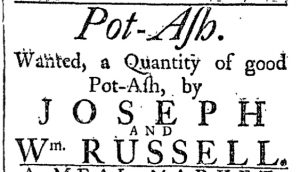
“Wanted, a Quantity of good Pot-Ash.”

The word “Pot-Ash” caught my attention as I was looking at this advertisement, since I had never heard of it. After doing some research, I learned from a journal article by Henry Paynter that potash is a type of potassium carbonate that was made from the ashes of trees and plants during the eighteenth century. Home potash production was encouraged during the American Revolution, since it could be used to produce saltpeter for gunpowder. For more day-to-day life, it was used to make goods such as soap and glass, to dye fabrics, and for baking. Potash soap was very popular in England during the middle of the eighteenth century. Similar to South Carolina indigo compared to indigo from French and Spanish colonies, Great Britain imported potash produced in the American colonies rather than Russia because of its cheaper price, sacrificing quality to save money. As the colonial potash industry matured, production shifted north in order to utilize trees more favorable for making potash. Unfortunately, this process led to mass amounts of forests being cleared by the late eighteenth century, and Americans had to find other ways to produce the money-making potash.

**********

ADDITIONAL COMMENTARY: Carl Robert Keyes

Like many other colonial newspapers, the masthead of the Providence Gazette proclaimed that it “Contain[ed] the freshest Advices, both Foreign and Domestic.” Although the printer, John Carter, and many readers may have considered news items the most significant of those “Advices,” advertisements also kept colonists informed of events and commerce by providing details not necessarily available elsewhere in the newspaper. On occasion, Carter did not have sufficient space to publish all of the “Advices,” whether classified as news or paid notices. The April 22, 1769, edition included a brief note to that effect: “Sundry Articles of Intelligence composed for the Day’s Paper, and a few Advertisements, omitted for Want of Room, shall be in our next.”

Even though some advertisements did not make it into the April 22 issue, Joseph Russell and William Russell were well represented in its pages. News comprised the first two pages, a portion of the third, and most of the fourth. Overall, advertising accounted for slightly less than an entire page. Yet the Russells managed to have two advertisements included among the contents, the notice concerning potash on the final page and another promoting “Barrel Pork,” pepper, indigo, and other commodities on the third page. Both would have been familiar to regular readers of the Providence Gazette, having appeared the previous week and in earlier issues. As a result, these “Advices” may have seemed less pressing than the information in other advertisements or the “Sundry Articles of Intelligence” already composed but omitted until the following week.

Carter may have granted preferential treatment to the Russells precisely because they were such prolific advertisers. They advertised often, sometimes placing multiple advertisements in a single issue. They also tended to insert lengthy advertisements, especially when they listed dozens or hundreds of items they imported and sold at their shop. Carter relied on revenues from advertising to make the Providence Gazette a viable enterprise. In the colophon, every week he called on readers to submit both subscriptions and advertisements to the printing office. Given that the Russells did so regularly advertise in the pages of his newspaper, Carter may have prioritized their advertisements over others when running low on space, even though the “Advices” provided by the Russells had already become familiar in Providence and beyond over the course of several weeks.

April 21

GUEST CURATOR: Samantha Surowiec

What was advertised in a colonial American newspaper 250 years ago today?

New-London Gazette (April 21, 1769).

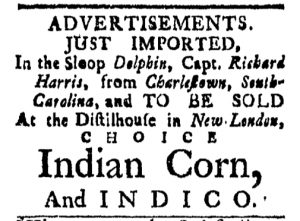
“JUST IMPORTED … from Charlestown, South Carolina … INDICO.”

Indigo was used as a dye to create vibrant blues and some greens. Although this indigo from Charleston was sold in Connecticut, in an article on South Carolina indigo and its role in the European textile industry R.C. Nash points out that plantation owners preferred to sell their indigo in London rather than in the colonies.[1] During the mid to late eighteenth century, South Carolina indigo made up 25 percent of the product being traded in the Atlantic. The colony first began producing the dye after its rice industry started to fail following the Seven Years War. According to Nash, they quickly gained a foothold in the British market as textile industries in Great Britain grew.[2] Scholars have found that South Carolina indigo was actually of much poorer quality than its competitors from French and Spanish colonies, but it continued to dominate the market because of how cheap it was. As indigo production became more popular, those plantations that produced both rice and indigo began to acquire more and more slaves, eventually coming to own 30 percent more slaves than those that only sold rice or indigo.[3] By producing both rice and indigo, South Carolina plantation owners adapted to and shaped the changing Atlantic trade economy.

**********

ADDITIONAL COMMENTARY: Carl Robert Keyes

With the exception of a short verse in the “Poets Corner” in the first column, advertisements filled the entire final page of the April 21, 1769, edition of the New-London Gazette. Some of those notices marketed commodities, such as “CHOICE Indian Corn, and INDICO,” “SALTS OF LYE,” and “Linseed Oil.” Others offered services, such as “WEBB’S Passage-Boat” that “Continues to ply between New-London and Sterling, as usual.” One offered a reward for the return of an apprentice who ran away from his master. Another reported that twenty-eight hogsheads of rum had been stolen from Nathaniel Shaw’s store and offered a reward for information about the culprits. Several legal notices appeared among these various advertisements, as did an advertisement for a book recently published and for sale by the printer. No classification system aided readers in navigating these advertisements. The compositor arranged them according to where they fit on the page, not by their contents or purpose.

The compositor did not, however, leave readers completely to their own devices. The advertisement for “CHOICE Indian Corn, and INDICO,” immediately below the “Poets Corner” bore the title “ADVERTISEMENTS,” presumably to inform readers that only advertisements appeared throughout the remainder of that issue. Even the placement of that headline did not signal a strict classification system. A paid notice appeared on the previous page. In other issues of the New-London Gazette, the “ADVERTISEMENTS” headline also appeared immediately below “Poets Corner” on the final page, even though numerous advertisements ran on the previous page. Such was the case a week earlier in the April 14 edition; the third featured page half a dozen paid notices before readers encountered the “ADVERTISEMENTS” headline on the fourth page. Advertisements appeared immediately after the shipping news form the customs house, a visual marker just as reliable for indicating the placement of paid notices as the “ADVERTISEMENTS” headline.

The first advertisement in the final column on the last page of the April 21 edition included an additional headline: “NEW ADVERTISEMENT.” All the others on the page, including those underneath it, ran in one or more previous issues. This headline likely aided readers in identifying new content if they skimmed the paid notices quickly. It was the closest the newspaper came to using a classification system for paid notices, though this classification was not based on the contents of advertisements.

**********

[1] R.C. Nash, “South Carolina Indigo, European Textiles, and the British Atlantic Economy in the Eighteenth Century,” Economic History Review 63, no. 2 (May 2010): 386.

[2] Nash, “South Carolina Indigo,” 363-4.

[3] Nash, “South Carolina Indigo,” 379.

April 20

GUEST CURATOR: Matthew Ringstaff

What was advertised in a colonial American newspaper 250 years ago today?

Postscript to the Boston Weekly News-Letter (April 20, 1769).

LOST … A Stone Sleeve Button with a red Cypher set in Gold.”

On April 20, 1769, the Postscript to the Boston Weekly News-Letter contained this advertisement for a lost “Stone Sleeve Button with a red Cypher set in Gold, and with a gold Chain.” I was interested in this piece of jewelry. According to Thomas Hamilton Ormsbee, “Although carelessness, loss by theft, and general wear and tear have taken a heavy toll on colonial jewelry so that comparatively small amount is still extant, portraits of well-to-do citizens and their families from Puritan-founded New England to South Carolina and newspaper advertisements of colonial goldsmiths show that jewelry of all sorts was in high favor. In fact, it was a natural accessory to the elaborate satin and brocaded costumes affected by both men and women of substance and social standing.” Who made the jewelry that colonists owned? “Some of this jewelry was imported; much was made by the various gold and silversmiths of the colonies.”

**********

ADDITIONAL COMMENTARY: Carl Robert Keyes

For the purposes of this project, Matt selected an especially interesting source to support his analysis of today’s featured advertisement. In a “Flashback” article published online in March 2009, Collectors Weekly republished Thomas Hamilton Ormsbee’s two-part series on “Colonial Americans and Their Jewelry” originally published in the March and April 1941 issues of American Collector magazine. As the twenty-first-century editors explain, “This article discusses the various types of fine jewelry that was popular among 18th-century Americans, using advertisements written by jewelers and notices written by Americans who had lost previous pieces as examples.” The advertisements for the lost “Stone Sleeve Button with a red Cypher set in Gold, and with a gold Chain” falls in the latter category. Matt selected an article that demonstrates how multiple advertisements can provide a revealing overview of the history of a particular product in early America when considered collectively.

That article also references other sorts of advertisements from eighteenth-century newspapers. Ormsbee declares that items created and sold by jewelers, goldsmiths, and silversmiths were “evidently as tempting to the ‘have-nots’ of that time as [they are] today, for news items about robberies were fairly numerous.” He then tells the story of a Boston goldsmith who inserted an advertisement in the March 21, 1765, edition of the Boston News-Letter to list the jewelry stolen from his shop and offer a reward. The Boston-Gazette later reported that the thief had been caught and punished with “40 stripes at the public Whipping Post,” but did not indicate whether the goldsmith recovered his merchandise. Although the anonymous colonist who placed today’s featured advertisement described the jewelry as “LOST” rather than stolen, he or she did worry that anyone who found it might attempt to sell it rather than return it to its rightful owner. “If offer’d to Sale,” the advertiser pleaded, “it is desired it may be stop’d.” In other words, confiscate the jewelry and inform the printer to contact the advertiser that the lost jewelry had been recovered.

Ormsbee’s two-part series about eighteenth-century advertisements for jewelry is a lively read that includes images of both jewelry and portraits of colonists wearing their precious possessions. Alas, the article does not include images of the advertisements, privileging images of material culture over the print culture that provides important context for understanding the significance of jewelry in colonial American commerce and culture.

April 19

GUEST CURATOR: Matthew Ringstaff

Who was the subject of an advertisement in a colonial American newspaper 250 years ago today?

Georgia Gazette (April 19, 1769).

“ABOUT TWENTY-ONE VALUABLE PLANTATION SLAVES.”

On April 19, 1769, Benjamin Fox put an advertisement in the Georgia Gazette to sell a plantation. The advertisement boldly stated “ABOUT TWENTY ONE VALUABLE PLANTATION SLAVES.” I was curious about the lives of plantation slaves and learned more from the Understanding Slavery Institute sponsored by several museums in Great Britain. According to the Understanding Slavery Institute, “plantations depended on skilled slaves – masons, joiners, coopers, metalworkers – to keep factories, fields, equipment and transport prepared and functioning. The needs of the wider slave community were served by other vital workers: cooks, nurses, and seamstresses.” However, other slaves were very skilled in agriculture. Those slaves were responsible for more important decisions on the plantation. They were sometimes responsible for determining when sugar cane was ready for harvest or when tobacco leaves were ideal for picking or “how best to pack, load, and transport the commodities grown on the plantation.” Slaves had occupations and could be traded and sold from plantation to plantation as their services were required.

**********

ADDITIONAL COMMENTARY: Carl Robert Keyes

Although this particular advertisement did not, other advertisements concerning enslaved men and women often listed their skills or occupations. As Matt indicates, enslaved artisans contributed far more than labor to colonial commerce. Their involuntary contributions also included their skill and expertise.

Consider the advertisements that ran in the South-Carolina and American General Gazette earlier in the same week as this advertisement from the Georgia Gazette. One offered to sell a “Valuable NEGRO MAN” … who was “well qualified for a gentleman’s servant, or as a waiter in a tavern.” Another advertisement described an enslaved man who was “a very good GARDINER.” In both instances, they skillfully accomplished tasks beyond agricultural labor in the fields on plantations.

In the course of describing a plantation for sale, yet another advertisement also listed “about thirty likely NEGROES,” many best suited for working in the fields but some possessing other valuable skills. They included “a very good bricklayer, a driver, and two sawyers” along with seventeen considered “fit for the field or boat-work.” In addition, John Matthews once again ran an advertisement that had appeared for months. He sought to sell both a plot of land and an enslaved laundress. He also mentioned that he “hath not yet sold his negro Shoe-makers” and could thus supply customers with boots and shoes “as usual.” Matthews had previously attempted to sell those shoemakers, placing advertisements in Charleston’s newspapers for months. He proclaimed that “they have done all my business for nine Years past, and are at least equal to any Negroes of the Trade in this Province.” Matthews stated that he intended to “decline Shoemaking,” but his advertisement suggests that he supervised skilled enslaved artisans rather than making any shoes himself.

Considering advertisements about enslaved men, women, and children collectively, along with other sources, reveals the broad range of skills they possessed and occupations they followed in eighteenth-century America. While many did indeed labor in the fields on plantations, a significant number worked in diverse settings at various occupations that required specialized skills.

April 17

GUEST CURATOR: Matthew Ringstaff

What was advertised in a colonial American newspaper 250 years ago today?

Boston Chronicle (April 17, 1769).

“APPRENTICES, (Wanted for the PRINTING BUSINESS).”

On April 17, 1769, John Mein and John Fleeming, the printers of the Boston Chronicle, put this advertisement searching for three young apprentices in their own newspaper. The printers wanted apprentices between thirteen and sixteen years of age. Two would work in the “PRINTING BUSINESS” and one in “BOOK BINDING.” Young men usually started apprenticeships in their teenage years and they finished in their early twenties. Bookbinding apprenticeship were not easy, according to Ed Crews. “Mastering the trade required hard work, dexterity, attention to detail, and a willingness and ability to handle painstaking tasks. By the time they became journeymen, apprentices had learned dozens of skills, including folding pages, collating them, stitching, gluing, and techniques for decorating covers.” This shows how hard it was to be a skilled bookbinder. Most apprenticeships were strenuous and not easy, but being an apprentice to a bookbinder could open new opportunities when the apprenticeship ended. Crews says, “Bookbinders with high skills, working in the right shop, could expect satisfying jobs and pay.”

**********

ADDITIONAL COMMENTARY: Carl Robert Keyes

Residents of Boston and its environs had access to several local newspapers in the late 1760s. The Boston Evening-Post, the Boston-Gazette, the Boston Post-Boy, and the Boston Weekly News-Letter had all been published in one form or another for several years or even decades. In December 1767, John Mein and John Fleeming commenced publication of another newspaper, the Boston Chronicle, expanding the options for disseminating both news and advertising. According to Isaiah Thomas in his monumental History of Printing in America, the Boston Chronicle was “intended to imitate in its appearance the London Chronicle.” Like their competitors, Mein and Fleeming published one issue each week. Upon successfully concluding the first year of publication, the partners altered the size of the newspaper and began distributing new issues on both Mondays and Thursdays, making it the first newspaper published twice a week in New England.

In an overview of its contents, Thomas states that the Boston Chronicle “was well supplied with essays on various subjects judiciously selected from British authors, and it contained the celebrated letters of the Pennsylvania Farmer” by John Dickinson, a series reprinted in nearly every newspaper in the colonies in late 1767 and early 1768. Thomas also notes that the newspaper “grew daily into reputation, and had a handsome list of subscribers.” He did not, however, note how successfully Mein and Fleeming attracted advertisers for their newspaper.

Examining the pages of the Boston Chronicle reveals that no matter how “handsome” the list of subscribers, the newspaper did not publish as many advertisements as any of its local competitors, especially not in 1769. This may have been due in part to Mein’s outspoken political sympathies. “Before the close of the second year of publication,” Thomas reports, Mein “engaged in a political warfare with those who were in opposition to the measures of the British administration. In the Chronicle he abused numbers of the most respectable whigs in Boston; and he was charged with insulting the populace.” Perhaps some prospective advertisers hesitated to insert their notices in the Boston Chronicle for fear of being associated with Mein’s strident politics. Others may have made principled decisions not to advertise in the pages of his newspaper. Thomas declares that as the newspaper steadily lost its subscribers “it could neither be profitable to its publishers, nor answer the design of its supporters.”[1] Again, he does not comment on the role of advertising, especially the revenues generated from paid notices, in the demise of the Boston Chronicle.

Not only did the Boston Chronicle carry fewer advertisements than its competitors, a greater proportion of those that appeared in its pages promoted Mein and Fleeming’s endeavors, including their advertisement for apprentices “Wanted for the PRINTING BUSINESS” that appeared immediately below an advertisement for a book Mein sold at the London Book-Store. Only eight advertisements ran in the April 17, 1769, edition of the Boston Chronicle, one quarter of them placed by the publishers. The advertisement for apprentices was not explicitly political, but the politics of the printers may have influenced how many other advertisements happened to appear on the same page.

**********

[1] Isaiah Thomas, The History of Printing in America: With a Biography of Printers and an Account of Newspapers (1810; 1874; New York: Weathervane Books, 1970), 264-265.

April 16

GUEST CURATOR: Matt Ringstaff

What was advertised in a colonial American newspaper 250 years ago this week?

Providence Gazette (April 15, 1769).

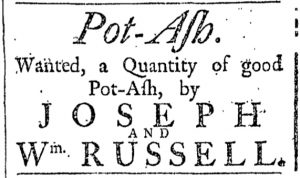
“Wanted, a Quantity of good Pot-Ash.”

Before seeing the word “Pot-Ash” in Joseph and William Russell’s advertisement from 1769 in the Providence Gazette I had no idea what is was or what it was used for. I understood from the advertisement was that there was a large market for it. Potash, “a crude form of potassium carbonate,” came from the ashes of burned trees. Colonists originally used it for making soap and, later, gunpowder. According to William E. Burns, colonists used small amounts of potash for baking to help cakes rise. Colonists made potash “by burning logs and other wood to ashes, then placing the ashes in a barrel lined with twigs and straw.” After that step, “[p]otash makers poured water on top of the ashes, dissolving out the salts.” Then they boiled what was left to create potassium carbonate that “made up less than a quarter of the mass.” Potash had many uses in colonial times, “from household soapmaking to glass manufacture.”[1]

**********

ADDITIONAL COMMENTARY: Carl Robert Keyes

Sometimes when guest curators examine the featured advertisements I instead choose to comment more extensively on methodology, pedagogy, or the benefits and challenges of working with digitized primary sources. For this entry, I offer a few comments on Assumption College’s twenty-fifth annual Undergraduate Symposium.

Today all of the guest curators that have worked on the project this spring will make presentations about their contributions at the Symposium, sharing their work beyond the classroom in yet another forum. Designed to replicate a conference, the Symposium draws together talented undergraduate students from across the many departments on campus. Students may make oral presentations or participate in poster sessions, whichever best fits their projects and matches the practices in their disciplines.

The guest curators for the Adverts 250 Project, all of them History majors enrolled in my upper-level Revolutionary America class, will make presentations that they have previously delivered in class in preparation for the Symposium. I oversaw a workshop for each presentation. The entire class discussed what worked well and offered constructive suggestions for improvement so each guest curator could make the necessary revisions and deliver a polished presentation at the Symposium.

The ten presentations related to the Adverts 250 Project have been divided into two sessions of five presentations each. A faculty moderator from the Symposium Committee will oversee each session. I will make a formal introduction for each young scholar. Then each will make a ten-minute presentation, followed by five minutes for questions and discussion. Later in the day everyone involved in the Symposium will gather at a reception hosted by the Provost and the Symposium Committee to celebrate their accomplishments.

Preparing for and participating in the Symposium requires a lot of time. In my Revolutionary America class, we have given over three of twenty-seven class meetings to this endeavor. This means that we cover less content in the course of the semester, but I know from experience that students ultimately learn the content we do cover much better because it has been linked to other skills they have developed and honed as part of the Adverts 250 Project. From History Labs in class to the Symposium near the end of the semester, the guest curators have enhanced their information literacy, expanded their research skills, refined their writing abilities, and gained valuable experience with public speaking. All of these will serve them well in their future studies and, more significantly, beyond the classroom.

Good luck at the Symposium today, guest curators!

**********

[1] William E. Burns, Science and Technology in Colonial America (Westport, CT: Greenwood Press, 2005), 25.