April 15

GUEST CURATOR: Matthew Ringstaff

What was advertised in a colonial American newspaper 250 years ago today?
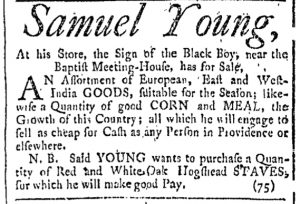
Providence Gazette (April 15, 1769).

“A Quantity of Red and White Oak Hogshead STAVES.”

On April 15, 1769, Samuel Young put an advertisement put in the Providence Gazette to tell readers that he wanted “to purchase a Quantity of Red and White Oak Hogshead STAVES, for which he will make good Pay.” Staves are narrow pieces of wood used to make barrels. A hogshead is a barrel that holds 64 gallons. According to Jeremy M. Bell, “Barrels were the shipping containers of their time” in the eighteenth century. They held an abundance of items, including alcohol, corn, and tobacco. Today it is not very common to see barrels in stores, except maybe a Cracker Barrel, but in colonial times they were extremely common in shops, very noticeable objects for customers. Bell states that barrels were so frequently used that the British Parliament passed the first act to standardize hogsheads and their measurements in 1423. Starting with a tun barrel at 252 gallons, they made it so that each designation of volume would then be cut in half. A pipe barrel held 126 gallons. Therefore, a hogshead measured 64 gallons and a standard barrel at 32 gallons. Practically everyone involved in commerce in early America used hogsheads and barrels of other sizes.

**********

ADDITIONAL COMMENTARY: Carl Robert Keyes

No advertisements for enslaved men, women, and children appeared in the April 15, 1769, edition of the Providence Gazette. None of the paid notices offered men and women for sale. None of them encouraged white colonists to engage in acts of surveillance in the service of capturing escaped slaves and returning them to those who held them in bondage, nor did any describe suspected runaways that had been imprisoned. Yet black bodies were not absent from the pages of the Providence Gazette or the commercial landscape in the city.

Before he announced that he sold an “Assortment of European, East and West-India GOODS” and sought “Hogshead STAVES,” Samuel Young proclaimed that he operated a store at “the Sign of the Black Boy.” Enslaved men and women had labored to produce many of the goods Young sold. Enslaved men and women would eventually handle the barrels made from the staves Young acquired. They were integrated into the networks of production, exchange, and consumption in the early modern Atlantic world. That was a fact that would have been difficult for residents of Providence to overlook, but Young’s choice of shop sign provided a stark visual reminder that black bodies had been appropriated and exploited for a variety of purposes. Enslaved men and women contributed their labor, their skills, and their expertise in the production of commodities. The image of a “Black Boy” then served as a marketing logo and a landmark that aided colonists in finding many of those commodities as they navigated the streets of Providence.

Elsewhere in the April 15 issue, the Providence Gazette disseminated news about the imperial crisis brewing as a result of the Townshend Acts and other abuses by Parliament. Some correspondents wrote about “AMERICAN Liberty,” while others defended the prerogatives of George III and Parliament. Calls for “AMERICAN Liberty,” however, extended only so far, only to white colonists. Most colonists who reduced enslaved men, women, and children to a stylized image on “the Sign of the Black Boy” did not contemplate how to evenly apply their rhetoric to all of the residents of Rhode Island and the other colonies.

April 14

GUEST CURATOR: Matthew Ringstaff

What was advertised in a colonial American newspaper 250 years ago today?

New-Hampshire Gazette (April 14, 1769).

“Public Vendue … at Capt. Jacob Tilton’s Tavern.”

This advertisement from the New-Hampshire Gazette on April 14, 1769, sparked my interest because of what was being sold and where the sale took place: “TO BE SOLD … at Capt. Jacob Tilton’s Tavern … SUNDRY HOUSEHOLD FURNITURE.” The location of this “Public Vendue” or auction, Tilton’s Tavern, seemed unusual. How often does a bar have an auction for household furniture? In the twenty-first century when a bar holds some type of event it is often a car or motorcycle show, but not a furniture auction. According to Leigh Zepernick, a collections intern at the Old State House in Boston, “It is difficult to overstate the importance of taverns in 18th century life. In addition to providing food, drink, and lodging, they were venues for town meetings, legal proceedings, and business transactions. Taverns were a place to debate politics, play games such as cards or dice, and catch up with the latest news and gossip. They were the hub of social life, and in Boston in particular, they were ubiquitous. In 1765, there was one tavern for every 79 adult men.”

**********

ADDITIONAL COMMENTARY: Carl Robert Keyes

Edward Moyston’s trade card for the City Tavern (1789). Courtesy Historical Society of Pennsylvania (Society Miscellaneous Collection).

As Matt notes, a lot more than eating and drinking took place at taverns in eighteenth-century America. Two decades after the New-Hampshire Gazette ran the advertisement about an auction at Tilton’s Tavern in Portsmouth, Edward Moyston distributed a trade card for the City Tavern in Philadelphia. His marketing made it clear that the City Tavern was a place for conducting business. Indeed, the “CITY-TAVERN” appeared in much smaller font than the headline for the trade card that announced the “Merchants’ Coffee-House & Place of Exchange” could be found at the tavern. Moyston had set aside the “two Front Rooms,” noting that they had been “specially appropriated to these purposes” due to a subscription agreement with “Merchants, Captains of Vessels, and other Gentlemen.” Although Moyston also marketed the rest of his establishment as “a TAVERN and HOTEL: Where Gentlemen and the Families are accommodated, as usual, with the most superior Liquors … and every article for the Table is served up with elegance,” he positioned the City Tavern as a place to conduct business. To that end, he likely supplied newspapers published in Philadelphia and other cities for his patrons so they could stay informed of politics and commerce. Those “Merchants, Captains of Vessels, and other Gentlemen” certainly also shared news and gossip with each other in conversations that took place as they cast up accounts and pursued new transactions.

Tilton’s Tavern in Portsmouth may not have been as grand as the City Tavern in Philadelphia (which has been reconstructed and serves visitors today), but it served a similar purpose. As the advertisement Matt selected demonstrates, it was a gathering place familiar to readers of the New-Hampshire Gazette and other members of the community. Holding an auction at Tilton’s Tavern was business as usual in the eighteenth century, one of the many activities that took place at an establishment where people gathered to exchange information and goods in addition to consuming food and beverages. Its convenience and central location likely made it a preferred venue compared to the home of the patron who intended to auction furniture and housewares.

April 13

GUEST CURATOR: Bryant Halpin

What was advertised in a colonial American newspaper 250 years ago today?

Pennsylvania Gazette (April 13, 1769).

“CYDER.”

In this advertisement, Isaac Gray lists goods for sale, including “CYDER”. Mark Turdo provides descriptions of cider written in the eighteenth century by Reverend Israel Acrelius as part of A History of New Sweden: Or, the Settlements on the River Delaware. Acrelius included many different kinds of cyder, such as Apple-wine (cider),” “Cider Royal,” and “Mulled cider,” and “Sampson.” Colonists used wooden mills to help prepare cider. This was a long process that began with a horse-powered grinding up apples. They then placed the apples under a press until the juice ran off. The juice went into a barrel and left to ferment. If the apples were “not of a good sort,” they boiled the cider and added a few pounds of ground ginger into it, and it became “more wholesome and better for cooking.” Acrelius stated, “This liquor is usually unwholesome, causes ague when it is fresh, and colic when it is too old.” Some people heated their cider with a red-hot iron.

**********

ADDITIONAL COMMENTARY: Carl Robert Keyes

When they visited Isaac Gray’s warehouse to purchase cider, some customers likely acquired some of the grocery items also listed in his advertisement, intending to use them to enhance the beverage. As Bryant notes, Israel Acrelius described adding ginger to one kind of cider, a variation that he called “Apple-wine.” The minister also offered a recipe for “Cider Royal,” made by adding “some quarts of brandy” to a barrel of cider “along with several pounds of Muscovado sugar.” This resulted in a drink that “becomes stronger and tastes better.” It could be further improved by drawing it off into bottles, putting raisins in them, and then allowing the mixture to age “for a year or so.” Gray listed both raisins and “double and single refined loaf and lump sugars” among his wares. Although he did not mention brandy, he carried enough varieties of beer, wine, and spirits that he may have had some brandy among his merchandise as well.

Acrelius also described other sorts of cider commonly consumed in Pennsylvania in the eighteenth century. “Mulled cider” was served warm. In addition to sugar, it included “yolks of eggs and grains of allspice.” Gray named pepper and ginger in his advertisement, but also made a generic nod to other spices that he had in stock. If sugar, eggs, and allspice did not sufficiently enhance mulled cider then Acrelius recommended adding rum “to give it greater strength.” The recipe for “Sampson” required fewer ingredients: “Sampson is warmed cider with rum in it.” Gray certainly offered rum for sale, though he referred to it as “OLD Jamaica spirits.” In a final variation, “Cider Royal of another kind,” Acrelius described a mixture “in which one-half is cider and the other mead [honey liquor], both freshly fermented together.”

Gray marketed his “CYDER” for home consumption. Some customers may have enjoyed it in its original form as purchased from his warehouse, but Acrelius suggests that many others would have doctored it to their own tastes before they consumed it. In that regard, Gray operated a business similar to modern liquor stores that provide not only alcoholic beverages but also various accouterments, such as tonics and bitters, to make mixed drinks. Then and now, purveyors of beer, wine, and spirits, sell other products intended to enhance consumers’ enjoyment of their beverages.

April 12

GUEST CURATOR: Bryant Halpin

Who was the subject of an advertisement in a colonial American newspaper 250 years ago today?

Georgia Gazette (April 12, 1769).

“RUN AWAY … A NEGROE FELLOW, named JACK.”

This advertisement for a runaway “NEGROE FELLOW, named JACK,” includes a description of some injuries: “a large scar on left side of his head cut by a hanger, and a scar upon his ear by the same stroke, and several cuts upon his body.” These injuries could have been a reason why Jack was motivated to try to escape. Running away was one form of resistance enslaved men and women attempted. According to James H. Sweet, “Slave resistance began in British North America almost as soon as the first slaves arrived in the Chesapeake in the early seventeenth century.” This advertisement was part of a long history of slave resistance that had been going on ever since slaves arrived in America almost 150 years earlier. Slaves resisted in other ways if masters “increased workloads, provided meager rations, or punished too severely … by slowing work, feigning illness, breaking tools, or sabotaging production.”

**********

ADDITIONAL COMMENTARY: Carl Robert Keyes

Jack’s story was not unique. The advertisements in the April 12, 1769, edition of the Georgia Gazette chronicled the attempts of several other enslaved men in their endeavors to escape from bondage. Immediately above the advertisement that described Jack, another announced that a “NEGROE FELLOW, named ABRAM” who “talks good English” had made his escape nearly three weeks earlier. Almost immediately to the left, another advertisement documented the escape of a “NEGROE BOY named ROBIN, well known in Savannah” as well as “SEVEN NEGROE FELLOWS, named QUAMINA, PRINCE, HARRY, SAWNEY, POMPEY, JAMIE this country born, and another of the same name of the Angola country.”

That same issue also included advertisements about enslaved men, women, and children whose attempts to escape had failed. One reported that a “NEGRO FELLOW, and A WENCH, with A CHILD about two months old” had been “TAKEN UP” about twenty miles from Augusta near the end of January. The arrival of the child may have been the primary motivation for Sampson and Molly to flee when they did, departing shortly after Molly gave birth. Two other advertisements described captured runaways who had been “Brought to the Work-house” until slaveholders claimed them, a “NEW NEGRO FELLOW, who calls himself CATO” and Michael, a “TALL STOUT ABLE NEGROE FELLOW … of the Coromantee country.” These prisoners each considered the possible punishments for running away worth the risk of obtaining their freedom if they managed to make it to safety without being captured.

Georgia Gazette (April 12, 1769).

Some of their advertisements were among the most visible items in the Georgia Gazette. The advertisement about Abram, for instance, featured a crude woodcut of an enslaved man on the run. It was one of only four visual images in the entire issue. Two other advertisements for freight and passage had woodcuts of ships; the masthead depicted a lion and unicorn flanking a crown. The woodcut drew attention to the description of Abram, just as the headline “Brought to the Work-house” in gothic type distinguished those advertisements from others. The compositor deployed that font sparingly throughout the rest of the issue, but did so consistently for “Brought to the Work-house” advertisements, not only in the April 12 issue but week after week. These decisions about typography and graphic design significantly increased the visibility of many advertisements about enslaved men and women who attempted to escape, underscoring how disruptive and dangerous colonists considered such acts of resistance.

April 11

GUEST CURATOR: Bryant Halpin

What was advertised in a colonial American newspaper 250 years ago this week?

Supplement to the Boston-Gazette (April 10, 1769).

“Sperma-Caeti CANDLES.”

In this advertisement from the Supplement to the Boston-Gazette for April 10, 1769, Richard Smith sold “Sperma-Caeti CANDLES” at his store on King Street. What are spermaceti candles? According to Emily Irwin, the materials to make spermaceti candles came from sperm whales. Those materials were supplied by the whaling industry. Spermaceti candles burned longer, cleaner, and brighter than other candles made from tallow (animal fat) or beeswax, making them a popular choice. Spermaceti candles were the height of the candle-making technology for Americans in the eightheenth and nineteenth centuries. Irwin states, “The spermaceti candle represents a changing society and an evolving culture; a culture that was constantly striving for a clean burning and more efficient means by which to light the darkness.”[1]

Despite the high cost of these candles, Americans were willing to pay for them, but only the richest of Americans could afford to fully enjoy the benefits of spermaceti candles. These candles were made from the “head matter” which was an oily substance that came from sperm whales. This material was hard to acquire, especially compared to tallow and beeswax. Spermaceti candles were often made in port towns such as Providence or Boston.

**********

ADDITIONAL COMMENTARY: Carl Robert Keyes

Edes and Gill had too much content to fit all of it into the standard four-page edition of the Boston-Gazette on Monday, April 10, 1769. As the masthead proclaimed, they published “the freshest Advices, Foreign and Domestic.” Some of those “Advices” were news items and editorials. Others were paid notices that also delivered news, such as an advertisement offering a reward for capturing the perpetrator of a theft that recently occurred at John Carnes’s shop in Boston and another that advised landholders to pay taxes on their property in Berkshire County or risk having their land sold at public auction. Even advertisements for goods and services counted among “the freshest Advices” as they informed readers of upcoming concerts, ships seeking passengers and freight in advance of departing for London, and all sorts of fashionable textiles and housewares in stock in local shops.

The printers had so much content that many of the paid notices overflowed into a separate supplement devoted entirely to advertising. Richard Smith’s advertisement for “Sperma-Caeti CANDLES” and “an Assortment of ENGLISH GOODS” was one of two dozen that ran in the supplement. On the same day, the Boston Evening-Post also issued a two-page supplement, though advertising comprised only one of those pages. To the south, the New-York Gazette and Weekly Mercury distributed its own two-page supplement filled with paid notices. Half a dozen other newspapers were also published throughout the colonies, from Massachusetts to South Carolina, on April 10, 1769. Each of them carried a significant amount of advertising, even if the printers did not have so many as to justify distributing a supplement. Green and Russell even squeezed a short advertisement into the bottom margin of the first page of the Massachusetts Gazette. Peter Crammer’s advertisement for “Choice Liver Oyl” ran as a single line across all three columns.

All of these examples demonstrate the popularity of advertising in eighteenth-century America. Printers certainly appreciated the revenues, squeezing as many advertisements as possible into each issue and distributing supplements when they did not have enough space. Many advertisers likely considered such marketing a necessary investment. Smith’s advertisement for “Sperma-Caeti CANDLES” ran between John Langdon’s advertisement for “Best Sperma Ceti Candles” and “Isaac White’s advertisement for “Dipp’d Tallow Candles.” With so many competitors advertising their wares in the public prints, Smith likely considered it imperative to do so as well or risk losing out on his share of the market.

**********

[1] Emily Irwin, “The Spermaceti Candle and the American Whaling Industry,” Historia 21 (2012), 45.

April 10

GUEST CURATOR: Bryant Halpin

What was advertised in a colonial American newspaper 250 years ago today?

Pennsylvania Chronicle (April 10, 1769).

“A FRESH supply of choice drugs and medicines.”

When I looked at this advertisement I wondered what kinds of “drugs and medicines” colonists had in 1769? How did colonists deal with diseases? According to Robin Kipps, who manages the Pasteur & Galt Apothecary at Colonial Williamsburg, “The sciences of biology and chemistry had not made significant impacts on the theories of disease. The big health issues of the day were not heart disease, cancer, obesity, or diabetes; they were smallpox, malaria, and childhood illnesses.” In the colonial and revolutionary periods, Americans did not have to worry about the same kind of disease that we do today. Instead, they had all kinds of other deadly diseases they had to worry about that people nowadays do not need to worry about due to advances in science and medicine. Colonists did not have the vaccines at this point in time to prevent many deadly diseases from happening and spreading to others, though they had experimented with smallpox inoculation.

**********

ADDITIONAL COMMENTARY: Carl Robert Keyes

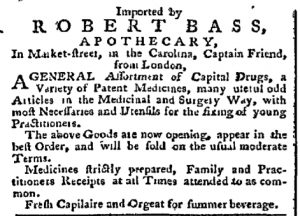
John Sparhawk had competition. He was not the only purveyor of “choice drugs and medicines” in Philadelphia who advertised in the April 10, 1769, edition of the Pennsylvania Chronicle. Robert Bass, an apothecary who regularly inserted advertisements in several local newspapers, also ran a notice, one that may have more effectively captured the attention of prospective clients.

Sparhawk, a bookseller, published a comparatively sparse advertisement. Like many other printers and booksellers in eighteenth-century America, he supplemented his income by selling other items, including patent medicines, on the side. Such was the case with the “FRESH supply” that he had “just received from London” and sold at his bookstore. He made appeals to price and quality, pledging that he sold them “as low as can be bough[t] in America of equal quality,” but otherwise did not elaborate on these patent medicines.

Pennsylvania Chronicle (April 10, 1769).

Robert Bass, on the other hand, underscored his expertise in his advertisement, using his superior knowledge to leverage readers to visit his shop to seek consultations and make purchases. In addition to using his own name as a headline, he listed his occupation, “APOTHECARY,” all in capitals as a secondary headline. He did not merely peddle patent medicines that he had imported from suppliers in London. He also “strictly prepared” medicines in his shop, filling all sorts of prescriptions or, as he called them, “Family and Practitioners Receipts.” For those who desired over-the-counter remedies, he also stocked “a Variety of Patent Medicines.” His experience and reputation as an apothecary suggested that he could more effectively recommend those nostrums to clients based on their symptoms than Sparhawk the bookseller could. Bass also carried medical equipment, further underscoring his specialization in the field.

Not every customer needed the level of expertise Bass provided. Many would have been familiar with several patent medicines. For those customers who desired to make their own selections from among the products available on the shelves, Sparhawk (and Bass as well) simply made appeals to price and quality. That model differed little from patrons choosing over-the-counter medications at retail pharmacies or other kinds of stores today. For prospective customers who required greater skill and expertise from the person dispensing medications, Bass made it clear in his advertisement that he was qualified to address their needs.

April 9

GUEST CURATOR: Bryant Halpin

What was advertised in a colonial American newspaper 250 years ago this week?

New-Hampshire Gazette (April 7, 1769).

Garden Seeds.”

In this advertisement from the New-Hampshire Gazette, shopkeeper John Adams promoted garden seeds imported from London to potential customers. Customers throughout the colonies, including Virginia, purchased seeds from shopkeepers. According to Wesley Greene, a garden historian in the Landscape Department at the Colonial Williamsburg Foundation, “All of the stores in eighteenth-century Williamsburg offered vegetable seeds for sale, so there were certainly a number of fine gardens in town that were nost likely vegetable gardens.” Greene states that vegetables in those gardens were considered “luxuries rather than staples.” Vegetables were expensive, took a long time to grow, could only be grown in season, and did not last long. Colonists in Williamsburg who did have vegetable gardens showed off their higher status to their fellow colonists. As Greene explains, “In the eighteenth century, a gentleman made a statement about who he was by how his table was set. Vegetables such as Cauliflowers and Articholes conveyed an important merssage that guest were dining at the home of a person of taste and consequence.”

**********

ADDITIONAL COMMENTARY: Carl Robert Keyes

In the spring of 1769, shopkeeper John Adams of Portsmouth, New Hampshire, aimed to supplement the livelihood he earned by selling “a general Assortment of English GOODS” at his shop on Queen Street by also peddling “a fresh Assortment of Garden-Seeds” imported from London. He likely was not the only purveyor of “Garden Seeds” in town, but he was the only local entrepreneur who devoted a lengthy advertisement to listing dozens of varieties of seeds.

Adams acknowledged that he had competition, especially from more than half a dozen women who advertised seeds for sale in the several newspapers published in Boston and distributed throughout the region. Four days before his advertisement ran in the New-Hampshire Gazette, Elizabeth Clark, Abigail Davidson, Lydia Dyar, Elizabeth Greenleaf, Susanna Renken, and Rebeckah Walker each published similar advertisements in the Boston-Gazette. That same day, Sarah Winsor placed an advertisement in Green and Russell’s Massachusetts Gazette, as did Greenleaf and Renken. In an attempt to capture as much of the market as possible, the appropriately named Greenleaf also advertised in the Boston Evening-Post on that day. For some reason, Richard Draper circulated the Boston Weekly News-Letter and the Massachusetts Gazette a day later than usual that week. On April 7, the same day that Adams’s advertisement ran in the New-Hampshire Gazette, Anna Johnson and Bethiah Oliver added their voices to the chorus of seed sellers, accompanied by Clark and Greenleaf, with list of seeds in Draper’s newspapers.

As these lists of advertisers demonstrate, prospective customers interested in purchasing garden seeds had many options … and Adams knew it. To prevent competitors in Boston from infringing on his share of the market in Portsmouth and its environs, Adams proclaimed that he sold his seeds “at the same Rate … as those sold in Boston” even before he listed the many varieties on offer. In so doing, he cautioned local consumers that they did not need to send away for their garden seeds. Instead, he offered them the convenience of visiting his shop and enjoying the same prices they would encounter in Boston, saving time and hassle in the process.

April 8

GUEST CURATOR: Bryant Halpin

What was advertised in a colonial American newspaper 250 years ago today?

Providence Gazette (April 8, 1769).

“A MEAL-MARKET.”

When I first looked at this advertisement, the phrase “MEAL-MARKET” was foreign to me. According to Oxford English Dictionary “meal” means processed grains, as in “the edible part of a grain … ground to powder” or “the finer part of ground grain.” Bucklin and Peck obtained the processed grain, such as “Wheat Flour, Rye and Indian Meal,” from millers. They also sold “Virginia Corn, and Ship Bread.”

George Washington also worked with millers. According to the historians at George Washington’s Mount Vernon, he moved away from the tobacco and began to plant more grains, mostly wheat and corn in the 1760s. Washington then expanded his gristmill and with that it became more efficient and effective and the revenue started to increase. In order to have an efficient and effective gristmill he had to set up the mill next to a reliable flowing water source. This was key because in order to power the mill water must flow past the waterwheel to generate power. When Washington did have success with his mill he then brought in extra revenue by charging neighboring farmers a fee to grind their grain.

**********

ADDITIONAL COMMENTARY: Carl Robert Keyes

Bucklin and Peck made several promises to prospective customers in their advertisement in the April 8, 1769, edition of the Providence Gazette. They pledged that they would “sell as cheap as they can possible afford, do Justice in Weight and Measure, and, for the Accommodation of the Public, will retail the smallest Quantities that shall be desired.” The second of those appeals – “do Justice in Weight and Measure” – was especially important. It addressed a complaint leveled against millers that went back centuries.

In “Mills and Millers in Old and New World Folksong,” Jessica Bank explains that both the technology of mills and milling and folk songs about millers crossed the Atlantic from Britain to the colonies. Notorious for short-weighting the grains they processed, millers were depicted in depicted in folk songs as “selfish grasping thie[ves] who take advantage of anyone [they] can.” Millers had a reputation for refusing to operate their mills in the presence of their customers, a strategy that allowed them to cheat on the weights and measures. Bank notes that the popular expression “Keep your nose to the grindstone” originally had a second imperative, “and keep your eye to the road,” derived from the practice of ceasing operations of a mill as long as customers were in view.

“The image of the shifty, untrustworthy miller who enriches himself by stealing from those who use his mill to grind their grain,” Bank explains, “appears to have been incredibly long-lived and widely-known, appearing in a number of the folksongs that made their way to Colonial America.” Given that this image of the miller was so prevalent in eighteenth-century popular culture, Bucklin and Peck made a wise decision to address it in their advertisement offering “Wheat Flour, Rye and Indian” for sale. Their other appeals – low prices and the convenience of quantities that suited the needs of their customers – were standard marketing strategies adopted by many advertisers, but proclaiming that they “do Justice in Weight and Measure” was specific to their occupation. Bucklin and Peck understood the suspicion leveled against millers and those who sold the products of their mills; they crafted their advertisement accordingly.

April 7

GUEST CURATOR: Bryant Halpin

What was advertised in a colonial American newspaper 250 years ago today?

Massachusetts Gazette [Draper] (April 7, 1769).
“TOBACCO PIPES.”

In this advertisement John Allman and Company sold tobacco pipes. Also in this advertisement they looked for people to employ in the pipe factory. Their business depended on a crop from the southern colonies: tobacco. For some of the southern colonies, especially Virginia, the tobacco business had been the economic lifeblood for much of the colonial period. With all this tobacco exported from the southern colonies, consumers also needed pipes to smoke the tobacco. According to Ivor Noël Hume, the manufacturers of those tobacco pipes made them out of a lot of materials, such as silver, brass, pewter, iron, and even lead. But the material they preferred to use most of the time was clay. Tobacco pipe makers used clay all the way until the nineteenth century. Unfortunately, clay pipes were easily breakable and usually broke almost as fast as they were made. Consumers continued to use them because they were much cheaper to make than silver, brass, and iron pipes.

**********

ADDITIONAL COMMENTARY: Carl Robert Keyes

When John Allman and Company advertised “TOBACCO PIPES made here, equal in Goodness to any imported,” in the April 7, 1769, edition of Draper’s Massachusetts Gazette, they joined a larger movement dedicated to promoting domestic manufactures in the colonies. In the late 1760s colonists decried a trade imbalance with Britain that sent too much of their specie across the Atlantic and made it increasingly difficult to conduct business. That prompted many to call for producing more goods locally rather than depending on imports. In the wake of the Stamp Act, colonists boycotted goods from Britain. Combined with other acts of resistance, such as petitions from colonial assemblies and public demonstrations, those boycotts convinced Parliament to repeal the Stamp Act. Just a couple of years later, however, Parliament instituted the Townshend Acts. Colonists objected to paying duties on glass, lead, paints, paper, and tea. They once again resorted to boycotts and promoting domestic manufactures. This time far more colonists made calls for producing goods locally, both in editorials and advertisements.

Allman and Company did not need to invoke the Townshend Acts for readers to understand their intent in this advertisement. Their rhetoric made it clear that they tapped into continuing discourses about commerce, politics, production, and consumption. Allman and Company invited the patronage of “the Well wishers to our own Manufactories.” Even as they pursued their own livelihood, they depicted producing tobacco pipes as a public service, arguing that prospective customers should offer their “Encouragement” to both the Allman and Company and the welfare of “this Country.” To do their part, Allman and Company was determined “to carry on the above Business in an extensive Manner” in order to produce sufficient tobacco pipes to meet demand without any local consumers having to purchase imported alternatives. Prospective customers did not need to worry about price or quality; Allman and Company’s tobacco pipes were “cheap” and “equal in Goodness to any imported.” In addition, their production further supported the local economy. As Bryant notes, the partners aimed to hire more workers “in the Pipe Manufactory.” Given the competitive price and quality, how could conscientious colonists not choose to make a political statement by purchasing Allman and Company’s tobacco pipes over any others?

April 6

GUEST CURATOR: Aidan Griffin

What was advertised in a colonial American newspaper 250 years ago today?

Supplement to the New-York Journal (April 6, 1769).

“MICHEAL POREE, SURGEON DENTIST.”

The professions of surgeon, dentist, and barber were once the same. The familiar rotating pole of red and white symbolizes their past. However, Michael Poree only advertises as a dentist in the New-York Journal.

His advertisement made me wonder about the differences between medicine, especially surgery, in early America and today. Surgeries are conducted frequently today because anesthesia is available, but that was not the case in colonial America. Another reason why surgeries were conducted infrequently was because doctors did not know as much about what was inside the human body. Giles Firmin, an English surgeon and dentist who arrived in Massachusetts in 1630 believed that better understanding was necessary. According to William C. Wigglesworth, “Firmin’s insistence on the necessity of accurate anatomic knowledge led him, in 1647, to argue that the General Court should pass a resolution providing that ‘such as studies of physic or chirugery may have liberty to reade anatomy, and to anatomize once in foure years some malefactor in case there be such, as the Court shall afford.’ Nevertheless, not until 1834 would the General Court legalize dissections of unclaimed bodies, at the urging of the Massachusetts Medical Society.”  To learn more, visit “Surgery in Massachusetts, 1620-1800.”

**********

ADDITIONAL COMMENTARY: Carl Robert Keyes

Michael Poree, a surgeon dentist, offered a variety of services “to remedy the various complaints incidental to the teeth and gums” in his advertisement in the supplement that accompanied the April 6, 1769, edition of the New-York Journal. Yet those services may not have been the primary source of his income. He devoted far more space in his notice to hawking patent medicines, some of them related to dentistry but others intended for other afflictions.

One “PREPARATION” that he sold had multiple purposes, as did many other patent medicines promoted in eighteenth-century newspaper advertisements. Poree recommended it “for cleaning and preserving the teeth and gums,” but also noted that it cured scurvy. He peddled another “potion” that he trumpeted as “excellent for curing all disorders in the mouth, eradicating every degree of scurvy in the gums; preserving the teeth from decaying, and rendering them beautiful, white and sound.” The surgeon dentist had an eye for the cosmetic aspects of his occupation. In addition to helping patients maintain teeth that were white and beautiful, he promised that his artificial teeth “appear as well … as real teeth.”

Poree also attempted to enhance his own authority as both a surgeon dentist and, especially, a purveyor of patent medicines by invoking his relationship with a doctor who had achieved some renown in the region. Dr. Forget had attracted so many patients in Philadelphia that it “prevents his visiting the different parts of North-America,” a situation that allowed Poree to serve as Forget’s surrogate in New York. The doctor had sent to him “some general medicines” to sell to patients who were not able to travel to Philadelphia. These included “an apozem” or infusion for combatting a variety of fevers, “a potion for removing all obstructions of the viscera and womb,” and “a water” or tincture for “every disorder of the eyes” that made surgery unnecessary.

When it came to surgery, Poree specialized in dentistry, but he expanded his practice by selling patent medicines for maladies beyond those that affected the teeth and gums. As he dispensed preparations, apozems, potions, and waters, he likely consulted with patients and clients on a broad range of medical concerns. The nota bene that concluded his advertisement also suggests that he referred people to Forget for situations that were too far beyond his own area of expertise. Yet he first attempted to capture as much of the market for medical attention as possible by selling patent medicines in addition to providing his services as surgeon dentist.