March 21

What was advertised in a colonial American newspaper 250 years ago today?

Mar 21 - 3:21:1768 Connecticut Courant
Connecticut Courant (March 21, 1768).

“(For other Advertisements, see the Suppliment.)”

Compared to newspapers published in most other towns and cities, Hartford’s Connecticut Courant featured relatively little advertising. The March 21, 1768, edition devoted even less space to advertisements than usual, presumably because the printer, Thomas Green, opted to insert “Letter X” of John Dickinson’s “LETTERS from a FARMER in Pennsylvania, to the Inhabitants of the British Colonies” in its entirety. Only five advertisements appeared in the issue, a short notice from the “Treasury-Office” immediately below the masthead as the first item in the first column on the first page and four others that comprised less than a column on the third page.

Samuel Gilbert’s notice concerning “A good, convenient Dwelling-House and Garden” for sale or rent was the last of those advertisements. “Letter X” filled the remainder of the issue, but Green first inserted an announcement at the conclusion of Gilbert’s advertisement: “(For other Advertisements, see the Suppliment.)” These directions suggest that Green did indeed have other paid notices to disseminate to the public, but the copy of the Connecticut Courant photographed and digitized by Readex for its America’s Historical Newspapers database does not include a supplement. The database does include, however, a nearly complete run of that newspaper for 1768, lacking only two of the issues printed on each Monday of the year. (Gaps in the issue numbers make it clear that two are indeed missing.) Readex reproduced supplements to other issues when they were among the collections of the libraries and archives that partnered with the company in making these historical sources more widely available and accessible. That the database does not include the supplement for the March 21, 1768, edition of the Connecticut Courant suggests that no extant copy had been located. This is disappointing but hardly surprising. We are fortunate to have an almost complete archive of the Connecticut Courant, a situation that demonstrates that newspapers were less ephemeral than other printed media that disseminated advertising in eighteenth-century America. The traces of other forms of advertising, including broadsides and catalogs, mentioned in early American newspapers, printers’ ledgers, and other sources indicate that our collections of newspapers and their advertisements will always be much more complete than our collections of other advertising media from the period.

An ephemeral advertising supplement that disappeared over time, however, might not be the only explanation. Alternately, Green may have gotten ahead of himself when he advised readers to consult the supplement for other advertisements. The printer may have intended to publish and distribute an additional half sheet, a common practice for other newspapers but less common for the Connecticut Courant, but ultimately ran out of time or determined that he did not have sufficient advertising content to merit the expenditure of resources. Green may have announced a supplement that has not survived to the twenty-first century because it never actually existed in the eighteenth century. Our archive of the Connecticut Courant may be more complete than the evidence from the period otherwise suggests. The announcement concerning an advertising supplement may testify to the aspirations of the printer rather than the work he accomplished.

February 20

What was advertised in a colonial American newspaper 250 years ago today?

Feb 20 - 2:20:1768 New-York Journal Supplement
Supplement to the New-York Journal (February 20, 1768).

“SAMUEL BROOME, And COMPANY, Have just imported … a beautiful assortment of European and India Goods.”

In general, printers published three types of newspaper supplements in eighteenth-century America: advertising supplements delivered the same day as the regular issue, news supplements distributed sometime during the week between issues, and mixed supplements published on the day of the regular issue.

The first were the most common, especially in the largest port cities. A standard issue consisted of four pages, created by printing two pages on each side of a broadsheet and then folding it in half. Given the size of the population in Boston, Charleston, New York, and Philadelphia, printers often found that they had too much content, especially advertisements, to squeeze everything into just four pages. In such cases they simultaneously distributed a two-page supplement comprised exclusively of advertising. Such was the case with the February 18, 1768, edition of the Pennsylvania Gazette. Space in the standard issue was almost evenly divided between news and advertisements, but paid notices alone filled the pages of the supplement. Hugh Gaine charted a similar course for the February 22, 1768, edition of the New-York Gazette and Weekly Mercury, though the standard issue contained nearly three full pages of advertising. No news items appeared in the supplement.

On February 20, 1768, John Holt distributed a Supplement to the New-York Journal, two days after the regular issue made its usual weekly appearance. This supplement consisted of four pages rather than two, but otherwise followed the pattern for midweek supplements. It contained mostly news items with very few advertisements. What little advertising did appear, including Samuel Broome and Company’s notice, served as filler that completed the supplement. Two days earlier, James Parker issued a two-page New-York Gazette Extraordinary as a midweek supplement to the New-York Gazette and Weekly Post-Boy. Like the Supplement to the New-York Journal, it contained mostly news items with very few advertisements.

During the same week, Richard Draper included a supplement with the Massachusetts Gazette on the day of its usual publication. The supplement balanced news items and advertisements. On the same day, John Holt issued a Supplement to the New-York Journal that accompanied the regular issue, not to be confused with the midweek supplement released two days later. (All three publications bore the same issue number, 1311, but the regular issue and the first supplement were dated February 18 while the second supplement was dated February 20.) This supplement also devoted significant space to both news items and advertisements; neither eclipsed the other.

Supplements from the latter two categories became more common during periods that the imperial crisis intensified. The number of commercial notices and other types of advertisements had been sufficient justification for publishing supplements to accompany the regular issues during times of relative harmony between colonists and Parliament. During periods of unrest, however, the volume of advertising no longer served as the determinative factor in whether or when printers published supplements. The proliferation of supplements certainly disseminated more advertisements to colonists, but the understanding of the purpose of supplements likely shifted as both publishers and readers conceived of them as more than just mechanisms for circulating advertising. The revenues collected from advertisements made possible the publication of supplements in times of political turmoil. In turn, these extraordinary issues may have stoked demand for newspapers – featuring news items – published more frequently. Printers soon experimented with semiweekly and triweekly publication. Not long after the American Revolution, newspapers in the largest cities commenced daily publication.

January 17

What was advertised in a colonial American newspaper 250 years ago this week?

Jan 17 - 1:14:1768 Pennsylvania Gazette Supplement
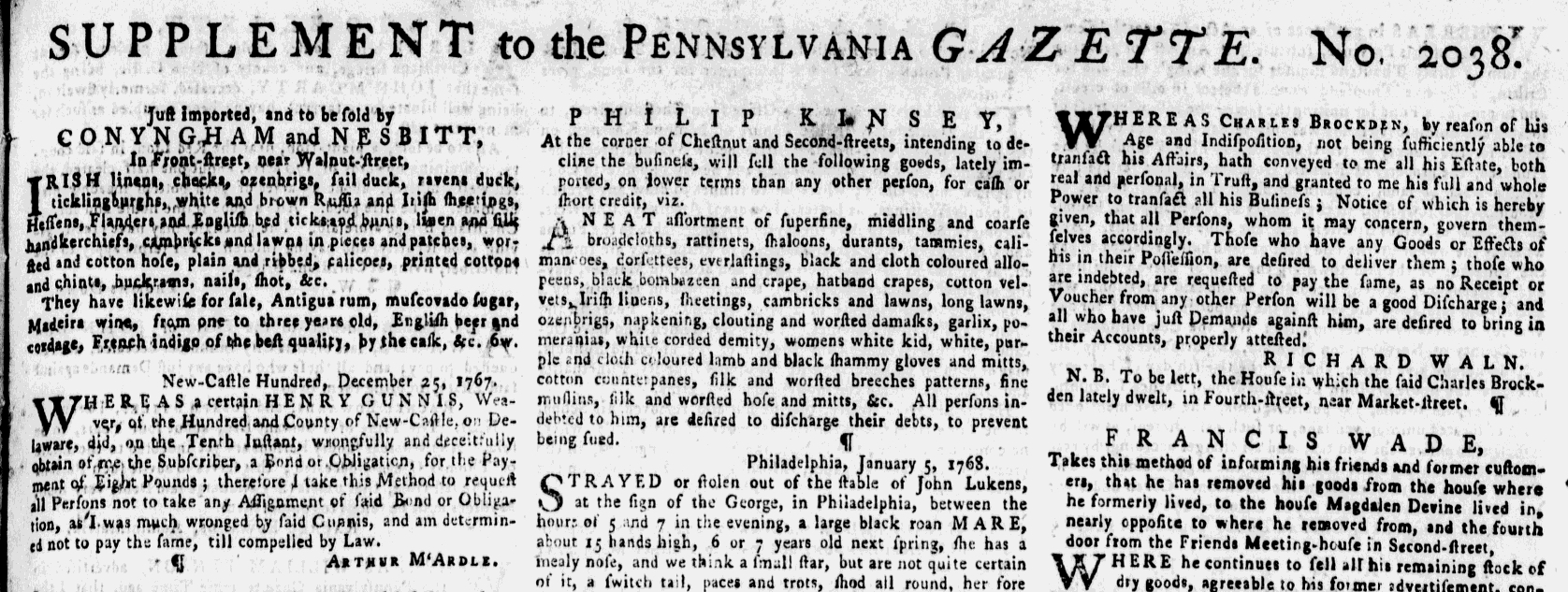
Detail from Supplement to the Pennsylvania Gazette (January 14, 1767).

“SUPPLEMENT to the PENNSYLVANIA GAZETTE.”

No advertisements were published in colonial America on January 17, 1768. That was because January 17, 1768, was a Sunday, the one day of the week that no newspapers were published in any of the colonies. The methodology for the Adverts 250 Project allows for selecting an advertisement printed earlier in the week if none were published on a particular date; I’ll comment more on today’s featured advertisement after establishing the context for its publication. Due to the time, labor, and technology involved in printing in the 1760s, printers issued their newspapers just once a week, though they sometimes circulated a supplement or an extraordinary later in the week if circumstances merited a special publication of momentous news that demanded immediate coverage. That situation occurred with increased regularity as the imperial crisis intensified in the late 1760s and 1770s.

Even though newspapers published only one issue each week, printers staggered their distribution dates. In January 1768, Monday was the most popular date with at least ten newspapers, including four in Boston, made available at the beginning of the week. Only two newspapers, however, appeared on Tuesdays, the South-Carolina Gazette and Country Journal in Charleston and the Wochentliche Philadelphische Staatsbote in Germantown, Pennsylvania. The Georgia Gazette was the sole newspaper published on Wednesdays, followed by five newspapers, including the Pennsylvania Gazette, on Thursdays. Four newspapers, three from New England and the other from South Carolina, appeared on Fridays. The week ended with the publication of the Providence Gazette, conveniently timed to reprint news from the Boston papers as soon as they arrived at the printing office. This accounting includes only those currently available in databases of digitized newspapers. It overlooks only a couple of publications. Their inclusion would not alter the pattern of publishing most newspapers at the beginning of the week, especially in the largest port cities.

For most newspapers, the weekly issue consisted of four pages, a single broadsheet printed on both sides and folded in half. Between news items and advertising, however, some newspapers consistently had sufficient content to publish a two-page half sheet supplement for distribution with the regular issue. Often advertisements filled the entire supplement. Rather than select a particular advertisement to feature today, I have instead chosen one of those supplements filled with advertisements, the Supplement to the Pennsylvania Gazette. Advertisements filled two of the four pages of the standard issue for January 14, 1767, as well as the entire supplement. Overall, advertising comprised two-thirds of the content that week.

David Hall and William Sellers frequently issued an advertising supplement with the standard issue, doing so with such regularity that it practically became a standard feature of the weekly publication. Subscribers were likely more surprised not to receive a supplement overflowing with advertisements than to discover one accompanying the newest edition. Although newspapers in Boston, Charleston, and New York sometimes issued such supplements, the Pennsylvania Gazette did so with the greatest consistency in the late 1760s. This resulted in part from the size of Philadelphia, but also from the attention that the Pennsylvania Gazette’s former proprietor, Benjamin Franklin, devoted to developing newspaper advertising. Among his other accomplishments, Franklin is considered the “Father of American Advertising.” It seems appropriate on his birthday to feature an advertising supplement from the newspaper that he cultivated into the most prominent American publication of the eighteenth century. Advertising, especially the revenue from advertising that allowed for prolonged and widespread distribution, aided in making the Pennsylvania Gazette so influential.

October 30

What was advertised in a colonial American newspaper 250 years ago today?

Oct 30 - 10:30:1767 South-Carolina and American General Gazette
South-Carolina and American General Gazette (October 30, 1767).

“Ravens Duck, German Stripes, Holland Shirting.”

It may appear that I have made an error in posting the image of today’s advertisement, but that is not the case. Rather than rotate it ninety degrees counterclockwise to make it easier to read, I have instead chosen to retain its original orientation from the October 30, 1767, edition of the South-Carolina and American General Gazette. A closer look at E. Pierce’s advertisement for “GERMAN Osnaburghs” and other textiles reveals important lessons about both eighteenth-century printing practices and modern remediation projects.

Pierce’s advertisement appeared on the fifth page of the October 30 issue. Although most issues of eighteenth-century newspapers consisted of only four pages (a single broadsheet printed on both sides and folded in half), sometimes printers issued a two-page supplement when they had sufficient news and advertising. Robert Wells took that approach with this issue, though he did not include a masthead that denoted a supplement. Instead, he continued the consecutive page numbering of the issue, indicating that he conceived of the contents of the extra sheet coming after the news and advertising from the standard issue. If the additional sheet had been tucked into the broadsheet to form the third and fourth pages of a six-page issue (which was quite likely, especially considering the lack of a masthead designating a supplemental issue), the page numbers did not match that format. The pages for the broadsheet ran from 213 to 216. The pages on the half sheet were 217 and 218, indicating Wells thought of them as coming after the other content. Otherwise, they would have been pages 215 and 216, the numbers associated with the third and fourth pages of the six-page issue. The numbering suggests that Wells may not have initially intended to issue a six-page issue but instead made that decision only after some of the sheets had been printed.

Oct 30 - South-Carolina and American General Gazette Page 5
South-Carolina and American General Gazette (October 30, 1767).

Yet this does not explain the odd orientation of Pierce’s advertisement. In order to fit as much content as possible on the pages of the additional sheet, Wells rotated several advertisements to print in short columns that ran perpendicular to the three columns that ran from the top to bottom of the page. Given the scarcity of paper, this also resulted in maximum efficiency in using his resources.

That being the case, it would be helpful to know more about the dimensions of the extra sheet. From the digitized images of the newspaper, the extra sheet appears to be a different size than the standard issue. The broadsheet featured four columns of text, while the additional pages had only three and the narrow column of rotated advertisements. When printing the images on each page on office paper (once again remediating them to 8.5 x 11 inches), the type on the extra sheet appears much larger than the type from the broadsheet, though it all would have been the same type of a consistent size throughout the entire issue read by colonists in the eighteenth-century. Both the digitized images and hard copies of those images hide the original dimensions of the pages of the original newspaper. That aspect of the materiality of the text has been lost because the database that includes these images does not provide sufficient metadata about the size of each page. As an historian with significant experience investigating these sorts of discrepancies, I realize that if I want to learn more about the dimensions of the original broadsheet and additional sheet, which in turn will tell me more about newspaper production in colonial South Carolina, that I must consult an original copy of the newspaper.

Digitization of eighteenth-century newspapers is wonderful for delivering content. The process makes historical sources much more widely accessible to scholars and the general public. The Adverts 250 Project is possible because of digitization. Yet digitization, especially digitization without extensive metadata, only produces surrogates for the original sources, sometimes hiding certain aspects (such as the size of the page or type of paper) even while revealing others (the contents). Robert Wells found it necessary to print two extra pages to accompany the October 30, 1767, edition of the South-Carolina and American General Gazette. The digitized images, however, obscure elements of the printing process and the actual appearance of the newspapers that subscribers and other readers encountered in the eighteenth century.

October 8

What was advertised in a colonial American newspaper 250 years ago today?

Oct 8 - 10:8:1767 Massachusetts Gazette
Massachusetts Gazette (October 8, 1767).

The Advertisements taking up so much Room, the several Articles intended for this Page are thrown into a SUPPLEMENT.”

This notice appeared at the bottom of the first column on the second page of the October 8, 1767, edition of the Massachusetts Gazette. Richard Draper followed a standard procedure among eighteenth-century printers: when faced with too much content to fit into the allotted space he opted to distribute a two-page supplement along with the regular issue. This happened fairly frequently, especially in major port cities. Higher concentrations of residents meant greater numbers of advertisements to squeeze into each week’s four-page issue, sometimes yielding supplements devoted almost exclusively to advertising. The October 8 supplement, however, consisted primarily of news items as a result of “The Advertisements taking up so much Room” in the regular issue.

Draper and the Massachusetts Gazette did not have a higher number of advertisers than usual. Instead, advertisements placed by two local shopkeepers occupied significant amounts of space. Shopkeeper Jolley Allen continued publication of his lengthy list-style advertisement that filled two entire columns on the final page. Not to be outdone, bookseller John Mein commenced a new full-page advertisement for his “grand Assortment of the most MODERN BOOKS In every Branch of Polite Literature Arts and Sciences,” the one that he intended to launch in the Boston-Gazette three days earlier. That advertisement combined a previous advertisement for “A NEW EDITION of Dilworth’s Spelling Book” (set apart almost as a distinct advertisement in the lower right corner) and descriptions of two other books followed by a list of other books and stationery supplies in stock. The compositor created four narrow columns instead of the usual three slightly wider ones, resulting in a new look for that particular page compared to the rest of the newspaper.

Overall, just two advertisements accounted for nearly half of the October 8 issue of the Massachusetts Gazette, making the supplement practically a necessity. This happened as a result of both the printer and the advertisers experimenting with the format for newspaper notices. Although colonial newspapers published full-page advertisements sporadically in the 1760s, having an issue dominated by only two advertisements would have been an extraordinary event for readers, one that would have garnered even more notice among potential customers for John Mein and Jolley Allen.

May 7

What was advertised in a colonial American newspaper 250 years ago today?

May 7 - 5:7:1767 Pennsylvania Gazette
Supplement to the Pennsylvania Gazette (May 7, 1767).

“SUPPLEMENT to the PENNSYLVANIA GAZETTE.”

The masthead of the Pennsylvania Gazette declared that it “Contain[ed] the Freshest Advices, Foreign and Domestic.” Readers expected a variety of news updates from Europe, especially England, the Caribbean and other locales in the Atlantic world, and neighboring colonies. The Pennsylvania Gazette also carried some local news, but when it came to local affairs word of mouth often scooped newspapers published only once a week.

Readers also expected to encounter a variety of advertising. The Pennsylvania Gazette, like its counterparts in the largest colonial port cities, attracted so much advertising that the printers frequently issued a half sheet supplement devoted exclusively to paid notices of various sorts. Doing so shifted the relative balance of news items and advertising, though sometimes the supplement resulted from the regular issue including more news than usual.

Such was not the case with the May 7, 1767, edition of the Pennsylvania Gazette and the accompanying Supplement. News items appeared on only two of the four pages of the standard issue. Instead of two pages, a half sheet, Hall and Sellers created a four-page supplement, an entire broadsheet filled entirely with advertising. This doubled the number of pages in the May 7 issue. It also underscored the newspaper’s roles as a delivery mechanism for advertising. Paid notices covered three-quarters – six out of eight – pages.

Even with the supplement, space was at a premium. The paid notices were composed primarily of text with little variation in font size. Hall and Sellers incorporated few woodcuts into the advertisement: none of the houses or fleeing figures that accompanied real estate and runaway slave advertisements, respectively, and only one ship in a brief notice about “Accommodations for Passengers” aboard a ship departing “For KINGSTON, in JAMAICA,” in three weeks. Four advertisers drew attention to their notices by including woodcuts specific to their businesses that they commissioned. William Dawson, cutler, presumably replicated his shop sign, “the Scythe and Sickle,” as did dyers Joseph Allardyce and Company “at the Sign of the Blue Hand.” John Young, Sr., a saddler, and Richard Truman, who made “Dutch FANS and SCREENS,” each included images of the products they constructed.

Rather than examine a single advertisement published 250 years ago today, consider the entire issue of the Pennsylvania Gazette. Doing so underscores the importance of advertising in the dissemination of some of the most successful and widely circulated early American newspapers. It also demonstrates the extensive culture of consumption in port cities, practices of purchasing and display that filtered out to the provinces as merchants and shopkeepers distributed goods from their point of entry to customers throughout the colonies.

March 17

GUEST CURATOR: Daniel McDermott

What was advertised in a colonial American newspaper 250 years ago today?

Mar 17 - 3:17:1767 South-Carolina Gazette and Country Journal
South-Carolina Gazette and Country Journal (March 17, 1767).

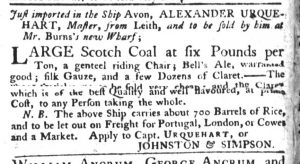
Just imported … LARGE Scotch Coal.”

Since the eighteenth century, coal has been arguably one of the most important commodities in the history of industrialized civilizations. In eighteenth-century America, coal was imported from one of the many mines in Great Britain.[1] Commonly used as a source of energy, coal also brings environmental impacts to surrounding areas when it is burned.

According to the Environmental Protection Agency, its effects on the water cycle in the form of acid rain was one of the earliest known environmental effects from coal. Sulfur dioxide is released from the burning of coal and stays in the atmosphere. However, the sulfur is precipitated out of the atmosphere, just like water, but instead it becomes acid rain. The sulfur dioxide stays in the atmosphere for hundreds of years; therefore, the environmental effects from earlier periods are still present today.[2] For further information on how acid rain affects the environment, you visit the Environmental Protection Agency’s website.

 John Evelyn first reported the effects of air pollution in seventeenth-century England by John Evelyn in his book, Fumufugium. According to Fredric C. Menz and Hans M. Seip, Robert Angus Smith “first conducted detailed studies of acid rain and described many of its potentially harmful effects” in 1872. The importation of coal in eighteenth-century America and the eventually rise of coal mining in North America eventually brought similar environmental problems across the Atlantic. The environmental impacts of coal are not confined to the boundaries of countries or continents.

**********

ADDITIONAL COMMENTARY: Carl Robert Keyes

Alexander Urquehart’s advertisement for “LARGE Scotch Coal at six Pounds per Ton” and an assortment of other goods appeared in an exceptional issue of the South-Carolina Gazette and Country Journal. Like the printers of newspapers in the largest port cities, Charles Crouch sometimes published a supplement when the amount of news, advertising, and other content exceeded what would fit in the standard four-page weekly issue. In most instances, supplements were printed on half sheets, limiting them to two pages. The Supplement to the South-Carolina Gazette and Country Journal issued on March 17, 1767, however, consisted of four pages – or an entire second broadsheet. The size of the sheet used for the supplement (with two columns of text) was not as large as that of the standard issue (with three columns), so this did not double the total content delivered to subscribers. Still, it significantly increased the size of that week’s issue.

In particular, it increased the amount of advertising delivered to readers of the South-Carolina Gazette and Country Journal. The entire supplement – all eight columns – was devoted exclusively to advertising. Indeed, paid notices of every variety practically eclipsed news items in the March 17 issue, making it a delivery mechanism for advertising rather than news (and presumably generating greater revenue for the printer than other issues that balanced the amount of space devoted to advertisements versus other content). Advertising comprised seven of the twelve columns in the standard issue in addition to filling the entire supplement.

Among the news items that did appear, the printer noted that “TO Morrow, being the Anniversary of the REPEAL OF THE STAMP-ACT, we hear will be observed by the Lovers of Liberty and America, with Hearts elate, for our happy Delivery from so manifestly intended Oppression.” Considering that the Stamp Act assessed taxes on each advertisement printed in colonial newspapers, in addition to those leveled for the newspaper itself, it seems appropriate that the printer of the South-Carolina Gazette and Country Journal would mark the first anniversary of its repeal by publishing an issue that overflowed with advertisements.

**********

[1] U.S. Department of Commerce, Historical Statistics of the United States: Colonial Times to 1970, Part 2 (Washington, DC: Government Printing Office, 1975), 1184.

[2] L.A. Barrie and R.M. Hoff, “The Oxidation Rate and Residence Time of Sulphur Dioxide in the Arctic Atmosphere,” Atmospheric Environment 18, no. 12 (1984): 2711-2722.

March 10

What was advertised in a colonial American newspaper 250 years ago today?

Mar 10 - 3:10:1767 South-Carolina Gazette and Country Journal Page 6
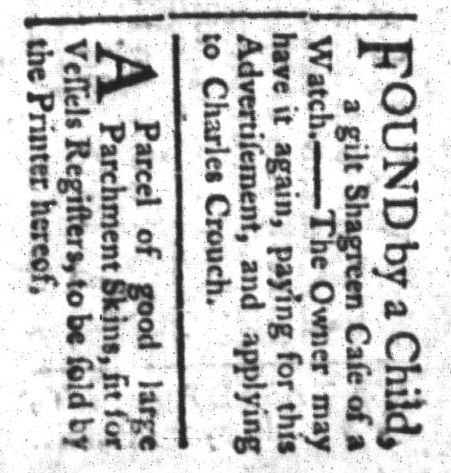
This is the orientation of these advertisements in the Supplement to the South-Carolina Gazette and Country Journal (March 10, 1767).

“A Parcel of good large Parchment Skins, for for Vessels Registers, to be sold by the Printer hereof.”

Advertising supplements were a fairly common feature of newspapers in the 1760s, especially publications printed in the largest American cities. Between news items, commercial notices, and paid announcements of various sorts, printers frequently ran out of space in the standard four-page issue. It made a lot of sense to distribute two-page supplements comprised solely of advertisements since it was advertising, rather than subscription fees, which really paid the bills.

Still, printers had to be careful in allocating resources to the advertising supplements. They had to weight the labor, time, and supplies they would expend against how quickly for frequently they published advertisements. Sometimes printers had more material than would fit in the standard issue but not enough to justify devoting an entire half sheet to a supplement. In such instances, they could opt to print the supplement on smaller sheets.

Mar 10 - South-Carolina Gazette and Country Journal Page 5
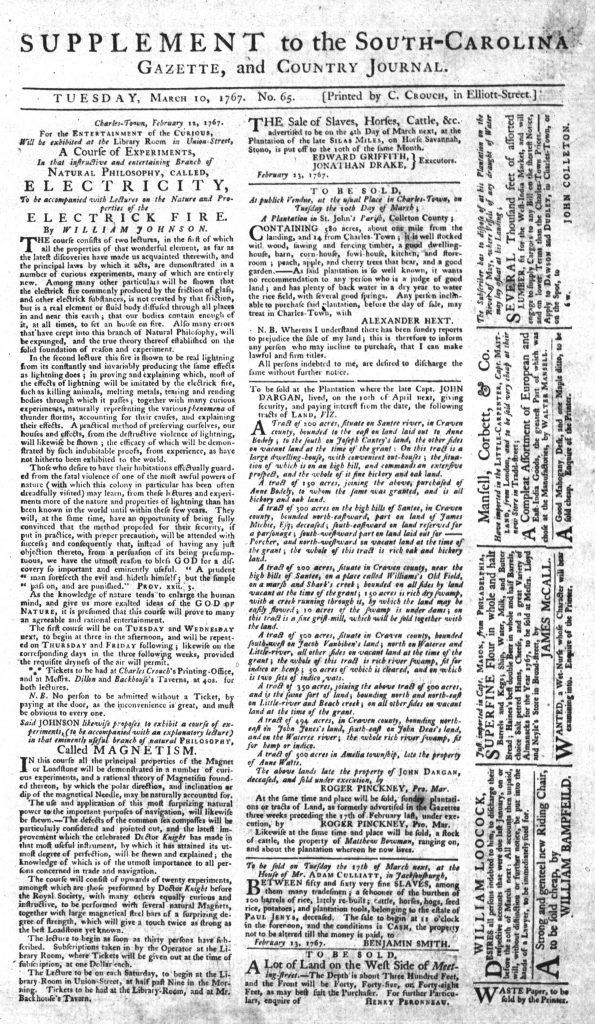
First page of Supplement to the South-Carolina Gazette and Country Journal (March 10, 1767).

Such appears to have been the case with the Supplement to the South-Carolina Gazette and Country Journal from March 10, 1767. It is impossible to say so definitively based solely on digitized images of the newspaper from Accessible Archives. No provider of digital surrogates of eighteenth-century newspapers includes metadata concerning the dimensions of the page or columns relative to individual images. Doing so would be time consuming and prohibitively expensive, resulting in scholars and others having significantly less access to digitized sources at all.

Although I do not have access to original copies of the South-Carolina Gazette and Country Journal from 1767, the layout of the March 10 supplement contains all the indications of a smaller sheet that I have been able to confirm when working between digital surrogates and original copies of other newspapers. The regular issue contains three columns, but the supplement has two columns along with a third column of advertisements rotated to fit in the remaining space. The rotated advertisements are the same width as the others, indicating that type had not been reset, nor would it need to be reset to move any of the advertisements back into future editions of the regular issue.

Mar 10 - South-Carolina Gazette and Country Journal Page 6
Second Page of the Supplement to the South-Carolina Gazette and Country Journal (March 10, 1767).

In this instance, however, Charles Crouch engaged in even greater economy of space than his counterparts who adopted this trick in other newspapers. Rather than provide space between the rotated advertisements in the third column, he squeezed them together in order to fit in very short advertisements. On the front of the supplement, this resulted in a two-line advertisement oriented in a different direction than the others in the third column. On the other side, where he did not have to take space for the masthead into consideration, Crouch found room for two advertisements rotated in the same direction as the others in the additional column.

Charles Crouch worked to fill the March 10 supplement of his newspaper with as much advertising as he could possible fit on its pages. In so doing, he made room to promote products he sold (“WASTE Paper” and “good large Parchment Skins”) that otherwise would not have fit in the regular issue or the supplement.

February 12

What was advertised in a colonial American newspaper 250 years ago today?

feb-12-2121767-pennsylvania-gazette
Pennsylvania Gazette (Februar 12, 1767).

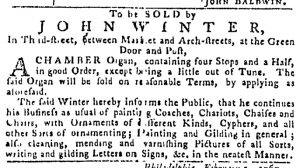
“To be SOLD by JOHN WINTER …”

Yesterday I questioned whether an advertisement for an escaped slave appeared regularly in the Georgia Gazette for six months because the aggrieved master wanted his human property returned so badly or because the printer needed content to fill the pages of the newspaper. Recently I have been contrasting the volume of advertising that appeared in newspapers published in major urban ports compared to those published in smaller cities and towns, usually noting how little advertising appeared in the latter.

Today I am featuring a newspaper at the other end of the spectrum. The Pennsylvania Gazette, founded in 1728 by Samuel Keimer but transformed into one of the most important and influential newspapers in the colonies after Benjamin Franklin in the decades after purchased it in 1729, often served as a vehicle for delivering advertising, sometimes at the expense of other content (including news items),

feb-12-supplement-pennsylvania-gazette
First page of Supplement to the Pennsylvania Gazette (February 12, 1767).

Consider the issue published 250 years ago today. David Hall and William Sellers, the printers of the Pennsylvania Gazette in 1767, placed at least some advertising on every page of the newspaper. Advertisements accounted for a quarter of a column on the second page and column and a half on the front page. Except for the colophon at the bottom of the last page, only advertisements appeared on the third and fourth pages. Nearly sixty advertisements of varying lengths filled just shy of eight columns, out of twelve total, in the February 12, 1767, issue of the Pennsylvania Gazette.

But wait: there’s more! A half sheet supplement accompanied the issue. Hall and Sellers granted a little space for the masthead. Otherwise, advertising filled all six columns of the two-page supplement. Many, but not all, were shorter than those in the regular issue, which allowed Hall and Sellers to squeeze in nearly sixty more paid notices. Unlike their counterparts in other cities, the printers of the Pennsylvania Gazette did not to insert advertisements about the goods and services they provided just to fill the page.

Historians of print culture in early America have long argued that any profits derived from printing a newspaper in the colonies derived from advertising revenue rather than subscriptions. By that measure, Hall and Sellers seemed to be doing very well for themselves as they published the Pennsylvania Gazette in 1767, presumably content to let advertisements sometimes crowd out other content. On the other hand, their decision to do so might also explain why William Goddard underscored that he intended “to give his readers a weekly relation of the most remarkable and important occurrences, foreign and domestic, collected from the best magazines and papers in Europe and America” when he issued his proposals for printing the Pennsylvania Chronicle, a competitor to the Pennsylvania Gazette. Perhaps Goddard suspected that some readers of the Gazette sometimes felt shortchanged when it came to reading actual news, rather than advertising, in their newspaper.

November 10

GUEST CURATOR: Carolyn Crawford

What was advertised in a colonial American newspaper 250 years ago today?

nov-10-11101766-boston-evening-post-supplement
Supplement to the Boston Evening-Post (November 10, 1766).

“A fine assortment of neat pinchbeck shoe-buckles.”

As I read this advertisement, I was overwhelmed by the variety of goods imported in the Thames by Captain Watt and offered for sale by “Baker & Bridgham In Union Street.” The assortment of goods ranged from fabrics such as satins and flannels to accessories such as buckles and buttons.

I was intrigued by the description of the shoe buckles made of pinchbeck. Pinchbeck, a form of brass, was commonly used to design accessories during the colonial era. An alloy of copper and zinc, pinchbeck resembled gold in its appearance. At first, many colonists might have thought that pinchbeck was real gold because of its bright and polished image. However, pinchbeck was a “counterfeit” of gold regularly used to craft various jewelry and other adornments, including rings, necklaces, earrings, brooches and shoe buckles.

Colonial smiths and jewelers designed items made of pinchbeck for customers, who asked for their jewelry and accessories to be specific shapes, include precious stones, or have their name engraved. However, there were other colonists who preferred to take advantage of the already stocked and readymade items that were available from shopkeepers like Baker and Bridgham.

**********

ADDITIONAL COMMENTARY: Carl Robert Keyes

The November 10, 1766, issue of the Boston Evening-Post was accompanied by an advertising supplement. Approximately half of the regular issue already consisted of advertising, but T. and J. Fleet sold more advertisements than the issue could contain. As was often the case with colonial newspapers, this issue and its supplement functioned as a delivery mechanism for advertising more than as a means of delivering news items. Rather than a mixture of legal notices and other sorts of advertising that transmitted news and announcements, almost every advertisement that appeared in the supplement promoted consumer goods and services. A couple of dozen merchants and shopkeepers enticed readers in Boston to desire and purchase the merchandise they stocked.

This supplement demonstrates one of the disadvantages of working with digitized sources. The size of the page on which it was printed appears to be different than the broadsheet for the regular issue, but the database does not provide sufficient metadata (or any sort of measurements at all) to make that determination. Each page of the regular issue included three columns, but both pages of the supplement had four. When downloading the entire issue as a PDF, the supplement appears wider, but there’s no way to know if the relative proportions accurately represent the original sources without consulting those sources themselves. This hinders our ability to understand some of the ways that colonists might have interacted with the advertising supplement as a material text.

The content of the advertisements does not tell the entire story. Was the supplement indeed printed on a larger sheet? If so, why? Would it have been simply to squeeze in all the remaining advertisements? Or was that a strategy the Fleets employed to call special attention to the advertisements they published, perhaps making their newspaper more attractive to other advertisers (and, in turn, generating more revenues)? Is there evidence that the supplement was folded in order to fit inside the original issue and delivered at the same time? The digitized images of the November 10 issue and its supplement do not indicate the answers to these questions. Digital surrogates simultaneously allow for greater access to historical sources and conceal some of the important attributes of the originals.