February 15

What was advertised in a colonial American newspaper 250 years ago today?

Boston-Gazette (February 15, 1773).

“THE Persons who may incline to purchase PATTY HALL’s House … need not be afraid of the Neighbours.”

The feud between Patty Hall and her neighbors continued in the advertisements in the February 15, 1773, edition of the Boston-Gazette.  The altercation first appeared in the public prints when Hall placed a notice offering her house for sale in the February 1 edition of the Boston-Gazette.  She noted that her neighbors made “a great Bustle” in court about “a Piece of Land” associated with the property, but then “dropt the Matter.”  That being the case, she assured “Any Person that inclines to Purchase, may depend that a good Title will be given.”  Hall also accused her neighbors of various acts of vandalism and intimidation, including throwing stones at her.

Hall’s neighbors apparently read or heard about the advertisement.  They did not wait a week to respond in the next issue of the Boston-Gazette.  Instead, they placed notices in the next newspapers published in town, the Massachusetts Gazette and Boston Weekly News-Letter and the Massachusetts Spy on February 4.  Hall’s neighbors sarcastically mentioned the “Politeness” accorded to them before clarifying that the matter had moved to another court and requesting that public “suspend their Judgment” until “Evidences on both Sides are properly examined.”  They also inserted their advertisement in the next issue of the Boston-Gazette on February 8, a week after Hall’s original notice.  It ran immediately above a response from Hall.  She described additional harassment she claimed that she experienced from her neighbors.

Having set the record straight once already, Hall’s neighbors did not feel the need to rush to publish a response to Hall’s latest advertisement.  Instead, they waited for the next edition of the Boston-Gazette on February 15.  In what they framed as a letter to the editors, Hall’s neighbors assured anyone “who may incline to purchase PATTY HALL’s House – with such a Title as she can give – need not be afraid of the Neighbours.”  They asserted that knocking at all hours and other alleged torments “were never heard by the Neighbours” and concluded that “it was all done within Doors.”  That being the case, they declared, Hall was in the best position to identify the real culprits.  Her neighbors recommended that if anyone who purchased the house wished to avoid such intrusions that they “need not keep the same Company” as Hall.

Edes and Gill, the printers of the Boston-Gazette, may have enjoyed the argument between Hall and her neighbors.  They almost certainly appreciated the revenue that their advertisements generated.  In publishing those advertisements, Edes and Gill and the printers of other newspapers abdicated a small amount of editorial control to those who paid to purchase space in their publications.  The advertisements carried news, of a sort, that would not have appeared among the articles and editorials that the printers selected to include elsewhere in their newspapers.  Hall and her neighbors could have relied on rumors and gossip to malign each other, but they realized that advertisements gave them a much larger audience for presenting their grievances to the court of public opinion.

February 8

What was advertised in a colonial American newspaper 250 years ago today?

Boston-Gazette (February 8, 1773).

“MRS. HALL is sensible that the Advertisement in Thursday’s Papers was intended to injure her in the Sale of her House.”

The feud between Patty Hall and her neighbors continued to move back and forth between newspapers.  It began when Hall inserted a notice in the February 1, 1773, edition of the Boston-Gazette.  She accused five of her neighbors of conspiring to drive her out of her house on Hanover Street by making spurious claims in court before dropping the matter and simultaneously vandalizing the house and even throwing stones at her as she passed through her year.  Hall did not give any reason that her neighbors felt such enmity, but she did declare that she could give “a good Title” to anyone who purchased the house.

Rather than waiting a week to respond in the next issue of the Boston-Gazette, Hall’s neighbors inserted a response in the February 4 editions of both the Massachusetts Gazette and Boston Weekly News-Letter and the Massachusetts Spy.  They described themselves as “THE PERSONS mentioned with so much Politeness by Mrs. HALL in her Advertisement” and directed readers to “See Edes and Gill’s last Gazette.”  They advised that the “Conduct of both Parties” would become apparent, “either to their Honor or Disgrace,” upon more extensive examination.  In other words, they cautioned readers not to believe everything that Hall put into print.  At the same time, they warned against trusting the title that Hall offered “until the same shall be determined in a due Course of Law,” clarifying that they had not dropped the case, as Hall indicated, but instead moved it to another court.

Hall had at least one thing in common with her neighbors.  She did not wait to respond in the same newspaper that carried their notice.  She did not allow them that much time to frame the narrative.  Instead, she once again published an advertisement in the Boston-Gazette, this time in the February 8 edition.  Her neighbors apparently decided to insert their advertisement in that newspaper as well.  The compositor conveniently combined the two notices into a single advertisement that told a story for readers.  The format, a short line instead of a full line separating the two notices, allows the possibility that Hall reprinted the advertisement to provide context for her response, but her reference to suspending further advertisements because she had “no Money to trifle with” suggests that she would not have taken on the expense of reprinting an advertisement she found so objectionable.

She certainly meant to acknowledge that “the Advertisement in Thursday’s Papers was intended to injure her in the Sale of her House.”  She intentionally misunderstood the “Compliment to her Politeness,” stressing that she “least intended” any pleasantries because she “knew to whom she was speaking, and chose to address them in a Language they understood.”  She adamantly asserted that she had “no Notion of treating Persons politely” when she suspected them of perpetrating the “dirty Actions” she described in her first advertisements as well as “daubing her Yard and Doors with the most nauseous Filth, beating at her Shutters with Axes and Clubs, and disturbing her with repeated Noises at all Hours of the Night.”  She lamented that she gave her neighbors “no other Provocation” except her “Refusal to cut down Part of her House” until a court determined the true ownership of the land that portion of the dwelling occupied.  Hall claimed that she welcomed a court decision because she was confident that it “will do her Justice, and act without Partiality.”  Beyond the courts, she continued to use the public prints to excoriate her neighbors for their malicious behavior.

Both Hall and her neighbors expected that the public engaged with their version of events across multiple publications and through discussing what they read in one newspaper or another or what their acquaintances told them they had read or heard.  As the adversaries waited for a legal decision from the court, they pursued another sort of vindication in the court of public opinion.

February 4

What was advertised in a colonial American newspaper 250 years ago today?

Massachusetts Gazette and Boston Weekly News-Letter (February 4, 1773).

“The Conduct of the Parties from first to last will best appear … when the Evidences on both Sides are properly examined.”

Printers selected which items appeared among the news and editorials in their newspapers, yet colonizers exercised some amount of editorial authority when they published news in the form of advertisements.  Consider and exchange between Patty Hall and her neighbors in two newspapers published in Boston in the first week of February 1773.

Hall initiated the exchange with an advertisement in the February 1 edition of the Boston-Gazette.  Placing the notice for the purpose of selling a house, Hall seized the opportunity to name several of her neighbors and report that they “made a Complaint to the Selectmen, about a Piece of Land; and they laid it before the Grand Jury; and after making a great Bustle, dropt the Matter.”  The matter being settled, Hall declared that the purchaser “may depend that a good Title will be given.”  According to Hall, that was only the beginning of the trouble she supposedly had with her neighbors.  She claimed that at the same time she “had her Windows broke, Spouts tore down, the Drane stopt,and frequently Stones thrown at all Parts of the House.”  To make matters even worse, she “very nearly escap’d a great Stone thrown at her passing thro’ the Yard.”  She suspected that her neighbors were directly responsible or “employ somebody to do it” and offered a reward to anyone “that will apprehend the Person or Persons concern’d.”

Boston-Gazette (February 1, 1773).

The neighbors that Hall named – “Constable Hale, James Bailey, Samuel Sloan, Retailer, Elizabeth Clarke and Nowell, and Deacon Barrett” – objected to the version of events that Hall published in the Boston-Gazette.  Rather than wait a week to make their rebuttal in the next edition of that newspaper, they inserted their own notice in both the Massachusetts Gazette and Boston Weekly News-Letter and the Massachusetts Spy just three days later.  They identified themselves as “THE PERSON mentioned with so much Politeness by Mrs. HALL in her advertisement, *” and directed readers to “* See Edes and Gill’s last Gazette.”  They offered clarifications about the outcome of the “Bustle” in court, stating that when Hall “gave Notice that the Matter was dropt, she should have added,—  “in order to be taken up at another Court.’”  Unlike Hall, the neighbors considered the matter far from settled.  They encouraged others “to suspend their Judgment both as to the Merits of the Cause and the Title … until the same shall be determined in a due course of law.”  As for the other allegations made by Hall, her neighbors implied that she fabricated the story.  “The Conduct of the Parties from first to last will best appear, either to their Honor or Disgrace,” they asserted, “when the Evidences on both Sides are properly examined.”  In refusing the dignify Hall’s allegations with any more of a response, her neighbors suggested they had no merit.

Hall wished to frame the narrative of her troubles with her neighbors.  Purchasing a paid notice in one of the local newspapers allowed her to do so.  Similarly, those neighbors also bought advertising space to tell their side of the story.  This allowed both parties to bypass the printer-editors of the Boston-Gazette, the Massachusetts Gazette and Boston Weekly News-Letter, and the Massachusetts Spy to determine for themselves what kind of content the public read or heard about as colonizers discussed the altercation that appeared among newspaper advertisements that delivered all kinds of local news.

December 28

What was advertised in a colonial. American newspaper 250 years ago today?

Boston-Gazette (December 28, 1772).

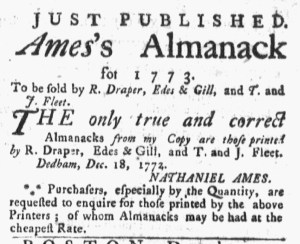
“The only true and correct ALMANACKS from my Copy, are those printed by R. Draper, Edes & Gill, and T. & [J.] Fleet.”

As 1772 came to an end and the new year approached, Richard Draper, Benjamin Edes and John Gill, and Thomas Fleet and John Fleet continued their efforts to direct prospective customers to the edition of Nathaniel Ames’s almanac for 1773 that they collaboratively printed and sold.  The final issues of the Boston Evening-Post, the Boston-Gazette, and the Massachusetts Gazette and Boston Post-Boy for 1772 once again carried advertisements with a note from the almanac’s author that warned against counterfeit editions and proclaimed that the “only true and correct ALMANACKS from my Copy, are those printed by R. Draper, Edes & Gill, and T. & [J.] Fleet.”

None of those newspapers featured the extended version that ran in the Massachusetts Gazette and Boston Weekly News-Letter on December 24.  The Fleets even ran a streamlined version in the Boston Evening-Post, eliminated the introductory lines that declared “THIS DAY IS PUBLISHED, And TO BE SOLD by R. DRAPER, T. & J. FLEET, and EDES & GILL” as well as the final lines that advised “Purchasers, especially by the Quantity, are requested to be particular in enquiring whether they are printed by the above Printers, of whom ALMANACKS may be had at the cheapest Rate.”

The version of the advertisement in the Massachusetts Gazette and Boston Post-Boy remained unchanged, as did the version in the Boston-Gazette.  Edes and Gill did not include any fanfare about “JUST PUBLISHED” the first time they inserted the note from Ames in the Boston-Gazette.  They positioned that note just below local news, implying that it was just as much a piece of newsworthy information as an advertisement for an item they sold.  Those printers pursued a similar strategy the next time they ran the notice.  This time it did not serve as a transition from news to advertising.  Instead, it was the only advertisement that appeared on second page of the December 28 edition of the Boston-Gazette, running immediately below news from Warsaw.  That made it even more likely that anyone carefully perusing the news would encounter the notice from the printers.  Taking advantage of their access to the press to shape how information was disseminated to reader-consumers, Edes and Gill continued their practice of treating counterfeit almanacs that competed with their “true and correct” almanacs as news the community needed to know.  As part of their marketing efforts, they used the placement of the notice on the page to enhance their insinuation that consumers had a duty to choose the “true and correct” copies over any counterfeits.

December 21

What was advertised in a colonial American newspaper 250 years ago today?

Boston-Gazette (December 21, 1772).

“Purchasers, especially by the Quantity, … be particular in enquiring whether they are printed by the above Printers.”

All three newspapers published in Boston on December 21, 1772, carried a notice concerning Nathaniel Ames’s almanac for 1773.  Two of them announced that the almanac was “JUST PUBLISHED” and “sold by R. Draper, Edes & Gill, and T. and J. Fleet.”  All three contained a note from the author to advise consumers that the “only true and correct ALMANACKS from my Copy, are those printed by R. Draper, Edes & Gill, and T. & [J.] Fleet.”  Either Ames or, more likely, the printers added an additional note suggesting that “Purchasers, especially by the Quantity, … be particular in enquiring whether they are printed by the above Printers; of whom ALMANACKS maybe had at the cheapest Rate.”

In addition to the almanacs printed by Draper, Edes and Gill, and the Fleets, Ezekiel Russell and John Hicks produced and sold An Astronomical Diary; or, An Almanack for the Year of Our Lord, 1773 attributed to Ames.  They printed their edition in Boston.  Printers in other towns in New England reprinted Ames’s almanac from Boston editions, including Ebenezer Watson in Hartford, Thomas Green and Samuel Green in New Haven, and Timothy Green in New London.

Massachusetts Gazette and Boston Post-Boy (December 21, 1772).

The printers who printed the “only true and correct” editions of Ames’s popular almanac each inserted the warning about counterfeit editions in their newspapers.  The Fleets ran in the Boston Evening-Post on December 21, the same day that Edes and Gill published it in the Boston-Gazette.  Richard Draper ran a more extensive version in the Massachusetts Gazette and Boston Weekly News-Letter on December 24.  To disseminate the message even more widely, the printers arranged to have the advertisement also appear in the Massachusetts Gazette and Boston Post-Boy on December 21.  Of the five newspapers published in Boston at the time, only Isaiah Thomas’s Massachusetts Spy did not carry the notice.  Instead, it featured an advertisement for the version printed by Russell and Hicks on December 24.

The brief version of the advertisement devised by Draper, Edes and Gill, and the Fleets in the Boston-Gazette, the variation that did not announce the publication of the almanac, appeared immediately below news items and, unlike other advertisements, without a line to separate it from other content.  In making those choices about placement and typography, Edes and Gill implied that information about pirated editions was newsworthy rather than solely a notice directed at consumers.  Blending news and advertising, they sought to serve the best interests of prospective customers while simultaneously protecting their own interests.

It was an interesting turn of events considering that a few years earlier it had been Draper, Edes and Gill, and the Fleets who published a pirated edition of Ames’s almanac.

November 30

What was advertised in a colonial American newspaper 250 years ago today?

Boston-Gazette (November 30, 1772).

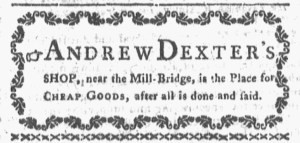
“ANDREW DEXTER’S SHOP.”

Andrew Dexter’s advertisement in the November 30, 1772, edition of the Boston-Gazette consisted of only three lines, but its design likely gave it greater impact than other notices of similar length.  A border comprised of ornamental type enclosed the entire advertisement, making the manicule that called attention to the first line an unnecessary addition.  In its entirety, the advertisement stated, “ANDREW DEXTER’S SHOP, near the Mill-Bridge, is the Place for CHEAP GOODS, after all is done and said.”

Dexter had some experience using borders to set his advertisements apart from others in newspapers published in Boston.  A lengthier advertisement that ran in the Boston Evening-Post, the Boston-Gazette, and the Massachusetts Gazette and Boston Weekly News-Letter in May featured a border.  The border was not nearly as elaborate as the one in the advertisement published in November, but so few newspaper advertisements had borders that it still served its purpose.

Boston Evening-Post (November 30, 1772).

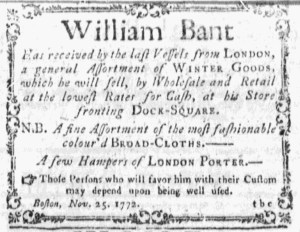
The number of advertisers who opted for borders increased in the wake of examples that Jolley Allen, who had a long history with borders, and Dexter published in multiple newspapers in May.  On the same day that Dexter’s brief notice with the prominent border ran in the Boston-Gazette, William Bant inserted advertisements with borders in both the Boston Evening-Post and the Boston-Gazette.  Jonathan Williams, Jr., once again ran his advertisement enclosed within a border in the Massachusetts Gazette and Boston Post-Boy.  Herman Brimmer and Andrew Brimmer had a border around just their names in an advertisement in the Supplement to the Boston Evening-Post.  Later in the week, Bant and Williams ran advertisements enclosed within borders in the December 4 edition of the Massachusetts Gazette and Boston Weekly News-Letter.  The Brimmers’ advertisement with a border around their names appeared in the supplement that accompanied that issue.

About half a dozen advertisers in Boston incorporated borders into their newspaper notices, publishing them so widely that they became a familiar to readers of several publications.  The majority of advertisers did not adopt this strategy for distinguishing their notices from others, but enough did so to suggest that advertisers carefully observed the tactics deployed by their competitors, including decisions about graphic design, and planned accordingly for their own advertisements.

November 23

What was advertised in a colonial American newspaper 250 years ago today?

Boston-Gazette (November 23, 1772).

“A General Supply of the most modern BOOKS.”

Like many modern booksellers, James Foster Condy sold books and more at his store on Union Street in Boston in the early 1770s.  In a lengthy advertisement that ran in the November 23, 1772, edition of the Boston-Gazette, he highlighted several aspects of his business, promoting his merchandise, his prices, and his customer service.

Condy began with an announcement about a new publication, “A POEM, Entitled, the GRAVE. By Robert Blair.”  That volume also included “An ELEGY written in a Country Church-Yard. By Mr. Gray.”  In addition to listing the price, just one shilling, Condy appealed to colonizers who considered themselves refined consumers of literature, assuring them that the “Pamphlet will fully recommend itself, to the best Judges and Lovers of Poetry.”  The bookseller had a particular interest in this pamphlet, having made arrangements with a local printer to produce a new edition.

The portion of Condy’s advertisement that hawked the poems could have stood on its own as a separate notice, but the bookseller determined that it served as a good introduction to an overview of his wares.  In addition to the poetry, printed in Boston, he also stocked a “General Supply of the most modern BOOKS” imported from London.  Rather than list any titles, Condy highlighted various genres, including “Law, Physick, History, Divinity, and every Branch of polite Literature” as well as bibles and other devotional materials.  He even had “Books for the Amusement and Instruction of Children.”

The bookseller also carried an assortment of stationery and writing supplies.  That portion of his advertisement occupied almost as much space as the portion about the poetry and more than the portion about other books.  Condy listed everything from “Writing Paper of every Sort” and “Account Books of every Size and Quality” to “various Sorts of Penknives” and “Quills,” to “Glass Ink Potts” and “red and black Sealing Wax.”  In yet another section of the advertisement, he called attention to other kinds of merchandise, some of it related to the books and stationery he sold.  Condy stocked “reading Glasses” and “Glasses for near-sighted Persons” as well as “Diagonal Machines for viewing of Prints” and “a Convex Glass for drawing Landscapes.”

The bookseller concluded with a pitch that extended beyond his merchandise.  He proclaimed that he offered the lowest prices that consumers would encounter not only in the city but anywhere in the colonies, asserting that “All those Persons who please to purchase at said Store, may depend on buying as cheap as at any Store in BOSTON or AMERICA.”  He was so confident in that claim that he declared its veracity “without Exception.”  In addition, his customers would be “used” or treated “in such a Manner as will leave no Room for Complaint, but give entire Satisfaction.”  In other words, Condy considered customer service an important aspect of his business.

With all of the books, stationery, writing supplies, glasses, and other merchandise, the inventory at Condy’s bookstore looked much the same to consumers in eighteenth-century America as modern bookstores appear to customers who browse an array of goods.  Condy did not rely on a single revenue stream.  Instead, he marketed and sold a variety of wares, using price and customer service to further entice prospective clients.

November 2

What was advertised in a colonial American newspaper 250 years ago today?

Boston-Gazette (November 2, 1772).

“The Sale of this Book has been so surprizingly rapid, as to demand Three Editions in New-York and Philadelphia.”

Two advertisements for “A DISSERTATION on the GOUT, and all CHRONIC DISEASES” by William Cadogan, “Fellow of the College of Physicians,” ran in the November 2, 1772, edition of the Boston-Gazette, one right above the other.  Benjamin Edes and John Gill, printers of that newspaper and printers of a Boston edition of Cadogan’s book, inserted the first advertisement.  Joseph Edwards, a bookseller, placed the other notice.

Both advertisements attempted to leverage the popularity of the book in other markets to generate sale in Boston.  Edes and Gill confided that the “above Pamphlet had Nine Editions in England in the short Space of Five Months.”  Edwards provided a similar figure, stating that the “Book is so much esteemed in England, that it has already past through Eight Editions.”  It had also gained following in the colonies.  “The Sale of this Book has been so surprizingly rapid, as to demand Three Editions in New-York and Philadelphia.”  Several months earlier, William Bradford and Thomas Bradford deployed a similar strategy in marketing their Philadelphia editions.  Given that so many other readers already purchased the book, the printers and the bookseller in Boston suggested that prospective customers should not miss out on acquiring copies of this bestseller.

Such demand suggested that the “rational and natural Method of CURE” for gout and other chronic illnesses that Cadogan proposed in the book was indeed effective.  Indeed, Edes and Gill even made a joke at the expense of colonizers in New York.  They observed that the book “has had such an Effect on the veteran Bacchanalians of New-York, that Madeira is no longer a fashionable Prescription for the Cure of this Disease.”  The printers included a short blurb from the book, explaining how “strong Wines” like Madeira actually made gout worse rather than better.  Cadogan was so convincing and his cure so effective that even New Yorkers who previously imbibed too much Madeira in their quest to quell the symptoms of gout had given up that remedy in favor of a more “judicious” approach.

Edwards did not resort to such levity.  Instead, he emphasized the accessibility of Cadogan’s writing.  A wide array of readers, not just physicians, could understand the discourse and recommendations in the book.  “The Doctrines advanced in it,” Edwards declared, “are rational and philosophical, and are delivered in a familiar style, which renders them intelligible to Gentlemen of all professions, as well as to Physicians.”  The bookseller sought to avoid the impression of a niche market for the medical text.

In their newspaper notices, the printers and the bookseller promoted the popularity of Cadogan’s Dissertation on the Gout, the effectiveness of the “Method of “CURE” outlined in it, and the accessible style.  Running simultaneous advertisements also testified to the popularity of the book.  Edes and Gill as well as Edwards aimed to encourage sales by creating a wide market that extended beyond physicians.

October 12

What was advertised in a colonial American newspaper 250 years ago today?

Boston-Gazette (October 12, 1772).

“New Advertisements.”

Benjamin Edes and John Gill, printers of the Boston-Gazette, wanted to increase the chances that readers took notice of their call to settle accounts in the fall of 1772.  In the October 12 edition, they inserted an announcement that “ALL Persons indebted for this Paper, whose Accounts have been above 12 Months standing, are requested to make immediate Payment.”  The copy was standard for such notices, placed by printers throughout the colonies, but Edes and Gill deployed a format intended to increase the attention the notice received.  Decorative type enclosed the printers’ notice to delinquent subscribers within a border.  Edes and Gill did not however, devise that format for their own purposes.  Instead, they adopted a strategy already in use by some of their advertisers.  Herman Brimmer and Andrew Brimmer, for instance, enclosed “Variety of Goods,” the headline to their lengthy advertisement listing scores of items, within an ornate border.  Jonathan Williams, Jr., had a border around his entire advertisement.

Edes and Gill also selected an advantageous place on the page for their notice, inserting it at the top of the first column on the final page.  It appeared immediately below a headline for “New Advertisement,” another design element intended to direct attention to the printers’ call for subscribers to pay their bills.  That headline helped to distinguish advertisements on that page from others that ran on the second and third pages.  A brief note on the third page also aided Edes and Gill’s efforts to highlight their notice.  The advertisements on the third page commenced with instructions: “For New Advertisements, See last Page.”  The printers incorporated a variety of means of increasing the visibility of their notice. They exercised their prerogative in placing it first among the notices labeled “New Advertisements” and used notes elsewhere in the issue to direct readers to one of the only advertisements that featured a border composed of decorative type.  Edes and Gill used graphic design to demand attention for an otherwise mundane notice.

September 28

What was advertised in a colonial American newspaper 250 years ago today?

Massachusetts Gazette and Boston Post-Boy (September 28, 1772).

“FALL and WINTER / GOODS / OF ALL KINDS, / AND EXCELLENT / BROAD CLOTHS.”

In their efforts to capture as much of the market as they could, merchants and shopkeepers in cities with multiple newspapers often advertised in more than one publication.  They submitted identical copy to each printing office, but the compositors usually exercised discretion over the appearance of the advertisements in their newspapers.  This resulted in all sorts of variations in capitalization, italics, font sizes, line breaks, and white space.

Consider, for instance, an advertisement that Jonathan Williams, Jr., placed in the Boston-Gazette and the Massachusetts Gazette and Boston Post-Boy on September 28, 1772.  The two notices had identical copy, but what appeared as “Fall and Winter GOODS / of all Kinds,—and excellent / BROAD CLOTHS” on three lines in the Gazette ran as “FALL and WINTER / GOODS / OF ALL KINDS, / AND EXCELLENT / BROAD CLOTHS” over five lines in the Post-Boy.  Similar variations occurred throughout the remainder of the advertisements.  The version in the Post-Boy also occupied more space relative to other advertisements than the one in the Gazette.  Longer than it was wide, Williams’s advertisement in the Post-Boy filled nearly two “squares” of space.  In contrast, his advertisement in the Gazette was wider than it was long, filling a little less than one square.

Boston-Gazette (September 28, 1772).

Despite the differences in size and format, both advertisements featured borders made of decorative type that distinguished them from other notices.  It hardly seems likely that this happened by chance, that compositors working independently in two printing offices just happened to create borders for Williams’s notice.  This suggests that the advertiser played some role in designing those advertisements.  That may have involved brief conversations with the printers or compositors, but more likely resulted from submitting written instructions.

Williams certainly did not invent this strategy of making his advertisements distinctive compared to others that did not incorporate borders or other decorative type.  In July 1766, Jolley Allen placed the same advertisement in four newspapers published in Boston.  They had identical copy but different formats.  Borders enclosed all of them, though the compositors made different decisions about what kind of decorative type formed those borders.  Other advertisers occasionally adopted a similar strategy, hoping the borders would help draw attention to their advertisements across multiple newspapers.