May 2

What was advertised in a colonial American newspaper 250 years ago today?
Boston-Gazette (May 2, 1774).

{ Blue }
Rich { Black and } Sattins
{ White }

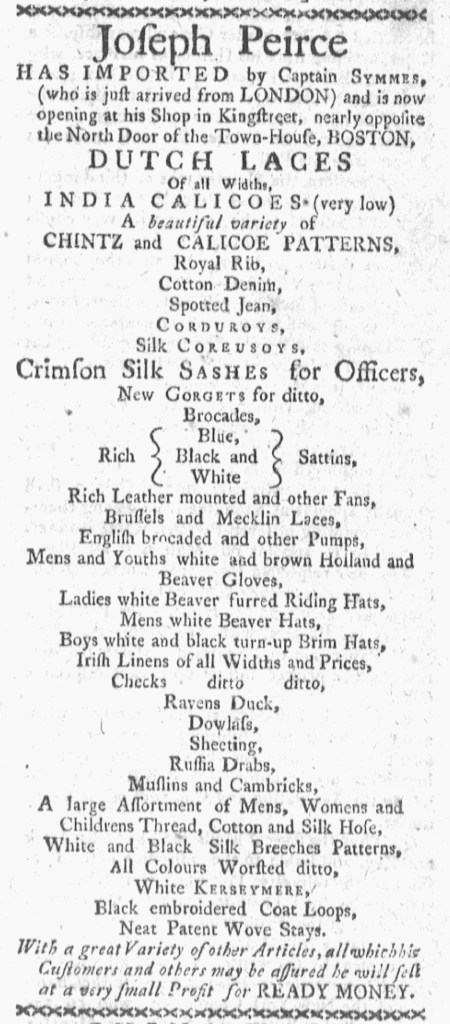
Joseph Peirce’s advertisement on the front page of the May 2, 1774, edition of the Boston-Gazette stood out thanks to its unique graphic design.  The shopkeeper provided a list of merchandise that he recently imported from London, but rather than arrange it in a dense paragraph, as in most advertisements, or create columns with one item per line, as in some advertisements, this one featured one item per line with each line centered.  As a result, the text created an irregular shape with a lot of white space on either side.  That certainly distinguished the advertisement from the news in the column to the right, justified on both sides.

Advertisers usually generated copy, while compositors made most decisions about format.  When merchants and shopkeepers ran advertisements with identical copy in multiple newspapers, variations in fonts, capitalization, italics, font size, and other design elements testified to the creative work done by the compositors in each printing office.  Advertisers likely submitted general instructions with the copy for advertisements that arranged goods in columns, but that may not have always been the case.  M.B. Goldthwait’s advertisement for “DRUGS and MEDICINES” in the April 28, 1774, edition of the Massachusetts Spy, for instance, listed a variety of patent medicines in a paragraph, while his advertisement in the May 2 edition of the Massachusetts Gazette and Boston Post-Boy separated them into side-by-side columns.

Peirce seems to have submitted specific instructions with the copy for his advertisement.  It had the same format in the May 2 editions of the Boston Evening-Post and the Massachusetts Gazette and Boston Post-Boy and the May 5 edition of the Massachusetts Gazette and Boston Weekly News-Letter.  They even gave the same treatment to three lines for:

{ Blue }
Rich { Black and } Sattins
{ White }

That indicates that the compositors incorporated the format that Peirce sketched when he composed the copy.  Curiously, the advertisements in the Boston-Gazette, the Boston Evening-Post and the Massachusetts Gazette and Boston Weekly News-Letter appear identical, as though the printing offices shared type set in one and transferred to the others.  If that was indeed the case, it raises questions about day-to-day operating practices and collaboration among printers in Boston. Even if some printing office shared type, Pierce’s advertisements in the Boston-Gazette and the Massachusetts Gazette and Boston Post-Boy had minor variations while retaining the same format.  That suggests that Peirce provided his vision for his advertisement to at least two printing offices, taking an active role in designing as well as writing his notice.

Left to right: Boston-Gazette (May 2, 1774); Boston Evening-Post (May 2, 1774); Massachusetts Gazette and Boston Weekly News-Letter (May 5, 1774).

March 18

What was advertised in a colonial American newspaper 250 years ago today?

Connecticut Gazette (March 18, 1774).

Make Way! A Probationer for NEW GATE!

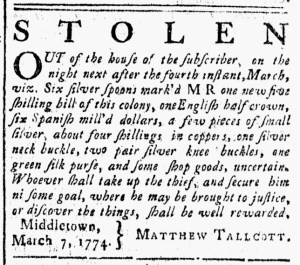
For Matthew Talcott, all was fine on the evening of March 4, 1774, but he woke up to discover a calamity the next morning.  Sometime during the night six silver spoons “marked M R,” “one silver neck buckle, two pair silver knee buckels,” quite a bit of cash, and “some shop goods, uncertain,” had been stolen from his shop in Middletown, Connecticut.  In response, Talcott turned to the public prints, running advertisements in hopes that someone “shall take up the thief, and secure him in some [jail], where he may be brought to justice.”  He also sought to recover the stolen items and money.  In addition to giving a reward, he invested in advertisements in three newspapers published in the colony.

Connecticut Journal (March 18, 1774).

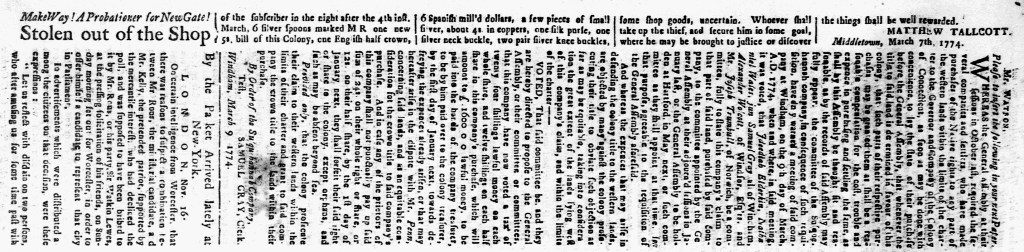
Talcott’s advertisement first appeared in the Connecticut Gazette, published in New London, and the Connecticut Journal and New-Haven Post-Boy on March 11.  In each instance, a headline alerted readers to the contents of the rest of the advertisement.  The Connecticut Journal used “STOLEN” as the headline, while the Connecticut Gazette featured a more playful one that may have attracted even more attention: “Make Way! A Probationer for NEW GATE!”  The colony had recently opened a prison in a copper mine converted for that purpose in East Granby.  Someone in the printing office, rather than Talcott, may have devised the headline.

What suggests that was the case?  The two advertisements featured some variations.  The one in the Connecticut Gazette indicated that the theft took place “out of the Shop” while the Connecticut Journal stated it occurred “OUT of the house” of the unfortunate Talcott.  He likely worked where he resided.  Some of the stolen goods also appeared in slightly different order.  Talcott likely wrote the copy once for one newspaper and then copied it for the other, but was not exact in the process.  The compositor for the Connecticut Journal then used the first word as the headline, a common practice.  The editor or the compositor for the Connecticut Gazette, on the other hand, may have spotted an opportunity for creativity.

Connecticut Courant (March 15, 1774).

Consider that Talcott’s advertisement next ran in the Connecticut Courant, published in Hartford, on March 15.  It featured the same copy, including the snappy headline, that appeared in the Connecticut Gazette.  It also appeared in the margin on the final page, suggesting that the printing office received the advertisement at the last moment.  Type had already been set for the rest of the issue, but the compositor found a way to include Talcott’s notice.  Rather than Talcott submitting his advertisement directly to the Connecticut Courant, he may have made arrangements with the printer of the Connecticut Gazette to instruct his counterpart in Hartford to publish it, marking it in the copy sent as part of an exchange network of printers throughout the colony and the region.

While not conclusive, the circumstances collectively suggest that Talcott wrote the original copy, the Connecticut Gazetteembellished it with a provocative headline, and the Connecticut Courant reprinted it.  Several people played a role in creating the advertisement ultimately distributed to readers throughout the colony.

October 28

What was advertised in a colonial American newspaper 250 years ago today?

New-York Journal (October 28, 1773).

“Gentlemen’s caps, and gloves, lined with fur, very useful for travelling, and sleighing.”

During the final week of October 1773, John Siemon, a furrier, inserted advertisements in three newspapers published in New York, placing his notices before the eyes of as many readers in and near the city as possible.  He hawked a “General and complete assortment, of new fashion’d muffs & tippets, ermine, cloak linings, … gentlemen’s caps, and gloves, lined with fur,” and other items.  In addition, he “trims Ladies robes and riding dresses” and “faces and lapels Gentlemen’s waistcoats.”  As an ancillary service, Siemon provided directions “to rub the furs in summer” to keep them in good condition when not being worn.

Although Siemon submitted nearly identical copy to the three printing offices, his advertisements had very different formats when they appeared in the newspapers.  Arguably the one that best represented Siemon’s brand, the notice in the New-York Journal featured a woodcut depicting a muff, an image that regularly accompanied the furrier’s advertisements.  Siemon apparently considered it worth the investment to commission a single woodcut for the exclusive use of his business, but did not realize the potential of purchasing multiple woodcuts with the same image in order to achieve visual consistency and product recognition across several publications.

Rivington’s New-York Gazetteer (October 28, 1773).

Siemon’s advertisement in Rivington’s New-York Gazetteer had a different kind of visual appeal.  The furrier joined the ranks of advertisers who enclosed their notices within borders comprised of decorative type, including Crommelin and Horsfield, bakers, John J. Roosevelt, a merchant, Richard Sause, a cutler.  James Rivington and the compositors in his printing office made such borders a regular part of advertisements for consumer goods and services.  Those borders helped to draw attention to certain advertisements while also giving the pages of Rivington’s newspaper a distinctive look.  In contrast, no images or decorative type adorned Siemon’s advertisement in the New-York Gazette and Weekly Mercury.  It consisted solely of text with the typography determined by the compositor to match other advertisements in that publication.

New-York Gazette and Weekly Mercury (October 25, 1773).

In most instances, advertisers submitted copy to printing offices and then compositors determined the format of the advertisements.  Siemon’s advertisements suggest that was indeed the case when advertising in the New-York Gazette and Weekly Mercury, yet he offered specific directions, in the form of the familiar woodcut, for his advertisement in the New-York Journal.  His advertisement in Rivington’s New-York Gazetteer demonstrates the greatest level of collaboration between advertiser and compositor.  Siemon either requested or agreed to include a distinctive visual element associated with notices in that newspaper.  The furrier took graphic design into account to varying degrees in his efforts to disseminate his advertisements in multiple newspapers.

September 20

What was advertised in a colonial American newspaper 250 years ago today?

Massachusetts Gazette and Boston Post-Boy (September 20, 1773).

When there will be added to his other Performances.

Mr. Bates continued exhibiting feats of horsemanship for audiences in Boston in late September 1773, advertising once again in the September 20 editions of the Boston Evening-Post, the Boston-Gazette, and the Massachusetts Gazette and Boston Post-Boy.  He planned his next performance for Tuesday, September 21, weather permitting.  He placed shorter notices in the first two newspapers, but in the Massachusetts Gazette and Boston Post-Boy reverted to some of the material from the lengthier version that he initially published to introduce himself when he arrived in town.

The copy of the Massachusetts Gazette and Boston Post-Boy digitized in America’s Historical Newspapers features manuscript additions, likely notes generated in the printing office when producing a handbill for Bates’s performance a week later on September 28.  For instance, the date has been crossed out and “28” written above it.  Similarly, “at the Bottom of the MALL in Boston” has a line through it after a description of the act with the location added in manuscript to the portion giving the date.  Manuscript additions for “A Variety of Manly Exercises never se[en here]” and the word “with” to introduce “a Burlesque on Horsemanship” appear on that copy of the newspaper, later integrated into the handbill, along with a line through “The Seats are made proper Ladies and Gentlemen,” which did not appear on the handbill.  The newspaper advertisement also features manuscript lines under each of the European courts where Bates previously performed.  Perhaps the compositor or an assistant underlined each when added to the handbill, ensuring none were overlooked or inadvertently omitted.  Large crosshatching at the bottom of the advertisement may have been added once all the material had been set in type and transferred to the handbill.

Handbill: Mr. Bates, “Horsemanship,” (Boston: [likely Nathaniel Mills and John Hicks], 1773). Courtesy American Antiquarian Society.

The manuscript additions do not capture all of the additions made to the handbill.  For instance, the handbill included an appeal intended to incite a sense of urgency to see the show: “AS Mr. BATES’s Stay in Town will be but short, he will go thro’ all his Performances at the above Time.”  In other words, audiences would see all of the acts in his repertoire during a single performance, but only if they acquired tickets quickly before Bates departed from Boston.  He previously used a similar marketing strategy in New York.  Even though the manuscript notes do not document every revision made for the handbill, they do suggest that Bates turned to the printing office of Nathaniel Mills and John Hicks, the printers of the Massachusetts Gazette and Boston Post-Boy, to produce the handbill.  The colophon for their newspaper solicited advertisements, presumably both newspaper notices and other formats, and stated that they pursued the printing business “in its different branches.”  This copy of the Massachusetts Gazette and Boston Post-Boy digitized for broader access to the newspaper likely reveals some of the consultation between the printing office and the advertiser that went into producing a handbill that circulated in Boston.

July 6

What was advertised in a colonial American newspaper 250 years ago today?

Essex Gazette (July 6, 1773).

“Should it be observed that Mr. Watkins’s Advertisement, in the next Page, is not inserted in due Order, it may be imputed to our mistaking his Design in the Copy.”

Benjamin Watkins’s advertisement in the July 6, 1773, editions of the Essex Gazette filled two-thirds of a column.  In it, he listed many of the items included among the “fine Assortment of English and India GOODS” that he sold at his shop in Marblehead, Massachusetts.  Listing one or two items per line, Watkins divided his advertisement into two columns.  Compared to other advertisements that consisted of dense paragraphs that clustered the merchandise together, this format incorporated more white space that made it easier for prospective customers to peruse and spot items of interest.

Essex Gazette (July 6, 1773).

Still, the advertisement may not have appeared exactly as Watkins intended.  The editors considered it necessary to publish a brief notice about it: “Should it be observed that Mr. Watkins’s Advertisement, in the next Page, is not inserted in due Order, it may be imputed to our mistaking his Design in the Copy.”  In general, advertisers usually submitted copy to printing offices and then entrusted the format of their advertisements to compositors.  On occasion, some advertisers made special requests or gave instructions, as seems to have been the case with Jolley Allen and the decorative borders that regularly enclosed his advertisements that ran simultaneously in multiple newspapers in Boston.

On occasion, advertisers submitted copy in the format they desired.  That seems to have been the case with Watkins when he sent his advertisement to the printing office in Salem.  Apparently, Watkins’s message to the printers and notes on the format caused some confusion, prompting the compositors to do their best to follow his directions.  Those efforts fell short.  An updated version of the advertisement appeared in the next issue of the Essex Gazette.  It retained the format of two columns with one item per line, but removed some items and moved others so they appeared in a different order.

What kind of communication occurred between Watkins and the printing office?  Watkins ran a shorter advertisement in the June 22 edition.  It consisted of the introduction to the longer versions as well as a nota bene that explained, “The Particulars to be in next Week’s Paper.”  The printers may have inserted that note because they did not have sufficient space to run Watkins’s entire advertisement in that issue, but that may have also been a strategy to gain more time to decipher whatever the merchants sent to the printing office.  On June 29, the longer advertisement appeared for the first time, in the format that merited the note in the July 6 edition.  Perhaps the printers received a message from a dissatisfied Watkins after they had already printed the page that included the second insertion of his advertisement.  In acknowledgment, they published the note on the last page that went to press and then set about making corrections to achieve a final version that ran in four consecutive issues.

Though speculative, this seems like a reasonable sequence of events based on the various iterations of the advertisements and common practices in printing offices in eighteenth-century America.  It suggests that some advertisers actively provided extensive directions concerning format and design even though most simply submitted copy and left the rest to the compositors.

October 8

What was advertised in a colonial American newspaper 250 years ago today?

South-Carolina Gazette (October 8, 1772).

“Dancing & Fencing.”

“THE Sign of the Golden Cup.”

Mr. Pike, a dancing master, and Thomas You, a silversmith, both used graphic design to draw attention to their advertisements in the October 8, 1772, edition of the South-Carolina Gazette, yet they adopted different strategies.  Their notices further enlivened the vibrant graphic design that distinguished notices in that newspaper from those that ran in other newspapers.  The compositor for the South-Carolina Gazette made liberal use of varying font sizes, gothic letters for headlines, italics, capitals, and centering compared to advertisements.

That being the case, the compositor may have played a role in how the dancing master used decorative type and gothic letters to enhance his advertisement.  The headline “Dancing & Fencing” in gothic letters appeared inside a border composed of printing ornaments above a secondary headline spread over three lines: “PIKE’s ACADEMY / for / DANCING and FENCING.”  Compare that to a similar advertisement that Pike ran in the South-Carolina Gazette and Country Journal.  It featured only one headline, “DANCING and FENCING,” that did not appear in a different font than the rest of the advertisement.  Rather than constituting a second headline, “PIKE’s ACADEMY, for FENCING and DANCING” was part of the first paragraph of the advertisement.  An enterprising compositor at the South-Carolina Gazette likely played a significant role in designing Pike’s advertisement, perhaps assuming full responsibility without consulting the advertiser.

On the other hand, You almost certainly submitted instructions to include a woodcut depicting a golden cup in his advertisement for the merchandise he sold at the “Sign of the Golden Cup.”  You commissioned that image for his exclusive use, previously inserting it in advertisements in the South-Carolina Gazette in December 1770 and March 1771.  Prior to that, he used a different woodcut in his advertisements in December 1766 and July 1767.  He seemed to appreciate that images helped draw attention to his notices.  How to incorporate an image, however, he may have left to the discretion of the compositor.  In 1772, his woodcut of a golden cup appeared in the center, flanked by his name and location.  In earlier advertisements, it was positioned to the left, replicating the placement of woodcuts depicting ships that adorned other notices.

The advertisements in the South-Carolina Gazette testify to both the role of the compositor in designing newspaper notices and occasional collaboration or consultation involving both the compositor and the advertiser.  Rather than dense text, variations abounded in the advertisements in that newspaper, making the South-Carolina Gazette one of the most visually interesting publications in the early 1770s.

September 28

What was advertised in a colonial American newspaper 250 years ago today?

Massachusetts Gazette and Boston Post-Boy (September 28, 1772).

“FALL and WINTER / GOODS / OF ALL KINDS, / AND EXCELLENT / BROAD CLOTHS.”

In their efforts to capture as much of the market as they could, merchants and shopkeepers in cities with multiple newspapers often advertised in more than one publication.  They submitted identical copy to each printing office, but the compositors usually exercised discretion over the appearance of the advertisements in their newspapers.  This resulted in all sorts of variations in capitalization, italics, font sizes, line breaks, and white space.

Consider, for instance, an advertisement that Jonathan Williams, Jr., placed in the Boston-Gazette and the Massachusetts Gazette and Boston Post-Boy on September 28, 1772.  The two notices had identical copy, but what appeared as “Fall and Winter GOODS / of all Kinds,—and excellent / BROAD CLOTHS” on three lines in the Gazette ran as “FALL and WINTER / GOODS / OF ALL KINDS, / AND EXCELLENT / BROAD CLOTHS” over five lines in the Post-Boy.  Similar variations occurred throughout the remainder of the advertisements.  The version in the Post-Boy also occupied more space relative to other advertisements than the one in the Gazette.  Longer than it was wide, Williams’s advertisement in the Post-Boy filled nearly two “squares” of space.  In contrast, his advertisement in the Gazette was wider than it was long, filling a little less than one square.

Boston-Gazette (September 28, 1772).

Despite the differences in size and format, both advertisements featured borders made of decorative type that distinguished them from other notices.  It hardly seems likely that this happened by chance, that compositors working independently in two printing offices just happened to create borders for Williams’s notice.  This suggests that the advertiser played some role in designing those advertisements.  That may have involved brief conversations with the printers or compositors, but more likely resulted from submitting written instructions.

Williams certainly did not invent this strategy of making his advertisements distinctive compared to others that did not incorporate borders or other decorative type.  In July 1766, Jolley Allen placed the same advertisement in four newspapers published in Boston.  They had identical copy but different formats.  Borders enclosed all of them, though the compositors made different decisions about what kind of decorative type formed those borders.  Other advertisers occasionally adopted a similar strategy, hoping the borders would help draw attention to their advertisements across multiple newspapers.

May 7

What was advertised in a colonial American newspaper 250 years ago today?

May 7 - 5:7:1768 Providence Gazette
Providence Gazette (May 7, 1768).

“To be SOLD by JOSEPH AND Wm. RUSSELL.”

How much influence did eighteenth-century advertisers exert when it came to designing their advertisements? This notice placed by prolific advertisers Joseph Russell and William Russell complicates the usual answer to that question.

In most instances advertisers submitted copy and left it to compositors to determine format. The publication of the same advertisement in multiple newspapers with consistent copy but significant deviations in layout, font size, and other visual aspects testifies to the division between advertisers as copywriters and compositors as designers. Yet on relatively rare occasions some advertisements retained specific visual elements, such as a decorative border, across multiple publications, indicating that an advertiser did indeed have a hand in determining the format. In general, most colonial newspapers exhibited an internal logic when it came to the appearance of advertisements. Compositors tended to standardize the appearance of paid notices within their publication depending on genre (consumer goods and services, legal notices, runaway slaves, for example), even as the copy differed from advertisement to advertisement. Advertisers often resorted to formulaic language and accepted patterns for including information, contributing to that standardization of visual elements.

The advertisements in the Providence Gazette, however, displayed far less consistency when it came to graphic design. Compared to counterparts at other newspapers, the compositor seems to have been much more interested in experimenting with how to use type to create distinctive advertisements even when those advertisements were comprised entirely of text. Does the compositor deserve exclusive credit for such innovations? Or did the variations emerge as the result of consultations with advertisers?

Although the advertisement the Russells placed in the May 7, 1768, edition of the Providence Gazette does not provide any definitive answers, its various elements suggest some level of collaboration. It featured a headline that listed a product rather than the names of the advertisers. Their names appeared at the end of the notice, quite unusual for advertisements that promoted consumer goods and services. The dual columns listing their wares differed from the structure of most, but not all, other advertisements recently published in that newspaper. The Russells may have worked closely with the compositor. Alternately, they may have noticed how the compositor experimented with type in previous issues of the Providence Gazette and decided to alter the copy they submitted in order to facilitate further innovations. Even if they did not directly consult the compositor, they may have been inspired to pursue their own experiment in composing copy to see how those advertisements would then appear in print. Whether initiated by compositors or advertisers, one innovation in the appearance of paid notices in the Providence Gazette may have sparked a series of other innovations that resulted in advertisements for consumer goods and services in that newspaper exhibiting greater distinctiveness among themselves compared to the static appearance of most advertisements published in other newspapers.