May 27

What was advertised in a revolutionary American newspaper 250 years ago today?
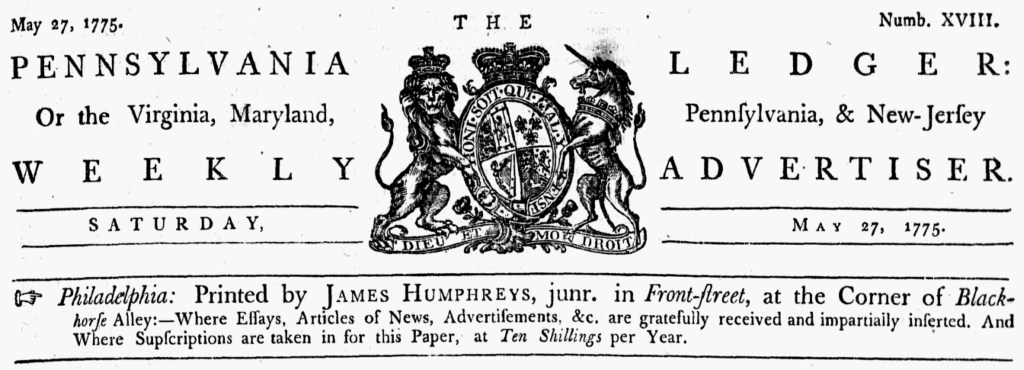
Pennsylvania Ledger (May 27, 1775).

“Essays, Articles of News, Advertisements, &c. are gratefully received and impartially inserted.”

Among newspapers published during the era of the American Revolution, those that included a colophon usually featured it at the bottom of the final page.  A few, including the Pennsylvania Ledger, incorporated the colophon into the masthead.  James Humphreys, Jr., the printer, also used the colophon as a perpetual advertisement for subscriptions and advertisements.  After all, the full title of the newspaper was the Pennsylvania Ledger: Or the Virginia, Maryland, Pennsylvania, & New Jersey Weekly Advertiser.  Accordingly, the colophon gave more than just place of publication and the name of the printer (“Philadelphia: Printed by JAMES HUMPHREYS, junr. in Front-street, at the Corner of Black-horse Alley”); it also informed readers that “Essays, Articles of News, Advertisements, &c. are gratefully received and impartially inserted” and “Subscriptions are taken in for this Paper, at Ten Shillings per Year.”  The enhanced colophon did not, however, give prices for advertising, though Humphreys stated that he set “the same terms as is usual with the other papers in the city” in the subscription proposals he distributed in January 1775.

What did Humphreys mean when he declared that he “impartially inserted” essays (or editorials), news, and advertisements?  In the proposals t, he asserted that “a number of worthy and reputable Gentlemen” in Philadelphia had encouraged him “to establish a Free and Impartial NEWS PAPER, open to All, and influenced by None.”  Furthermore, he proclaimed that he was “determined to act on the most impartial principles, and not render himself liable to be influenced by any party whatever.”  Such idealism stood in stark contrast to the partisanship of most newspapers as the imperial crisis intensified.  Humphreys’s determination to print essays and news from various perspectives amounted to sufficient proof for many Patriots that the printer was a Loyalist since he did not uniformly promote the American cause.  Decades later, Isaiah Thomas, the patriot printer who published the Massachusetts Spy at the same time Humphreys published the Pennsylvania Ledger, took a more evenhanded approach in his History of Printing of America: “The publisher announced his intention to conduct his paper with political impartiality; and perhaps, in times more tranquil than those in which it appeared, he might have succeeded in his plan.  …  The impartiality of the Ledger did not comport with the temper of the times.”[1]  Thomas seemed to consider Humphreys’s commitment to freedom of the press authentic rather than a rationalization for printing Loyalist views.  He was not so kind in his descriptions of other printers whose politics did not align with his own.

Still, the “temper of the times” likely prompted Humphreys to adjust his own advertising for political pamphlets available at his printing office.  When it came to “impartially insert[ing]” advertisements submitted by others, he gave assurances that he neither took an editorial stance when it came to the information they disseminated nor gave some more prominent placement on the page than others.  He did not rank newspapers notices but instead gave advertisers equal access to his press.

**********

[1] Isaiah Thomas, The History of Printing in America: With a Biography of Printers and an Account of Newspapers (1810; New York: Weathervane Books, 1970), 439-440.


September 13

What was advertised in a colonial American newspaper 250 years ago today?

Essex Gazette (September 13, 1774).

“This GAZETTE may be had for 6s. 8d. per Annum, exclusive of Postage.”

The printers of the Essex Gazette incorporated the colophon into the masthead of that newspaper.  Within that masthead, they declared that the publication “Contain[ed] the freshest Advices, both foreign and domestic” and gave the date and volume and issue numbers.  Next came the publication information that more often appeared at the bottom of the final page in other newspapers: “SALEM: Printed by Samuel and Ebenezer Hall, at their Printing-Office in King-Street.”  That made it easy for prospective subscriber and advertisers as well as others with business for the printers to contact or visit them.

Even with that choice about where to place the colophon, the Halls still recognized the bottom of the final page as valuable space for promoting their newspaper, publishing a perpetual advertisement that ran across all three columns in each issue.  A single line advised, “This GAZETTE may be had for 6s. 8d. per Annum, exclusive of Postage – 3s. 4d. (or 4s. 6d. if sent by the Eastern Post) to be paid at Entrance.”  Throughout the colonies, printers generously extended credit to subscribers, recognizing that if they increased their circulation then they could attract more advertisers.  In turn, printers often published notices calling on subscribers to pay for subscriptions going back months and even years.

For their part, the Halls refused to assume the risk of allowing readers to subscribe completely on credit.  They required payment of three shilling and four pence, half of the annual price of six shillings and eight pence, at the time that subscriptions commenced.  Even if they had difficulty collecting the balance from subscribers, those initial payments covered some of the expenses and limited their losses.  In addition, subscribers who ordered their newspapers delivered by a post rider were expected to pay an additional shilling at the start, though the notice did not indicate if that covered the entire year or, like the entrance fee, was only half of what subscribers were expected to pay.  Either way, the Halls intended that service would further expand their circulation.

No matter what kinds of news or paid notices the printers placed on the final page of the Essex Gazette from week to week, readers always encountered an advertisement for the newspaper as the final item.  Colonial newspapers often passed from hand to hand, reaching readers beyond the original subscribers.  This strategy encouraged those additional readers to consider purchasing their own subscriptions for consistent access to the news rather than rely on the possibility that others would share their newspapers.

July 22

What was advertised in a colonial American newspaper 250 years ago today?

South-Carolina and American General Gazette (July 22, 1774).

“Orders for Books, Stationary Wares, Book-binding & Printing Work.”

Like many other printers, Robert Wells, printer of the South-Carolina and American General Gazette used the colophon of his newspaper as an advertisement for that newspaper and a variety of goods and services available at his printing office.  His colophon, however, appeared in a different place than most others that ran either at the bottom of the final page or, less often, within the masthead at the top of the first page.  Wells placed his colophon at the bottom of the first page, extending across all four columns.  He sometimes devoted each of those columns to news, as was the case for the July 22, 1774, edition, yet other times included paid notices on the first page.  No matter what other content appeared, readers encountered an advertisement on the front page in the form of the colophon.  They did so repeatedly if they perused all four columns before examining the rest of the newspaper.

In that colophon, Wells gave a grand name to the site where he conducted business, calling it the “OLD PRINTING-HOUSE, GREAT STATIONARY and BOOK STORE.”  That name testified to his experience as a printer (“OLD”) and the quality and array of merchandise he stocked (“GREAT”).  He advised that he received “SUBSCRIPTIONS andADVERTISEMENTS for this Paper, which is circulated through all the SOUTHERN COLONIES, &c.”  That included Georgia and North Carolina in addition to South Carolina with “&c.” (et cetera) suggesting Virginia and Maryland as well.  The South-Carolina and American Gazette directly competed with the South-Carolina Gazette, printed by Peter Timothy, and the South-Carolina Gazette and Country Journal, printed by Charles Crouch, both published in Charleston.  In emphasizing the vast reach of his newspaper’s circulation, Wells sought to encourage advertisers who wished to disseminate information as widely as possible, whether they aimed to sell consumer goods, enslaved people, or real estate, or called on colonizers to settle accounts with businesses or the executors of estates or described enslaved people who had liberated themselves by running away from their enslavers.  The printer also accepted “Orders for Books, Stationary Wares, Book-binding & Printing Work,” a variety of goods and services enmeshed within the book trades.  “Printing Work” included broadsides, handbills, trade cards, catalogs, and other advertising ephemera for customers to distribute on their own, contributing to the culture of marketing in the colonies and disseminating information in print via means other than newspapers.  Wells wished to generate greater demand for printed materials, including advertisements, that would benefit both his customers and his business.  In doing so, he devised a colophon that did more than identify the location and printer of the South-Carolina and American General Gazette.

December 12

What was advertised in a colonial American newspaper 250 years ago this week?

New-York Journal (December 9, 1773).

“Advertisements of no more Length than Breadth are inserted for Five Shillings, four Weeks, and One Shilling for each Week after, and larger Advertisements in the same Proportion.”

Some printers kept the colophons for their newspapers quite simple, if they included one at all.  The colophon for the Boston-Gazette, for instance, simply stated, “Boston: Printed by EDES & GILL, in Queen-Street, 1773.”  The colophon for the Boston Evening-Post was even more streamlined: “BOSTON: Printed by THOMAS & JOHN FLEET.”  In each instance, the colophon usually appeared at the bottom of the final column on the last page, rather unobtrusive, though the printers sometimes moved the colophon to the third page if they lacked space.

In contrast, other printers inserted much more elaborate colophons that ran across all the columns at the bottom of the final page, that position a permanent element of the design of their newspapers.  In such cases, the colophons often doubled as advertisements, providing much more information than the name of the printer and place of publication.  Such was the case with the colophon for the New-York Journal.  The first line covered the basics: “NEW-YORK: Printed by JOHN HOLT, at the Printing-Office near the COFFEE-HOUSE.”  Two more lines made a sales pitch for the services available at Holt’s printing office, declaring “all Sorts of Printing is done in the neatest Manner, with Care and Expedition.”  Holt invited job printing orders, whether for broadsides, handbills, trade cards, or blanks, touting both his skill and speed in producing them.  He also solicited advertisements for the New-York Journal, an important source of revenue for any newspaper.  The colophon even listed the rates for placing notices: “Advertisements of no more Length than Breadth are inserted for Five Shillings, four Weeks, and One Shilling for each Week after, and larger Advertisements in the same Proportion.”  That initial fee covered both space in the newspaper, one shilling per week, and setting type, an additional shilling.  Setting four weeks as a minimum run generated content while simultaneously enhancing revenues.  Many advertisements in the New-York Journal ran for months rather than weeks.  (This raises suspicions about whether Holt actually charged for each insertion or continued running some advertisements to testify to current and prospective subscribers and potential advertisers about the popularity of his newspaper.)  While every printer welcomed advertisements for their newspapers, most did not regularly comment on the business of advertising.  Holt provided important details in his colophon.

June 26

What was advertised in a colonial American newspaper 250 years ago today?

Providence Gazette (June 26, 1773).

“Hand-Bills in particular done in a neat and correct Manner.”

Like many other colonial printers who published newspapers, but not all of them, John Carter, the printer of the Providence Gazette used the colophon at the bottom of the final page to promote services available at his printing office rather than merely giving the name and location of the printer.  In the early 1770s, the colophon for the Providence Gazette regularly advised that customers could place orders for job printing “at Shakespear’s Head, … where all Manner of Printing-Work is performed with Care and Expedition.”  Job printing orders included broadsides, trade cards, handbills, and blanks (or forms) of various sorts.

On April 25, 1772, Carter added an additional line to the colophon, advising prospective customers about “Hand-Bills in particular done in a neat and correct Manner, at a very short Notice, and on reasonable Terms.”  Among the newspaper printers who inserted extended colophons that doubled as advertisements for their printing offices, others also gave handbills special emphasis.  In Boston, Isaiah Thomas, the printer of the Massachusetts Spy, included a note in his colophon that declared, “Small HAND-BILLS at an Hour’s Notice.”  In Philadelphia, the colophon for William Goddard’s Pennsylvania Chronicle concluded with “Blanks and Hand-Bills, in particular, are done on the shortest Notice, in a neat and correct Manner.”  Solomon Southwick, the printer of the Newport Mercury, on the other hand, focused on “all Kinds of BLANKS commonly used in this Colony.”

That several printers made a point of including handbills among the services listed in their colophons suggests that they regularly received orders for such items, likely far more orders than those examples in research libraries, historical societies, and private collections suggest.  That Thomas proclaimed that his printing office could produce handbills so quickly further testifies to the likelihood that merchants, shopkeepers, and others distributed handbills as an alternative or as a supplement to newspaper notices, creating a more visible and vibrant culture of advertising in early America, especially in urban ports, than surviving primary sources alone indicate.  Since handbills were intended to be ephemeral and disposable, colonizers did not save and preserve them in the same manner that newspaper printers and some subscribers compiled complete runs of many eighteenth-century newspapers, complete with the advertisements they contained.

April 26

What was advertised in a colonial American newspaper 250 years ago today?

Massachusetts Gazette and Boston Post-Boy (April 26, 1773).

“Hope the Customers to the Paper will continue to encourage it by advertising.”

The first advertisement in the April 26, 1773, edition of the Massachusetts Gazette and Boston Post-Boy concerned the operation of the newspaper.  For nearly sixteen years, since August 1757, John Green and Joseph Russell printed the newspaper, but starting on that day “the Printing and Publishing of this PAPER will, in future be carried on by NATHANIEL MILLS and JOHN HICKS.”  Neither the printers nor readers knew it at the time, but the newspaper would not continue for nearly as long under Mills and Hicks.  They published the last known issue on April 17, 1775, two days before the skirmishes at Lexington and Concord that marked the beginning of the Revolutionary War.

At the time that ownership of the newspaper changed hands, Green and Russell expressed “their respectful Thanks for the Favours they have received.”  Furthermore, they expressed their “hope the Customers to the Paper will continue to encourage it by advertising, &c.”  That “&c.” (an abbreviation for et cetera) included subscribing to the newspapers and providing content, such as editorials and “Letters of Intelligence.”  The printers realized that the continued viability and success of the newspapers depended most immediately on maintaining advertising revenue since readers but subscribed for a year while most advertisements ran for only three or four weeks.

Readers likely noticed a new feature in the first issue published by Mills and Hicks, a colophon that ran across the bottom of the final page.  Green and Russell did not always include a colophon, perhaps because they considered the newspaper so well established that they did not consider it necessary to devote space to it in each issue.  Their final issue, the April 19 edition, for instance, did not feature a colophon.  On April 12, the colophon at the bottom of the last column on the final page simply stated, “Printed by Green and Russell.”  Mills and Hicks, on the other hand, opted for a more elaborate colophon that served as a perpetual advertisement for the newspaper and other services available in their printing office, a practice adopted by some, but not all, colonial printers.  Distributed over three lines, it read, “BOSTON: Printed by MILLS and HICKS, at their PRINTING-OFFICE in School-street, next Door to CROMWELL’S HEAD TAVERN, where Subscriptions, Advertisements, and Letters of Intelligence for this Paper are taken in; and the Printing Business carried on, in its different Branches, with the greatest Care.”

Mills and Hicks could not depend on their reputations to market the Massachusetts Gazette and Boston Post-Boy in the same way that Green and Russell did after more than a decade of publishing the newspaper.  In their first issue, they placed greater emphasis on soliciting advertisements to help support their enterprise.  Subsequent issues included the colophon, a regular feature that encouraged colonizers to advertise as well as purchase subscriptions and submit orders for job printing.

Colophon from Massachusetts Gazette and Boston Post-Boy (April 26, 1773).

January 3

What was advertised in a colonial American newspaper 250 years ago this week?

Pennsylvania Chronicle (January 3, 1772).

“Blanks and Hand-Bills, in particular, are done on the shortest Notice, in a neat and correct Manner.”

Some colonial printers used the colophon at the bottom of the final page of their newspapers merely to give publication information.  Such was the case in several newspapers during the first week of 1773.  The colophon for the New-Hampshire Gazette succinctly stated, “PORTSMOUTH, Printed by Daniel and Robert Fowle.”  Similarly, the colophon for the Boston-Gazette simply read, “Boston: Printed by EDES & GILL, in Queen-Street, 1773.”  Beyond New England, the colophon for the Pennsylvania Gazette gave similar information: “PHILADELPHIA: Printed by HALL and SELLERS, at the NEW PRINTING-OFFICE, near the Market.”

In contrast, many printers treated their colophons as perpetual advertisements for the goods and services they provided at their printing offices.  In many instances, those colophons included the most readily accessible information about subscription prices, advertising fees, or both.  Consider the colophon for the Pennsylvania Chronicle.  It opened with the same information that appeared in concise versions in other newspapers: “PHILADELPHIA: Printed by WILLIAM GODDARD, at the NEW PRINTING-OFFICE in Front-Street, near Market-Street, on the Bank Side, and almost opposite to the London Coffee-House.”  In a bustling city where printers published four other newspapers, Goddard wanted to make sure that subscribers, advertisers, and other customers could find his printing office.

From there, the printer noted that “Subscriptions, (at TEN SHILLINGS per Annum) Advertisements, Articles and Letters of Intelligence are gratefully received for this paper.”  In addition to generating revenue through subscriptions and advertising, Goddard encouraged an eighteenth-century version of crowdsourcing for content that he might choose to include in his publication.  In addition to publishing the Pennsylvania Chronicle, Goddard also accepted orders for job printing.  In the final lines of the colophon, he asserted that “all Manner of Printing Work is performed with Care, Fidelity and Expedition,” adding that “Blanks [or printed forms] and Hand-Bills, in particular, are done on the shortest Notice, in a neat and correct Manner.”  That Goddard and other printers so often mentioned handbills in their colophons suggests that many more of those ephemeral advertisements came off of colonial presses than the relatively few that survived might suggest.

Eighteenth-century printers introduced a variety of variations into their colophons.  Some included only brief publication information, while others consistently used their colophons as advertisements to promote their businesses.  Those who took that approach were the most consistent advertisers of the period, disseminating at least one advertisement in each issue they printed.  Even the most prolific advertisers among the merchants, shopkeepers, and artisans who placed paid notices did not advertise at that rate.

November 20

What was advertised in a colonial American newspaper 250 years ago today?

New-London Gazette (November 20, 1772).

“A curious Assortment of new-fashion’d GOODS.”

One advertisement dominated the final page of the November 20, 1772, edition of the New-London Gazette.  Ebenezer Backus, Jr., ran a notice that filled more than three-quarters of the page, inviting customers to attend a sale of a “curious Assortment of new-fashion’d GOODS” at his store in Norwich.  Although other items appeared at the top of the page, the size of Backus’s advertisement in general combined with the size of font for the word “GOODS” in the middle of the page in particular, drew attention away from everything else.  Readers may have eventually noticed the “POETS CORNER,” a weekly feature on the final page, but the prominence of Backus’s advertisement likely meant they overlooked Thomas Hartshorn’s notice calling on those indebted to him to settle accounts, at least initially.

Backus’s notice may have circulated solely in this format, but that may not have been the case.  He could have also made arrangements with Timothy Green, the printer of the New-London Gazette, to produce additional copies to distribute as broadsides or handbills.  That seems to have been a practice among printers and entrepreneurs in the early 1770s.  Smith and Coit likely did so with a broadside book catalog that also ran in the August 4, 1772, edition of the Connecticut Courant.  Similarly, John Boyles may have adopted the same strategy with subscription proposals for Montesquieu’s Spirit of Laws in the October 19, 1772, edition of the Massachusetts Gazette and Boston Post-Boy.

The inclusion of a colophon suggests that Green printed separate broadsides or handbills for Backus to post around town or give to prospective customers.  Green did not always publish a colophon in the New-London Gazette.  When he did, it sometimes read, “NEW-LONDON: Printed by T. Green,” and other times simply stated, “Printed by T. Green.”  In contrast, the colophon centered at the bottom of the final page of the November 20 edition gave both the place of publication and the printer’s full name, “NEW-LONDON: Printed by TIMOTHY GREEN.”  Printers often placed their colophon on broadsides and handbills they printed for others, giving announcements or advertisements intended for other purposes a secondary purpose as marketing materials promoting the services offered by printers.  The presence of the colophon on the final page of the New-London Gazette does not definitively demonstrate that a broadside or handbill circulated separately, but it does support the possibility that colonizers encountered more advertising in a variety of formats than those preserved in the collections of research libraries and historical societies might suggest.

New-London Gazette (November 20, 1772).

June 28

What was advertised in a colonial American newspaper 250 years ago this week?

Maryland Gazette (June 25, 1772).

“ADVERTISEMENTS, of moderate Length, are inserted the First Time, for 5s.”

Many colonial printers did not regularly publish how much they charged for newspaper subscriptions or advertising, while some included that information in the colophon at the bottom of the final page of each issue.  A few transformed their colophons into extensive advertisements for all sorts of goods and services available at their printing offices.

Such was the case for Anne Catherine Green and Son, printers of the Maryland Gazette.  They did not merely state that they printed their newspaper in Annapolis.  Instead, they declared that “all Persons may be supplied with this GAZETTE, at 12s. 6d. a Year” or twelve shilling and six pence annually.  Green and Son published advertisements “of a moderate Length” for five shillings “the First Time” and an additional shilling “for each Week’s Continuance.”  Like many other printers, they charged more for “Long Ones in Proportion to their Number of Lines.”  Some printers gave prices for only subscriptions or for only advertisements.  The more complete accounting from Green and Son demonstrates that a single advertisement that ran for a month generated almost as much revenue as a subscription for an entire year.

In addition to printing the Maryland Gazette, Green and Son also sold “most kinds of BLANKS” or printed forms for legal and financial transactions.  Throughout the colonies, printers hawked blanks.  Green and Son listed “COMMON and BAIL BONDS; TESTAMENTARY LETTERS of several Sorts, with their proper BONDS annexed; BILLS of EXCHANGE; [and] SHIPPING-BILLS.”  They appended “&c.” (an eighteenth-century abbreviation for et cetera) to indicate that they had on hand, “ready Printed,” an even greater variety of blanks to meet the needs of their customers.  In addition, they did “All Manner of PRINTING-WORK … in the neatest and most expeditious Manner.”  That included broadsides for posting around town, handbills for distributing on the streets, catalogs for auctions, and other advertising materials.

Each issue of the Maryland Gazette concluded with an extensive advertisement for goods and services available at the printing office.  Green and Son significantly expanded the colophon beyond giving the name of the printer and the place of publication, reminding readers that the printing office offered far more than just copies of the newspaper.

March 15

What was advertised in a colonial American newspaper 250 years ago this week?

Maryland Gazette (March 12, 1772).

“All Persons may be supplied with this GAZETTE, at 12s. 6d. a Year.”

Advertisements usually filled the final page of the Maryland Gazette in the early 1770s.  In addition, a colophon appeared at the bottom of the page.  Rather than merely announcing the names of the printers and place of publication, “ANNAPOLIS: Printed by ANNE CATHARINE GREEN and SON, at the PRINTING-OFFICE,” the lengthy colophon served as an advertisement for various goods and services.  Not all colonial printers used the colophon for such purposes, but a significant number did so.

Most commonly, printers promoted their newspapers – subscriptions, advertisements, or both – when they published extended colophons.  Green and Son informed prospective subscribers that they “may be supplied with this GAZETTE, at 12s. 6d. a Year.”  In addition, “ADVERTISEMENTS, of a moderate Length, are inserted the First Time, for 5s. and 1s. for each Week’s Continuance.”  Advertisers received a significant discount for running their notices more than once, but the higher fee for the initial insertion also covered setting type and bookkeeping.  Green and Son did not define what constituted a “moderate Length” for advertisements, but did state that they charged fees for “Long Ones in Proportion to their Number of Lines.”  Advertisements generated significant revenue for most colonial printers.

Green and Son also used the colophon to hawk blanks or printed forms for commercial and legal transactions.  They had in stock, “ready Printed, most kinds of BLANKS,” including “COMMON and BAIL BONDS; TESTAMENTARY LETTERS of all Sorts, with their proper BONDS annexed; and BILLS of EXCHANGE; SHIPPING-BILLS, &c. &c.”  Repeating the abbreviation for et cetera underscored the range of blanks available at the printing office.  Finally, Green and Son did job printing, including broadsides and handbills, when colonizers placed orders.  They declared, “All Manner of PRINTING-WORK performed in the neatest and most expeditious Manner,” emphasizing skill and efficiency.

Once readers perused the paid notices that ran in the Maryland Gazette they encountered a final advertisement at the bottom of the last page.  Green and Son transformed the colophon into a marketing mechanism that remained consistent from issue to issue even as the other contents changed.  They listed many of the goods and services available at printing offices throughout the colonies, while also specifying the subscription and advertising fees for their own newspaper.
