July 20

What was advertised in a colonial American newspaper 250 years ago today?

Connecticut Courant (July 20, 1773).

He has been enabled to contract for a new Sett of neat and elegant Types.”

With Alexander Robertson, James Robertson, and John Trumbull disseminating subscription proposals for a new newspaper, the Norwich Packet, Ebenezer Watson, the printer of the Connecticut Courant in Hartford, faced more competition.  The Norwich Packet would bring the total number of newspapers published in the colony to four, including the Connecticut Journal and New-Haven Post-Boy and the New-London Gazette.  Watson already felt as though he “has hitherto laboured under peculiar Disadvantages and Embarrassments, by Reason of the Badness of his Types,” his anxiety likely magnified by the printers of the Norwich Packet declaring that their newspaper “will be Printed with Splended new Types.”  Watson did his best with the equipment he possessed, though “anxiously concerned to perform the various Branches of his Business in the neatest and most elegant Manner.”  In particular, he wished to print newspapers “as welcome and entertaining as possible to his kind Customers, and the Public,” but lacked the “where with all to furnish his Office with better Materials.”

Such confessions may have generated some sympathy and understanding among readers of the Connecticut Courant, but they did not improve the legibility of the newspapers that Watson printed.  He had acknowledged the issue several months earlier when he issued a call for subscribers and others to settle accounts.  Even without “the Complaints of his Customers,” Watson was “sensible that the Courant is very badly printed” because “his Types are worn out,” yet he could not “replenish the Office with a new Set of Printing Materials” when those same customers who complained did not pay their bills.  Fortunately for Watson, “through unexpected Interposition and Assistance of Friends, he has been enabled to contract for a new Sett of neat and elegant Types.”  He anticipated that they would arrive “by the Beginning of Winter.”  For the moment, however, he “asks the Patience and Candour of the indulgent Public till the Arrival of his Types.”  Once he had access to them, Watson anticipated that “the CONNECTICUT COURANT will appear with a Lustre and Brightness equal (if not surpassing that of the other Papers in this Colony).”  In addition, the printer realized that his newspaper circulated beyond Connecticut.  With new types, he looked forward to the day that his newspaper would “rank with any Publications throughout this extensive Continent,” including the other newspapers published in his own colony.

July 13

What was advertised in a colonial American newspaper 250 years ago today?

Connecticut Courant (July 13, 1773).

“A Universal Assortment of DRUGS and MEDICINES … together with the following BOOKS.”

At the same time that booksellers Smith and Coit advertised in the Connecticut Courant in the summer of 1773 they also distributed a broadside book catalog that listed hundreds of titles available at their shop in Hartford.  While booksellers sometimes placed full-page newspaper advertisements that doubled as broadsides, that was not quite the case here.  A single page of the Connecticut Courant did not have sufficient space to accommodate all five columns of titles that appeared on the broadside.  As a result, four of those columns ran on the second page of the July 13 edition, amounting to a full-page advertisement, of sorts, and the final column ran on the third page.

That required some revisions on the part of the compositor.  Both the newspaper advertisement and the broadside book catalog featured the date “5th July, 1773.”  The printing office likely produced the broadside first, at about the same time the July 6 edition of the newspaper went to press, and then the compositor adapted type already set to fit in the next issue of the Connecticut Courant.  The same introductory material ran across the top of both the broadside and the newspaper advertisement, but the compositor did have to rest that portion to run across only four columns instead of five.  The entries in the columns themselves, however, remained the same, with the exception of “Robinson Crusoe” moving from the bottom of the fourth column to the top of the fifth column on the facing page.

The compositor also removed a list of additional merchandise, including stationery, writing supplies, and groceries, that ran across all five columns at the bottom of the broadside.  Those items did not disappear from the newspaper advertisement.  Instead, the compositor reset the type so it fit at the bottom of the additional column that appeared on the third page.  When readers held open the issue to peruse the interior pages, they saw the entire advertisement in a slightly different format than what appeared on the broadside.  The contents of Smith and Coit’s entire broadside book catalog made it into the newspaper, appearing for only a single week.  Still, that demonstrated the determination of the booksellers to disseminate multiple forms of marketing materials and the ingenuity of the compositor in making it happen.  In addition, it likely was not the first time that Smith and Coit simultaneously distributed a broadsided book catalog and a newspaper advertisement.

Smith and Coit’s Broadside Book Catalog (1773). Courtesy Huntington Library.

June 22

What was advertised in a colonial American newspaper 250 years ago today?

Connecticut Courant (June 22, 1773).

“PROPOSALS, For PUBLISHING, upon a PLAN entirely new, a Periodical PAPER.”

For several years, three newspapers served residents of Connecticut, the New-London Gazette (established as the Connecticut Gazette in November 1763), the Connecticut Courant (established October 1764), published in Hartford, and the Connecticut Journal and New-Haven Post-Boy (founded October 1767).  In addition, the Newport Mercury, the Providence Gazette, and several newspapers published in New York circulated in Connecticut.  In 1773, Alexander Robertson, James Robertson, and John Trumbull made plans to launch a fourth newspaper in the colony.  To that end, they distributed subscription proposals for the “NORWICH PACKET, OR THE CONNECTICUT, MASSACHUSETTS, NEW-HAMPSHIRE, AND RHODE-ISLAND INTELLIGENCER, AND WEEKLY ADVERTISER.”  They intended for their newspaper to serve a region that extended far beyond the town where they published it.

As was the case with the Maryland Journal (published in Baltimore) and Rivington’s New-York Gazetteer, it took some time for the printers to amass a sufficient number of subscribers to commence publication.  The Robertsons and Trumbull stated that the “first Paper will be published as soon as a competent Number of Subscribers are procured.”  They printed the first issue in October 1773, the Norwich Packet became the third new newspaper in the colonies that year.  That brought the total to thirty-three newspapers throughout the colonies, most of them in English along with two in German published in Pennsylvania.  By the end of the year, the New-York Gazette or Weekly Post-Boy folded, while Isaiah Thomas and Henry-Walter Tinges established the Essex Journal in Newburyport, Massachusetts.  Even as a few newspapers, such as the Boston Chronicle, went out of business in the early 1770s, colonizers gained access to a greater variety of newspapers in the years just before the American Revolution.  Overall, the total number rose from twenty-six in 1765 to thirty-one in 1770 to forty-three in 1775.  During the Revolutionary War, several of those newspapers ceased or paused publication.  Printers founded others to supply colonizers with information about the war, commerce, and other news.

The Norwich Packet continued publication throughout most of the war, though suspended from late September 1782 through late October 1783.  The Robertsons and Trumbull, however, parted ways.  In May 1776, Trumbull became the sole publisher when the Robertsons, who were Loyalists, relocated to New York.  In their subscription proposals, the three printers asserted that they planned to publish a “succinct detail of the Proceedings of the Parliament of Great-Britain, especially such as relate to America, and the political Manoeuvres of the Statesmen in and out of Administration.”  How to interpret and respond to those “Proceedings” and “Manoeuvres” eventually resulted in such deep fissures that some colonizers declared and fought for independence while others remained loyal to Britain.  When the Robertsons and Trumbull established the Norwich Packet, the updates and editorials in the newspaper helped shape public discourse about the relationship between the colonies and Parliament.  Within just a couple of years, the Norwich Packet related and recorded many of the events of the Revolutionary War.  In order to publish “the most recent Advices of every remarkable Event,” however, the printers first had to convince “THE PUBLIC” to subscribe.

May 11

What was advertised in a colonial American newspaper 250 years ago today?

Connecticut Courant (May 11, 1773).

BOOKS.”

Hezekiah Merrill’s advertisement for books “JUST IMPORTED, FROM LONDON” filled most of the second page of the May 11, 1773, edition of the Connecticut Courant, filling the space allotted to two columns on other pages.  The compositor, however, did not abide by the usual column width.  Instead, the headline and introduction at the top of the advertisement and a nota bene giving more information at the bottom extended the entire width.  A list of books, one title per line, arranged in three columns accounted for most of the advertisement.  To direct prospective customers to items of interest, Merrill included headers for “DIVINITY,” “LAW,” “PHYSIC & SURGERY,” “HISTORY,” “SCHOOL BOOKS,” and “MISCELLANY.”

Merrill’s advertisement had the appearance of a broadside book catalog that just happened to appear in the pages of a newspaper … and the bookseller may very well have had it printed separately.  Ebenezer Watson, the printer of the Connecticut Courant, made similar arrangements with other advertisers.  In July 1773, for instance, Watson printed a broadside book catalog for Smith and Coit to distribute on their own and inserted it in the Connecticut Courant.  It filled an entire page.  I believe that this previously happened with a full-page advertisement that Smith and Coit placed on August 4, 1772, though no separate broadside book catalog has yet been located.  Similarly, no extant broadside version of Merrill’s advertisement has been identified.

Entrepreneurs created and distributed printed advertisements in a variety of formats in eighteenth-century America, from broadsides and handbills to trade cards and billheads to furniture labels and catalogs.  All of those formats were much more ephemeral than newspaper notices because printers and some subscribers saved their newspapers.  For many newspapers published in the 1700s, we have complete or nearly complete runs, granting access to an array of content that included extensive advertising.  Newspaper notices, in turn, provide evidence of other forms of advertising that have not been preserved by research libraries, historical societies, and private collectors.  Booksellers and auctioneers frequently mentioned catalogs in their newspaper advertisements, but few remain extant.  Merchants, shopkeepers, artisans, tavernkeepers, and others described the signs that marked their locations, sometimes including woodcuts that depicted them, though few of those signs survive today.  Similarly, printers and advertisers likely worked together in producing and distributing far more handbills and broadsides, including broadside book catalogs, than have been saved.  Given its size and unusual format, Merrill’s newspaper advertisement could have circulated separately as part of larger marketing campaign.

May 4

What was advertised in a colonial American newspaper 250 years ago today?

Connecticut Courant (May 4, 1773).

A new PLAN.”

When William Beadle “open’d a new Store” in Wethersfield, just south of Hartford, he placed an advertisement in the Connecticut Courant to inform prospective customers that he sold his wares according to “A new PLAN.”  Before explaining that plan, Beadle first attempted to entice consumers to browse the “great Variety for Gentlemen and Ladies wear,” placing particular emphasis on the choices he made available to female customers.  He also carried a “good Supply of necessary Articles for Family Use and Country Business.”  Beadle sold all of that merchandise “as cheap as Goods can be sold in the Country.”

However, he did not extend credit to his customers.  That was the “new PLAN” that he featured in the headline for his advertisement.  Beadle wished “to prevent all Distinctions, and the Difficulties and Inconvenience that attend the common Practice of trusting” or allowing customers to make purchases on credit.  He did not assume the responsibility of making “Distinctions” among his customers, deciding who merited credit and how much, nor did he intend to experience the “Difficulties and Inconveniences” of pleading with customers to settle accounts when their bills came due.  Merchants and shopkeepers frequently ran advertisements encouraging customers to settle accounts, some of them threatening legal action against those who proved recalcitrant.  Beadle’s solution to such problems was “not to trust at all, not even a Shilling to any Person whatsoever.”

He asked prospective customers to consider that “he is a Stranger in this Place, and consequently free from all Connections.”  In other words, he recently moved to the area and did not possess sufficient knowledge of the residents to make judicious decisions about granting credit to prospective customers.  That being the case, Beadle “hopes this Resolution will give no Offence.”  Furthermore, he invited “all Persons who are convinced of the Utility of Business being done in this Method, (considered either as a public or private Advantage) [to] favour him with their Countenance and Custom.”  As much as they enjoyed participating in a transatlantic consumer revolution, some colonizers began to consider purchasing on credit a vice and a character flaw.  As Kate Haulman notes, fine garments, like those sold by Beadle, often “expressed neither merit nor wealth, since [they were] purchased on credit.”[1]  Beadle framed his refusal to give credit as a virtue that consumers should reward with their patronage, a virtue that transferred to them when they did so.

As a newcomer to Wethersfield, Beadle presented his “new PLAN” for selling all sorts of goods, including garments for men and women, as a sound business practice that not only benefited his business but also his prospective customers by reeling in some of the excesses of the consumer revolution.  He wanted prospective customers to spend money and gave them a means of feeling as though they did so responsibly.

**********

[1] Kate Haulman, “Fashion and the Culture Wars of Revolutionary Philadelphia,” William and Mary Quarterly, 3rd ser., 62, no. 4 (October 2005): 634.

April 27

What was advertised in a colonial American newspaper 250 years ago today?

Connecticut Courant (April 27, 1773).

WATCHES! only.”

Having established himself in Hartford, watchmaker Thomas Hilldrup continued his advertising campaign with a new notice in the April 27, 1773, edition of the Connecticut Courant.  He stated that his “motive was to merit the approbation of the public from his first commencing business here” in the fall of 1772, while also providing an update that he had been successful in that endeavor as measured by “the many repeated favours already confer’d” by customers in the area.  Hilldrup also reminded prospective clients of the services and incentives he offered, including repairing watches “in a perfect and durable manner,” giving a warrantee that they would “perform well, free of any expence for one year,” and providing “advice gratis.”

Connecticut Courant (April 27, 1773).

Those appeals echoed Hilldrup’s earlier advertisements, but other aspects of his notice seemed to comment on a notice that a competitor, Enos Doolittle, placed in the previous issue of the Connecticut Courant.  Doolittle used a headline that read, “Clocks & Watches,” and informed the public that he had been trained in “the business of Clock Making and repairing all kinds of Watches.”  In turn, Hilldrup emphasized that he specialized in watches with a headline that proclaimed, “WATCHES! only.”  Doolittle also noted that he “employed a journeyman who has serv’d a regular Apprenticeship to the Watchmaking business in London.”  Hilldrup implied that this indicated some sort of shortcoming in the way that Doolittle managed his business.  In a nota bene, marked with a manicule to draw attention, Hilldrup declared, “The public are desired to take notice that I am capable of going through the business myself without any assistance.”  Hilldrup suggested that hiring a journeyman to handle some of the business that came into the shop meant that Doolittle lacked the skill necessary to do the work on his own.  Doolittle, like other artisans who mentioned employees, presented the journeyman’s presence as evidence of a thriving business.

Artisans rarely made direct comparisons between themselves and their competitors when they placed newspaper advertisements during the era of the American Revolution.  Hilldrup was an exception, though he did not explicitly name Doolittle in his notice.  Still, readers of the Connecticut Courant likely noticed that Hilldrup’s advertisement commented on the one placed by his competitor.

January 26

What was advertised in a colonial American newspaper 250 years ago today?

Connecticut Courant (January 26, 1773).

“WATCHES … every Particular in repairing at HALF PRICE.”

For the past four years the Adverts 250 Project has traced newspaper advertisements placed by watchmaker John Simnet, first in Portsmouth in the New-Hampshire Gazette for a year and a half in 1769 and early 1770 and then in newspapers published in New York.  In both locations, the cantankerous artisan engaged in public feuds with his competitors and sometimes ran notices that mocked and denigrated them.

At the end of January 1773, Simnet decided to insert an advertisement for his shop in New York in the Connecticut Courant, published in Hartford.  That put him in competition with Thomas Hilldrup, who had been advertising in the Connecticut Courant for months, Enos Doolittle, who had been advertising in that newspaper for six weeks, and other watchmakers in Hartford and other towns in Connecticut.  It was an unusual choice for an artisan in New York to extend their advertising efforts to newspapers in neighboring colonies, especially when they had the option to run notices in multiple newspapers in New York.  Did Simnet believe that he would gain clients in Hartford?  Perhaps he thought his promotions – “every Particular in repairing at HALF PRICE” and “no future Expence, either for cleaning or mending” – would indeed convince faraway readers to send their watches to him when they needed maintenance.

New-York Journal (January 21, 1773).

Even if those offers caught the attention of prospective customers in Connecticut, the final lines of Simnet’s advertisement likely confused them.  The advertisement previously ran in the New-York Journal for eight weeks, starting on December 3, 1772.  In the most recent edition, published on January 21, 1773, Simnet added a short poem that addressed “Rhyming Pivot, of York, / With Head, light as Cork.”  The “Rhyming Pivot” may have been Isaac Heron, a nearby neighbor and competitor, who included short verses in his advertisement that ran in the New-York Journal for several weeks, starting on December 24.  At the conclusion of Heron’s notice, he asked “brethren of the Pivot,” fellow watchmakers, to confiscate certain watches that had gone missing from his shop if clients brought them to their shops “for repair or sale.”  Simnet, easily agitated, apparently did not like that another watchmaker dared to try to generate business via notices in the public prints.  He responded with his own poem that described his competitor’s merit as “a Joke or a Song” and declared that he belonged on Grub Street in London, known for authors who often lacked talent and the printers and booksellers who peddled works of dubious quality.

The poem may have resonated with readers of the New-York Journal who were familiar with Heron’s advertisement (and may have also witnessed Simnet’s feud with James Yeoman several months earlier), but readers of the Connecticut Courant had no context for understanding it.  Why did Simnet choose to have his updated advertisement reproduced in its entirety rather than the original version, without the poem, that ran for so many weeks in New York.  The ornery watchmaker was usually very calculated in his decisions about marketing.  What made him decide that advertising in the Connecticut Courant was a good investment?  Even if he considered it worth the costs, why did he include a poem that would have confounded prospective clients?

December 22

What was advertised in a colonial American newspaper 250 years ago today?

Connecticut Courant (December 22, 1772).

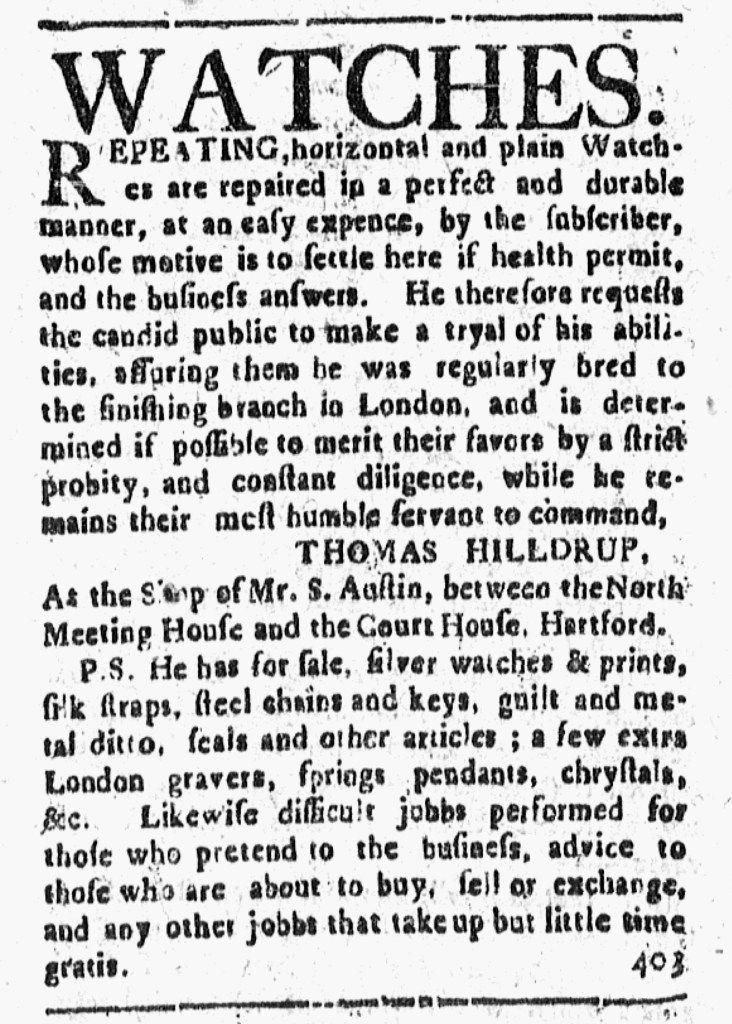
“WATCHES … Advice to those who are about to buy, sell or exchange.”

When Thomas Hilldrup arrived in Hartford in the fall of 1772, he commenced an advertising campaign in hopes to introduce himself to prospective customers who needed their watches repaired.  He first advertised in the September 15 edition of the Connecticut Courant.  That notice ran for three weeks.  On October 13, he published a slightly revised advertisement, one that appeared in every issue, except November 10, throughout the remainder of the year.  Although many advertisers ran notices for only three or four weeks, the standard minimum duration in the fee structures devised by printers, Hilldrup had good reason to repeat his advertisement for months.  He intended to remain in Hartford “if health permit[s], and the business answers.”  If he could not attract enough customers to make a living, then he would move on to another town.

Hoping to remain in Hartford, he asked prospective customers “to make a trial of his abilities” to see for themselves how well he repaired watches.  Satisfied customers would boost his reputation in the local market, but generating word-of-mouth recommendations would take some time.  For the moment, he relied on giving his credentials, a strategy often adopted by artisans, including watchmakers, who migrated from England.  Hilldrup asserted that he “was regularly bred” or trained “to the [watch] finishing branch in London.”  Accordingly, he had the skills “to merit [prospective customers’] favors” or business, aided by his “strict probity, and constant diligence.”  In addition, Hilldrup offered ancillary services in hopes of drawing customers into his shop.  He sold silver watches, steel chains, watch keys, and other merchandise.  He also provided “advice to those who are about to buy, sell or exchange” watches, giving expert guidance based on his professional experience.  Hilldrup concluded his advertisement with an offer that he likely hoped prospective customers would find too good to dismiss.  He stated that he did “any other jobbs that take up but little time gratis.”  Doing small jobs for free allowed the watchmaker to cultivate relationships with customers who might then feel inclined or even obligated to spend more money in his shop.

By running an advertisement with the headline “WATCHES” in a large font larger than the size of the title of the newspaper in the masthead, Hilldrup aimed to make his new enterprise visible to prospective customers in and near Hartford.  He included several standard appeals, such as promising low prices and noting his training in London, while also promoting ancillary services to convince readers to give him a chance.

December 15

What was advertised in a colonial American newspaper 250 years ago today?

Connecticut Courant (December 15, 1772).

“The Printer is sensible that the Courant is very badly printed.”

Throughout the colonies, printers had difficulties getting subscribers to pay for their newspapers.  They regularly inserted notices calling on subscribers to settle accounts, especially when one year ended and another began.  Such was the case when Ebenezer Watson ran a notice in the December 15, 1772, edition of the Connecticut Courant.  He asserted that for most of his customers “the Year … terminates with this Day’s Publication (No. 416).”  That made it a good time for him to “return his sincere Thanks to all those Gentlemen who have not only been his Customers a Number of Years, but who have been very punctual” in paying for their subscriptions.  The printer requested that those who had been punctual continue to pay their bills in a timely fashion because “it is by their kind Assistance that he has been enabled to continue his Business to this Time.”  Watson depended on them for the “Continuance” of the Connecticut Courant.

He also addressed those who still owed for their subscriptions, declaring that he “takes the Liberty, ONCE MORE! To ask all those indebted to him, whose Accounts are of a Number of Years standing, whether they don’t think it REASONABLE that he should NOW, call upon them for PAYMENT.”  With a bit of exasperation, Watson underscored that his subscribers had a responsibility to settle accounts since he had made the request so often.  With a bit of sarcasm, he advised that “If they think the Request UNREASONABLE, after having been waited upon such a Length of Time, they are hereby inform’d that they are at Liberty to take their own Time.”  Unlike other printers, Watson did not threaten legal action.  Instead, he sought to shame delinquent subscribers into paying, suggesting that none of them could really consider his request unreasonable given the amount of time that Watson supplied them with newspapers.

The printer then made a curious admission in a nota bene.  He stated that he was “sensible that the Courant is very badly printed.”  Furthermore, he acknowledged that “the Complaints of his Customers on that Account are very just.”  Such critiques applied to the material quality of the newspapers produced in Watson’s printing office, but not to the quality of the news that he collated and disseminated to readers.  Those complaints also did not justify withholding payment.  Indeed, if subscribers wished to see an improvement in the quality of the printing then they needed to send their payments.  Watson explained that “his Types are worn out” and he could not “procure new ones” without “a large Sum of Money.”  That being the case, “an immediate Settlement is the only effectual Plan to be adopted to replenish the Office with a new Set of Printing Materials.”  That was a different strategy than most printers deployed when they called on subscribers and others to settle accounts.  Watson sought to negotiate with his customers by promising that the quality of the newspaper would improve but only if they fulfilled their half of the bargain by making payments that he would then use to purchase new type.  The printer gambled that a carrot, the promise of new types, would be more effective than a stick, threatening legal action, in convincing recalcitrant customers to pay their overdue accounts.

September 8

What was advertised in a colonial American newspaper 250 years ago today?

Connecticut Courant (September 8, 1772).

“Invite all Captains of Vessels (especially from Connecticut) and Sailors.”

After moving from Stamford, Connecticut, to New York, Foster Lewis kept residents of his former home apprised of his new endeavors.  On September 8, 1772, he inserted an advertisement in the Connecticut Courant to inform readers in Hartford and other towns that he “has opened a public house near Burling-Slip, known by the name of the New England Tavern.”  He promised prospective patrons that if “they give him their Custom … they may depend upon being handsomely used.”  In other words, Lewis made hospitality a priority at the New England Tavern.  He also noted that he “provides good Stabling for Horses” for patrons who arrived in New York by land rather than by sea.

Given the tavern’s location near the waterfront in New York, Lewis addressed his advertisement to mariners, both “Captains of Vessels (especially from Connecticut) and Sailors.”  He hoped to cultivate a sense of community among customers with connections to Connecticut as well as give them an additional reason to choose his tavern over others.  In highlighting his own origins in the neighboring colony, Lewis likely intended to suggest that he exerted even greater effort in making mariners and travelers from New England, especially Connecticut, feel welcome and comfortable in his establishment.  After all, the name of the public house, the New England Tavern, testified to the character of its proprietor and patrons.

Although Lewis no longer lived and worked in Connecticut, he sought to capitalize on identifying with that colony in the advertisement he placed in the Connecticut Courant.  Rather than being treated as strangers and run-of-the-mill customers, patrons who hailed from Connecticut could expect enthusiastic service grounded in their shared connections to that colony.  Lewis apparently suspected that this marketing strategy would resonate with colonizers in Connecticut, making the effort to place his notice in a newspaper published there rather than opting for any of the newspapers published in New York.  Some readers and prospective patrons may even have known Lewis, prompting them to expect a friendly and familiar face if they visited the New England Tavern.