March 8

What was advertised in a colonial American newspaper 250 years ago today?

Connecticut Courant (March 8, 1774).

Best Bohea TEA, Such as Fishes never drink!!”

Nearly three months after the destruction of tea now known as the Boston Tea Party, William Beadle of Wethersfield, Connecticut, published an advertisement that alluded to the event.  “Best Bohea TEA, Such as Fishes never drink!!” he proclaimed in a notice in the March 8, 1774, edition of the Connecticut Courant.  Two manicules, one at each end, directed readers to the phrase “Such as Fishes never drink!!”  The double exclamation points gave the comment even more exuberance, especially considering that exclamation points rarely appeared in eighteenth-century newspaper notices.  Beadle’s advertisement certainly differed from those placed by merchants and shopkeepers who assured prospective customers and the public that they did not stock tea and, by extension, opposed Parliament’s attempts to impose duties on the colonies.

What message did Beadle intend for readers of the Connecticut Courant?  What kind of commentary did he offer about consumer politics?  James R. Fichter examines Beadle’s advertisement in his recently published Tea: Consumption, Politics, and Revolution, 1773-1776.  Fichter indicates that Beadle’s neighbors “knew him as a man … who dabbled in dark and ambiguous humor.”  Some of that humor was on display in his previous advertisements.  Perhaps Beadle made a joke “at the expense of the Boston tea partiers or the drinkers deprived of their tea.”  After all, humor about the destruction of the tea already spread.  As Fichter recounts, Peter Oliver, a noted loyalist, reported that “some Bostonians abstained from eating local fish ‘because they had drank of the East India Tea.’”  Was Beadle taking a political position and mocking the excesses of patriots in Boston and other cities and towns who stopped selling tea?  Fichter also suggests that Beadle could have been “drawing attention to Connecticut not having a tea boycott” or he might have meant that he carried Dutch tea smuggled into the colonies.  Consumers could purchase and drink such tea with a clear conscience since it had not been subject to Parliament’s duties.  Yet Beadle may not have been making a political argument at all.  Perhaps he just wanted to publish the boldest advertisement, gain the most attention, and garner the most customers among merchants and shopkeepers who continued to advertise and sell tea in Connecticut.  According to Fichter, “Tea advertising remained common in Connecticut, and Beadle bore little burden for his cheek: he placed generic advertisements for tea throughput the spring and summer of 1774 and early 1775.”[1]

**********

[1] James R. Fichter, Tea: Consumption, Politics, and Revolution, 1773-1776 (Cornell University Press, 2023).

February 22

What was advertised in a colonial American newspaper 250 years ago today?

Connecticut Courant (February 22, 1774).

“Three Dollars Reward [for] one of the said books.”

A headline offering “Three Dollars Reward” usually opened an advertisement about a runaway apprentice, livestock that escaped, an indentured servant who departed without permission, or enslaved people who liberated themselves.  On occasion, such a headline appeared in advertisements for lost items that the owners wished to recover.  In this instance, however, Benjamin Trumbull, a minister and historian, sought a copy of a book that had been published more than a century earlier.

Trumbull explained that in 1656 “the colony of New Haven, printed a code of laws, introduced with an account of the settlement of New Haven, in New England, by Governor Eaton.”  He asserted that “Five hundred of those books were distributed in the towns of New Haven, Milford, Guilford, Stanford, Branford, and Southold, on Long-Island.”  Trumbull imagined that with “so large a number it is not improvable that some remain legible,” so he put out a call for copies to his fellow colonizers, hoping that the reward would encourage them to “convey one of the said books” to him within two months.  The historian was “very desirous of obtaining” the book because “much light may probably be reflected on the history of New Haven.”

He was so eager to acquire a copy that he advertised in both the Connecticut Journal and New-Haven Post-Boy, starting on February 18, 1774, and the Connecticut Courant, published in Hartford, starting on February 22.  Despite disseminating his notice throughout much of the colony in those newspapers, this apparently did not have the intended results as quickly as Trumbull wished.  On March 11, three weeks after the notice first appeared, he inserted it in the Connecticut Gazette, published in New London, expanding the reach of his plea.  He did not, however, advertise in the colony’s other newspaper, the Norwich Packet, during that “term of two months.”  Perhaps he did not consider it worth the investment, that newspaper being less than six months old at the time and likely having less circulation than the others.

Whether or not Trumbull managed to acquire a copy of the book, he eventually published the first volume of A Complete History of Connecticut, Civil and Ecclesiastical, from the Emigration of Its First Planters from England, in MDCXXX, to MDCCXXIII in 1797.  According to the historical background in the American Antiquarian Society’s catalog, that book “took over twenty years to complete but remained the best work on Connecticut for a century.”  One of the historians of the founding generation, he also published the first volume of A General History of the United States of America in 1810.  It spanned the period “from the discovery of North America, to the year 1765.”  Trumbull died before completing the intended second and third volumes.

January 18

What was advertised in a colonial American newspaper 250 years ago today?

Connecticut Courant (January 18, 1774).

“He employs Workmen who manufacture the Leather in the best Manner.”

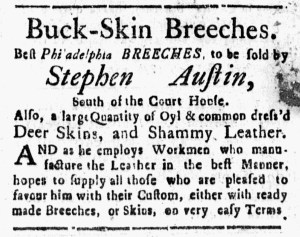
Stephen Austin sold “Buck-Skin Breeches” as well as “dress’d Deer Skins, and Shammy Leather” at his shop “South of the Court House” in Hartford.  In an advertisement that he placed in the January 18, 1774, edition of the Connecticut Courant, he not only highlighted the quality of his products but also the skill of those who labored in his shop.  Austin informed prospective customers that he “employs Workmen who manufacture the Leather in the best Manner.”  Among his competitors, Cotton Murray, a tailor, also ran an advertisement in the Connecticut Courant.  The tailor focused primarily on the services that he performed, but also added a nota bene about an employee who dressed leather.  Murray declared that he “carries on Leather Breeches making in all its branches, has a quantity of Leather of the best kind, and has employed a Workman in that business who serv’d his time in Europe.”

Both Austin and Murray promoted contributions that employees made to their businesses.  Artisans often relied on various assistants, whether employees, apprentices, or family members, but such workers did not regularly appear in newspaper advertisements.  Instead, the proprietors personified their shops, especially in an era that most businesses did not have names.  Austin’s shop, for instance, did not have a name.  Instead, his own name and one of the products he sold appeared as headlines.  For Murray, it was his name and occupation in the headlines.  Even artisans who ran shops identified by signs, like Daniel King, a brass founder “At the Sign of the Bell and Brand” in Philadelphia, deployed their own names rather than the sign that doubled as a shop’s name in the headlines of their advertisements.  Such methods emphasized work undertaken by the proprietor while obscuring the labor of others in a shop.  Artisans often considered such name recognition the best strategy for building their own reputations and the reputations of their businesses, but occasionally some of them saw benefits in marketing the skills of their employees.  Austin and Murray both hoped that doing so would help convince customers to select them over their competitors.

January 4

What was advertised in a colonial American newspaper 250 years ago today?

Connecticut Courant (January 4, 1774).

“Loaf and Brown Sugar, Coffee, Chocolate, Peeper, Spices.”

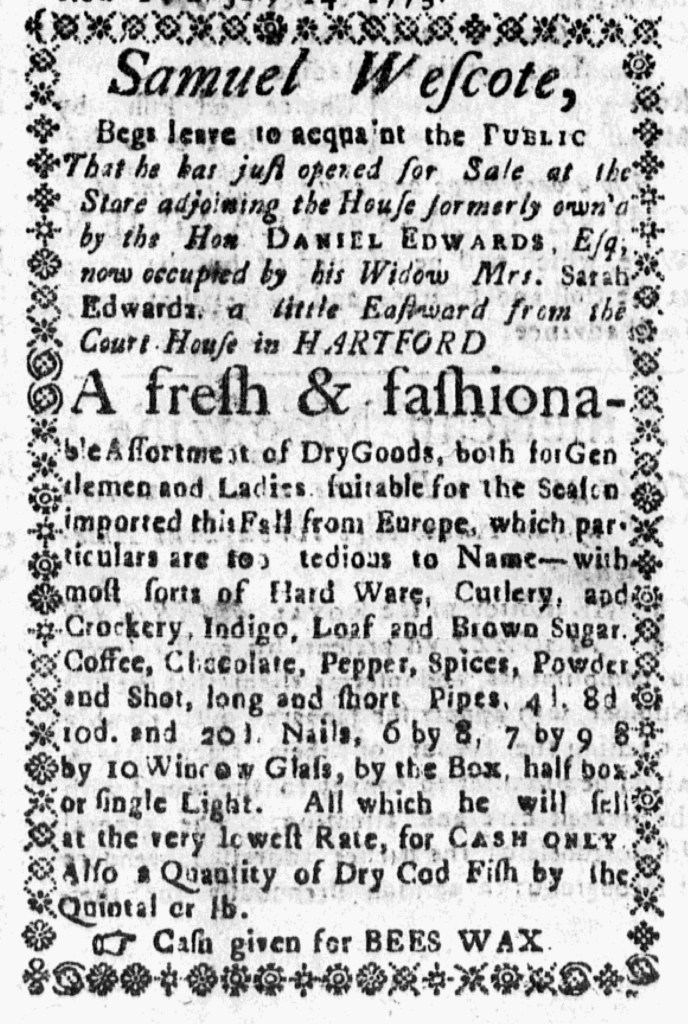
In the fall of 1773 and into the winter of 1774, Samuel Wescote ran advertisements in the Connecticut Courant to promote a “fresh & fashionable Assortment of Dry Goods, both for Gentlemen and Ladies.”  He gave directions to his store “a little Eastward from the Court-House in HARTFORD,” informed the public that he had recently imported his inventory from Europe, and insisted that he offered such a selection that the “particulars are too tedious to Name” in a newspaper notice.  Prospective customers needed to visit his store to see for themselves!  In addition to dry goods, he stocked “most sorts of Hard Ware, Cutlery, and Crockery” as well as sugar, coffee, and spices.  Wescote pledged to sell his wares “at the very lowest Rate,” but he did not extend credit.  “CASH ONLY,” he advised.

The contents of Wescote’s advertisement replicated what appeared in others that ran in the Connecticut Courant and newspapers throughout the colonies during the era of the American Revolution.  Its format, however, differed from most others.  A border comprised of a variety of printing ornaments surrounded the notice.  The compositor did not choose a single decoration but instead incorporated many in a seemingly random order.  Most other advertisements did not feature a border, though William Beadle of Wethersfield did opt for a border around his advertisement for a “good Assortment of GOODS suitable for the present Season” that ran in some of the same issues as Wescote’s advertisement.  Where did Beadle and Wescote get the idea to request borders for their advertisements?  Maybe they noticed the borders around Caleb Bull’s advertisements when they perused the Connecticut Courant … or perhaps all of those advertisers took inspiration from another newspaper that circulated in the colony, Rivington’s New-York Gazetteer, or the Connecticut, New-Jersey, Hudson’s-River, and Quebec Weekly Advertiser.  In the summer and fall of 1773, decorative borders became a signature feature of advertisements in that newspaper.  Rivington and others who labored in his printing office certainly did not invent that particular style, but they utilized to an extent previously unknown in colonial American newspapers.  As advertisements with borders increased in number and frequency in Rivington’s New-York Gazetteer they also became more common in many newspapers printed in the region served by that newspaper.  Printers, compositors, and advertisers in towns beyond New York seemed to take note of a format that became popular in Rivington’s New-York Gazetteer.

December 21

What was advertised in a colonial American newspaper 250 years ago today?

Connecticut Courant (December 21, 1773).

“He has just received a fresh Assortment of BOOKS.”

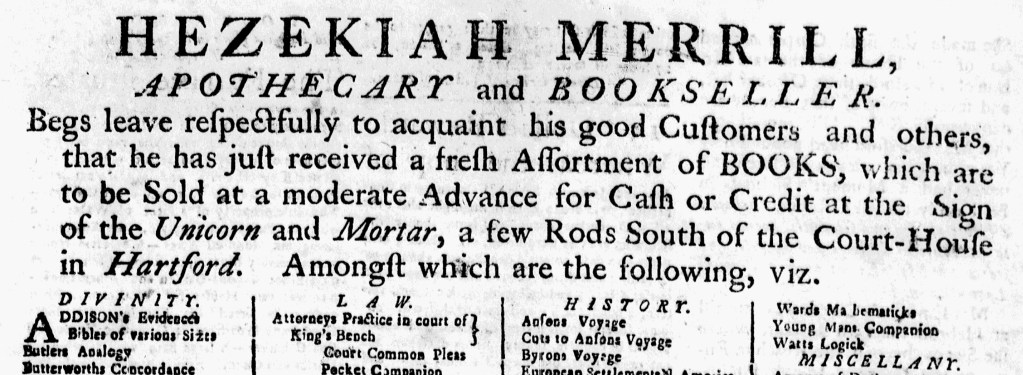
Hezekiah Merrill, “APOTHECARY and BOOKSELLER … at the Sign of the Unicorn and Mortar” in Hartford, ran a full-page advertisement in the December 21, 1773, edition of the Connecticut Courant.  His name and occupation served as headlines running across the top of the page, followed by an introduction that gave his location and announced that he “just received a fresh Assortment of BOOKS,” which also ran across the entire page.  To aid prospective customers in navigating the advertisement, Merrill divided the books by genre with headings that included “DIVINITY,” “LAW,” “PHYSIC & SURGERY,” “HISTORY,” “SCHOOL BOOKS,” and “MISCELLANY.”  In smaller type, four columns listed individual titles for sale, compared to three columns for news, editorials, advertising, and other contents on the other three pages of the newspaper.  A nota bene in the same size font as the list of titles, ran across the entire page at the bottom.  In it, Merrill promoted stationery, writing supplies, and a variety of items often sold by apothecaries.  In many ways, Merrill’s advertisement dominated that issue of the Connecticut Courant.  It accounted for one-quarter of the total space as well as more space than the other advertisements combined.  When readers perused the issue, Merrill’s advertisement became visible to others gathered nearby.

It was not the first time that the bookseller and apothecary published an oversized advertisement in his local newspaper.  On May 11, 1773, he ran an advertisement that filled two of the three columns on the second page.  He may have made arrangements with Ebenezer Watson, the printer, to produce the advertisement separately as handbills or broadside book catalogs, though no such items have been identified in research libraries, historical societies, or private collections.  Compared to newspapers, often preserved by printers or subscribers in complete or nearly complete runs, handbills and broadside book catalogs were much more ephemeral advertising media.  Still, in the case of Smith and Coit’s broadside book catalog that also ran as a full-page advertisement in the Connecticut Courant in July 1773, Watson had experience producing advertisements in more than one format for his clients.  For Smith and Coit, Watson reset the type, using five columns in the broadside but only four in the newspaper.  He could have done the same for Merrill or, even more easily, printed the newspaper advertisement as a separate handbill or broadside book catalog without making any adjustments to type already set.  Either way, Merrill, Smith and Coit, other booksellers, and other retailers likely distributed more advertisements in the eighteenth century than happen to survive today.

Connecticut Courant (December 21, 1773).

November 16

What was advertised in a colonial American newspaper 250 years ago today?

Connecticut Courant (November 16, 1774).

“The BEST of BEER.”

In the fall of 1773, Amasa Jones placed advertisements in the Connecticut Courant to alert residents of Hartford and nearby towns that he “HATH just received a large Supply of LONDON PORTER, and BRISTOL BEER.”  Most of his advertisement focused on cultivated relationships with former and prospective customers.  He “Returns his Thanks to those Gentlemen that have been Kind enough to favour him with their Custom,” simultaneously inviting them to purchase beer from him once again.  Jones hoped “they will continue” those “favours” by placing new orders.  He concluded with a note to “All those Gentlemen that are dispos’d to Favour him with their Custom,” whether or not they previously bought beer from Jones, to promise that they “may depend upon having a Bottle of the BEST of BEER.”

That final line sounded much like an advertising slogan that marketing agencies would develop for breweries two centuries later: “the BEST of BEER.”  Had Jones consulted more closely with the printing office, that final line, rather than his name, could have been the headline for his advertisement.  After all, other advertisements in the November 16 edition of the Connecticut Courant had headlines like “Hartford LOTTERY” and “Best ANCHORS.”  Some entrepreneurs did experiment with headlines other than their names.  Although Jones missed that opportunity, he did conclude with an overture for prospective customers to imagine themselves enjoying the “LONDON PORTER” and “BRISTOL BEER” he sold.  He encouraged them to imagine themselves drinking a single bottle of beer, savoring the experience as they imbibed “the BEST of BEER” that they could acquire anywhere in England or the colonies.  Jones certainly wished to sell beer in quantities, but to do so he devised a marketing strategy that emphasized appreciating his “LONDON PORTER” and “BRISTOL BEER” one bottle at a time.  Consumers need to try those beverages to see for themselves if Jones did indeed sell “the BEST of BEER.”

November 9

What was advertised in a colonial American newspaper 250 years ago today?

Connecticut Courant (November 9, 1773).

“Shall have their Money return’d if the Work he does shall not be found upon Tryal to answer their End.”

In the fall of 1773, Enos Doolittle, a silversmith, took to the pages of the Connecticut Courant to advise prospective clients that he also offered services as a “CLOCK and WATCH-MAKER.”  To that end, he “lately furnished himself with a universal Assortment of WATCH FURNITURE” or parts, including springs, glasses, dial plates, keys, and seals.  Doolittle assured “Any Gentlemen that please to Favour him with their Custom” that he possessed the skills necessary both to repair damaged clocks and watches or make new ones.

To entice prospective customers, Doolittle presented a return policy.  He pledged that customers “shall have their Money return’d if the Work he does shall not be found upon Tryal to answer their End.”  That put him in company with other watchmakers who issued similar guarantees.  For instance, Thomas Hilldrup, a “WATCH MAKER from LONDON” who advertised extensively in newspapers published in Connecticut during the previous year, asserted that he “restored [watches] to their pristine vigour, and warranted [them] to perform well, free of any expence for one year.”  Similarly, Issac Heron in New York noted, “As usual, he warrants their performance – not for ever, but one year,” while Thomas Morgan in Baltimore “proposes to engage his performance for one year, provided the owners do not abuse the same, nor apply to unskilful hands, where many good watches are greatly abused for want of experience.”  Watchmakers set some conditions along with their guarantees.

Doolittle paired his warranty with a promise of low prices that matched those set by his competitors.  He may have been making a jab at the “WATCH MAKER from LONDON” who so often advertised his own shop in Hartford when he declared that “his Motives are barely to obtain such a Support as one of his Profession has a right to expect.”  Accordingly, Doolittle “is determined to Work as Cheap as any one in the Colony.”  Eschewing the pretensions that played such a significant role in advertisements placed by some of his competitors, Doolittle promised quality work for reasonable prices.  In contrast to watchmakers who sought acclaim for themselves and their work, Doolittle suggested that he labored industriously on behalf of his clients and focused on customer satisfaction.

October 5

What was advertised in a colonial American newspaper 250 years ago today?

Connecticut Courant (October 5, 1773).

“At the Sign of the Unicorn & Mortar.”

Hezekiah Merrill ran an apothecary shop in Hartford in the early 1770s.  In October 1773, he placed advertisements in the Connecticut Courant to promote the variety of patent medicines that he sold, including Bateman’s Drops and Cordials, Turlington’s Balsam of Life, and Hooper’s Female Pills.  Each of those remedies would have been as familiar to eighteenth-century readers as popular over-the-counter medications are to modern consumers.  Merrill, like others who sold the same patent medicines, did not believe that they required descriptions when advertising them.  The apothecary also stocked books at his shop.

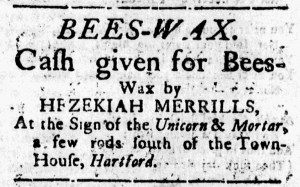
Merrill marked the location of his shop with “the Sign of the Unicorn & Mortar,” an appropriate image for an apothecary, and further advised prospective customers that they could find it “a few rods south of the Town-House.” Residents of Hartford regularly passed the shop and its sign, making it a familiar sight in their daily routines.  For visitors from the countryside, the sign made Merrill’s location unmistakable as they navigated town.  The apothecary encouraged consumers to associate the image of the Unicorn and Mortar with his business, treating it as a logo of sorts.  He inserted two advertisements in the October 5, 1773, edition of the Connecticut Courant, both of them invoking his shop sign.  A longer one on the first page listed the patent medicines and other merchandise, while a shorter one on the third page solicited beeswax in exchange for cash.  Just as residents of Hartford frequently glimpsed the sign, readers of the Connecticut Courant encountered “the Sign of the Unicorn & Mortar” more than once when they perused that issue.

Today, those advertisements testify to some of the sights that colonizers saw as they traversed the streets of colonial Hartford.  According to Thomas Hilldrup’s advertisement in the same issue of the Connecticut Courant, “the sign of the Dial” adorned the shop where he cleaned and repaired watches near the court house.  Other purveyors of goods and services in Hartford almost certainly displayed signs, contributing to the visual landscape of commercial activity in the town.  Few of those signs survive today, except for the descriptions of them in newspaper advertisements.

August 24

What was advertised in a colonial American newspaper 250 years ago today?

Connecticut Courant (August 24, 1773).

“PROPOSALS, For printing by SUBSCRIPTION, A NEW Periodical Production, entitled, The ROYAL American Magazine.”

Isaiah Thomas, the printer of the Massachusetts Spy, continued his efforts to garner subscribers for a new publication, the Royal American Magazine, in August 1773.  He previously disseminated subscription proposals in his own newspaper, first on June 24 and then in four of the five issues published in July.  By the end of that month, he inserted the extensive proposals in two other newspapers published in Boston (the Massachusetts Gazette and Boston Post-Boyand the Massachusetts Gazette and Boston Weekly News-Letter) as well as both newspapers published in Rhode Island (the Newport Mercury and the Providence Gazette) and one each in New York (the New-York Journal) and Philadelphia (the Pennsylvania Chronicle).  In total, subscription proposals for the Royal American Magazine appeared fourteen times in seven newspapers in five towns in July.

In August, those proposals ran another thirteen times, as listed below.  Thomas inserted them in his own newspaper three more times.  He also concluded the cycle in three other newspapers.  Most printers charged a set rate for an advertisement to run three times and then additional fees for each insertion after that.  The proposals made their second and third appearances in both the Newport Mercury and the Pennsylvania Chronicle in August (and already made three appearances in the Massachusetts Gazette and Boston Post-Boy in July).  According to the colophon for the New-York Journal, advertisements ran four times before the printer assessed additional fees.  The proposals made their third and fourth appearances in the New-York Journal in August 1773.  They also ran for the first time in the Boston Evening-Post and the Boston-Gazette.  That meant that all of the newspapers published in Boston carried the proposals at least once, reaching readers in that city and beyond who did not regularly read the Massachusetts Spy.  Thomas may have struck a deal with his fellow printers in town since three of those newspapers printed the proposals only once.  Thomas also added another newspaper to the roster of those that disseminated the subscription proposals.  The Connecticut Courant, published in Hartford, carried them on August 24, the first time for a newspaper in that colony.  The proposals filled nearly two columns (out of twelve) in that issue.  Three days later, the proposals ran in the New-London Gazette.

Thomas realized that to successfully attract enough subscribers to make the only magazine published in America at the time a viable venture, he needed to market the proposed publication widely.  That meant saturating the market in Boston as well as establishing a network that included towns in other colonies.  Advertisements in newspapers published in New York, Philadelphia, Providence, New London, Newport, and Hartford reached even wider audiences than the Massachusetts Spy and its counterparts in Boston.  Thomas engaged “the printers and booksellers in America,” near and far, to act as local agents who collected subscriptions for the Royal American Magazine on his behalf.

  • August 2 – Boston-Gazette (first appearance)
  • August 2 – Newport Mercury (second appearance)
  • August 2 – Pennsylvania Chronicle (second appearance)
  • August 5 – Massachusetts Spy (sixth appearance)
  • August 5 – New-York Journal (third appearance)
  • August 9 – Newport Mercury (third appearance)
  • August 9 – Pennsylvania Chronicle (third appearance)
  • August 12 – Massachusetts Spy (seventh appearance)
  • August 12 – New-York Journal (fourth appearance)
  • August 16 – Boston Evening-Post (first appearance)
  • August 19 – Massachusetts Spy (eighth appearance)
  • August 24 – Connecticut Courant (first appearance)
  • August 27 – New-London Gazette (first appearance)
Connecticut Courant (August 24, 1773).

August 17

Who was the subject of an advertisement in a colonial American newspaper 250 years ago today?

Connecticut Courant (August 17, 1773).

“Ruth, the Wife of me the subscriber threatens to run me in debt.”

Colonizers placed newspaper advertisements for a variety of purposes.  In many ways, their paid notices served as an extension of local news coverage, though in such instances the advertisers rather than the printers made editorial decisions about the information disseminated to readers.  Consider the August 17, 1773, edition of the Connecticut Courant.  An advertisement for the “SAY-BROOK BARR LOTTERY,” held for the purpose of “fixing Buoys and other Marks on an near Say-brook Barr at the Mouth of Connecticut River” to “render the Navigation into and out of said River, both safe and easy,” informed the public about where to buy tickets and when the drawing would be held.  Another advertisement described a horse “Stray’d or stolen out of the pasture of Martin Smith” and offered a reward for its return.  In yet another advertisement, Samuel Russel, “Sheriffs Deputy,” warned that Solomon Bill, “who the greater part of his life has been strongly suspected to be concern’d in counterfeiting money,” had escaped before his trial and offered a reward for his capture.

Other advertisements testified to marital discord in local homes, likely overlapping with the gossip that both men and women shared as they went about their daily routines.  Moses Phelps declared that his wife, Ruth, “threatens to run me in debt.”  Accordingly, he ran his advertisement “to forbid all persons trusting her on my account, as I will pay no debt contracted by her.”  Unable to exercise his patriarchal authority at home, Moses resorted to the public prints to try to compel his wife to behave in a manner he considered appropriate.  Cornelias Flowers, Jr., did so as well, stating that throughout his marriage to Mary that she “behaved herself in a very unbecoming manner, and has injured me in the most tender part.”  No doubt some readers gossiped and speculated about the particulars of what happened between Cornelias and Mary.  Utilizing the same formulaic language as Moses Phelps, Cornelias stated that Mary “intends to run me in debt” and instructed “all persons not to trust her on my account, for I will pay no debt she shall contract.”

Such news may not have been as momentous as some of the accounts from London, Paris, New York, Philadelphia, Boston, Charleston, and other places that the printer chose to include elsewhere in that issue of the Connecticut Courant, but, for many colonizers, it likely had just as much impact on their daily lives.  News of a notorious counterfeiter at large in the colony, a lottery to improve navigation of a river important to local commerce, and troubled marriages spread by word of mouth, yet the inclusion of these items among newspaper advertisements helped raise awareness and keep conversations about them flowing.