December 24

What was advertised in a revolutionary American newspaper 250 years ago this week?

Connecticut Gazette (December 22, 1775).

“All kinds of Work both in the Plain and Regimental Way.”

When Edward Davis placed an advertisement in the Connecticut Gazette in December 1775, it looked much like advertisements that other tailors ran in newspapers throughout the colonies.  He stated that he “performs in the neatest and genteelest Manner, and at the most reasonable Prices, all kinds of Work.”  In just a few words, he emphasized his skill and made appeals to quality, fashion, and price.  “Any Gentlemen who are disposed to honour him with their Commands,” Davis declared, “he will faithfully serve and with the utmost Punctuality; and will with Gratitude acknowledge the smallest Favours conferr’d on their most obedient Servant.”  Those overtures promising exemplary customer service echoed advertisements placed by many other shopkeepers and artisans.

Yet Davis’s notice also contained some distinctive features that resonated with current events.  He introduced himself as a “TAYLOR from BOSTON” who “Has taken a Shop in the Parish of Scotland, in Windham, near the Meeting House.” Newcomers often used newspaper advertisements to introduce themselves when they moved to a new town, hoping to attract the attention of prospective customers.  At other times, Davis’s previous experience in Boston would have supported his claim to make garment in the “genteelest Manner,” bringing the styles of the bustling urban port to the countryside.  In this instance, however, noting that he came “from BOSTON” might have signaled that he was a refugee who departed the city during the exchange negotiated by General Thomas Gage and the Sons of Liberty after the battles at Lexington and Concord.  At the time Davis ran his advertisement, the siege continued.  In Connecticut and Rhode Island, the frequency of advertisers describing themselves as “from BOSTON” seemed to increase, likely reflecting decisions made by many residents to leave when they had the chance.  After all, they had already experienced the distresses that ensued when Parliament passed the Boston Port Act to close the harbor until colonizers made restitution for the tea destroyed in December 1773.  Davis made another nod to the war that began the previous April.  In addition to “Plain” clothing, he also made items in the “Regimental Way” to outfit soldiers and officers.  At a glance, his advertisement looked like so many others placed by tailors, but on closer inspection it testified to the times and the transition from imperial crisis to warfare.

December 8

What was advertised in a revolutionary American newspaper 250 years ago today?
Connecticut Gazette (December 8, 1775).

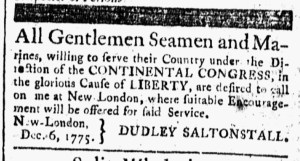
“All Gentlemen Seamen and Marines, willing to serve their Country … are desired to call on me.”

A variety of advertisements ran in the December 8, 1775, edition of the Connecticut Gazette.  Some marketed consumer goods and services, one described an indentured servant who ran away, one offered a “convenient Dwelling-House for Sale,” and a couple concerned strayed livestock.  The advertisement that appeared first after the news, however, was a recruiting notice.  A thick black line helped to draw attention to it, though that visual element that signified mourning was part of the memorial to “Mrs. FAITH HUNTINGTON, the late amiable Consort of Col. JEDEDIAH HUNTINGTON of Norwich … and greatly beloved Daughter of the Honorable Governor [Jonathan] TRUMBULL,” the only governor who supported the American cause at the beginning of the Revolutionary War.  The memorial attributed Huntington’s death to the distress she experienced during her husband’s absence from their home while he dedicated himself to military service, declaring that the “Authors of American Oppression and the public Calamity, are accountable for her death.”  That assertion may have helped rally readers to respond to the recruiting notice that appeared immediately after the memorial.  “All Gentlemen Seamen and Marines, willing to serve their Country under the Direction of the CONTINENTAL CONGRESS, in the glorious Cause of LIBERTY,” it proclaimed, “are desired to call on me at New-London, where suitable Encouragement will be offered for said Service.”  Dudley Saltonstall signed the notice.

Who was Dudley Saltonstall?  The finding aid for the Dudley Saltonstall Papers at the Penobscot Marine Museum notes that Saltonstall “sailed as a privateer during the Seven Years’ War.  At the beginning of the Revolutionary War, he was one of the first men commissioned by Connecticut as a Navy captain.”  His brother-in-law, Silas Deane, a delegate to the First Continental Congress and the Second Continental Congress, recommended Saltonstall.  He also had a career as a slave trader.  In 1779, he had command of an expedition “sent to dislodge the British from Castine, Maine.”  The Penobscot Expedition resulted in failure, the entire American fleet lost, and Saltonstall court martialed and dismissed from the Continental Navy.  Although Saltonstall is now best known for the Penobscot Expedition, at the time he placed this recruiting notice in the Connecticut Gazette he was putting together a crew for other ventures.  A few months later, he sailed for the Bahamas to acquire gunpowder.  The fleet captured Nassau, but only after the governor moved most of the gunpowder.

December 1

What was advertised in a revolutionary American newspaper 250 years ago today?

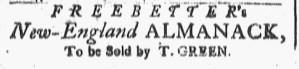
Connecticut Gazette (December 1, 1775).

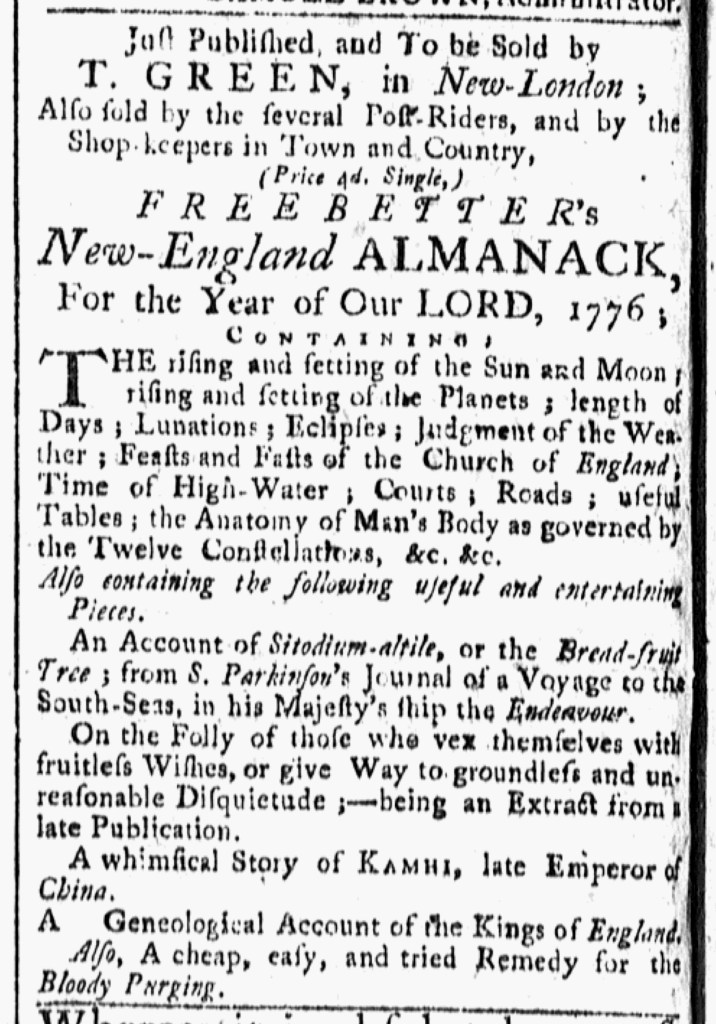
“Sold by the several Post-Riders, and by the Shop-keepers in Town and Country.”

With only a month until the new year began, Timothy Green, the printer of the Connecticut Gazette, advertised “FREEBETTER’s New-England ALMANACK, For the Year of Our LORD, 1776.”  He emphasized items that usually appeared in almanacs and called attention to special features.  The former included the “rising and setting of the Sun and Moon; rising and setting of the Planets; length of Days; Lunations; Eclipses; Judgment of the Weather; Feasts and Fasts of the Chrich of England; Times of High-Water; Courts; Roads; useful Tables; [and] the Anatomy of Man’s Body as governed by the Twelve Constellations.”  The special features included a “whimsical Story of KAHM, late Emperor of China,” and a “Geneological Account of the Kings of England.”  They also included an “Account of Sitodium-altile, or the Bread-fruit Tree; from S. Parkinson’s Journal of a Voyage to the South-Seas, in his Majesty’s ship the Endeavour” and an essay on “the Folly of those who vex themselves with fruitless Wishes, or give Way to groundless and unreasonable Disquietude; –being an Extract from a late Publication.”  Green may have intended those excerpts as teasers to encourage readers to purchase the original works at his printing office in New London.

To acquire the almanac, however, customers did not have to visit Green or send an order to him.  Instead, he advised that “the several Post-Riders” with routes in the region and “the Shop-keepers in Town and Country” also sold “FREEBETTER’s New-England ALMANACK, For … 1776.”  The printer established a distribution network for the useful reference manual.  Shopkeepers often stocked a variety of almanacs so their customers could choose among popular titles.  Printers sometimes offered discount prices for purchasing multiple copies, usually by the dozen or by the hundred.  That allowed retailers to charge competitive prices to generate revenue with small markups over what they paid.  In this instance, Green did not indicate how much shopkeepers paid for the almanac, only that it sold for “4d. Single” or four pence for one copy.  That constrained shopkeepers when it came to marking up prices.  In addition to shopkeepers, “several Post-Riders” sold the almanac.  That arrangement meant greater convenience for customers and, printers hoped, increased sales and circulation.  In the 1770s, printers in New England began mentioning postriders in their advertisements for almanacs and other printed materials, perhaps acknowledging an existing practice or perhaps establishing a new means of engaging with customers.  The price that Green listed in his advertisement also kept customers aware of reasonable prices charged by post riders.

October 27

What was advertised in a revolutionary American newspaper 250 years ago today?

Connecticut Gazette (October 27, 1775).

“AN AMERICAN EDITION.”

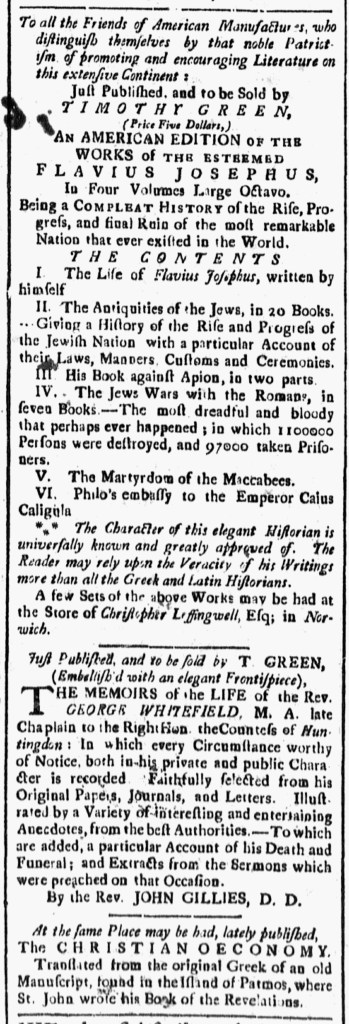
Calls to “Buy American” during the imperial crisis and the Revolutionary War extended to advertisements for books.  In the October 27, 1775, edition of the Connecticut Gazette, Timothy Green, the printer, promoted three works published in the colonies and available at his printing office in New London.  He addressed the advertisement to “all the Friends of American Manufactures, who distinguish themselves by that noble Patriotism of promoting and encouraging Literature on this extensive Continent.”

Those books included the “MEMOIRS of the LIFE of the Rev. GEORGE WHITEFIELD,” one of the most famous ministers of the era.  When he died in Newburyport, Massachusetts, on September 30, 1770, news spread throughout the colonies as widely and as quickly as news about the Boston Massacre earlier that year.  John Gillies compiled the memoir from Whitefield’s “Original Papers, Journals, and Letters” and added “a particular Account of his Death and Funeral; and Extracts from the Sermons which were preached on that Occasion.”  They originally appeared in a London edition published in 1772, but Green most likely sold an American edition printed by Robert Hodge and Frederick Shober in New York in 1774.

For another of the books, The Works of Flavius Josephus in four volumes, Green triumphantly proclaimed that it was an “AMERICAN EDITION.”  Earlier in the eighteenth century, American printers sometimes put a London imprint on the title page of books they printed in the colonies, believing that customers preferred imported works.  Mitch Fraas, curator at the Kislak Center for Special Collections, Rare Books, and Manuscripts at the University of Pennsylvania, notes the prevalence of “books printed in America … bearing the false imprint of European cities.”  That seems to have been the case with two 1773 editions of The Works of Flavius Josephus with a New York imprint yet “Probably printed in Glasgow,” according to the entries in the American Antiquarian Society’s catalog.  Yet colonizers had access to an authentic American edition … and Hodge and Shober had been involved in the production, just as they had printed an edition of The Christian Oeconomy, the final book in Green’s advertisement, in 1773.

Rather than looking to London to provide them with books, some printers and booksellers embraced American editions and encouraged prospective customers to do the same.  Green framed doing so as the patriotic duty of “Friends of American Manufactures” who supported the American cause and participated in the Continental Association, a nonimportation agreement enacted throughout the colonies in response to the Coercive Acts.  Readers could do their part to defend American liberties through the choices they made in the marketplace, including purchasing an “AMERICAN EDITION” when they went to the bookstore.

October 6

Who was the subject of an advertisement in a revolutionary American newspaper 250 years ago today?

“Ran-away … a Negro Man Servant named JACK.”

Connecticut Gazette (October 6, 1775).

Even as it carried essays about the imperial crisis and news about one of the first battles of the Revolutionary War, the October 6, 1775, edition of the Connecticut Gazette also ran advertisements described enslaved men and women who liberated themselves by running away from their enslavers.  Each notice encouraged readers to engage in surveillance of Black people they encountered to determine if they matched the description in the newspaper.  Each also offered a reward to those who assisted in capturing fugitives from slavery and returning them to their enslavers.

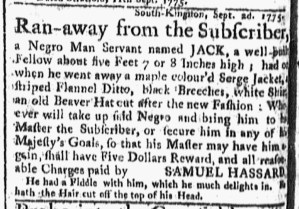
One of those advertisements, for instance, described a “Negro Man Servant named JACK” who fled from Samuel Hassard of South Kingstown, Rhode Island, at the beginning of September.  He had managed to elude capture for a month.  Hassard described Jack as a “well-built Fellow about five Feet 7 or 8 Inches high,” but did not indicate his approximate age.  At the time he departed, he wore a “maple colour’d Serge Jacket, a striped Flannel [Jacket], black Breeches, white Shirt, [and] an old Beaver Hat cut after the new Fashion.”  Hassard also mentioned that Jack “had a Fiddle with him, which he much delights in” and that he “Hath the Hair cut off the top of his Head.”  Both details made Jack more easily recognizable to readers of the Connecticut Gazette.

In another advertisement, Mortemore Stodder of Groton described a “Negro Girl about 17 or 18 Years old” whose name was once known but did not appear in the notice.  Instead, Stodder informed readers that the “thick set” young woman “speaks good English” and “has a Scar across her Nose and another Scar on the top of one Foot occasioned by a burn.”  In addition to those distinguishing features, she “[h]ad on a tow Shift, a striped woollen Petticoat, and a brown Gown.”  Stodder was so concerned that others might help the young woman remain free that he added a nota bene advising, “All Persons are hereby forbid to harbour, conceal, or carry off the above Servant, on Penalty of the Law.”  There would be consequences beyond Stodder’s frustration and displeasure if he learned that anyone aided this young woman in liberating herself.

As the siege of Boston continued, Timothy Green, the printer of the Connecticut Gazette, published the latest entry in “The Crisis,” a series of essays supporting the American cause, new details about the Battle of Bunker Hill, and an address from George Washington, “Commander in Chief of the Army of the United Colonies of North-America,” to the inhabitants of Canada.  Even as those pieces each promoted liberty in various ways, Green continued a practice adopted by all newspaper printers.  He generated revenue by disseminating advertisements about enslaved people who fled from their enslavers to seize their own freedom.

**********

For all advertisements about enslaved people that ran in American newspapers published 250 years ago today, visit the Slavery Adverts 250 Project‘s daily digest.

September 17

What was advertised in a revolutionary American newspaper 250 years ago this week?

Connecticut Gazette (September 15, 1775).

“Excellent Accommodations for Passengers.”

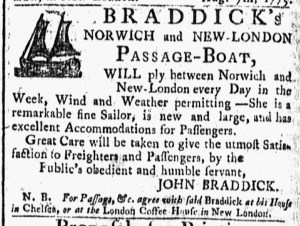
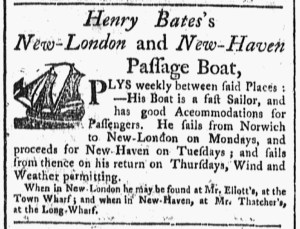
In the early months of the Revolutionary War, colonizers who needed to travel between Norwich and New London had an option other going by road between the two towns.  They could instead book passage on “BRADDICK’s NORWICH and NEW-LONDON PASSAGE-BOAT,” according to John Braddick’s advertisement in the September 15, 1775, edition of the Connecticut Gazette.  He offered that service “every Day in the Week, Wind and Weather permitting,” though his advertisement did not specify the time that the boat departed from each town.  Presumably it left Norwich in the morning, sailed about fifteen miles down the Thames River to New London on the coast, remained there for a few hours, and returned in the late afternoon before darkness arrived.  Prospective passengers could get more information from Braddick at his house near Chelsea Landing in Norwich or at the London Coffee House in New London.

Connecticut Gazette (September 15, 1775).

The same issue also carried an advertisement for “Henry Bates’s New-London and New-Haven Passage Boat.”  His service ran weekly rather than daily, transporting passengers over a much longer distance.  Despite the name in the advertisement, Bates’s passage boat actually originated in Norwich on Mondays and remained in New London overnight, departing for New Haven on Tuesdays.  The boat departed for the return trip through the Long Island Sound on Thursdays, though Bates did not indicate whether it arrived in New Haven on Tuesdays or Wednesdays or when it made its stop in New London.  He did state that his service depended on “Wind and Weather.”  Prospective customers could learn more “at Mr. Eliott’s, at the Town Wharf” in New London and “at Mr. Thatcher’s, at the Long-Wharf” in New Haven.

Newspaper advertisements advised readers of the transportation infrastructure that linked cities and towns in the colonies.  Most such advertisements promoted stage services, but along the Connecticut coastline travelers had other options.  Both Bates and Braddick emphasized the “excellent Accommodations” they provided for passengers, attempting to convince them that passage boats offered the most comfortable as well as the fastest way to travel from one town to another.

August 4

What was advertised in a revolutionary American newspaper 250 years ago today?

Connecticut Gazette (August 4, 1775).

“Thomas Tileston, HAT-MAKER from BOSTON.”

Thomas Tileston, a hatmaker, ran an advertisement in the Connecticut Gazette for several weeks in the summer and early fall of 1775.  He published it to inform prospective customers that “he has taken a Shop In WINDHAM, … Where he intends the carrying on his Business in all its Branches.”  He currently had in stock the “Best of Beaver, Beaverett, Castor and Felt HATS.”  Tileston promised exemplary customer service, asserting that they “may depend on the best Usage” and promising to undertake all orders “with Fidelity and Dispatch.”

As a newcomer to the area, Tileston introduced himself as a “HAT-MAKER from BOSTON.”  Advertisers often indicated where they previously conducted business or received their training, but this detail had new significance.  Tileston’s arrival in Windham coincided with the outbreak of hostilities at Lexington and Concord and the ensuing siege of Boston. General Thomas Gage, the governor, and the Massachusetts Provincial Congress negotiated an agreement that permitted Loyalists to enter the city and Patriots and others to depart.  After enduring the closure of the harbor a year earlier via to the Boston Port Act and the hardships that resulted, Tileston may have decided to take what might have been his last opportunity to leave the city and establish himself elsewhere before the situation deteriorated even more.  Windham was certainly a small town compared to Boston, yet Tileston did not merely suggest that he brought an elevated sense of fashion with him.  He likely expected that readers might consider him a refugee and hoped that they would believe that he merited support from consumers in his new town.

Given the stakes, Tileston went to additional lengths to draw attention to his advertisement.  A border composed of printing ornaments enclosed his notice, distinguishing it from other advertisements that appeared in the Connecticut Gazette.  Week after week, Tileston’s notice had that distinctive feature, making it easy for readers to spot.  The hatmaker would have had to make special arrangements with the printer for his advertisement to receive such treatment.  Perhaps he even had to pay more for it.  Tileston apparently considered it worth the investment as he sought to establish his business in a new town.

June 30

What was advertised in a revolutionary American newspaper 250 years ago today?

Connecticut Gazette (June 30, 1775).

“A Person from Boston … will teach … the several Hands now in Practice.”

A “Person from Boston” sought to open a school in southwestern Connecticut in the summer of 1775.  He placed an advertisement in the Connecticut Gazette in hopes of reaching prospective pupils and their families, stating that he would commence instruction in New Haven “or any of the neighbouring Towns” if a sufficient number of “Scholars” signed up for lessons.  In addition to reading and arithmetic, he taught “the several Hands now in Practice, both Useful and Ornamental,” including “Round Hand, Roman Print, Italic Print, Italian Hand, Old English Print, and German Text.”

The schoolmaster did not give his name, instead merely identifying himself as a “Person from Boston, who was educated by one of the most eminent School-Masters in that Place.”  He asked that those “who may incline to favor and promote this Undertaking … leave their Names with the Printer” of the Connecticut Gazette.  Timothy Green, the printer, likely did more than keep a list of names of interested students.  He served as a surrogate for the anonymous schoolmaster.  Even though residents of New Haven and the vicinity did not know the “Person from Boston,” they did know Green and could ask him for his impressions of the man, whether he seemed reputable and capable of the instruction he proposed. Furthermore, the unnamed schoolmaster left “A Specimen of the above Person’s Performance, in the several Hands mentioned” at the printing office “for the Inspection of any Person who may incline the forward the Undertaking.”  Anyone who visited the printing office for that purpose could chat with Green about the “Person from Boston” as they examined the “Specimen.”

They might have learned that he was a refugee from Boston who left the city following the battles at Lexington and Concord.  When the siege of Boston commenced, Governor Thomas Gage and the Massachusetts Provincial Congress negotiated an agreement that allowed Loyalists to enter the city and Patriots and others to depart.  Other refugees from Boston resorted to newspapers advertisements to attract customers and clients after taking up residence in new towns.  It may have been a similar situation for the “Person from Boston” who found himself in New Haven at the beginning of the Revolutionary War.

June 11

What was advertised in a revolutionary American newspaper 250 years ago this week?

Connecticut Gazette (June 9, 1775).

“SEIZE the ROGUE!”

Most articles in eighteenth-century newspapers did not have headlines.  Considering that most issues consisted of only four pages and most newspapers were published just once a week, printers did not have the space to include short summaries of the content.  They expected subscribers and others would engage in practices of intensive reading, working their way through the articles, letters, and other “intelligence” that appeared in their newspapers.  Some regular features did have headlines, such as “THOMAS ALLEN’s Marine List” and the “POET’S CORNER” in the Connecticut Gazette, but most articles did not.

Advertisers, on the other hand, sometimes devised headlines for the notices they paid to insert in early American newspapers.  Quite often their names served as the headline.  Such as the case for an advertisement placed by Nathan Bushnell, Jr., in the June 9, 1775, edition of the Connecticut Gazette.  He ran the same advertisement in the New-England Chronicle, deploying the name of the service he provided, “CONSTITUTIONAL POST,” as a secondary headline.  Elsewhere in the Connecticut Gazette, an advertisement intended to raise funds for “Building a Meeting-House, for Public Worship” in Stonington deployed a headline to inform readers that it contained the “Scheme of a LOTTERY” that listed the number of tickets and the available prizes.

John Holbrook of Pomfret intended to attract attention with the headline for his advertisement: “SEIZE the ROGUE!”  Holbrook explained that a “noted thief” had stolen various items from his house during the night of April 28, 1775.  He described “a large silver WATCH with a silver-twist chain, a clarat colour’d coat lately let out at the sides and at the outsides of the sleeves, a jacket near the same colour, both of them lined, … [and] a psalm book with the names of Asa Sharper and Caleb Sharpe in it,” along with other pilfered items.  Holbrook offered a reward to “Whoever brings said villain … with the above articles” or a smaller reward for just “the said thief without the articles.”  Given the amount of time that had passed, there was a good chance that the thief had fenced or sold the stolen items, giving some colonizers greater access to consumer culture through what Serena Zabin has termed an informal economy.  Whatever the fate of the watch, coat, and psalm book, Holbrook used a lively headline to increase the chances that readers would take note of his advertisement.  He did so at a time that editors and others employed in printing offices did not yet craft headlines for most of the news they published.

March 10

What was advertised in a colonial American newspaper 250 years ago today?

Connecticut Gazette (March 10, 1775).

“Please to make your Cloth suitable … and not expect a Silk Purse to be made of a Sow’s Ear.”

As spring approached in 1775, Nathaniel Wollys, “Silk-Dyer and Clothier,” took to the pages of the Connecticut Gazetteto advise the public that “he carries on the Clothing-Business” in “several Branches.”  Those included “fulling, colouring, shearing, pressing and dressing of Bays, Fustian, Ratteen and Bearskin,” dying “Cotton and linnen Yarn blue,” “dy[ing] and dress[ing] Silks of all Kinds,” and “tak[ing] out Colours, Spots or Stains of any Kind.”  Colonizers certainly knew the differences among the various textiles Wollys named, even if they are now unfamiliar to most consumers in the twenty-first century.  Like other advertisers who provided services, Wollys emphasized both his own engagement with customers, his “Fidelity and Dispatch,” and the quality of his work, done in “the neatest and best Manner.”

However, the fuller appended a lively nota bene that reminded prospective customers to have reasonable expectations for what he could accomplish with the textiles they delivered to his mill for treatment or cleaning.  Some feats were beyond the skills of any clothier, no matter how experienced.  “Please to make your Cloth suitable for the Work you intend it for,” Wollys bluntly instructed, “and not expect a Silk Purse to be made of a Sow’s Ear.”  Perhaps he reacted to customers who had recently expressed displeasure or dissatisfaction with the finished product, seeking to set the terms for new clients before they hired his services.  If that was the case, former customers may have given voice to the frustration they experienced as they participated in boycotts of imported fabrics and substituted homespun textiles.  While using such cloth became a mark of distinction permeated with political meaning, garments and other items made from homespun were not of the same quality as those made from imported textiles.  Even as consumers made sacrifices in support of their political principles, some of Wollys’s customers may have transferred their disappointment in not having access to the same finery to the clothier who processed the cloth that they increasingly incorporated into their everyday routines.  Wollys could accomplish a lot when he treated cloth “in the neatest and best Manner,” yet clients also needed to be realistic about the anticipated outcomes.