October 29

What was advertised in a colonial American newspaper 250years ago today?

Connecticut Journal (October 29, 1773).

“SIR, PLEASE to return with speed, for things are bad.  WR”

Among the several advertisements in the October 29, 1773, edition of the Connecticut Journal, Job Perit sold a “large Assortment of English & India GOODS,” Daniel Huntington peddled a “fresh Parcel of Drugs and Medicine,” and Amos Morrision, a “Wigg-Maker & Hair-Dresser,” presented his services to prospective clients.  John Danielson and John Row each placed real estate notices, while John Lothrop called on “all those that are any Ways indebted to him” to settle accounts or face legal action.  One notice announced a fair “for the Barter and Sale of all Kinds of Goods, homespun or other Manufactures, Horses, Sheep,” and other livestock.  Another announced a delay in drawing numbers for the New Haven Lottery.  Jonathan Brown and Ebenezer Townsend offered rewards for a strayed or stolen horses.  The printers, Thomas Green and Samuel Green, advertised “THE MACARONIE JESTER,” a book of jokes, and invited subscribers for the Royal American Magazine to submit their names to the printing office to be forwarded to Isaiah Thomas in Boston.

Some of these advertisements may have been of greater interest than others to various readers, but each of them addressed the public and clearly stated their purpose.  A more cryptic advertisement did not do so.  In its entirety, that brief notice stated, “SIR, PLEASE to return with speed, for things are bad.  WR.”  What did it mean?  Who placed the advertisement?  What was the relationship between “WR” and “SIR”?  What had happened to prompt “WR” to place this notice?  Why did “WR” choose to place an advertisement in the public prints along with whatever other means of contacting “SIR” they used?  Did some readers suspect that they knew the identities of “WR” and “SIR” and the circumstances that inspired the advertisement?  Did they gossip and share their suspicions with others?  How much did the printers know about “WR” and their situation?  Whatever the answers to these questions, the Greens surrendered a small bit of editorial control over the contents of their newspaper when they published the advertisement.  Every printer did so with every advertisement they published, allowing others to determine some of the contents of their publications while simultaneously exercising the prerogative to reject paid notices if they did not believe they matched the tone of the newspaper.  Each advertisement, like each news item, essay, and letter, told a story and disseminated information to the reading public.  In the case of “WR” and “SIR,” however, the advertisement obscured most of the relevant information and addressed a single reader.  In placing the notice, “WR” leveraged the power of the press for their own purposes, just as every advertiser did when they purchased space in newspapers.

October 8

Who was the subject of an advertisement in a colonial American newspaper 250 years ago today?

Connecticut Journal (September 10, 1773).

“RUNAWAY … a Molatto Fellow named PERO.”

“Said Pero, was born FREE of an Indian Woman, called Hannah Moree.”

Late in the summer of 1773, Samuel Turner of Hartford inserted an advertisement about “a Molatto Fellow named PERO” in the Connecticut Journal and New-Haven Post-Boy.  Turner alerted the public that Pero an enslaved man who ran away and offered a reward for his capture and return.  In enlisting the aid of readers in the surveillance of young men with darker skin, the enslaver provided a description of Pero that included his approximate age, height, and clothing.  He also threatened that “All Masters of Vessels and Others are forbid harbouring, concealing, or carrying off said Fellow at their Peril,” suggesting that he would initiate legal action against anyone who assisted his human property in liberating himself.

Connecticut Journal (October 8, 1773).

Several weeks later, Oliver Collins and Benjamin Douglass challenged Turner’s version of events with advertisements of their own.  Collins cited the issue in which he saw “an Advertisement sign’d Samuel Turner, offering Five Dollars Reward for taking up a Molatto Fellow, named Pero, whom the said Turner claims to be a Slave for Life.”  Turner misled the public, according to Collins.  He asserted that the young man, also known as Aaron, “was born FREE of an Indian Woman, called Hannah Moree.”  As a young child, Pero had been “bound to me by Advice of Authority … per Indenture, bearing the Date the 16th of Nov. 1750.”  Furthermore, the indenture ended five years earlier in 1768 when Aaron turned twenty-one.  Collins pleaded with “all who have the common Feelings of Humanity, to yield their Influence and Assistance to protect the said Indian against all Attempts upon his just Liberty.”  Turner attempted to leverage the power of the press to enslave Aaron, just as so many other colonizers did in their newspaper advertisements about enslaved people who liberated themselves, while Collins demonstrated that the press could be an instrument for extending and protecting freedom when colonizers chose to use it for those ends.

Advertisements alone, however, would not secure Aaron’s liberty.  Benjamin Douglas turned to the courts in his efforts to aid the young man.  Citing the same advertisement that Turner inserted “in this Paper, No. 308,” on September 10, Douglas declared his “full Conviction that Aaron Moree, a Molatto Fellow,” also known as Pero, “was free born.”  Sympathetic to the young man pursued by Douglas and perhaps hounded by colonizers who recognized him from the advertisement, Douglas “commenced a Suit for the Trial of his Liberty, and taken him into my Service and Protection, until it shall be issued.”  Ignoring Turner’s threats against anyone “harbouring, concealing, or carrying off” Aaron, Douglas issued his own warning to “any, who under the Influence of that Advertisement, may molest the said Aaron, that it shall be at their own Peril.”

Whatever Collins and Douglas’s views about enslaving Africans, African Americans, and Indigenous Americans more generally, they recognized the injustices in the case of Aaron Moree.  Most advertisements concerning enslaved people published in the early 1770s sought to perpetuate their enslavement.  In contrast, colonizers occasionally published newspaper notices that challenged slavery.  In this instance, that challenge focused on an individual, yet it demonstrated that the press did not have to be the tool of enslavers exclusively.

October 1

What was advertised in a colonial American newspaper 250 years ago today?
Connecticut Journal and New-Haven Post-Boy (October 1, 1773).

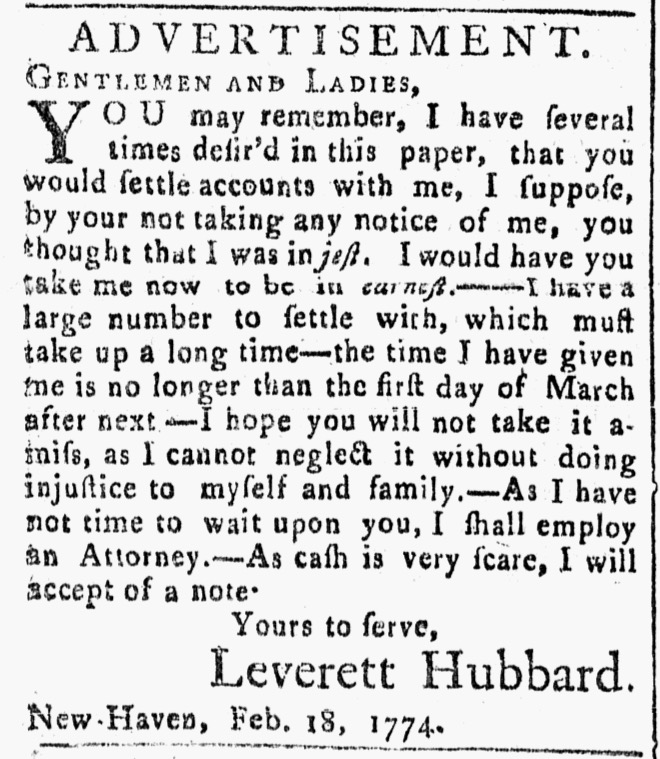
“WATCHES are restored to their pristine vigour, and warranted to perform well, free of expence for one year.”

Thomas Hilldrup, “WATCH MAKER from LONDON,” apparently considered his advertising campaign effective.  On October 1, 1773, his notice with the dateline, “Hartford, July 20, 1773,” once again appeared in the Connecticut Journal and New-Haven Post-Boy and the New-London Gazette.  Four days later, the same notice ran once again in the Connecticut Courant, the only newspaper printed in Hartford at the time.  When Hilldrup first arrived in Hartford in 1772 he commenced advertising in the Connecticut Courant, but it did not take long for him to surmise that he might benefit from advertising more widely.  He soon placed notices in the other two newspapers published in the colony.  Other watchmakers inserted their own advertisements in hopes of maintaining their share of local markets, but none of them advertised in multiple newspapers.  Hilldrup’s competitors also discontinued their advertisements after a few insertions, while the newcomer’s notices became a consistent feature in the three newspapers.

Hilldrup likely thought he made a wise investment by marketing his services in all three newspapers.  After all, those publications circulated widely throughout the colony.  Even if residents of New Haven or New London were unlikely to send their watches to Hilldrup at “the sign of the Dial” in Hartford, the watchmaker may have believed that prospective customers in other towns served by the Connecticut Journal and the New-London Gazette would find it as convenient to hire his services as those of his competitors … but only if Hilldrup made the effort to inform the public of his “constant diligence” in restoring watches “to their pristine vigour.”  In addition, his repeated advertisements in the three newspapers highlighted the guarantee he extended to clients, a promise that watches he fixed were “warranted to perform well, free of any expence for one year.”  In placing advertisements so widely and so often, Hilldrup reasoned that he could entice prospective clients beyond Hartford to give him a chance to serve them when they needed “Repeating, Horizontal and plain WATCHES” cleaned and repaired.

September 3

What was advertised in a colonial American newspaper 250 years ago today?

Connecticut Journal (September 3, 1773).

“Amos Morrisson, Wigg-Maker & Hair-Dresser.”

“Just published … THE MACARONIE JESTER.”

Amos Morrisson may not have been very happy about where his advertisement appeared in the September 3, 1773, edition of the Connecticut Journal.  The “Wigg-Maker & Hair-Dresser” likely did not appreciate that an advertisement for “THE MACARONIE JESTER” appeared immediately below his notice directed to fashionable ladies and gentlemen.  Eighteenth-century readers would have immediately recognized the derogatory term for a man who took current fashions, both clothing and hair, to absurd and preposterous lengths.  The Oxford English Dictionary explains that this synonym for dandy or fop was especially popular in the second half of the eighteenth century to describe “a member of a set of young men who travelled in Europe and extravagantly imitated Continental tastes and fashions.”  On both sides of the Atlantic, the term broadened to refer to any man whose overindulgence in fashion suggested idleness and vice.

Given such negative associations with too much luxury, Morrisson may have been dismayed by the proximity of his advertisement and one for The Macaroni Jester, “Just published, And to be sold by the Printers.”  The wigmaker and hairdresser promoted “various modes” of wigs and hairstyles for men and women, such as “Bagg Wiggs and Spencer Bobs” and “Ladies Roles and French Curls,” as well as accoutrements to adorn hair, including ribbons.  Furthermore, he confided, “If the above Articles should not happen to suit, Gentlemen can be suited in any Taste whatever, in the best Manner and at the shortest Notice.”  Morrisson catered to his clients, but the advertisement for The Macaroni Jester raised suspicions about the “Macaroni beau,” others who luxuriated in current fashions and consumerism, and the purveyors of goods and services who outfitted them.  According to the staff at the Library of the Society of Friends, the book include “includes a ditty on ‘The Origin of Macaronies,” [but] there’s little else of the Macaroni in it: the word has been used simply as a synonym for humour, satire and above all absurdity.”  The “original stories, witty repartees, comical and original Bull’s, [and] entertaining Anecdotes” promised in the advertisement “poke fun at many stock figures.”  Still, that would not have been apparent to readers of the Connecticut Journal, especially since the advertisement emphasized that “the origin of a Macaroni” was “illustrated with a curious and neat copperplate frontispiece of a Macaroni beau.”

Morrisson almost certainly did not want such associations with the goods and services he provided as wigmaker and hairdresser.  Did he complain to the printing office about the juxtaposition of the two advertisements?  In the next issue, Morrisson’s advertisement ran on the front page, while the advertisement for The Macaroni Jester appeared on the final page.  That may have been the result of the usual sort of reorganization that took place between issues.  Compositors regularly moved around advertisements that ran for multiple weeks.  All the same, nothing prevented Morrisson from voicing his concerns about the unfortunate proximity of the two advertisements.

July 23

What was advertised in a colonial American newspaper 250 years ago today?

Connecticut Journal and New-Haven Post-Boy (July 23, 1773).

WATCHES are restored to their pristine vigour, and warranted to perform well, free of any expence for one year.”

Though dated “Hartford, July 20, 1773,” Thomas Hilldrup’s advertisement in the July 23 edition of the Connecticut Journal and New-Haven Post-Boy had been composed much earlier.  The same copy first ran in Connecticut Courant, published in Hartford, on May 25.  It appeared in each issue of that newspaper since then, though Hilldrup dropped a short nota bene carried over from his previous advertisement after two insertions.  In this latest advertisement, Hilldrup, a “WATCH MAKER from LONDON,” declared that he had already met with so much success during his brief time in Connecticut, that he had been so “IMbolden’d by the encouragement receiv’d from the indulgent public,” that he “remov’d his shop” to a new location.  Prospective customers could find him at “the sign of the Dial” in the shop formerly occupied by Dr. Neil McLean near the courthouse in Hartford, “where Repeating, Horizontal and plain WATCHES are restored to their pristine vigour, and warranted to perform well, free of any expence for one year.”

After publishing this promotion in the Connecticut Courant for two months, Hilldrup extended that guarantee to readers of the Connecticut Journal.  It was not the first time, however, that the watchmaker took to the pages of a newspaper printed in another town in his efforts to build a large enough clientele to allow him to settle permanently in Hartford.  His advertising campaign commenced in the Connecticut Courant in the fall of 1772, but eventually expanded to the Connecticut Journal and New-Haven Post-Boy and the New-London Gazette during the winter months.  The newcomer ran advertisements in every newspaper published in the colony at the time, making it clear that local watchmakers who already established their reputations among prospective customers faced some new competition.  Placing an advertisement in the Connecticut Journal and New-Haven Post-Boy the first time may have been an experiment for a watchmaker who recently arrived in Hartford.  Opting to place another advertisement in that newspaper six months later, however, indicated that he believed the first one had been effective in generating business beyond clients served primarily by Hartford’s Connecticut Courant.  Even then, he did not consider merely announcing his presence in Hartford sufficient to draw clients to his shop.  Instead, he offered a one-year guarantee on repairs to convince prospective customers to give him a chance over his competitors.

May 28

What was advertised in a colonial American newspaper 250 years ago today?

Connecticut Journal (May 28, 1773).

“Physician, Surgeon, and Man-Midwife.”

When Richard Tidmarsh arrived in town in the spring of 1773, he published “An Address to the Inhabitants of New-Haven, and the Public in general” to offer his services as “Physician, Surgeon, and Man-Midwife.”  Like others who provided medical care and placed newspaper notices, he included an overview of his experience and credentials in hopes of convincing prospective patients otherwise unfamiliar with him that he was indeed qualified.

Tidmarsh asserted that he “was regularly bred in London” to all three “Branches” of medicine.  In other words, he received formal training in the largest city in the empire.  Furthermore, he had the “Advantage of being Pupil and Dresser in one of the most considerable Hospitals” in London.  He eventually migrated to Jamaica, where he “practised some Years with good Success,” but ultimately decided to relocate to mainland North America because of what he considered an “unhealthy Climate” in the Caribbean.

The “Physician, Surgeon, and Man-Midwife” did not arrive in New Haven directly from Jamaica.  Instead, he “lately practised ay Hartford in this Colony.”  Tidmarsh attempted to bolster his reputation by declaring that “his Abilities are well known” in Hartford, especially since “he was particularly successful in several dangerous Cases, where the Patients were gave over and deemed incurable.”  Given the relative proximity, he likely believed that prospective patients and “the Public in general” were more likely to hear of those successes in Hartford through other sources than they were to learn about his training in London or his work in Jamacia.  Even if they did not, Tidmarsh may have believed that including the local angle made his entire narrative more credible.

Given his background and experience, Tidmarsh hoped that residents of New Haven and nearby towns would consider him a “useful Member of Society” and seek medical care from him.  To encourage them to do so, he stated that he “proposes to practice as reasonable as any Gentleman of the Faculty” at the college (now Yale University).  His services did not come at higher prices than those of other physicians, surgeons, and man-midwives (though Tidmarsh conveniently overlooked female midwives who cultivated relationships and provided care to patients in the area).  As a newcomer in New Haven, he recognized the importance of sharing a short biography and assuring prospective patients about the quality and cost of his services.

May 21

What was advertised in a colonial American newspaper 250 years ago today?

Connecticut Journal (May 21, 1773).

(The Particulars will be in our next.)

Several shopkeepers advised readers of the Connecticut Journal and New-Haven Post-Boy that they recently acquired new merchandise. William Sherman advertised a “compleat Assortment of English & India Goods” and a “general Assortment of Hard-Ware.”  Thomas Gelstharp stocked a “Small Assortment of the neatest Silk, Thread, Cotton & Worsted HOSE” and other garments, while Daniel Lyman carried a “fresh Assortment of GOODS,” including nails, wines, shoes, and “sundry Articles, too tedious for Advertisement.”

Joseph Smith promoted his own “fresh and neat Assortment of GOODS, suitable for the Season,” but, unlike Lyman, he did wish to provide a more complete catalog of his wares to entice prospective customers to visit his shop.  His brief advertisement, however, ended with a note that “(The Particulars will be in our next.)”  A more extensive advertisement did indeed appear in the May 28, 1773, edition of the Connecticut Journal, filling more than half a column and listing dozens of items.

What explained the note appended to Smith’s initial advertisement?  Had his new merchandise “just come to Hand” so recently that he did not have an opportunity to compose a list of items in time to submit his advertisement to the printing office for the next edition of the Connecticut Journal?  Had that been the case, he may have believed that a short notice with few details was better than no advertisement at all.  When readers encountered the advertisements from Sherman, Gelstharp, and Lyman, they also saw Smith’s notice.

On the other hand, the printers, Thomas Green and Samuel Green, may have revised Smith’s advertisement and inserted the note about “The Particulars” appearing in the next issue because they did not have sufficient space to run all of the copy.  They could have strategically selected which advertisement to truncate when they set type for the May 28 edition. In that case, how did they handle the accounting and customer service?  Did the abbreviated version run gratis, the note about “The Particulars” intended for the advertiser rather than readers?  Did Smith pay a reduced rate for it?  Did the printers make any other effort to alert Smith that they would print his advertisement in its entirety but did not have enough space in the current issue?

Printers who published newspapers depended on revenue from advertising as much as revenue from subscriptions.  In addition, they likely had more contact with most advertisers than they had with most subscribers, especially considering that advertisements usually ran for only three or four weeks.  Renewing advertisements or placing new ones required contacting the printing office once again.  Both resulted in additional entries in the ledgers.  Printers likely had to exert more effort in managing their relationships with their advertisers than their relationships with their subscribers.  The note at the end of Smith’s advertisement may have been part of the Greens’ effort to manage their relationship with a local shopkeeper they hoped would continue to place notices in their newspaper.

May 7

What was advertised in a colonial American newspaper 250 years ago today?

Connecticut Journal (May 7, 1773).

ALL Persons indebted for this Paper, whose Accounts have been above 12 Months standing, are requested to make immediate Payment.”

It was the only decorative type in the May 7, 1773, edition of the Connecticut Journal and New-Haven Post-Boy.  It had been the only decorative type in the previous issue of that newspaper.  It would be the only decorative type in the following issue.  Thomas Green and Samuel Green, the printers, used decorative type sparingly.  What prompted them to deploy it in three consecutive issues in the spring of 1773?  They wished to call attention to their own notice that called on “ALL Persons indebted for this Paper, whose Accounts have been above 12 Months standing … to make immediate Payment.”  Such notices appeared frequently in newspapers throughout the colonies.  Printers often gave them privileged places to help direct readers to them.  Less often, they used decorative type to distinguish their notices from other advertisements.

Connecticut Journal (April 23, 1773).

The Greens enclosed their notice within an ornate border, enhancing its visibility no matter where it appeared on the page, whether near the bottom of the last column on the third page when it first ran on April 30 or as the last item on the last page in subsequent issues on May 7 and May 14.  No other advertisements in those issues featured decorative type, nor did the remainder of the contents.  In the previous issue published on April 23, a single line of printing ornaments that separated news items comprised the extent of decorative type.  After the Greens discontinued their notice, printing ornaments depicting skulls and bones appeared above a death notice for “Mrs. MARY LOTHROP, the agreable Consort of Mr. John Lothrop, of this Town,” in the May 21 edition.  No other decorative type appeared among the news or advertisements.

Connecticut Journal (May 21, 1773).

The Greens certainly had printing ornaments among their type.  They apparently believed that decorative type had practical value, that it could draw attention to an advertisement they considered important.  While they recognized the potential for adorning advertisements and other content, they did not embrace all the possible uses of printing ornaments in their newspaper in the eighteenth century.  That innovation came later.  Like other colonial printers, the Greens produced pages rather conservative in appearance compared to the vibrant use of printing ornaments in advertisements in many nineteenth-century newspapers.

April 23

Who was the subject of advertisements in colonial American newspapers 250 years ago today?

Connecticut Journal (April 23, 1773).

“TO BE SOLD … A likely Negro Man … Enquire of the Printers.”

TO BE SOLD, A Negro Boy … Enquire of the Printers.”

Timothy Green ran a busy printing office in the early 1770s.  In addition to publishing the New-London Gazette, he sold books, some that he printed but most of them imported.  In the April 23, 1773, edition of his newspaper, Green advertised one of his own imprints, informing readers that “A Faithful HISTORY OF REMARKABLE OCCURRENCES, IN THE Captivity and Deliverances OF Mr. JOHN WILLIAMS, Minister of the Gospel in DEEERFIELD” was “Just Published, and to be Sold.”  Green also did job printing, including broadsides, handbills, and blanks (or forms).  Similarly, Thomas Green and Samuel Green oversaw a bustling printing office where they published the Connecticut Journal and New-Haven Post-Boy.  In the spring of 1773, they distributed subscription proposals for a new edition of “A Discourse on Justification by Faith alone. BY THE REVEREND JONATHAN EDWARDS.”  Those proposals also appeared in the April 23 edition of the New-London Gazette, part of a network of printers and others who cooperated in collecting the names of subscribers who reserved copies.

New-London Gazette (April 23, 1773).

Among their many other responsibilities, all three printers also served as slave brokers.  The same day that they promoted important historical and theological works, they also advised readers to “Enquire of the Printers” to learn more about enslaved people advertised for sale in their newspapers.  In the Connecticut Journal, a brief advertisement announced, “TO BE SOLD, (for no Fault, but for want of Employ,) A likely Negro Man, about 26 Years old, fit for Town or Country. Enquire of the Printers.”  An even shorter, but equally insidious, advertisement in the New-London Gazette stated, “TO BE SOLD, A Negro Boy, about 13 Years old, lately brought into the Country.  Enquire of the Printer.”  In both cases, the advertisers declined to identify themselves, instead instructing interested parties to contact the printers for more information.  In turn, the printers facilitated the sales of enslaved people twice over and generated revenue from the advertisements in the process.  First, they disseminated the notices, undertaking the labor required to print and distribute the advertisements and the rest of the newspapers.  Then, they actively participated in the sale of the “likely Negro Man” and the “Negro Boy, about 13 Years old,” responding to messages they received in the printing office and colonizers who visited to learn more.  As these advertisements demonstrate, printers in New England participated in perpetuating slavery during the era of the American Revolution, alongside their counterparts in Maryland, Virginia, South Carolina, and other colonies with greater numbers of enslaved people.  Such advertisements underwrote the production and dissemination of the news, while those that required readers to “Enquire of the Printers” further enmeshed printers in the slave trade as brokers for sales.

For an extended consideration of such advertisements, see Jordan E. Taylor, “Enquire of the Printer: Newspaper Advertising and the Moral Economy of the North American Slave Trade, 1704-1807,” Early American Studies 18, no. 3 (Summer 2020): 287-323, and the companion website.

April 2

What was advertised in a colonial American newspaper 250 years ago today?

Connecticut Journal (April 2, 1773).

They shall be under the necessity of reducing it to its original size and price, unless the Subscribers for it, are more punctual in their payments.”

On April 17, 1772, Thomas Green and Samuel Green began printing the Connecticut Journal on larger sheets.  That allowed them to deliver more content to their subscribers, meeting the demand of “many of our Customers, and others, … desirous of having [the newspaper] enlarged.”  When they did so, they also noted that the previous edition “completed Four Years and an Half since the first Publication” of the newspaper, yet many of the subscribers “paid not a single Farthing” during that time and others were “indebted for Two or Three Year’s Papers.”  The printers called on anyone who owed for newspapers, advertisements, printed blanks, or anything else “to make speedy Payment.”

Almost a year later, the Greens made similar pleas.  On April 2, 1773, they declared, “The Printers are sorry, they can with truth inform the Public, That they have not for this year past, received from all the Customers for this Journal, so much money as they have expended for the blank paper, on which it has been printed.”  Colonial printers often lamented that subscribers and others did not pay their bills, but few did so in such stark terms.  The Greens noted that the “next week’s paper … completes one year since its enlargement,” a benefit to subscribers that accrued even greater expenses for the printers.  That benefit would not continue, the Greens warned, if subscribers did not settle accounts.  They proclaimed that “they shall be under the necessity of reducing it to its original size and price, unless the Subscribers for it, are more punctual in their payments.”  Other printers often threatened to take legal action against recalcitrant subscribers to force them to pay what they owed.  The Greens, on the other hand, threatened other consequences that would have an impact on all readers, not just those taken to court.

Whether it involved suing subscribers or publishing the names of those who refused to pay, printers usually did not follow through on their threats.  Whether or not the Greens’ notice prompted some subscribers to submit payment, the printers did not opt to revert to the original size of the newspaper.  Through experience, many readers likely believed that they could ignore such notices from the printers without suffering any consequences.  Printers wished to maintain robust circulations so they could sell advertising, a factor that played a role in their decisions about how to handle difficult subscribers.