March 25

What was advertised in a revolutionary American newspaper 250 years ago today?
New-York Gazette and Weekly Mercury (March 25, 1776).

“Work in the jewellery way … all sorts of silver-smiths work.”

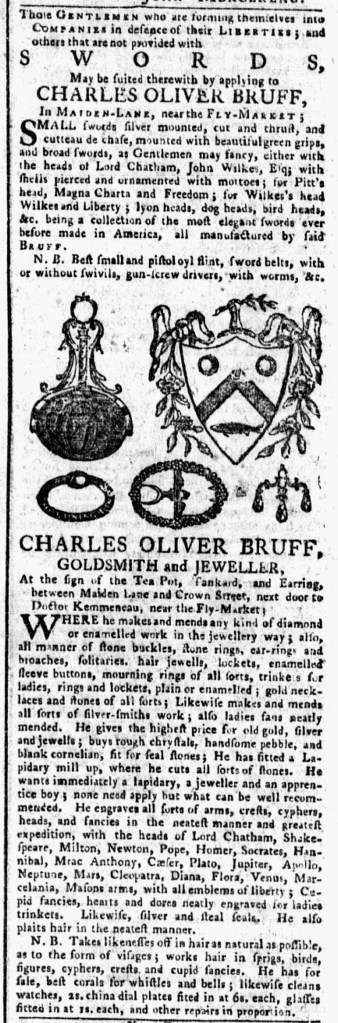
By the time that Charles Oliver Bruff, a goldsmith and jeweler, placed his advertisement in the March 25, 1776, edition of the New-York Gazette and Weekly Mercury he was a veteran advertiser with at least a decade of experience running notices in the public prints in New York.  While little direct evidence about the effectiveness of advertising in early America exists, the fact that Bruff repeatedly invested in marketing suggests that he believed that it worked and considered it worth the investment.  Indeed, his latest advertisement consisted of two advertisements.  The copy for the first one ran as its own notice in the Constitutional Gazette more than six months earlier.  As the first anniversary of the battles at Lexington and Concord approached, Bruff once again offered swords to “Those GENTLEMEN who are forming themselves into COMPANIES in defence of their LIBERTIES.”

Bruff may have considered advertising effective because he did more than merely announce that he had goods for sale.  Instead, he carefully crafted appeals to consumers, encouraging them to purchase his wares.  As he targeted prospective customers “forming themselves into COMPANIES,” for instance, he adorned them with likenesses of British politicians who advocated for the American colonies and corresponding mottoes, including “[William] Pitt’s head, Magna Charta and Freedom” and “[John]Wilkes’s head[,] Wilkes and Liberty.”  He also underscored that the words he stocked were “made in America, all manufactured by said BRUFF.”  When nonimportation agreements became one of the primary strategies for practicing politics, Bruff and other entrepreneurs marketed goods produced in the colonies.

The goldsmith and jeweler also deployed visual images to promote his business.  He advised readers that he kept shop “At the sign of the Tea Pot, Tankard, and Earring,” but they likely noticed the woodcut that adorned his advertisement before anything else.  It featured several of the items available at his shop, including a handheld looking glass with an ornate handle and frame, a ring, a buckle, and an earring.  The image also included an elaborate coat of arms.  A shield decorated with two silver balls, a chevron, and a fish was in the center.  A hand grasping a sheaf of wheat appeared above the shield.  Ribbons cascaded over the side, giving way to leaves and flowers.  The ornate woodcut corresponded to an appeal that Bruff made in the second of those advertisements combined into a single lengthy advertisement: “He engraves all sorts of arms, crests, cyphers, heads, and fancies in the neatest manner.”  For good measure, he reminded prospective customers that he also engraved “all emblems of liberty” on jewelry and other items.

In addition to his “work in the jewellery way” and “silver-smiths work,” Bruff provided other services to entice customers into his shop.  He cleaned watches, installed new glass, and made other repairs at reasonable prices and even “works hair in springs, birds, figures, cyphers, crests and cupid fancies” and “plaits hair in the neatest manner.”  Bruff made his advertisements worth the investment by developing a variety of appeals to consumers and promising an array of goods and services to encourage them to visit his shop.
January 31

What was advertised in a revolutionary American newspaper 250 years ago today?

Constitutional Gazette (January 31, 1776).

“BEST Geneva, made and distilled from rye.”

Advertisements for consumer goods and services crowded the pages of early American newspaper.  Did they work?  Unfortunately, that question is difficult to answer.  The advertisements reveal what kinds of marketing appeals merchants, shopkeepers, artisans, and other entrepreneurs thought would resonate with consumers and influence them to make purchases, but they rarely indicated how readers responded.

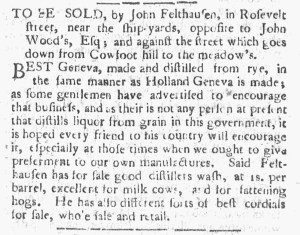
That so many entrepreneurs advertised and that they invested in advertising regularly suggests that they believed that they received a sufficient return on their investment to make the expense worth it.  Consider John Felthausen and his advertisement for “BEST Geneva [or Jenever, a type of gin], made and distilled from rye,” in the January 31, 1776, edition of the Constitutional Gazette.  That was not the first time that Felthausen placed that advertisement.  Three months earlier, he ran an advertisement with nearly identical copy in the New-York Gazette and Weekly Mercury.  If Felthausen believed that previous advertisement had not yielded results, would he have run it again in another newspaper a few months later?

That new advertisement had nearly identical copy, though the compositor for the Constitutional Gazette made very different decisions about the format than the compositor for the New-York Gazette and Weekly Mercury.  Felthausen may have even clipped the advertisement from one newspaper and delivered it to the printing office for the other, making marks on it to indicate copy he wished to update.  Those revisions amounted to adding a sentence at the end: “He has also different sorts of best cordials for sale, wholesale and retail.”  He retained his appeal to “every friend to this country” to “encourage” or support his business, “especially at those times when we ought to give preferment to our own manufactures.”  The distiller apparently believed that his previous advertisement met with sufficient success to merit repeating it to hawk both his “BEST Geneva” and additional products not previously included.

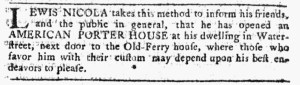
January 7

What was advertised in a revolutionary American newspaper 250 years ago this week?

Pennsylvania Evening Post (January 6, 1776).

“He has opened an AMERICAN PORTER HOUSE.”

During the first week of 1776, Lewis Nicola took to the pages of the Pennsylvania Evening Post “to inform his friends, and the public in general, that he has opened an AMERICAN PORTER HOUSE at his dwelling in Water-street” in Philadelphia.  He promised that “those who favor him with their custom may depend upon his best endeavors to please.

Nicola assumed that readers knew who brewed the porter that he served at his establishment.  After all, “Mr. HARE’s best AMERICAN DRAUGHT PORTER” had been the subject of several advertisements that recently ran in the Pennsylvania Evening Post.  William Dibley served “this new and glorious manufacture” at the Fountain and White Horse Inn on Chestnut Street.  Joseph Price encouraged “all the SONS of AMERICAN LIBERTY” to drink “Messrs. HARE’s and Co. best DRAUGHT and BOTTLED AMERICAN PORTER” at his tavern “at the sign of the Bull and Dog” on Market Street.  Similarly, Patrick Meade offered “Messrs. HARE and Co. AMERICAN PORTER” to “the TRUE FRIENDS to LIBERTY” at the Harp and Crown in nearby Southwark.

Robert Hare, the son of an English brewer who specialized in porter, arrived in Philadelphia in 1773.  He established his own brewery where he brewed porter, “the first person to brew the drink in America.”  The timing worked well for Hare; he commenced brewing American porter as the imperial crisis intensified and the Revolutionary War began.  Colonizers looked to support local enterprises by purchasing “domestic manufactures” while they boycotted goods imported from England.  That positioned Hare’s brewery for success.

Just as significantly, consumers liked his porter (unlike some of the substitutes for imported tea that some colonizers concocted).  When John Adams attended the First Continental Congress in the fall of 1774, he lauded Hare’s porter in a letter to Abigail: “I drink no Cyder, but feast upon Phyladelphia Beer, and Porter.  A Gentleman, one Mr. Hare, has lately set up in this City a Manufactory of Porter, as good as any that comes from London.  I pray We may introduce it into the Massachusetts.  It agrees with me, infinitely better than Punch, Wine, or Cyder, or any other Spirituous Liquor.”  With Hare’s porter having such a reputation, Nicola did not need to mention the brewer when he opened his “AMERICAN PORTER HOUSE.”  The public knew the porter came from Hare’s brewery.

December 19

What was advertised in a revolutionary American newspaper 250 years ago today?

Dunlap’s Maryland Gazette (December 19, 1775).

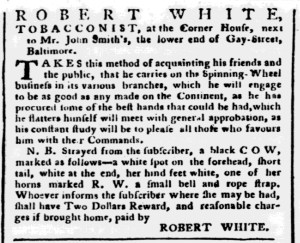
“He carries on the Spinning-Wheel business in its various branches.”

In the final weeks of 1775, Robert White, a tobacconist in Baltimore, diversified his business.  He inserted an advertisement in the December 19 edition of Dunlap’s Maryland Gazette that announced that “he carries on the Spinning-Wheel business in its various branches.”  Why would a tobacconist decide to go into that line of business?  The Continental Association, a nonimportation and nonconsumption agreement devised by the Furst Continental Congress, remained in effect.  It called on colonizers to replace imported goods, including textiles, with alternatives produced in the colonies.  That meant more time spent spinning, a domestic chore that gained political significance.  Women styled Daughters of Liberty in newspaper accounts participated in public spinning bees to demonstrate their patriotism and inspire others to follow their example in their own homes.  To do so, they needed the right equipment.  White saw an expanding market for spinning wheels.

He was not alone in marketing equipment for producing homespun cloth.  His advertisement happened to appear immediately above Fergus McIllroy’s notice promoting “LOOMS made properly, for carrying on the Linen and Woolen Weaving-business.”  McIllroy, a “House Joiner,” also pursued a new line of work, though in his case doing so did not depart nearly as much from his primary occupation.  In addition, he reported that he had previously constructed more than two hundred looms in Ireland before migrating to the colonies.  White, the tobacconist, did not invoke such experience when it came to spinning wheels, yet he confidently proclaimed that he “will engage” his spinning wheels “to be as good as any made on the Continent” because “he has procured some of the best hands that could be had.”  In turn, White “flatters himself” that his workers and the spinning wheels they produced “will meet with general approbation” or approval from customers.  The tobacconist apparently served as a supervisor, an entrepreneur who established a business when he identified need for it during difficult time yet did not participate in making the spinning wheels.  Instead, in overseeing his new business, he pledged that “his constant study will be to please all those who favours him with their Commands.”  With no resolution in sight for the imperial crisis that became a war the previous April, White’s advertisement likely resonated with readers who understand the political implications of a tobacconist deciding to produce spinning wheels.

December 15

What was advertised in a revolutionary American newspaper 250 years ago today?

Essex Journal (December 15, 1775).

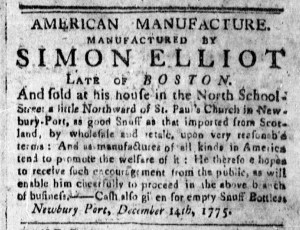
“Manufactures of all kinds in America tend to promote the welfare of it.”

In December 1775, Simon Elliott took to the pages of the Essex Journal, printed in Newburyport, Massachusetts, to promote the snuff that he made in that town.  He published his advertisement as the siege of Boston continued, much of the copy testifying to the imperial crisis that had become a war with the skirmishes at Lexington and Concord the previous April.

The advertisement featured an elaborate headline.  Indeed, it had a primary headline and a secondary headline, like many other newspaper advertisements.  Elliot’s name, centered and all in capital letters of a larger font than anything else in that issue of the Essex Journal except the name of the newspaper in the masthead, demanded attention.  It was the second line of three, the other two also centered and in capital letters but smaller fonts: “MANUFACTURED BY / SIMON ELLIOT / LATE OF BOSTON.”  A secondary headline, “AMERICAN MANUFACTURE,” appeared above the headline that made Elliot’s name so prominent.

Like so many other artisans when they moved to new towns and introduced themselves to prospective customers, Elliot mentioned his origins.  Usually, “OF BOSTON” sufficed, but in this instance “LATE OF BOSTON” likely indicated that he had been displaced from that city recently.  Many residents chose to leave following the outbreak of hostilities.  In the early days of the siege of Boston, the Sons of Liberty and General Gage negotiated an exchange that allowed Loyalists to enter and others to depart.  In the following months, newspapers throughout New England carried advertisements by entrepreneurs “from Boston,” a diaspora of refugees displaced at the beginning of the Revolutionary War.

In addition to signaling the hardships he recently faced, Elliot also promoted the quality of the snuff that he made in Newburyport, asserting it was “as good Snuff as that imported from Scotland.”  That was no small claim since tobacco processed into snuff in Scotland had a superior reputation at the time.  Yet Elliot had more to say about his “AMERICAN MANUFACTURE” and why consumers should favor it over others.  Echoing the Continental Association, a nonimportation agreement devised by the First Continental Congress, and popular discourses of the last decade, Elliot declared that “as manufactures of all kinds in America tend to promote the welfare of it: He therefore hopes to receive such encouragement from the public” to support his new enterprise.  Supporters of the American cause, he suggested, had a civic duty to purchase the snuff that he made in Newburyport as well as support other entrepreneurs who produced domestic manufactures.

November 28

What was advertised in a revolutionary American newspaper 250 years ago today?

Dunlap’s Maryland Gazette (November 28, 1775).

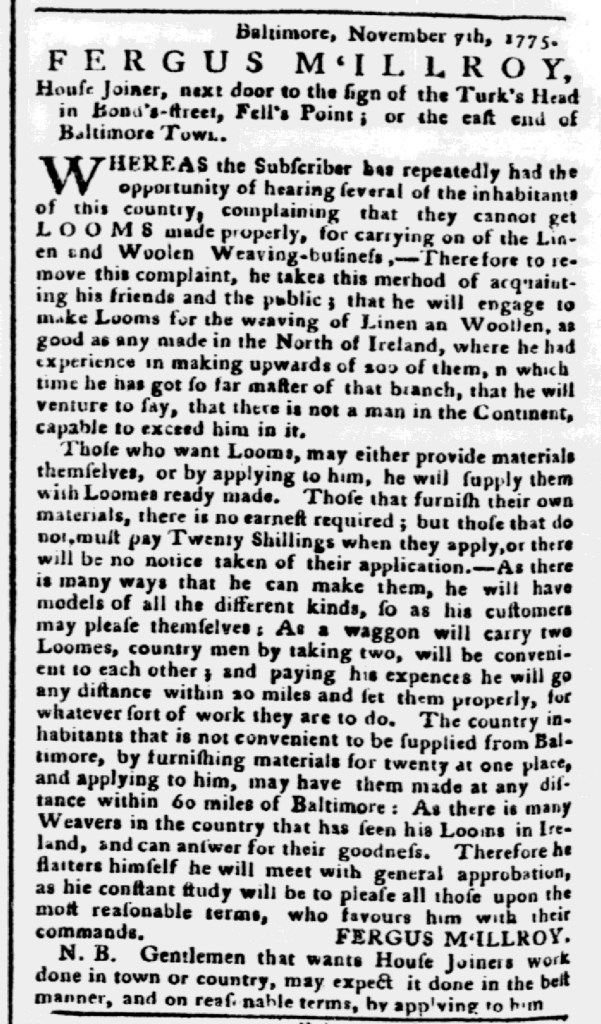
“He will engage to make Looms for the weaving of Linen an[d] Woollen.”

At the same time that David Poe advertised that he “set up … the business of SPINNING WHEEL Making” in Baltimore in November 1775, Fergus McIllroy took to the pages of Dunlap’s Maryland Gazette to inform the public that he “will engage to make Looms for the weaving of Linen an[d] Woolen.”  Both artisans responded to demand for equipment for making textiles that arose in response to the Continental Association, a nonimportation and nonconsumption agreement devised by the First Continental Congress to leverage commerce as a means of achieving political goals.  The text of the pact stated that it would remain in place until Parliament repealed duties on tea and the Coercive Acts that punished Boston for the destruction of tea in what has become known as the Boston Tea Party.  It also issued a call to “encourage Frugality, Economy, and Industry; and promote Agriculture, Arts, and the Manufactures of this Country, especially that of Wool.”

Many colonizers, both men and women, wanted to do their part in producing domestic manufactures as alternatives to imported textiles and other goods, but they needed materials and equipment.  McIllroy reported that he “repeatedly had the opportunity of hearing several of the inhabitants of this country, complaining that they cannot get LOOMS made properly, for carrying on of the Linen and Woolen Weaving-business.”  Although he currently worked as a “House Joiner,” he claimed that he “has experience of making upwards of 200” looms before he migrated to Baltimore.  That being the case, he pledged that his looms were “as good as any made in the North of Ireland.”  Yet prospective customers did not have to take his word for it: “there is many Weavers in the country that has seen his Looms in Ireland, and can answer for their goodness.”  For good measure, he added that he was a “master” when it came to making looms and “there is not a man in the Continent capable to exceed him.”

In addition, McIllroy noted the “many ways that he can make them,” so he had “models of all the different kinds, so as his customers may please themselves.”  Furthermore, they could supply the materials for constructing their looms or leave it to McIllroy to provide the materials.  In the latter instance, customers had to pay a deposit of twenty shillings before McIllroy would make their loom.  He also outlined the conditions for visiting homes to “set them up properly.”  If a town within sixty miles of Baltimore wished to order twenty or more looms, he offered to do the work there to avoid transporting the new looms over long distances.  McIllroy stood ready to contribute to the American cause with his “Industry” that in turn “promote[d] … the Manufactures of this Country,” joining with other artisans who vowed to do the same.

November 16

What was advertised in a revolutionary American newspaper 250 years ago today?

Pennsylvania Evening Post (November 16, 1775).

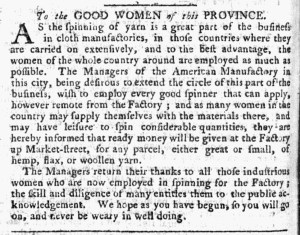
“The Managers of the American Manufactory … wish to employ every good spinner that can apply.”

The proprietors of the American Manufactory in Philadelphia periodically took to the public prints to encourage the public to support their enterprise.  In the March 1775, they called a general meeting at Carpenters’ Hall, the site where the First Continental Congress held its meetings the previous fall.  They invited prospective investors to attend as well as sign subscription papers already circulating.  A month later, the proprietors ran a brief advertisement, that one seeking both materials (“A Quantity of WOOL, COTTON, FLAX, and HEMP”) and workers “(a number of spinners and flax dressers”).  That notice happened to appear in the Pennsylvania Journal on April 19, 1775, the day of the battles at Lexington and Concord, though it would take a while for residents of Philadelphia to learn about the outbreak of hostilities near Boston.  The mission of the American Manufactory to produce an alternative to imported textiles became even more urgent.  In August, the proprietors once again sought workers, publishing an address “To the SPINNERS in thisCITY and the SUBURBS.”  They offered women an opportunity to participate in politics and “help to save the state from ruin.”

In November 1775, the proprietors or “Managers of the American Manufactory” made another appeal “To the GOOD WOMEN of this PROVINCE.”  They explained that “the spinning of year is a great part of the business in cloth manufactories” and “in those countries where they are carried on extensively, and to the best advantage, the women of the whole country are employed as much as possible.”  Having already engaged women “in this CITY and the SUBURBS” who responded to their previous advertisement and apparently needing even more yarn to make into textiles, the managers found themselves “desirous to extend the circle … to employ every good spinner than can apply, however remote from the Factory.”  They believed that women in the countryside “may supply themselves with the materials there” and had “leisure to spin considerable quantities.”  They may have been right on the first count, but perhaps overestimated how many other responsibilities wives, mothers, sisters, and daughters had in their households.  For those who made the time, the managers offered “ready money … for any parcel, either great or small, of hemp, flax, or woollen yarn.”

The managers also lauded the contributions of “those industrious women who are now employed in spinning for the Factory,” declaring that “the skill and diligence of many entitles them to the public acknowledgement.”  They served the American cause in their own way according to their own abilities, just as the delegates to the Second Continental Congress did and just as the soldiers and officers participating in the siege of Boston did.  “We hope as you have begun,” the managers encouraged, “so you will go on, and never be weary in well doing.”

November 14

What was advertised in a revolutionary American newspaper 250 years ago today?

Dunlap’s Maryland Gazette (November 14, 1775).

“He has set up … the business of SPINNING WHEEL Making.”

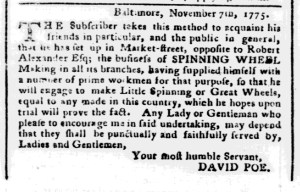
David Poe established a workshop for making spinning wheels in Baltimore in the fall of 1775.  To attract the attention of prospective customers, he placed an advertisement in the November 14 edition of Dunlap’s Maryland Gazette, advising “his friends in particular, and the public in general, that he has set up … the business of SPINNING WHEEL Making in all its branches.”  Rather than make one spinning wheel at a time, he could produce them in quantity, “having supplied himself with a number of prime workmen for that purpose.”  Poe did not specify whether those “prime workmen” were free, indentured, or enslaved.  He instead emphasized that he “will engage to make Little Spinning or Great Wheels, equal to any made in this country.”  Furthermore, he invited readers to see for themselves, stating that he “hopes upon trial” spinning wheels made in his workshop “will prove the fact.”

Poe advertised spinning wheels at a time that they became political symbols.  In response to the Coercive Acts that Parliament passed to punish Boston after the destruction of imported tea during a protest now known as the Boston Tea Party, the First Continental Congress devised the Continental Association, a nonimportation, nonconsumption, and nonexportation pact that called on colonizers to abstain from purchasing goods, including textiles, imported from England.  The agreement also included a call for colonizers to “encourage Frugality, Economy, and Industry; and promote Agriculture, Arts, and the Manufactures of this Country, especially that of Wool.”  Poe heeded that call as homespun cloth produced in the colonies became a fashionable political statement.  Newspapers carried reports of women participating in politics by holding spinning bees in public spaces.  Rather than a useful tool operated in domestic settings, the spinning wheel became a symbol of public commitment to the American cause, a visible demonstration to friends, neighbors, and the rest of the community that industrious women hoped would inspire others to follow their lead.  Poe did his part, aiming to provide “Any Lady or Gentleman” with spinning wheels for their households.  He did not make direct reference to the Continental Association or the events that had unfolded in the seven months since the battles at Lexington and Concord, but he did not need to do so.  Readers certainly understood the connection between spinning wheels and current events.

October 30

What was advertised in a revolutionary American newspaper 250 years ago today?

Boston-Gazette (October 30, 1775).

“He pays cash for all kinds of homespun cloths.”

Enoch Brown, a shopkeeper, had a history of promoting domestic manufactures (or goods made in the colonies) as alternative to items imported from Britain.  In the spring of 1768, for instance, he ran an advertisement alerting “those Persons who are desirous of Promoting our Own Manufactures … That he takes in all Sorts of Country-made Cloths at his Store on Boston Neck.”  In the wake of learning about duties levied on certain imported goods in the Townshend Revenue Act, many colonizers set about organizing nonimportation agreements.  They simultaneously embraced goods produced locally as a means of supporting the colonial economy and correcting a trade imbalance with Britain.  Several years later, Brown ran another advertisement with similar themes in January 1775.  Bearing the headline “American Manufacture,” that notice emphasized that the variety of textiles Brown stocked “were manufactured in this Province, and are equal in quality to any, and superior to most imported from England, and much cheaper than can be produced from any part of Europe.”

Although Brown had been at the same location for years, he departed Boston for Watertown following the battles at Lexington and Concord.  That presented challenges for both Brown and his customers, so “for greater Conveniency” he once again moved, this time to “Little-Cambridge” in the fall of 1775.  When he opened his shop, he advertised a “Variety of Winter Goods” for the coming season as well as “sagathees, duroys, camblets,” and other textiles “of American manufacture, which he sells extreme cheap.”  Customers could acquire any of those for low prices, despite the disruptions taking place as the siege of Boston continued.  Committed to giving consumers choices that matched their political principles, Brown sought new merchandise made locally.  In a nota bene at the end of his advertisement, he declared that he “pays cash for all kinds of homespun cloths.”  In so doing, he filled the role of intermediary between producers and consumers, giving both the opportunity to support the American cause.  After all, the Continental Association devised by the First Continental Congress did not merely instruct consumers to cease purchasing imported goods but also called on colonizers to “encourage Frugality, Economy, and Industry; and promote Agriculture, Arts, and the Manufactures of this Country.”  As a shopkeeper who bought and sold homespun cloth, Brown did his part.

October 27

What was advertised in a revolutionary American newspaper 250 years ago today?

Connecticut Gazette (October 27, 1775).

“AN AMERICAN EDITION.”

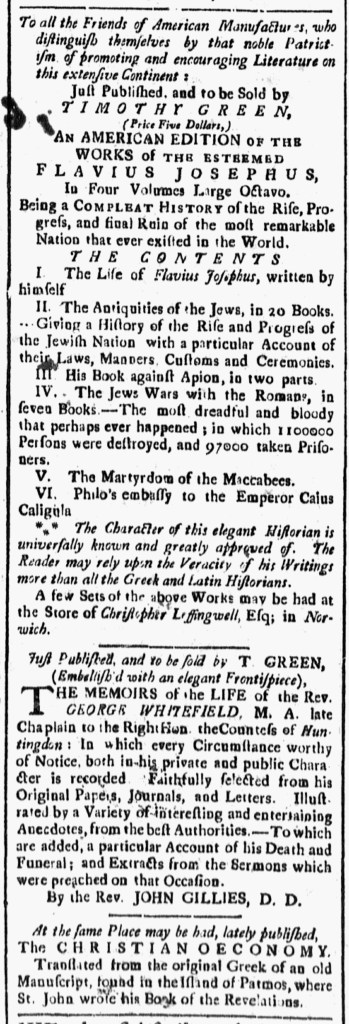
Calls to “Buy American” during the imperial crisis and the Revolutionary War extended to advertisements for books.  In the October 27, 1775, edition of the Connecticut Gazette, Timothy Green, the printer, promoted three works published in the colonies and available at his printing office in New London.  He addressed the advertisement to “all the Friends of American Manufactures, who distinguish themselves by that noble Patriotism of promoting and encouraging Literature on this extensive Continent.”

Those books included the “MEMOIRS of the LIFE of the Rev. GEORGE WHITEFIELD,” one of the most famous ministers of the era.  When he died in Newburyport, Massachusetts, on September 30, 1770, news spread throughout the colonies as widely and as quickly as news about the Boston Massacre earlier that year.  John Gillies compiled the memoir from Whitefield’s “Original Papers, Journals, and Letters” and added “a particular Account of his Death and Funeral; and Extracts from the Sermons which were preached on that Occasion.”  They originally appeared in a London edition published in 1772, but Green most likely sold an American edition printed by Robert Hodge and Frederick Shober in New York in 1774.

For another of the books, The Works of Flavius Josephus in four volumes, Green triumphantly proclaimed that it was an “AMERICAN EDITION.”  Earlier in the eighteenth century, American printers sometimes put a London imprint on the title page of books they printed in the colonies, believing that customers preferred imported works.  Mitch Fraas, curator at the Kislak Center for Special Collections, Rare Books, and Manuscripts at the University of Pennsylvania, notes the prevalence of “books printed in America … bearing the false imprint of European cities.”  That seems to have been the case with two 1773 editions of The Works of Flavius Josephus with a New York imprint yet “Probably printed in Glasgow,” according to the entries in the American Antiquarian Society’s catalog.  Yet colonizers had access to an authentic American edition … and Hodge and Shober had been involved in the production, just as they had printed an edition of The Christian Oeconomy, the final book in Green’s advertisement, in 1773.

Rather than looking to London to provide them with books, some printers and booksellers embraced American editions and encouraged prospective customers to do the same.  Green framed doing so as the patriotic duty of “Friends of American Manufactures” who supported the American cause and participated in the Continental Association, a nonimportation agreement enacted throughout the colonies in response to the Coercive Acts.  Readers could do their part to defend American liberties through the choices they made in the marketplace, including purchasing an “AMERICAN EDITION” when they went to the bookstore.