August 18

What was advertised in a colonial American newspaper 250 years ago today?

Massachusetts Gazette and Boston Weekly News-Letter (August 11, 1774).

“Render this Country an essential Service, by establishing a Manufacture necessary to its Prosperity.”

Abraham Cornish had been in business and advertising long enough by the late summer of 1774 that he expected colonizers to be familiar with his brand of “CORNISH’s New-England Cod-Fish HOOKS.”  He deployed the name of his product as a headline for his advertisement in the August 18 edition of the Massachusetts Gazette and Boston Weekly News-Letter.  Still, for those who needed a refresher or a bit more encouragement to purchase his fishhooks, he provided more information about why those from “his Manufactory” were superior to others.  That they were made in America was central to his marketing efforts.

The savvy entrepreneur had recently moved from “the North-End of Boston, to the Upper Part of Charlestown,” where he continued to make fishhooks “warranted of the best Quality.”  He called on “all concerned in the Fishery” to “favor him with their Custom, as they will thereby promote their own private Interest, and render this Country an essential Service, by establishing a Manufacture necessary to its Prosperity.”  It was a win-win-win situation for “the American Fishery,” the manufacturer, and all colonizers at a time that the political crisis intensified due to the imposition of the Coercive Acts in retaliation for the Boston Tea Party.  Those whose livelihood depended on fishing could acquire equipment “found much Superior to any imported, Cornish could maintain or even expand his business, and the colonies would benefit from “domestic manufactures” that both supported a local industry and directly contributed to the local economy.  Ever since the boycotts inspired by the Stamp Act nearly a decade earlier, many colonizers had advocated for producing more “domestic manufactures” as a means of reducing their reliance on imported goods.  Doing so also served as political leverage in the struggles with Parliament.  Such plans placed obligations on both artisans and tradespeople to produce goods and consumers to purchase those goods instead of imported items.  Like many other producers of “domestic manufactures,” Cornish assured prospective customers that they did not have to sacrifice quality, decalaring that his fishhooks were “made of the best Wire only” and “better shap’d to take Fish.”  He proclaimed that they were “universally approv’d,” having gone into even greater detail in a previous advertisement about how “Fishermen who made Trial of his Hooks … found them … superior to those imported from England.”  Cornish devised a “Buy American” campaign before the colonies declared independence.

July 20

What was advertised in a colonial American newspaper 250 years ago today?

Pennsylvania Gazette (July 20, 1774).

“Patterns of the different prints may be seen at the Manufactory.”

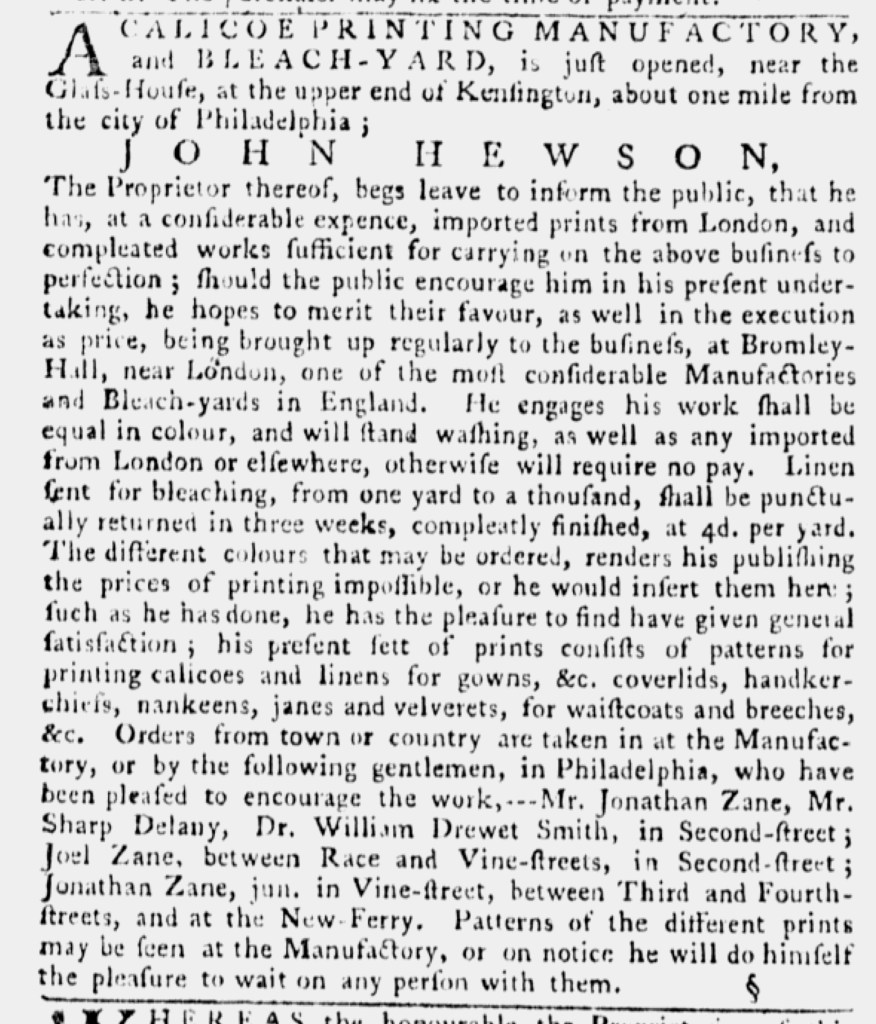
John Hewson joined the chorus of entrepreneurs promoting “domestic manufactures” or goods produced in the colonies as an alternative to imported goods when he announced that his “CALICOE PRINTING MANUFACTORY, and BLEACH-YARD, is just opened” on the outskirts of Philadelphia.  As the imperial crisis intensified, it became more important than ever for producers and consumers in the colonies to unite in opposition to the “oppressive and arbitrary yoke” of a “corrupt and designing Ministry.”  That was how an editorial addressed “To the INHABITANTS of the different COLONIES IN AMERICA” described current events.  The following pages of the July 20, 1774, edition of the Pennsylvania Gazette featured a “SUMMARY of Monday’s DEBATES on the BOSTON BILLS” (or the Coercive Acts), “RESOLUTIONS unanimously entered into by the Inhabitants of SOUTH-CAROLINA, at a General Meeting, held at Charles-Town,” and updates from other colonies about how they intended to respond to the Boston Port Act.

That made it an opportune time for Hewson to promote his new enterprise, one that he assured consumers rivaled in quality his competitors on the other side of the Atlantic.  At “considerable expence,” he had “imported prints from London, and completed works for carrying on [his] business to perfection.”  In addition, he possessed valuable experience, having been “brought up regularly to the business, at Bromley-Hall, near London, one of the most considerable Manufactories and Bleach-yards in England.”  Realizing that prospective customers may have been skeptical of his claims, Hewson offered a guarantee: “his work shall be equal in colour, and will stand washing, as well as any imported from London or elsewhere, otherwise will require no pay.”  Customers had nothing to lose if Hewson did not charge for work that they found unsatisfactory.  Furthermore, he charged reasonable prices for textile printing, though the extensive combinations of colors “renders his publishing the prices of printing impossible.”  Hewson had a variety of patterns for customers to order.  They could examine samples “at the Manufactory” or schedule appointments for Hewson to visit them.  They could also place orders “at the Manufactory” or leave them with one of several associates “who have been pleased to encourage the work” and, in turn, endorsed the endeavor by partnering with Hewson in receiving orders.

Hewson did not directly mention the deteriorating relationship between the colonies and Britain nor proposals for new nonimportation agreements intended to harness commerce as political leverage.  That hardly seemed necessary considering that readers almost certainly had current events in mind as they perused newspaper advertisements.  Hewson did not need to belabor the political advantages of supporting his “CALICOE PRINTING MANUFACTORY” when news items and editorials already did that work.

July 14

What was advertised in a colonial American newspaper 250 years ago today?

Rivington’s New-York Gazetteer (July 14, 1774).

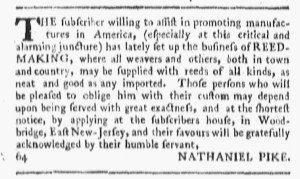
“At this critical and alarming juncture … set up the business of REED-MAKING.”

Nathaniel Pike testified that he wished to do his part to support the American cause in an advertisement in the July 14, 1774, edition of Rivington’s New-York Gazetteer.  He informed the public that he was “willing to assist in promoting manufacturers in America, (especially at this critical and alarming juncture)” and, accordingly, “lately set up the business of REED-MAKING.”  Eighteenth-century readers familiar with weaving knew that reeds were the “part of a loom consisting of a set of evenly spaced wires known as dents (originally slender pieces of reed or cane) fastened between two parallel horizontal bars used for separating, or determining the spacing between, the warp threads, and for beating the weft into place.”[1]  Pike pledged that “weavers and others, both in town and country, may be supplied with reeds of all kinds, as neat and good as any imported.”

Although Pike did not name the Boston Port Act or any of the other Coercive Acts passed by Parliament in retaliation for the Boston Tea Party, readers certainly understood the context for his reference to “this critical and alarming juncture.”  From New England to Georgia, colonizers discussed how to respond, many of them advocating for a new round of nonimportation agreements like the ones enacted in response to the Stamp Act and the duties imposed on certain goods in the Townshend Acts.  That meant that “domestic manufactures” or goods produced in the colonies would become important alternatives to imported goods.  Pike offered his own product made in the colonies, those reeds that matched imported ones in quality, yet his enterprise also facilitated greater production of textiles in the colonies.  Every stage of producing cloth took on greater significance in the face of boycotting fabrics imported from England, from farmers raising sheep for their wool to women participating in spinning bees that put their patriotism on display to consumers choosing and wearing homespun cloth out of allegiance to their political principles.  By supplying weavers with reeds for their looms, Pike served a vital role in protests against the abuses perpetrated by Parliament.  He expected that current events would help in marketing his product.

**********

[1] Oxford English Dictionary, II.11.a.

July 7

What was advertised in a colonial American newspaper 250 years ago today?

Massachusetts Spy (July 7, 1774).

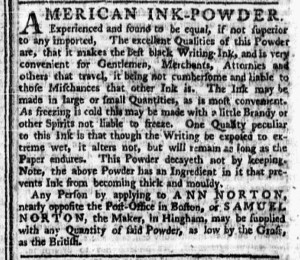
“AMERICAN INK-POWDER.”

In an advertisement in the July 7, 1774, edition of the Massachusetts Gazette, Ann Norton of Boston and Samuel Norton of Hingham heralded “AMERICAN INK-POWDER” made by Samuel.  They encouraged “Gentlemen, Merchants, Attornies and others that travel” to purchase this product “found to be equal, if not superior to any imported.”  Most of the advertisement described the various qualities of the ink powder that made it better than imported alternatives.  As colonizers in Boston and other towns considered enacting nonimportation agreements to protest the Boston Port Act, entrepreneurs like the Nortons seized the opportunity to present “domestic manufactures” or goods produced in the colonies as patriotic choices for consumers.  On the same page as the Nortons’ advertisement for “AMERICAN INK-POWDER,” Philip Freeman once again ran his notice asserting that “we can manufacture enough [gloves] here, to supply the whole Continent” and recommending that “the importation of this article at least will be totally stopped” during such “threatning” times.

Both advertisements ran in a newspaper that featured a new addition to its masthead: a snake in several segments facing a dragon.  The words “JOIN OR DIE” appeared above the snake and abbreviations for New England and other colonies accompanied each segment.  Readers understood that the snake represented the colonies and the dragon represented Great Britain.  As Isiah Thomas, the printer of the Massachusetts Spy, explained in his History of Printing in America(1810), “The head and tail of the snake were supplied with stings, for defence against the dragon, which appeared furious, and as bent on attacking the snake.”[1]  It was a more elaborate version of the “JOIN, OR DIE” emblem that ran in Benjamin Franklin’s Pennsylvania Gazette twenty years earlier and the “UNITE OR DIE” emblem added to the masthead of the New-York Journal just two weeks earlier.  With this image, Thomas made the threat to American liberty explicit with the addition of the dragon.  That “political device,” as Thomas called it, joined a quotation from Joseph Addison’s Cato that had been part of the masthead for many months: “DO THOU Great LIBERTY inspire our Souls – And make our Lives in THY Possession happy – Or, our Deaths glorious in THY just Defence.”  An assertion that the Massachusetts Spy was “Open to ALL Parties, but Influenced by None” disappeared from the masthead.  The combination of the quotation from Cato and the “political device” made the editorial perspective of the newspaper clear.  Thomas ceased publishing the Massachusetts Spy in Boston and left the city in April 1775 and soon after established the Massachusetts Spy; or, American Oracle of Liberty in Worcester.  Throughout the remainder of the newspaper’s publication in Boston, the snake defending itself against the dragon was part of the masthead, setting the tone for all the news, editorials, and advertisements that appeared below.

Massachusetts Spy (July 7, 1774).

**********

[1] Isaiah Thomas, The History of Printing in America: With a Biography of Printers and an Account of Newspapers (1810; New York: Weathervane Books, 1970), 273.

June 16

What was advertised in a colonial American newspaper 250 years ago today?

Massachusetts Spy (June 16, 1774).

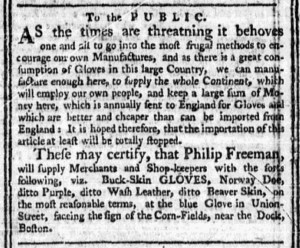
“It is hoped therefore, that the importation of this article at least will be totally stopped.”

Current events informed Philip Freeman’s marketing strategy as he attempted to sell gloves in the summer of 1774.  As colonizers from New England to Georgia discussed how to respond to Parliament closing Boston Harbor and other legislation passed following the Boston Tea Party, many proposed a new round of nonimportation agreements.  American merchants previously participated in boycotts to protest the Stamp Act and duties on several commodities imposed in the Townshend Acts, believing that disruptions to commerce served as an effective political tool.  Parliament relented, repealing the Stamp Act and duties on glass, lead, paint, and paper (but doubled down on tea with a new Tea Act in 1773).  A variety of other factors, including petitions and popular protests, played a role, so nonimportation agreements may not have had as much of an influence as intended.  Still, colonizers believed that boycotting goods imported from Britain effectively achieved their political goals.

Freeman believed that was the case and encouraged prospective customers of its veracity.  “As times are threatning,” he declared, “it behoves one and all to go into the most frugal methods to encourage our own Manufactures.”  He recognized “a great consumption of Gloves in this large Country,” yet proposed that “we can manufacture enough here, to supply the whole Continent.”  Such industry would have multiple benefits: it “will employ our own people, and keep a large sum of Money here, which is annually sent to England for Gloves.”  Furthermore, Freeman asserted that the gloves he made “are better and cheaper than can be imported from England.”  Not willing to wait for any sort of official nonimportation agreement enacted in Boston or throughout the colony or in cooperation with other colonies, Freeman implored that “the importation of this article at least will be totally stopped.”  In common cause, Freeman and his competitors in the colonies could meet demand without having to resort to imported gloves.  He did not direct his advertisement to consumers but rather the “Merchants and Shop-keepers” that he could supply with several different kinds of gloves “on the most reasonable terms.”  Working in concert, Freeman envisioned that glovemakers, retailers, and consumers could participate in politics via the decisions they made about production, consumption, and importing goods, starting immediately and informally with gloves and perhaps extending to other items through formal agreements as colonizers continued to organize in opposition to the Boston Port Act.

June 13

What was advertised in a colonial American newspaper 250 years ago today?

Supplement to the Newport Mercury (June 13, 1774).

“American SNUFF … MANUFACTURED in Pennsylvania.”

George Lawton and Robert Lawton advertised “American SNUFF” in the Newport Mercury as colonizers from New England to Georgia discussed how to respond to the Boston Port Act, legislation that closed the harbor as punishment for the destruction of tea in December 1773.  Simultaneously, newspapers covered other abuses perpetrated by Parliament.  The June 13, 1774, edition of the Newport Mercury, for instance, featured “A BILL for better regulating the Government of the Province of the Massachusetts-Bay, in North-America” and “A BILL for the impartial Administration of Justice in the Cases of Persons questioned for any Acts, done by them in the Execution of the law, or for the Suppression of Riots & Tumults in the Province of the Massachusetts-Bay, in New-England.”  Although neither had yet been passed when the ship that carried them departed from Bristol more than five weeks earlier, the printer, Solomon Southwick, noted “there is no doubt of their having passed before this time.”  In colorful commentary, he added that “the — [devil] himself can suggest nothing too horrid to be expected from the present administration.”  Another note followed the second bill: “God save the PEOPLE from such Laws!

It was in that context that the Lawtons marketed “American SNUFF … MANUFACTURED in Pennsylvania” as an alternative to snuff imported from Great Britain.  They asserted that consumers in Pennsylvania “esteemed” this snuff “equal to any imported,” so customers did not have to sacrifice quality in their support of “domestic manufacturers,” goods produced in the colonies.  The Lawtons presented trying this snuff as the patriotic duty of consumers who had concerns about current events.  “[I]t is hoped,” they implored, “that the public spirit of this colony will not be wanting to promote the use of this article, if on trial it should be fo[u]nd to merit it.”  In other words, the Lawtons encouraged prospective customers to try the snuff, taking into account the endorsements from colonizers in Pennsylvania, and see for themselves if they liked it as much as imported snuff.  If they did, their subsequent purchases could serve two purposes: acquiring a product they enjoyed while putting political principles into practice.  In many places, colonizers already discussed another round of nonimportation agreements, drawing on a strategy deployed in response to the Stamp Act and the Townshend Acts.  Immediately above the Lawtons’ advertisement, the resolutions from “a town meeting held at Providence” called for “an universal stoppage of all trade with Great-Britain, Ireland, Africa, and the West-Indies” until Parliament opened Boston Harbor once again.  Colonizers sought to use commerce for political leverage.  Similarly, decisions about which products to consume had political implications.  Even with no boycott currently in place, the Lawtons encouraged consumers to think about how they could support the colonies in their contest against Parliament.

May 30

What was advertised in a colonial American newspaper 250 years ago today?

Dunlap’s Pennsylvania Packet (May 30, 1774).

“Fox will engage his rifles to be as good as any that can be made in England.”

John Fox marketed American ingenuity when he advertised scythe rifles, instruments for “setting an edge on scythes,” that he invented.  In the May 30, 1774, edition of Dunlap’s Pennsylvania Packet, the cutler proclaimed that his rifles “are far superior to any thing yet invented for that purpose.”  He was so certain of that assertion that he confidently asserted that “the more [his rifles] are known the more they will be used,” especially since “it will be found they are much cheaper and more convenient than any stone.”  Rifles were made of wood, light enough for farmers to carry with them to sharpen the edges of scythes as they worked in the fields; whetstones were much heavier and, in turn, much less convenient for such purposes.  Continuing his pitch, Fox claimed that “one rifle will serve a man two or three years hard working, if of a good quality,” and he considered “his rifles to be as good as any that can be made in England.”  Furthermore, he pledged to sell his product “wholesale and retail as cheap as those imported of as good a quality.”  If any customers were not satisfied once they gave his rifles a try, the cutler offered to exchange any that “should not prove good.”

During the imperial crisis, colonial entrepreneurs promoted “domestic manufactures” or products made in America rather than imported.  Such appeals appeared in newspaper advertisements with greater frequency when confrontations with Parliament intensified, especially when colonizers enacted nonimportation agreements in response to the Stamp Act and the Townshend Acts.  Fox marketed his scythe rifles as relations between the colonies and Parliament once again deteriorated, this time because of duties on tea, the Boston Tea Party, and the Boston Port Act that closed the harbor until residents made restitution.  Dunlap’s Pennsylvania Packet and other newspapers published in Philadelphia carried extensive coverage of the debates and passage of the Boston Port Act and the responses in other cities and towns.  Fox’s advertisement appeared immediately below resolutions passed at “a meeting of the inhabitants of the city of Annapolis” on May 25, 1774.  They agreed “to put an immediate stop to all exports to Great-Britain” and, upon a date to be determined in coordination with other town in Maryland and “the principal colonies of America,” that “there be no imports from Great-Britain till the said act be repealed.”  Perhaps it was coincidence that Fox’s advertisement happened to follow the resolutions from Annapolis.  No matter where the two items appeared in relation to each other in the newspaper, the political crisis that inspired the resolutions provided support for Fox’s encouragement to purchase the rifle scythes he “MADE AND SOLD … At his shop in Fourth street, Philadelphia,” as an alternative to imported ones.

December 13

What was advertised in a colonial American newspaper 250 years ago today?

Boston-Gazette (December 13, 1773).

“He flatters himself that all Merchants who are Lovers of this Country will establish the Trade here and not import this Article.”

John Clarke made and sold “all sorts of Metal Buttons” at the “FACTORY-HOUSE” in Boston.  His advertisement in the December 13, 1773, edition of the Boston-Gazette testified to the many ways that he marketed his buttons, both within and beyond newspaper notices.  For instance, Clarke did more than describe his “Gold, Silver, Gilt, Plated, Silver’d, Lacquer’d, and best Block-Tin BUTTONS, of the newest and most fashionable Taste” and “Fancy Buttons with the Cloth under them of the Colour requir’d.”  He also provided samples on “a Pattern Card,” inviting prospective customers to “come and see the Variety of them.”  Clarke hoped that after examining those specimens they would place orders.  He also devised a means of identifying his buttons once they left his manufactory, advising that “each Card and Gross Paper of Buttons of the said Clarke’s make, are printed as follows, viz. MADE BY JOHN CLARKE, At the FACTORY, in Boston: Where may be had, ALL Sorts of Metal Buttons, as cheap as in London.”  His newspaper advertisement reproduced a shorter advertisement that appeared on the packaging of his products.

Clarke also made an appeal to support domestic manufactures, echoing the sentiments that John Keating so often published in advertisements for his “PAPER MANUFACTORY” in New York and others who wished to support local economies rather than importing so many goods from Great Britain.  He presented his buttons to “all the Well-Wishers of this Country and hopes the Patronage of the Gentlemen of this and the neighbouring Provinces and Towns, that they will give his Buttons the preference of any imported.”  Clarke made this appeal as tensions mounted in Boston over the arrival of ships carrying tea that Parliament intended to tax under the new Tea Act.  Within a week, colonizers would board those ships and throw the tea into the harbor.  Clarke likely expected that his message would resonate with readers of theBoston-Gazette, one of the newspapers that most often decried the abuses of Parliament and the colonial officials that attempted to implement its policies.  Those readers (and his prospective customers) included “Merchants who are Lovers of this Country” who had a duty, Clarke asserted, to “establish the Trade here and not import this Article.”  He did not, however, expect merchants, shopkeepers, tailors, and consumers to accept an inferior product as an alternative to the buttons imported from London.  He asked customers to try his buttons, determine “if on Trial they prove as good or better,” and only then place orders for larger quantities “on as good Terms as they can be furnish’d in London.”

At a time when the imperial crisis intensified, Clarke encouraged colonizers to “Buy American” and support his “FACTORY HOUSE” for making buttons, “the first of the Business ever set up in America.”  In addition to his extensive appeal that ran in the Boston-Gazette, the packaging for his buttons included an abbreviated version that promoted his “FACTORY, in BOSTON,” and compared its output, “ALL Sorts of Metal Buttons,” to those imported from London.

August 2

What was advertised in a colonial American newspaper 250 years ago today?

New-York Gazette and Weekly Mercury (August 2, 1773).

“He makes all sorts of coaches … equal to any imported from England.”

William Deane made appeals to price and quality in an advertisement for the coaches he constructed at his shop “in Broad-street” in the August 2, 1773, edition of the New-York Gazette and Weekly Mercury.  Compared to most other advertisers, however, he devised much more elaborate marketing strategies to convince prospective customers of the price and quality he offered.

Deane started by describing the various services in his shop.  He made several different kinds of carriages as well as “all sorts of harness and saddlers work.”  In addition, he also did “painting, gilding and Japanning, in the neatest and most elegant manner.”  Deane emphasized that he achieved a high level of quality while offering the lowest possible prices because he did not outsource any of those jobs to artisans.  Instead, he “finishes all carriages whatever in his own shop, without applying to any other.”  Accordingly, he was “determined to make them as good, sell them as cheap, and be as expeditious as there is a possibility.”

The carriagemaker realized that he needed “to convince the public of the truth of what he asserts.”  To that end, he vowed that he “will make any piece of work that is required, equal to any imported from England, and will sell it at the prime cost of that imported.”  His customers did not have to sacrifice either price or quality, one for the other, when they supported domestic manufacture by purchasing carriages made in his shop in New York.  Furthermore, they benefitted from additional bargains since they “will save the freight, insurance, and the expences naturally attending to putting the carriages to rights after they arrive.”  In so many ways, purchasing a carriage from Deane was so much easier than importing one made in England.  In addition, he “has now a considerable stock of the best of all materials fit for making carriages,” so he was ready to serve customers who placed orders.

Deane offered a “further inducement,” a one-year guarantee on the carriages made in his shop.  He had been providing guarantees in newspaper advertisements for at least six years (including in an advertisement with nearly identical copy in the New-York Journal more than a year earlier).  The carriagemaker declared that he “will engage his work for a year after it is delivered, that is, if any part gives way, or fails by fair usage, he will make it good at his own expence.”   To make the choice even more clear, he underscored that prospective customers would not have access to that kind of customer service in maintaining their carriages if they opted for ones made in England.  “Those advantages,” Deane intoned, “cannot be obtained on carriages imported.”

The carriagemaker’s advertisement revolved around price and quality.  He did more than make casual reference to them, developing a sophisticated marketing strategy that touted the advantages of purchasing carriages made in his shop.  He used only the best materials and oversaw every aspect of the construction to produce carriages that rivaled in craftsmanship those imported from England.  He also offered competitive prices, especially since his customers saved on shipping and insurance, and a one-year guarantee on any parts that might require repairs.  Deane sought to convince prospective customers that all of this made his carriages the best choice.

March 28

What was advertised in a colonial American newspaper 250 years ago this week?

New-York Journal (March 25, 1773).

“The Public will find upon trial, the SNUFF manufactured by them to be equal in Quality, and Flavour, to any imported from Great-Britain.”

In the spring of 1773, the firm of Maxwell and Williams announced that they processed and sold tobacco and snuff to customers in New York.  According to their advertisement in the March 25, 1773, edition of the New-York Journal, the partners formerly “carried on a large and extensive trade in the SNUFF and TOBACCO Manufactories” in Bristol.  Upon relocating their business in the colonies, they supplied the public with “all sorts of best Scotch and Rappee SNUFF, [and] Pugtail, Rag, and fine mild smoaking TOBACCO.”

Although relative newcomers to New York, Maxwell and Williams enthusiastically joined calls to encourage “domestic manufactures” through purchasing goods produced in the colonies rather than imported from England.  Like other artisans who made such appeals, the tobacconists declared that consumers did not have to sacrifice quality when they chose to acquire local goods rather than imported alternatives.  “The Public will find upon trial,” Maxwell and Williams confidently asserted, “the SNUFF manufactured by them to be equal in Quality, and Flavour, to any imported from Great-Britain.”  They invited consumers to make that determination for themselves.

Maxwell and Williams also sought to distinguish their product from any others produced in New York or other colonies.  They not only wished for consumers to support domestic manufactures; they also wanted consumers to support their domestic manufactures in particular.  To that end, Maxwell and Williams stated that they “erected … a complete apparatus for carrying on the said business in all its branches.”  In addition, their snuff was “made of the best materials, and in a manner superior to any thing of the kind yet attempted in this country.”  Only after making all of those pitches did the partners most explicitly call on consumers to purchase goods produced in the colonies rather than imported alternatives, offering competitive prices to make doing so even more attractive.  “[A]s an encouragement to those who are inclined to countenance Manufactories set on foot in AMERICA,” Maxwell and Williams trumpeted, they would sell “their SNUFF on lower terms than any can be imported.”

Many entrepreneurs, including tobacconists, launched “Buy American” campaigns prior to the Revolutionary War.  Some sought to address a trade imbalance between the colonies and Britain.  Others recognized the political dimensions of both production and consumption, leveraging commerce and industry as a means of participating in politics.  All of them wished to create new opportunities for the success of their own endeavors by adding support for domestic manufactures to the array of marketing strategies commonly deployed by advertisers.