What was advertised in a colonial American newspaper 250 years ago today?
Essex Journal (August 17, 1774).
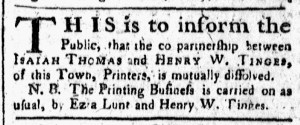
“The co partnership between ISAIAH THOMAS and HENRY W. TINGES, of this Town, Printers, is mutually dissolved.”
When the Essex Journal commenced publication on December 4, 1773, Henry-Walter Tinges printed it in partnership with Isaiah Thomas. Tinges managed the printing office in Newburyport, while Thomas continued printing the Massachusetts Spy in Boston. Less than a year passed before their partnership ended. On August 17, 1774, “No. 35” of the Essex Journal carried a notice “to inform the Public, that the co partnership between ISAIAH THOMAS and HENRY W. TINGES, of this Town, Printers, is mutually dissolved.” A nota bene further explained, “The Printing Business is carried on as usual, by Ezra Lunt and Henry W. Tinges.” The young printer had a new partner. He also updated the colophon on the final page to reflect this change.
Many decades later, Thomas provided a brief account of his partnership with Tinges in The History of Printing in America (1810). Thomas recollected that he “opened a printing house” in Newburyport “[a]t the request of several gentlemen,” taking Tinges as a partner “who had the principal management of the concerns at Newburyport.”[1] The young man had previously “served part of his apprenticeship with [John] Fleming,” one of the Tory printers of the Boston Chronicle, “and the residue with Thomas.”[2] Although the newspaper’s colophon stated that the new printing office in Newburyport accepted job printing orders that would be completed “in a neat manner, on the most reasonable Terms, with the greatest Care and Dispatch,” Tinges devoted most of his time to printing the Essex Journal. Thomas did not specify why the partnership was “mutually dissolved,” though he may have been frustrated that the printing office did not attract more business or distracted with the responsibilities of running his busy shop in Boston at the same time that the closure of the harbor mandated by the Boston Port Act introduced all sorts of challenges. Whatever the reason, Thomas “sold the printing materials to Ezra Lunt, the proprietor of a stage, who was unacquainted with printing; but he took Tinges as a partner.”[3] Tinges contributed his experience and knowledge of the printing trade, while Lunt provided the capital for the necessary equipment. Even though Tinges performed the bulk of the labor in the printing office, his name appeared second in the colophon during his partnership with Thomas and again during his partnership with Lunt. Although he may have taken direction from his partners on occasion, Tinges collated the news, engaged with subscribers, advertisers, and other customers, and disseminated additional information in response to “enquire of the printer” advertisements in the Essex Journal.
Essex Journal (August 17, 1774).
**********
[1] Isaiah Thomas, The History of Printing in America: With a Biography of Printers and an Account of Newspapers (1810; New York; Weathervane Books, 1970), 179.
What was advertised in a colonial American newspaper 250 years ago today?
Essex Journal (July 6, 1774).
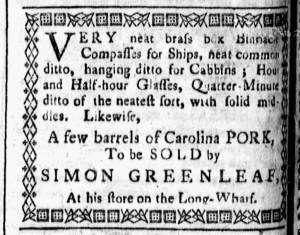
“Hour and Half-hour Glasses … of the neatest sort.”
Simon Greenleaf advertised “VERY neat brass box Binnacle Compasses for Ships” and hourglasses “of the neatest sort” for sale at his store “on the Long-Wharf” in Newburyport in the summer of 1774. He also hawked a “few barrels of Carolina PORK” in his advertisement in the Essex Journal. Readers likely considered the decorative border that enclosed Greenleaf’s notice the most distinctive aspect of his marketing efforts. It certainly distinguished his notice from the other advertisements in the July 6 edition and had done so since its first appearance on June 22.
Greenleaf apparently made a request when he submitted his copy to the printing office or met with the printer, Henry-Walter Tinges, to work out an arrangement for this enhancement to his advertisement. Tinges and Isaiah Thomas commenced publication of the Essex Journal seven months earlier, with Tinges running the printing office in Newburyport while Thomas continued publishing the Massachusetts Spy in Boston. Had Thomas overseen the Essex Journal, Greenleaf might not have managed to have the border included in his advertisement. In the past, Thomas seemingly had not been amenable to such flourishes in the Massachusetts Spy, even when advertisers managed to have borders included with their notices published simultaneously in other newspapers. Ultimately, graphic design depended not only on the imagination of advertisers and compositors but also the preferences of printers who published colonial newspapers.
For the Essex Journal, Greenleaf’s advertisement was a milestone. It was the first that incorporated decorative type. Tinges had experiments with using ornaments to as dividers between news items and in the headline for the “POETS-CORNER” on the final page of the newspaper. Occasionally, he placed the first letter of the first word in an article or letter within a decorative border, but this was the first time that a border enclosed any content, whether news or advertising. In addition, Tinges did not provide any of the common stock images, such as ships or houses, for the use of advertisers. Throughout the publication of the Essex Gazette to that point, the only visual images appeared in the masthead, the coat of arms of the colony on the left of the title and a packet ship on the right. That made Greenleaf’s advertisement even more noteworthy and memorable when readers encountered it since its appearance differed from anything else in that newspaper.
What was advertised in a colonial American newspaper 250 years ago today?
Essex Journal (June 29, 1774).
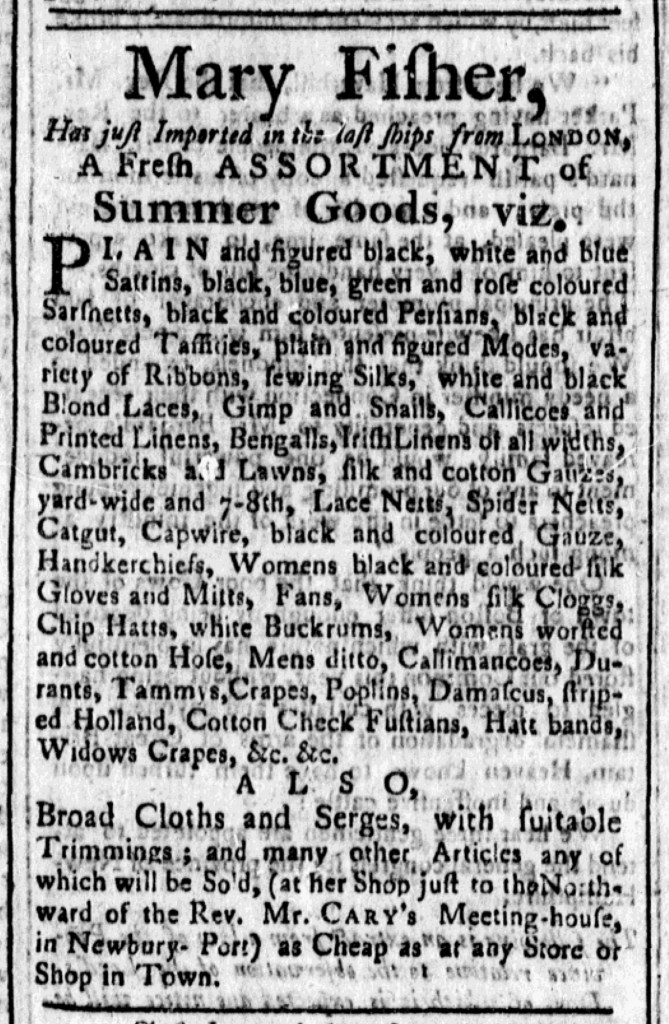
“Imported in the last ships from LONDON, A Fresh ASSORTMENT of Summer Goods.”
As June 1774 came to a close, the final issue of the Essex Journal for that month carried news that arrived from Salem, Boston, New London, New York, Philadelphia, Williamsburg, and Charleston. The editor also selected a short address “To the Farmers in America” from “FREEDOM” to reprint from the most recent edition of the Massachusetts Spy. It advised, “INCREASE your SHEEP and raise WOOL as far as possible, that you from this time wear LIBERTY CLOTH.” Although framed as advice to farmers, the suggestion to wear homespun cloth applied to all consumers who wished to protest various abuses by Parliament, especially the Boston Port Act that went into effect at the beginning of the month. Colonizers discussed their prospects for using commercial means to achieve political ends, recognizing that any boycott of imported goods should be accompanied by encouraging “domestic manufactures” as alternative products. That included clothing made of homespun fabrics to substitute for textiles imported from London.
Even as “FREEDOM” promoted “LIBERTY CLOTH” as a symbol of patriotism, merchants and shopkeepers hawked imported goods elsewhere in the newspaper. No nonimportation or nonconsumption agreement had yet been adopted. George Searle, for instance, “Just Imported from LONDON … an assortment of Painters Oils and Colours.” Similarly, John Stickney and Son, announced that they “imported from London, a large assortment of English, India and hard ware GOODS.” Those goods certainly included garments and fabrics. Mary Fisher provided more detail, advertising that she “just Imported in the last ships from LONDON, A Fresh ASSORTMENT of Summer Goods.” She then listed dozens of items, including an array of textiles that ranged from “PLAIN and figured black, white and blue Sattins” to “black, blue green and rose coloured Sarsnetts [sarcenets]” to “Callicoes and Printed Linens.” Even as such items fell out of favor in some circles, Fisher offered an opportunity for consumers who desired imported textiles, even those who supported the patriot cause, and realized that they should buy what they could before discussions about boycotts became actual boycotts. Fisher offered her wares “as Cheap as at any Store or Shop in Town,” making it possible for consumers to stockpile items they purchased from her. Her imported textiles did not have the appearance of homespun “LIBERTY CLOTH,” but, for the moment, customers could at least equivocate that they had not bought those fabrics while a nonconsumption agreement was in effect. Memories of boycotts in response to the Stamp Act and the duties on certain goods in the Townshend Acts guided consumers in preparing for a new round of protests.
What was advertised in a colonial American newspaper 250 years ago today?
Essex Journal (April 20, 1774).
“A large experience of 34 years at sea.”
Joseph Atkins took to the pages of the Essex Journal to inform the public that “he still continues to teach reading, writing, and arithmetic” in the spring of 1774. He apparently accepted both boys and girls, though he taught them separately. In a nota bene, he advised that he “intends to open a school for young ladies” at the end of April.
In addition to the basics of reading, writing, and arithmetic, Atkins also provide instruction in navigation “after the most approv[e]d methods. Experience mattered to the schoolmaster, not just experience in the classroom but also experience on ships. He asserted that his confidence in how he taught navigation to his pupils flowed from “a large experience of 34 years at sea.” Navigation was not merely academic to Atkins but instead a practical matter, an essential part of the occupation he previously pursued. Prospective students and their parents, he suggested, should feel similar confidence that his decades at sea prepared him to teach navigation to boys and young men who had prospects of working on vessels themselves. Newburyport was, after all, a maritime community.
The placement of Atkins’s advertisement on the third page of the April 20 edition of the Essex Journal underscored that was the case. It ran immediately below the “MARINE LIST,” a roster of ships that recently “ARRIVED” and “SAILED” from the “PORT of NEWBURY.” A day earlier, the town welcomed the Dove from Antigua and the Newhall from Guadeloupe. Most of the ships that departed in the past ten days made their way to the “West-Indies,” though the Larkventured to Newfoundland. Although Atkins’s time at sea was presumably behind him, he aimed to pass along a valuable skill to young men who might join the crew of any of the vessels that visited Newburyport. His “large experience of 34 years at sea” recommended him as a teacher as much as anything he could say about his methods of instruction.
What was advertised in a colonial American newspaper 250 years ago today?
Essex Journal (April 6, 1774).
“The business will be carried on as usual by his sons.”
In the spring of 1774, Patrick Tracy of Newburyport, Massachusetts, ran an advertisement in the Essex Journal to request those he owed money to call on him to settle accounts because he had “quitted the business he has been in of late years.” Only after that did the conscientious entrepreneur also instruct “all who are indebted to him … to make speedy payment, more especially those whose debts have been long standing.” Tracy made what he owed his priority, signaling how he did business and suggesting to current and prospective customers that they could expect similar treatment from his sons who carried on the business. Tracy considered that business well enough known that he did not indicate his occupation.
His sons, however, revealed that they “have taken the business lately carried on by their honoured father” and “carry on the distillery as usual” in an advertisement that conveniently appeared immediately below Tracy’s notice in the April 6 edition of the Essex Journal. Their father deployed more subtle means in attempting to pass along his clientele to his sons, while they instead emphasized their desire for “the continuance of his good customers and the custom of all others.” The elder Tracy established a reputation during his many years in business. His sons hoped to benefit from the customer loyalty their father had cultivated, asserting a “mutual advantage” for all involved.
To that end, they also made clear that they put the interests of their customers and associates first. In addition to operating the distillery “as usual,” they also stocked “an assortment of English Goods, which they will sell by wholesale upon reasonable terms, and so as to afford a profit to the purchaser.” Though they intended to make money on those transactions, the distillers associated “profit” with their customers who purchased imported goods from them, reversing the usual relationship between sellers and buyers. Shopkeepers and others who purchased those items to sell retail would acquire them at low enough prices that Jackson, Tracy, and Tracy practically guaranteed that they could in turn offer such bargains that retail customers would purchase their wares.
In their newspaper advertisements, Tracy and his sons carefully choreographed his departure from the family business and their role in continuing its operations. They sought to maintain and even expand the existing clientele by emphasizing certain principles, including paying what they owed to associates and selling merchandise at such “reasonable terms” that everyone involved benefited from the transactions.
What was advertised in a colonial American newspaper 250 years ago today?
Massachusetts Spy (February 24, 1774).
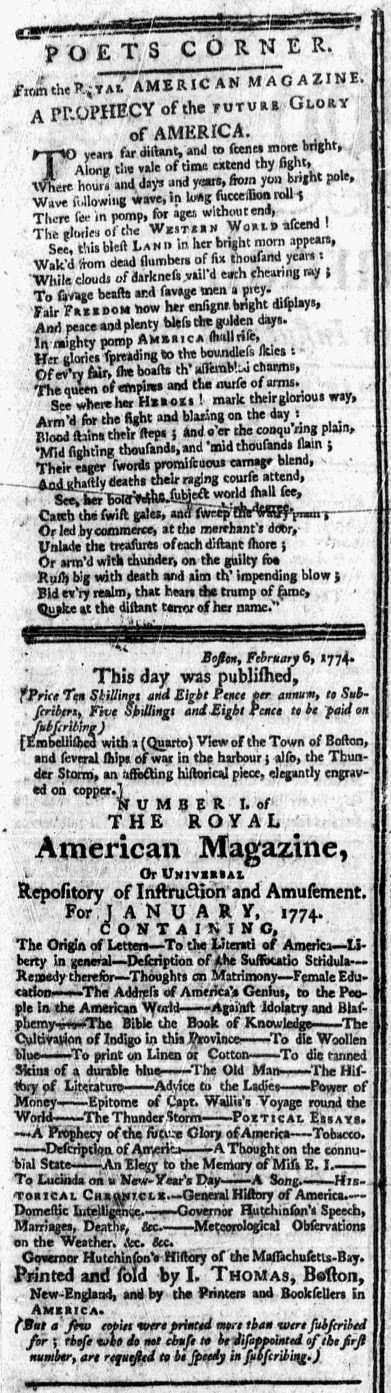
“POETS CORNER. From the ROYAL AMERICAN MAGAZINE.”
Isaiah Thomas, printer of the Massachusetts Spy, continued promoting a new venture, the Royal American Magazine, in the February 24, 1774, edition of his newspaper. He once again ran an advertisement announcing that “This day was published … NUMBER I. of THE ROYAL American Magazine,” noting the price, promoting the two copperplate engravings that accompanied the inaugural issue, listing the contents, and encouraging “those who do not chuse to be disappointed of the first number … to be speedy in subscribing.” That was not the extent of Thomas’s efforts to market the Royal American Magazine in that issue of the Massachusetts Spy. The “POETS CORNER,” a regular feature in the upper left corner of the final page, featured a poem entitled, “A PROPHECY of the FUTURE GLORY of AMERICA.” A note of introduction indicated that the verses came “From the ROYAL AMERICAN MAGAZINE.” Thomas conveniently placed the advertisement for the magazine immediately below the poem, guiding readers toward subscribing.
That was not the only instance of the industrious printer publishing an excerpt from the magazine in his efforts to increase its visibility and gain new subscribers. On February 23, the Essex Journal, a newspaper that Thomas recently launched in Newburyport in partnership with Henry-Walter Tinges, carried the advertisement on the final page and an excerpt “From the Royal American Magazine” on the first page. In this instance, the excerpt was a short essay “Against IDOLATRY and BLASPHEMY” that critiqued the practice of using “epithets” including “Most gracious Sovereign” and “Most excellent Majesty” because they “can justly be applied to none but GOD; and therefore, applying them to men, is idolatry.” The author, identified only as “A CHRISTIAN,” took the opportunity to take a swipe at “Roman catholics … paying divine honours to a vain empty Pope.” Yet they were not much better than “protestants and Englishmen” who were “in some degree partakers of the same guilt.” Americans, on the other hand, could avoid “this sin” by “pay[ing] honour to whom honour is due, among men” and “pay[ing] supreme honour to none by the SUPREME.” In selecting that piece to excerpt, Thomas played to the prejudices of Protestants in New England, many of them descended from Puritans who first colonized the region. The excerpt on the first page and the advertisement on the last page bookended the contents of that issue of the Essex Journal, the reiterating reminding readers to subscribe and read the new magazine.
In both newspapers, Thomas inserted excerpts to create a buzz around the Royal American Magazine. He offered previews to prospective subscribers, both in the list of contents and the excerpts themselves, in hopes of inciting curiosity and demand for the new publication.
What was advertised in a colonial American newspaper 250 years ago today?
Essex Journal (February 2, 1774).
“He assures the Public that No. I. for January 1774, will this week be put in the Press.”
Isaiah Thomas, printer of the Massachusetts Spy, continued promoting a new venture, the Royal American Magazine, throughout January and into February 1774. As the month began, he once again placed an update in the Essex Journal, the newspaper the industrious printer recently began publishing in partnership with Henry-Walter Tinges in Newburyport. That update advised the public that publication of the first issue of the magazine had been delayed because the ship carrying new types “was cast ashore at Cape Cod … and although the cargo was saved” the types did not arrive in Boston in time for “the day intended for Publication.”
The Adverts 250 Project has tracked Thomas’s advertising campaign for the Royal American Magazine throughout June, July, August, September, October, November, and December 1773. The printer and his associates advertised in Boston, throughout New England, in New York and Pennsylvania, and as far south as Maryland. Eighteen more advertisements for the Royal American Gazette appeared in newspapers in January 1774, half of them the update about the types.
A notice that “Subscription Papers will be returned to the intended Publisher in a few Days” that previously circulated widely made its final appearance in the Maryland Gazette, published in Annapolis, in that newspaper’s first issue of the year. An earlier update, that one addressed to “generous Patrons and Promoters of useful KNOWLEDGE throughout AMERICA,” that had also circulated widely ran twice in the Connecticut Courant, published in Hartford, and once in the Maryland Journal, published in Baltimore. That notice had not previously appeared in the Connecticut Courant. It was the first time that any advertisement about the Royal American Magazine ran in the Maryland Journal, extending the reach of Thomas’s marketing efforts.
He also opted to insert the complete subscription proposals in the Massachusetts Spy once again. In the January 13 edition, he added a note of explanation: “It being a considerable time since the PROPOSALS for the ROYAL AMERICAN MAGAZINE (which is now in the Press) were first published, and many Gentlemen and Ladies being desirous of seeing them, they are for that reason again inserted in this paper.” Thomas had not published the complete subscription proposals in the Massachusetts Spy since August 19, 1773. He claimed that he merely responded to the wishes of “many Gentlemen and Ladies,” though that may have been a ploy to suggest the sort of interest and demand that might prompt prospective subscribers to reserve their copies. Running the complete subscription proposals once again also buttressed his update about the types that appeared on another page of that issue, while his assertion that the magazine “is now in the Press” underscored that those who had hesitated to subscribe until it became clear that Thomas would actually publish the magazine could no longer wait. In the next issue, the complete subscription proposals and the update about the types ran one after the other on the first page of the January 20 edition of the Massachusetts Spy.
The update about the types ran in various newspapers at least nine times in January. It may have first appeared in the January 3 edition of the Massachusetts Gazette and Boston Post-Boy, an issue no longer extant. When it ran in the January 10 edition, the dateline read, “Boston, January 3, 1774,” suggesting that it could have been in the previous issue as well. Throughout the rest of the month, the update appeared in the Essex Journal four times and in the Massachusetts Spy three times. Newspapers published by Thomas almost exclusively carried that update, circulating it throughout Massachusetts and other colonies in New England as post riders delivered subscriptions far and wide. In addition to the Massachusetts Gazette and Boston Post-Boy, the New-Hampshire Gazette also carried the update about the types in January. Dated “January 2d,” it ran in the January 28 edition.
Connecticut Gazette (January 7, 1774).
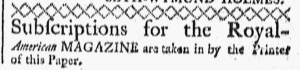
One other advertisement about the Royal American Magazine ran in January, this one exclusively in the Connecticut Gazette, published in New London. A brief notice informed readers that “Subscriptions for the Royal-American MAGAZINE are taken in by the Printer of this Paper.” Thomas may or may not have arranged with Timothy Green to publish this advertisement. It appeared in three consecutive issues before being discontinued, standard practice for other advertisements submitted to the printing office. Thomas could have sent instructions (and promised to pay) for the advertisement. That seems most likely, especially since it was the first time that any advertisements for the Royal American Magazine ran in the Connecticut Gazette. On the other hand, Green may have taken the initiative, aware from his participation in a network of printers that crisscrossed New England and other colonies that Thomas would soon publish the first issue of the magazine. Green may have collected subscriptions as a service to his local customers as much as a favor to Thomas, encouraging them to visit his printing office to acquire reading materials rather than purchase them elsewhere.
Thomas’s advertising campaign for the Royal American Magazine continued in January 1774, though it also continued to taper off compared to previous months. He exerted more effort in disseminating the subscription proposals widely and inciting interest in the prospects of the new magazine than in promoting it once publication commenced. Once he achieved sufficient demand to make the magazine viable, he did not advertise as widely.
**********
“Subscription Papers will be returned” Update
January 6 – Maryland Gazette (tenth appearance)
“generous Patrons” Update
January 4 – Connecticut Courant (first appearance)
January 11 – Connecticut Courant (second appearance)
January 20 – Maryland Journal (first appearance)
Subscription Proposals
January 13 – Massachusetts Spy (ninth appearance)
January 20 – Massachusetts Spy (tenth appearance)
“Types are now arrived” Update
January 5 – Essex Journal (first appearance)
January 6 – Massachusetts Spy (first appearance)
January 10 – Massachusetts Gazette and Boston Post-Boy (first known appearance; possible second appearance)
January 12 – Essex Journal (second appearance)
January 13 – Massachusetts Spy (second appearance)
January 19 – Essex Journal (third appearance)
January 20 – Massachusetts Spy (third appearance)
January 26 – Essex Journal (fourth appearance)
January 28 – New-Hampshire Gazette (first appearance)
“Subscriptions … taken in”
January 7 – Connecticut Gazette (first appearance)
January 14 – Connecticut Gazette (second appearance)
January 21 – Connecticut Gazette (third appearance)
What was advertised in a colonial American newspaper 250 years ago today?
Essex Journal (January 12, 1774).
“Said MAGAZINE was not published on Saturday last, agreeable to his promise.”
Throughout the second half of 1773, Isaiah Thomas, the printer of the Massachusetts Spy, attempted to launch another publication, the Royal American Magazine. If he could attract a sufficient number of subscribers to take the project to press, it would be the only magazine published in the colonies at the time. After a few months, Thomas announced that subscribers had indeed answered his call, responding to the proposals and other advertisements he placed in newspapers in Massachusetts, New Hampshire, Rhode Island, Connecticut, New York, Pennsylvania, and Maryland. He planned to distribute the first issue of the Royal American Magazine on January 1, 1774.
That, however, did not come to pass. In the January 6 edition of the Massachusetts Spy, the first issue of the new year, Thomas inserted an update that explained that “the only Reason why said MAGAZINE was not published on Saturday last, agreeable to his Promise, was, that he sent to England for a compleat Set of Types, for said Work” and the ship that was supposed to deliver them to Boston ran ashore on Cape Cod about three weeks earlier. Fortunately, “the Cargo was saved.” Thomas eventually received the new type, but not by “the Day intended for Publication.” He assured subscribers that the magazine “will THIS WEEK be put in the Press, and published on the first Day of February next.” In the eighteenth century, monthly magazines often came out during the final days of the month rather than the beginning of the month, so this plan still allowed Thomas to produce a January issue.
This misfortune also presented an opportunity for “Gentlemen and Ladies who intend subscribing for the Royal AMERICAN MAGAZINE” but had not yet done so to “send in their Names immediately, otherwise they may be disappointed of having the first Number.” In addition to encouraging more subscribers, Thomas also continued soliciting “LUCUBRATIONS” or essays for the inaugural issue. Given the delay caused by not receiving the type by the expected date, Thomas had more time to collect content produced by American authors for the magazine.
After this update ran in the Massachusetts Spy on January 6, Thomas placed it in the Massachusetts Gazette and Boston Post-Boy on January 10 and the Essex Journal, published in Newburyport, Massachusetts, on January 12. Thomas had recently commenced publishing the Essex Journal in partnership with Henry-Walter Tinges. Not surprisingly, his advertisement was the only one to appear on the front page of Essex Journal. Other advertisements appeared elsewhere in the issue.
What was advertised in a colonial American newspaper 250 years ago today?
Essex Journal (January 5, 1774).
“At the sign of the Golden-Eagle, in Newbury Port.”
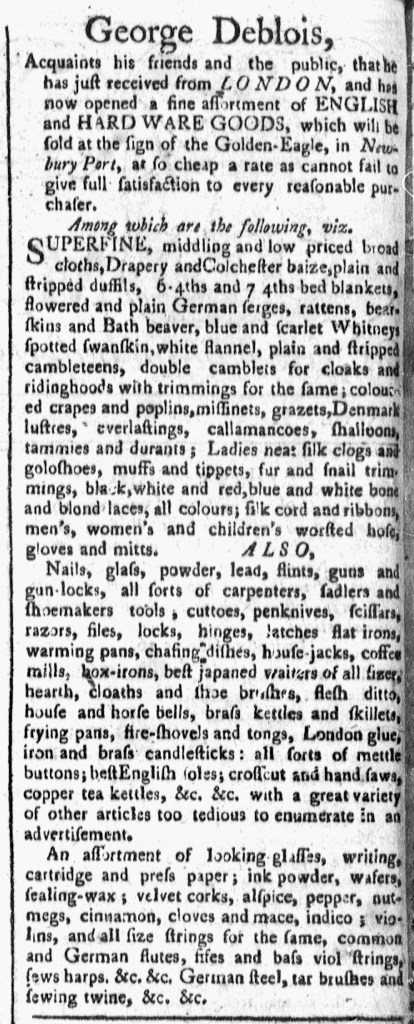
George Deblois recognized an opportunity to place his advertisements before as many prospective customers as possible. The savvy merchant ran a shop “at the sign of the Golden-Eagle” in Newburyport, Massachusetts. For several years, he placed advertisements in the Essex Gazette, published in nearby Salem and the New-Hampshire Gazette in Portsmouth. When Isaiah Thomas and Henry-Walter Tinges announced their intention to establish a new newspaper in Newburyport, Deblois became one of the first advertisers in the Essex Journal.
In late November 1773, Thomas took to the pages of the newspaper he published in Boston, the Massachusetts Spy, to announce the impending publication of the first issue of the Essex Journal on December 4. He advised that the “Number I” would be “distributed and given, GRATIS, to the Inhabitants” of both Massachusetts and New Hampshire. In addition, he suggested that “THOSE who incline to ADVERTISE in said paper, in this or the neighbouring Towns, may find it GREATLY to their ADVANTAGE, especially the Merchants and Shopkeepers in BOSTON, as a very large Number will be printed off, and distributed throughout the Provinces of Massachusetts Bay and New-Hampshire. [Gratis.]”
Deblois did not want any of those “Merchants and Shopkeepers in BOSTON” displacing him by capturing any of the market that he already managed to gain in the region the Essex Journal would serve. In addition to maintaining his current clientele, he also wished to expand his customer base. For both reasons, he heeded the call for advertisements, submitting a notice to include in the inaugural issue. When Thomas and Tinges commenced weekly publication of the Essex Journal on December 29, Deblois ran the same advertisement. It appeared once again on January 5, 1774, inviting consumers to acquire merchandise from among “a fine assortment of ENGLISH and HARDWARE GOODS … at so cheap a rate as cannot fail to give full satisfaction to every reasonable purchaser.” Deblois listed dozens of items he stocked and promised “a great variety of other articles too tedious to enumerate in an advertisement.” As access to print culture expanded with a new newspaper printed in the town where he kept shop, Deblois made certain that readers encountered his advertisements as they perused the Essex Journal.
What was advertised in a colonial American newspaper 250 years ago today?
Essex Journal (December 29, 1773).
“The Number of at present, is insufficient to defrey the expence attending the Printing of a News-Paper.”
After published an inaugural issue of the Essex Journal and distributing it gratis to incite interest in the first newspaper published in Newburyport, Massachusetts, Isaiah Thomas and Henry-Walter Tinges paused publication to gather the names of subscribers. More than three weeks after that first issue appeared on December 4, 1773, Thomas and Tinges commenced weekly publication of the Essex Journal. In a notice on the first page, they confessed to “such Gentlemen and Ladies who wish well to this undertaking and have not yet subscribed that THEIR helping hands are wanted to bear up this Fabrick, … which if not well supported will fall, and lay the Foundation in Ruins.” In other words, “the Number of Subscribers at present, is insufficient to defrey the expence attending the Printing of a News-Paper.”
Still, Thomas and Hinges took a chance, hoping that publishing a second and subsequent issues would convince prospective customers who intended to subscribe but had not yet done so to submit their names to the printing office. According to the printers, some had indicated that was their plan: “we were assured that many intended to subscribe on the appearance of a second paper, and others would, at times, drop in.” The fate of the newspaper depended on the “kindness and generosity” of subscribers.
In addition to printing a second issue to demonstrate the usefulness of the venture to readers in Newburyport and other towns in Massachusetts and New Hampshire, Thomas and Hinges adjusted the publication date to suit the needs of the community. They distributed the inaugural issue on a Saturday, but learned that “meets not the public approbation,” so they “altered the day of publication to WEDNESDAY, which is greatly approved of.” In turn, that required a new investment on the part of the printers: “we intend establishing a rider from Boston to this place, that we may have the most early and authentic intelligence.” Thomas also published the Massachusetts Spy in Boston on Thursdays. He may have originally thought that the Essex Journal could reprint content from that newspaper on Saturdays, but delivering “the most early and authentic intelligence” on Wednesdays likely meant drawing more content from the Boston Evening-Post, the Boston-Gazette, and Massachusetts Gazette and Boston Post-Boy, all of them published on Mondays. Thomas and Hinges noted the “not very inconsiderable” expense, but also declared their commitment “to spare no pains or cost in our power to tender, in future, THIS paper as useful and entertaining as any News-Paper in America.”
Thomas and Hinges apparently gained more subscribers as well as advertisers. They published the Essex Journal on every Wednesday in 1774 and Hinges and a new partner continued into 1775. Then publication became sporadic in May, following the fighting at Lexington and Concord, and moved to Fridays for the remainder of the year, throughout most of 1776, before moving to Thursdays and ceasing in February 1777.