July 22

What was advertised in a revolutionary American newspaper 250 years ago today?
Essex Journal (July 22, 1775).

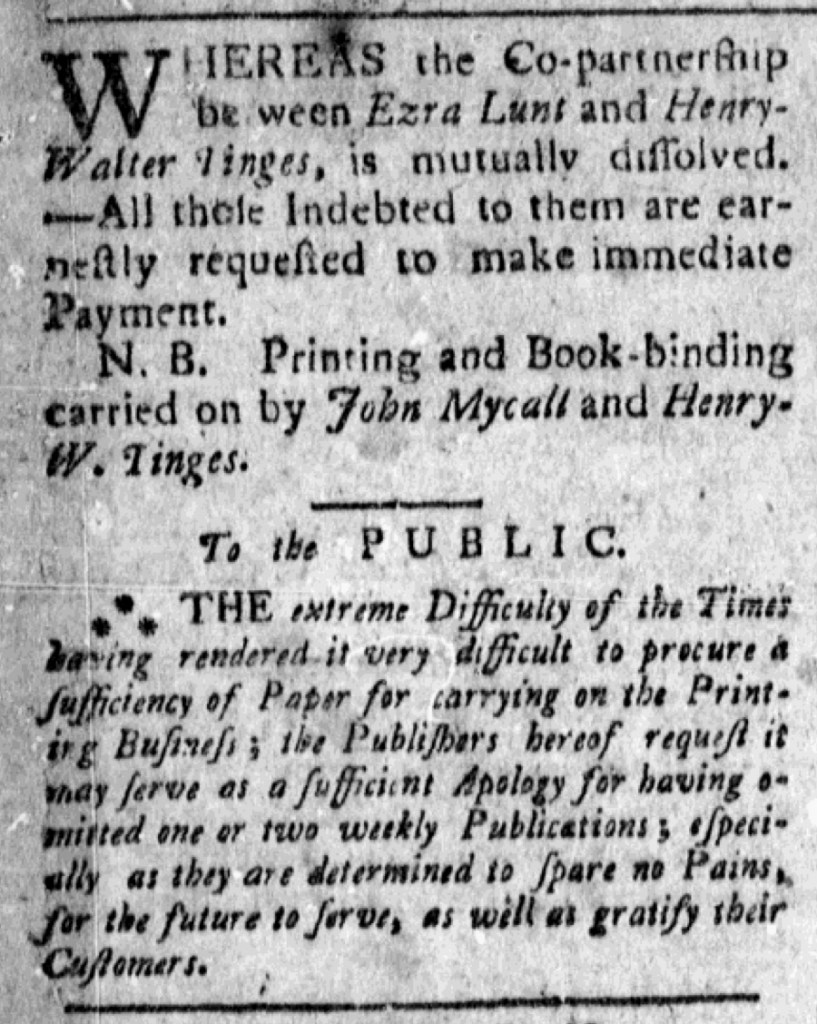
THE extreme Difficulty of the Times having rendered it very difficult to procure a sufficiency of Paper.”

A notice on the first page of the July 22, 1775, edition of the Essex Journal, Or, the Massachusetts and New-Hampshire General Advertiser informed readers that the “Co-partnership between Ezra Lunt and Henry-Walter Tinges,” the publishers of the newspaper, “is mutually dissolved” and called on “those Indebted to them” to settle accounts.  Yet the printing office in Newburyport was not being shuttered.  Instead, a nota bene declared, “Printing and Book-binding carried on by John Mycall and Henry-W. Tinges.”  Mycall became Tinges’s third partner in less than three years.  The young printer first went into business with Isaiah Thomas, the printer of the Massachusetts Spy in the late fall of 1773.  The more experienced printer remained in Boston while his junior partner oversaw the printing office and their new newspaper.  The partnership lasted less than a year.  On August 17, 1774, they notified the public that they “mutually dissolved” their partnership, but the “Printing Business is carried on as usual, by Ezra Lunt and Henry W. Tinges.”

Nearly a year later, Lunt departed and Mycall took his place.  As their first order of business, the new partners addressed some of the challenges the newspaper faced since the battles at Lexington and Concord three months earlier.  “THE extreme Difficulty of the Times having rendered it very difficult to procure a sufficiency of Paper for carrying on the Printing Business,” they lamented, “the Publishers hereof request it may serve as a sufficient Apology for having immitted one or two weekly Publications.”  Indeed, publication had been sporadic during May, immediately after the outbreak of hostilities, returned to a regular schedule in June, and then missed a week in July before announcing the departure of Lunt and arrival of Mycall.  The Essex Journal had missed only two issues, but the publishers did not consistently distribute the newspapers on the same day each week.  That likely added to the impression that they had not supplied all the newspapers that their customers expected.  In addition, the two most recent issues, June 30 and July, and the one that carried the notice about the new partnership consisted of only two pages rather than the usual four.  Mycall and Tinges vowed that “they are determined to spare no Pains, for the future to serve, as well as gratify their Customers.”  Mycall and Tinges kept that promise.  Publication returned to a regular schedule with only minor disruptions.

June 9

What was advertised in a revolutionary American newspaper 250 years ago today?

Essex Journal (June 9, 1775).

“The Editor being driven from his house and business by the perfidious [Thomas] Gage.”

Like so many other Bostonians, Joseph Greenleaf, the publisher of the Royal American Magazine, became a refugee who fled from the city during the siege that followed the battles at Lexington and Concord.  When the governor, General Thomas Gage, and the Massachusetts Provincial Congress agreed that Loyalists could enter the city and Patriots and others could depart, each with any of their effects they could transport (except for firearms and ammunition), Greenleaf removed to Watertown.  He crafted his own narrative of what happened in an advertisement that ran in the June 9, 1775, edition of the Essex Journal: “The Editor [was] driven from his house and business by the perfidious –– Gage in public violation of his most sacred engagements, leaving ALL (except Beds and some Clothing) behind.”  Apparently, Greenleaf had not managed to take his press or any of his supplies and other equipment with him.

He found himself in desperate need of money, deprived of his livelihood in Boston.  In his advertisement in the Essex Journal, published in Newburyport, Greenleaf called on “Subscribers for the American Magazine at Newbury, Newbury-Port, and the vicinity … to pay their respective ballances to the month of March, being fifteen months, to Bulkeley Emerson of Newbury-Port,” his local agent in that town.  In a single sentence, Greenleaf gave an abbreviated history of the Royal American Magazine.  The publication, first proposed by Isaiah Thomas in May 1773, had commenced publication with the January 1774 issue.  Thomas published several issues, fell behind, and then suspended the magazine due to the “Distresses” that he and everyone else in Boston experienced due to the Boston Port Act closing the harbor until colonizers made restitution for the tea destroyed there in December 1773.  Almost as soon as he announced that he suspended the Royal American Magazine, Thomas informed subscribers and the public that Greenleaf became the new proprietor.  From August 1774 through April 1775, Greenleaf worked diligently to publish the delinquent issues and get the magazine back on schedule.  He succeeded … until the beginning of the Revolutionary War became too disruptive to continue.

When Greenleaf became the proprietor of the magazine, Thomas transferred all the accounts to him.  Some subscribers thus owed for the entire fifteen months of the magazine’s run from January 1774 through March 1775.  Under the circumstances, the publisher could no longer afford to extend credit to them.  He prorated the subscription fees, but expected that “being driven from his house and business … will no doubt excite the Subscribers to be kindly Punctual, as it is at present the only dependence for support of the Person and Family of their Humble Servant.”  The war meant that Greenleaf could no longer do business as usual.  After leaving Boston, he needed subscribers to pay what they owed.

**********

The Adverts 250 Project has tracked the entire marketing campaign for the Royal American Magazine from Thomas’s first mention of distributing subscription proposals to Greenleaf’s last advertisements for the final issue.

March 29

What was advertised in a colonial American newspaper 250 years ago today?

Essex Journal (March 29, 1775).

“A DISCOURSE … Preached … In Cammemoration of the MASSACRE at BOSTON.”

In March 1775, residents of Boston once again participated in an annual commemoration of the Boston Massacre, marking its fifth anniversary.  Joseph Warren delivered the oration, just as he had done three years earlier.  As had been the case in years past, local printers published and marketed copies of the address.  Printers in other towns also produced and advertised their own editions of Warren’s oration, helping to keep its memory alive as colonizers dealt with the effects of the Coercive Acts that Parliament imposed in retaliation for the Boston Tea Party.

Colonizers in other towns joined in commemorating the Boston Massacre and critiquing Parliament.  Oliver Noble, “Pastor of a Church in NEWBURY,” delivered a sermon that did so, “PREACH[ING] AT THE REQUEST of a Number of Respectable Gentlemen of said Town.”  In turn, Noble partnered with Ezra Lunt and Henry-Walter Tinges, the printers of the Essex Journal, to publish the sermon “at the General Desire of the Hearers.”  The extensive title, which doubled as the advertising copy, gave an overview of its contents and purpose: “SOME STRICTURES upon the sacred Story recorded in the Book of ESTHER, shewing the Power and Oppression of State Ministers, tending to the Ruin and Destruction of GOD’s People:– And the remarkable Interpositions of Divine Providence in Favour of the Oppressed; IN A Discourse … In Cammemoration of the MASSACRE at BOSTON.”  An advertisement ran in the March 29 edition of the Essex Journal, encouraging colonizers to acquire their own copies.  Those who had heard Noble preach could experience the sermon again every time they read it, remembering how the minister delivered each “STRICTURE” and how other “Hearers” reacted.  Others who had not been fortunate to be present for the commemoration did not have to miss it entirely if they purchased and read Noble’s Discourse.

Relations between the colonies and Britain had deteriorated to the worst point yet during the imperial crisis.  Although they did not know it, a war would start within weeks of Noble preaching his sermon in commemoration of the Boston Massacre and advertising it in the Essex Journal, a war that began because colonizers wanted redress of their grievances and eventually became a war for independence.  Commemoration and commodification of the events that were part of that conflict began before the fighting started.

March 22

What was advertised in a colonial American newspaper 250 years ago today?

Essex Journal (March 22, 1775).

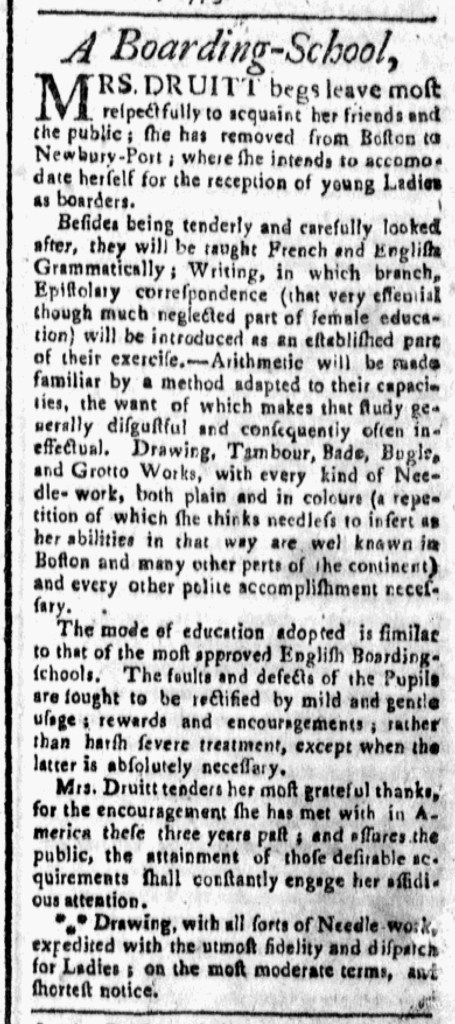
“The mode of education adopted is similar to that of the most approved English Boarding-schools.”

When Eleanor Druitt moved to Newburyport from Boston in the spring of 1775, she placed an advertisement in the local newspaper, the Essex Journal, to announce that she planned to open a boarding school for “young Ladies.”  According to her notice, she had been in the colonies for just three years, yet in that time she had established a reputation for educating young women that she hoped would serve her well in her new town.  Druitt provided a “mode of education … similar to that of the most approved English Boarding-schools,” offering pupils in Massachusetts the same benefits.

The schoolmistress gave an overview of the curriculum, emphasizing that students would learn “French and English Grammatically” and “Writing, in which branch, Epistolary correspondence (that very essential though much neglected part of female education) will be introduced as an established part of their exercise.”  In other words, she taught young women how to write polite letters that would serve them well in maintaining relationships with family and friends in other cities and towns.  Her students also learned arithmetic, “made familiar by a method adapted to their capacities, the want of which makes that study generally disgustful and consequently often ineffectual.”  Druitt had a much higher estimation of young women’s aptitude for drawing, embroidery, and other kinds of decorative “Needle-work,” asserting that she “thinks needless to insert” a longer description “as her abilities in that way are well known in Boston and many other parts of the continent.”  The families of prospective pupils may have seen some of the advertisements she ran in Boston’s newspapers over the past three years since those publications circulated in Newburyport and other towns in Massachusetts and New Hampshire.  In general, her curriculum focused on “polite accomplishment[s]” to distinguish the “young Ladies” that she “tenderly and carefully looked after.”

To that end, Druitt declared that the “faults and defects of the pupils [will] be rectified by mild and gentle usage.”  That meant “rewards and encouragement; rather than harsh severe treatment.”  Parents did not need to worry about the treatment their daughters would receive when boarding with Druitt, though she did state that she would adopt some of those stricter methods as a last resort when “absolutely necessary.”  The schoolmistress suggested that she established just the right balance of encouragement and discipline that allowed pupils at her boarding school to thrive.  Families had a variety of concerns as the imperial crisis intensified in the spring of 1775, but they need not worry about the “reception” their daughters would experience at Druitt’s boarding school.

March 15

What was advertised in a colonial American newspaper 250 years ago today?

Essex Journal (March 15, 1775).

The Sign of the GOLDEN EAGLE.”

In an era before standardized street numbers, colonizers used a variety of methods for giving directions and marking locations.  For instance, the colophon for the Essex Gazette noted that Ezra Lunt and Henry-Walter Tinges ran their printing office in “KING-STREET, opposite to the Rev. Mr. PARSONS’s Meeting-House” in Newburyport.  Some of the advertisements in the March 15, 1775, edition of their newspaper also gave directions in relation to other locations.  Robert Fowle, a stonecutter from Boston, advised prospective customers that he now had a workshop “next to Mr. Jonathan Titcomb’s store, near Somersby’s Landing,” places that he believed were familiar to local readers.  John Vinal ran a school “nearly opposite Mr. Davenport’s Tavern.”  Thomas Mewse gave even more elaborate directions to the site where he “CUTS Stamps and prepares a Liquid for Marking” textiles with the names of the owners, stating that he “may be spoke with at Mr. Jacksons, next door to Dr. Coffin’s, in Rogers’s-street, Newbury-Port.”

Another advertiser relied on a shop sign to mark the location where customers could purchase “English CHEESE,” “A good Assortment of English and Piece Goods, Iron-mongery, Cutlery and Braziery Ware,” and other merchandise: “the Sign of the GOLDEN EAGLE, Near the Court House.”  References to shop signs did not appear in advertisements in the Essex Journal as often as in advertisements inserted in newspapers published in Boston, New York, and Philadelphia, in part because that newspaper carried fewer paid notices than the others.  In addition, Newburyport was a smaller town with fewer businesses that relied on such devices to mark their locations.  Yet an advertisement that directed readers to “the Sign of the GOLDEN EAGLE” demonstrates that shop signs became part of the visual culture that colonizers encountered as they traversed the streets of smaller ports, not just major urban centers.  Few shop signs from the colonial era survive today.  Newspaper advertisements testify to the existence of this method that merchants, shopkeepers, and artisans used to establish commercial identities and mark their locations.

February 15

What was advertised in a colonial American newspaper 250 years ago today?

Essex Journal (February 15, 1775).

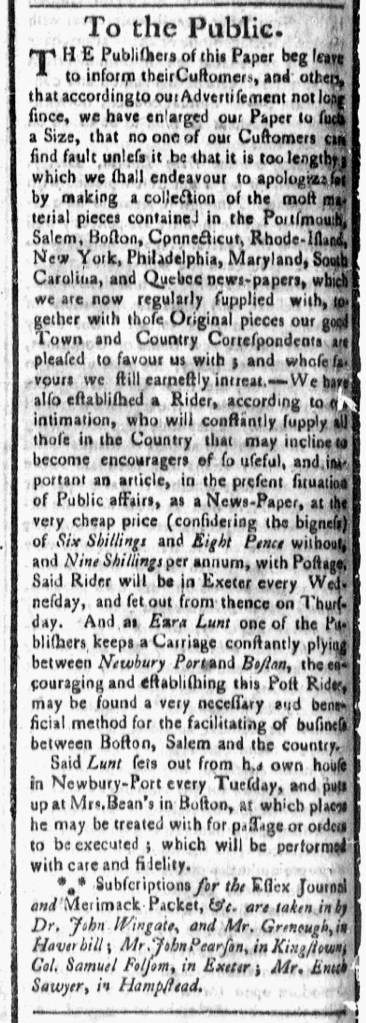
“We have enlarged our Paper to such a Size, that no one of our Customers can find fault.”

An advertisement in the February 15, 1775, edition of the Essex Journal, printed in Newburyport, Massachusetts, revealed important details about its production and circulation.  Ezra Lunt and Henry-Walter Tinges, the publishers, inserted an address “To the Public” to celebrate that they recently “enlarged our Paper to such a Size, that no one of our Customers can find fault unless it be that it is too lengthy.”  Lunt and Tinges coyly declared that they would “apologize” for the length by “making a collection of the most material pieces contained the Portsmouth, Salem, Boston, Connecticut, Rhode-Island, New York, Philadelphia, Maryland, South Carolina, and Quebec news-papers.”  They asserted that they “are now regularly supplied with” newspapers from all those places.  Like other colonial printers, Lunt and Tinges participated in exchange networks with their counterparts in other cities and towns.  Upon receiving newspapers, they scoured them for content to include in their own publication, usually reprinting articles, editorials, essays, and letters word for word.  One header in the February 15 edition, for instance, stated, “From the Massachusetts Spy.”  They supplemented news from far and wide with “Original pieces our good Town and Country Correspondents are pleased to favour us with.”

Lunt and Tinges’s also gave details about the circulation of the Essex Journal, both where to subscribe and logistics for delivery.  They informed readers that subscriptions “are taken in by Dr. John Wingate, and Mr. Grenough, in Haverhill; Mr. John Pearson, in Kingstown; Col. Samuel Folsom, in Exeter; Mr. Enoch Sawyer, in Hampstead.”  That list of local agents resembled the one that appeared in the colophon of each issue of the Massachusetts Spy, printed by Isaiah Thomas in Boston.  At the bottom of the last page, readers glimpsed an announcement that “J. Larkin, Chairmaker, and Mr. W. Calder, Painter, in Charlestown; Mr. J. Hiller, Watch maker, in Salem; Mr. B. Emerson, Bookseller, in Newbury-Port; Mr. M. Belcher, in Bridgewater; and [] Dr. Elijah Hewins, in Stoughtonham” collected subscriptions for the Massachusetts Spy.  Tinges likely learned about recruiting local agents from Thomas, a founding partner of the Essex Journal.  When it came to delivering the newspaper to subscribers, Lunt and Tinges promoted the services of both a post rider whose route included Exeter, New Hampshire, and the carriage that Lunt operated between Newburyport and Boston.  This network “facilitate[ed] business between Boston, Salem, and the country” in addition to disseminating newspapers.

Intended to increase the number of subscribers (and, in turn, advertisers), this advertisement in the Essex Journal testified to several business practices followed by printers throughout the colonies.  Lunt and Tinges described the various kinds of networks that played a role in gathering subscriptions, collecting news and other content, and delivering newspapers to readers.  Each played a role in making information more widely available to the public during the era of the American Revolution.

December 21

What was advertised in a colonial American newspaper 250 years ago today?

Essex Journal (December 21, 1774).

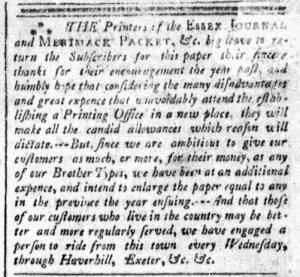
Intend to enlarge the paper equal to any in the province the year ensuing.”

The Essex Journal and Merimack Packet: Or The Massachusetts and New-Hampshire General Advertiser completed its first year of publication with its December 21, 1774, edition.  For the last time, the masthead stated, “VOL. I.”  The compositor updated that to “VOL. II” the following week.  Isaiah Thomas and Henry-Walter Tinges launched the newspaper, published in Newburyport, with a free preview issue on December 4, 1773, then commenced weekly publication on December 29.  Thomas withdrew from the partnership in August 1774, about the same time that he transferred proprietorship of the Royal American Magazine to Joseph Greenleaf.  Ezra Lunt joined Tinges in publishing the Essex Journal without a disruption in distributing the newspaper to subscribers.  Despite those disruptions and the “many disadvantages and great expence that unavoidably attend the establishing a Printing Office in a new place,” the Essex Journal made it through its first year and continued into a second.

In a notice in the final issue of Volume I, Lunt and Tinges announced their plans to improve and expand the newspaper.  They proclaimed that they “are ambitious to give our customers as much, or more, for their money, as any of our Brother Types” who published the Essex Gazette in Salem, the New-Hampshire Gazette in Portsmouth, or any of the five newspapers printed in Boston at the time.  To that end, Lunt and Tinges confided, “we have been at an additional expence, and intend to enlarge the paper equal to any in the province the year ensuing.”  Furthermore, they sought to improve the newspaper for subscribers in other ways.  In order that “those of our customers who live in the country may be better and more regularly served, we have engaged a person to ride from this town every Wednesday, through Haverhill, Exeter,” and other towns.  Lunt and Tinges published the Essex Journal on Wednesdays.  As soon as the ink dried, they gave copies to a postrider to deliver to subscribers throughout the countryside, improving on the services provided throughout the previous year.

Printers often noted when their newspapers completed another year of publication, often marking the occasion with calls for subscribers and others to settle overdue accounts.  Lunt and Tinges did not make any mention of subscribers who were delinquent in making payment.  Instead, they expressed their appreciation and sketched their plans for the next year, hoping to increase support and enthusiasm for the newest newspaper published in Massachusetts.

August 17

What was advertised in a colonial American newspaper 250 years ago today?

Essex Journal (August 17, 1774).

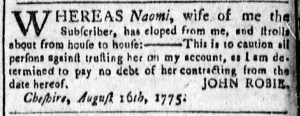
“The co partnership between ISAIAH THOMAS and HENRY W. TINGES, of this Town, Printers, is mutually dissolved.”

When the Essex Journal commenced publication on December 4, 1773, Henry-Walter Tinges printed it in partnership with Isaiah Thomas.  Tinges managed the printing office in Newburyport, while Thomas continued printing the Massachusetts Spy in Boston.  Less than a year passed before their partnership ended.  On August 17, 1774, “No. 35” of the Essex Journal carried a notice “to inform the Public, that the co partnership between ISAIAH THOMAS and HENRY W. TINGES, of this Town, Printers, is mutually dissolved.”  A nota bene further explained, “The Printing Business is carried on as usual, by Ezra Lunt and Henry W. Tinges.”  The young printer had a new partner.  He also updated the colophon on the final page to reflect this change.

Many decades later, Thomas provided a brief account of his partnership with Tinges in The History of Printing in America (1810).  Thomas recollected that he “opened a printing house” in Newburyport “[a]t the request of several gentlemen,” taking Tinges as a partner “who had the principal management of the concerns at Newburyport.”[1]  The young man had previously “served part of his apprenticeship with [John] Fleming,” one of the Tory printers of the Boston Chronicle, “and the residue with Thomas.”[2]  Although the newspaper’s colophon stated that the new printing office in Newburyport accepted job printing orders that would be completed “in a neat manner, on the most reasonable Terms, with the greatest Care and Dispatch,” Tinges devoted most of his time to printing the Essex Journal.  Thomas did not specify why the partnership was “mutually dissolved,” though he may have been frustrated that the printing office did not attract more business or distracted with the responsibilities of running his busy shop in Boston at the same time that the closure of the harbor mandated by the Boston Port Act introduced all sorts of challenges.  Whatever the reason, Thomas “sold the printing materials to Ezra Lunt, the proprietor of a stage, who was unacquainted with printing; but he took Tinges as a partner.”[3]  Tinges contributed his experience and knowledge of the printing trade, while Lunt provided the capital for the necessary equipment.  Even though Tinges performed the bulk of the labor in the printing office, his name appeared second in the colophon during his partnership with Thomas and again during his partnership with Lunt.  Although he may have taken direction from his partners on occasion, Tinges collated the news, engaged with subscribers, advertisers, and other customers, and disseminated additional information in response to “enquire of the printer” advertisements in the Essex Journal.

Essex Journal (August 17, 1774).

**********

[1] Isaiah Thomas, The History of Printing in America: With a Biography of Printers and an Account of Newspapers (1810; New York; Weathervane Books, 1970), 179.

[2] Thomas, History of Printing, 180.

[3] Thomas, History of Printing, 179.

July 6

What was advertised in a colonial American newspaper 250 years ago today?

Essex Journal (July 6, 1774).

“Hour and Half-hour Glasses … of the neatest sort.”

Simon Greenleaf advertised “VERY neat brass box Binnacle Compasses for Ships” and hourglasses “of the neatest sort” for sale at his store “on the Long-Wharf” in Newburyport in the summer of 1774.  He also hawked a “few barrels of Carolina PORK” in his advertisement in the Essex Journal.  Readers likely considered the decorative border that enclosed Greenleaf’s notice the most distinctive aspect of his marketing efforts.  It certainly distinguished his notice from the other advertisements in the July 6 edition and had done so since its first appearance on June 22.

Greenleaf apparently made a request when he submitted his copy to the printing office or met with the printer, Henry-Walter Tinges, to work out an arrangement for this enhancement to his advertisement.  Tinges and Isaiah Thomas commenced publication of the Essex Journal seven months earlier, with Tinges running the printing office in Newburyport while Thomas continued publishing the Massachusetts Spy in Boston.  Had Thomas overseen the Essex Journal, Greenleaf might not have managed to have the border included in his advertisement.  In the past, Thomas seemingly had not been amenable to such flourishes in the Massachusetts Spy, even when advertisers managed to have borders included with their notices published simultaneously in other newspapers.  Ultimately, graphic design depended not only on the imagination of advertisers and compositors but also the preferences of printers who published colonial newspapers.

For the Essex Journal, Greenleaf’s advertisement was a milestone.  It was the first that incorporated decorative type.  Tinges had experiments with using ornaments to as dividers between news items and in the headline for the “POETS-CORNER” on the final page of the newspaper.  Occasionally, he placed the first letter of the first word in an article or letter within a decorative border, but this was the first time that a border enclosed any content, whether news or advertising.  In addition, Tinges did not provide any of the common stock images, such as ships or houses, for the use of advertisers.  Throughout the publication of the Essex Gazette to that point, the only visual images appeared in the masthead, the coat of arms of the colony on the left of the title and a packet ship on the right.  That made Greenleaf’s advertisement even more noteworthy and memorable when readers encountered it since its appearance differed from anything else in that newspaper.

June 29

What was advertised in a colonial American newspaper 250 years ago today?

Essex Journal (June 29, 1774).

Imported in the last ships from LONDON, A Fresh ASSORTMENT of Summer Goods.”

As June 1774 came to a close, the final issue of the Essex Journal for that month carried news that arrived from Salem, Boston, New London, New York, Philadelphia, Williamsburg, and Charleston.  The editor also selected a short address “To the Farmers in America” from “FREEDOM” to reprint from the most recent edition of the Massachusetts Spy.  It advised, “INCREASE your SHEEP and raise WOOL as far as possible, that you from this time wear LIBERTY CLOTH.”  Although framed as advice to farmers, the suggestion to wear homespun cloth applied to all consumers who wished to protest various abuses by Parliament, especially the Boston Port Act that went into effect at the beginning of the month.  Colonizers discussed their prospects for using commercial means to achieve political ends, recognizing that any boycott of imported goods should be accompanied by encouraging “domestic manufactures” as alternative products.  That included clothing made of homespun fabrics to substitute for textiles imported from London.

Even as “FREEDOM” promoted “LIBERTY CLOTH” as a symbol of patriotism, merchants and shopkeepers hawked imported goods elsewhere in the newspaper.  No nonimportation or nonconsumption agreement had yet been adopted.  George Searle, for instance, “Just Imported from LONDON … an assortment of Painters Oils and Colours.”  Similarly, John Stickney and Son, announced that they “imported from London, a large assortment of English, India and hard ware GOODS.”  Those goods certainly included garments and fabrics.  Mary Fisher provided more detail, advertising that she “just Imported in the last ships from LONDON, A Fresh ASSORTMENT of Summer Goods.”  She then listed dozens of items, including an array of textiles that ranged from “PLAIN and figured black, white and blue Sattins” to “black, blue green and rose coloured Sarsnetts [sarcenets]” to “Callicoes and Printed Linens.”  Even as such items fell out of favor in some circles, Fisher offered an opportunity for consumers who desired imported textiles, even those who supported the patriot cause, and realized that they should buy what they could before discussions about boycotts became actual boycotts.  Fisher offered her wares “as Cheap as at any Store or Shop in Town,” making it possible for consumers to stockpile items they purchased from her.  Her imported textiles did not have the appearance of homespun “LIBERTY CLOTH,” but, for the moment, customers could at least equivocate that they had not bought those fabrics while a nonconsumption agreement was in effect.  Memories of boycotts in response to the Stamp Act and the duties on certain goods in the Townshend Acts guided consumers in preparing for a new round of protests.