May 21

What was advertised in a colonial American newspaper 250 years ago today?

May 21 - 5:21:1768 Providence Gazette
Providence Gazette (May 21, 1768).

“Will now undertake to make Kinds of Wigs.”

Convenience!  That was the hallmark of Benjamin Gladding’s advertisement in the May 21, 1768, edition of the Providence Gazette.  The peruke (wig) maker and hairdresser acknowledged that some of his potential clients had not previously had access to all the goods and services they desired in the local marketplace.  In particular, he noted that some “Gentlemen … have heretofore been at the Trouble of sending to Boston for their Wigs.”  That, Gladding proclaimed, was no longer necessary because “he has lately engaged a Journeyman” to assist in his shop.  Together, they could meet the needs of prospective clients in Providence. Gentlemen no longer needed to resort to the inconvenience of having wigs shipped from Boston.

In case prospective clients were as concerned about quality as convenience, Gladding offered additional commentary about the skills and expertise of his new journeyman, describing him as “a compleat Workman.”  Together, they labored “to make all Kinds of Wigs, in the neatest and best Manner, and in the most genteel Taste.”  In making this assertion, Gladding underscored that he offered potential customers more than just convenience.  He implicitly compared the wigs produced in his shop to those that came from Boston, stressing that they were not inferior in any way.  They possessed the same quality, having been made “in the neatest and best Manner,” and they were just as fashionable, following “the most genteel Taste” currently in style in the colonies and the British Atlantic world.  Gladding further emphasized his familiarity with the latest trends when he promoted his services as a hairdresser.  Since he set hair according to “the newest Fashions,” his clients did not need to worry that friends and acquaintances would critique them as ignorant or outdated, at least not as far as their tonsorial choices were concerned.

Gladding concluded his advertisement by pledging that “his constant Endeavour will be to render every Satisfaction.”  By then he had demonstrated what this promise meant:  prospective clients could depend on attention to convenience, quality, and fashion when they patronized his shop.
May 17

What was advertised in a colonial American newspaper 250 years ago today?

May 3 - 5:3:1768 South-Carolina Gazette and Country Journal
Supplement to the South-Carolina Gazette and Country Journal (May 17, 1768).

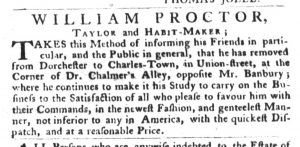
“He has removed from Dorchester to Charles-Town.”

William Proctor, a tailor, placed an advertisement in the South-Carolina Gazette and Country Journal when he relocated from the small town of Dorchester on the Ashley River to the bustling urban port of Charleston. He addressed his notice to both “his Friends in particular, and the Public in general,” a strategy intended to maintain any clients who wished to patronize him at his new location as well as introduce him to the residents of Charleston.

Given that Dorchester, a town already in decline and abandoned after the American Revolution, was eighteen miles from Charleston, Proctor probably had few existing customers in his new city. After all, residents could choose from among many tailors and others who worked in the garments trades in one of the largest ports in the American colonies. Still, acknowledging “his Friends in particular” in his advertisement served an important purpose. It signaled to prospective clients that he had experience pursuing his trade, that he had previously cultivated a clientele in Dorchester and thus deserved their consideration now that he set up shop in Charleston.

He enhanced that appeal by underscoring that “he continues to make it his Study to carry on the Business to the Satisfaction of all who please to favour him with their Commands.” Proctor provided his own testimonial about the quality of the garments he made and the level of customer satisfaction he previously achieved, promising that new clients would not be disappointed if they engaged his services. In case some prospective customers remained skeptical about the clothing he produced, the tailor proclaimed that he constructed garments “in the newest Fashion, and genteelest Manner, not inferior to any in America.” In so doing, he cautioned readers not to dismiss him as a backwoods amateur merely because he had lived and worked outside the colony’s largest city. Instead, he pledged that he was as familiar with current trends – and capable of replicating them – as tailors from Charleston as well as Philadelphia and New York. That he made such a claim at all suggested that he was prepared for prospective clients to assess his efforts and reach their own conclusions, realizing that word of his ineptitude would spread if he did not manage to achieve “the Satisfaction of all who please to favour him with their Commands.” Proctor’s advertisement established a narrative about his skills and the types of garments he created, but consumers possessed the power to verify or discredit the reputation he attempted to construct.

April 4

What was advertised in a colonial American newspaper 250 years ago today?

Apr 4 - 4:4:1768 New-York Gazette Weekly Post-Boy
New-York Gazette: Or, the Weekly Post-Boy (April 4, 1768).

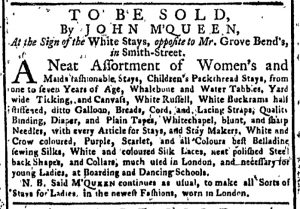
“M’QUEEN continues as usual, to make all Sorts of Stays for Ladies, in the newest Fashions, worn in London.”

How effective were the advertisements for consumer goods and services that appeared in eighteenth-century newspapers?  This is a difficult question to answer, especially from the perspective of consumers. From the perspective of the advertisers, however, their persistence in running newspaper advertisements suggests that they believed those advertisements effectively generated more business than if they had instead chosen not to advertise.  This speaks to attitudes about advertising in eighteenth-century America.

John McQueen sold made and sold stays (or corsets) in New York in the 1760s.  He repeatedly placed advertisements in the local newspapers (including advertisements in March 1766 and February 1767), an indication that he considered them effective for stimulating demand among prospective customers. At the very least, he saw advertising as a necessity for informing readers of the various kinds of stays he stocked.  Neglecting to advertise might have resulted in surrendering his share of the market to competitors.  Such an interpretation implies that McQueen merely attempted to direct existing demand to his establishment.  The contents of the advertisements, however, suggest that he considered advertising more powerful than that.  After all, he did not merely announce that he sold stays; the staymaker also formulated appeals to fashion that he expected would resonate with potential customers.

For instance, McQueen underscored that he sold “all Sorts of Stays for Ladies, in the newest Fashions, worn in London.”  This echoed appeals that he made in previous advertisements:  “all sort of Stays for Ladies in the newest Fashions that is wore in London” and “all Sorts of Stays, in the newest Fashion that is wore by the Ladies of Great-Britain or France.”  In addition to invoking current tastes, McQueen linked his stays to European fashions, especially those in the metropolitan center of the empire.  New York was a relatively small city compared to London, but “Ladies” who purchased McQueen’s stays could trust that they were not less cosmopolitan than their counterparts on the other side of the Atlantic. McQueen reinforced this appeal when he also applied it “neat polished Steel back Shapes, and Collars, much used in London.”  He continued by asserting that these items were “necessary for young Ladies, at Boarding and Dancing Schools.”  He bound fashion and gentility together, seeking to convince prospective customers that they needed the stays he made and sold, especially if they intended to comport themselves appropriately at certain venues where the better sorts gathered.

McQueen considered these appeals effective enough that he consistently incorporated them into newspaper advertisements over the course of several years.  He did more than announce that he made and sold stays.  He offered reasons why readers should purchase his wares, attempting to stimulate demand.  Had he not believed that this would yield a return on his investment then he likely would have scaled back or discontinued his advertisements rather than continue to pay for notices that had no effect on consumers.

March 1

What was advertised in a colonial American newspaper 250 years ago today?

Mar 1 - 3:1:1768 South-Carolina Gazette and Country Journal
South-Carolina Gazette and Country Journal (March 1, 1768).

“He makes jumps and stays … in the newest fashion, either in the English or French manner.”

John Burchet presented himself to consumers in Charleston as a “STAY and MANTUA-MAKER, from LONDON and PARIS.” He established his former places of residence and employment not merely by way of introduction but also to strengthen one of the appeals he advanced in his advertisement. Burchet announced to prospective clients that he made garments “in the newest fashion, either in the English or French manner.” Although he did not elaborate on his time in the English and French capitals, he leveraged the connection to assure customers that they could rely on him to outfit them in “the newest fashion” rather than trends that already declined in popularity. He implied that he had special insight into la mode on the other side of the Atlantic.

Keeping up with the current styles in England and France was important to residents throughout the colonies, but perhaps especially to the gentry and middling sorts aspiring to join their ranks in the largest urban ports. Although the size of Charleston, Boston, New York, and Philadelphia paled in comparison to the metropolis of London, the better sorts in those cities wished to imagine themselves as cosmopolitan as their peers across the ocean. Anxious that they would be seen as backwater provincials, they adopted new fashions – both clothing and housewares – at a speed that often surprised European visitors to the colonies. Some shopkeepers and members of the garments trade emphasized their correspondence with counterparts in England as a means of keeping abreast of the newest trends. Burchet, however, suggested that he offered something even better: why settle for an American staymaker who imitated the styles popular in Europe when it was possible to hire one “from LONDON and PARIS” who had direct knowledge from his time in those cities? This marketing strategy did rely on both the staymaker and the customer suspending their disbelief to some extent. After all, having once lived and worked in London and Paris did not give Burchet immediate access to fashions there. He relied on transatlantic correspondence, just like his competitors. Yet he marshaled the cachet of his origins, prompting clients to imagine visiting his shop for measurements and fittings and ultimately wearing garments made by an artisan “from LONDON and PARIS.” Burchet’s stays and other wares might have yielded the same appearance as those made by others, but his personal narrative added value to the clothing he made.

February 2

What was advertised in a colonial American newspaper 250 years ago today?

Feb 2 - 2:2:1768 South-Carolina Gazette and Country Journal
South-Carolina Gazette and Country Journal (February 2, 1768).

“They engage to take back every Article from a Customer, that they can make the least reasonable Objection against.”

David Maull and John Wood, “TAYLORS, from LONDON,” incorporated a variety of marketing appeals into their advertisement in the February 2, 1768, edition of the South-Carolina Gazette and Country Journal. They included some of the most popular marketing strategies deployed in the eighteenth century, but they also devised several innovative strategies that differentiated their commercial notice from others.

Purveyors of goods and services commonly promoted quality and fashion. Maull and Wood did so when they stated that their work represented “the neatest and newest fashion.” Artisans often underscored their competence. Maull and Wood reported that “they carry on the Taylors Business in all its Branches.” Shopkeepers and artisans both proclaimed their origins or other connections to London to give their goods and services more cachet in the transatlantic marketplace. Maull and Wood announced that they had migrated “from LONDON,” where they had presumably received training and previously worked. Invoking some sort of link to London also bolstered their claim to produce garments in the “newest fashion.” Many advertisers made a nod toward customer service, as Maull and Wood did when they pledged to fulfill orders “with quickest Dispatch.” Maull and Wood used stock language in making these common appeals to customers.

Yet the tailors also attempted to entice clients with a series of other marketing strategies in a nota bene that concluded their advertisement. They provided a money-back guarantee, promising “to take back every Article from a Customer, that they can make the least reasonable Objection against.” They also offered reduced rates to customers who paid in cash, vowing to “discount Five per Cent.” On the other hand, they extended “twelve Months Credit” to other customers during a period that most advertisers either demanded cash or allowed only “short credit.” Consumers regularly made purchases on credit in eighteenth-century America, but it was not a method of payment promoted by most purveyors of goods and services in their advertisements in the late 1760s. Maull and Wood made clear that they were willing to work out payment schedules that fit the needs of their prospective clients. John Ward, another tailor who advertised in the same issue, made no mention of how he expected customers to pay. Finally, Maull and Wood doubled the length of their advertisement by publishing a roster of prices to demonstrate their reasonable prices to prospective clients. This eliminated negotiating over the bill and anxieties that a better deal might have been possible by locking in rates from the start.

Maull and Wood distinguished their advertisement from others published in Charleston’s newspapers by augmenting the most common appeals with innovative marketing strategies. They did not invent any of the methods they used, but they effectively amalgamated multiple popular and novel tactics for attracting customers into a single advertisement to an extent not achieved by most other advertisers of consumer goods and services in the 1760s.

January 19

What was advertised in a colonial American newspaper 250 years ago today?

Jan 19 - 1:19:1768 South-Carolina Gazette and Country Journal
South-Carolina Gazette and Country Journal (January 19, 1768).

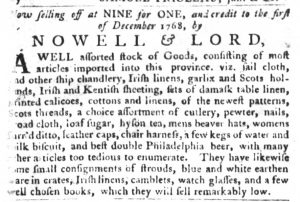
“A WELL assorted stock of Goods, consisting of most articles imported into this province.”

In their advertisement in the January 19, 1768, edition of the South-Carolina Gazette and Country Journal, Nowell and Lord incorporated many of the most common marketing strategies deployed by merchants and shopkeepers in eighteenth-century America. The format of their advertisement, like the appeals, would have been familiar to readers. Like many of their competitors in Charleston and throughout the colonies, Nowell and Lord composed a list-style advertisement that revealed the range of goods they stocked, from “Irish and Kentish sheeting” to “leather caps” to “blue and white earthen ware.”

In and of itself, this format demonstrated the veracity of one of their appeals to potential customers: consumer choice. The partners reiterated that their patrons could choose the items that matched their needs, desires, tastes, and budgets throughout their advertisement. First, they described their inventory as “A WELL assorted stock of Goods,” proclaiming that it included “most articles imported into this province.” In other words, customers were unlikely to find merchandise in other shops that Nowell and Lord did not also carry. To underscore the variety they offered, the partners promoted their “choice assortment of cutlery” midway through the advertisement. They also made a point of noting that the list they printed in the newspaper was not exhaustive; instead, they also carried “many other articles too tedious to enumerate.” Customers would delight in the number of choices available to them when they visited Nowell and Lord’s shop.

In addition to consumer choice, the shopkeepers also made appeals to price and fashion. For instance, they stressed that they sold their merchandise “remarkably low.” To make their wares even more affordable, they offered “credit to the first of December 1768.” When it came to textiles for making garments, they informed readers that they imported “the newest patterns,” allowing customers to impress their friends and acquaintances by keeping up with current fashions in other parts of the empire.

Nowell and Lord deployed consumer choice as the central marketing strategy in their advertisement, but they supplemented that appeal with assurances about price and fashion. To sell their merchandise, they replicated methods used by countless other advertisers throughout the colonies. That so many merchants and shopkeepers consistently relied on the same strategies testifies to the power they believed those strategies possessed to entice and influence colonial consumers.

December 24

What was advertised in a colonial American newspaper 250 years ago today?

Dec 24 - 12:24:1767 New-York Gazette Weekly Post-Boy
New-York Gazette: Or, the Weekly Post-Boy (December 24, 1767).

“Newest fashioned hat trimmings.”

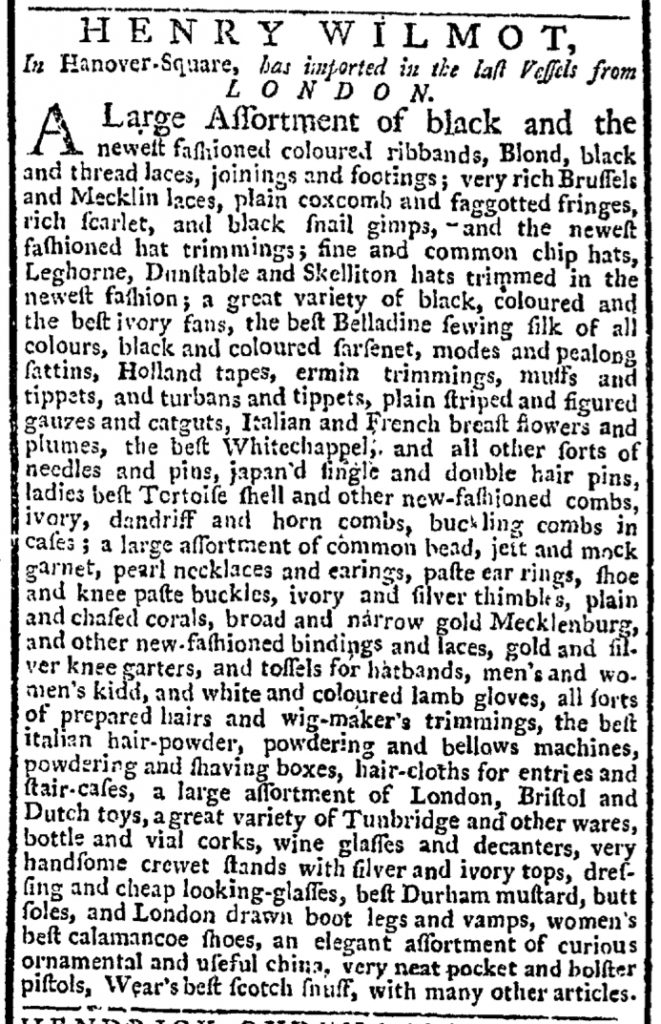
At his shop on Hanover Street in New York, Henry Wilmot stocked an impressive array of goods “imported in the last Vessels from LONDON.” His advertisement in the December 24, 1767, edition of the New-York Gazette: Or, the Weekly Post-Boy described all kinds of personal adornments, from lace and ribbons to hairpins and combs to jewelry and gloves. To incite demand for these baubles from Britain, Wilmot deployed one of the most common marketing strategies of the period, an appeal to fashion. Many shopkeepers made general statements about the fashionable qualities of all of their wares, but Wilmot instead reiterated this point throughout his advertisement. He repeated some variation on the phrase “newest fashion” five times in the list of his inventory: “newest fashioned coloured ribbands,” “newest fashioned hat trimmings,” “Leghorne, Dunstable and Skelliton hats trimmed in the newest fashion,” “new-fashioned combs,” and “new-fashioned bindings and laces.”

This method may have been intended to convey to potential customers that Wilmot exercised careful attention to detail when it came to keeping abreast of the latest trends in London. Rather than make sweeping claims about all of his merchandise, he highlighted particular items that consumers could trust reflected tastes currently on display in the cosmopolitan center of the empire. In turn, this suggested that he could provide guidance in selecting from among his other merchandise, steering customers away from items too far out of style in favor of those that suitably complemented the “newest fashioned” garments and adornments. At the very least, repeating the phrase “newest fashion” may have induced potential customers to associate all of Wilmot’s merchandise with current styles, as did the use of adjectives like “best” and “elegant.”

Colonial consumers often worried that shopkeepers hawked whatever merchandise they could acquire, that English merchants sent castaways no longer popular in the London market. Wilmot addressed those suspicions with repeated assertions that he stocked and sold goods of the “newest fashion,” stylish items that had not been lingering in his shop but instead arrived on the vessels that most recently entered port.

September 28

What was advertised in a colonial American newspaper 250 years ago today?

Sep 28 - 9:28:1767 New-York Gazette
New-York Gazette (September 28, 1767).

“All kind of Hanging Paper, of the newest Patterns.”

Prior to the Revolution, many Americans decorated their homes with wallpaper (known in the eighteenth century as “Hanging Paper” or paper hangings) imported from Great Britain. That trade temporarily ceased during the war, but Americans resumed acquiring wallpaper (and many other consumer goods) from England almost as soon as the Treaty of Paris brought an end to hostilities in 1783. At that time, the new nation set its own trade policies and, no longer inhibited by restrictions put in place by Parliament, increased the flow of goods from other European nation-states. Some advertisers promoted French paper hangings as alternatives to any from Britain in the 1780s and 1790s.

Yet importers did not provide Americans sole access to wallpaper, either before or after the Revolution. Domestic manufacturers incorporated “Buy American” appeals into their marketing efforts in the final decades of the eighteenth century. Some even lobbied for tariffs on imported paper hangings in order to bend competition in the marketplace to their own advantage.[1]

Advertisements from the late colonial period reveal that production of wallpaper commenced in America prior to the Revolution. John Scully, for instance, made, sold, and installed “Hanging Paper” and “Borderings suitable to the Paper” in New York in the 1760s. Realizing that many prospective clients might consider imported wallpaper superior for a variety of reasons, he advanced multiple appeals to convince readers of the New-York Gazette to give him a chance. He stressed that he “MANUFACTURES all kind” of wallpaper, implying he offered the same range of choice as his competitors who imported from England. He underscored that his wares followed “the newest Patterns,” reassuring potential customers that they did not have to purchase wallpaper produced on the other side of the Atlantic in order to keep up with fashions set in the cosmopolitan center of the empire. Lest potential clients assume that American manufacturers could not produce wallpaper of the same quality as the English imports, Scully proudly stated that he had “served a regular Apprenticeship” in that business. Customers could depend on his skill.

John Scully realized that his livelihood depended on successfully competing with shopkeepers and paperhangers who sold and installed wallpaper imported from England. To do so, he made appeals to choice, fashion, and his own training to convince consumers to purchase from him.

**********

[1] For more on the marketing of paper hangings after the Revolution, see Carl Robert Keyes, “A Revolution in Advertising: ‘Buy American’ Campaigns in the Late Eighteenth Century,” in Creating Advertising Culture: Beginnings to the 1930s, vol. 1, We Are What We Sell: How Advertising Shapes American Life … And Always Has, ed. Danielle Sarver Coombs and Bob Batchelor (Praeger, 2014), 1-25.

June 15

What was advertised in a colonial American newspaper 250 years ago today?

Jun 15 - 6:15:1767 New-York Gazette
New-York Gazette (June 15, 1767).

“Just arrived … Thomas Paul, TAYLOR from LONDON.”

George Senneff, “TAYLOR, from LONDON,” and Thomas Paul, “TAYLOR from LONDON” competed for clients in New York. In the process, they resorted to similar advertising campaigns. Senneff’s connection to London was central in his marketing efforts. Not only did he promote his place of origin, he also stressed his familiarity with current fashions in the cosmopolitan center of the empire and pledged to outfit his patrons in the same manner. He promised customers that he made a variety of garments “after the newest and genteelest Taste, as is now worn in London.” To drive the point home, he reiterated that he made riding habits for women “after the newest Fashions now worn in London.”

Thomas Paul deployed the same appeal in his advertisement. He noted his origins before stating that he produced “Mens Cloaths, both trim and plan, in the newest and genteelest Taste, as is now worn in London.” To enhance this claim, he added an element not present in Senneff’s advertisement. Paul noted that he had “Just arrived in the Ship New-York, Capt. Lawrence.” Senneff, on the other hand, gave no indication of how long he had been in New York or how recently he had migrated from London.

This created an interesting tension between their advertisements, especially when they appeared in close proximity, as they did in the June 15, 1767, edition of the New-York Gazette. Senneff’s notice was at the bottom of the first column on the first page and Paul’s notice two columns to the right. Through repetition, Senneff more forcefully asserted that his garments accorded to “the newest Fashions now worn in London,” but Paul’s recent arrival may have trumped that declaration since his familiarity with current tastes certainly derived from direct observation. Faced with a choice between Senneff and Paul, the latter’s recent residence and work in London may have been the deciding factor for some potential customers.

April 30

What was advertised in a colonial American newspaper 250 years ago today?

Apr 30 - 4:30:1767 Boston News-Letter
Massachusetts Gazette (April 30, 1767).

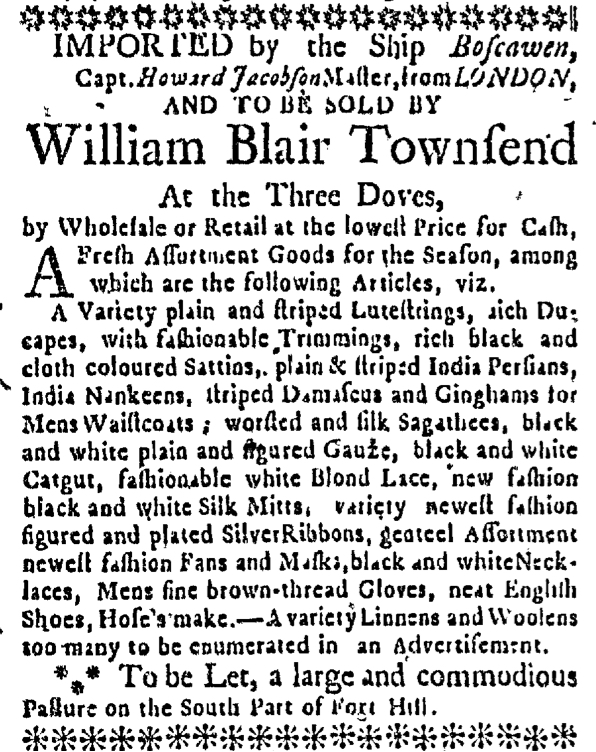
“Genteel Assortment newest fashion Fans and Masks.”

At his shop at the sign of the Three Doves in Boston, William Blair Townsend sold “A Fresh Assortment Goods for the Season” recently imported from London. Many of his competitors advised potential customers that they stocked fashionable goods, especially textiles, accessories, and adornments for garments, but most deployed some sort of blanket statement to that effect. Townsend, on the other hand, underscored that he carried dry goods à la mode, inserting the word “fashionable” five times in his list of merchandise. For instance, he carried “Ducapes, with Fashionable Trimmings” and “fashionable white Blond Lace.” For those worried that merchants in England attempted to pawn off inventory already going out of style to colonial shopkeepers to pass along to their customers far removed from the cosmopolitan center of the empire, Townsend asserted that his customers could purchase “new fashion black and white Silk Mitts” as well as a “variety newest fashion figured and plated Silver Ribbons.” Both could have been used to dress up garments that might otherwise have been already passing out of style. Townsend adopted even more expansive language as he continued describing his wares: “genteel Assortment newest fashion Fans and Masks.” Other eighteenth-century advertisers commonly made appeals to fashion, but Townsend made it the centerpiece of his marketing strategy.

Not all colonists were as keen on keeping up with current fashions as the customers Townsend sought to cultivate. The Massachusetts Gazette Extraordinary, a supplement for “other News and New-Advertisements,” included a notice that “In a few Days will be Published, AN ADDRESS TO PERSONS of FASHION.” The author did not look upon the consumer revolution, its rituals of purchasing and display, with fondness. This pamphlet was a warning “worthy the serious Attention of every Christian, especially at a Time when Vice and Immorality seem to have an Ascendancy over Religion.” This advertisement stood in stark contrast to the array of advertisements hawking all sorts of consumer goods that surrounded it. Seemingly separated from Townsend’s advertisement by several pages according to modern archival practices, the Extraordinary may have been inserted in the Massachusetts Gazette as a means of keeping the two publications for April 30 together. If that was the case, the advertisement for the “ADDRESS TO PERSONS of FASHION” appeared on the far left of the page that faced Townsend’s advertisement. Readers would have encountered the critique of fashion almost immediately before perusing the shopkeeper’s efforts to extoll his stylish merchandise.