April 30

What was advertised in a colonial American newspaper 250 years ago today?
Apr 30 - 4:30:1767 Boston News-Letter
Massachusetts Gazette (April 30, 1767).

“Genteel Assortment newest fashion Fans and Masks.”

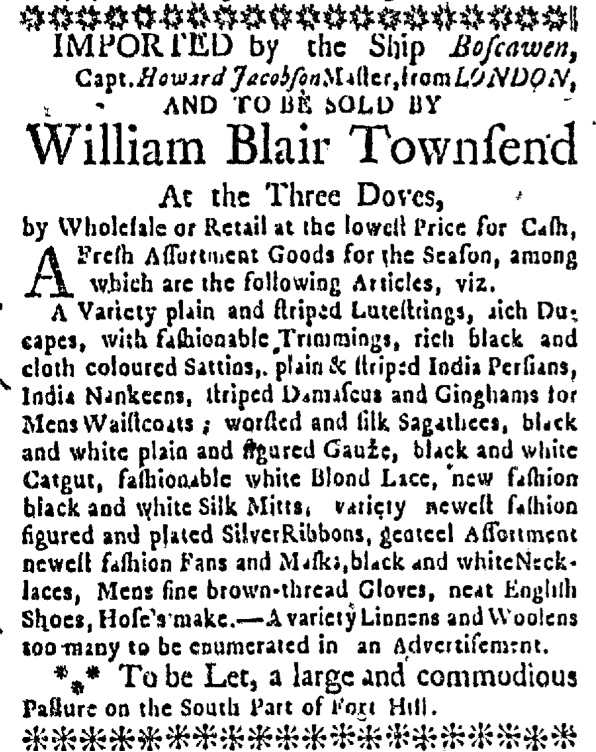
At his shop at the sign of the Three Doves in Boston, William Blair Townsend sold “A Fresh Assortment Goods for the Season” recently imported from London. Many of his competitors advised potential customers that they stocked fashionable goods, especially textiles, accessories, and adornments for garments, but most deployed some sort of blanket statement to that effect. Townsend, on the other hand, underscored that he carried dry goods à la mode, inserting the word “fashionable” five times in his list of merchandise. For instance, he carried “Ducapes, with Fashionable Trimmings” and “fashionable white Blond Lace.” For those worried that merchants in England attempted to pawn off inventory already going out of style to colonial shopkeepers to pass along to their customers far removed from the cosmopolitan center of the empire, Townsend asserted that his customers could purchase “new fashion black and white Silk Mitts” as well as a “variety newest fashion figured and plated Silver Ribbons.” Both could have been used to dress up garments that might otherwise have been already passing out of style. Townsend adopted even more expansive language as he continued describing his wares: “genteel Assortment newest fashion Fans and Masks.” Other eighteenth-century advertisers commonly made appeals to fashion, but Townsend made it the centerpiece of his marketing strategy.

Not all colonists were as keen on keeping up with current fashions as the customers Townsend sought to cultivate. The Massachusetts Gazette Extraordinary, a supplement for “other News and New-Advertisements,” included a notice that “In a few Days will be Published, AN ADDRESS TO PERSONS of FASHION.” The author did not look upon the consumer revolution, its rituals of purchasing and display, with fondness. This pamphlet was a warning “worthy the serious Attention of every Christian, especially at a Time when Vice and Immorality seem to have an Ascendancy over Religion.” This advertisement stood in stark contrast to the array of advertisements hawking all sorts of consumer goods that surrounded it. Seemingly separated from Townsend’s advertisement by several pages according to modern archival practices, the Extraordinary may have been inserted in the Massachusetts Gazette as a means of keeping the two publications for April 30 together. If that was the case, the advertisement for the “ADDRESS TO PERSONS of FASHION” appeared on the far left of the page that faced Townsend’s advertisement. Readers would have encountered the critique of fashion almost immediately before perusing the shopkeeper’s efforts to extoll his stylish merchandise.
February 2

What was advertised in a colonial American newspaper 250 years ago today?

feb-2-221767-new-york-gazette
New-York Gazette (February 2, 1767).

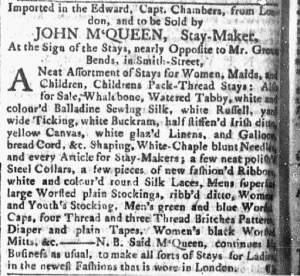
“Said M‘Queen, continues his Business as usual, to make all sorts of Stays for Ladies.”

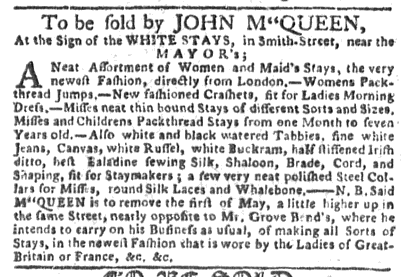
John McQueen pursued multiple branches of the staymaking business at his shop “At the Sign of the Stays … in Smith-Street” in New York. He sold stays (or corsets) recently imported from London, but stated that he made “all sorts of Stays” as well. McQueen described himself as a “Stay-Maker” rather than a shopkeeper, although he also engaged in retailing “every Article for Stay-Makers” to others who practiced the trade. He sold textiles and accessories, like many shopkeepers, but the landmark that identified his shop, “the Sign of the Stays,” testified to his primary occupation and merchandise.

Even though he possessed the skills “to make all sorts of Stays,” McQueen may have considered it necessary to stock and advertise inventory imported from London. In addition to keeping up with demand that might have exceeded the number of garments he could produce in his shop, this also allowed him to assert that customers who purchased his stays could be certain that they made stylish choices that kept with those made by genteel women who resided across the Atlantic in the metropolitan capital of the British empire. McQueen had a habit of concluding his advertisements with declarations that he made stays “in the newest Fashions that is wore in London,” as he did in a nota bene that accompanied today’s advertisement. In an advertisement published nearly a year earlier, he resorted to even more grandiose language, proclaiming that he made stays “in the newest Fashion that is wore by the Ladies of Great-Britain or France, &c. &c.” In that case, he also reported that he imported stays “directly from London.”

Which merchandise comprised the bulk of McQueen’s business? Imported Stays or those he made in his own shop? Either way, he needed to establish some sort of connection – some sort of awareness of – current fashions in London and other cosmopolitan cities in Europe to help move any of his inventory made in his own shop. In the coming years many colonists would increasingly turn to homespun and look askance at goods and styles transported across the Atlantic for England, but for the moment most were still invested in expressing British identity through the Anglicization of the goods they purchased and clothing they wore.

December 31

What was advertised in a colonial American newspaper 250 years ago today?

dec-31-12311766-georgia-gazette
Georgia Gazette (December 31, 1766).

“A LARGE and NEAT ASSORTMENT of superfine broad cloths.”

Inglis and Hall frequently advertised in the Georgia Gazette. Among Savannah’s shopkeepers, this partnership often placed the most extensive commercial notices in the local newspaper, making their marketing familiar to readers. Although they sometimes experimented with the format of their advertisements, most of the time Inglis and Hall took a fairly conservative approach to the strategies they deployed.

Today’s advertisements, for instance, included several of the most common appeals to consumers made throughout the eighteenth century. Inglis and Hall promoted “A LARGE and NEAT ASSORTMENT” of goods recently imported from England. Listing dozens of items potential customers could expect to find when visiting their shop. In addition, Inglis and Hall noted that these new arrivals supplement “their former assortment,” prompting readers to recollect previous list advertisements that enumerated their merchandise. In so doing, Inglis and Hall made an appeal to choice. Potential customers did not have to accept whatever goods the shopkeepers happened to have in stock. Instead, they could make their own selections to suit their tastes and budgets.

The retailers acknowledged both of those aspects of the shopping experience as well. They concluded their advertisement by promising to sell all of their merchandise “on the most reasonable terms.” Appeals to price were common in the eighteenth century, though they often received as little elaboration as in today’s advertisement. Such appeals became a standard part of boilerplate advertisements, yet shopkeepers dared not omit pledges to low and competitive prices. Potential customers came to expect such reassurances.

Appeals to fashion or taste could also be fleeting or expansive, depending on the advertisement. Today’s advertisement took the former approach when it listed some of the less utilitarian goods for sale: “fashionable Roman tea-urns, tea kettles, coffee pots, and waiters, pewter plates, water dishes, and measures.” Ultimately, customers had to decide for themselves whether Inglis and Hall actually carried “fashionable” housewares that testified to their taste and that they desired to show off to visitors, yet the advertisement helped to shape their expectations.

Today’s advertisement was not especially innovative in 1766, but that did not make it dull or lacking in marketing strategy. Inglis and Hall incorporated an array of standard advertising strategies to attract customers to their shop. They announced that they stocked new goods, noted the origins of their wares, and made appeals to choice, price, and fashion. Ingis and Hall depended on marketing techniques that advertisers throughout the colonies generally agreed were effective.

November 22

GUEST CURATOR: Patrick Keane

What was advertised in a colonial American newspaper 250 years ago today?

nov-22-11221766-providence-gazette
Providence Gazette (November 22, 1766).

“SUPERFINE broad cloths.”

Gideon Young sold imported materials at his shop that people could use to make clothing. He sold some materials that were intended for the rich (“fashionable silks”) as well as some that were not intended for the rich (“midling and coarse broad cloths”). I found it interesting that he sold at low prices so that he could bring in rich or poor people. He wanted to bring as much attention to his shop as possible; the best way was having “cheap” prices for those who lived in Providence.

On the Colonial Williamsburg website, Edward R. Crews talks about the “18th Century love of fashion and the art of making clothes.” People who bought these materials from Young could then bring them to a milliner to make the clothing for them. Some of the colonists who bought from Young might use the materials to make fancy clothing. Young wanted to appeal to the lower class by having lower prices so that they too could make their own clothes that could also look fancy.

**********

ADDITIONAL COMMENTARY: Carl Robert Keyes

Who were Gideon Young’s customers? As Patrick notes, they could have included colonists from a variety of backgrounds. Young stocked some textiles that would have appealed to genteel gentlemen and ladies as well as others more likely to be purchased by the middling and lower sorts. By offering low prices, he invited all sorts of potential customers to visit his shop.

That Young attempted to cater to different kinds of clients demonstrates a tension that emerged as the consumer revolution of the eighteenth century expanded to include greater numbers of colonists. Products and fashions that had once been reserved for the elite increasingly became more widely accessible as the number of imported goods rose and prices fell. Affluent colonists engaged in conspicuous consumption as a means of continuing to distinguish themselves from their social subordinates. However, even as the elite bought more and more things, other colonists purchased what they could afford and engaged in their own acts of displaying their possessions – and their good taste – to others.

Young certainly wanted to make his customers feel special when he offered “fashionable silks” and “best black sattins, pelong, and alamode.” Yet he balanced a sense of exclusivity against “cheap” prices that suggested that not everyone who visited his shop on Union Street came from the upper echelons of Providence residents.

If all sorts of colonists could buy “fashionable” and “best” goods with all the “trimmings to suit” for low prices from shopkeepers like Young, how could the elite assert their status? A rise in concern for manners as well as attention to personal comportment accompanied the consumer revolution of the eighteenth century. Colonists concentrated on demonstrating their gentility through their actions and interactions with others rather than relying solely on their possessions to testify to their status. In such cases, the clothes did not, by themselves, make the man (or woman). Appearances and possessions were not enough to claim social status. Colonists who wanted to claim a place among the genteel also needed to exhibit politeness and demonstrate that they understood refined rules for social interactions.

October 24

GUEST CURATOR: Megan Watts

What was advertised in a colonial American newspaper 250 years ago today?

oct-24-10241766-new-hampshire-gazette
New-Hampshire Gazette (October 24, 1766).

“Stephen Hardy, Taylor from London.”

This advertisement starts off with the words: “Stephen Hardy, Taylor from London.” It originally caught my attention because it mentioned a specific line of products. Many newspaper advertisements were from the equivalent of general stores, shops where a variety of goods — from agricultural tools to alcohol to handkerchiefs — could be purchased. Yet this one is an advertisement for a very specific line of goods and services. Hardy “Makes Gentlemens Cloaths of all sorts” and “He has just Imported A variety of Remnants of Cloth.” The advertisement made me curious about clothing and fashions in Colonial America. I looked at the different terms used in the advertisement, including “Breeches,” “Ladies Riding Habets,” and “strip’d Linnen.”

Those lines got me thinking about what the everyday wear for colonists was and how clothing was important to colonial society. Even in the modern day, clothing can be interpreted as a symbol of socioeconomic status. This also proved true for the 1700s. Typically men of the middle to upper class wore breeches and shirt, not necessarily with a jacket nor necessarily of a matching pattern. Women’s fashions varied with social class in regard to fabric and style.

In addition, another thing very important to note about clothing and fashion during this time was the complex etiquette associated with clothes. There was a specific protocol, especially with the social elite, about what was acceptable in informal and formal situations. There were informal everyday garments, the “undress,” and formal garments, the “dress” clothing. In addition different accessories and fabrics were included in this silent protocol. A consumer from the upper classes who read the advertisement would know right away which things were appropriate for everyday use and what needed to be worn. These choices would not only appease their peers but showcase to the others that they enjoyed a privileged social position. This idea of social status and acting in a way that befits one’s station was an important component of early American society. Understanding colonial clothing helps modern day people understand colonial society overall.

**********

ADDITIONAL COMMENTARY: Carl Robert Keyes

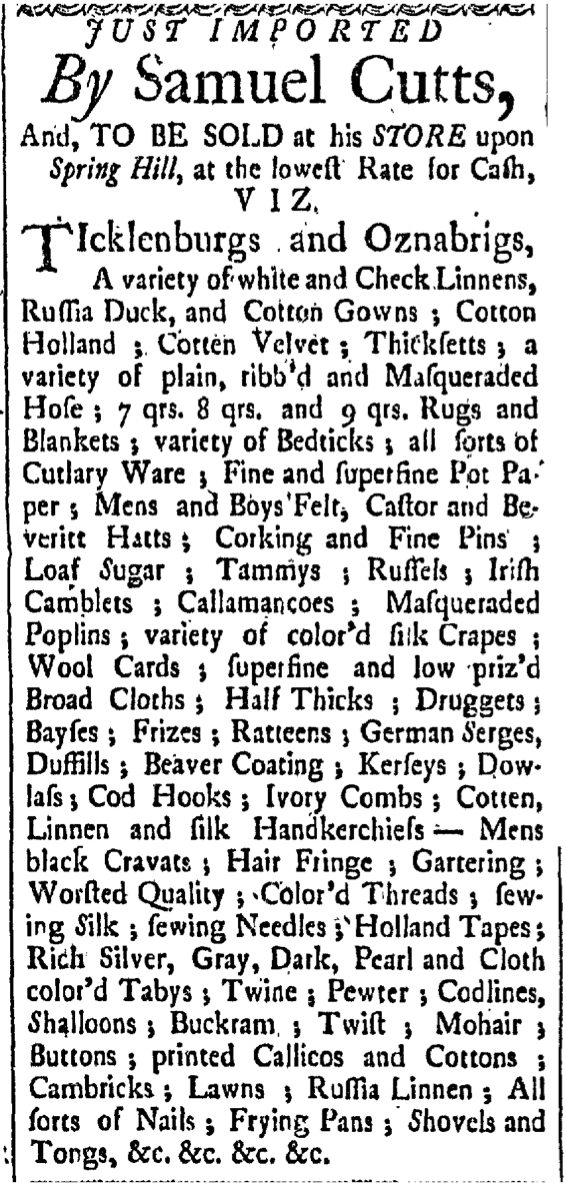
Given the size of Portsmouth relative to other colonial cities, the New-Hampshire Gazette published fewer advertisements than newspapers from Boston, New York, Philadelphia, and Charleston. In any of those urban ports, Stephen Hardy’s advertisement would have competed with several others that offered similar goods and services. In the October 24, 1766, issue of the New-Hampshire Gazette, however, only one other advertisement bore any sort of resemblance to Hardy’s notice. Samuel Cutts promoted an array of imported textiles, but also listed “All sorts of Nails; Frying Pans; Shovels and Tongs, &c. &c. &c. &c.”

Hardy and Cutts certainly competed for some of the same customers, but several aspects of Hardy’s advertisement suggest that he enticed Portsmouth’s more genteel consumers (or those who aspired to gentility). Perhaps most significantly, Hardy, a “Taylor from London,” offered services to accompany the goods he sold. He not only imported textiles but also “punctually served” his clients who visited him to have “Gentlemens Cloaths of all sorts” and “Ladies Riding Habets” made to specification. Cutts, on the other hand, sold textiles but did not assist customers in transforming them into finished apparel. Cutts did sell pins and sewing needles so his customers could make their own clothing out of the fabrics they purchased from him.

In listing his occupation as a “Taylor” rather than a shopkeeper, Hardy also underscored that he was “from London.” He did not indicate how recently he had migrated to the colonies (though many readers of the New-Hampshire Gazette would have known approximately how long he had resided in Portsmouth), but listing his origins affiliated him with the Britain’s largest city and the cosmopolitan center of the empire. By implication, his textiles and the clothing he made from them aligned with the latest fashions of the transatlantic elite.

Hardy also addressed his prospective clients as gentlemen and ladies, suggesting the status of those who visited his shop. When customers did call on Hardy they found themselves surrounded with fine textiles and adornments, rather than the diversity of qualities (or the hardware and housewares) listed in Cutts’ advertisement. As Megan notes, Hardy specialized in his trade; the inventory in his advertisement and shop reflected his work as a tailor rather than a shopkeeper.


October 12

GUEST CURATOR: Jordan Russo

What was advertised in a colonial American newspaper 250 years ago this week?

oct-12-10101766-new-hampshire-gazette
New-Hampshire Gazette (October 10, 1766).

“TIcklenburgs and Oznabrigs.”

Two words in larger type near the top of this advertisement caught my interest: “Ticklenburgs and Oznabrigs.” They were words that I had not seen before. Both of these items are textiles; the majority of the items listed in the advertisement were textiles. As I mentioned earlier this week, clothing was an important way for colonists to indicate their position in society. The list of items is very long and diverse; there were many types of items all different types of people would have wanted.

T.H. Breen indicates that the volume of consumer goods imported into the colonies allowed prices to decrease. Samuel Cutts’ advertisement states that he sold his goods “at lowest Rate.” Cutts was making sure his potential customers knew that he had the lowest prices and they could have the best deals for all these items. We could compare this to today’s consumer culture; stores are always advertising that they are having sales and have better deals than other stores. Modern customers are always attracted to being able to purchase something for the least amount of money.

**********

ADDITIONAL COMMENTARY: Carl Robert Keyes

In her work as guest curator so far, Jordan has identified some of the most significant aspects of eighteenth-century advertising. In one sense, she has returned the Adverts 250 Project to its origins, examining the most common appeals that appeared in early American advertisements. Today we take such appeals — price, choice, fashion — for granted, but that was not the case during the consumer revolution of the eighteenth century. Those appeals were the building blocks of the first generation of advertising for consumer goods and services in American newspapers and magazines, but not all advertisers deployed one or more of those most basic appeals.

As the eighteenth century progressed, appeals to price, choice, and fashion became increasingly common. Some advertisers experimented with incorporating two or all three into their advertisements. In one form or another, each of those appeals appeared in the advertisement Jordan selected for today. Samuel Cutts explicitly made an appeal to price. As Jordan notes, he offered his wares “at the lowest Rate.” Several aspects of his advertisement suggested that customers had many choices in his store, from the extensive list of merchandise to the repetition of the word “variety” to concluding the advertisement with “&c. &c. &c. &c.” Indeed, inserting the eighteenth-century abbreviation for et cetera would have been sufficient to signal that he carried other goods, but repeating it so many times underscored that customers could examine many more items if only they visited his store. Cutts’ appeals to fashion were more subtle, but colonial consumers would have had the ability to classify which textiles were intended for which consumers. Those who wished to attire themselves in the finer textiles, for instance, would not have purchased “Oznabrigs,” a coarse fabric commonly used for clothing for slaves.

In examining some of these most common appeals, Jordan identifies some of the concerns that were most important to eighteenth-century advertisers and consumers. In the process, she also demonstrates that in some regards colonists were not that much different from modern Americans participating in the marketplace.

September 27

GUEST CURATOR: Nicholas Commesso

What was advertised in a colonial American newspaper 250 years ago today?

sep-27-9271766-providence-gazette
Providence Gazette (September 27, 1766).

“A fresh and large Assortment of English and India Goods.”

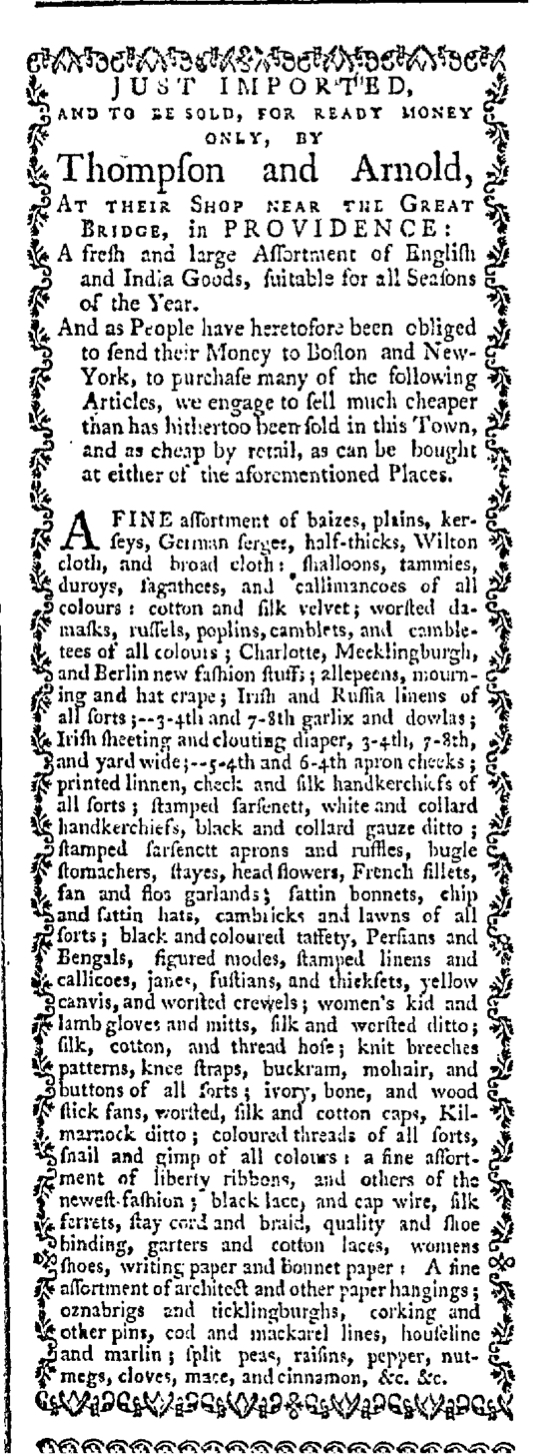
This advertisement in the Providence Gazette features a lengthy list of newly imported goods at the shops of Thompson and Arnold. “TO BE SOLD, FOR READY MONEY ONLY,” these goods had been imported from both from England and India. Included in this “FINE assortment” were different textiles, clothing, and related items, such as “Irish and Russia linens of all sorts,” satin bonnets, shalloons, tammies, “colored threads of all sorts,” and countless other products. Why was importation so important? Business for the British was truly booming in colonial America. As T.H. Breen notes, newspapers “carried more and more advertisements for consumer goods,” and all Americans were a part of this “consumer revolution.”[1]

This shop clearly emphasized fashion, as they offered many different options in terms of colors and materials, which especially interested women. For women, shopping was an exhibition of liberty, and “with choice came a measure of economic power.” They had choices of products and choices of shops to visit. A variety of options allowed customers to gain leverage as they asked questions and made demands. Additionally, Breen argues, choice “reinforced the Americans’ already strong conviction of their own personal independence.”[2]

**********

ADDITIONAL COMMENTARY: Carl Robert Keyes

I originally intended to feature this advertisement a week ago today, but when Nick submitted the same advertisement (printed a week later) for approval I decided to hold off for a week. I figured that the chances were quite probable that he and I would approach the advertisement from very different perspectives, that discussion of this advertisement would be enhanced from both of us examining it.

That turned out to be the case. I initially selected this advertisement because I wanted to discuss its format. In some regards it looks quite similar to an advertisement previously published by Thompson and Arnold (which appeared for the first time in the August 9, 1766, issue of the Providence Gazette and then many more times in subsequent issues.) The original iteration of this advertisement deployed graphic design in several unique ways. It surely caught the attention of readers and potential customers.

This version of the advertisement reverted to some of the more standard aspects of eighteenth-century newspaper advertisements. In particular, it inhabited a single column within the issue, whereas the earlier version spanned two columns. The previous version also used three columns to delineate Thompson and Arnold’s merchandise, but in today’s advertisement their inventory collapsed into a dense list instead. This did not have the same visual resonance, nor did it make it as easy for potential customers to locate specific products of interest.

Still, the updated version of Thompson and Arnold’s advertisement featured design elements intended to continue drawing the eyes of readers. Like the previous version, it retained a decorative border made of printing ornaments. Very few newspaper advertisements in the 1760s had such borders (though we have previously seen that Jolley Allen made sure that his advertisements in Boston’s newspapers were easily identified by their borders). In addition, Thompson and Arnold’s advertisement was much longer than most that appeared in the Providence Gazette. Its size alone merited notice. Finally, today’s advertisement appeared in the first column of the first page of the Providence Gazette, right below the masthead. In design, layout, and location, there was no way for readers to overlook Thompson and Arnold’s updated advertisement.

**********

[1] T.H. Breen, “An Empire of Goods: The Anglicization of Colonial America, 1690-1776,” Journal of British Studies 25, no. 4 (October 1986): 486-487.

[2] Breen, “Empire of Goods,” 489.

May 14

What was advertised in a colonial newspaper 250 years ago this week?

May 14 - 5:12:1766 New-York Gazette
New-York Gazette (May 12, 1766).

“The whole are made from Patterns of the newest Fashion.”

Last week I argued that when Stephen Hardy introduced himself as “TAYLOR from LONDON” that he suggested to potential customers that they could depend on him to outfit them in the latest fashions from the cosmopolitan center of the British Empire. Joseph Beck, “STAYMAKER, from LONDON,” deployed the same strategy, though he did so much more explicitly. Rather than expect readers to make the connection on their own, he stated that the stays (eighteenth-century undergarments similar to corsets) he made were of a fashion “now preferred by Ladies of the first Distinction in London.”

An ocean separated Beck and other New Yorkers from London, but the staymaker assured potential customers that all of his wares were “made from Patterns of the newest Fashion.” This was possible because he remained in contact with others who pursued his occupation in the empire’s largest city: the patterns were “constantly sent him by some of the most eminent Staymakers in London.” Beck had connections. Those connections gave him access to the latest fashions and, in turn, gave cachet to the stays he made and sold.

After establishing that his stays were quite fashionable, Beck made an interesting pivot. He combined a “Buy American” appeal with his promises of London cosmopolitanism. Not only did he sell his stays at a lower price than those imported from England, since they were “made in this City, and the Stuff mostly of the Product of America, it’s hoped the Ladies will give the Preference on that Account.”

American colonists did not smoothly break away from Britain, politically, economically, or culturally. Beck’s advertisement transmitted competing messages about the economic independence of the colonies while shoring up British identity and fashion.

March 10

What was advertised in a colonial newspaper 250 years ago today?

Mar 10 - 3:10:1766 New-York Gazette
New-York Gazette (March 10, 1766).

“To be sold by JOHN M”QUEEN, At the Sign of the WHITE STAYS.”

Staymaker John M”Queen was concerned with fashion – and from start to finish his advertisement suggested that his potential customers should be as well. He opened with a summary of his wares (“A Neat Assortment of Women and Maid’s Stays, the very newest Fashion, directly from London”) and concluded with a reassurance (“all sorts of Stays, in the newest Fashion that is wore by the Ladies of Great-Britain or France”). What is a stay? Colonial Williamsburg offers “A Glossary of Terms” describing women’s clothing in the colonial era: stays were the eighteenth-century version of what became corsets in the nineteenth century, but visit the glossary for a much more complete examination.

New York was one of the largest cities in the colonies in the 1760s, but it was a provincial outpost. M”Queen incited anxieties that residents did not want to be seen as inhabitants of some backwater village. Instead, his advertisement suggests, they wanted full membership in British (and European) fashion and culture. His stays were not merely of the “newest Fashion” in the colonies. Instead, they had arrived “directly from London” and were the same style as those “wore by the Ladies of Great-Britain or France.” Not just an importer, M”Queen was a staymaker himself, but as he produced stays locally he kept his eyes on changing fashions in London.

As an aside, it is worth mentioning that this advertisement linking consumption and fashion was aimed at female customers, but that should not be misinterpreted as evidence that eighteenth-century women placed more emphasis on fashion than men. Given the nature of the product he marketed, M”Queen addressed women, but advertisements for men’s garments during the period were just as likely to invoke a language of fashion and cosmopolitan connections to European metropolitan centers.