August 4

What was advertised in a colonial American newspaper 250 years ago today?

Pennsylvania Journal (August 4, 1773).

“MARY GRIFFITH also begs to acquaint the Ladies, that she cleans blonds and gauses.”

Thomas Griffith received top billing in an advertisement addressed “TO THE LADIES” in the August 4, 1773, edition of the Pennsylvania Gazette, though Mary Griffith also provided services for “the Ladies … at their house … in Christian-street” in Philadelphia.”  Thomas’s name served as a secondary headline, making him as visible in his notice as “JOSEPH CRUKSHANK, PRINTER,” “JOHN LAUGEAY,” “SAMUEL SMITH, & SONS,” and other male advertisers were in their own notices.  Although Mary’s name did appear in capital letters, it did not appear in a larger font or centered and extended across the column.  Instead, “MARY GRIFFITH” ran in the same size font as the rest of the paragraph that described her contributions to the family business.

Thomas introduced himself as a “Fan-Maker from London, but last from Charlestown,” establishing that he had experience serving genteel ladies in both the most cosmopolitan city in the empire and one of largest ports in the colonies.  He stocked “every material belonging to the fan-trade” imported from London, including “a new assortment of FAN-MOUNTS of beautiful paintings, and of various coloured grounds, some curiously sprigged and bordered with silver” and “a few cut carved and painted ivory fan-sticks.”  That inventory made it possible for customers to create unique fans that reflected their personalities, according to their own tastes and budgets.  Thomas invited ladies to find or select “their own sticks” and choose a mount (as well as bindings, rivets, and buttons) that he would then use to construct a new fan “in a few hours … in as compleat a manner as any in London.”  His customers could confidently display their fans, knowing that no friends or acquaintances possessed any duplicates.  For her part, Mary “cleans blonds and gauses by a new method to look like new.”  Prospective customers knew that “blonds” referred to silk lace made of two threads twisted and formed in hexagonal meshes and “gauses” (or “gauzes”) were a very thin, transparent fabric made of silk.  Mary advised that ladies could view a specimen of her work, a clever way of enticing them to visit the shop that she shared with Thomas.  In addition, she made “all foreign and minionet [or mignonette] laces to the greatest of perfection.”

Between them, Mary and Thomas supplied various kinds of accessories that helped genteel ladies enhance their appearance and distinguish themselves from others in a society enmeshed in consumer culture and conscious of the latest fashions on both sides of the Atlantic.  Thomas achieved greater visibility in their shared newspaper advertisement, but Mary likely assisted in cultivating rapport with his customers seeking fans in addition to other customers interested in her laces.  The format of the advertisement in the public prints did not necessarily reflect the extent of the partnership in their shop.
July 17

What was advertised in a colonial American newspaper 250 years ago today?

Providence Gazette (July 17, 1773).

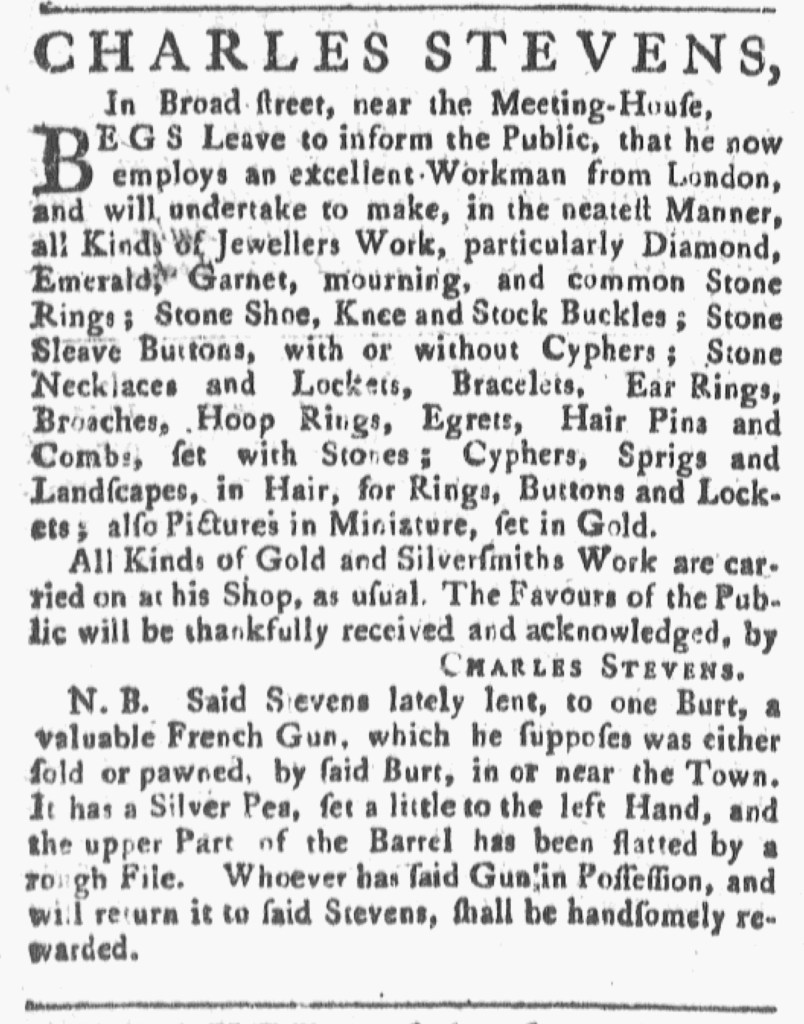
“He now employs an excellent Workman from London.”

Charles Stevens, a goldsmith and jeweler, occasionally advertised in the Providence Gazette in the late 1760s and early 1770s.  A new development in his workshop prompted each of his advertisements.  On September 24, 1768, for instance, Stevens advised the public, “particularly those who have hitherto kindly favoured him with their Custom,” that he moved to a new location “in the main Street of Providence, where he continues to carry on his Business, in all its various Branches, and engages to execute his Work in the best and most elegant Manner.”  The goldsmith and jeweler made the same appeals as other artisans, yet they appeared in the public prints only when Stevens wanted to make sure that former clients knew about his new location.  Similarly, when he “removed to BROAD-STREET” in the summer of 1771, Stevens placed an advertisement to inform the public, “particularly his old Customers,” that he “carries on his Business in all its Branches, as usual.”

The goldsmith and jeweler had other news to share two years later.  In July 1773, he placed an advertisement to announce that “he now employs an excellent Workman from London, and will undertake to make, in the neatest Manner, all Kinds of Jewellers Work.”  Artisans who placed newspaper advertisements rarely gave credit to employees and relations who labored in their workshops.  Those who did so usually emphasized one or more of three specific reasons.  Sometimes an employee or associate possessed expertise that the proprietor did not, expanding the offerings available at the shop.  Sometimes their connections to London or other cities suggested greater familiarity with current fashions and tastes as well as superior training in their craft.  Sometimes an additional employee testified to the popularity of a workshop, suggesting that the artisan who ran it required assistance to keep up with orders.  All three reasons may have applied to the “excellent Workman from London” who produced “all Kinds of Jewellers Work” in Stevens’s shop.  The proprietor noted, “All Kinds of Gold and Silversmith’s Work are carried on at his Shop, as usual.”  Stevens may have shifted his focus to that work, leaving jewelry orders to his new employee.  He had already established his reputation in Providence, accepting jobs “as usual,” yet the addition of an employee with specialized skills merited an advertisement to keep existing customers and the public aware of new developments that benefited his patrons.

July 8

What was advertised in a colonial American newspaper 250 years ago today?

Rivington’s New-York Gazetteer (July 8, 1773).

“He has obtained a certificate from the Queen’s Stay-Maker in London.”

Readers of Rivington’s New-York Gazetteer likely noticed the image that adorned John Burchett’s advertisement in the July 8, 1773, edition.  After all, it was the only image featured throughout the issue, with the exception of a woodcut depicting a ship at sea that appeared in the masthead.  Burchett, a “STAY and RIDING HABIT-MAKER” who kept shop “at the Sign of the Crown and Stays,” led his advertisement with a woodcut that replicated that sign.

Yet Burchett did not rely on the image alone to market his goods and services.  Instead, he incorporated other appeals in his efforts to convince prospective customers to purchase stays from him.  For instance, he invoked his origins and previous experience, describing himself as “From LONDON and PARIS.”  Like others in the garment trades, Burchett suggested to consumers that they would derive additional cachet from hiring someone with connections to such cosmopolitan cities.  Most tailors, milliners, and staymakers who migrated across the Atlantic could claim roots in only one of those capitals of fashion and gentility, yet Burchett asserted ties to both.  He especially emphasized the recognition he gained in London, informing prospective customers that “he has obtained a certificate form the Queen’s Stay-Maker in London.”

That testified to the taste and quality associated with stays made by Burchett.  For those concerned about price, he declared that he “has also a good number of ready made stays of the best quality, cheaper than can be imported.”  He even gave prices so prospective customers could assess the bargains for themselves without having to visit his shop.  In addition, he proposed a payment plan meant to encourage consumers to select him over his competitors.  The staymaker pledged that “any lady who shall employ him” could pay “half cash … and the rest in dry goods.”  That put him in a position to barter with female shopkeepers and the wives and daughters of merchants and shopkeepers.

Burchett did not merely announce that he made and sold stays and then hope that customers would visit his shop at the Sign of the Crown and Stays.  Instead, he deployed an image that corresponded to the sign associated with his business as an invitation to peruse a lively narrative that included a variety of marketing strategies.  He commented on fashion and price while emphasizing his experience working in London and Paris and alternatives to paying with cash or credit.  As a result of such attention to so many aspects of his business, prospective customers could trust that the staymaker would indeed “use all possible endeavours to merit their interest.”

June 12

What was advertised in a colonial American newspaper 250 years ago today?

Providence Gazette (June 13, 1773).

“MAKES in the newest Fashion, and in the neatest Manner, all Sorts of Men and Womens Saddles.”

In the summer of 1773, John Sebring, a “Saddler, Chaise and Harness-Maker, from London,” once again took to the pages of the Providence Gazette to promote his services.  As he had done in previous advertisements, he used only his last name as a headline for his notice, implying that readers should have been so familiar with his reputation that he did not need to give his full name.  In addition, he asserted that he already established a clientele in the city, expressing “his Thanks to all those who have obliged him with their Custom.”  Anyone in need of saddles and accessories who was not already familiar with the remarkable Sebring, the advertisement suggested, needed to learn more about the saddler from London and his wares.

To underscore that point, Sebring proclaimed that he “MAKES in the newest Fashion, and in the neatest Manner, all Sorts of Men and Womens Saddles … with every other Article in the Saddlery Way.”  In so doing, he deployed common marketing strategies.  He made an appeal to fashion, asserting his familiarity with the latest styles, as well as an appeal to quality and his own skill in producing “Saddles, Portmanteaus, Saddle Bags, Holsters, Half Covers, Velvet Jockey Caps, Leather Caps, Bridles,” and other accessories.  In a nota bene, he reiterated his knowledge of the current trends: “Ladies Hunting Side Saddles made in the newest Fashion.”  In each instance, his London origins bolstered those appeals, suggesting that he had access to the “newest Fashion” in the most cosmopolitan city in the empire and that he received superior training in his trade in that metropolis compared to local competitors.  His clients, however, did not have to pay a premium for those benefits.  Sebring declared that he set prices “on as low Terms as are sold in any Shop in Providence.”

Appropriately, the saddler ran his workshop “at the White Horse.”  He invited current and prospective customers to visit him there to take advantage of the many benefits he outlined in his advertisement, seeking to convince genteel gentlemen and ladies that he was in the best position of any saddlers in Providence to serve their needs.

April 4

What was advertised in a colonial American newspaper 250 years ago this week?

New-York Journal (April 1, 1773).

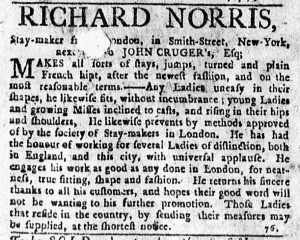
“Any Ladies uneasy in their shapes, he likewise fits, without incumbrance.”

Richard Norris billed himself as a “Stay-maker from London” even though he had resided and worked in New York for several years by the time he published his advertisement in the April 1, 1773, edition of the New-York Journal.  He considered his connection to the largest and most cosmopolitan city in the empire a selling point.  Norris informed readers that he previously served the best sorts of clients on both sides of the Atlantic, declaring that he “has had the honour of working for several Ladies of distinction, both in England, and this city.”  The quality of his stays (or corsets) and his skill in producing them yielded “universal applause” from his clients.

Although Norris had been in New York for some time, he also suggested that he maintained his connection to London.  For instance, he made stays “after the newest fashion” in that city.  In another advertisement, he described how he “acquires the first fashions of the court of London by a correspondent he has settled there.”  Furthermore, he adhered to “methods approved of by the society of Stay-makers in London” in designing and making his stays, especially those for “young Ladies and growing Misses inclined to casts, and rising in their hips and shoulders.”

Norris frequently coupled appeals to the latest fashions from London with attempts to make women feel anxious about their bodies.  “Any Ladies uneasy in their shapes, he likewise fits, without incumbrance,” the staymaker asserted in 1768 and reiterated in 1770 and 1773.  In return for helping them address purported physical shortcomings that he helped them to overcome (or at least disguise) with his stays, Norris asked his clients to recommend him to others.  He extended “his sincere thanks to all his customers, and hopes their good word will not be wanting to his further promotion.  Not unlike modern marketing for clothing and beauty products, Norris encouraged “young Ladies and growing Misses” to feel uncomfortable with their bodies, purchase his product to ease their anxieties, and reward him for his part in addressing a supposed shortcoming that he highlighted and did not allow them to overlook.

December 22

What was advertised in a colonial American newspaper 250 years ago today?

Connecticut Courant (December 22, 1772).

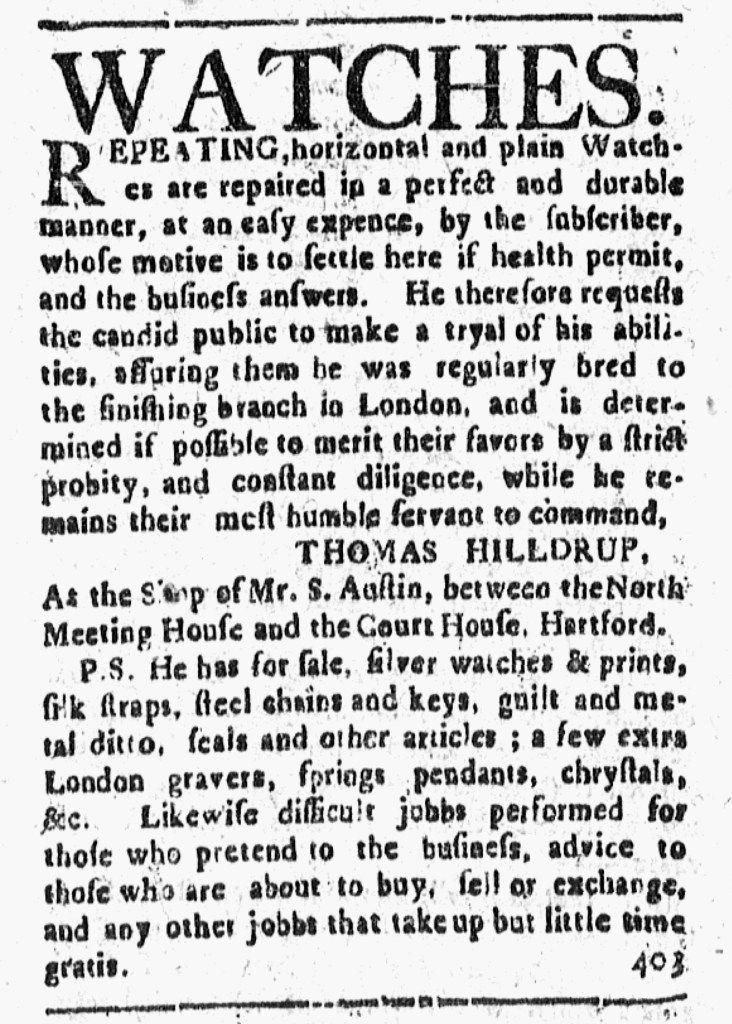
“WATCHES … Advice to those who are about to buy, sell or exchange.”

When Thomas Hilldrup arrived in Hartford in the fall of 1772, he commenced an advertising campaign in hopes to introduce himself to prospective customers who needed their watches repaired.  He first advertised in the September 15 edition of the Connecticut Courant.  That notice ran for three weeks.  On October 13, he published a slightly revised advertisement, one that appeared in every issue, except November 10, throughout the remainder of the year.  Although many advertisers ran notices for only three or four weeks, the standard minimum duration in the fee structures devised by printers, Hilldrup had good reason to repeat his advertisement for months.  He intended to remain in Hartford “if health permit[s], and the business answers.”  If he could not attract enough customers to make a living, then he would move on to another town.

Hoping to remain in Hartford, he asked prospective customers “to make a trial of his abilities” to see for themselves how well he repaired watches.  Satisfied customers would boost his reputation in the local market, but generating word-of-mouth recommendations would take some time.  For the moment, he relied on giving his credentials, a strategy often adopted by artisans, including watchmakers, who migrated from England.  Hilldrup asserted that he “was regularly bred” or trained “to the [watch] finishing branch in London.”  Accordingly, he had the skills “to merit [prospective customers’] favors” or business, aided by his “strict probity, and constant diligence.”  In addition, Hilldrup offered ancillary services in hopes of drawing customers into his shop.  He sold silver watches, steel chains, watch keys, and other merchandise.  He also provided “advice to those who are about to buy, sell or exchange” watches, giving expert guidance based on his professional experience.  Hilldrup concluded his advertisement with an offer that he likely hoped prospective customers would find too good to dismiss.  He stated that he did “any other jobbs that take up but little time gratis.”  Doing small jobs for free allowed the watchmaker to cultivate relationships with customers who might then feel inclined or even obligated to spend more money in his shop.

By running an advertisement with the headline “WATCHES” in a large font larger than the size of the title of the newspaper in the masthead, Hilldrup aimed to make his new enterprise visible to prospective customers in and near Hartford.  He included several standard appeals, such as promising low prices and noting his training in London, while also promoting ancillary services to convince readers to give him a chance.

November 28

What was advertised in a colonial American newspaper 250 years ago today?

Providence Gazette (November 28, 1772).

“He has had the Advantage of several Years Experience in some of the principal Shops in London.”

John Sebring, a “Saddler, Chaise and Harness Maker,” used solely his last name, “SEBRING,” as the headline for his advertisement that ran in the Providence Gazette in November 1772.  Occasionally advertisers deployed that strategy, perhaps intending to suggest to prospective customers that their reputations were already so well established that they did not need to give their full names.  That did not prevent Sebring from providing plenty of information about his business to refresh the memories of prospective customers who could not quite place him by last name alone.

The saddler listed all sorts of saddles and accoutrements that he made “in the newest Fashion” at his shop.  He also provided details about some of the specialized merchandise that he produced, including “Men and Womens Saddles on such a Construction, that if the Horse should throw his Rider, and the Foot should hang in the Stirrup, the Stirrup will leave the Saddle before the Horse takes three Steps.”  Sebring emphasized safety in marketing his saddles, indicating that his concern for his customers extended beyond the point of sale.

He also highlighted the experience he gained in London, using an appeal often made by artisans who migrated across the Atlantic.  In addition to introducing himself as “from London,” Sebring declared that he “has had the Advantage of several Years Experience in some of the principal Shops in London.”  Artisans often believed that such declarations served as testimonials to their skill and experience, pledging that they would deliver the same quality workmanship to prospective customers in their new towns as they did for former customers in the cosmopolitan center of the empire.  Sebring stated that he “hopes to merit the Approbation of all that may please to favour him with their Custom” by fulfilling their expectations for the saddles, harnesses, and other items he made and sold at his shop.

Sebring’s advertisement contained a lengthy list of his wares, a common element in newspaper advertisements of the era, but the saddler also incorporated elements intended to distinguish him for his competitors.  He used a flashy headline, emphasized his experience in “principal Shops” in London, and featured a saddle with detachable stirrups for the safety of his customers.  Any of those strategies could have piqued the interest of prospective customers, inciting them to visit the saddler’s shop to satisfy their curiosity.

November 22

What was advertised in a colonial American newspaper 250 years ago this week?

Maryland Gazette (November 19, 1772).

“They are well acquainted with the newest Fashions.”

When they settled in Annapolis, Jane Nelson and Anne Nelson took out an advertisement in the Maryland Gazette to introduce themselves to the community and encourage “Ladies … to favour them with their Commands” or orders for “all Kind of Milliners and Mantua-makers Work.”  As newcomers to the colony, they could not rely on their reputations to market their services.  Instead, they emphasized their connections to London, the cosmopolitan center of the empire, and their knowledge of current styles there.

In the deadline for their advertisement, the Nelsons proclaimed that they “Just arrived from LONDON.”  Artisans, tailors, milliners, and others often trumpeted that they were “from London” in their advertisements, sometimes long after they crossed the Atlantic.  The Nelsons made it clear that they only recently made that journey.  Accordingly, prospective clients could trust that they were indeed “well acquainted with the newest Fashions” and capable of making hats, cloaks, and other garments “in the most elegant and fashionable manner.”  Having recently come from London, the Nelsons could also provide guidance about “Ladies fashionable dress and undress Caps” and other items.

The Nelsons also aimed to convince prospective clients that they offered exemplary customer service.  They asserted that “Ladies … may depend on having their Work neatly done, and with the utmost Dispatch.”  If given a chance, the Nelsons assured those ladies that “they will not be disappointed in their Endeavours to please, as it shall be their constant Study and greatest Ambition.”  In addition to serving clients who visited them in Annapolis, the Nelsons also took “Orders from the Country,” pledging to punctually complete them.

These “Milliners and Mantua-makers” deployed a two-pronged approach to marketing their services upon arriving in Annapolis.  They promoted their connections to London, underscoring their familiarity with the latest tastes there, while simultaneously vowing to meet and exceed the expectations of their clients in terms of customer service.  The Nelsons hoped that combination of appeals would entice the ladies of Annapolis to engage their services.

November 13

What was advertised in a colonial American newspaper 250 years ago today?

Connecticut Journal (November 13, 1772).

“Will alter any Fault (if observed within Twelve Months) gratis.”

Like many other artisans who migrated across the Atlantic, Edward Hart, a “WIG-MAKER,” described himself as “Lately from London” when he introduced himself to prospective customers in a newspaper advertisement.  Realizing that readers were unfamiliar with him and his work, he sought to use his origins to suggest a certain level of skill and, especially, knowledge of current fashions in the cosmopolitan center of the empire to convince clients in Wallingford and nearby towns to give him a chance.  In an advertisement in the November 13, 1772, edition of the Connecticut Journal, he declared that he made “Lady’s Hair Rolls … in the best Manner.”  He also boasted that his customers would “be served with all Sorts of Wigs, made in the present Taste.”

Hart did not confine his marketing efforts to those appeals.  He also offered free repair services for a year, pledging that he would “alter any Fault (if observed within Twelve Months) gratis.”  Knowing that he could not yet depend on his reputation to sell his wigs, Hart likely hoped that providing that warranty would persuade prospective customers that they had nothing to lose when they purchased his wares.  If they discovered any defects, the wigmaker pledged to correct them without charge.  Customer service extended beyond the initial purchase, aiding Hart in cultivating a clientele in a new location.

At a glance, Hart’s advertisement may look like little more than a dense block of text to modern readers, but it was not a mere announcement that he made and sold wigs.  Instead, he advanced several appeals intended to entice consumers to acquire their wigs from him rather than other sources.  He promoted his origins in London, the quality of his work, and his knowledge of the latest trends.  In case that was not enough, he also provided a warranty to reassure customers still hesitant after his other marketing appeals.  Rather than inserting an announcement in the newspaper, Hart devised a strategy for attracting customers to his new shop.

October 14

What was advertised in a colonial American newspaper 250 years ago today?

Pennsylvania Journal (October 14, 1772).

“Having for some years operated for, and with the most proficient of the art, in the above-mentioned metropolis (of London).”

When William Johnson, a “GLOVER and BREECHES-MAKER,” arrived in Philadelphia in the fall of 1772, he placed advertisements in the Pennsylvania Journal to introduce himself to the community and invite prospective clients to visit the shop he opened on Front Street.  Like many other artisans who migrated across the Atlantic, Johnson emphasized his experience working in London, the cosmopolitan center of the empire.  Until he had time to establish his reputation in the local market, he depended on his connections to London to sell his services.  In the headline for his advertisements, he described himself as “lately arrived from LONDON.”  In the nota bene that concluded his notice, Johnson declared that he “hopes himself capable to give all possible satisfaction, with respect to the neatness of the fitting, and execution of the workmanship; having for some years operated for, and with the most proficient of the art, in the above-mentioned metropolis (of London).”  He opened and closed his advertisement with references to London.

Johnson also intended for the timing of his arrival to resonate with prospective clients.  Having “lately arrived from LONDON” suggested that he was familiar with the most recent styles in that “metropolis.”  His clients could depend on getting news and advice about current trends, helping them to keep up with new tastes on the other side of the Atlantic and perhaps stay ahead of friends and acquaintances in Philadelphia.  Some artisans continued to promote their connections to London long after they relocated to the colonies.  Johnson provided details that made it possible for prospective clients to determine for themselves that he did indeed recently arrive in the city and, by extension, his knowledge of fashions in London was as current as possible.  He reported that he “lately arrived from LONDON, by Capt. SPARKS.”  The “ship Mary and Elizabeth, J. Sparks from London” appeared among the “ARRIVALS” in the shipping news from the “Custom-House, Philadelphia,” in the September 30 edition of the Pennsylvania Journal.  When Johnson’s advertisement ran in the October 14 edition, he had been in the city for less than three weeks.  In addition, merchants, shopkeepers, and others also referenced the arrival of the ship in their advertisements.  Randle Mitchell, for instance, stated that he “Just imported” new merchandise “in the Elizabeth and Mary, Capt. Sparks, from London.”  Robert Bass, an apothecary, stocked new medicines “JUST IMPORTED in the Mary and Elizabeth, Capt. Sparks from London.”

As yet unknown to prospective clients in Philadelphia, Johnson attempted to leverage his experience in the “metropolis” of London to convince prospective clients to avail themselves of his services.  That experience garnered proficiency in his craft, including “the neatness of the firring, and the execution of the workmanship,” while also giving him access to current styles in the most fashionable city in the empire.  He included the name of the captain of the vessel that transported him across the Atlantic as a means of confirming that he possessed recent knowledge of the latest trends.