March 18

What was advertised in a colonial American newspaper 250 years ago today?

Connecticut Gazette (March 18, 1774).

Make Way! A Probationer for NEW GATE!

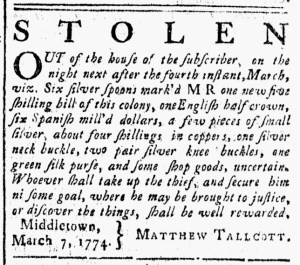
For Matthew Talcott, all was fine on the evening of March 4, 1774, but he woke up to discover a calamity the next morning.  Sometime during the night six silver spoons “marked M R,” “one silver neck buckle, two pair silver knee buckels,” quite a bit of cash, and “some shop goods, uncertain,” had been stolen from his shop in Middletown, Connecticut.  In response, Talcott turned to the public prints, running advertisements in hopes that someone “shall take up the thief, and secure him in some [jail], where he may be brought to justice.”  He also sought to recover the stolen items and money.  In addition to giving a reward, he invested in advertisements in three newspapers published in the colony.
Connecticut Journal (March 18, 1774).

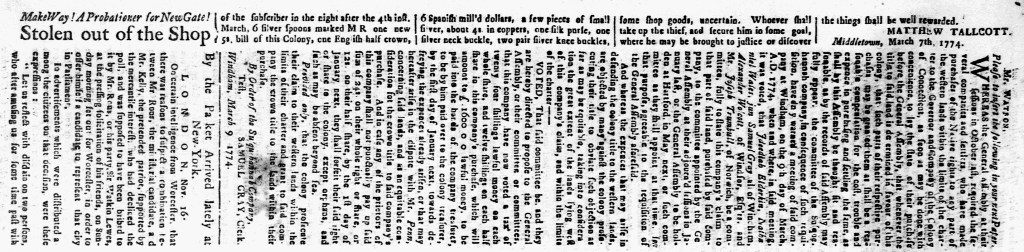
Talcott’s advertisement first appeared in the Connecticut Gazette, published in New London, and the Connecticut Journal and New-Haven Post-Boy on March 11.  In each instance, a headline alerted readers to the contents of the rest of the advertisement.  The Connecticut Journal used “STOLEN” as the headline, while the Connecticut Gazette featured a more playful one that may have attracted even more attention: “Make Way! A Probationer for NEW GATE!”  The colony had recently opened a prison in a copper mine converted for that purpose in East Granby.  Someone in the printing office, rather than Talcott, may have devised the headline.

What suggests that was the case?  The two advertisements featured some variations.  The one in the Connecticut Gazette indicated that the theft took place “out of the Shop” while the Connecticut Journal stated it occurred “OUT of the house” of the unfortunate Talcott.  He likely worked where he resided.  Some of the stolen goods also appeared in slightly different order.  Talcott likely wrote the copy once for one newspaper and then copied it for the other, but was not exact in the process.  The compositor for the Connecticut Journal then used the first word as the headline, a common practice.  The editor or the compositor for the Connecticut Gazette, on the other hand, may have spotted an opportunity for creativity.
Connecticut Courant (March 15, 1774).

Consider that Talcott’s advertisement next ran in the Connecticut Courant, published in Hartford, on March 15.  It featured the same copy, including the snappy headline, that appeared in the Connecticut Gazette.  It also appeared in the margin on the final page, suggesting that the printing office received the advertisement at the last moment.  Type had already been set for the rest of the issue, but the compositor found a way to include Talcott’s notice.  Rather than Talcott submitting his advertisement directly to the Connecticut Courant, he may have made arrangements with the printer of the Connecticut Gazette to instruct his counterpart in Hartford to publish it, marking it in the copy sent as part of an exchange network of printers throughout the colony and the region.

While not conclusive, the circumstances collectively suggest that Talcott wrote the original copy, the Connecticut Gazetteembellished it with a provocative headline, and the Connecticut Courant reprinted it.  Several people played a role in creating the advertisement ultimately distributed to readers throughout the colony.

January 26

What was advertised in a colonial American newspaper 250 years ago today?

Pennsylvania Journal (January 26, 1774).

“THOMAS & MARY GRIFFITH, Are removed from Christian-street, to … Sixth-street.”

When Thomas Griffith and Mary Griffith took the pages of the Pennsylvania Gazette at the end of January 1774, they incorporated the same headline they used in their advertisement the previous August.  They promoted their services “TO THE LADIES” of Philadelphia and nearby towns, Thomas his “FAN-MAKING business” and Mary cleaning various kinds of laces “to look like new.  The Griffiths had recently “removed from Christian-street” and now operated their businesses on Sixth Street, occasioning the new advertisement.

Despite deploying the same headline, this notice was shorter than the other one.  Perhaps the Griffiths felt that they had established their reputations in Philadelphia and did not need to provide as much information for a clientele that they wished to follow them to their new location as they had when they introduced themselves upon arriving in a new city.  Thomas had described himself as a “Fan-Maker from London, but last from Charlestown,” but did not do so in the new advertisement, nor did he go into any detail except to say that he “intends to continue the FAN-MAKING business in general.”  Similarly, Mary provided only a brief overview, but did not mention her “new method” for cleaning laces to entice prospective customers.  The Griffiths did “return thanks to the Ladies for the encouragement they received,” another suggestion that they had cultivated a clientele over the last six months.

The secondary headline for their new advertisement included both their names, “THOMAS & MARY GRIFFITH,” whereas Thomas’s name alone ran as the secondary headline in their other advertisement.  This time, Mary’s contribution to the household economy received the same visibility as Thomas’s “FAN-MAKING business,” though his enterprise still received top billing.  It may have been that publishing a shorter advertisement prompted this change, though the Griffiths may have also realized that Mary’s enterprise brought as many or more of “THE LADIES” to the shop in their house as the fans that Thomas made and sold.  Whatever convinced them to take a new approach, they apparently considered their previous newspaper advertisements effective enough to merit investing in a new advertisement when they moved to a new location.

September 8

What was advertised in a colonial American newspaper 250 years ago today?

Pennsylvania Journal (September 8, 1773).

“Given away GRATIS … ROBERT BELL’S SALE CATALOGUE of a COLLECTION of NEW AND OLD BOOKS.”

Robert Bell became one of the most prominent and influential American booksellers and publishers of the late eighteenth century, in part due to his flamboyant personality and flair for marketing.  He disseminated advertising in the same formats as other booksellers and publishers – newspaper notices, book catalogs, handbills, broadsides – yet introduced innovations intended to engage and entice consumers.

Such was the case in an advertisement that Bell placed in the September 8, 1773, edition of the Pennsylvania Journal.  If they included a headline at all (other than their names), most advertisers used a stark description of their wares, such as “BOOKS” or “PORT WINE.”  Bell, on the other hand, devised a headline that both described and addressed prospective customers: “The CURIOUS IN BOOKS.”  In other advertisements, his headlines addressed “THE SONS OF SCIENCE IN AMERICA” and “THE AMERICAN WORLD” and “those who possess a PUBLIC SPIRIT.”  In other advertisements, his headlines made dramatic pronouncements, such as “HISTORY” and “LITERATURE” and “XENOPHONTICK BANQUET.”  Bell often crafted a headline intended to distinguish his advertisements from others.

He invited “The CURIOUS” to note that “This Day is Published and given away GRATIS, to all who are pleased to call or send for it, ROBERT BELL’S SALE CATALOGUE Of a COLLECTION of NEW AND OLD BOOKS.”  Those who desired a copy had the option of visiting the shop or, for their convenience, Bell had catalogs delivered to those who requested them.  He emphasized the many choices available, declaring that the catalog listed “above FIFTEEN HUNDRED VOLUMES” and then further elaborating the selection included “a number of elegant and uncommon BOOKS, very scare and rarely to be met with.”  That was because many of them were secondhand books from “the LIBRARY of a Gentleman who lately left this Country.”  That meant customers had access to rare volumes not widely available in the colonial marketplace.  It also implied scarcity, just one copy of many of the books in the catalog, so prospective customers needed to purchase books that interested them quickly.

To encourage “The CURIOUS” to take action, Bell listed more than just the authors and titles of the books in his catalog.  Every entry included “the lowest Price fixed to each Book” so consumers could make their own assessments about whether they could afford the books and how much they valued them.  Presenting prospective customers with prices also helped them imagine completing transactions and adding books to their own libraries.  Although they had to pay for any purchases, Bell distributed the catalogs to “The CURIOUS” for free as a means of getting them started on those imaginative journeys that the bookseller hoped would culminate in sales.  Bell combined a lively advertisement and free catalog into an innovative marketing campaign that set him apart from most other booksellers of the period.

June 17

What was advertised in a colonial American newspaper 250 years ago today?

Rivington’s New-York Gazetteer (June 17, 1773).

“A Rogue!  A Rogue!  A Rogue!”

The headline set one advertisement apart from others that appeared in the June 17, 1773, edition of Rivington’s New-York Gazetteer.  Some of those others had headlines like “TO BE SOLD,” “IMPORTED,” “TO BE LETT,” or “WANTED.”  Many deployed the name of the advertiser as the headline, including “ABRAHAM DURYEE,” “ENNIS GRAHAM,” “THOMAS HAZARD,” and “JOSEPH PEARSALL.”  Even the printer used his own name, “JAMES RIVINGTON,” as the headline for his advertisement.  A few headlines provided more specific details, such as “DELAWARE LOTTERY,” “HORSEMANSHIP,” “INDIGO,” “THEATRE,” and “WATCHES.”

One distinctive advertisement paired two headlines, “FIVE POUNDS REWARD” and “A Rogue!  A Rogue!  A Rogue!” The first frequently appeared in advertisements describing and offering rewards for the capture and return of apprentices and indentured servants who ran away from their masters and enslaved people who liberated themselves from their enslavers.  In contrast, the repetition of “A Rogue!  A Rogue!  A Rogue!” set the advertisement apart from any of the others and likely demanded the attention of readers, inciting curiosity about what kind of offenses merited such a headline.

When they set about learning more, readers discovered that the rogue was an “atrocious villain, known by the name of Isaac Vanden Velden” who had recently “imposed on several persons in this city, with bills of exchange, which he has forged in the name of Mr. Paul Hogstraffer, of Albany.”  Even before those incidents, Vanden Velden had a reputation for misconduct in both Philadelphia and Albany, according to the advertisement, and sometimes “pretends to have large rights in land on the Mississippi.  The con artist “talks fast, and affects a good deal of propriety in his conversation,” so much so that he “has a very good address, and appears capable of executing any artful piece of fraud.”  Readers might detect Vander Velden, “a German,” from his speech; although he “speak good English,” he retained “a little of his own country accent.”

A nota bene indicated that the rogue was headed in the direction of Philadelphia.  Given the circulation of Rivington’s New-York Gazetteer well beyond the city, the advertiser hoped that readers put on alert about Vanden Velden would capture and “secure the above impostor in any of his Majesty’s jails, so that he may be brought to justice.”  In this instance, the advertisement with its extraordinary headline served as a public service announcement and a supplement to the news that ran elsewhere in the newspaper.

May 27

What was advertised in a colonial American newspaper 250 years ago today?

Supplement to the Massachusetts Gazette and Boston Weekly News-Letter (May 27, 1773).

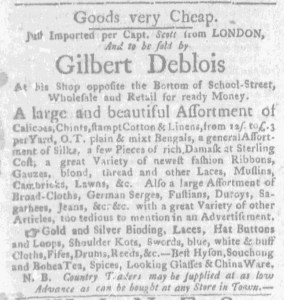
“Goods very Cheap.”

As May 1773 came to an end, Samuel Eliot and Thomas Walley continued publishing advertisements that included colorful commentary about their low prices.  In the supplement that accompanied the May 27 edition of the Massachusetts Gazette and Boston Weekly News-Letter, Eliot once again asserted that “Those who are acquainted with his Prices, will not need to be told that he sells at low Rates; those who are not, who will please to call on him, shall be satisfied he makes no idle Profession, when he engages to sell his Goods on the most similar terms.”  Elsewhere in the supplement, Walley expressed his exasperation with the elaborate stories that some of his competitors printed about how they “sell cheaper than cheap and lower than anybody else.”  Rather than publish tales with “little meaning,” he “rather chuses to inform his good Customers and others that he will sell at such Prices, as that both the Seller and Buyer may make a Profit.”

In contrast, Gilbert Deblois took a streamlined approach to promote the low prices he charged for a “large and beautiful Assortment” of textiles, accessories, housewares, tea, and a “great Variety of other Articles, too tedious to mention in an Advertisement.”  He deployed a headline that summarized his prices: “Good very cheap.”  He also inserted a nota bene to advise that “Country Traders may be supplied at as low Advance as can be bought at any Store in Town,” reinforcing the message in the headline.  In the standard issue, Herman Brimmer and Andrew Brimmer published an advertisement with a primary headline, “Variety of GOODS,” and a secondary headline, “Exceeding Cheap.”  The Brimmers listed dozens of items from among the “Assortment of English, India and Scotch GOODS” they recently imported, but they did not make additional remarks about the low prices of those items.  They relied on the secondary headline to market their prices.

Deblois and the Brimmers adopted a different approach than Eliot and Walley in their efforts to alert prospective customers to their low prices.  The former chose brevity, allowing short headlines to frame the remainder of their advertisements, while the latter offered narratives intended to engage and perhaps even entertain readers.  In both instances, the advertisers made price a defining factor in their newspaper notices.  They did not merely announce that they had goods for sale.  They presented a reason for consumers to select their shops over others.

May 15

What was advertised in a colonial American newspaper 250 years ago today?

Providence Gazette (May 15, 1773).

Once more!

The headline expressed some exasperation.  The partnership of Stewart and Taylor sought to settle their “Company Accounts, which was to have taken Place in November last,” but six months later they were placing an advertisement in the Providence Gazette to “Once more!” call on “all that are indebted to them to make immediate Payment.”  Merchants, shopkeepers, and others regularly ran newspaper notices for the same purpose.  John Carter, the printer of the Providence Gazette, inserted his own notice in the same issue that carried Stewart and Taylor’s advertisement, though it was brief in comparison.  Carter declared, “ALL Persons indebted for this Gazette one Year, or more, are requested to make immediate Payment.”

Along with the headline intended to attract attention, Stewart and Taylor provided details about the consequences for not complying with their final notice.  They wished to settle accounts quickly, “otherwise they will be necessitated to sue [at the] June Court.”  The partners hoped that such threats would prompt “all Delinquents [to] come and make Payment, to prevent a Method being taken that will be very disagreeable.”  Although not all advertisements placed for the purpose of settling accounts included allusions to legal action, enough did so that readers recognized the tactic for leveraging the “Delinquents.”  Relatively few, however, included such a headline.  The “Once more!” likely communicated to those “Delinquents” that Stewart and Taylor meant business.

Among those who devised headlines, most advertisers used their names, including Jabez Bowen, Nicholas Brown and Company, Polly Chace, Nathaniel Green, Jonathan Russell, Thurber and Cahoon, John Updike, Joseph West, and Samuel Young.  Joseph Russell and William Russell deployed their names as a secondary headline that followed the primary headline that promoted “WEST-INDIA RUM.”  In his advertisement about an indentured servant who absconded, Samuel Jefferys used “Eight Dollars Reward” as the headline.  That made “Once more!” unique among the headlines featured in advertisements in the May 15, 1773, edition of the Providence Gazette.  Stewart and Taylor shrewdly invoked a phrase intended to arouse curiosity and capture the attention of the “Delinquents” who had not yet settled accounts.

March 19

What was advertised in a colonial American newspaper 250 years ago today?

New-Hampshire Gazette (March 19, 1773).

“Gentlemen in the Country … may depend upon Care being taken in the Packing of the WARE.”

Half a dozen women and two men advertised garden seeds in newspapers published in Boston in the middle of March 1773.  In the week from the 13th through the 19th, Elizabeth Clark and Nowell, Lydia Dyar, Elizabeth Greenleaf, Anna Johnson, Susanna Renken, Rebeckah Walker, John Adams, and Ebenezer Oliver each placed notices in at least one newspaper.  Greenleaf and Renken ran advertisements in all five newspapers in Boston.  Elsewhere in New England, other entrepreneurs inserted similar notices in other newspapers.  Walter Price Bartlett advised residents of Salem and nearby towns that he sold seeds in an advertisement in the Essex Gazette.  In Connecticut, Nathan Beers promoted garden seeds in Connecticut Journal and New-Haven Post-Boy.  In Rhode Island, Charles Dunbar advertised seeds in the Newport Mercury and James Green did the same in the Providence Gazette.

The New-Hampshire Gazette also carried an advertisement for seeds, but not one placed by a local vendor.  Instead, John Adams extended his advertising campaign beyond the Boston Evening-Post, Boston-Gazette, and Massachusetts Gazette and Boston Weekly News-Letter in an effort to capture the market in the neighboring colony.  His advertisement in the New-Hampshire Gazette included a feature that helped distinguish it from those placed by his female competitors in the public prints in Boston, a headline that proclaimed “GARDEN SEEDS” in capital letters.  For some reason, both Adams and Oliver deployed such headlines, but women who sold seeds in Boston did not.  The headline increased the visibility of Adams’s advertisement in the New-Hampshire Gazette and likely had other benefits since Adams did not enjoy the same name recognition in Portsmouth as in Boston.

His advertisement included another feature that not only distinguished it from those of his female competitors in Boston but also engaged prospective customers beyond the city.  Adams included a note addressed to “Gentlemen in the Country” at the end of his notice, assuring those “that will please to favour him with their Custom” that they “may depend upon Care being taken in the Packing of the WARE.”  In addition, he promised that those customers “shall be supplied as cheap as can be bought in Boston.”  Adams asserted that he would not be undersold by any of his competitors.

In writing the copy, Adams devised an advertisement appropriate for multiple markets.  The headline enhanced its visibility when it appeared alongside notices placed by competitors in Boston’s newspapers.  That same headline provided a quick summary to prospective customers beyond Boston who were less familiar with his business, whether they encountered his advertisement in a newspaper published in Boston or in the New-Hampshire Gazette.  The note about carefully packaging any orders shipped outside the city addressed potential concerns among readers “in the Country” in both Massachusetts and New Hampshire.  Adams thought ambitiously about the markets he could serve and crafted an advertisement with distinguishing features to achieve those ambitions.

November 10

What was advertised in a colonial American newspaper 250 years ago today?

Essex Gazette (November 10, 1772).

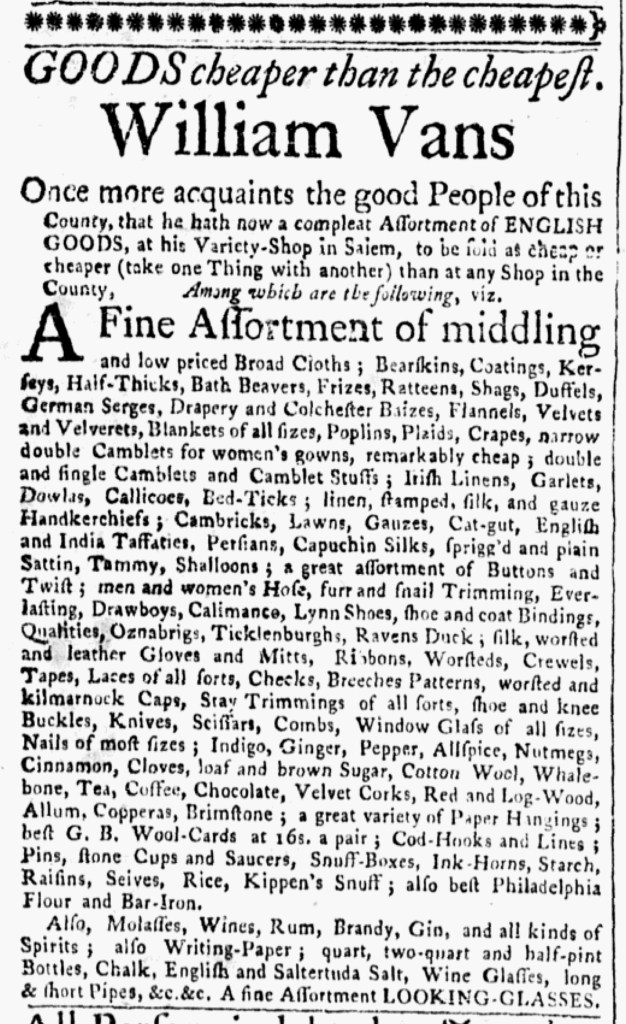
GOODS cheaper than the cheapest.”

William Vans ran a “Variety-Shop” in Salem in the early 1770s.  To incite interest in his wares, he regularly advertised in the Essex Gazette.  He often mentioned his low prices, comparing them to what consumers could expect to pay for the same merchandise in other shops.  For instance, in May 1771 he proclaimed that he sold his wares “as cheap as any Store in Town.”  Eighteen months later, he enhanced a similar appeal to price with a headline that made his marketing pitch.  “GOODS cheaper than the cheapest” appeared at the top of his advertisement in the November 10, 1772, edition of the Essex Gazette.  Vans intended the meaning of “cheap” as understood in the eighteenth century, promoting inexpensive wares without suggesting that low prices indicated inferior quality.  In the introduction to his extensive inventory, Vans declared that he set prices “as cheap or cheaper … than at any Shop in the County,” deciding to give his assertion more weight by expanding it beyond “any Store in Town.”

That Vans devised a headline with a marketing message distinguished his advertisement from others in the same issue.  William Scott advertised the “Essence of Pearl, and Pearl Dentifrice,” the toothpaste created by Jacob Hemet, “DENTIST to her Majesty, the Princess Amelia,” that he sold at his shop.  A headline that advised the product was “For the TEETH and GUMS” appeared at the beginning of the advertisement, but it did not make an explicit marketing appeal like Vans’s headline.  Most merchants and shopkeepers used their names, printed in larger font, as headlines.  Such was the case for John Appleton, “John & Andw. Cabot,” George Deblois, John Dyson, Samuel Flagg, Stephen Higginson, John Prince, and others.  Van’s name received similar treatment, but below the “GOODS cheaper than the cheapest” headline.  Some of those merchants and shopkeepers did make appeals to price in the introductions that came before their lists of merchandise.  Deblois, for instance, declared that “he will sell as cheap as is sold in any Shop or Store in Town, and as low as is sold in Boston, or elsewhere.”  John Appleton stated that “he is determined to sell at such very low Rates … as cannot fail to give full Satisfaction to every reasonable Purchaser.”  Those advertisers made appeals to price, but prospective customers encountered them only after wading into those notices.  Consumers did not have to read the smaller print in Vans’s advertisement to know that he claimed to sell “GOODS cheaper than the cheapest.”  In this instance, the format certainly enhanced the message.

August 25

What was advertised in a colonial American newspaper 250 years ago today?

Connecticut Courant (August 25, 1772).

“WINES.”

William Ellery stocked a variety of wares, but emphasized “WINES” in his advertisement in the August 25, 1772, edition of the Connecticut Courant.  Many purveyors of goods and services used their names as the sole or primary headline in their newspaper advertisements, but Ellery opted to open his advertisement with a segment of his merchandise that he thought would attract attention.  The headline, “WINES,” appeared in a large font, followed by a list of “CHOICE Old Madeira, Claret, Teneriff and Mountain, Malaga WINES.”  Only after that preview did Ellery give his name and location as a secondary headline before providing a more extensive account of beer, spirits, and groceries.  In contrast, an advertisement in the next column featured a more familiar headline, “Imported from LONDON, and to be sold by Stephen Mears, Opposite the North Meeting House in Hartford,” with “Stephen Mears” centered and in a larger font.

Ellery used graphic design to his advantage elsewhere in his advertisement as well.  The “N.B.” that marked the nota bene that followed his list of merchandise appeared in an even larger font than “WINES,” as did the “M” in “MR. ELLERY.”  Even if readers skimmed over “Bristol Beer, and Dorchester Ale, by the Cask, or Dozen Bottles” and “Coffee by the Bag or single Pound,” the large letters guided them to a message from the merchant.  He expressed “his Thanks to those People who have heretofore favour’d him with their Custom” and invited them to continue to “favour him with their Custom.”  Ellery deployed two of the most popular marketing appeals of the period, choice and price, proclaiming that he “his Shop is fuller sorted than ever, as he has just received a large Supply of the above Articles, and flatters himself he cans sell so low as to give intire satisfaction” to his customers.  In contrast, other advertisers tended to position such notes below the headline and above the list of goods.  Once again, Ellery adopted a format that distinguished his advertisement from others.

Ellery’s notice consisted entirely of text, as did all of the advertisements in most issues of the Connecticut Courant.  That did not mean, however, that every advertisement looked the same.  Some advertisers did rely on standard formats, but others sought to engage readers by presenting familiar messages in less familiar formats.  The design of Ellery’s advertisement challenged prospective customers to look more closely at his merchandise and the assertions he made about low prices and extensive choices.

March 13

What was advertised in a colonial American newspaper 250 years ago today?

New-Hampshire Gazette (March 13, 1772).

Choice Bohea TEA.”

When Stephen Hardy, a tailor, placed an advertisement in the March 13, 1772, edition of the New-Hampshire Gazette, his name served as the headline.  Such was the case in many advertisements for consumer goods and services in newspapers published throughout the colonies.  The names of the purveyors appeared first or appeared in larger font than the goods and services offered for sale or both.  As a result, colonizers skimming advertisements encountered a litany of names of merchants, shopkeepers, and artisans rather than products.

On occasion, however, headlines for advertisements did identify products.  In that same issue of the New-Hampshire Gazette, one advertisement promoted “Choice Bohea TEA TO BE SOLD BY DANIEL PEIRCE, junr.”  The body of the advertisement listed other items for sale as well, but the headline, “Choice Bohea TEA,” appeared in the same size font as “Stephen Hardy” elsewhere on the page, making those two headlines the most noticeable content on the page.  Although Peirce’s name ran in all capital letters, the font size did not distinguish it from the rest of the content of his advertisement.  Indeed, the decision to also print “ENGLISH, & WEST INDIA GOODS,” “GROCERIES, NAILS, GLASS,” “PEPPER,” “GINGER,” and “SHOES” in all capital letters of the same size as “DANIEL PEIRCE” made it harder to spot the name of the advertiser.  “Choice Bohea TEA” was the focal point of Peirce’s advertisement, just as “Stephen Hardy” was the focal point of the tailor’s advertisement.

Other advertisements deployed a similar strategy.  Gilliam Butler’s advertisement for “ENGLISH and WEST INDIA GOODS” also used “Choice Bohea TEA” in a larger font as its headline.  Peter Pearse’s advertisement promoted “Shushong, Hyson, Congo, and Bohea TEA,” with “Sushong, Hyson” in a larger font, occupying the first line, and operating as an abbreviated headline.  Neal McIntire’s advertisement had a similar structure: “Tar, Pitch” led a list of commodities for sale, appeared in a larger font on the first line, and displaced the seller’s name as a headline.  In an advertisement for textiles, “Russia Duck” instead of “THOMAS MARTIN” served as the headline.

Why did so many advertisements in that issue deviate from using the name of the advertiser as the headline?  Did purveyors of goods and services who placed notices in the New-Hampshire Gazette adopt different standards for writing copy than advertisers in other towns?  That may have been the case, especially if they consulted advertisements that previously ran in the New-Hampshire Gazette when writing their own notices.  The printers, Daniel Fowle and Robert Fowle, may have also played a role.  On occasion, printers noted that they aided in composing advertisements.  Perhaps Peirce, Butler, Pearse, McIntire, and Martin received advice from the Fowles, encouragement to place their products first and their names later in their advertisements.  Whatever the explanation, the advertising pages of the New-Hampshire Gazette often had a distinctive look in the early 1770s because the headlines name products instead of purveyors.