January 22

What was advertised in a revolutionary American newspaper 250 years ago today?
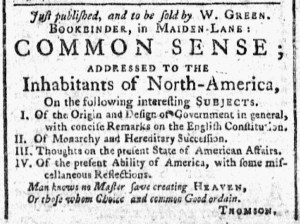
New-York Gazette and Weekly Mercury (January 22, 1776).

To be sold by W. GREEN … COMMON SENSE.”

Just days after an advertisement for Thomas Paine’s Common Sense made its first appearance in a newspaper beyond those published in Philadelphia, a second advertisement appeared in yet another newspaper.  The Constitutional Gazettecarried that first advertisement on January 20, 1776.  A variation ran in the New-York Gazette and Weekly Mercury on January 22.

Both advertisements included the title of the political pamphlet, “COMMON SENSE,” though the version in the Constitutional Gazette indicated that it was “ADDRESS TO THE INHABITANTS OF AMERICA” while the one in the New-York Gazette and Weekly Mercury instead stated that it was “ADDRESSED TO THE Inhabitants of North-America.”  Both listed the “interesting SUBJECTS” contained within the pamphlet, offering four section headings that included “Of the Origin and Design of Government in general, with concise Remarks on the English Constitution” and “Thoughts on the present State of American Affairs.”  Both concluded with an epigraph from James Thomson’s poem, “Liberty” (1734): “Man knows no Master save creating HEAVEN, / Or those whom Choice and common Good ordain.”  Those lines previewed the arguments readers would encounter in the pamphlet.  These advertisements in newspapers printed in New York replicated those previously published in newspapers in Philadelphia.

The new advertisement in the New-York Gazette and Weekly Mercury did have one significant difference from the earlier advertisements.  It did not include the name of the publisher of the first edition, Robert Bell.  The introduction to the version in the Constitutional Gazette did mention the prominent printer and bookseller, advising readers that “ROBERT BELL, in Third-Street, Philadelphia,” sold the pamphlet and then also listing William Green, a “Bookseller, in Maiden Lane, New-York,” as a local purveyor of Common Sense.  The version in the New-York Gazette and Weekly Mercury, however, eliminated Bell and named Green as the sole vendor of the pamphlet: “Just published, and to be sold by W. GREEN.  BOOKBINDER, in MAIDEN-LANE.”  Eighteenth-century readers knew to separate the phrases “Just published” and “to be sold by.”  Only the latter referred to Green’s role in the production and distribution of the pamphlet.  The phrase “Just published” merely meant “now available.”  Green did not print Common Sense, but when he submitted copy for his advertisement to the New-York Gazette and Weekly Mercury’s printing office he privileged his role in making the incendiary new pamphlet available in that city.  As the pamphlet gained popularity, John Anderson, the printer of the Constitutional Gazette, published and advertised a local edition (and a second local edition), but for a short time Green was the only retailer in New York hawking the pamphlet in the public prints.  His marketing efforts contributed to the stir caused by Paine’s appeal to declare independence rather than continue to seek a redress of grievances within the imperial system.
January 20

What was advertised in a revolutionary American newspaper 250 years ago today?

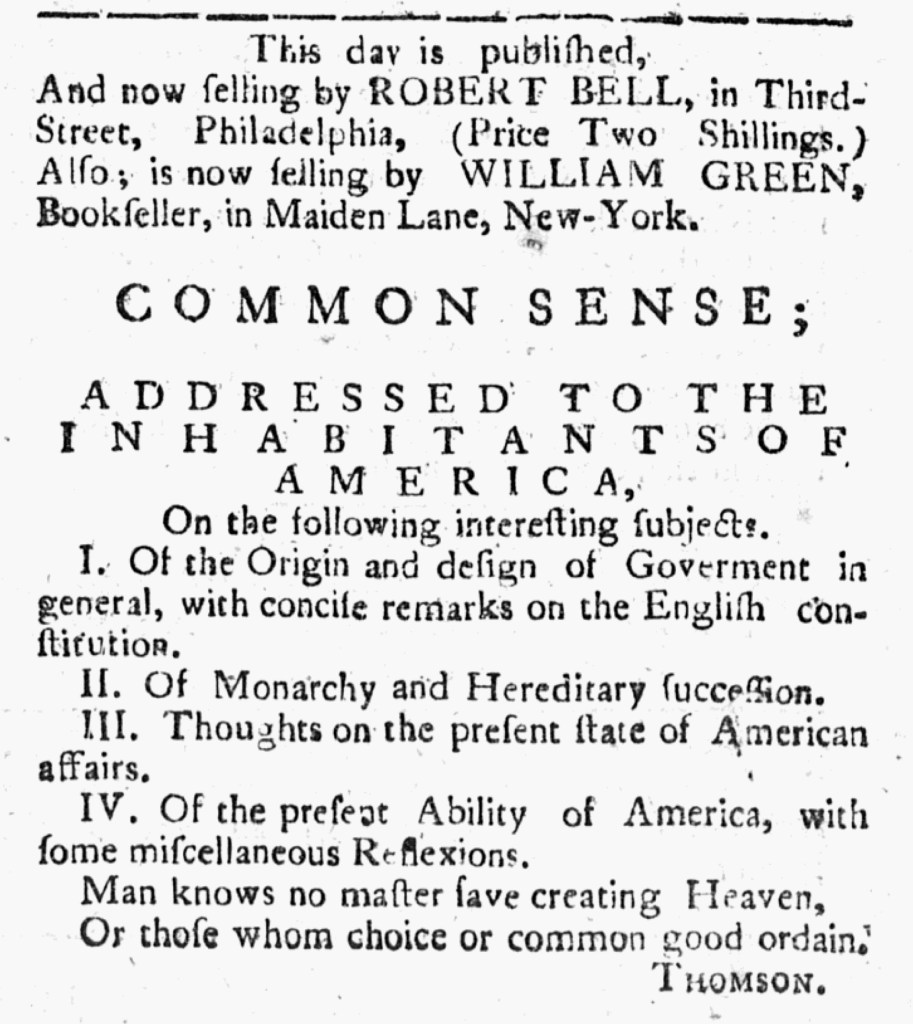
Constitutional Gazette (January 20, 1776).

“Now selling by WILLIAM GREEN, Bookseller, in Maiden Lane, New-York.  COMMON SENSE.”

Just eleven days after the first newspaper advertisement for Thomas Paine’s Common Sense appeared in the January 9, 1776, edition of the Pennsylvania Evening Post, the first advertisement for the inflammatory political pamphlet ran in a newspaper outside of Philadelphia.  Within a week, Robert Bell, the publisher of the first edition, inserted advertisements in all six newspapers printed in Philadelphia, including Henrich Millers Pennsylvanischer Staatsbote.  One of the most savvy and influential American printers and booksellers of the eighteenth century, Bell quickly dispatched copies of the pamphlet to New York.  On January 20, the Constitutional Gazette carried an advertisement that nearly replicated those in Philadelphia’s newspapers.

That notice announced the publication of the pamphlet and stated that it was “now selling by ROBERT BELL, in Third-Street, Philadelphia” for two shillings per copy.  Yet prospective customers did not need to send to Philadelphia to acquire copies because the pamphlet was “now selling by WILLIAM GREEN, Bookseller, in Maiden Lane, New-York.”  Like the other advertisements, the notice in the Constitutional Gazette did not identify Paine as the author.  It gave the title of the work, “COMMON SENSE; ADDRESSED TO THE INHABITANTS OF AMERICA,” and listed the various headings for the sections of the pamphlet.  Readers may have already heard about a new pamphlet that took Philadelphia by storm and some of the arguments for declaring independence that it contained, yet such an outline likely told them more than they already knew and whetted their appetites for more.  What did the pamphlet say about “Monarchy and Hereditary succession”?  What kinds of “Thoughts on the present state of American affairs” did it contain?  What did the author think of “the present Ability of America” in its contest against Great Britain?  Even before they saw anything in print, most residents of New York probably first learned about Common Sense via word of mouth.  The advertisement in the Constitutional Gazette offered readers an opportunity to move beyond excited conversations about what they heard the pamphlet said about monarchy, government, and the prospects for declaring independence to obtaining their own copies and reading the treatise for themselves.  It did not take long for advertisements for Common Sense to move beyond Philadelphia’s newspapers to the Constitutional Gazette in New York and other newspapers in other cities and towns.

January 4

What was advertised in a revolutionary American newspaper 250 years ago today?

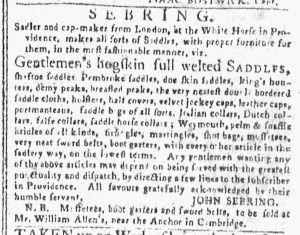
New-England Chronicle (January 4-11, 1776).

“SEBRING, Sadler and cap-maker from London, at the White Horse in Providence.”

After migrating to the colonies from England in the early 1770s, John Sebring occasionally placed advertisements in the Providence Gazette, offering his services as a “Saddler, Chaise and Harness Maker.”  Though he remained in Providence at the beginning of the Revolutionary War, he saw an opportunity to advertise in the New-England Chronicle, printed in Cambridge, in January 1776.  As the siege of Boston continued, he introduced himself to readers as a “Sadler and cap-maker from London.”  Even though it had been more than three years since he left the largest and most cosmopolitan city in the British Empire, he continued to stress his connection to it.  Prospective customers, after all, associated both skill and taste with artisans who had trained in London or gained experience working there.  Sebring also deployed one of the signature elements of his advertisements, using solely his surname rather than his full name as the headline.  That initial proclamation, the mononym “SEBRING,” suggested celebrity and an established reputation.

In this advertisement, Sebring declared that he “Makes all sorts of Saddles, with proper furniture for them, in the most fashionable manner.”  Practical was good, but stylish was even better!  He listed a variety of items that he made “at the White Horse in Providence,” the location featured in his newspaper notices since he first began advertising, and then advised that “Any gentleman wanting any of the above articles may depend on being served with the greatest punctuality and dispatch, by directing a few lines” to him.  Sebring had previously confined his advertisements to the Providence Gazette, but he apparently believed that the disruptions of the war opened new markets to him.  American officers and soldiers gathered in Cambridge and nearby towns, many of them dispatched from distant places.  As they would have been unfamiliar with local artisans, Sebring presented his workshop to supply saddles and other equipment via a mail order system.  In a nota bene at the conclusion of the advertisement, he offered a chance to examine some of his wares before placing orders for customized items.  “Mussetees [or musette bags, lightweight knapsacks used by soldiers], boot garters and sword belts,” Sebring stated, “to be sold at Mr. William Allen’s, near the Anchor in Cambridge.”  Sebring apparently recruited a local agent to help him break into a new market.

**********

Clarification:  Readers of the New-England Chronicle did not encounter this advertisement in the issue distributed on January 4, 1776.  It should not have been the featured advertisement on January 4, 2026.  Here’s how the mistake happened.

The format for the date in the masthead of some colonial newspapers confuses modern readers.  That’s because some newspapers published weekly did not state only the date on which the newspaper was published but instead indicated the week that it covered.  The New-England Chronicle was one of those newspapers.  Rather than giving “January 4, 1776” as the date, the masthead for that issue stated, “From THURSDAY, Decem. 28, 1775, to THURSDAY, January 4, 1776.”  For the issue published on January 11, the masthead stated, “From THURSDAY, January 4, to THURSDAY, January 11, 1776.”

While America’s Historical Newspapers associates the correct publication date with the issues of the vast majority of newspapers in the database, a couple newspapers use the date for the beginning of the week rather than the publication date.  When an undergraduate research assistant downloaded digital copies of all American newspapers published in 1776, I neglected to warn him that was the case for the New-England Chronicle.  I compounded the error by not looking at the masthead closely enough when I consulted the issue for January 4-11 to select an advertisement to feature on January 4.  I only noticed the problem after publishing the entry.

Since advertisements for consumer goods and services typically ran for multiple weeks, I hoped that Sebring’s advertisement also appeared in the December 28 – January 4 issue.  If that had been the case, I would have simply cropped the image from that issue and substituted it in this entry.  However, Sebring’s notice made its first appearance in the January 4-11 issue.

I decided that the next best solution was updating the date in the citation that accompanies the image of Sebring’s advertisement and adding this clarification.  It provides insight into the process of conducting research with digitized sources … and a warning about the importance of attention to detail.  I have more than a decade of experience working with digitized eighteenth-century newspapers.  I initially saw what I expected to see, not what was actually there, and only discovered the error when I took a closer look at the newspapers as I continued production of this project.  Fortunately, I caught the error quickly and updated the filenames for the downloaded newspapers accordingly.  In addition to this clarification, I am also making small adjustments to the Slavery Adverts 250 Project to adhere to the dates advertisements about enslaved people were published in the New-England Chronicle.

November 30

What was advertised in a revolutionary American newspaper 250 years ago today?

New-York Journal (November 30, 1775).

“A neat Mezzotinto Print of the Hon. JOHN HANCOCK, Esq.”

Richard Sause, a cutler in New York, became a purveyor of patriotic memorabilia during the Revolutionary War.  In October 1775, he advertised “ROMAN’s MAP OF BOSTON,” billing it as “one of the most correct that has ever been published.”  He described the cartographer, Bernard Romans, as “the most skilful Draughtsman in all America,” noting that he earned credibility because he “was on the spot at the engagements of Lexington and Bunker’s-Hill.”  Nicholas Brooks, a shopkeeper who specialized in prints, and Romans collaborated on the project in Philadelphia.  Sause acted as a local agent for marketing and distributing the map in New York.

That was not the only item commemorating current events that Sause advertised and sold.  At the end of November 1775, he took to the pages of the New-York Journal once again, informing the public that he sold a “neat Mezzotinto Print of the Hon. JOHN HANCOCK, Esq.”  The print depicting the merchant from Boston who served as president of the Second Continental Congress was another one of Brooks’s projects.  In addition, Sause also stocked “a view of the BATTLE at Charlestown” and “an accurate Map of the Present Seat of Civil War, taken by an able Draftsman.”  Sause seemingly worked closely with Brooks in acquiring the various prints and marketing them to patriots in New York, perhaps even providing him with advertising copy to adapt for his own notices.  The prints that Sause offered for sale appeared in the same order in his advertisement in the New-York Journal that they did in Brooks’s advertisement in Pennsylvania Journal.  Brooks may have sent a clipping along with the prints that he dispatched to the cutler in New York.

Although Sause had established himself as a cutler who also sold hardware and jewelry in a series of advertisements in New York’s newspapers, his activities in the marketplace in 1775 emphasized his commitment to the American cause.  Before he began selling prints, he promoted “SMALL SWORDS” to gentlemen who anticipated participating in the defense of their liberties and their city.  Even though he continued to advertise an “assortment of Jewellery, Cutlery, Hardware, and Haberdashery,” he made items related to the conflict with Parliament and British troops quartered in the colonies the focal point of his advertisements.

November 13

What was advertised in a revolutionary American newspaper 250 years ago today?

Norwich Packet (November 13, 1775).

“Wanted, a Quantity of Hog’s Bristles [from] Friends to American Manufactures.”

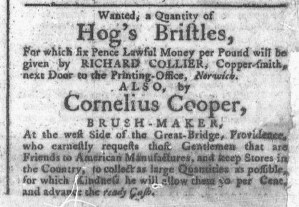
Cornelius Cooper, a brushmaker who had relocated from Philadelphia to Providence, needed materials to continue operating his business in the fall of 1775.  He ran an advertisement to that effect in the Providence Gazette, but his efforts did not end there.  He also enlisted the help of Richard Collier, a coppersmith, in Norwich, Connecticut.  An advertisement in the November 13, 1775, edition of the Norwich Packet proclaimed, “Wanted, a Quantity of Hog’s Bristles, For which six Pence Lawful Money per Pound will be given.”  The notice listed Collier as the local agent who collected the bristles and paid the premium, yet it did not end there.

Instead, it also advised that “Cornelius Cooper,” his name in a font as large as “Hog’s Bristles,” offered the same price.  After giving directions to his shop on “the west Side of the Great-Bridge, Providence,” the “BRUSH-MAKER” declared that he “earnestly requests those Gentlemen that are Friends to American Manufactures, and keep Stores in the Country, to collect as large Quantities as possible.”  In his advertisement that simultaneously ran in the Providence Gazette, he indicated that he wished to acquire “Five Thousand Weight of Hog’s Bristles,” a considerable quantity.  In making an appeal to “Friends to American Manufactures,” he invoked the Continental Association and efforts to replace goods imported from England with items produced in the colonies.  That became more important than ever after the battles at Lexington and Concord.  Decisions in the marketplace, including collecting hog’s bristles and purchasing brushes made from them, had political implications.  Collier supported the cause by serving as a local agent for Cooper; the brushmaker presented an opportunity for others to do the same, especially shopkeepers in the countryside who collected bristles from their patrons.  In return for that “Kindness,” Cooper not only paid “ready Cash” but also “allow[ed] them 30 per Cent.”  It seems that he offered a discount to retailers who collected bristles if they purchased his brushes to stock in their stores.  That strategy meant acquiring supplies and making sales at the same time, a neat arrangement for a brushmaker seeking to establish himself in New England.

October 16

What was advertised in a revolutionary American newspaper 250 years ago today?

New-York Journal (October 16, 1775).

“THIS Map of Boston, &c. is one of the most correct that has ever been published.”

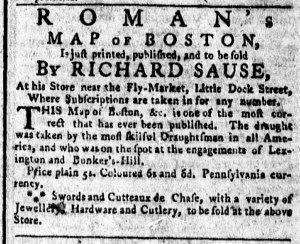
Richard Sause, a cutler in New York, became a local agent in that city when Nicholas Brooks and Bernard Romans collaborated on a map of Boston.  Brooks, a shopkeeper in Philadelphia, described himself as “the printer of said Maps” in newspaper advertisements, though he likely meant that he was the publisher who collaborated with Romans, a noted cartographer.  Sause had not been among the original list of local agents in an advertisement that appeared in Rivington’s New-York Gazetteer in August 1775, nor had he been on the list on a broadside subscription proposal that circulated in the summer and fall.  When Brooks and Romans launched a second project, “An Exact VIEW of the late BATTLE at CHARLESTOWN,” the subscription proposal in the Pennsylvania Ledger included “Mr. Richard Sause in New-York” among the local agents.  Brooks and Romans apparently supplied him with copies of the map as well as the print depicting what is now known as the Battle of Bunker Hill.

Sause, a frequent advertiser, was already familiar to consumers in New York.  A woodcut depicting various kinds of cutlery available at his “Jewlery, Hardware, and Cutlery Store” often adorned his advertisements in newspapers printed in that city.  In the summer and fall of 1775, he emphasized “SMALL SWORDS” in his advertisements.  Following the outbreak of hostilities at Lexington and Concord in April, residents of New York and other towns did not know what to expect.  Many prepared to defend their liberties should the British turn their attention to them.  Sause made sure that Patriots in New York knew that he could supply them with various kinds of small swords.  He even made a pitch for those items at the end of his advertisement for Romans’s map of Boston: “Swords and Cutteaux de Chase [a short sword], with a variety of Jewellery, Hardware and Cutlery, to be sold at the above Store.”

Yet the “MAP OF BOSTON” was the main attraction in that advertisement.  In addition to the headline in capital letters, Sause’s notice billed the map as “one of the most correct that has ever been published.”  To help make sales, he emphasized that the “draught [draft] was taken by the most skilful Draughtsman in all America.”  Buyers could depend on its accuracy because Romans “was on the spot at the engagements of Lexington and Bunker’s-Hill.”  Current events certainly played a role in Sause expanding his business to incorporate a new revenue stream, yet marketing and selling both Brooks and Romans’s map of Boston and prints depicting the Battle of Bunker Hill also gave him an opportunity to participate in politics via the marketplace.

December 18

What was advertised in a colonial American newspaper 250 years ago today?

New-Hampshire Gazette (December 18, 1772).

“PROPOSALS for Re-printing by Subscription, ENGLISH LIBERTIES.”

In the first week of November in 1772, John Carter, printer of the Providence Gazette, issued a proposal for “Re-printing by Subscription, ENGLISH LIBERTIES, OR, The free-born Subject’s INHERITANCE,” a volume “Compiled first by HENRY CARE, and continued with large Additions, by WILLIAM NELSON, of the Middle Temple, Esq.”  The contents of the book included the “Magna Charta, or the Great Charter of English Liberties,” “a short History of the Succession, not by any hereditary Right,” “a Declaration of the Liberties of the Subject, and of the Oath of Allegiance and Supremacy,” and other essays.

Carter inserted the subscription proposal in the Providence Gazette, sometimes placing it on the front page to give it greater prominence.  Except for notices about goods and services available at his printing office, advertisements appeared on the final pages of that newspaper.  Carter also arranged to have the subscription proposal published in other newspapers in New England, including in the New-Hampshire Gazette.  The proposal stated that ‘SUBSCRIPTIONS are received by JOHN CARTER, the Publisher, and by T. and J. FLEET,” printers of the Boston Evening-Post, as well as “by a Number of Gentlemen in the neighbouring Towns and Governments, to whom Subscription Papers are sent.”  Daniel Fowle and Robert Fowle, printers of the New-Hampshire Gazette, likely had subscription proposals, either broadsides posted in their office or handbills to distribute to customers, and collected names of those who wished to reserve copies of the book.

In the proposal, Carter advised that he would not take the work to press without first knowing that he had generated sufficient interest to make it a viable venture.  “As soon as the Names and Residences of 500 Subscribers are collected,” he declared, “the Work will be immediately put to the Press, & compleated with all Expedition.”  It apparently took some time for Carter to convince that many consumers to subscribe to the project.  Unlike many books advertised via subscription proposal, however, he was eventually successful, publishing English Liberties more than a year later in 1774.  True to his word, Carter included a list of subscribers, six pages at the end of the book.  The “Friends of Libertyand useful Knowledge” that the printer addressed in the subscription notice could see their names listed among other “Friends of Liberty and useful Knowledge.”

February 14

What was advertised in a colonial American newspaper 250 years ago today?

New-London Gazette (February 14, 1772).

“SUBSCRIPTIONS … will be received by T. & J. Fleet, in Boston, T. Green in New-London, and by the other Printers in Connecticut.”

When a “Gentleman in England, of Distinguished character for many munificent deeds to the Publick,” supposedly wished to sponsor publication of “a second Volume of Collection of Papers relative to the History of Massachusetts Bay” in 1772, Thomas Fleet and John Fleet, printers of the first volume, set about promoting the project.  Advertisements initially appeared in newspapers published in Boston, but eventually ran in other newspapers as well.

An advertisement nearly identical to one in the January 23, 1772, edition of the Massachusetts Gazette and Boston Weekly News-Letter appeared in the New-London Gazette on February 14.  It featured the same introduction that gave the story of the “Gentleman in England” and cautioned that “None will be printed for Sale” except those reserved by subscribers in advance.  It also included the primary justification intended to persuade colonizers to support the project: “As most of these Papers will, probably, be irrecoverably lost in a few Years, unless preserved by Printing, it is hoped that a sufficient Number of Subscribers will soon appear, from a regard to the Public.”  Readers had a duty “for the Benefit of Posterity,” the advertisement underscored, to participate in the preservation of important documents through printing them so widely that they would always remain accessible.

The version of the advertisement that ran in the New-London Gazette did have some variations.  Timothy Green, the printer of that newspaper, reserved space for other content by significantly reducing the list of local agents who worked with the Fleets.  “SUBSCRIPTIONS to encourage the Printing of this Collection,” the advertisement instructed, “will be received by T. & J. Fleet, in Boston, T. Green in New-London, and by the other Printers in Connecticut.”  The original version listed local agents in nearly a dozen cities and towns in New England, New York, and Pennsylvania.  It also concluded with a note that “A few of the first Volumes of Collection of Papers, may be had at the Heart and Crown.”  Compared to readers of the Massachusetts Gazette and Boston Weekly News-Letter, readers of the New-London Gazettewere less likely to know that a sign depicting a heart and crown marked the location of the Fleets’ printing office.  Green edited that final note to advise readers of his newspaper that “A few of the first Volume of Collection of Papers may be had of T. & J. Fleet, in Boston.”

Green participated in an extensive network of local agents, comprised primarily of printers, who accepted subscriptions for the proposed “second Volume of Collection of Papers relative to the History of Massachusetts Bay.”  His responsibilities included marketing as well as collecting names of colonizers who wished to reserve copies.  He published advertisements consistent with those distributed by the printers in charge of the project, but edited them to suit his own purposes and to provide clarifications for readers of his newspaper.  That resulted in an advertising largely consistent from newspapers in one town to another, but with minor variations.

November 1

What was advertised in a colonial American newspaper 250 years ago today?

New-London Gazette (November 1, 1771).

“Subscriptions are taken in by T. GREEN.”

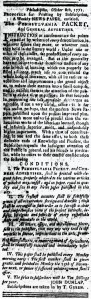
When John Dunlap distributed subscription proposals in advance of publishing the Pennsylvania Packet, he expressed his intention to disseminate the new newspaper widely.  He lined up local agents from a variety of occupations in towns in Pennsylvania and far beyond.  They included “James Wilson, Esq; Attorney at Law, Carlisle,” Pennsylvania, “Richard Thomas, Esq; Sheriff, Charlestown,” Maryland, “Rev. William Dunlap, King and Queen county, Virginia.”  He also enlisted booksellers Noel and Hazard in New York as well as printers in the major port cities.  Some of them published their own newspapers, yet they assisted a fellow printer in another town launch his own publication.  They likely received complimentary copies of the Pennsylvania Packet, part of an exchange network that allowed printers to liberally reprint content from one newspaper to another.  From Cape May, Massachusetts, to Charleston, South Carolina, local agents stood ready to receive subscriptions to the Pennsylvania Packet.  Beyond the continent, “Messrs. Esmand and Walker, Printers in Bridgetown, Barbados” also accepted subscriptions on Dunlap’s behalf.

In addition to that extensive list, the proposals ended with a note that “many other Gentlemen, whose names will be particularized in our first Number” also served as local agents in other towns.  Timothy Green, printer of the New-London Gazette was one of those local agents.  His newspaper carried the same subscription proposals for the Pennsylvania Packet that ran in the Pennsylvania Chronicle, though Green trimmed the list of local agents.  The final line simply stated, “Subscriptions are taken in by T. GREEN.”  When it came to local subscribers, Green probably did not worry too much about the Pennsylvania Packet competing with the New-London Gazette.  Given the time required to deliver it from Philadelphia to Connecticut, its contents supplemented rather than replaced the “freshest ADVICES, both FOREIGN and DOMESTICK” that the masthead of the New-London Gazette promised.  In addition, Green’s newspaper exclusively carried certain content, including local advertisements, legal notices, and shipping news from the custom house.  Colonial printers served as editors, selecting items from multiple newspapers to reprint, but some readers also acted as their own editors through consulting several newspapers on their own, deciding for themselves which “ADVICES” they considered most important.  When they served as local agents for newspapers published in other towns, printers like Green facilitated that process.

September 20

What was advertised in a colonial American newspaper 250 years ago today?

New-Hampshire Gazette (September 20, 1771).

“Sold (by appointment of Mr. Hemet) … at William Scott’s Irish Linnen Store … in New England.”

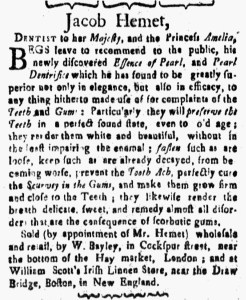
Readers of the New-Hampshire Gazette learned that Jacob Hemet, “DENTIST to her Majesty, and the Princess Amelia,” compounded an “Essence of Pearl, and Pearl Dentrifice,” a paste or powder for cleaning teeth, “which he has found to be so greatly superior not only in elegance, but also in efficacy, to any thing hitherto made use of for complaints of the Teeth and Gums” when they perused the September 20, 1771, edition.  That information appeared in an advertisement that provided additional details about how Hemet’s products contributed to both health and beauty.

At a glance, it may have appeared that Hemet placed the advertisement.  His name served as the headline, a common practice among purveyors of goods and services when they placed notices in eighteenth-century newspapers.  A short paragraph at the end of the advertisement, however, revealed that Hemet designated local agents to hawk his products on his behalf.  Interested parties could purchase Hemet’s Essence of Pearl and Pearl Dentrifice “wholesale and retail” from “W. Bayley, in Cockspur street, near the bottom of the Hay market, London” as well as “at William Scott’s Irish Linnen Store, near the Draw Bridge, Boston, in New England.”  Hemet may have written the copy for the advertisement and transmitted it to Bayley and Scott, but he probably did not arrange for running the advertisement in the New-Hampshire Gazette.

Instead, he likely left those details to Scott following his “appointment” as an agent in the colonies.  Scott placed the advertisement in the Boston-Gazette on September 16.  Taking advantage of his exclusive access to Hemet’s products, he aimed to expand the market by advertising in nearby New Hampshire as well.  Yet the advertisement did not suggest a local or regional market but instead encouraged consumers to think of themselves as participating in a transatlantic market that connected them to the heart of the empire.  Scott made available to them products that residents of London presumably purchased, products that Hemet supplied to members of the royal family.  Prospective customers skeptical of the efficacy of Hemet’s Essence of Pearl and Pearl Dentrifice may have been more willing to take a chance on products supposedly distributed to consumers in London, grateful that the dentist opted to select an agent in the colonies who could provide them with the same products used by Hemet’s most elite clients.