February 26

What was advertised in a colonial American newspaper 250 years ago today?

Feb 26 - 2:26:1768 New-London Gazette
New-London Gazette (February 26, 1768).

“I will Sell as Cheap as any Man in Norwich.”

Nathaniel Backus, Jr., listed several commodities and their prices in an advertisement he inserted in the February 26, 1768, edition of the New-London Gazette. In addition, he offered “a good Assortment of European Goods, which I will Sell as Cheap as any Man in Norwich.” Backus listed his location as Norwich Landing. The New-London Gazette served a region that extended far beyond the port town for which it was named.

Note that Backus did not compare his prices to those in other cities and towns in New England. He confined his comparison to the local marketplace, seeking to assure potential customers that they could not do any better dealing with other local shopkeepers. Few, if any, of his wares – “BEST London Pewter,” “German Serge,” “Barbados Rum,” and “Bohea Tea,” to name just a few of the commodities he listed – had arrived directly at Norwich. Instead, they had likely been shipped first to Boston or New York. Even if they had been transported via a more direct route, this “good Assortment of European Goods” would have passed through the port of New London and its customs house before continuing up the Thames River to Norwich. These additional legs required in shipping the goods to the small town of Norwich likely made them slightly more expensive for retailers to obtain them, affecting the prices Backus and others charged their customers. Shopkeepers in Portsmouth, New Hampshire, and Providence and Newport, Rhode Island, sometimes favorably compared their prices to those in Boston, New York, or all of New England. Retailers located inland, like Backus in Norwich, however, did not make such appeals at the same rate.

Backus guaranteed the prices he listed in his advertisement: “those that favour me with their Custom, may depend on being served through the Season, at the above Prices.” This allowed for consumers to do some comparison shopping even before visiting his shop. If potential customers considered the prices he listed for select items to be reasonable then they might have been more willing to accept Backus’s assertion that he sold his merchandise “as Cheap as any Man in Norwich.”

February 19

What was advertised in a colonial American newspaper 250 years ago today?

Feb 19 - 2:19:1768 New-London Gazette
New-London Gazette (February 19, 1768)

“Robert Bingham … Makes all Kinds of Surgeons Instruments for Amputation.”

In a notice in the New-London Gazette, Robert Bingham, a “CUTLER, from LONDON,” deployed many of the appeals most commonly included in newspaper advertisements during the eighteenth century. Artisans tended to promote the skills they had acquired in their trade, via training or experience or both. Without much elaboration, Bingham did mention his skill, noting that he completed his work “in the neatest manner.” Like many other advertisers, Bingham also established his connection to London, the center of the empire. For artisans, this often implied skill achieved through training superior to that available in the colonies. More often than not, advertisers of all sorts – whether merchants, shopkeepers, or artisans – incorporated appeals to price into their commercial notices. Bingham again followed the standard practice of the period, declaring that he performed his work at the “most reasonable rate.”

In general, Bingham wrote copy that prospective customers likely found reassuring, if not especially innovative or exciting. His appeals did not particularly distinguish his business from others, but neglecting to insert any of them into his advertisement would have distinguished him in the wrong ways. He needed to do more than merely announce his services. He needed his advertisement to demonstrate that he understood the expectations of potential clients.

Still, the composition of Bingham’s advertisement suggests that he may have attempted to make a more nuanced appeal to skill than just asserting that he made cutlery “in the neatest manner.” He worked in a shop in Lebanon, Connecticut. Residents of this small village and the surrounding area were much more likely to purchase “Table Knives and Forks, – Raisors [razors] – Scissars, – Penknives” than “Surgeons Instruments for Amputation and Trepanning; – also Surgeons Pocket Instruments.” Yet Bingham did not commence his advertisement with the items most likely to meet local demand. Instead, he first listed specialized instruments that required skill and precision in crafting, signaling his abilities to readers without making explicit reference to skill. Bingham may have considered the order he listed his wares a persuasive marketing strategy, one that showcased his skills more effectively than professing his abilities at great length.

February 12

What was advertised in a colonial American newspaper 250 years ago today?

Feb 12 - 2:12:1768 New-London Gazette
New-London Gazette (February 12, 1768).

“Lemuel Pattingell … Fabricates and Sells, THE best jerk’d BUTTONS.”

In February 1768, Lemuel Pattingell inserted an advertisement in the New-London Gazette to inform readers that he “Fabricates and Sells, THE best jerk’d BUTTONS.” In addition to their high quality, Pattingell’s buttons were also durable. He proclaimed that they “wear at least twice so long as those Imported.” Potential customers who might have been skeptical of these claimes could examine the buttons for themselves before contacting Pattingell. He announced that “Samples … may be seen at the Printing Office in N. London.” Although brief, this advertisement tapped into concerns about production, consumption, and politics in the colonies and the empire that had gained prominence in the fall of 1767 and continued for months in the public prints.

Colonists found themselves at a disadvantage when it came to a trade deficit with Britain. Many merchants and shopkeepers expressed a preference for dealing in cash rather than credit in their advertisements, hoping to staunch the flow of specie out of the colonies and across the Atlantic. Parliament exacerbated discontent over this situation when it decided to impose new duties on certain imported goods in the Townshend Act. Several weeks before it went into effect in late November 1767, the Boston town meeting voted to initiate a nonimportation agreement to commence at the beginning of the new year. Simultaneously, they also voted to encourage domestic production in whatever way possible, including consuming goods produced in the colonies. As word about these developments spread, both in print and via conversation, other towns adopted similar measures. Consumers’ decisions about which goods to purchase became increasingly politicized as fall became winter.

Pattingell’s advertisement appeared among news and advertisements that advanced those discussions. Elsewhere on the same page of the February 12, 1768, issue of the New-London Gazette, John Armbruester advertised the “Choice GENEVA” he distilled in Norwich. The twelfth and final letter in John Dickinson’s “Letters from a Farmer in Pennsylvania to the Inhabitants of the British Colonies” dominated the first and second pages. Advertisers often liked to suggest that imported goods, including adornments like buttons, possessed cosmopolitan cachet, but that appeal fell out of favor when the imperial crisis intensified and colonists turned to homespun cloth and other goods produced locally. Pattingell’s emphasis on quality and durability addressed the primary concerns of potential customers at the time he placed his advertisement. In turn, that advertisement further shaped public discourse about the politics of consumption, demonstrating to consumers that they could purchase goods made in the colonies rather than relying on imports.

January 29

What was advertised in a colonial American newspaper 250 years ago today?

Jan 29 - 1:29:1768 New-London Gazette
New-London Gazette (January 29, 1768).

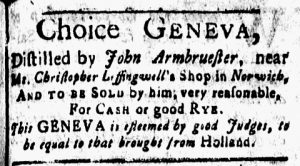
“Choice GENEVA.”

John Armbruester placed an advertisement in the January 29, 1768, edition of the New-London Gazette to inform residents of Norwich and the surrounding area that he distilled and sold Geneva. Advertisers regularly promoted Geneva in eighteenth-century newspapers, either on its own, as Armbruester did, or along with an array of other spirits. Colonists certainly knew what they were being offered, but the name Geneva has largely fallen out of use today. What was Geneva?

The Oxford English Dictionary provides some clarification in its entries for gin and genever. Dutch distillers first produced a variation of gin in the late sixteenth century. This aromatic drink, flavored with juniper berries and a variety of herbs and spices, was known in Dutch as genever, but in English as Dutch gin or Hollands gin (shortened from Hollands geneva). In the middle of the eighteenth century, distillers in London produced a “less coarse, more subtly flavoured gin” that became known as London gin. That variation became the most usual form of the drink. Today consumers enjoy (London) gin in mixed drinks and cocktails, whereas genever (or jenever) is usually drunk neat.

Gin was just gaining in popularity in England at the time Armbruester distilled and sold his Geneva in Connecticut. Either he had not yet learned the process for making gin rather than genever or the demand for gin had not yet increased so significantly that he determined producing it would yield greater revenues. Whatever his reasons, the advertisement made it clear that he did indeed distill genever rather than gin. He favorably compared his “Choice GENEVA” to “that brought from Holland” rather than any produced in London, noting that “This GENEVA is esteemed by good Judges, to be equal.” In his competition with transatlantic rivals, Armbruester assured local consumers that his product was not inferior to any genever they could import from the region where it had originally been distilled two centuries earlier.

January 22

What was advertised in a colonial American newspaper 250 years ago today?

Jan 22 - 1:22:1768 New-London Gazette
New-London Gazette (January 22, 1768).

“CLEAN LINEN RAGS.”

Christopher Leffingwell used his advertisement in the January 22, 1768, edition of the New-London Gazette to promote the “Quantity of coarse and fine Writing, Printing and Wrapping PAPER” he manufactured, but he simultaneously issued a call for readers to supply him with the rags he needed to produce more paper. Purchasing and producing paper amounted to more than mere commerce. These were political acts in the wake of the Townshend Act imposing new duties on imported paper the previous November.

Leffingwell made that apparent. He described handing over rags to local paper manufacturers as “an entire Saving to the COUNTRY.” He opined that “every Friend and Lover” of America should deliberately and vigorously participate in such an endeavor. They should “readily save every Scrap,” including the smallest rags, that came into their possession with the intention of turning them over to him to be made into paper that would reduce the colony’s dependence on imported paper being taxed by Parliament. Leffingwell paid for the rags he received, acknowledging that “the Price given for them, may to some seem very small.” That attitude, he cautioned, did not recognize the greater purpose. By working together to bolster the production of paper in Connecticut, colonists contributed to “the whole Saving” that became “very considerable.” As Lessingwell “paid in Cash” for rags collected by his neighbors and, in turn, they purchased the paper he manufactured from those rags, they collectively advanced the local economy. They made their colony less dependent on goods imported from Britain while also avoiding sending local cash across the Atlantic as payment of the new taxes from the Townshend Act. Lessingwell’s decision to buy up as many rags as possible, laying out “£. 100 lawful Money” so far, had resulted in saving the same amount which “otherwise might have been entirely lost.” In return for his assistance to the economic welfare of the colony, he requested that readers reward him by continuing to supply him with rags as well as purchasing the paper those rags produced. Leffingwell provided a means for colonists of all backgrounds to engage in resistance to Parliament.

“If the People will furnish me with a sufficient Stock of fine white Rags (which they may easily do) it will enable me to supply them with as good Paper as is imported from Abroad, and as cheap,” Leffingwell proclaimed. Everyone benefited from this scenario. Paper and rags, production and consumption, all took on political significance as Leffingwell challenged colonists to consider the meanings attached to some of the most mundane items they encountered in their daily lives.

October 16

What was advertised in a colonial American newspaper 250 years ago today?

Oct 16 - 10:16:1767 Page 1 New-London Gazette
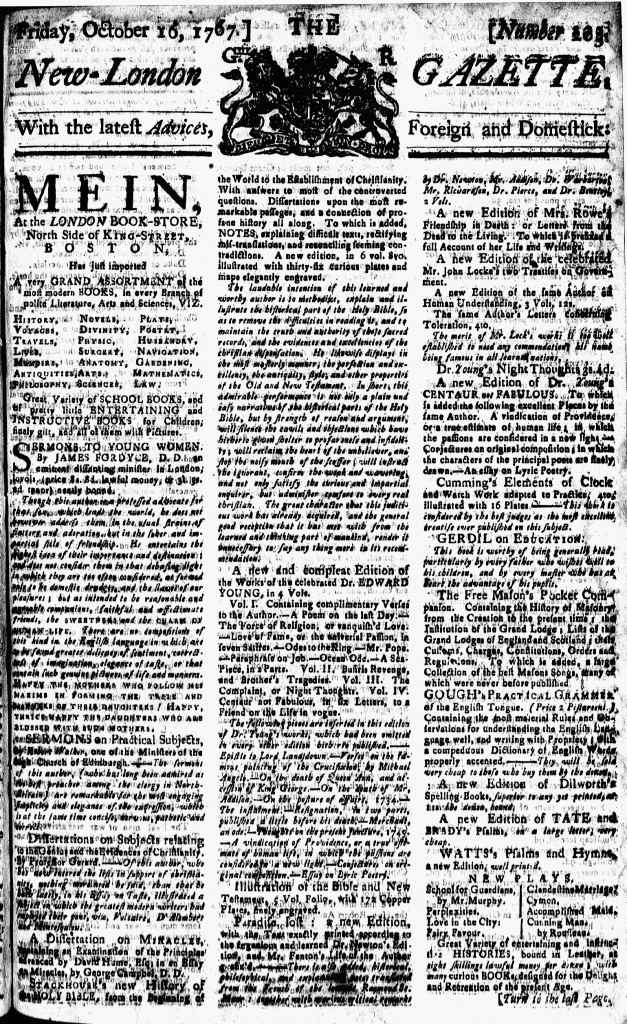
First Page of the New-London Gazette (October 16, 1767).

“MEIN, At the LONDON BOOK-STORE, North Side of KING-STREET, BOSTON.”

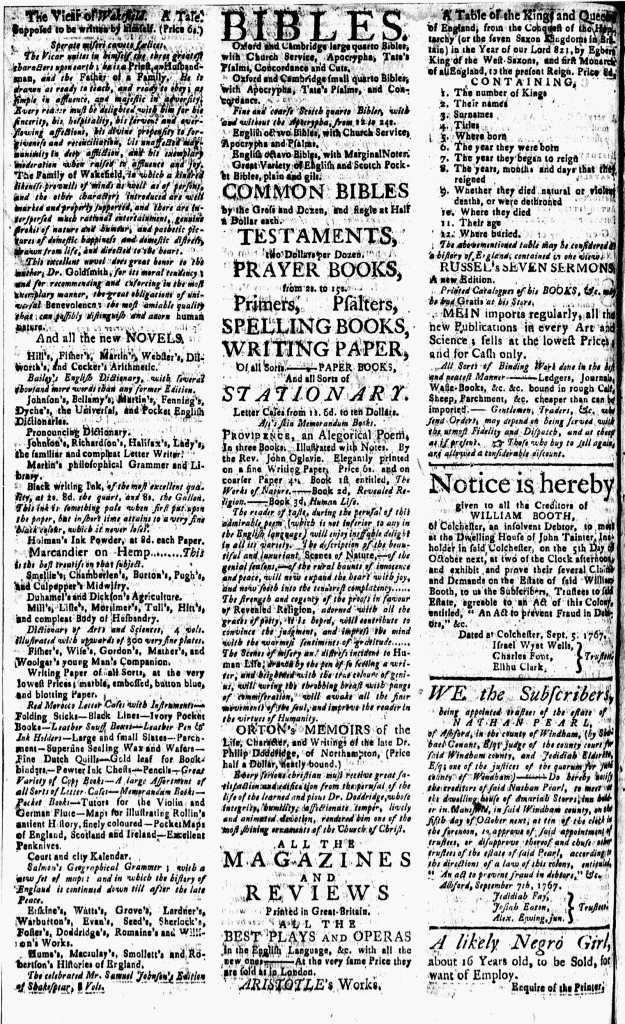
The Adverts 250 Project previously featured an extraordinary advertisement that John Mein placed in the New-London Gazette in the fall of 1767. Not only did Mein, a Boston bookseller, advertise in a distant newspaper, his advertisement occupied nearly two entire pages. That was a bold and innovative marketing strategy.

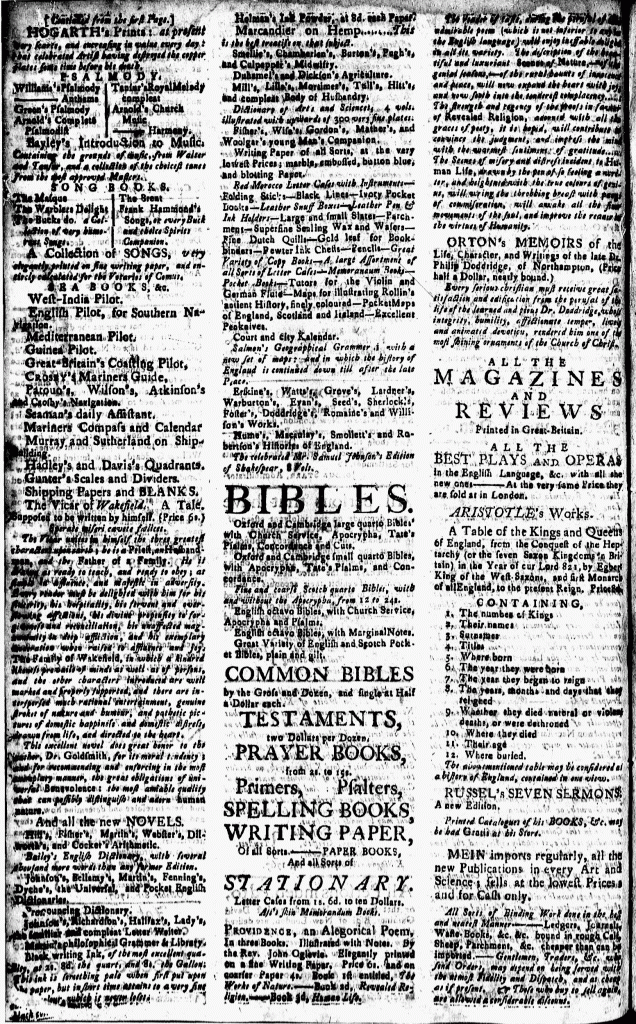
It was not a one-time gimmick. Mein placed a similar advertisement in the October 16, 1767, edition of the New-London Gazette, an advertisement that was even more elaborate than the previous one. The new version extended over six columns, two entire pages (with the exception of the masthead on the first page). Mein’s advertisement accounted for half of that issue of the newspaper, limiting the amount of space for news items and prompting the printer to insert a notice that “Advertisements omitted will be in our next.”

This new advertisement had another feature that distinguished it from the previous version. It appeared on the first and fourth pages of the four-page newspaper (rather than the final two pages). This meant that it was both the first and last item readers encountered when they read that issue of the New-London Gazette. In addition, if a reader held the open newspaper aloft to read the second and third pages, observers would glimpse only the first and last pages. From their perspective it would appear that the New-London Gazette contained nothing except Mein’s advertisement. Similarly, a closed copy of the newspaper sitting on a desk or table assumed the appearance of a broadsheet book catalogue since no other advertisements or news items would have been visible.

Oct 16 - 10:16:1767 Page 4 New-London Gazette
Final Page of New-London Gazette (October 16, 1767).

These visual aspects that depend on the material qualities of the newspaper might be overlooked when working with a copy bound into a volume with other issues of the New-London Gazette, a common practice for preserving and archiving eighteenth-century newspapers. Deprived of the ability to exist as a separate issue but instead reduced to four consecutive pages in a larger book, the transformed newspaper does not immediately suggest all of the visual characteristics that early American readers would have experienced. The same could also be said of digitized versions of the advertisement, each page completely disembodied from the others. The greater significance of Mein’s advertisement becomes apparent only upon contemplating how the form in which the New-London Gazette was originally delivered to readers, not just the format the issue happens to occupy in the twenty-first century.


October 2

What was advertised in a colonial American newspaper 250 years ago today?

Oct 2 - 10:2:1767 New-London Gazette
New-London Gazette (October 2, 1767).

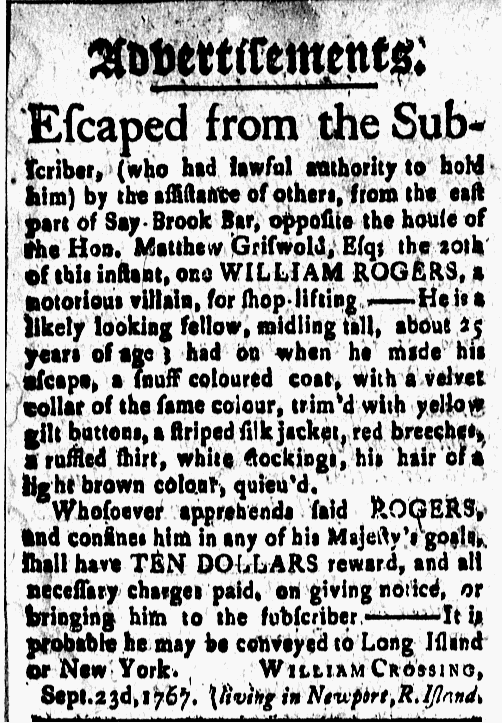
“WILLIAM ROGERS, a notorious villain, for shop lifting.”

In the fall of 1767, William Crossing placed an advertisement in the New-London Gazette to warn readers that William Rogers, a “notorious villain,” had escaped from his custody. According to Crossing, he had “lawful authority to hold” Rogers “for shop lifting.” Advertisements concerning theft appeared regularly in newspapers throughout the colonies. Sometimes retailers indicated that goods had been stolen from their shops. Other times advertisers reported that thieves took items from their homes. Theft, rather than purchasing, became an alternate means for some colonists to participate in the consumer revolution in eighteenth-century America.

Crossing described a particular kind of theft: “shop lifting.” While it came as no surprise that this crime existed in colonial America, the use of that particular term to describe it made me wonder when “shoplifting” entered the English lexicon. According to the Oxford English Dictionary, “shoplift” was used as a noun as early as 1665 and as a verb as early as 1756 (a little over a decade before it appeared in today’s advertisement). Describing “one that steals out of shops” as a “shoplift” has fallen out of use, now described by the OED as historical and rare. The term “shoplifter,” on the other hand, has survived from the 1660s and is still in common use today.

Although “shoplift” and “shoplifter” described petty criminals in Restoration England, the OED does not include any examples of “shoplift” as a verb until nearly a century later, when it appeared in the July 22, 1756, edition of London’s Public Advertiser. The newspaper reported on fabrics stolen from a linen draper’s shop. The OED also indicates that the word “lyft” had been in use as early as 1585. In 1824, Sir Henry Ellis, a prominent antiquarian and eventually principal librarian of the British Museum, noted the meanings of several words associated with theft in Early Modern English: “ffoyste is to cutt a pocket, nyppe is to cut a purse, lyft is to robbe a shoppe.” In its original iteration, “lyft” did not need further clarification to indicate that it referred to stealing goods from a shop while pretending to be a customer. The origins of the term “shop lifting” date back to the time of Shakespeare, long before the transatlantic consumer revolution of the eighteenth century.

September 25

What was advertised in a colonial American newspaper 250 years ago today?

Sep 25 - 9:15:1767 Page 3 New-London Gazette
New-London Gazette (September 25, 1767).

“London BOOK-STORE, North Side of KING-STREET, BOSTON.”

John Mein, prominent bookseller in Boston, placed an extraordinary advertisement in the September 25, 1767, edition of the New-London Gazette. A regular advertiser in Boston’s newspapers, Mein previously experimented with a full-page advertisement in the Massachusetts Gazette two months earlier. The length of his advertisement in the New-London Gazette, however, far exceeded that previous notice: it extended nearly two full pages and amounted to almost half of the entire issue. Mein’s advertisement for “A very GRAND ASSORTMENT of the most modern BOOKS, in every Branch of polite Literature, Arts and Sciences” filled the entire third page and all but the second half of the final column on the fourth page. It took up so much space that Timothy Green, the printer, inserted a notice at the bottom of the second page to assure readers (and advertisers whose notices had been squeezed out to make room for Mein) that “Advertisements omitted will be in our next.” Although not unknown, full-page newspaper advertisements were not common in the 1760s. When they did appear they merited special notice, yet they seemed restrained compared to Mein’s nearly-two-page advertisement.

Sep 25 - 9:15:1767 Page 4 New-London Gazette
New-London Gazette (September 25, 1767).

Mein’s extensive advertisement qualified as exceptional for another reason: he operated the “LONDON BOOK-STORE” on King Street in Boston, yet he supplemented his marketing efforts in local newspapers with a newspaper notice in faraway New London, Connecticut. Retailers frequently acknowledged that they served customers in the hinterlands that surrounded their own cities and towns, but they rarely placed advertisements in newspapers published in other colonies if they had local alternatives. Retailers in Boston, for instance, expected that when they advertised in any of the city’s four newspapers that they would attract customers from other parts of Massachusetts beyond the busy port. They typically did not, however, insert advertisements in newspapers printed in other towns, each with their own hinterlands in other colonies. Mein deviated from standard practices related to newspaper advertising, apparently considering the opportunity to enter new markets worth the investment. He had previously published book catalogs that may have been distributed far beyond Boston. Any customers they generated may have encouraged him to consider advertising in newspapers in distant cities. He acknowledged customers who resided outside Boston in the final paragraph of his advertisement: “Gentlemen, Traders, &c. who send Orders, may depend on being served with the utmost Fidelity and Dispatch, and as cheap as if present.” In his efforts to gain customers from markets beyond Boston, Mein anticipated and addressed potential obstacles that might prevent them from patronizing his business.

September 18

What was advertised in a colonial American newspaper 250 years ago today?

Sep 18 - 9:18:1767 New-London Gazette
New-London Gazette (September 18, 1767).

“Stolen from the subscriber … a plaid jacket.”

Peter Bulkley was the victim of a theft! In an advertisement in the New-London Gazette, he listed several items (mostly clothing, but also some cash) stolen on the night of September 13, 1767. He accused John Nicholas, “a Frenchman,” of stealing a hat, a coat, a jacket, a shirt, a pair of breeches, a pair of trousers, a pair of stockings, a pair of shoe buckles, and a pair of knee buckles. Nicholas made off with an entire outfit!

What did the thief intend to do with these items? He may have been on the move to another town or another colony, somewhere that he could wear the clothes himself without attracting notice (provided others did not see Bulkley’s advertisement). Alternately, he might have planned to sell the clothes, either one piece at a time or as a package. If the latter, he may have known someone who received secondhand (sometimes stolen) goods with the intention of reselling them. In Dangerous Economies, Serena Zabin describes an informal economy in eighteenth-century America, an extralegal marketplace that included fences who worked with thieves in the redistribution of consumer goods.[1]

Bulkley was not alone in advertising that someone stole an assortment of goods from him. Throughout the colonies, victims of theft placed advertisements describing the stolen items and offering rewards for the return of their goods and the capture of the thief. Whether Nicholas planned to keep or sell the stolen clothing, Bulkley’s advertisement and the many others like it provide evidence that some colonists devised alternate methods for participating in the consumer revolution. Rather than read the lengthy advertisements listing all sorts of imported goods and then purchasing them from merchants and shopkeepers, some colonists – especially those without the means to purchase new items – instead resorted to theft or buying secondhand goods of uncertain origins.

**********

[1] Serena R. Zabin, Dangerous Economies: Status and Commerce in Imperial New York (Philadelphia: University of Pennsylvania Press, 2009). See especially chapter 3, “The Informal Economy.”

September 11

What was advertised in a colonial American newspaper 250 years ago today?

Sep 11 - 9:11:1767 New-London Gazette
New-London Gazette (September 11, 1767).

“Choice MADEIRA, TENERIFE, and FAYAL WINES.”

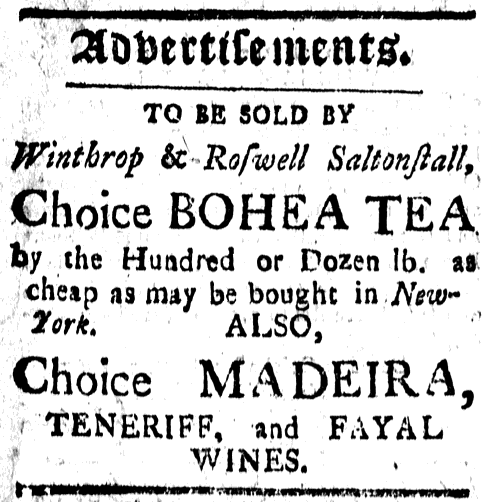
Some newspaper advertisements presented consumers with lengthy lists of manufactured goods imported from England, but others promoted foods and beverages that originated in places outside Britain’s global empire. In the September 11, 1767, edition of the New-London Gazette, for instance, Winthrop and Roswell Saltonstall announced that they sold “Choice … WINES” imported from islands in the eastern Atlantic. Madeira and Fayal wines came from Portuguese outposts. Madeira, a fortified wine, derived its name from the main island in the Madeira archipelago. Fayal (an English variation of Faial) wines came from one of the islands in the central group of the Azores, an archipelago consisting of nine islands. Tenerife wines came from the largest of the seven Canary Islands, conquered and colonized by Spain. In consuming wines from Madeira, Tenerife, and Fayal, colonists participated in vibrant networks of exchange that crisscrossed the Atlantic. Such networks often crossed imperial boundaries, even as nation-states attempted to enforce mercantilist policies.

Given that the Saltonstalls advertised these wines in the public prints, they most likely had imported them legally. Yet a variety of commodities – sugar, molasses, rum, foodstuffs, and wine – found their way to colonial markets via smuggling. “The case of wine is a good example,” according to David Hancock. “Not just in war but also in peace, the varieties and amounts of wine available in British America were greater than those allowed by law and recorded at the customs house.”[1] As the Saltonstalls’ advertisement suggests, colonists could identify many types of wine and made associations with their places of origin. Just as they were accustomed to extensive choices when it came to textiles and housewares, they expected wine merchants to present an assortment so they could make their own selections. Without going into elaborate detail, the Saltonstalls listed three different wines to signal the diversity of their stock to prospective customers.

[1] David Hancock, “Rethinking The Economy of British America,” in The Economy of Early America: Historical Perspectives and New Directions, ed. Cathy Matson (University Park: Pennsylvania State University Press, 2006), 81.