What was advertised in a colonial American newspaper 250 years ago today?
New-London Gazette (July 31, 1767).
“Intending to carry on my former Business …”
Charles Jeffery had been away from New London for a while, having left “to settle sundry Accounts of long standing,” but, “having almost compleated the same,” he was back and ready to resume the business he had allowed to lapse during his absence. To make sure that “all good old Customers” knew of his return, he placed an advertisement in the New-London Gazette.
Jeffery reminded readers of the various branches of the business he formerly pursued: “Butchery,—Baking Loaf and Ship Bread,—Butter Bisket, Tallow-Chandling;—Also brewing SHIP BEER, &c. &c. &c.” He did not elaborate on the goods he offered for sale, neglecting to make any of the common appeals to price or quality. He did, however, make a nod toward the sort of customer service that readers could expect; they could “depend on being used in the neatest and best manner, by their humble Servant.” He aimed this promise directly at “all good old Customers.”
Despite the hiatus in his business, Jeffery anticipated that readers of the New-London Gazette were sufficiently familiar with him and the commodities he sold that he did not need to do much by way of attempting to convince them to resume trading with him. In that regard, his advertisement resorted more to announcing his enterprise instead of marketing it. He did not even seem particularly interested in attracting new customers but rather desired to revive relationships with former associates, those “good old Customers” who made purchases from him in the past.
Jeffery may have felt little need to engage in much marketing, perhaps assuming that he had already achieved prominence and a positive reputation among residents of New London and its hinterland. In addition, he likely faced less competition than his counterparts in larger port cities, like Boston, Charleston, New York, and Philadelphia. Had he temporarily suspended business in any of those locales, he may very well have posted a rather different sort of advertisement when he sought to return to the marketplace.
What was advertised in a colonial American newspaper 250 years ago this week?
New-London Gazette (July 17, 1767).
“CASH is given for clean Linen RAGS.”
Eighteenth-century newspapers were peppered with calls for rags. In any given issue, the printer might insert this sort of notice among the advertisements or use it to complete a page featuring primarily news items. These pleas for rags, however, were not merely filler. They played a vital role in the production of paper in colonial America. At the time, paper was made of linen rather than wood pulp. As a result, the rags that colonists turned over to the “Paper Manufactory” became the paper printers used to publish books, newspapers, almanacs, and anything else that came off their presses.
In 1767, printers throughout New England dressed up their usually plain calls for rags with a short poem that extolled the virtues of rags. In four rhyming couplets, it explained:
RAGS are as Beauties, which concealed lie,
But when in Paper, how it charms the Eye!
Pray save your Rags, new Beauties to discover,
For Paper truly, every one’s a Lover.
By th’ Pen and Press such Knowledge is display’d,
As wou’dn’t exist if Paper was not made.
Wisdom of Things, mysterious, divine,
Illustriously doth as PAPER shine!
Every rag possessed hidden beauty just waiting to emerge when rags were transformed into paper. In their current form, rags were deceptive, hiding their potential to convey the “Wisdom of Things” far and wide once they became paper. Not to be discarded as trash, rags were actually a treasure beyond value.
Rags currently in the possession of readers of the New-London Gazette could eventually become future issues delivered to them, but only if subscribers turned their rags over to one of the many men listed in the extensive network of local agents who collected rags for the Paper Manufactory. Colonists who wished to continue receiving news and advertisements via the New-London Gazette (or any of the other newspapers that published this poem along with a similar announcement) had to assume responsibility for that portion of the paper production process.
Although printers exercised considerable discretion in the content of newspapers, their readers played a significant part in producing the material that became the text. The dissemination of print in early America depended in part on average colonists surrendering their rags, a rather humble start considering the tapestry of colonial life recorded in the pages of newspapers and other publications that came off American presses in the eighteenth century.
What was advertised in a colonial American newspaper 250 years ago today?
New-London Gazette (July 3, 1767).
“A Passage-Boat fitted in the best Manner for the Reception of Passengers.”
Samuel Beebe and Ebenezer Webb were competitors. Both operated a ferry service, or “Passage-Boat,” between New London, Connecticut, and Long Island, New York, but they did not follow the same route. In his advertisement, which appeared immediately above Beebe’s notice, Webb allowed that “Passengers may be landed on any Part of the East End of the Island,” but then claimed that “Sterling is preferable for a Landing Place.” Beebe, who delivered passengers to Oyster Point Pond at the easternmost tip of Long Island, disagreed. “Passengers, by being landed on the East End,” he argued, “saves more Time than the Distance between there and Sterling.” Beebe admitted that his passengers disembarked at a location farther from New York than if they sailed to Sterling with Webb, but there were other factors that they needed to take into account. “[F]or while a Boat is beating Seven Miles to windward,” Beebe explained, “a Traveler may go Twenty Miles on Shore.” Travelers needed to be well-informed and discerning about the relative advantages of transport via land versus over sea. Webb pointed out that by taking his ferry passengers “must save 50 Miles” compared to traveling only by land around Long Island Sound, but Beebe countered that sometimes traveling by land might be the faster option, especially since “a level plain Road” ran the 120 miles between Oyster Point Pond and New York.
Although Beebe and Webb focused primarily the advantages of their route, both enhanced their advertisements by mentioning other amenities to attract potential clients. In so doing, they marketed transportation services as a travel experience. They invited customers to consider the overall package, not just the route. Webb, for example, delivered copies of the New-London Gazette to subscribers on Long Island. When Beebe began advertising that “he keeps a House of Entertainment for Man and Horse” at Oyster Point Pond, an establishment where “Gentleman Travellers may be well used,” Webb updated his advertisement with a final note that “Good Entertainment for Travellers may be had at the Subscriber’s House.” Both indicated that their ferries operated “Wind and Weather permitting.” Should acts of nature delay departures, passengers could depend on comfortable lodgings while they waited. Time, distance, and comfort all played a role in convincing travelers which “Passage-Boat” to sail.
What was advertised in a colonial American newspaper 250 years ago today?
New-London Gazette (June 26, 1767).
“The Subscribers are desired speedily to send for their Books.”
It took some time for Timothy Green to publish Joseph Fish’s book of nine sermons inspired by Matthew 26:18, but much of the responsibility for the delay belonged to the author. Fish continued to write, revise, and add material to the manuscript “After the Proposals for Printing these Sermons by Subscription, were sent abroad.” Six months before announcing that the book had been “JUST PUBLISH’D,” Green issued an advertisement requesting that those who accepted subscriptions forward their lists to him so he could determine how many copies to print.
In the interim, the book expanded. That, in turn, raised the cost of production and, ultimately, the retail price, even for subscribers. Earlier subscription notices marketed the book for 1 shilling and 10 pence, but the additional material made it necessary to increase the price by 4 pence to a total of 2 shillings and 2 pence if “stitch’d in blue Paper.” Reader who desired a volume “bound in Leather” rather than the basic wrapper could pay an additional shilling. Green catered to different tastes and price points.
He also realized that it was problematic to raise the price of Fish’s Sermons by nearly 20% after customers subscribed at a lower cost. To counter objections, he argued that “even with that Addition they will be uncommonly Cheap, as the Book contains upwards of 200 Pages.” (The reverend Fish might have been dismayed that the printer made an appeal to quantity over the quality of the contents.) In addition, Green reported that many others who had not previously subscribed were so keen on acquiring the book that they stood ready to purchase it at the higher price. The printer gave subscribers an opportunity to opt out by requesting that they send for their books soon. Any not claimed, he warned, would be sold to others who eagerly stood ready to purchase any surplus copies. Rather than apologize for raising the price and breaking the conditions set forth in the subscription notices, Green instead lectured subscribers. Even considering the higher price, they could hardly argue with the value, he admonished. After all, other prospective customers certainly acknowledged that this was a good deal. The original subscribers needed to obtain their copies as quickly possible or else risk losing out as others swooped in and claimed their books.
What was advertised in a colonial American newspaper 250 years ago today?
New-London Gazette (May 29, 1767).
“Cheaper for Cash than can be had at Capt. Nathl. Backus’s, or any Store in Norwich.”
Ebenezer Coburn sold “All Sorts of Iron-Mongery, and Cutlery Ware … at his Shop … at the Sign of the Black Horse, at Norwich-Landing” in Connecticut. In marketing his wares, he resorted to one of the most common appeals in eighteenth-century newspaper advertisements, low prices, promising that customers could purchase his merchandise “cheaper for Cash” from him than from “any store in Norwich.” Merchants and shopkeepers throughout the colonies frequently made similar claims. Many simply stated that they had low prices, but others specified that they offered the best prices in town and would not be undersold by any of their competitors. A few even boasted that they offered the lowest prices in the entire colony or the region, especially in New England.
In that regard, Coburn’s notice replicated standard advertising practices. Yet he deviated from most other advertisements in one significant way: he named one of his competitors and explicitly stated that his prices were lower. Before even mentioning other shops in Norwich, Coburn singled out Captain Nathaniel Backus. In their advertisements, most shopkeepers either graciously pretended that their competitors did not exist or politely acknowledged them by indicating that their own shop had the best prices. Coburn, on the other hand, fired a shot in a price war with Backus, challenging consumers to take special note of what the captain charged for his wares.
Why did Coburn take aim at Backus in particular? Was the captain the most prominent trader in Norwich and thus Coburn’s most significant competitor? Had Backus established a reputation for especially low prices that Coburn hoped to turn to his advantage? Did some sort of personal, rather than professional, animosity exist between Coburn and Backus? The captain was a man of some prominence in Norwich, a descendent of the founders of the town and one of only six men who owned his own carriage prior to the Revolution. He exercised some clout in the local marketplace.
Something happened relatively recently that caused Coburn to compare their prices. Two weeks earlier he had published a nearly identical advertisement in the New-London Gazette; it did not mention Backus or that Coburn sold “by Wholesale or Retail.” Given the number of vessels that had “Entered In” according to the recent shipping news, Backus very well may have recently received a large shipment of imported goods, enough to seemingly flood the local market in Norwich. By naming Backus in particular, Coburn may have been trying to gain ground on his most prominent and most significant competitor, one who commanded the attention of local consumers even without advertising in the New-London Gazette.
What was advertised in a colonial American newspaper 250 years ago today?
New-London Gazette (May 15, 1767).
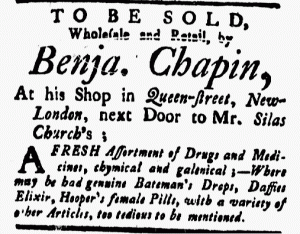
“TO BE SOLD … At his Shop in Queen-street, New-London.”
Throughout the winter and early spring in 1767 very few advertisements for consumer goods appeared in the New-London Gazette. When May arrived, the newspaper experienced a resurgence in that category of advertising, though it must be noted that this amounted to a fairly small number of paid notices compared to newspapers printed in larger cities. Still, the publication took on a slightly different tone as retailers turned to its pages to promote their wares to prospective customers.
While small in number, advertisements for consumer goods in the May 15 issue covered a wide variety of products. Richard Ransom announced that he made and sold spinning wheels and various sorts of furniture “in the neatest and best Manner.” Robert Douglass, Jr., advertised that he “MAKES and Sells Goldsmith’s and Jeweller’s Work.” Benjamin Chapin hawked “ A FRESH Assortment of Drugs and Medicines, chymical and galenical.” For his part, Christopher Lessingwell had recently imported “A GENERAL assortment of English Goods, which he will Sell cheap.” Ebenezer Coburn specialized in “Iron-Mongery, and Cutlery Ware.”
Although this selection of advertisements may not seem particularly impressive compared to the volume that appeared in newspapers – and special advertising supplements! – in Boston, Charleston, New York, and Philadelphia, regular readers of the New-London Gazette would have noticed a striking increase in advertising aimed at consumers. That several appeared in the pages of the New-London Gazette simultaneously may have directed greater attention to all of them collectively. One may have been fairly easy to overlook, but multiple advertisements promoting consumer culture had the effect of reinforcing each other, even if that had not been the intention of the advertisers themselves.
What accounted for advertisements for consumer goods once again appearing alongside paid legal notices and advertisements for runaway servants, horses “to cover,” and real estate for sale? Was it merely a change in seasons? To what extent did shopkeepers and artisans continue to promote their wares in the New-London Gazette? Did the diversity of advertisements in the May 15 issue prompt others to insert their own marketing appeals? How did advertising practices in smaller towns compare to those in bustling urban ports? These are some of the questions I would like to address as I continue to track how advertising functioned in New London and its newspaper.
What was advertised in a colonial American newspaper 250 years ago today?
New-London Gazette (March 27, 1767)
“Genuine Medeira, Tenerif, and Fayal Wines, per Pipe or lesser Quantity.”
Winthrop and Roswell Saltonstall’s advertisement for imported wines and other commodities stood out in the March 27, 1767, issue of the New-London Gazette. It was one of only three advertisements promoting consumer goods and services. One of them advertised ferry service – “A Passage-Boat” – that Ebenezer Webb operated between Long Island and New London. The other, placed by the printer, announced the publication of “An excellent Treatise, entituled Heaven upon Earth.” Very few other paid notices appeared in that issue.
Such was usually the case when it came to advertising in the New-London Gazette. Of the more than twenty newspapers published in the colonies in 1767, the New-London Gazette and Hartford’s Connecticut Courant carried the least advertising, often half a dozen or fewer total notices. Even the Providence Gazette, which experienced a dearth of advertising in the winter of 1766 and 1767, usually filled a page or more with advertisements repeated from earlier issues, but the printers of the New-London Gazette and the Connecticut Courant did not adopt that strategy. Visually, both newspapers from Connecticut stood in stark contrast to their counterparts published in other colonies. Other eighteenth-century newspapers overflowed with advertising, often to the extent that printers distributed supplements devoted exclusively to paid notices of all sorts.
In general, advertisements for consumer goods and services manifested dual purposes in early America. They did more than merely announce the availability of various wares. Instead, advertisers sought to incite demand among potential customers, fueling a consumer revolution that did not emerge from incipient demand alone. In the process of generating demand, advertisers also engaged in competition with others in the same occupation. At least this is the story the Adverts 250 Project tells almost every day. It is a story that flows naturally from the Pennsylvania Gazette and the South-Carolina Gazette and Country Journal, from the Boston Post-Boy and the New-York Mercury, each of them filled with advertisements, but not from the New-London Gazette or the Connecticut Courant.
What explains the differences? Was advertising primarily an urban phenomenon in the decade prior to the American Revolution? Do other factors explain the relative scarcity of advertising in some, but not all, newspapers published outside the largest cities? This project grew out of a dissertation that examined advertising in eighteenth-century Philadelphia. Consulting as many newspapers from as many places as possible raises new questions and suggests that previous conclusions merit moderation.
What was advertised in a colonial American newspaper 250 years ago today?
New-London Gazette (December 19, 1766).
“These Sermons will be immediately committed to Press, as soon as it can be known how many are subscribed for.”
Timothy Green published this advertisement to encourage “Those Gentlemen who have kindly assisted in taking in Subscriptions for Mr Fish’s Nine Sermons” to send him a list of colonists they had signed up to purchase a copy of the book once it had been printed. He also requested that others “who incline to become subscribers” inform him “as speedy therein as possible” so he could determine “what Number of Books it will be necessary to print.”
In the eighteenth century printers published many books by subscription, limiting their risk and reducing the possibility of having so many unsold copies that they could not turn a profit on a particular publication. Printers gauged interest in proposed projects through a form of advertising known as the subscription notice, which usually announced an intended publication, indicated the price, and described its content and material aspects.
While subscription notices were often printed in newspapers alongside other advertisements, this type of marketing circulated in other ways as well. Broadsides (what we would call posters today) were displayed in printer’s shops and other places. The “Gentlemen” who assisted Green may have posted subscription notice broadsides in their shops or offices. Printers sometimes sent circular letters (what we would call junk mail today) to prospective customers they suspected would have an interest in a proposed publication. Rather than write the same letter by hand multiple times, printers much more efficiently created circular letters by setting the type, printing dozens or hundreds of the same letter, and writing in the names of intended recipients in a space left blank for the salutation. By the end of the eighteenth century, subscription notices appeared on the advertising wrappers that accompanied magazines. Enterprising printers also sometimes placed subscription notices as separate inserts in magazines before distributing them to subscribers.
Modern historians use subscription notices carefully. Just because a printer issued a subscription notice did not necessarily mean that it generated enough interest to move forward with publishing the book or other proposed work. In the case of “Mr Fish’s Nine Sermons,” however, Green did take the advertised book to press in 1767. Today’s advertisement did not include the full title of Joseph Fish’s The Church of Christ a Firm and Durable House: Shown in a Number of Sermons on Matth. XVI. 18. Upon this Rock I Will Build My Church, and the Gates of Hell Shall Not Prevail Against It. Apparently Green’s subscription notices played a part in inciting sufficient interest to publish “Mr Fish’s Nine Sermons.”
Who was the subject of an advertisement in a colonial American newspaper 250 years ago today?
New-London Gazette (October 17, 1766).
“ALSO, An able body’d hearty Wench 16 Years old (with a sucking Child.”
This advertisement started with the sale of a twenty-nine-year old slave, described as “strong and healthy.” The seller then indicated where he was born and that he has skills in farming. Next, he stated he was selling a “Wench” who was sixteen years old. By calling her a wench he degraded her status as a woman even further. In this case, a female slave was held at even lower regard than a male slave, perhaps because of the fact that when she had a child it took away from her ability to do work. The girl being sold was “able-bodied” and could “do all Sorts of House Work,” but was being sold because of “her breeding.” The words “breeding” and “wench” show the seller’s opinion about women, especially enslaved women, as well as an assumption that because she was a women and a slave she should be good at housework because that was what she was born to do.
In “Work, Pregnancy, and Infant Mortality among Southern Slaves,” John Campbell talks about how in the South slave owners placed value not on the gender of slaves but rather their age and physical condition. Campbell also points out that both male and female slaves were “harvesting equal proportions of cotton,” showing that in the South it did not matter to the slave owners the gender of the slave as long as they were capable of doing the work.[1] However, this advertisement was printed in the northern colony of Connecticut during an earlier period; the seller’s tone was different. It changed, becoming more aggressive and angry when going from depicting the man to the girl being sold. It is as if the seller was annoyed that she had a child that was now going to be a burden on him and he had to sell them because the child would be a distraction to her. He was not willing to make the long-term investment in the child, showing that Northern slave owners in the colonial period were not as ambivalent about their slaves’ genders as Southern slave owners were in the nineteenth century. In his advertisement the seller said the young woman came “with a sucking child.” He seemed upset with the fact that she had a child and that the child was nothing but an inconvenience, because the child was still breastfeeding. Female slaves could be looked at as beneficial because they had the ability to produce more slaves for their owners but that could also be a shortcoming because when they were pregnant and while the child was dependent mothers were not able to work to the same capacity.
**********
ADDITIONAL COMMENTARY: Carl Robert Keyes
I appreciate how Lindsay compares the sentiments expressed in today’s advertisement to the attitudes adopted by slaveholders in another region during another period, underscoring that there was not a monolithic experience of slavery in America. Instead, different people (both enslaved and free) faced very different circumstances depending on the period and place in which they lived.
New-London Gazette (October 17, 1766).
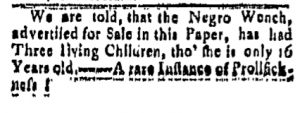
Another notice that appeared on the same page of the New-London Gazette further complicates today’s advertisement. “We are told,” an anonymous narrator (perhaps the printer) proclaimed, “that the Negro Wench advertised for Sale in this Paper, has had Three living Children, tho’ she is only 16 Years old. — A rare Instance of Prollfickness!” (Presumably the last word was supposed to be “prolificness.”) As Lindsay noted, the seller wished to be rid of this young woman solely because of her “breeding” and the inconveniences that it caused. The other notice, however, seemed to celebrate the young enslaved woman’s ability to produce children, promoting her fecundity as a selling point for potential buyers.
Who was responsible for the announcement that the sixteen-year-old “hearty Wench” already had three children? Was this an advertisement – a puff piece – placed by the current owner of the young woman in hopes of generating interest and making a sale? Or did the printer insert it of his own volition, as a point of interest he hoped would inform and entertain readers? The placement on the page makes it difficult to reach any particular conclusion. The notice appeared among the advertisements included in that issue of the New-London Gazette, but it appears at the bottom of the column immediately to the left of the column in which the advertisement for the “hearty Wench” was printed. It may have been positioned to prime readers to consider purchasing the young woman, but it also could have been intended as amusing filler when news and advertising did not completely fill the column. Either way, it now provides disheartening evidence concerning the levels of degradation one enslaved woman experienced at the hands of her captor and his community.
When Lindsay first presented this advertisement for my approval, I thought I might contemplate whether it suggested a family was being separated. When I examined it in the context of the rest of the issue, however, I discovered a much more revolting situation.
**********
[1] John Campbell, “Work, Pregnancy, and Infant Mortality among Southern Slaves,” Journal of Interdisciplinary History 14, no. 4 (Spring 1984): 797.
What was advertised in a colonial American newspaper 250 years ago this week?
New-London Gazette (October 10, 1766).
“A valuable FARM, containing about 130 Acres of choice good Land.”
The majority of people in colonial America lived on farms. This advertisement could have been directed at someone who was new to Connecticut and needed somewhere to start a new life. Settling in the New World offered most colonists the chance to own land for the first time so this advertisement might have attracted colonists that came to New England for that reason. The buyer would not have to start from scratch since the farm already had “a Large double House well finished two good Barns, a good Well, and every Convenience for a pleasant Place.”
Colonists needed to make profits off their farms so a main selling point in this advertisement was that the farm had “a good Orchard, that will make 100 Barrells of Cyder.” The buyer knew that his land would already be making a profit. T.H. Breen states, “Consumer demand was the driving engine of economic change” in the eighteenth century.[1] Purchasing this farm would have allowed a colonist to take part in consumer culture by selling the surplus of products from the farm.
**********
ADDITIONAL COMMENTARY: Carl Robert Keyes
Although the Adverts 250 Project focuses primarily on the marketing of consumer goods and services in eighteenth-century America, newspapers included advertisements that colonists placed for many other purposes. The guest curators often find such advertisements as interesting as those that attempted to persuade readers to become consumers. In addition, those advertisements provide a means of exploring other aspects of the colonial American experience, which is the overarching purpose of the class in which the guest curators are enrolled. Accordingly, I allow each guest curator to select one advertisement that deviates from the usual methodology.
Such entries certainly enhance the Adverts 250 Project by acknowledging and incorporating the other types and purposes of eighteenth-century advertisements. That being said, the guest curators sometimes draw interesting connections between consumer culture and an advertisement that did not explicitly market consumer goods and services. As part of her examination of an advertisement for “A valuable Farm,” Jordan has done so by linking the profits from surplus production on the farm (especially the revenue generated from “100 Barrells of Cyder” coming out of the “good Orchard”) to opportunities to participate in the marketplace as consumers in addition to producers. Potential buyers would have also seen advertisements for goods and services in the New-London Gazette, invitations to be part of a transatlantic network of exchange that accelerated throughout the eighteenth century as the number and variety of possessions in households significantly increased. I appreciate the cause-and-effect relationship that Jordan suggests would have linked the two sorts of advertisements: colonists hoping to be active consumers first needed a means of earning the money (or at least demonstrating that they had the resources to barter or merited credit) necessary to make purchases.
**********
[1] T.H. Breen, “An Empire of Goods: The Anglicization of Colonial America, 1690-1776,” Journal of British Studies 25, no. 4 (October 1986): 476.