December 25

What was advertised in a colonial American newspaper 250 years ago this week?

New-York Gazette and Weekly Mercury (December 23, 1771).

“He intends to stay a month only in this city.”

John Siemon, a furrier, planned to remain in New York for a short time, “a month only,” so he quickly set about introducing himself to prospective clients by placing advertisements in local newspapers.  He commenced with an advertisement in the New-York Journal on December 19, followed by another advertisement in the New-York Gazette and Weekly Mercury on December 23.  In the latter advertisement, he informed the public that he had “Lately arrived from LONDON” and visited New York via Philadelphia.  He brought with him “a general assortment of the newest fashion’d MUFFS, TIPPETS, ERMINES and lining for CLOAKS … now worn by the LADIES at the Court of Great-Britain.”  He also instructed milliners and shopkeepers to contact Fromberger and Siemon on Second Street in Philadelphia if they wished to place any orders following his departure.

Word for word, Siemon’s advertisement in the New-York Gazette and Weekly Mercury replicated the one he placed in the New-York Journal.  One important difference, however, distinguished one notice from the other.  An image of a muff and tippet adorned the advertisement in the New-York Journal, doubling the amount of space it occupied (and its cost).  The same image previously appeared in Fromberger and Siemon’s advertisements in the Pennsylvania Chronicle and the Pennsylvania Journal, transferred from one printing office to another.  Siemon collected the woodcut and took it with him to New York to incorporate into his advertising campaign there, but since he had only one woodcut the image could appear in only one newspaper at a time.  He apparently chose to include it in the advertisement in the first newspaper going to press after his arrival in the city, intending to maximize the number of readers who encountered the image and took note of his advertisement as quickly as possible.  After all, if he planned “to stay a month only in this city” then he needed to make prospective customers aware of his presence as quickly as possible.  Advertising in multiple newspapers helped, but Siemon also strategically selected which newspaper would carry the image that identified his business.

November 27

What was advertised in a colonial American newspaper 250 years ago this week?

New-York Gazette and Weekly Mercury (November 25, 1771).

“Every other article that fashion produces in the millenary business.”

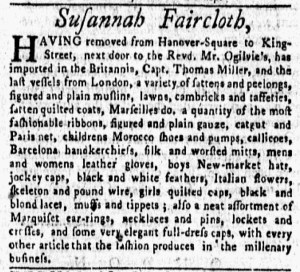
The appropriately named Susannah Faircloth sold a variety of textiles and adornments at her shop in New York in the early 1770s.  In an advertisement in the November 25, 1771, edition of the New-York Gazette and Weekly Mercury, she listed “a variety of sattens and peelongs, figured and plain muslins, lawns, cambricks and taffeties” and “figured and plain gauze,” naming an array of fabrics familiar to discerning eighteenth-century consumers.  She acquired her wares from England, having imported them “in the Britannia, Capt. Thomas Miller, and the last vessels from London.”

Faircloth and other advertisers reported such connections to the cosmopolitan center of the empire as a means of convincing prospective customers that they carried the latest fashions.  Elsewhere in the same issue, for instance, the partnership of Leigh and Price promoted goods “imported by the Britannia, Capt. Miller, and by the late Vessels from London.”  Several artisans who set up shop in New York indicated that they formerly practiced their trades in London, including Bennett and Dixon, “Jewellers, Goldsmiths, and Lapidaries, from LONDON,” James Yeoman, “WATCH and CLOCK-MAKER, from LONDON,” and Thomas Brown, “Marble Cutter, FROM LONDON.”  With so many artisans hailing from London and so many merchants and shopkeepers outfitting customers in garments and goods from London, the advertisements in the New-York Gazette and Weekly Mercury suggested to customers that they had full access to the styles of the fashionable metropolis.

Faircloth also invoked the latest tastes more explicitly.  Among her inventory, she carried “a quantity of the most fashionable ribbons.”  She concluded her advertisement with a proclamation that she also sold “every other article that the fashion produces in the millenary business.”  Prospective customers could depend on her to offer more than just goods shipped from London.  She also provided knowledge of the latest trends, a valuable resource for consumers.

November 11

What was advertised in a colonial American newspaper 250 years ago today?

New-York Gazette and Weekly Mercury (November 11, 1771).

“Mr. SAUNDERS … is lately returned to this town.”

Hyman Saunders needed no introduction … or, more appropriately, when the illusionist returned to New York after an absence of a couple of months in 1771 he needed very little introduction.  In a brief advertisement in the November 11 edition of the New-York Gazette and Weekly Mercury, Saunders “acquaint[ed] the nobility and gentry, that he is lately returned to this town, and intends to perform in private, (only) his dexterity and grand deception, to any select company.”  He advised those who wished to hire him to perform to send a note via the printer a day in advance.

Saunders needed little introduction in part because he had advertised in the public prints upon first arriving in New York a year earlier.  In the fall of 1770, he placed advertisements in the New-York Journal to announce that he had “Just arrived from EUROPE” and intended to stage “several new and astonishing performances in the dexterity of hand, different from what has been hitherto attempted, and such as was never seen in this province.”  Saunders offered a spectacle to entertain audiences, both those who attended his public performances and those who hired him for private shows.  To incite demand, he proclaimed that he would stay in the city “but a few weeks,” a common strategy among itinerant performers, but he extended his stay into February 1771.  At that time, he informed prospective audiences that he “intends to CONTINUE his PERFORMANCES a few Nights.”  He did indeed move on to Philadelphia eventually, advertising in the May 6, 1771, edition of the Pennsylvania Chronicle that he had “Just arrived from EUROPE” but had also performed “before his Excellency the Earl of DUNMORE, governor of New-York” upon arriving in the colonies.  In introducing himself to audiences in Philadelphia, Saunders distributed an advertisement that closely paralleled his initial notice in the New-York Journal.

He did not need to be so verbose when he returned to New York six months later.  His earlier advertisements introduced him to the public and his performances established his reputation in the city.  Those who saw performances of his “dexterity and grand deception” likely bolstered his publicity in the press via conversations with family, friends, and acquaintances.  In the fall of 1771, the itinerant performer no longer required the same sort of elaborate advertisements that he customarily inserted in local newspapers upon arriving in a new town.  Familiar to New Yorkers, Saunders determined that a brief notice would suffice.

October 7

What was advertised in a colonial American newspaper 250 years ago today?

New-York Gazette and Weekly Mercury (October 7, 1771).

“High Gaine has for sale, a great variety of books.”

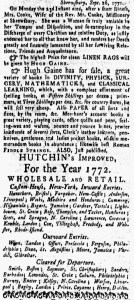
Although some colonial printers reserved the final pages of their newspapers for advertising, not all did so.  In many newspapers, paid notices could and did appear on any page, including the front page.  Such was the case in Hugh Gaine’s New-York Gazette and Weekly Mercury.  Consider the issue for October 7, 1771.  Gaine divided the first page between news items and advertising, filling the first two columns with the former and the last two with the latter.  He did the sane on the second page.  On the third page, he arranged news in the first column and into the second, but the bottom half of the second column as well as the remaining two columns consisted entirely of advertising.  Gaine gave over the entire final page to paid notices.

In general, Gaine placed news and advertising next to each other, but, like other printers who followed that method, he did not intersperse news and advertising on the page.  He delineated space intended for news and space intended for advertising rather than having paid notices appear among news items and editorials … with one exception.  He inserted an advertisement for books, stationery, and other items available at his printing office among the news on the third page. That advertisement appeared below a death notice for “Mrs. Cooke, Wife of the Rev. Mr. Cooke, Missionary at Shrewsbury,” and above the shipping news from the New York Custom House.  A line of ornamental type then separated the news (and Gaine’s advertisement) from the advertisements that completed the column and filled the remainder of the page.  In choosing this format, Gaine increased the likelihood that readers perusing the newspaper for news and skipping over the sections for advertising would see his own advertisement.  He was not the only colonial printer who sometimes adopted that strategy, leveraging his access to the press to give his own advertisement a privileged place.  Gaine inserted other advertisements elsewhere in the October 7 edition, most of them short notices intended to complete a column, but he exerted special effort in drawing attention to his most extensive advertisement by embedding it among the news.  His customers who purchased space for their notices did not have the same option.

September 25

What was advertised in a colonial American newspaper 250 years ago this week?

New-York Gazette and Weekly Mercury (September 23, 1771).

“[The particulars are ommitted this week for want of room.]”

When the ship America arrived in New York as summer turned to fall in 1771, merchants and shopkeepers received new merchandise from their associates in England.  Many of them placed newspaper advertisements to alert prospective customers that they had new inventory.  Purveyors of goods were not alone, however, in welcoming new opportunities to do business.  For Hugh Gaine, the printer of the New-York Gazette and Weekly Mercury, the America delivered more than just news for him to publish but also opportunities to generate advertising revenue.

Henry Remsen and Company placed an advertisement announcing that they “Have imported in the America, Capt. Hervey, from Hull … a general assortment of seasonable goods.”  Similarly, Daniel Phoenix noted that he “Has just imported in the America, Capt. Hervey, from Hull … the following goods” and then, like Remsen and Company listed dozens of items.  Henry Williams ran a shorter advertisement, but he also declared that he “HATH imported by theAmerica, Captain Hervey,” a variety of textiles that he would sell for low prices.

Gerret Keteltas and Wynandt Keteltas also published a short advertisement in the September 23 edition of the New-York Gazette and Weekly Mercury, after receiving “a neat and general assortment of European and India goods” via “the America, Capt. Hervey.”  Unlike the others, their advertisement did not appear in its entirety.  Instead, Gaine truncated their notice and included an explanation that “The particulars are ommitted this week for want of room.”  The printer could have made room for the advertisement, but at the expense of publishing news from London received by ships that recently arrived in New York.  Instead, he gave the Keteltases’ advertisement a privileged spot in the next edition placing it at the top of one of the columns on the third page.  It appeared immediately below the chart of high tides and prices current that Gaine regularly incorporated into the masthead, making it even more likely that readers would take note of the advertisement.

Like other printers, Gaine faced editorial decisions about the balance of news and advertising.  Paid notices accounted for significant revenue for many printers, especially for Gaine since he regularly issued a two-page supplement devoted entirely to advertising.  Yet subscribers who wanted to read the news were also an important part of the equation.  If they discontinued their subscriptions because they did not receive as much news content as they wished, then newspapers became less attractive to advertisers who wished to reach as many prospective customers as possible.  In this instance, Gaine attempted to chart a course to satisfy both readers and advertisers when both news and imported good arrived on the America.

September 23

What was advertised in a colonial American newspaper 250 years ago today?

Supplement to the Boston-Gazette (September 23, 1771).

A large and compleat Assortment of ENGLISH, INDIA, and SCOTCH GOODS.”

Benjamin Edes and John Gill, printers of the Boston-Gazette, had more content than would fit in the standard issue on September 23, 1771.  Like other newspapers published during the colonial era, an issue of the Boston-Gazette consisted of four pages.  Edes and Gill printed two pages on each side of a broadsheet and then folded it in half.  On occasion, however, they had sufficient content to merit publishing a supplement to accompany the standard issue.  They did so on September 23.  Hugh Gaine, printer of the New-York Gazette and Weekly Mercury, did so as well.

Both supplements consisted of two pages.  Both contained advertisements exclusively.  Despite these differences, Gaine adopted a slightly different strategy in producing the supplement for his newspaper than Edes and Gill did.  The standard issue of the New-York Gazette and Weekly Mercury featured four columns per page.  The supplement did as well.  Gaine used a half sheet that matched the size of the standard issue; all six pages were the same size.  Edes and Gill, on the other hand, did not.  A standard issue of the Boston-Gazette had three columns, but only two columns for the supplement.  The printers chose a smaller sheet to match the amount of content and conserve paper.  They generated revenue from the advertisements in the supplement, but kept costs down in producing it.

The relative sizes of the supplements compared to the standard issues would be readily apparent when consulting originals, but not when working with digitized images.  As a result of remediation, digital images become the size of the screen and change as readers zoom in and zoom out.  The size of the page of a digital image is not permanent, unlike the size of the page of the original newspaper.  In the process of remediation, information about originals gets lost if those creating new images do not record and make metadata accessible.  In this case, modern readers consulting digitized images can deduce that Edes and Gill used a different size sheet for the supplement, but have a much more difficult time imagining the experience of eighteenth-century subscribers who received sheets of two different sizes.

September 2

What was advertised in a colonial American newspaper 250 years ago today?

Pennsylvania Chronicle (September 2, 1771).

“Those who have taken subscriptions of others, [send] their lists … to the Publisher.”

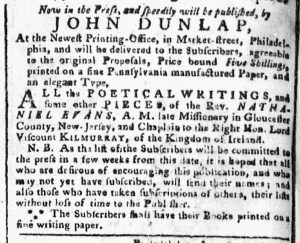
In the course of just a few days late in the summer of 1771, readers in New England, New York, Pennsylvania, and South Carolina encountered the same advertisement in their local newspapers.  John Dunlap, a printer in Philadelphia, distributed subscription notices for his current project, “ALL THE POETICAL WRITINGS, AND SOME OTHER PIECES, of the Rev. NATHANIEL EVANS,” in order to entice customers in distant places to reserve copies of the forthcoming work.  On September 2, Dunlap’s advertisement ran in the New-York Gazette and Weekly Mercury, the Pennsylvania Chronicle, and the South-Carolina and American General Gazette.  Four days earlier, the same advertisement ran in the Massachusetts Gazette and Boston Weekly News-Letter and the Pennsylvania Journal.

With one exception, the advertisements featured identical copy with minor variations in format, the copy being the domain of the advertiser and decisions about design at the discretion of the compositor.  The exception concerned the directions issued to prospective subscribers for submitting their names.  In the newspapers published in Philadelphia, Dunlap requested “that all who are desirous of encouraging this publication, and who may not yet have subscribed, will send their names” to him directly.  In addition, he asked that “those who have taken subscriptions of others,” acting as agents on Dunlap’s behalf, dispatch “their lists without loss of time to the Publisher.”  In the advertisements in the other newspapers, however, he instructed subscribers to submit their names “to the Printer hereof.”  Newspaper printers in other cities served as his local agents, including Richard Draper in Boston and Hugh Gaine in New York.  Robert Wells, printer of the South-Carolina and American General Gazette, underscored that he was Dunlap’s local agents, revising the copy in his newspaper to instruct subscribers to “send in their Names, without Loss of Time, to ROBERT WELLS.”

Dunlap did not rely merely on generating demand among local customers when he published “THE POETICAL WRITINGS … of the Rev. NATHANIEL EVANS.”  Instead, he inserted subscription notices in newspapers published in the largest cities in the colonies, hoping to incite greater interest in the project and attract additional buyers.  In the process, he recruited other printers to act as local agents who collected subscriptions on his behalf.  He created a network of associates that extended from New England to South Carolina as part of his marketing campaign.

August 28

What was advertised in a colonial American newspaper 250 years ago this week?

New-York Gazette and Weekly Mercury (August 26, 1771).

“Some of the best workmen … that could be had in any part of England.”

In the summer of 1771, Bennett and Dixon introduced themselves to residents of New York as “Jewellers, Gold-smiths, and Lapidaries, from London” and invited prospective customers to their shop near the post office.  The partners recently imported “a great variety of jewellery,” including “necklaces, ear rings, egrets, sprigs and pins for ladies hair, rings, lockets, and broaches of all sorts, ladies tortoise-shell combs plain and sett,” and many sorts of buckles.  They promised low prices for both wholesale and retail prices.

Yet Bennett and Dixon were not merely purveyors of imported jewelry, accessories, and adornments.  They also accepted commissions and fabricated items at their shop.  In promoting that aspect of their business, they underscored the level of skill represented among their employees.  “[F]or the better carrying on the jewellery, goldsmith and lapidary business,” Bennett and Dixon proclaimed, they “engaged some of the best workmen in those branches, that could be had in any part of England.”  The partners imported not only merchandise and materials but also artisans with exceptional skills.  Prospective customers did not need to feel anxious that items they ordered from Bennett and Dixon would be of inferior quality or easily distinguished from imported jewelry.  Even though New York was far away from London, the cosmopolitan center of the empire, consumers could still acquire custom-made jewelry that rivaled anything produced on the other side of the Atlantic.  Bennett and Dixon also declared that their customers did not have to pay a premium for jewelry as “good as in the City of London.”  Their artisans worked “as cheap” as their counterparts there, keeping prices reasonable for customers who placed special orders.

Colonial consumers often worried that they only had access to second best when compared to goods and services available in English cities, especially London.  Advertisers like Bennett and Dixon frequently reassured prospective customers that they had choices that rivaled anything available to consumers in the metropolitan center of the empire.

July 3

What was advertised in a colonial American newspaper 250 years ago this week?

Pennsylvania Chronicle (July 1, 1771).

“THE imprudent Behaviour of my Son JESSE HALL, lays me under the painful Necessity of forwarning all Persons from harbouring or concealing him.”

Conradt Wolff lamented that his wife, Jenny, “hath behaved herself in such a manner as lays me under a necessity of forbidding any persons from trusting her on my account.”  In an advertisement in the July 1, 1771, edition of the New-York Gazette and Weekly Mercury, he warned the public that he “will pay no debts of her contracting.”  Throughout the colonies, similar notices frequently ran in eighteenth-century newspapers.  Aggrieved husbands deployed “runaway wife” advertisements to discipline disobedient women, though their notices told only one side of a story of marital discord. Relatively few wives possessed the resources to respond in print.  Those that did usually provided much different narratives, often accusing their husbands of abuse and neglect.  From their perspective, running away was an act of self-preservation and principled resistance rather than willful disobedience.

On occasion, colonists resorted to the public prints in the wake of other sorts of tumult within their households.  On the same day that Wolff placed an advertisement in the New-York Gazette, Moses Hall placed his own notice in the Pennsylvania Chronicle.  Hall, however, deplored the misbehavior of his son, Jesse.  “THE imprudent Behaviour of my Son,” Hall declared, “lays me under the painful Necessity of forwarning all Persons from harbouring or concealing him.” Furthermore, “they may depend on being prosecuted to the utmost Rigour of the Law, if they disregard this Notice.”  Hall did not elaborate on his son’s “imprudent Behaviour,” though gossip and rumors likely circulated beyond the newspaper.  That was almost certainly the case for the Camps and the Brents in Elizabethtown, New Jersey.  John D. Camp, Jr., informed readers of the New-York Gazette that he had been “compel’d by David Brent, to marry Catherine, his daughter.”  Camp vowed to “allow her a separate Maintenance, in all Respects suitable to her Degree,” but he would not pay “any Debts of her Contracting.”  Camp carefully avoided the details about events that resulted in his unwelcome wedding.  If friends and acquaintances had not been discussing whatever transpired between John and Catherine and her father before the advertisement ran in the New-York Gazette, its appearance probably prompted them to share what they knew for certain and speculate on what they did not.

Wolff, Hall, and Camp all attempted to focus attention on the subjects of their advertisements:  an absent wife, a troublesome son, or an imperious father-in-law.  In even publishing their notices, however, they called attention to themselves and their shortcomings in maintaining order within their households.  They sought to regain authority through the power of the press, but in the process they made their private altercations all the more visible to the public.  They framed the narratives and obscured the details, yet they still alerted others to scenes of difficulty and embarrassment that did not reflect well on them despite their efforts to shift responsibility to the actions of others.

July 1

What was advertised in a colonial American newspaper 250 years ago today?

New-York Gazette and Weekly Mercury (July 1, 1771).

“A continuance of the same circumspect conduct and integrity.”

In the late 1760s and early 1770s, John Coghill Knapp regularly advertised the services he provided at the “Scrivener, Register, and Conveyancer’s OFFICE” in New York, including “Writings and conveyances of every kind” and “Different sums of money ready to lend.”  He also assisted in recovering debts “in the most civiliz’d easy manner, … at most times without law.”  In other words, through negotiation Knapp avoided going to court.  For “Executors and administrators,” especially those thrust into unfamiliar roles, he offered instruction “in the due execution of their office,” helping them navigate their responsibilities while “prevent[ing] the expence and difficulties from want of knowledge therein.”  In addition, Knapp aided “Seafaring men, and other strangers,” noting that they “often meet with difficulty in matter not altogether relative to the law.  Although he did not mention it in every advertisement, Knapp brokered sales of indentured servants and enslaved men, women, and children.

Knapp often composed colorful copy for his advertisements.  In a notice in the July 1, 1771, edition of the New-York Gazette and Weekly Mercury, he started with his credentials, stating that he was “ONE of the attornies of his Majesty’s high and honourable court of King’s Bench at Westminster, duly admitted, sworn, and inrolled, the 2d day of June 1755.”  After migrating to the colonies, he established his office in New York in 1764.  Having gained experience over the years, Knapp proclaimed that he “gives the most candid and satisfactory opinion and advice in all cases of law and equity, founded on such plain truths as are not to be overcome by the alluring arguments of any smooth tongue Causidie.”  Yet Knapp possessed a smooth tongue himself, declaring that he effectively met “the loud positive harangue of him who attempts to annihilate the reason of both judge and jury.”  The attorney deployed clever turns of phrase to impress potential clients with his competence and effectiveness.

Such flamboyance, however, attracted critiques.  In addition to describing his credential and services, Knapp also offered some sort of defense of his conduct in many of his advertisements.  He claimed, for instance, that he acted with integrity and requested that manner in which he “executed the business of this office for seven years past, will intitle him to a continuance of that favour and protection” that he previously received from clients and associates in the face of attacks from competitors and rivals.  In lively language that only hinted at the particulars of previous controversies, Knapp asserted that “he has so feelingly overcome the many daring assaults and unspeakable injuries done to his person and property, by cruel, invidious and designing men.”  He labeled them “hypocrites, pretending with so much ease to see the mote in their brother’s eye, but cannot behold the beam that is in their own.”

Knapp may have been an effective attorney and advocate for his clients, but that did not always win him friends.  Alternately, his verbose advertisements may have been the eighteenth-century equivalent of the bombastic marketing campaigns undertaken by many law firms with questionable reputations in the twentieth and twenty-first centuries.  Knapp claimed that he tended to his clients’ interests, but his vigorous defense of his own conduct suggested that many readers already possessed knowledge of events that yielded an unflattering reputation.  The attorney attempted to establish his own narrative, simultaneously demonstrating his skill in making arguments on behalf of clients.