December 23

What was advertised in a colonial American newspaper 250 years ago today?
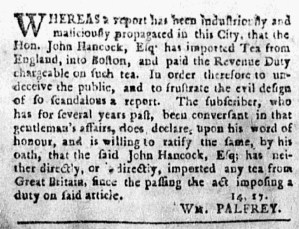
New-York Journal (December 23, 1773).

“John Hancock, Esq; has neither directly, or indirectly, imported any tea from Great Britain.”

As news of the Boston Tea Party reached New York and appeared in the December 23, 1773, edition of the New-York Journal, an advertisement in that newspaper took on new significance.  Starting on December 9 and continuing for four weeks, William Palfrey inserted an advertisement that addressed a “report [that] has been industriously and maliciously propagated in this City, that the Hon. John Hancock, Esq. has imported Tea from England, into Boston, and paid the Revenue Duty chargeable on such tea.”  Such rumors had the potential to tarnish the reputation of one of the merchants who had been most vocal in opposition to the provisions of the Tea Act, decrying Parliament’s attempts to meddle in affairs that he believed rightly belonged to colonial legislatures.

Palfrey, one Hancock’s clerks, took to the public prints to “undeceive the public, and to frustrate the evil design of so scandalous a report.”  He noted that he had “been conversant in that gentleman’s affairs” for “several years past” and, as a result, could vouch for Hancock.  In late 1773, many readers of the New-York Journal may not have been as familiar with the merchant as residents of Boston, though Hancock regularly appeared in articles reprinted from newspapers published in Massachusetts.  Five months before Palfrey’s advertisement appeared, the New-York Journal printed one of Governor Thomas Hutchinson’s letters from June 1768 that described the seizure of the Liberty, “a sloop belonging to Mr. Hancock, a wealthy merchant, of great influence over the populace,” for “a very notorious breach of the acts of trade.”  (The July 8, 1773, edition of the New-York Journal carried the entire letter and other private correspondence by the governor.)  Contrary to abiding by Parliament’s attempts to regulate colonial commerce and tax imported goods, Hancock had a history of smuggling tea and other items to avoid paying duties.  According to Palfrey, neither Hancock’s public position nor his private actions had changed.  The clerk declared “upon his word of honour” (and expressed his willingness to “ratify the dame, by his oath”) that Hancock had “neither directly, or indirectly, imported any tea from Great Britain, since the passing the act imposing a duty on said article” and most certainly had not paid import duties on tea.  As Jordan E. Taylor has recently demonstrated in Misinformation Nation: Foreign News and the Politics of Truth in Revolutionary America (2022), Patriots and Loyalists vied to establish narratives that fit their politics and their purposes, whether in newspapers, other printed materials, letters, or conversation.  That contest over the truth extended to advertisements, including Palfrey’s notice in the New-York Journal.

December 12

What was advertised in a colonial American newspaper 250 years ago this week?

New-York Journal (December 9, 1773).

“Advertisements of no more Length than Breadth are inserted for Five Shillings, four Weeks, and One Shilling for each Week after, and larger Advertisements in the same Proportion.”

Some printers kept the colophons for their newspapers quite simple, if they included one at all.  The colophon for the Boston-Gazette, for instance, simply stated, “Boston: Printed by EDES & GILL, in Queen-Street, 1773.”  The colophon for the Boston Evening-Post was even more streamlined: “BOSTON: Printed by THOMAS & JOHN FLEET.”  In each instance, the colophon usually appeared at the bottom of the final column on the last page, rather unobtrusive, though the printers sometimes moved the colophon to the third page if they lacked space.

In contrast, other printers inserted much more elaborate colophons that ran across all the columns at the bottom of the final page, that position a permanent element of the design of their newspapers.  In such cases, the colophons often doubled as advertisements, providing much more information than the name of the printer and place of publication.  Such was the case with the colophon for the New-York Journal.  The first line covered the basics: “NEW-YORK: Printed by JOHN HOLT, at the Printing-Office near the COFFEE-HOUSE.”  Two more lines made a sales pitch for the services available at Holt’s printing office, declaring “all Sorts of Printing is done in the neatest Manner, with Care and Expedition.”  Holt invited job printing orders, whether for broadsides, handbills, trade cards, or blanks, touting both his skill and speed in producing them.  He also solicited advertisements for the New-York Journal, an important source of revenue for any newspaper.  The colophon even listed the rates for placing notices: “Advertisements of no more Length than Breadth are inserted for Five Shillings, four Weeks, and One Shilling for each Week after, and larger Advertisements in the same Proportion.”  That initial fee covered both space in the newspaper, one shilling per week, and setting type, an additional shilling.  Setting four weeks as a minimum run generated content while simultaneously enhancing revenues.  Many advertisements in the New-York Journal ran for months rather than weeks.  (This raises suspicions about whether Holt actually charged for each insertion or continued running some advertisements to testify to current and prospective subscribers and potential advertisers about the popularity of his newspaper.)  While every printer welcomed advertisements for their newspapers, most did not regularly comment on the business of advertising.  Holt provided important details in his colophon.

October 28

What was advertised in a colonial American newspaper 250 years ago today?

New-York Journal (October 28, 1773).

“Gentlemen’s caps, and gloves, lined with fur, very useful for travelling, and sleighing.”

During the final week of October 1773, John Siemon, a furrier, inserted advertisements in three newspapers published in New York, placing his notices before the eyes of as many readers in and near the city as possible.  He hawked a “General and complete assortment, of new fashion’d muffs & tippets, ermine, cloak linings, … gentlemen’s caps, and gloves, lined with fur,” and other items.  In addition, he “trims Ladies robes and riding dresses” and “faces and lapels Gentlemen’s waistcoats.”  As an ancillary service, Siemon provided directions “to rub the furs in summer” to keep them in good condition when not being worn.

Although Siemon submitted nearly identical copy to the three printing offices, his advertisements had very different formats when they appeared in the newspapers.  Arguably the one that best represented Siemon’s brand, the notice in the New-York Journal featured a woodcut depicting a muff, an image that regularly accompanied the furrier’s advertisements.  Siemon apparently considered it worth the investment to commission a single woodcut for the exclusive use of his business, but did not realize the potential of purchasing multiple woodcuts with the same image in order to achieve visual consistency and product recognition across several publications.

Rivington’s New-York Gazetteer (October 28, 1773).

Siemon’s advertisement in Rivington’s New-York Gazetteer had a different kind of visual appeal.  The furrier joined the ranks of advertisers who enclosed their notices within borders comprised of decorative type, including Crommelin and Horsfield, bakers, John J. Roosevelt, a merchant, Richard Sause, a cutler.  James Rivington and the compositors in his printing office made such borders a regular part of advertisements for consumer goods and services.  Those borders helped to draw attention to certain advertisements while also giving the pages of Rivington’s newspaper a distinctive look.  In contrast, no images or decorative type adorned Siemon’s advertisement in the New-York Gazette and Weekly Mercury.  It consisted solely of text with the typography determined by the compositor to match other advertisements in that publication.

New-York Gazette and Weekly Mercury (October 25, 1773).

In most instances, advertisers submitted copy to printing offices and then compositors determined the format of the advertisements.  Siemon’s advertisements suggest that was indeed the case when advertising in the New-York Gazette and Weekly Mercury, yet he offered specific directions, in the form of the familiar woodcut, for his advertisement in the New-York Journal.  His advertisement in Rivington’s New-York Gazetteer demonstrates the greatest level of collaboration between advertiser and compositor.  Siemon either requested or agreed to include a distinctive visual element associated with notices in that newspaper.  The furrier took graphic design into account to varying degrees in his efforts to disseminate his advertisements in multiple newspapers.

October 17

What was advertised in a colonial American newspaper 250 years ago this week?

New-York Journal (October 14, 1773).

“He continues to teach … whatever is requisite to fit the young Students for Admission into any College or University.”

In the fall of 1773, J. Peter Tetard sought students for the boarding school he operated “near King’s Bridge,” about fifteen miles outside of New York.  In an advertisement in the October 14 edition of the New-York Journal, he expressed his appreciation for “the encouragement” he received since opening the school over the summer, suggesting both that the enterprise earned the approval of prominent colonizers and that some parents already enrolled their children in the school.  Yet he still had space for more students.

To entice parents to send their sons to his boarding school, Tetard made an appeal that continues to resonate today.  His curriculum encompassed “whatever is requisite to fit the young Students for Admission into any College or University.”  Tetard depicted matriculating at his academy as preparation that would lead to subsequent academic success.  To that end, he taught “the French Language in the most expeditious Manner, together with some of the most useful Sciences.”  Those included geography, ancient and modern history, logic, and “the learned Languages.”  His pupils acquired the ability to engage in “the skilful reading of the Classics.”  All of this set Tetard’s students on the path for further study at one of the colleges in the colonies or perhaps even a university in Europe, depending on their status and wealth.

Beyond the curriculum, Tetard emphasized his own role as instructor.  He described himself as “Late Minister of the Reformed French Church” in New York.  Most colonizers in New York remained deeply suspicious of both the French and Catholicism at the time, making it imperative that Tetard establish his commitment to Protestantism.  For parents unfamiliar with his reputation, he stated that his “Character and Capacity are well-known” as a result of residing “with Credit in the City of New-York for upwards of fifteen Years.”  Parents of prospective pupils who had concerns about Tetard’s faith or acumen as an instructor could make inquiries of friends and acquaintances who had lived in the city at the same time as the minister-turned-schoolmaster.  Tetard pledged that “Gentlemen who will entrust him with the Education of their Children, may depend on their Expectations being properly answered,” in terms of academic instruction, moral formation, and spiritual guidance.

Tetard also commented briefly on the building that housed his boarding school, noting that it “is remarkable for its healthy Situation, commanding one of the finest Prospects” in the colony.  In his advertisement, he introduced three elements that remain important in marketing education in the twenty-first century.  Tetard emphasized the quality of the faculty, the benefits associated with the facilities, and the preparation necessary to succeed in subsequent endeavors.

September 5

What was advertised in a colonial American newspaper 250 years ago this week?

New-York Journal (September 2, 1773).

“The Transpositions in Mr. SKINNER’S Advertisement, in our Paper … were owing to an Error in the Press.”

Something strange happened with S. Sp. Skinner’s advertisement for “the best of RUM” in the New-York Journal near the end of summer in 1773.  In the September 2 edition, a manicule directed attention to a note from the printing office: “The Transpositions in Mr. SKINNER’S Advertisement, in our Paper, Number 1597, and 1598, were owing to an Error in the Press.”  John Holt, the printer, apparently attempted to make amends with an advertiser after making mistakes in a notice that ran for several months.

Skinner’s advertisement first ran in the December 31, 1772, edition of the New-York Journal and then ran regularly for the next five months.  On May 27, 1773, he added a nota bene: “To prevent further Mistakes, desires his Country Customers to take Notice, that there is a Distillery adjoining Mr. Skinner’s Buildings, to the Southward, which is not occupied by him.”  Skinner did not want his advertisements to inadvertently send customers to his competitor.  The updated advertisement continued through August 5.  In the August 12 edition, however, six lines from the original advertisement were mistakenly printed below the nota bene, creating an advertisement that did not make sense.  Someone in the printing office noticed the error after that edition, “NUMBER 1597,” went to press … or perhaps Skinner contacted the printer …and attempted to make corrections for the August 19 edition, “NUMBER 1598.”  However, that only resulted in lengthening the advertisement by the nota bene a second time at the end.  It did not remedy the original error.  The compositor managed to make the necessary corrections for the August 26 edition.  The following week, Skinner launched a new advertisement, a shorter one, in the September 2 edition.  The first time it appeared, it included the note from the printing office, but not in subsequent insertions.

New-York Journal (August 5, 1773; August 12, 1773; August 19, 1773).

The various iterations of Skinner’s advertisement demonstrate a kind of error that was possible yet rarely occurred as printing offices throughout the colonies published advertisements for multiple weeks or even many months.  Typically, compositors set the type for each advertisement once, but then repositioned advertisements in each issue to make all the content fit.  That included adding new advertisements and removing others, all done without duplicating labor by setting type for any advertisement more than once.  What exactly occurred with Skinner’s advertisement, how the printing office introduced “The Transpositions” on August 12, is not readily apparent, though Holt and others clearly attempted to make corrections, introducing more “Transpositions” in the first attempt on August 19.  Most advertisements in colonial newspapers appeared week after week in the same format as their original insertion, printed from the same type. Something unusual, maybe even careless, happened with Skinner’s advertisement, prompting the printer to acknowledge the error, perhaps after receiving complaints from the advertiser about haphazard copy that made the notice border on gibberish.

July 25

What was advertised in a colonial American newspaper 250 years ago this week?

Rivington’s New-York Gazetteer (July 22, 1773).

“HORSEMANSHIP.”

“MR. BATES PROPOSES to perform on Tuesday next, and on Friday the 30th instant, and no more, before he leaves this City.”  That brief advertisement in the July 22 edition of Rivington’s New-York Gazetteer put readers on notice that only limited opportunities remained to see Bates’s show.  From both his frequent advertisements in New York’s newspapers and the reputation that he cultivated in the city, most readers probably knew that Bates performed feats of horsemanship for the entertainment of his audiences.

New-York Journal (July 22, 1773).

A much longer advertisement in the New-York Journal on the same day deployed the usual headline, “HORSEMANSHIP,” and described him as “The ORIGINAL PERFORMER.”  Bates offered a spectacle of the “MANLY ARTS” that he previously performed for dignitaries that included “the Emperor of Germany, the Empress of Russia, the King of Great-Britain, the French King, the Kings of Prussia, Portugal, Sweden, Denmark, and Poland, and the Prince of Orange.”  Bates confided that he “received the greatest applause” for those performances, “as can be made manifest by the CERTIFICATES from the several courts now in his possession.”  Readers did not have to take his word for it that he presented his feats of horsemanship to monarchs and aristocrats.  For a mere four shillings, colonizers in New York could gain access to the same exhibition enjoyed by royals and nobles, but they had to purchase tickets in advance because “No money will be taken at the Doors, nor Admittance without Tickets.”  Bates welcomed “Ladies and Gentlemen” and provided “proper” seating for their comfort, but requested that “Gentlemen will not suffer any dogs to come with them” for fear of scaring or distracting the horses.

A manicule drew attention to the same appeal that appeared in the other newspaper, though stated differently.  “Mr. Bates proposes, but twice more, before he leaves this City, to exhibit his Performances in Horsemanship,” the equestrian daredevil stated.  That being the case, he intended to sell “the Boards, Scantling, &c. at his riding Inclosure, together with the Benches, Rails, &c.”  Dismantling the venue underscored that audiences had only a limited time to witness Bates performing “on one, two, three and four Horses, at the Bulls-Head, in Bowery-Lane.”  They risked missing a performance that would “excel any Horseman that ever attempted any thing of the kind” if they hesitated and did not buy their tickets as soon as possible.

July 1

What was advertised in a colonial American newspaper 250 years ago today?

Supplement to the New-York Journal (July 1, 1773).

“Advice to the cautious, who are about to buy, swop, and little jobs to the wise for nothing.”

On July 1, 1773, watchmaker John Simnet placed a new advertisement in Rivington’s New-York Gazetteer.  On that day, another of his advertisements appeared in the New-York Journal for the tenth time.  While not uncommon for merchants, shopkeepers, and artisans to advertise in more than one newspaper simultaneously, they usually submitted identical notices to each printing office.  Prospective customers usually encountered the same advertisement no matter which publication they happened to read.

Simnet’s advertisements in the two newspapers were not that much different.  In each, he informed the public that he recently “removed” to a new location.  He also proclaimed that he charged “half the price” of his competitors when it came to cleaning and repairing watches, in addition to offering a service plan in which he would “keep them in order at his own trouble, without expence (except abused).”  In other words, as long as clients treated their watches well, Simnet provided small repairs free of charge.  The watchmaker, a frequent advertiser, had been promoting these aspects of his business for quite some time, even before one of his current advertisements first ran in the New-York Journal on April 29.

Rivington’s New-York Gazetteer (July 1, 1773).

He made additional appeals in his new advertisement in Rivington’s New-York Gazetteer.  In particular, he offered “advice to the cautious, who are about to buy, swop, and little jobs to the wise for nothing.”  With the exception of small jobs undertaken gratis, these services had not previously been part of Simnet’s marketing efforts in the public prints.  The description he deployed closely replicated the language that Thomas Hilldrup, a watchmaker in Hartford, used in advertisements that ran in all three newspapers published in Connecticut.  In those notices, Hilldrup declared that he offered “advice to those who are about to buy, sell or exchange, and any other jobbs that take up but little time gratis.” Simnet almost certainly saw those advertisements, especially considering that he advertised in the Connecticut Courant for the first time in January 1773.  He had been active in the greater New York market for more than two years, after relocating from Portsmouth, New Hampshire, but had not considered it necessary to advertise in any of the newspapers published in Connecticut until Hilldrup arrived in the colony in the fall of 1772 and then devised an extensive advertising campaign over the next several months.

One other aspect of Simnet’s new notice merits attention, especially considering that he placed it in a newspaper that served Connecticut, New Jersey, the Hudson River, and Quebec.  Simnet asserted that he was the “ONLY regular Watchmaker here, of the London Company,” a claim that he frequently made in other advertisements as a means of denigrating his competitors.  In addition, he had a long history of picking fights and engaging in public feuds in his newspaper advertisements, first in Portsmouth and then in New York.  It comes as little surprise that he would appropriate the marketing strategies of a competitor while simultaneously contending that he possessed superior skill and training, especially in a newspaper that he anticipated that competitor was likely to read.  The cantankerous watchmaker often seemed as interested in taunting his competitors as attracting clients to his shop.

June 27

What was advertised in a colonial American newspaper 250 years ago this week?

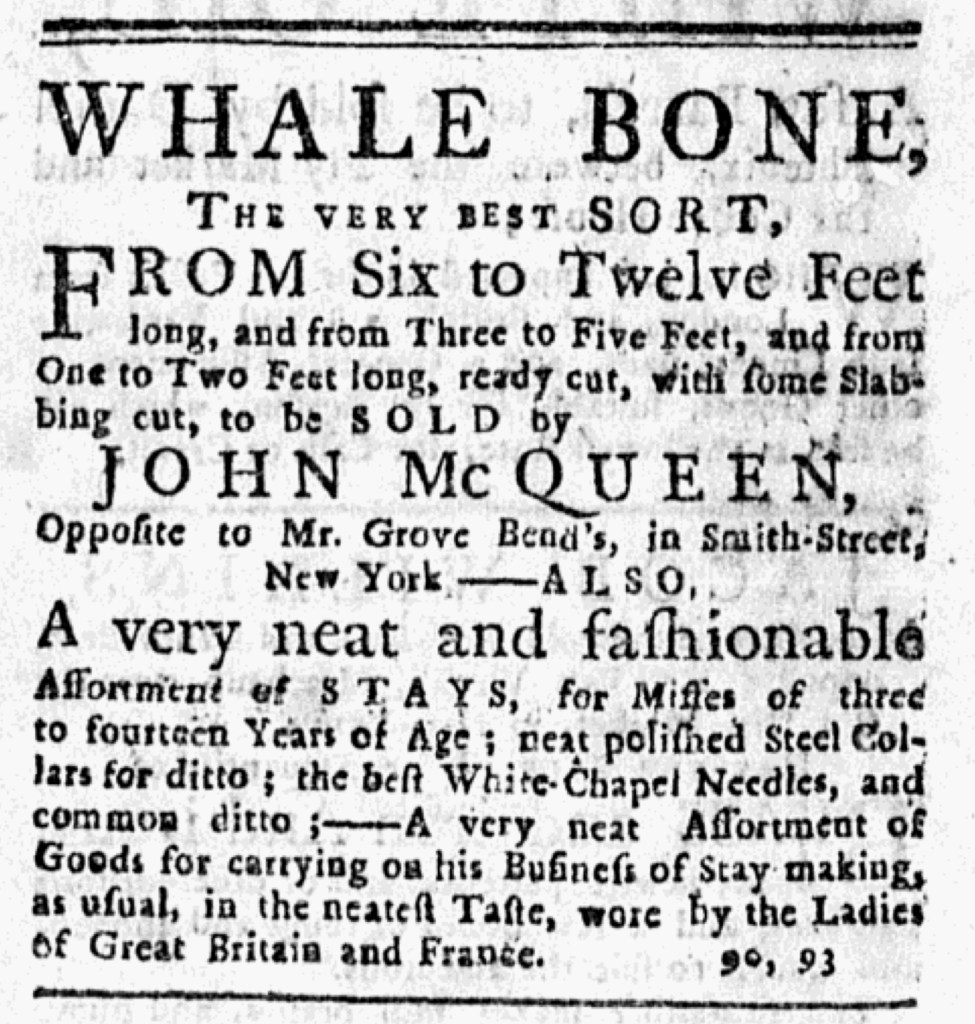
New-York Journal (June 24, 1773).

“Carrying on his Business of Stay-making … in the neatest Taste, wore by the Ladies of Great Britain and France.”

John McQueen continued making and selling stays in New York in 1773.  He had been living, working, and advertising in the city for many years.  Similar to a corset, a pair of stays, according to the Oxford English Dictionary, consisted of a “laced underbodice, stiffened by the insertion of whale-bone (sometimes of metal or wood) worn by women (sometimes by men) to give shape and support to the figure.”  Furthermore, the “use of the plural is due to the fact that stays were originally (as they still are usually) made in two pieces laced together.”  John White included a woodcut depicting a pair of stays and lacing in his advertisement in the September 19, 1772, edition of the Pennsylvania Chronicle.

When he advertised in the New-York Journal in June 1773, McQueen emphasized his role as a supplier of “WHALE BONE” of “THE VERY BEST SORT” to other staymakers.  In addition, he stocked a “very neat and fashionable Assortment of STAYS, for Misses of three to fourteen Years of Age.”  Apparently, both staymakers and consumers did not believe that girls were ever too young to deploy these devices to shape their figures.”  Richard Norris, another staymaker in New York, regularly placed newspaper advertisements addressed to “young Ladies and growing Misses” as well as “Any Ladies uneasy in their shapes.”  Cultivating and preying on such anxieties was not invented by the modern beauty and fashion industries.

McQueen also resorted to another familiar refrain, declaring that he had on hand a “very neat Assortment of Goods for carrying on his Business of Stay-making, as usual, in the neatest Taste, wore by the Ladies of Great Britain and France.”  He often made such transatlantic connections, suggesting to prospective customers that he could assist them in demonstrating the sort of sophistication associated with cosmopolitan cities in Europe.  In 1766, he declared that he made stays “in the newest Fashion that is wore by the Ladies of Great-Britain or France.”  In another advertisement from 1767, he confided that he made “all sorts of Stays for Ladies, in the newest Fashions that is wore in London.”  Encouraging anxiety about the female form and making comparisons to fashionable elites became standard marketing strategies for McQueen and other staymakers in the eighteenth century.

April 18

What was advertised in a colonial American newspaper 250 years ago this week?

New-York Journal (April 15, 1773).

“A Paper of as good Credit and Utility as any extant.”

An advertisement address to “the respectable Publick” informed readers of the New-York Journal that Samuel F. Parker and John Anderson “entered into Partnership together … and propose in August next, to publish the New-York Gazette, or the Weekly Post Boy.”  The newspaper, founded as the New-York Weekly Post-Boy in 1743, had a long history in the city.

James Parker, great-uncle to Samuel F. Parker, established the newspaper, took William Weyman into partnership in 1753, and dissolved the partnership one week before retiring in 1759.[1]  At that time, his nephew, Samuel Parker, continued the newspaper, taking John Holt into partnership the following year.  When Parker and Holt dissolved their partnership in 1762, Holt became the publisher of the newspaper.  According to Isaiah Thomas, the newspaper “appeared in mourning on the 31st of October, 1765, on account of the stamp act; it was, however, carried on as usual, without any suspension, and without any stamps.”[2]  When Parker wished to resume printing a newspaper in 1766, Holt opted to adopt a new title, the New-York Journal, and continued the volume numbering of the New-York Gazette or Weekly Post-Boy.  Parker regained that title and resumed publication in October 1766, also continuing the volume numbering.  Upon Parker’s death in 1770, Samuel Inslee and Anthony Car leased the newspaper from his son, Samuel F. Parker, and printed it until the end of their lease in August 1773.

Parker and Anderson anticipated the conclusion of that lease.  While they likely did not expect the public to know all the details of the newspaper’s publication history, they did believe that many readers would have been familiar with Parker’s father and the reputation of the newspaper as “a Paper of as good Credit and Utility as any extant since the first Commencement thereof.”  They intended to continue that tradition “by every possible Means” and pledged to deliver “especial Service [for] the Commercial Interest.”  In addition to publishing shipping news, prices current, and other content for the benefit of merchants, they also planned to provide for “the Amusement and Information of private Families in Matters both Foreign and Domestick.”  Amid the debates of the period, Parker and Anderson promised “free Access to all Parties without Distinction.”  In other words, they did not intend to operate a partisan press but instead welcomed “Pieces directed to the Proprietors” as long as the “Subject Matter” was “consistent, and within due Bounds to admit of Publication.”

Such lofty goals, however, did not meet with success.  Parker and Anderson published the New-York Gazette or Weekly Post-Boy for a few weeks in August and September 1773.  They may have continued the newspaper into November, but no issues bearing their imprint have been identified.  On December 9, Anderson ran an advertisement in Rivington’s New-York Gazetteer that announced the partnership had dissolved and called on “all persons that may have any demands against said partnership [to] bring in their accompts and receive payment.”  Anderson also noted that he “continues carrying on the Printing-Business in all its branches.”  Despite the difficulty he experienced with the New-York Gazette or Weekly Post-Boy, Anderson launched another newspaper, the Constitutional Gazette, in August 1775.  It lasted thirteen months, folding when the British occupied New York in September 1776.[3]

**********

[1] Unless otherwise noted, the details of the publication history come from the entries for the New-York Gazette, or Weekly Post-Boy (635-6) and New-York Weekly Post-Boy (704) in Clarence S. Brigham, History and Bibliography of American Newspapers, 1690-1820 (Worcester, Massachusetts: American Antiquarian Society, 1947).

[2] Isaiah Thomas, The History of Printing in America: With a Biography of Printers and an Account of Newspapers (1810; New York: Weathervane Books, 1970), 494.

[3] See the entry for the Constitutional Gazette in Brigham, History and Bibliography of American Newspapers, 618.

April 4

What was advertised in a colonial American newspaper 250 years ago this week?

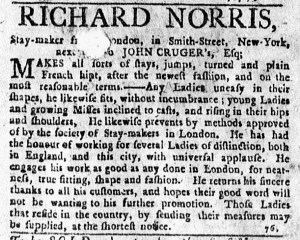
New-York Journal (April 1, 1773).

“Any Ladies uneasy in their shapes, he likewise fits, without incumbrance.”

Richard Norris billed himself as a “Stay-maker from London” even though he had resided and worked in New York for several years by the time he published his advertisement in the April 1, 1773, edition of the New-York Journal.  He considered his connection to the largest and most cosmopolitan city in the empire a selling point.  Norris informed readers that he previously served the best sorts of clients on both sides of the Atlantic, declaring that he “has had the honour of working for several Ladies of distinction, both in England, and this city.”  The quality of his stays (or corsets) and his skill in producing them yielded “universal applause” from his clients.

Although Norris had been in New York for some time, he also suggested that he maintained his connection to London.  For instance, he made stays “after the newest fashion” in that city.  In another advertisement, he described how he “acquires the first fashions of the court of London by a correspondent he has settled there.”  Furthermore, he adhered to “methods approved of by the society of Stay-makers in London” in designing and making his stays, especially those for “young Ladies and growing Misses inclined to casts, and rising in their hips and shoulders.”

Norris frequently coupled appeals to the latest fashions from London with attempts to make women feel anxious about their bodies.  “Any Ladies uneasy in their shapes, he likewise fits, without incumbrance,” the staymaker asserted in 1768 and reiterated in 1770 and 1773.  In return for helping them address purported physical shortcomings that he helped them to overcome (or at least disguise) with his stays, Norris asked his clients to recommend him to others.  He extended “his sincere thanks to all his customers, and hopes their good word will not be wanting to his further promotion.  Not unlike modern marketing for clothing and beauty products, Norris encouraged “young Ladies and growing Misses” to feel uncomfortable with their bodies, purchase his product to ease their anxieties, and reward him for his part in addressing a supposed shortcoming that he highlighted and did not allow them to overlook.