September 4

Who was the subject of an advertisement in a colonial American newspaper 250 years ago this week?
Norwich Packet (September 1, 1774).

“RAN-away … a Negro Man named Jason.”

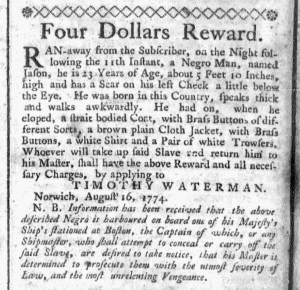
Like every other newspaper published in the colonies, from New England to Georgia, during the era of the American Revolution, the Norwich Packet carried advertisements that described enslaved men and women who liberated themselves by running away from their enslavers.  Such advertisements encouraged all colonizers to engage in surveillance of Black bodies to determine whether the people they encountered matched descriptions in the newspapers, offering rewards to those who provided information or captured and returned fugitives seeking freedom.

One such advertisement appeared as summer turned to fall in 1774.  Jason, an enslaved man “born in this Country,” departed sometime during the night of August 11.  Timothy Waterman of Norwich spent a few days trying to find Jason on his before resorting to a newspaper advertisement dated August 16.  It first ran in the August 18 edition of the Norwich Packet and appeared again on August 25.  For its third iteration in the weekly newspaper, Waterman’s notice included a nota bene with an update: “Information has been received that the above described Negro is harboured on board one of his Majesty’s Ship’s stationed at Boston.”  Waterman did not reveal the source of this information.  Perhaps his advertisement and its dissemination far beyond Norwich yielded this lead.  Waterman warned the captain of that vessel “or any Shipmaster” that should they “attempt to conceal or carry off said slave … that his Master is determined to prosecute them with the utmost severity of Law, and the most unrelenting Vengeance.”  He sought to combine the power of the press and the power of the state in his effort to retrieve Jason and return him to enslavement.

Waterman also expected that the Norwich Packet and the Connecticut, Massachusetts, New-Hampshire, and Rhode-Island Weekly Advertiser circulated widely enough that ship captains in Boston would either see his advertisement or otherwise become aware of it.  The information infrastructure worked in favor of enslavers and against enslaved men and women who made their own declarations of independence during the era of the American Revolution.  That so many of these advertisements appeared in colonial newspapers, year after year, decade after decade, suggests that they must have been effective, at least to some degree, or else enslavers would not have continued investing in them.

June 5

What was advertised in a colonial American newspaper 250 years ago this week?

Norwich Packet (June 2, 1774).

“CABINETS, CHAIRS, and a variety of useful and ornamental FURNITURE.”

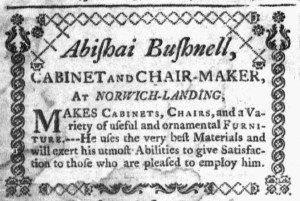
Alexander Robertson, James Robertson, and John Trumbull had been publishing the Norwich Packet for less than a year when Abishai Bushnell, “CABINET AND CHAIR-MAKER,” ran an advertisement with distinctive graphic design elements.  One of the printers or one of the compositors who worked in the printing office enclosed Bushnell’s copy within a border comprised of decorative ornaments.  That set it apart from other content, both news and advertising, in the Norwich Packet.  Bushnell may have also arranged to have his advertisement printed separated to use as labels for the “CABINETS, CHAIRS, and a variety of useful and ornamental FURNITURE” he made in his shop.

Except for the packet ship carrying letters from one port to another depicted in the masthead, the Norwich Packet did not usually feature visual images, neither to accompany news nor to adorn advertisements.  That included woodcuts of ships, houses, horses, indentured servants, and enslaved people, stock images that many printers made available to advertisers.  Yet the compositors did make liberal use of printing ornaments to indicate where one news item or editorial ended and another began and, especially, to separate advertisements from each other.  An intricate border also enclosed the first letter of the first word in the first article on the first page of each edition of the Norwich Packet, a design that changed every few weeks.  The masthead also made use of decorative type above and below the date of the newspaper, though that was a more recent innovation as the compositor experimented with the appearance of the front page.

Apparently, that was enough to convince Bushnell that Robertson, Robertson, and Trumbull could produce an advertisement that would attract attention with an ornate border that made it unlike anything else that appeared in the pages of the Norwich Packet.  The cabinetmaker almost certainly placed a special order or gave specific instructions about how he wished his advertisement to look.  After all, even though the compositor incorporated a lot of decorative type into each edition of the newspaper, no other advertisements received such treatment.  Bushnell did not opt for a woodcut of a chair or other piece of furniture representing his trade, but he did find a way to make his advertisement more visible and more memorable.

Decorative borders enclosing the first letter of the first word in the first item on the first page of the Norwich Packet (left to right: March 24, 1774; April 21, 1774; April 28, 1774; May 5, 1774; May 12, 1774).

March 31

What was advertised in a colonial American newspaper 250 years ago today?

Norwich Packet (March 31, 1774).

“Set off from the Printing-Office in Norwich every Thursday, immediately after the Publication of the NORWICH PACKET.”

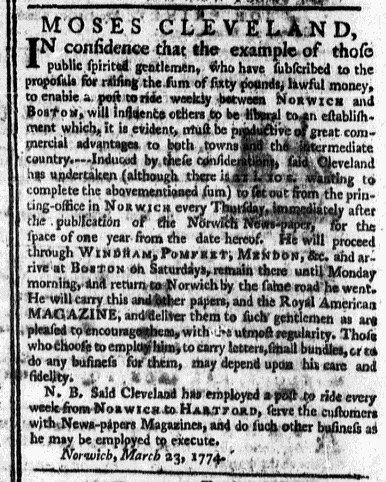
When Moses Cleveland set about establishing a “Post to ride weekly between Norwich and Boston,” he simultaneously advertised in newspapers in both towns.  His advertisements, dated March 23, 1774, first appeared in the March 24 edition of the Norwich Packet and ran a week later in the Massachusetts Spy.  Cleveland covered a route that incorporated stops in both Connecticut and Massachusetts, including Windham, Pomfret, and Mendon.  He advised prospective customers that he would “set out from the Printing-Office in Norwich every Thursday, immediately after the Publication of the NORWICH PACKET.”  Customers in Connecticut received that newspaper hot off the presses, while those in Boston only waited a couple of days.  He arrived there on Saturdays, delivering news from the west that the Boston Evening-Post, Boston-Gazette, and Massachusetts Gazette and Boston Post-Boy might publish the following Monday.  Cleveland remained there until Monday morning before returning to Norwich via the same route.

Massachusetts Spy (March 31, 1774).

His advertisement in the Massachusetts Spy featured almost identical copy, though either the postrider or the printer, Isaiah Thomas, made some updates.  In the Norwich Packet, Cleveland declared that he “will carry this Paper,” while in the Massachusetts Spy he stated that he “will carry this and other papers, and the Royal American MAGAZINE,” the publication that Thomas launched earlier in the year and had been promoting in the public prints from New Hampshire to Maryland for months.  Perhaps Cleveland instructed Thomas to mention the magazine in his advertisement, but a revision to the nota bene that concluded the notice suggests that Thomas did so on his own.  In the Norwich Packet, that postscript indicated that Cleveland “has employed a Post to ride every Week from Norwich to Hartford, [and] serve the Customers with this Paper.”  In the Massachusetts Spy, on the other hand, the nota bene advised that Cleveland “has employed a post to ride every week from NORWICH to HARTFORD, [and] serve the customers with News-Papers [and] Magazines.”  Had delivering the Royal American Magazine, the only magazine published in the colonies at the time, or any other magazines been among the services that Cleveland thought most likely to garner attention from prospective customers, he probably would have mentioned magazines in his advertisement that originated in the Norwich Packet.  More likely, the savvy Thomas seized an opportunity to promote his magazine and assure subscribers beyond Boston that they would receive it in a timely manner.

December 2

Who was the subject of an advertisement in a colonial American newspaper 250 years ago today?

Norwich Packet (December 2, 1773).

“RUN away … a Negro Boy, named PIGGEN.”

It was the ninth issue of the Norwich Packet, a newspaper established by Alexander Robertson, James Robertson, and John Trumbull in October 1773.  The ninth issue included an advertisement that described “a Negro Boy, named PIGGEN,” who liberated himself by running away from his enslaver, James Rogers.  The advertisement documented the clothing worn by the young man, “about 19 years of age,” when he departed from New London, Connecticut.  Rogers also reported that Piggen “speaks good English,” encouraging readers to listen to Black men they did not recognize as well as take note of their apparel.  Anyone who identified Piggen, captured him, and returned him to Rogers “shall have three dollars reward.”  This advertisement resembled so many others that appeared in newspapers from New England to Georgia.

It may not have been the first paid notice about an enslaved person that appeared in the Norwich Packet.  The first several issues have not survived.  Coverage in America’s Historical Newspapers, the most extensive database of digitized images of eighteenth-century newspapers, begins with the sixth issue.  Previous issues might have included advertisements offering enslaved men, women, and children for sale or advertisements about other enslaved people who liberated themselves.  Every newspaper published in New England at the time ran such advertisements.  Whether or not Rogers’s advertisement about Piggen was the first to appear in the Norwich Packet, it took the Robertsons and Trumbull no more than two months to incorporate this particular kind of content into their new publication.  In both northern colonies and southern colonies, printers quickly became complicit in perpetuating slavery by publishing such advertisements.  In Baltimore, for instance, the first issue of the Maryland Journal, published August 20, 1773, included an advertisement by a broker seeking to purchase and enslaved girl and a notice promising a reward for Prince, an enslaved man who emancipated himself.  In the third issue of Rivington’s New-York Gazetteer, published May 6, 1773, James Rivington published an advertisement offering a “Very fine Negro Boy” for sale.  Nathaniel Mills and John Hicks became the new proprietors of the Massachusetts Gazette and Boston Post-Boy in the spring of 1773.  They continued publishing advertisements about enslaved people, a policy already in place at that newspaper.  When printers ran such advertisements, they generated revenues that underwrote the dissemination of other news during the era of the American Revolution.

November 14

What was advertised in a colonial American newspaper 250 years ago this week?

Norwich Packet (November 11, 1773).

“NOAH HIDDEN, has undertaken to ride Post between the town of NORWICH and PROVIDENCE.”

Today the Adverts 250 Project features an advertisement from the Norwich Packet and the Connecticut, Massachusetts, New-Hampshire, and Rhode-Island Weekly Advertiser for the first time.  After circulating subscription proposals during the summer of 1773, Alexander Robertson, James Robertson, and John Trumbull established the newspaper on October 7, “judging from the date of the earliest issue located, that of Nov. 4, 1773, vol. 1, no. 5.”[1]  America’s Historical Newspapers does not include that issue, but instead begins with the November 11 edition.  Noah Hidden, a post rider, placed the final advertisement in that issue, though he may have started advertising as early as the inaugural edition.

Hidden advised the public that he “has undertaken to ride Post between the Town of NORWICH and PROVIDENCE,” a distance of about fifty miles.  He departed from the printing office in Norwich on Thursdays and from Knight Dexter’s house in Providence on Saturdays.  Not by accident, this itinerary matched the publication schedule of the newspapers in both towns.  The Robertsons and Trumbull distributed a new edition of the Norwich Packet on Thursdays.  For many years, John Carter published the Providence Gazette on Saturdays.  Hidden carried “Letters, Papers, Memorandoms, or small Bundles left at either of said Places,” pledging to take good care of them and offering receipts “if required.”  In particular, he noted that he would provide “those who choose to employ him, with this PAPER.”

The post rider presented this enterprise as a valuable service “to the Inhabitants of both towns and the intermediate Country.”  He underscored the “great utility” of disseminating the information in the newspapers and letters he delivered along his route.  Furthermore, Hidden asserted that his contributions to the regional information infrastructure merited the “Encouragement which a faithful Discharge of the Business he has undertaken shall entitle him to.”  His endeavors help to explain how the Robertsons and Trumbull could suggest that a newspaper published in Norwich served each of the colonies in New England.  Like other colonial newspapers, the Norwich Packet circulated far beyond its place of publication.

**********

[1] Clarence S. Brigham, History and Bibliography of American Newspapers, 1690-1820 (Worcester: American Antiquarian Society, 1947), 66.

June 22

What was advertised in a colonial American newspaper 250 years ago today?

Connecticut Courant (June 22, 1773).

“PROPOSALS, For PUBLISHING, upon a PLAN entirely new, a Periodical PAPER.”

For several years, three newspapers served residents of Connecticut, the New-London Gazette (established as the Connecticut Gazette in November 1763), the Connecticut Courant (established October 1764), published in Hartford, and the Connecticut Journal and New-Haven Post-Boy (founded October 1767).  In addition, the Newport Mercury, the Providence Gazette, and several newspapers published in New York circulated in Connecticut.  In 1773, Alexander Robertson, James Robertson, and John Trumbull made plans to launch a fourth newspaper in the colony.  To that end, they distributed subscription proposals for the “NORWICH PACKET, OR THE CONNECTICUT, MASSACHUSETTS, NEW-HAMPSHIRE, AND RHODE-ISLAND INTELLIGENCER, AND WEEKLY ADVERTISER.”  They intended for their newspaper to serve a region that extended far beyond the town where they published it.

As was the case with the Maryland Journal (published in Baltimore) and Rivington’s New-York Gazetteer, it took some time for the printers to amass a sufficient number of subscribers to commence publication.  The Robertsons and Trumbull stated that the “first Paper will be published as soon as a competent Number of Subscribers are procured.”  They printed the first issue in October 1773, the Norwich Packet became the third new newspaper in the colonies that year.  That brought the total to thirty-three newspapers throughout the colonies, most of them in English along with two in German published in Pennsylvania.  By the end of the year, the New-York Gazette or Weekly Post-Boy folded, while Isaiah Thomas and Henry-Walter Tinges established the Essex Journal in Newburyport, Massachusetts.  Even as a few newspapers, such as the Boston Chronicle, went out of business in the early 1770s, colonizers gained access to a greater variety of newspapers in the years just before the American Revolution.  Overall, the total number rose from twenty-six in 1765 to thirty-one in 1770 to forty-three in 1775.  During the Revolutionary War, several of those newspapers ceased or paused publication.  Printers founded others to supply colonizers with information about the war, commerce, and other news.

The Norwich Packet continued publication throughout most of the war, though suspended from late September 1782 through late October 1783.  The Robertsons and Trumbull, however, parted ways.  In May 1776, Trumbull became the sole publisher when the Robertsons, who were Loyalists, relocated to New York.  In their subscription proposals, the three printers asserted that they planned to publish a “succinct detail of the Proceedings of the Parliament of Great-Britain, especially such as relate to America, and the political Manoeuvres of the Statesmen in and out of Administration.”  How to interpret and respond to those “Proceedings” and “Manoeuvres” eventually resulted in such deep fissures that some colonizers declared and fought for independence while others remained loyal to Britain.  When the Robertsons and Trumbull established the Norwich Packet, the updates and editorials in the newspaper helped shape public discourse about the relationship between the colonies and Parliament.  Within just a couple of years, the Norwich Packet related and recorded many of the events of the Revolutionary War.  In order to publish “the most recent Advices of every remarkable Event,” however, the printers first had to convince “THE PUBLIC” to subscribe.