February 1

What was advertised in a revolutionary American newspaper 250 years ago today?
Pennsylvania Evening Post (February 1, 1776).

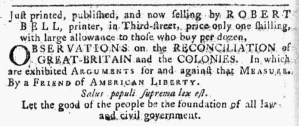
“A Number of ANXIOUS FRIENDS, and all the MILITARY MEN who wanted MITTENS.”

The screed extended an entire column and overflowed into another in the February 1, 1776, edition of the Pennsylvania Evening Post.  It continued the feud between Thomas Paine, the author of Common Sense, and Robert Bell, the publisher of the first edition who embarked on an unauthorized second edition.  Two days earlier, advertisements for Bell’s second edition and a forthcoming edition that Paine collaborated with William Bradford and Thomas Bradford in publishing ran side by side in that newspaper.  One included an address “To the PUBLIC” by Bell and the other featured a “declaration” by the author.  Paine, who still remained anonymous given the radical contents of the pamphlet, concluded by stating, “This is all the notice that will ever be taken of [Bell] in future.”

For his part, Bell was not finished taking notice of Paine.  He quickly submitted a response, addressed “TO MR. ANONYMOUS,” for publication among the advertisements that ran in the next issue of the Pennsylvania Evening Post.  He mocked Paine because the “Feeble author” “took the field” and engaged in battle that he supposedly could not win against the “Provedore to the Sentimentalists,” as Bell often referred to himself in the subscription proposals he circulated and in his newspaper advertisements for book auctions.  The publisher claimed that he had been “wantonly, and maliciously, dragged … into the unwished for field of public altercation,” yet he would defend his actions and his reputation.  Bell attacked Paine’s claim that he wished to remain anonymous: “You say you wanted to remain unknown … but, in practice, yourself telling it in every beer-house, gives the direct LIE to the assertor of such falsehood.”  Even though Paine’s name had not yet appeared in print, Bell alleged that the author had been bragging about writing Common Sense in taverns around town.

Bell also demeaned “boasted intentional generosity” of the “Would-be-Author” who had declared that he planned to use his share of the profits from the first edition, which he never received, to purchase mittens for the soldiers participating in the American invasion of Canada.  Bell insinuated that Paine mentioned drew the “MILITARY MEN who wanted MITTENS” into the dispute as a means of currying favor with the public as he threatened “malevolent LAW SUITS … against one industrious Bookseller, who never asked or received any thing from the public without giving an equivalent.”  In contrast to Paine’s manipulations of both his friends who acted as intermediaries and the public, Bell portrayed himself as an honest entrepreneur, “a poor individual who neither attempteth nor wisheth for more FRIENDS than the rectitude of his conduct in business, an in the affairs of society, shall both gain and retain.”

Taking another shot at Paine, Bell instructed him that “your taking the public field was bad, because there was no foundation for it, unless envy be allowed a good one.”  Furthermore, his “management of the fight and precipitate flight was worse – and final exit (as you say) worse and worse.”  The publisher scorned the way that author backed down, comparing his handling of the situation to a “rascally PUPPY, who, with open mouth, runs snarling at an honest manly DOG, whose notice is attracted by the yelpings of the ill-natured CUR.”  Paine, the “PUPPY,” ran away with his tail between his legs once he was on the receiving end of “words of stern contempt.”

Much of the dispute revolved around the revenues generated by Common Sense (or, as “the assignees of the nameless author” discovered, a surprising lack of profits on the first edition).  Yet the feud and the publication of multiple editions of Common Sense did produce revenues for Benjamin Towne, the printer of the Pennsylvania Evening Post. The competing advertisements comprised one-quarter of the content in the January 30 edition and Bell’s notice in response to Paine’s “declaration” occupied nearly as much space.  With those advertisements, Towne did not need to sell a single copy of the pamphlet to turn a profit on its publication by other printers.

January 30

What was advertised in a revolutionary American newspaper 250 years ago today?

Pennsylvania Evening Post (January 30, 1776).

“The said gentlemen have not yet been able to settle with Robert Bell.”

The feud between the Thomas Paine, the author of Common Sense, and Robert Bell, the publisher of the first edition of Common Sense, intensified in the January 30, 1776, edition of the Pennsylvania Evening Post.  Advertisements for Bell’s unauthorized “SECOND EDITION” and a “NEW EDITION” currently “In the press, and [to] be published as soon as possible” by William Bradford and Thomas Bradford dominated the final page of that newspaper.  Variations of both advertisements appeared in the Pennsylvania Evening Post three days earlier, each of them stirring the pot and inspiring Bell and Paine to submit new material to Benjamin Towne, the printer of that newspaper, to incorporate into their advertisements.

The advertisement for the Bradfords’ edition still included an address “To the PUBLIC,” but it doubled in length with a “declaration” made by the author “for the sake of relieving the anxiety of his friends.”  At this point, Paine remained anonymous, at least as far as associating his name with the political pamphlet in the public prints was concerned.  He explained that his original plan for Common Sense had been to have it “printed in a series of newspapers,” but others, including Benjamin Rush, convinced him that was impractical and that even printers who supported the American cause would shy away from such radical content.  Rush recommended Robert Bell, the noted bookseller as an alternative to the several printers who published newspapers in Philadelphia, acting as an intermediary between Paine and Bell.  In this new “declaration,” Paine explained that “he knew nothing of Robert Bell, who was engaged to print it by a gentleman of this city,” referring to Rush but not naming him.  Though Rush acted “from a well meaning motive,” his suggestion eventually embroiled Paine in “the unpleasant situation.”

Paine did not hesitate to name Bell, proclaiming that he “hath neither directly, nor indirectly, received, or is to receive, any profit or advantage from the edition printed by Robert Bell.”  In the agreement negotiated by Rush, Paine paid for the expense of printing the pamphlet whether it sold or not.  In addition, that “noisy man,” Bell, would receive “one half of the profits” if the pamphlet was a success.  Paine estimated that amount should have been “upwards of thirty pounds.”  Furthermore, the author did not intend to keep his half of the profits.  Instead, “when news of our repulse at Quebec arrived in this city,” he committed his share “for the purpose of purchasing mittens for the troops ordered on that cold campaign.”  An assault on Quebec City, part of the invasion of Canada undertaken by American forces, had failed on New Year’s Eve.  The patriotic Paine wanted to send supplies, especially mittens, to the American soldiers who continued the siege of that city, but Bell did not turn over any money “into the hands of two gentlemen” that Paine designated as his intermediaries.  Paine claimed that he had “Bell’s written promise” for that arrangement.  Anyone who wished to do so could verify that by consulting with them since their “names are left at the bar of the London Coffee-house” for that purpose.

“The said gentlemen,” Paine continued, “have not yet been able to settle with Robert Bell according to the conditions of his written engagement.”  In addition, when they examined his account of the expenses and sales, they did not consider it “equitable” according to that agreement.  Paine warned that Bell had a week to make good on their agreement or else “he will be sued for the same.”  He concluded by stating, “This is all the notice that will ever be taken of him in future.”  Given the ferocity of the advertisements already published, readers may have doubted that.

The advertisement for the Bradfords’ edition featured far more new material than Bell’s advertisement.  He added a few lines to the nota bene that ran in the previous edition of the Pennsylvania Evening Post, though he had been so anxious to publish his updated advertisement that he inserted it in the January 29 edition of Dunlap’s Pennsylvania Packetrather than waiting for it to appear in the Pennsylvania Evening Post on January 30.  In Dunlap’s Pennsylvania Packet, Bell’s expanded advertisement ran next to the shorter version of the advertisement for the Bradfords’ edition of Common Sense, the one that included an address “TO THE PUBLIC” but not the additional “declaration” by the author.

Bell took the opportunity to demean the “NEW EDITION” the Bradfords were printing.  He declared that “the public may be certain” that the “smallness of print and scantiness of paper” meant that it would be an inferior edition “when compared with Bell’s second edition.”  Why would readers wait for the Bradfords’ edition “yet in the press” when Bell’s second edition was “out of the press” and available for sale?  As a final insult, he trumpeted that comparing the Bradfords’ forthcoming edition to his own second edition was like the difference “in size and value” between a “British shilling” and a “British half-crown.”  His second edition, Bell claimed, was the better value in so many ways.  Even though Paine pledged that he had nothing more to say about Bell, that made it seem unlikely that the author and the publisher of the first edition would quietly discontinue their attacks in the public prints.  In three short weeks since the first advertisement for Common Sense appeared in the Pennsylvania Evening Post, the controversy between Bell and Paine became its own commotion!

January 27

What was advertised in a revolutionary American newspaper 250 years ago today?

Pennsylvania Evening Post (January 27, 1776).

“An author, without a name, hath asserted absolute falsehoods.”

The dispute over publishing the second edition of Thomas Paine’s Common Sense continued in an advertisement in the January 27, 1776, edition of the Pennsylvania Evening Post.  Robert Bell, the publisher of the first edition, and William Bradford and Thomas Bradford, the printers designated by Paine to publish a new edition with additional materials, ran competing advertisements on January 25.  The Bradfords’ advertisement included a note that informed the public that the author had not authorized Bell to publish a second edition, yet the enterprising printer and bookseller moved forward with the project anyway.  That advertisement ran once again on January 27.

In response, Bell submitted a new advertisement to the printing office.  An even more prominent headline proclaimed, “The SECOND EDITION of COMMON SENSE,” followed by a list of the four sections that appeared in the first edition.  That overview had been part of most of Bell’s advertisements, as well as an epigraph from “Liberty,” a poem by James Thomson.  In response to the address “To the PUBLIC” in the Bradfords’ advertisement, Bell added his own address “To the PUBLIC.”  In it, he explained that in the previous edition of the Pennsylvania Evening Post, “an author, without a name, hath asserted absolute falsehoods.”  At the time, Paine remained anonymous (and, for the first time, this advertisement described his political pamphlet as “WRITTEN BY AN ENGLISHMAN”).  Bell objected to the claims that Paine made that “he gave directions and orders to the publisher of the first edition not to proceed.”  For his part, Bell declared that “[a]s soon as the printer and publisher discovered the capricious disposition of the ostensible author, he disclaimed all future connexion,” perfectly content to break ties with Paine.  Furthermore, “by the publication of a second edition which he advertised in a news paper, [Bell] immediately declared his desirable independence from the trammels of catch-penny author-craft, whose cunning was so exceeding great as to attempt to destroy the reputation of his own first edition, by advertising intended additions before his earliest and best customers had time to read what they had so very lately purchased.”  That certainly was not a flattering portrait of Paine.  The contents of Common Sense gave colonizers a lot to discuss.  The dispute in the newspaper advertisements gave them even more.

Undaunted, Bell testified that he “neither heard nor received any orders not to proceed, there [the author’s] assertions must be far from truth.”  In addition, Bell further dismissed Paine’s expectations for the publication of a second edition, stating that “if he had either heard or received any such directions or orders, he most certainly would have treated them immediately with that contempt which such unreasonable, illegal, and tyrannic usurpations over his freedom and liberty in business deserved.”  Bell launched one more tirade: “When Mr. ANONYMOUS condescendeth again to puff his pamphlet … and to reduce a price which himself had a share in making, his brother bookseller, who scorneth duplicity in business or sentiment, wisheth he may find out a more eligible mode of proving his attachment to principles than to lay the foundations of his generosity in the despicable ebullitions of dishonest malevolence.”  Bell was annoyed that Paine promoted the Bradfords’ edition as “one half of the price of the former edition,” a suggestion that Bell overcharged when, according to Bell, the author and the publisher set the price in consultation with each other.  A lower price for the Bradfords’ edition was not truly “generosity,” especially when inspired by “despicable ebullitions of dishonest malevolence” rather than a desire to make the pamphlet more accessible to the public.  Clearly, Paine’s address “To the PUBLIC” did not cause Bell to back down but instead to double down on printing and marketing his second edition of Common Sense.

January 25

What was advertised in a revolutionary American newspaper 250 years ago today?

Pennsylvania Evening Post (January 25, 1776).

“A new edition of COMMON SENSE … with large and interesting additions by the author.”

A battle over publishing Thomas Paine’s Common Sense played out in advertisements became apparent to the public when they perused the advertisements in the January 25, 1776, edition of the Pennsylvania Evening Post.  Sixteen days earlier, that newspaper had been the first to carry an advertisement for the inflammatory political pamphlet.  Robert Bell, the publisher, promoted it, while Paine remained anonymous.  It sold so quickly that Bell began advertising “A NEW EDITION of COMMON SENSE” on January 20.  Five days later, he ran an updated version of the original advertisement, using type already set.  The compositor merely replaced the first line, removing the date (“Philadelphia, January 9, 1776”) and replacing it with a headline that proclaimed, “The second edition,” in a larger font.

Yet Paine and Bell had had a falling out.  Bell’s “second edition” was an unauthorized edition, as a new advertisement on the first page of the Pennsylvania Evening Post made clear.  William Bradford and Thomas Bradford, printers of the Pennsylvania Journal, announced that they had a “new edition” of Common Sense “IN the press, and will be published as soon as possible.”  Unlike Bell’s second edition advertised elsewhere in that issue, their new edition featured “large and interesting additions by the author, as will be expressed at the time of publication.”  As a preview, the Bradfords indicated that the bonus materials included a “seasonable and friendly admonition to the people called QUAKERS.”  To entice prospective customers to reserve copies or purchase them as soon as they were available, the Bradfords noted that “Several hundred are already bespoke,” including “one thousand for Virginia.”  Advertisements for the pamphlet already appeared in newspapers in New York.  The Bradfords made plans to distribute the pamphlet south of Philadelphia.  In addition, they reported that a “German edition is likewise in the press” for the benefit of the many German settlers in Pennsylvania and the backcountry extending down to North Carolina.

This advertisement included an address “To the PUBLIC,” perhaps composed by Paine, that outlined the dispute between the author and the original publisher.  “The encouragement and reception which this pamphlet hath already met with, and the great demand for the same,” the address declared, “hath induced the publisher of the first edition to print a new edition unknown to the author.”  Paine had “expressly directed him not to proceed therein without orders, because that large additions would be made hereto.”  He also did not appreciate that Bell had not managed to turn a profit on the first edition, though that did not receive mention in the address in the advertisement.  Readers needed to be aware that Bell’s new edition, “lately advertised by the printer of the first [edition], is without the intended additions.”  That being the case, readers who exercised a little patience for the Bradfords’ edition “now in the press” and authorized by the author could acquire both the contents of the original pamphlet and the additions in a single volume … and at a bargain price!  Even with the new material, the cost “will … be reduced to one half of the price of the former edition.”  Bell advertisements consistently listed “two shillings” for the pamphlet.  The Bradfords charged one shilling.  They also gave “allowance to those who take quantities” or a discount for purchasing in volume, either to retail or distribute to friends, family, and associates.  That would “accommodate [the pamphlet] to the abilities of every man.”  In other words, the lower price made it possible to disseminate Common Sense even more widely.  When it came to airing grievances over the publication of Common Sense in newspaper advertisements, this address “To the PUBLIC” was only the opening salvo.  The dispute continued in subsequent editions of the Pennsylvania Evening Post and other newspapers.

January 23

What was advertised in a revolutionary American newspaper 250 years ago today?

Pennsylvania Evening Post (January 23, 1776).

“HARE’s BEST AMERICAN DRAUGHT PORTER.”

Brand recognition usually was not an element of eighteenth-century advertisements, yet there were exceptions.  Consumers knew a variety of patent medicines by name, in part from the frequency of advertisements in American advertisements.  For instance, retailers regularly ran notices that promoted Keyser’s Pills for treating venereal disease.  The same went for almanacs, such as “POOR WILL’s POCKET ALMANACK” advertised in the January 23, 1776, edition of the Pennsylvania Evening Post.  In the same issue, Edward Jollie, a tobacconist, advertised “IRISH SNUFF” and “SCOTS SNUFF,” but those monikers referred to the style rather than the producer.  Like most consumer goods, they did not have a brand name associated with them.

That newspaper, however, also featured advertisements for a product that had recently achieved brand recognition, at least in and near Philadelphia.  Lewis Nicola once again ran his advertisement for the “AMERICAN PORTER HOUSE” that he operated on Water Street.  He no doubt served “HARE’s BEST AMERICAN DRAUGHT PORTER,” the local brew that William Dibley, Patrick Meade, and Joseph Price all advertised that they served to “the sturdy friends of American freedom,” “the Associators of Freedom,” and “the SONS of AMERICAN LIBERTY” at their establishments.  Immediately to the left of Nicola’s advertisement, another local tavernkeeper announced that he also served porter produced at Robert Hare’s brewery.  Jeremiah Baker took to the pages of the Pennsylvania Evening Post to announce to “his friend and customers, that he has laid in a stock of HARE’s BEST AMERICAN DRAUGHT PORTER” at his tavern “at the sign of Noah’s Ark” on Front Street.  Baker pledged that he served the Hare’s porter “in its greatest purity,” signaling that he did not water down the drinks, but did not consider it necessary to say anything else about the porter.  The name, all in capital letters to attract attention, spoke for itself, an early example of brand recognition.

January 21

What was advertised in a revolutionary American newspaper 250 years ago this week?

Pennsylvania Evening Post (January 20, 1776).

“A NEW Edition of COMMON SENSE is just published.”

On the same day that the first advertisement for Thomas Paine’s Common Sense appeared in a newspaper beyond Philadelphia, another advertisement for “A NEW Edition of COMMON SENSE” ran in both the Pennsylvania Evening Post and the Pennsylvania Ledger.  On January 9, 1776, the Pennsylvania Evening Post had been the first newspaper to carry an advertisement for the political pamphlet.  Within a week, Robert Bell, the publisher, inserted the advertisement in all six newspapers published in Philadelphia at the time.  The advertisement for the “NEW EDITION of COMMON SENSE” in the January 20 edition of the Pennsylvania Ledger was one of two for the pamphlet in that issue.  It also carried Bell’s original advertisement.  The printing office apparently included it on one of the first pages printed and later received the new notice to integrate into one of the last pages printed.

Pennsylvania Ledger (January 20, 1776).

These advertisements testify to the popularity of Common Sense immediately after its initial publication.  They also obscure a disagreement between Bell and Paine.  The author, who remained anonymous for nearly three months after publication of the first edition, did not authorize Bell to publish a second edition.  Paine wished to donate his share of the profits to purchase supplies for American soldiers participating in the invasion of Quebec, but he learned that Bell’s first edition did not generate any profits despite its popularity.  Disillusioned with their collaboration, Paine instructed Bell not to proceed with a second edition.  Instead, he intended to add appendices and other content and find a new publisher among the many printers in Philadelphia.  The author eventually worked with William Bradford and Thomas Bradford, the printers of the Pennsylvania Journal, though Bell moved forward with a second edition against Paine’s wishes.  Over the next several months, Bell and Paine engaged in an argument (even as the “Englishman” who penned Common Sense remained anonymous) in the public prints, both in letters and advertisements in the Pennsylvania Evening Post and other newspapers published in Philadelphia.  Advertisements became a means for promoting not only the political pamphlet but also the author’s preferred edition of it!

January 9

What was advertised in a revolutionary American newspaper 250 years ago today?

Pennsylvania Evening Post (January 9, 1776).

“THIS day was published … COMMON SENSE addressed to the INHABITANTS of AMERICA.”

On January 9, 1776, the first advertisement for Thomas Paine’s Common Sense appeared in an American newspaper.  The notice did not include Paine’s name.  Instead, it stated that Robert Bell, the prominent printer and bookseller, “published, and is now selling … COMMON SENSE addressed to the INHABITANTS of AMERICA, on the following subjects.”  The advertisement then listed the headings for the several sections in the first edition: “I. Of the origin and design of government in general, with concise Remarks on the English constitution.  II. Of Monarchy and Hereditary Succession.  III. Thoughts on the present state of American affairs.  IV. Of the present ability of America, with some miscellaneous reflections.”

Over the next several months, printers in many towns would publish and advertise local editions of Common Sense, making it the most widely disseminated political pamphlet during the era of the American Revolution (though, as Trish Loughran convincingly demonstrates, the number of copies has been wildly exaggerated).[1]  Historians also consider Common Sense the most persuasive pamphlet that advocated for the American cause.  Even though hostilities commenced at Lexington and Concord in April 1775, many Americans still hoped that the king would intervene to address their grievances.  The plain language of Common Sense (along with unflattering depictions of monarchy) played a significant role in convincing many colonizers to support independence over a redress of grievances.  Paine made a strong case for “the present ability of America” to establish a new government and trading relationships beyond the British Empire.

There seems to be some confusion about the publication date for Common Sense.  Some sources claim that it was published on January 10, 1776.  I suspect that is because advertisements for the pamphlet first appeared in the January 10 editions of the Pennsylvania Gazette, the newspaper Benjamin Franklin formerly operated, and the Pennsylvania Journal, published by Patriot printers William Bradford and Thomas Bradford.  Those advertisements featured almost identical copy (but different choices for the format made by the compositors), including the phrase “THIS DAY IS PUBLISHED” in the Pennsylvania Gazette and “This Day was Published” in the Pennsylvania Journal.  I have previously examined other instances of similar phrases, demonstrating that they did not literally refer to the publication date but instead meant that a book or pamphlet was now available for purchase.  When the advertisement ran in the Pennsylvania Ledger on January 13 and in the Wochentliche Pennsylvanische Staatsbote on January 16, both versions stated, “This Day was Published.”  Eighteenth-century readers knew how to interpret the phrase.  I wonder if some scholars consulted the more famous and the more venerable Pennsylvania Gazette (founded 1728) and Pennsylvania Journal (founded 1742), saw a phrase that suggested the date of the newspaper was indeed the publication date for Common Sense, and overlooked a newspaper that had been in production for a little less than a year when it carried its first advertisement for Common Sense.  (Benjamin Towne distributed the first issue of the Pennsylvania Evening Post on January 24, 1775.)  Bell may have been selling copies of Common Sense before January 9.  The advertisement in the Pennsylvania Evening Post does not definitively demonstrate that the pamphlet was published on January 9, but it does show when marketing for the pamphlet began and that Bell published it no later than January 9, 1776.

**********

[1] Trish Loughran, “Disseminating Common Sense: Thomas Paine and the Problem of the Early National Bestseller,” American Literature 78., no. 1 (March 2006), 1-28.

January 7

What was advertised in a revolutionary American newspaper 250 years ago this week?

Pennsylvania Evening Post (January 6, 1776).

“He has opened an AMERICAN PORTER HOUSE.”

During the first week of 1776, Lewis Nicola took to the pages of the Pennsylvania Evening Post “to inform his friends, and the public in general, that he has opened an AMERICAN PORTER HOUSE at his dwelling in Water-street” in Philadelphia.  He promised that “those who favor him with their custom may depend upon his best endeavors to please.

Nicola assumed that readers knew who brewed the porter that he served at his establishment.  After all, “Mr. HARE’s best AMERICAN DRAUGHT PORTER” had been the subject of several advertisements that recently ran in the Pennsylvania Evening Post.  William Dibley served “this new and glorious manufacture” at the Fountain and White Horse Inn on Chestnut Street.  Joseph Price encouraged “all the SONS of AMERICAN LIBERTY” to drink “Messrs. HARE’s and Co. best DRAUGHT and BOTTLED AMERICAN PORTER” at his tavern “at the sign of the Bull and Dog” on Market Street.  Similarly, Patrick Meade offered “Messrs. HARE and Co. AMERICAN PORTER” to “the TRUE FRIENDS to LIBERTY” at the Harp and Crown in nearby Southwark.

Robert Hare, the son of an English brewer who specialized in porter, arrived in Philadelphia in 1773.  He established his own brewery where he brewed porter, “the first person to brew the drink in America.”  The timing worked well for Hare; he commenced brewing American porter as the imperial crisis intensified and the Revolutionary War began.  Colonizers looked to support local enterprises by purchasing “domestic manufactures” while they boycotted goods imported from England.  That positioned Hare’s brewery for success.

Just as significantly, consumers liked his porter (unlike some of the substitutes for imported tea that some colonizers concocted).  When John Adams attended the First Continental Congress in the fall of 1774, he lauded Hare’s porter in a letter to Abigail: “I drink no Cyder, but feast upon Phyladelphia Beer, and Porter.  A Gentleman, one Mr. Hare, has lately set up in this City a Manufactory of Porter, as good as any that comes from London.  I pray We may introduce it into the Massachusetts.  It agrees with me, infinitely better than Punch, Wine, or Cyder, or any other Spirituous Liquor.”  With Hare’s porter having such a reputation, Nicola did not need to mention the brewer when he opened his “AMERICAN PORTER HOUSE.”  The public knew the porter came from Hare’s brewery.

January 2

What was advertised in a revolutionary American newspaper 250 years ago today?

Pennsylvania Evening Post (January 2, 1776).

“PRINTING In ENGLISH, GERMAN, and other Languages.”

In late December 1775 and early January 1776, Melchior Steiner and Charles Cist placed advertisements for “PRINTING In ENGLISH, GERMAN, and other Languages” in several newspapers published in Philadelphia.  Having acquired a “general assortment of new and elegant TYPES, and other Printing Materials,” they opened an office “where they intend carrying on the PRINTING BUSINESS in all its different branches, with care, fidelity, and expedition.”  Both partners had been born in Europe and migrated to Philadelphia, as Isaiah Thomas explained in his History of Printing in America (1810).  Steiner, born in Switzerland, served an apprenticeship with Henry Miller, the printer of the Henrich Millers Pennsylvanischer Staatsbote (formerly Der Wochentliche Philadelphische Staatsbote and Der Wochentliche Pennsylvanische Staatsbote).  Cist, an apothecary born in St. Petersburg, Russia, came to the colonies in 1769, worked for Miller as a translator of English into German, and “by continuing in the employment of Miller several years he acquired a considerable knowledge of printing.”[1]

Steiner and Cist, according to Thomas, “executed book and job work, in both the German and English languages,” the “different branches” of printing that they advertised in their notice.  They competed with other local printers, especially Miller.  Their former associate also took orders for job printing in both languages and annually published an almanac in German.  The masthead of the Pennsylvanischer Staatsbote indicated that “All ADVERTISEMENTS to be inserted in this Paper, or printed single by HENRY MILLER, Publisher hereof, are by him translated gratis.”  Thomas reported, “Not long after the commencement of the revolutionary war, [Steiner and Cist] published a newspaper in the German language; but, for want of sufficient encouragement, it was discontinued in April, 1776.”[2]  The venerable printer appears to have been misinformed on that point.  Clarence S. Brigham does not attribute any newspaper published in 1775 or 1776 to Steiner and Cist, but he does list another newspaper that Thomas credited to the partners, the Philadelpisches Staatsregister, published during the war from 1779 to 1781.[3]  Even if they considered launching a newspaper eventually, the new partners sought to establish a printing office with a reputation for “giv[ing] satisfaction to those who may be pleased to employ them” for job printing.  As they surveyed the local and regional landscape, they may have determined that Henrich Millers Pennsylvanischer Staatsbote and the Germantowner Zeitung already met the needs of colonizers who spoke German and the market would not support another newspaper.  That they operated their printing office in Philadelphia throughout most of the war, leaving temporarily during the British occupation of the city, testifies to the multilingual origins of the new nation.  English was the language spoken (and printed) most prevalently in the thirteen colonies that declared independence, but certainly not exclusively during the era of the American Revolution.

**********

[1] Isaiah Thomas, The History of Printing in America: With a Biography of Printers and an Account of Newspapers (1810; Weathervane Books, 1970), 404.

[2] Thomas, History of Printing, 404.

[3] Clarence S. Brigham, History and Bibliography of American Newspapers, 1690-1820 (American Antiquarian Society, 1947), 1392, 1487.

December 16

What was advertised in a revolutionary American newspaper 250 years ago today?

Pennsylvania Evening Post (December 16, 1775).

“A TREATISE … on the treatment of wounds and fractures, with a short APPENDIX on camp and military hospitals.”

Even before the battles at Lexington and Concord, advertisements for military manuals appeared in colonial newspapers.  The number of manuals available to the public and the frequency of the advertisements both increased following the outbreak of hostilities.  Yet not all the manuals on the market addressed military discipline and maneuvers.  In the December 16, 1775, edition of the Pennsylvania Evening Post, George Weed promoted “A TREATISE, entitled plain and concise practical remarks on the treatment of wounds and fractures, with a short APPENDIX on camp and military hospitals, principally designed for the use of young military surgeons, in North-America.  By JOHN JONES, M.D. Professor of Surgery, King’s College, New-York.”  As was often the case when advertising books, Weed did not generate advertising copy but instead used the lengthy title of the book to promote it in the public prints.  He likely sold copies of an edition printed by John Holt in New York.  The treatise apparently met with such success that Robert Bell, a prominent printer and bookseller in Philadelphia, decided to publish another edition in 1776.

Advertisement in John Jones, Plain and Concise Practical Remarks on the Treatment of Wounds and Fractures (New York: John Holt, 1775), 96.

The book itself became a vehicle for distributing additional advertising.  Printers and booksellers frequently inserted their own advertisements in books, pamphlets, and almanacs, yet that was not the case with this medical treatise.  Instead, it featured an advertisement from a medical practitioner that resonated with the contents of the book.  After the treatise and appendix, a full-page advertisement informed readers that “SPLINTS FOR FRACTURES, OF THE LEG AND THIGH, MADE IN IMMITATION OF MR. SHARP’S, WITH MR. POT’S BANDAGES FOR THE SAME, ARE SOLD BY DONALD M ‘LEAN, APOTHECARY AND DRUGGIST, FIVE DOORS FROM THE COFFEE-HOUSE, IN NEW YORK.”  Two lines of fleurettes, one above and below, adorned the advertisement.  Today, readers expect to encounter promotions for books and related products incorporated into books by publishers, yet that marketing strategy was not invented by the modern publishing industry.  Instead, it dates to the eighteenth century and earlier as printers, booksellers, and other entrepreneurs devised many kinds of advertising media.  The Adverts 250 Project focused primarily on advertisements that appeared in eighteenth-century newspapers for several reasons, including their abundance and frequency, yet early Americans encountered many forms of advertising, including broadsides, billheads, catalogs, trade cards, and advertisements inserted in books.