May 19

What was advertised in a colonial American newspaper 250 years ago today?
Pennsylvania Gazette (May 19, 1773).

“STOPPED, from a Person (supposed to be stolen) a SILVER TABLE-SPOON.”

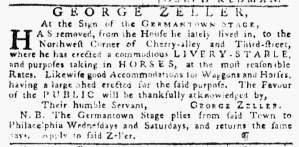
Newspaper advertisements promoted a variety of new merchandise in the eighteenth century, encouraging colonizers to participate in a transatlantic consumer revolution.  In the May 19, 1773, edition of the Pennsylvania Gazette, for instance, Owen Biddle advertised a “large and neat ASSORTEMNT of EUROPEAN & EAST-INDIA GOODS” recently imported from London and Bristol.  He listed dozens of textiles and housewares available at his shop.  Similarly, John McCalla and Son and other merchants and shopkeepers attempted to incite demand for their own “neat Assortment of MERCHANDIZE.”

Colonizers also participated in the consumer revolution by acquiring secondhand goods, sometimes at auctions and other times through estate sales.  Other sales took place through less formal mechanisms.  That led to more possibilities for participating in the consumer revolution, through theft and fencing stolen goods and knowingly or unknowingly buying stolen goods.  Historian Serena Zabin has described those exchanges as part of an informal economy that operated parallel to the legitimate marketplace.  The informal economy made space for indentured servants, free and enslaved Black men and women, and the poor to acquire goods, whether secondhand or stolen.

This also caused many colonizers to remain vigilant about secondhand goods offered for sale, prompting them to seize items when not satisfied with explanations about how the sellers acquired them.  Such was the case for a “SILVER TABLE-SPOON, marked T.P.A. and three Silver Tea-Spoons, marked A.H. in a Cypher.”  Among the advertisements for new goods in the May 19 edition of the Pennsylvania Gazette, another notice described those spoons and stated that they had been “STOPPED” or confiscated on suspicion of being stolen.  Whoever “STOPPED” the spoons informed the rightful owner or owners that they could reclaim them “on proving their Property, and paying Charges” (most likely, paying for the advertisement).

Newspaper advertisements chronicled the consumption and circulation of goods, whether the newest and most fashionable items just imported or secondhand goods sold at auctions and estate sales or stolen items that thieves attempted to fence.  Colonizers from many backgrounds devised numerous ways to participate in the consumer revolution.

May 12

What was advertised in a colonial American newspaper 250 years ago today?

Supplement to the Pennsylvania Gazette (May 12, 1773).

“A MUSICIAN.”

When an anonymous musician offered “to teach the art of playing on the Guittar, in the best and newest taste” and “likewise teaches the German flute,” he adorned his advertisement in the May 12, 1773, edition of the Pennsylvania Gazette with an image of a guitar, a flute, and a sheet of music.  The woodcut accounted for half of the space occupied by the advertisement.  The combination of visual image and advertising copy likely drew the attention of readers, especially since most advertisements did not feature any sort of image.

Some did have a stock image in the upper left corner.  For instance, four advertisements that sought passengers and freight for ships preparing to depart for other ports incorporated woodcuts of vessels at sea, perhaps the most common image that appeared in a newspaper published in the bustling urban port of Philadelphia.  In contrast, images depicting enslaved people appeared about as often as images of ships in advertisements in newspapers published in Charleston.  The May 12 edition of the Pennsylvania Gazette did not have any images of enslaved people, even though it included advertisements about enslaved men, women, and children for sale as well as notices describing enslaved people who liberated themselves and offering rewards for their capture and return.  That issue did feature one advertisement with a woodcut depicting an indentured servant who absconded.  Two advertisements for stallions “to cover” (or breed with) mares had woodcuts of horses.

Pennsylvania Gazette (May 12, 1773).

In addition to those stock images supplied by the printers, three images commissioned by advertisers to correspond to the goods and services they marketed adorned advertisements in that issue.  A woodcut depicting a stagecoach drawn by two horses enhanced the notice for the route that connected Philadelphia and New York, operated by Charles Bessonett and Company.  An image of a sickle accompanied the advertising copy in Jacob Eckfelt’s notice.  Finally, the woodcut depicting the guitar, flute, and sheet music distinguished the anonymous musician’s advertisement from others that consisted solely of text.

To varying degrees, eighteenth-century advertisers experimented with images in their newspaper notices, sometimes opting for stock images provided by the printers and other times commissioning woodcuts for their sole use.  Although the majority of advertisers did not incorporate images into their notices, enough did so to demonstrate both curiosity about the practice and a suspicion or even a belief that images were worth the additional investment.  While these images may seem quaint or rudimentary when viewed through modern eyes, they likely resonated with eighteenth-century readers who usually encountered images in advertisements and nowhere else in newspapers, with the exception of the image that appeared in the masthead on the first page of each issue.

May 5

What was advertised in a colonial American newspaper 250 years ago today?

Pennsylvania Gazette (May 5, 1773).

“Chymist and Druggist … at the Sign of the Unicorn’s Head.”

Isaac Bartram, “Chymist and Druggist,” offered a variety of goods and services at his “new Medicine Store” in Philadelphia in the spring of 1773.  According to his advertisement in the May 5 edition of the Pennsylvania Gazette, he sold a “great variety of fresh Drugs and Patent Medicines, imported from the best houses in London.”  Prospective customers would have been familiar with the patent medicines that Bartram listed in his notice, just as modern consumers recognize various brands of over-the-counter medications.  Among other nostrums, the apothecary carried “Godfrey’s cordial, Bateman’s drops, … Walker’s Jesuits drops, Daffey’s elixir, [and] Anderson’s Lockyer’s and Hooper’s female pills.”  For those willing to try equivalent products, like modern consumers who purchase generics, Bartram marketed “Wine bitters, of a superior quality to what is commonly sold under the title of Stoughton’s elixir.”  He also stocked medical equipment, including syringes, vials, and surgical instruments, and prepared prescriptions “for physicians, or for family use.”

In addition to the copy, Bartram deployed an image to draw more attention to his advertisement.  He indicated that he kept shop “at the Sign of the Unicorn’s Head.”  Appropriately, a woodcut depicting a unicorn’s head enclosed within a border adorned the upper left corner of his notice, accounting for nearly one-quarter of the space occupied by his advertisement.  This certainly increased Bartram’s advertising costs since he had to commission the unique image associated with his business and then pay for the additional space.  Most advertisers did not invest in images for their notices, though a growing number adopted the practice in the early 1770s.  Elsewhere in the same issue of the Pennsylvania Gazette, Stephen Paschall and son Stephen Paschall, as they styled themselves, included an image of a scythe, a sickle, and other sort of iron work available at their workshop “at the Sign of the Scythe and Sickle.”  The initials “SP” marked one of the items.  The Paschalls first published the image a year earlier.  These images may have replicated the signs displayed by Bartram and the Paschalls, the only surviving visual representations of signs that colonizers glimpsed as they traversed the streets of Philadelphia.

Most advertisers relied solely on the text of their notices to encourage readers to visit their shops.  Such was the case for Robert Bass, an apothecary whose advertisement for a “new and fresh Assortment of DRUGS and PATENT MEDICINES” appeared on the same page as Bartram’s advertisement.  The woodcut depicting the Sign of the Unicorn’s Head certainly made Bartram’s notice much more visible to readers, prompting them to read about his wares and, in the process, quite possibly justifying the investment.

April 28

What was advertised in a colonial American newspaper 250 years ago today?

Pennsylvania Gazette (April 28, 1773).

“A LARGE and curious collection of the most modern PRINTS and PICTURES.”

Nicholas Brooks regularly advertised a variety of merchandise available at his shop in Philadelphia in the early 1770s, though he specialized in visual images to adorn homes and offices and often highlighted those items.  Such was the case in his advertisement in the April 28, 1773, edition of the Pennsylvania Gazette.  Brooks promoted a “LARGE and curious collection of the most modern PRINTS and PICTURES” that he recently imported from London.

His new inventory included a “variety of maps of the world, and each quarter,” as well as a “general atlas, containing 36 new and correct maps.”  Those maps helped colonizers in Philadelphia, the largest city in British North America yet also an outpost in a global empire, envision their location in relation to London, other colonies, and faraway places connected via networks of trade that brought vessels from Europe, Africa, and the Caribbean to their bustling port.  Other items at Brooks’s shop also allowed colonizers to contemplate their connections to the empire, especially the cosmopolitan city at its center.  The collection of prints included “the different Macaronies of the present time, now in the greatest vogue in London.”  The term “macaroni” referred to young men, many of whom traveled in Europe, who imitated the extravagant fashions popular on the continent.  These prints gave colonizers in Philadelphia an opportunity to glimpse current fashions adopted by some of the elite in London, providing a guide for dressing themselves to demonstrate their sophistication and gentility.  For others, however, the prints served as a cautionary tale and a means of critiquing the excesses of young men who wallowed in too much luxury.  Satirical prints presented young men as feminized by their attention to fashion and their participation in consumer culture.

Even as Brooks offered such prints for sale at his shop, he also advertised jewelry and dry goods, almost certainly including textiles and garments, for customers to outfit themselves according to the latest fashions.  Colonizers had complicated relationships with consumer culture and the array of goods presented to them by merchants, shopkeepers, tailors, milliners, and other advertisers.  They critiqued even as they indulged, attempting to find the right level of participation that testified to their good taste without impugning their character by going too far.

April 14

What was advertised in a colonial American newspaper 250 years ago today?

Pennsylvania Chronicle (April 12, 1773).

“A VERY great Variety of plain and changeable mantuas, both ½ ell and ¾ ell wide.”

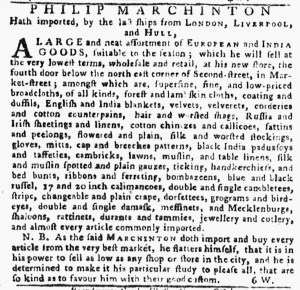
Daniel Benezet’s extensive advertisement from the March 15, 1773, edition of the Pennsylvania Chronicle continued to run in subsequent issues of that newspaper, though the compositor made modifications to the format.  The advertisement featured the same copy, but the organization better fit the page.  The original version filled two columns and overflowed into a third, in part because it appeared on the first page and the masthead occupied a significant amount of space at the top of the page.  Upon moving the advertisement to other pages, the compositor gained space to confine it to two columns.  In another modification, the headline at the top of the advertisement and the nota bene that announced “BENEZET is leaving off Business” and, as a result, “determined to sell the above Goods on very low Terms” at the bottom both ran across multiple columns.  The new format looked like a handbill that could have been printed separately as well as an advertisement integrated into the pages of the Pennsylvania Chronicle.

Pennsylvania Gazette (April 14, 1773).

When it came to the visual appeal of the advertisement, the compositor made all the difference.  Benezet placed a notice with the same copy in the April 14 edition of the Pennsylvania Gazette, but it did not look like the same advertisement.  The compositor for the Pennsylvania Chronicle deployed generous amounts of white space to make Benezet’s advertisement easier for readers to navigate.  He did so by dividing each column into two columns and listing only one item or category of items on each line.  In contrast, the compositor for the Pennsylvania Gazette resorted to a much more crowded format, listing hundreds of items in a single paragraph that extended more than a column.  Readers almost certainly found it more difficult to navigate the dense text in the version of the advertisement that ran in the Pennsylvania Gazette, a feature that likely made it more difficult to engage prospective customers.

The variations in the format of Benezet’s advertisement demonstrate the division of labor that usually defined advertising in early American newspapers.  Advertisers composed and submitted copy, but compositors made decisions about format and other aspects of graphic design.  On occasion, consistency in design across advertisements placed in multiple newspapers suggests that advertisers made specific requests or even consulted directly with compositors.  That did not happen when Benezet submitted the advertising copy to the Pennsylvania Gazette.  He may have even provided the notice from the Pennsylvania Chronicle as reference, leaving it to the compositor to make final decisions about format while incorporating the copy in its entirety.

March 31

What was advertised in a colonial American newspaper 250 years ago today?

Pennsylvania Gazette (March 31, 1773).

“A Quantity of well made RIFLES.”

Thomas Palmer, a gunsmith, made several appeals to prospective customers in Philadelphia in the advertisement he placed in the March 31, 1773, edition of the Pennsylvania Gazette.  He declared that his inventory included a wide selection, a “Quantity of well made RIFLES, of different Lengths and Sizes of Bores.”  Palmer was so confident of the quality of those guns that he proclaimed that he “will insure to the Purchasers” that they were “as good and as handsomely fitted up as any made in America.”  Consumers would not find better in Philadelphia or anywhere else in the colonies.  In addition, the gunsmith “makes Fowling Pieces, of different Sizes, such as have been approved of by Gentlemen of this City.”  Short of publishing testimonials from his clients, Palmer suggested that men with good reputations endorsed the guns produced in his workshop.  In addition to making rifles and fowling pieces, he also “repairs old Guns in the most careful Manner.”

Palmer did not rely on advertising copy alone to market his services.  Instead, he incorporated a visual image into his notice.  A woodcut that may have replicated a sign that marked the gunsmith’s location adorned the advertisement, though the copy did not make reference to any sign at Palmer’s shop on “the North Side of Market-street, between Fourth and Fifth-streets.”  On the other hand, Palmer may have considered it unnecessary to mention a sign in copy that appeared immediately below an image of a rifle and the words “THO: PALMER Gun Smith” enclosed within a double border.  Residents of Philadelphia may have already been familiar with the sign and readers from beyond the city would have easily recognized it if they decided to visit Palmer’s shop.  Whether or not Palmer displayed a sign at his shop on Market Street, the woodcut helped distinguish his advertisement from other content in the Pennsylvania Gazette, likely making it worth the investment.  With the exception of the seal in the masthead, only one other image appeared in that issue.  A stock image of a house ran with a real estate notice, but that lacked the same level of customization as the woodcut in Palmer’s advertisement.  The gunsmith deployed text and image simultaneously in his efforts to engage prospective customers.

February 24

What was advertised in a colonial American newspaper 250 years ago today?

Pennsylvania Journal (February 24, 1773).

“A weekly NEWS-PAPER … differing materially in its plan from most others now extant.”

James Rivington’s efforts to launch a new newspaper, Rivington’s New-York Gazetteer; or, the Connecticut, New-Jersey, Hudson’s River, and Quebec Weekly Advertiser, continued in the February 24, 1773, editions of the Pennsylvania Gazetteand the Pennsylvania Journal.  Although published in New York, Rivington intended circulation far beyond the city and sought subscribers in distant towns.  His first efforts to promote the proposed newspaper in the public prints appeared as advertisements in the Newport Mercury, a shorter notice, and the Pennsylvania Chronicle, a much more extensive notice, on February 22.

Despite its length, the advertisement in the Pennsylvania Chronicle did not give any particulars about how readers could subscribe to Rivington’s New-York Gazetteer.  The advertisement in the Newport Mercury concluded with a note that “Subscriptions are taken in by MOSES M. HAYS, of Newport, and the printer hereof,” but readers of the Pennsylvania Chronicle did not have access to similar information.  The advertisements in the Pennsylvania Gazette and the Pennsylvania Journal remedied that, advising that “Subscriptions are received by Mr. Nicholas Brooks, near the Coffee-House in Philadelphia.”  Given how often printers served as brokers of information that did not appear in their newspapers, prospective subscribers could have also enquired at any of the printing offices of the newspapers that carried Rivington’s advertisements.

In addition to naming a local agent, the advertisements in the Pennsylvania Gazette and the Pennsylvania Journalincluded the same appeals that Rivington made in the Pennsylvania Chronicle.  Although readers in Philadelphia and its hinterlands already had access to four newspapers in English and two in German, Rivington asserted that he would supply something different when he entered “this Periodical Business.”  He planned to publish the usual sorts of news about current events, politics, and commerce, yet he also aimed to supplement that material with items often associated with magazines imported from London.  That meant his readers would encounter the “best modern essays,” a “review of new-books … with extracts,” and “new inventions in arts and sciences, mechanics and manufactures, [and] agriculture and natural history.”  Rivington, known for his Loyalist sympathies, offered a selection of reading material that he may have believed emphasized cultural connections within the empire as a means of counteracting what he saw as an American press that too often stoked tensions during the imperial crisis of the 1760s and 1770s.

February 17

What was advertised in a colonial American newspaper 250 years ago today?

Pennsylvania Gazette (February 17, 1773).

“A SECOND PUBLICATION OF THE UNIVERSAL ALMANACK, For the Year 1773.”

Nearly six weeks into the new year, James Humphreys, Jr., commenced advertising a “SECOND PUBLICATION OF THE UNIVERSAL ALMANACK, For the Year 1773” with astronomical calculations “performed with the greatest exactness and truth” by David Rittenhouse.  Humphreys had advertised the first printing of the almanac more than three months earlier with notices in the November 9, 1772, edition of the Pennsylvania Packet and the November 11, 1772, edition of the Pennsylvania Gazette.  Those advertisements featured identical copy, though the compositors devised very different formats.

When Humphreys advertised the second publication in Pennsylvania Gazette on February 17, 1773, he used a slightly truncated version of the original advertisement.  (Perhaps the compositor took advantage of type already set from the previous run of the notice.)  Two days earlier, however, a much shorter version, one without a list of the contents, appeared in the Pennsylvania Packet.  In the next issue, published on February 22, Humphrey’s advertisement once again included the contents of the almanac, doubling the length of the notice.  That represented some expense for Humphreys, though John Dunlap, printer of the Pennsylvania Packet, may have given him a discount on advertising since he also sold the almanac.  Unlike the notice that ran in the Pennsylvania Gazette, one that listed only Humphreys, the advertisement in the Pennsylvania Packet stated that the almanac was “SOLD by JAMES HUMPHREYS junr. at his Printing-office, … and by John Dunlap.”

No matter the particulars of his arrangement with Dunlap, Humphreys took a chance on a second publication of the almanac so far into the year.  Other printers advertised surplus copies of almanacs that had not yet sold, hoping to achieve better returns on their investments for items that became more and more obsolete with each passing day.  Perhaps the initial publication did well enough that Humphreys considered printing a small number for the second publication worth the risk.  Perhaps he believed that the calculations by “that ingenious master of mathematics, Mr. DAVID RITTENHOUSE,” well known in Philadelphia, would recommend the almanac above all others.  In his first round of advertising, he asserted that “it is the only almanac published of his calculating.”  Perhaps Humphreys thought the other contents, a variety of poems, recipes, short essays, and even directions for “guarding against smutty crops of wheat,” were interesting enough to prospective customers that they would want to consult and enjoy them throughout the remainder of the year.  Perhaps he did not produce a second publication at all, but instead claimed he did in an effort to make the almanac appear popular and sell leftover copies of the first publication that he passed off as a subsequent printing.  Advertising a second publication of an almanac so far into the year was unusual, whatever Humphrey’s inspiration in doing so.

February 3

What was advertised in a colonial American newspaper 250 years ago today?

Pennsylvania Gazette (February 3, 1773).

“A LAWYER … lent the fourth volume of BLACKSTONE’s COMMENTARIES … to some gentleman whose name he hath forgot.”

After first appearing in the Pennsylvania Packet in January 1773, the curious story of the missing copy of “the fourth volume of BLACKSTONE’s COMMENTARIES, London edition,” ran among the advertisements in the February 2, 1773, edition of the Pennsylvania Gazette.  According to the advertisement, an unnamed lawyer lent the book “to some gentleman whose name he hath forgot” and desired for the borrower to return it, not to himself but instead to bookseller Robert Bell.  Readers may have suspected that Bell created the lawyer and the story of the missing book, especially since the advertisement concluded with a nota bene that announced that later in the month the “FOURTH VOLUME of the AMERICAN EDITION of BLACKSTONE’s COMMENTARIES ON THE LAWS OF ENGLAND, will be ready for the subscribers.”  How convenient that a borrower supposedly neglected to return just that volume to the unnamed lawyer!  How convenient that the narrator of the story thought that the missing book “hath been lent to several persons since it left the proprietor’s library” and called on “the second, third, or fourth borrower” to provide information about its whereabouts!

In the final third of the eighteenth century, Bell became one of the most prominent booksellers and publishers in the colonies and the new nation, working even before the Revolution to cultivate an American literary market.  He developed innovative marketing methods and attracted even more attention to them with his flamboyant personality.  While there is no way to definitively demonstrate that Bell fabricated the story of the lawyer and the missing volume of Blackstone’s Commentaries, such a ploy would not have been beyond the enterprising bookseller who spent two years marketing an American edition of all four volumes and gathering subscribers from throughout the colonies.  He made savvy use of the public prints, so it may have been possible that he initially published the story of the lawyer and the missing book in the Pennsylvania Packet to see if it generated additional interest in the complete collection of Blackstone’s Commentaries and later considered it worth the investment to disseminate the same story in another newspaper.  He updated the nota bene to indicate that publication would take place “some time this month” rather than “Sometime in February.”  The advertisement also included a date, February 2, 1773, the day before publication of that issue of the Pennsylvania Gazette.  Bell waited more than a week after inserting the notice in the Pennsylvania Packet before submitting it to another newspaper, further suggesting that the responses he received from the initial insertion may have aided him in deciding to run the same advertisement in an additional newspaper.  Even if he planned from the start to expand the circulation of the story of the lawyer and the missing volume of Blackstone’s Commentaries, he carefully timed his advertisements to coincide with publication of the final volume.

January 27

What was advertised in a colonial American newspaper 250 years ago today?

Pennsylvania Gazette (January 27, 1773).

“We find them very advantageous … and certainly is preferable to any method ever before invented.”

When Samuel Reynolds invented a machine “for raising Mill-stones, and turning them on their back, fit for dressing or washing in five minutes or less,” he took to the pages of the Pennsylvania Gazette to promote his product.  In an advertisement addressed “TO THE MILLERS IN GENERAL” in the January 27, 1773, edition, Reynolds described how millers could safely use his invention with “one hand only” to maneuver millstones for cleaning “without hurting the plaister on burr stones.”  He invited millers who wished to order the machine to contact him in Wilmington, Delaware, or any of three millers “at Brandywine mills,” Daniel Byrnes, Joseph Tatnall, and William Starr.

Rather than ask prospective customers to rely solely on the inventor’s own proclamations about his product, Reynolds included a testimonial from Byrnes, Tatnall, and Starr.  The experienced millers asserted that Reynolds “made each of [us] one of the said Machines, and we find them very advantageous, as the Mill-stone is taken up by them, with great ease and safety.”  In so doing, they reiterated the most important claims made by the inventor.  In addition, they declared that using Reynold’s new machine “certainly is preferable to any method ever before invented.”  Such an assessment bolstered the pitch made by Reynolds.

The inventor also suggested that he received advance orders or at least interest from other millers, though that may have been a marketing ploy rather than fact.  “As there has been a number made for people at a considerable distance, whose names an approbation are difficult to be collected,” he stated, “said Reynolds will be obliged to those that join in sentiment with the above, to favour him with a line for that purpose.”  In other words, he invited millers interested in the new machine to join with many others in showing their support by placing orders to acquire their own.  The savvy Reynolds sought to incite demand by demonstrating that demand already existed among experienced millers familiar with his product.